Original Article
The association between
5-HTTLPR/rs25531
polymorphisms and behavior problems
in Mongolian children
Yan Wang1, Yuling Li1, Enhebayaer1, Hongyan Guan2
1Institute of Life Science and Technology, Inner Mongolia Normal University, Hohhot 010022, Inner Mongolia Autonomous Region, China; 2Department of Early Child Development, Capital Institute of Pediatrics, Beijing 100020, China
Received September 22, 2017; Accepted May 3, 2018; Epub July 15, 2018; Published July 30, 2018
Abstract: To determine the association between 5-HTTLPR/rs25531 polymorphisms and behavior problems of Mongolian school-age children, 311 (female = 157, male = 154) healthy children aged 7 to 12 were investigated in Chifeng city of Inner Mongolia. Children’s behavior problems and temperament types were evaluated by the Child Behavior Checklist (CBCL) and Behavior Style Questionnaire (BSQ) or Middle Childhood Temperament Questionnaire (MCTQ), respectively. The 5-HTTLPR/rs25531 genotypes were determined by mf-RFLP (multiplex fluorescence-re -striction fragment length polymorphism) analysis. Association between the genotypes and behavior problem scores was analyzed using a generalized linear model (GLM). The results showed that: (1) no significant difference was found in genotypes based on age, gender, or prevalence of behavior problems in the Mongolian children; (2) the children with low-expression genotypes (LGLG, SLG, or SS) had significantly higher scores in withdrawn, aggression, internalizing, externalizing, and total behavior problems than those with high-expression genotypes (LALA, SLA, or LALG); (3) withdrawal behavior score was affected by the interaction of 5-HTTLPR/rs25531 genotypes with tempera-ment types (P < 0.01). The children with passive temperament and LALA, SLA, or LALG genotypes tended to suffer from withdrawal behavior; (4) there was a significant interaction between 5-HTTLPR/rs25531 genotypes and age in aggressive behavior score (P < 0.01). The children with LGLG, SLG, or SS genotypes were more likely to suffer from aggressive problems in an older age. Overall, the present study suggests that 5-HTTLPR/rs25531 polymorphisms might contribute to certain behavior problems, and that the interaction between genotypes and major affected fac-tors in behavior problems should be considered.
Keywords: Mongolian nationality, school-age children, behavior problems, gene polymorphism
Introduction
Behavior problems have been grouped into two categories, namely the internalizing and exter-nalizing problems. The former consists of prob-lems such as emotional reactivity, anxious or depressed mood, somatic complaints, and social withdrawal, whereas the latter includes
problems such as experiencing conflict with
other people, aggression, hyperactivity, atten-tion problems, and the total problems that comprise both internalizing and externalizing problems [1, 2]. The behavior problems that have been ignored in early childhood may result in antisocial behavior and mental disorders in late childhood [3, 4]. The World Health
most frequently studied candidate gene for psychiatric disorder traits such as affective dis-orders, anxiety, depression, suicide, obsessive-compulsive disorders, and addiction is the serotonin transporter (5-HTT)-linked polymor-phic region (5-HTTLPR) in the promoter of the
SLC6A4 gene, which plays an important role in serotonergic neurotransmission by facilitating the re-uptake of serotonin from the synaptic cleft [7]. The 5-HTTLPR polymorphism compris-es a 43-base pair insertion or deletion. The
most common alleles are classified into two
main groups, namely, the short (S) allele (14 repeats) and long (L) allele (16 repeats) [8], the L-allele having an mRNA expression app- roximately three-fold higher than the S-allele [9]. A previous study had shown that 5-HTT con-tains an A/G single nucleotide polymorphism (SNP) within the encoding gene, rs25531, which lies within the L-allele of 5-HTTLPR [10]. Combination of the two polymorphisms (5-HT- TLPR/rs25531) appears as a triallelic locus, including three alleles LA, LG, and S, in which the LG allele is functionally equivalent to the S allele; the rs25531 G-allele reduces the
tran-scriptional efficiency of L-allele of 5-HTTLPR to an extent comparable to that of S-allele [11]. Hence, there has been critical discussion regarding the inadequacy of the traditional dichotomous analysis of 5-HTTLPR, in distin-guishing between the LA and LG alleles [12], which may reduce its statistical power. So far, only a few studies have attempted to demon-strate the effect of triallelic polymorphism in behavior problems. Some studies have indicat-ed that individuals who were homozygous for the low expressing 5-HTTLPR alleles (S and LG)
experienced greater difficulty in disengaging
their attention from sorrow, happiness, and fear stimuli than those with the high expressing
5-HTTLPR homozygotes [13]. Xhosa adoles-cents exhibited the 5-HTTLPR/rs25531 LG hap-lotype, associated with a reduction in anxiety sensitivity [14]. However, the triallelic (5-HTT- LPR/rs25531) polymorphisms were not related to major depressive disorders in Chinese Han adolescents [15].
China is a country with a very large population, composed of many nationalities. Each one has his/her own particular custom and cultural
background, which influences the development
of children’s psychological behavior. Mongolian nationality is one of the main ethnic groups in
Inner Mongolia. So far,most of the studies have been concerned with the common psychologi-cal problems of Mongolian children and adoles-cents, including depression, aggression, and internalizing problems. However,documents on the behavior problems of Mongolian children were mainly related to the study of environmen-tal factors [16, 17]. There has been no study on the relationship of 5-HTTLPR/rs25531 poly-morphisms with behavior problems of Mon- golian school-age children. In order to provide a molecular foundation to the comprehensive understanding of behavior problems of Mon-
golian children, this study examined the influ -ence of 5-HTTLPR/rs25531 polymorphisms on the behavior problems of healthy Mongolian school-age children.
Materials and methods
Subjects and questionnaires
A total of 311 healthy Mongolian children aged 7-12 years (female = 157, male = 154; mean age ± SD = 9.23 ± 1.51 years) were recruited in Tianshan Mongolian Experimental Primary School, Chifeng, Inner Mongolia, China. The previous three generations of the immediate family were of Mongolian nationality in all cases.
Parents of all the participants filled out a set of
questionnaires. Chinese version of the Child Behavior Checklist (CBCL), consisting of 113 items, was administered to determine the behavior problem scores and prevalence. De- pending on how well each item describes the child, the respondent rates from 0 (it is not true at all/had no chance to observe) to 2 (it is com-pletely true), considering the last two months. The Chinese version of CBCL scale has been
confirmed with satisfactory reliability and valid -ity [18].
mediate low type, and passive temperament
types that include difficult, intermediate high
and slow to warm up type.
In this study, we also investigated the parental education background and occupation, aver-age family income, delivery methods, and the number of children in a family. 6 participants
were excluded based on genotyping, for a final
sample size of 311 participants.
Genotyping
Buccal swabs were collected and the entire genomic DNA was extracted via the TIANamp Swab DNA Kit according to the manufacturer’s instructions. The quality of DNA was assessed for each sample using agarose gel electro- phoresis, while the quantity of DNA was deter-mined by spectrophotometer (Quawell). The
5-HTTLPR/rs25531 genotypes were
deter-mined by mf-RFLP (multiplex
fluorescence-restriction fragment length polymorphism) analysis. The forward 5’-CGGGATGCGGGGGA- ATACTGGT-3’ and reverse primers 5’-TTGCC- GCTCTGAATGCCAGCAC-3’ were used for geno-typing the 5-HTTLPR polymorphism. The PCR product was resolved on a 1.6% agarose gel in TBE solution and visualized by UV light. The 100-bp low ladder (Sangon Biotech, Shanghai, China) was used to determine the length of the fragments. To identify the A/G SNP rs25531 on L allele, the fragments were digested using restriction endonuclease MspI. Digestion prod-ucts were analyzed using an ABI 3730XL DNA Analyzer (Applied Biosystems, Waltham, MA).
scores with each of the following factors: gen-der, age, temperament type, and environmen-tal factors. The main effect of 5-HTTLPR/
rs25531 polymorphisms and the relevant above-mentioned factors along with the inter-action between the genotypes and the relevant factors on behavior problem scores were used to perform the generalized linear model (GLM) analysis. In addition, the prevalence of behav-ior problems was compared using chi-square or
Fisher’s exact test. The statistical significance
limit was set at P = 0.05. All statistical analyses were performed using SPSS version 20.
Results
Descriptive statistics
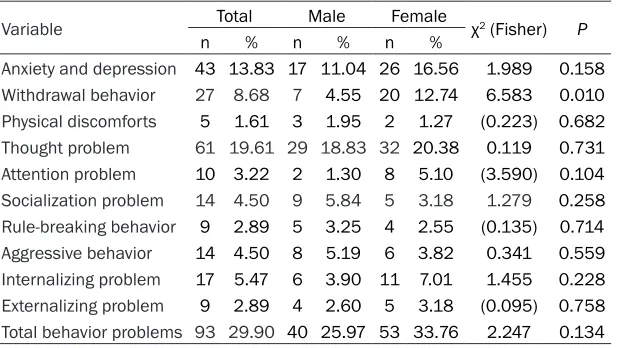
In this study, the total prevalence of behavior problems was 29.90%, among which the preva-lence of thinking problem was the highest (19.61%), and that of physical complaints was the lowest (1.61%). Chi-square test or Fisher’s exact test results showed that there was a
significant gender difference across the
[image:5.612.92.403.96.270.2]pre-valence of withdrawal behavior (Table 1). Kolmogorov-Smirnov test results showed that the behavior problem score was an abnormal distribution. Therefore, the nonparametric tests were used to examine the relationship between the behavior problem scores and relevant fac-tors including gender, age, temperament types, and family environmental factors. As is well known, children entered puberty close to 10 years of age, with growth spurts and sexual development, resulting in a series of changes in
Table 1. Prevalence of behavior problems in Mongolian school-age children
Variable Total Male Female χ2 (Fisher) P
n % n % n %
Anxiety and depression 43 13.83 17 11.04 26 16.56 1.989 0.158 Withdrawal behavior 27 8.68 7 4.55 20 12.74 6.583 0.010 Physical discomforts 5 1.61 3 1.95 2 1.27 (0.223) 0.682 Thought problem 61 19.61 29 18.83 32 20.38 0.119 0.731 Attention problem 10 3.22 2 1.30 8 5.10 (3.590) 0.104 Socialization problem 14 4.50 9 5.84 5 3.18 1.279 0.258 Rule-breaking behavior 9 2.89 5 3.25 4 2.55 (0.135) 0.714 Aggressive behavior 14 4.50 8 5.19 6 3.82 0.341 0.559 Internalizing problem 17 5.47 6 3.90 11 7.01 1.455 0.228 Externalizing problem 9 2.89 4 2.60 5 3.18 (0.095) 0.758 Total behavior problems 93 29.90 40 25.97 53 33.76 2.247 0.134
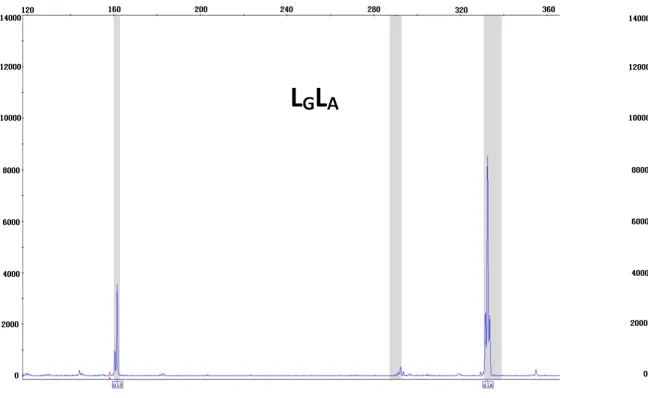
Digested products that included a 163-bp frag-ment indicated an LG allele, a 293-bp frag-ment indicated an S allele, and a 337-bp frag-ment indicated an LA allele (Figure 1).
Statistical analysis
Table 2. Effect of age, temperament types, and parents’ education on behavior problems scores of the children
Age groups
Z Temperament types Z Father’s education Z Mother’s education Z
7-10 y 11-12 y Active Passive A B A B
AD 2.00 (1.00-5.00) 5.00 (3.00-9.00) 2.696# 3.00 (1.00-5.00) 3.00 (1.00-6.00) 0.643 0.00 (0.00-2.25) 3.00 (1.00-6.00) 1.903# 0.00 (0.00-2.00) 3.00 (1.00-6.00) 2.051# WB 2.00 (1.00-4.00) 3.00 (2.00-5.00) 2.096# 2.00 (1.00-4.00) 3.00 (1.00-5.00) 1.672* 1.00 (0.00-2.25) 2.00 (1.00-4.00) 1.104 1.00 (0.00-2.00) 2.00 (1.00-4.00) 1.370* PD 0.00 (0.00-1.00) 1.00 (0.00-4.00) 1.940# 0.00 (0.00-2.00) 0.00 (0.00-2.00) 0.478 0.00 (0.00-1.00) 0.00 (0.00-2.00) 0.666 0.00 (0.00-1.00) 0.00 (0.00-2.00) 0.928 TP 0.00 (0.00-2.00) 2.00 (0.00-3.00) 1.737# 0.00 (0.00-2.00) 2.00 (0.00-3.00) 1.773# 0.00 (0.00-1.25) 1.00 (0.00-2.00) 0.728 0.00 (0.00-1.50) 1.00 (0.00-2.00) 0.963
AP 2.00 (0.00-4.00) 3.00 (1.00-5.75) 1.279 2.00 (0.00-4.00) 3.00 (2.00-6.00) 1.607* 1.00 (0.00-2.50) 2.00 (0.00-4.25) 1.446* 1.00 (0.00-2.00) 2.00 (0.00-4.25) 1.328
SP 2.00 (1.00-3.00) 2.00 (1.00-4.00) 1.067 2.00 (1.00-3.00) 2.00 (1.00-4.50) 0.909 2.00 (0.00-2.00) 2.00 (1.00-4.00) 0.973 2.00 (0.00-2.00) 2.00 (1.00-4.00) 1.192
RB 1.00 (0.00-2.00) 2.00 (1.00-3.00) 2.066# 1.00 (0.00-2.00) 2.00 (0.00-3.00) 0.964 1.00 (0.00-3.00) 1.00 (0.00-2.00) 0.437 1.00 (0.00-2.50) 1.00 (0.00-2.00) 0.736
AB 4.00 (1.00-7.00) 5.00 (2.00-10.00) 1.820# 4.00 (1.00-7.00) 6.00 (2.00-10.00) 1.130 3.00 (0.00-6.00) 4.00 (1.00-8.25) 0.916 3.00 (0.00-6.00) 4.00 (1.00-9.00) 1.093
IP 5.00 (2.00-9.00) 10.00 (5.00-15.75) 2.366# 6.00 (3.00-10.00) 7.00 (3.00-15.50) 1.056 3.00 (0.00-5.25) 6.50 (3.00-12.00) 1.544* 3.00 (0.00-5.00) 7.00 (3.00-12.00) 1.819# EP 5.00 (2.00-9.00) 6.00 (4.00-13.00) 1.487* 5.00 (2.00-9.00) 7.00 (3.00-12.50) 1.185 4.00 (0.00-6.00) 5.00 (2.00-11.00) 0.957 4.00 (0.00-6.00) 5.00 (2.00-11.00) 1.001
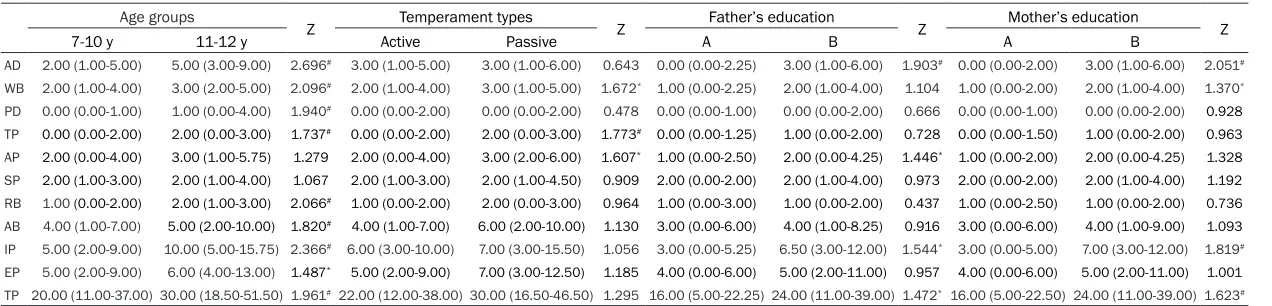
behavior. Therefore, in this study, the children were divided into a younger group (7-10 y) and an older group (11-12 y). Results of the non-parametric tests are shown in Table 2. Age was
found to significantly affect anxiety and depres -sion, withdrawal behavior, physical discom-forts, thought problem, rule-breaking behavior, aggressive behavior, internalizing problem, externalizing problem, and total behavior prob-lems (P < 0.05). Temperament types signifi
-cantly influenced withdrawal behavior, thought
problem, and attention problem (P < 0.05).
problems was lower in children with LALA, SLA,or LALG genotypes than in those with LGLG, SLG, or SS genotypes (Figure 2).
The association between genotypes and behav-ior problem score was examined using GLM analysis, in which the behavior problem score was taken as dependent variable and geno-types were considered as the independent vari-able. The results showed that children with LGLG, SLG, or SS genotypes had higher scores of withdrawn, aggressive, internalizing,
external-Table 3. Demographic data of the study subjects according to 5-HTTLPR/rs25531 genotypes
Genotypes (n, %)
Statistical test LALA/SLA/LALG LGLG/SLG/SS
Total sample
n 82 229
Sex, female (%) 22.29% 77.70% χ2 = 2.710, P = 0.10 Age (year) 9.11 ± 1.56 9.27 ± 1.49 t = -0.823, P = 0.408 Female participants
n 35 122
Age (year) 9.00 ± 1.53 9.17 ± 1.47 t = -0.605, P = 0.546 Male participants
n 47 107
Age (year) 9.21 ± 1.72 9.36 ± 1.66 t = -0.486, P = 0.628
Note: Continuous variables are reported as mean ± standard deviation; categorical variables are listed as a column-wise percentage.
Anxiety and depression, inter-nalizing problem, and total behavior problems were
sig-nificantly influenced by par -ents’ education (P < 0.05); attention problem was only affected by the father’s edu-cation while withdrawal be- havior was only affected by the mother’s education (P <
0.05).
The association of 5-HTTLPR/ rs25531 genotypes with be-havior problems
Testing for Hardy-Weinberg equilibrium (HWE) did not yi-
eld significant deviations
fr-om the expected distribution of 5-HTTLPR/rs25531
geno-types (χ2 = 2.793, P = 0.425).
According to literatures on dif-ferent mRNA expression level of 5-HTTLPR in vitro [20, 21], the 5-HTTLPR/rs25531 geno-types in this paper have been grouped into two levels for analysis, one containing a high-expression group (LALA, SLA, or LALG = 82) and another containing a low-expression group (LGLG, SLG, or SS = 229).
The result showed no signifi -cant age or gender difference across the genotypes (P > 0.05) (Table 3).
Genotypes did not reflect the
difference in prevalence of each behavior problem using
χ2-test (P > 0.05), but the
[image:7.612.90.377.96.260.2]prevalence of most behavior Figure 2. Prevalence of behavior problems in different genotypes of
[image:7.612.92.374.309.489.2]izing, and total behavior problems than those with LALA, SLA, or LALG genotypes (P ≤ 0.05). The
[image:8.612.91.523.97.335.2]association between 5-HTTLPR/rs25531 geno-types and the behavior problem scores of Mongolian school-age children are depicted in
Table 4.
Effect of G × E interaction on behavior prob-lem scores
Based on the above results, effect of the inter-action of genetic factor (G) and environment factors (E) on the behavior problem scores
Table 4. Correlation analysis between 5-HTTLPR/rs25531 genotypes and the behavior problems scores of Mongolian school-age children
Variables Genotypes _X ± SD B S.E 95% Wald CI χ2 P
Lower Upper
Withdrawn Intercept 2.873 0.066 2.744 3.003 1.89E+03 0.000
LALA/SLA/LALG 2.62 ± 2.16 -0.251 0.129 -0.504 0.001 3.816 0.051 LGLG/SLG/SS 2.87 ± 2.58 0a
Aggression Intercept 5.183 0.066 5.054 5.313 6.15E+03 0.000
LALA/SLA/LALG 4.91 ± 4.29 -0.269 0.129 -0.521 -0.017 4.362 0.037 LGLG/SLG/SS 5.18 ± 4.86 0a
Internalizing Intercept 7.917 0.066 7.788 8.047 14.354E+03 0.000 LALA/SLA/LALG 7.51 ± 5.66 -0.405 0.129 0.657 0.153 9.896 0.002
LGLG/SLG/SS 7.92 ± 7.08 0a
Externalizing Intercept 6.856 0.066 6.726 6.985 10.764E+03 0.000 LALA/SLA/LALG 6.60 ± 5.84 -0.258 0.129 -0.511 -0.006 4.030 0.045
LGLG/SLG/SS 6.86 ± 6.23 0a
Total problems Intercept 27.742 0.066 27.613 27.872 17.625E+03 0.000 LALA/SLA/LALG 27.28 ± 18.48 -0.462 0.129 -0.714 -0.210 12.880 0.000
[image:8.612.88.525.396.610.2]LGLG/SLG/SS 27.74 ± 20.36 0a Note: a, set to zero, with the parameter as the standard.
Table 5. Effect of the interaction of 5-HTTLPR/rs25531 genotypesand environmental factors on be-havior problems of Mongolian school-age children
Variables B S.E 95% Wald CI χ2 P
Lower Upper
Aggression 5-HTTLPR/rs25531 Intercept 7.000 0.135 6.736 7.264 2.695E+03 0.000 LALA/SLA/LALG -2.647 0.278 -3.191 -2.103 90.993 0.000 LGLG/SLG/SS 0a
Age Younger age group -2.391 0.155 -2.694 -2.088 2.389E+02 0.000
Older age group 0a
Interaction Genotype*Age groups 3.099 0.313 2.485 3.713 97.886 0.000 Genotype*Age groups 0a
Withdrawn 5-HTTLPR/rs25531 Intercept 3.184 0.162 2.866 3.502 3.853E+02 0.000 LALA/SLA/LALG 0.974 0.281 0.425 1.524 12.009 0.001 LGLG/SLG/SS 0a
Temperament Active -0.336 0.178 -0.685 0.014 3.550 0.060
Passive 0a
Interaction Genotype*Temperament -1.629 0.317 -2.250 -1.007 26.402 0.000 Genotype*Temperament 0a
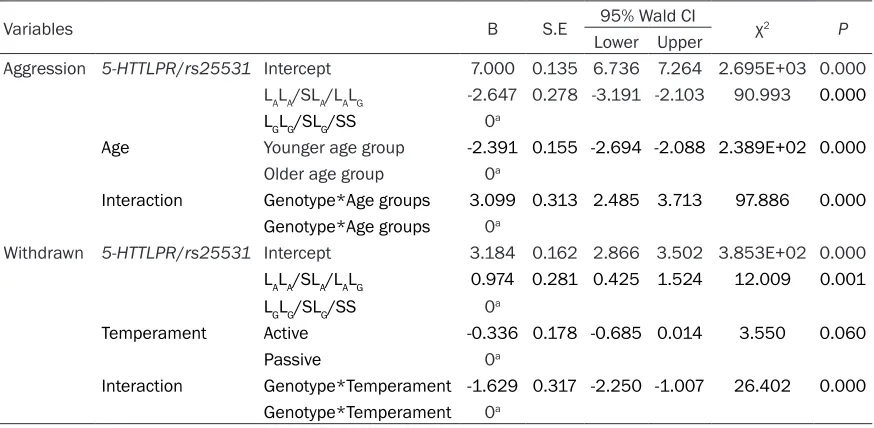
were analyzed using GLM analysis, in which each behavior problem score was taken as the dependent variable, and 5-HTTLPR/rs25531
genotypes (genetic factor, G) were considered
as the independent variables, each influenced
environment factors (E), namely, age,
tempera-Discussion
[image:9.612.96.374.73.305.2]With the recent process of rural urbanization, most Mongolian school-age children, from vil-lage or pastoral area, are being sent to school in the cities, either living in school or lodged Figure 3. Effect of interactionof 5-HTTLPR/rs25531 genotypes and age on
aggressive behavior score.
Figure 4. Effect of interaction of 5-HTTLPR/rs25531 genotypes and tempera-ment on withdrawal behavior score.
ment types, and parents’ education. The results sh- owed that aggressive
behav-ior score was influenced by
the 5-HTTLPR/rs25531 gen-otypes (P < 0.05), age (P < 0.05), and the interaction of
5-HTTLPR/rs25531 genoty- pes with age (P < 0.05). Moreover, the main effects of 5-HTTLPR/rs25531 geno-types (P < 0.05) and tempe- rament types were on with-drawal behavior score, as well as on the interaction of
5-HTTLPR/rs25531 genoty- pes with temperament types (P < 0.05) (Table 5).
The effect of G×E interaction on behavior problem scores is also shown in Figures 3
and 4. According to Figure 3, the children with LGLG, SLG, or SS genotypes in the older age
group had a significantly high -er aggressive behavior score than those in the younger age group. Therefore, the younger age group might have a pro-tective factor that prevents aggressive behavior in chil-dren with the LGLG, SLG, or SS genotypes.
As in Figure 4, there was a relatively small difference in withdrawal behavior score of children carrying LGLG, SLG, or SS genotypes across the temperament types, but chil-dren with LALA, SLA, or LALG genotypes and passive
tem-perament had a significantly
[image:9.612.96.375.361.588.2]with relatives, resulting in parents spending less time with them, and eventually developing a strained relationship between the parents and children. Psychological and behavior prob-lems of those children might not be guided and treated immediately. In this study, the total prevalence of behavior problems among Mon- golian school-age children was found to be 29.90%, which is higher than in the children of either Han, Zhuang, or Yao nationality in 2001 [22]. In addition, our study demonstrated a
sig-nificant influence of the educational level of
parents on some behavior problem scores (P < 0.05). With the rapid development of informa-tion technology, parents with relatively low edu-cation level are facing greater challenges in guiding their children. In short, the prevalence of behavior problems among children and ado-lescents will be on the rise and need to be attended more seriously.
Earlier studies showed that the SS genotype was present in 22% of Caucasians and in 60% of Asians, and the LL genotype was present in 29-43% of Caucasians, but only in 1-13% of East Asians [23, 24]. The results of genotype frequency (SS: 54.34%, LL: 6.43%) in our study were similar to those in other studies on Asians at home and abroad.
The results of GLM analysis in our study indi-cated that children with LGLG, SLG, or SS
geno-types had a significantly higher withdrawn,
aggressive, internalizing, externalizing, and total behavior problem scores than children with LALA, SLA, or LALG genotypes. Based on the available literature, the 5-HTTLPR/rs25531
polymorphisms have been found to modulate attention to threat [26], anxiety, negative effect, nutritional status in childhood, and suicidal ide-ation [26-28]. Additionally, the SS and SLG gen-otypes seem to be associated with higher neu-roticism [27] and more serious symptoms in patients who suffer from anxiety or depression [28]. These results, together with the present study, indicate that SS, SLG, or LGLG genotypes may be the risk factors that contribute to the development of behavioral problems among Mongolian school-age children.
A previous study had indicated that verbal and relational aggression increased consistently from childhood, and became more hostile in late childhood [29]. Moreover, aggressive syn-drome in childhood appears to be a stable
characteristic that persists into adulthood [5]. A recent study showed that a reduction in 5-HT activity can be associated with aggressive behavior, particularly with impulsive aggression [30]. In our study, children with LGLG, SLG, or SS
genotypes in the older age group had a signifi -cantly higher aggressive behavior score than those in the younger group (Figure 3), suggest-ing that the individuals carrysuggest-ing the low expres-sion genotypes (LGLG, SLG, or SS) were more likely to have aggressive behavior at an older age. Therefore, children with LGLG, SLG, or SS genotypes need to be given more attention and protection in early childhood.
As seen in the interaction curves (Figure 4), we concluded that carriers of LALA, SLA, or LALG
gen-otypes with passive temperament had a signifi -cantly higher withdrawal behavior score than those with active temperament. The main rea-son could be that the children with passive temperament were unable to adapt to the changes in new environment and hence suf-fered from emotional instability. For example, passive temperament was indirectly associat-ed with overt antisocial behavior and substance abuse via poor social decisions [31]. Previous studies have shown that mild forms of anxiety were related to a child’s temperament and emotion regulation [32]. Taken together, tem-perament may be one of the important factors
that influence the development of psychologi -cal behavior.
In conclusion, the present study suggests that the 5-HTTLPR/rs25531 polymorphisms may be a factor that contributes to several
behavior problems. Nonetheless, a specific gene cannot completely reflect the complexity
of gene-environment interactions. Therefore, future research should consider gene-gene-environment interactions to gain a more com-prehensive understanding of the mechanism and cause of behavior problems in Mongolian school-age children.
Acknowledgements
We are grateful to all the children and their parents for participating in this study. This work was supported by the National Natural Science
Fund of China (No. 31260265) , the Scientific
Disclosure of conflict of interest
None.
Address correspondence to: Yuling Li, Institute of Life Science and Technology, Inner Mongolia Normal University, No. 81 Zhaowuda Road, Saihan District, Hohhot 010022, Inner Mongolia Autonomous Region, China. Tel: 86-13789519197; Fax: 86-0471-4392448; E-mail: [email protected]
References
[1] Middleton M, Scott SL and Renk K. Parental depression, parenting behaviors, and behavior problems in young children. Inf Child Dev 2009; 18: 323-836.
[2] Yurdusen S, Erol N and Gencoz T. The effects of parental attitudes and mothers’ psychologi-cal well-being on the emotional and behavioral problems of their preschool children. Matern Child Health J 2013; 17: 68-75.
[3] Shi Z, Bureau JF, Easterbrooks M, Zhao XD and Lyons-Ruth K. Childhood maltreatment and prospectively observed quality of early care as predictors of antisocial personality disorder features. Infant Ment Health J 2012; 33: 55-69.
[4] McGue M, Iacono WG and Krueger R. The as-sociation of early adolescent problem behavior and adult psychopathology: a multivariate be-havioral genetic perspective. Behav Genet 2006; 36: 591-602.
[5] Hudziak JJ, van Beijsterveldt CE, Bartels M, Rietveld MJ, Rettew DC, Derks EM and Boomsma DI. Individual differences in aggres-sion: genetic analyses by age, gender, and in-formant in 3-, 7-, and 10-year-old Dutch twins. Behav Genet 2003; 33: 575-589.
[6] Haberstick BC, Schmitz S, Young SE and Hewitt JK. Genes and developmental stabiltiy of ag-gressive behavior problems at home and school in a community sample of twins aged 7-12. Behav Genet 2006; 36: 809-819. [7] Gelernter J. SLC6A4 polymorphism, population
genetics, and psychiatric traits. Hum Genet 2014; 133: 459-461.
[8] Heils A, Teufel A, Petri S, Stober G, Riederer P, Bengel D and Lesch KP. Allelic variation of hu-man serotonin transporter gene expression. J Neurochem 1996; 66: 2621-2624.
[9] Lesch KP, Bengel D, Heils A, Sabol SZ, Greenberg BD, Petri S, Benjamin J, Muller CR, Hamer DH and Murphy DL. Association of anx-iety-related traits with a polymorphism in the serotonin transporter gene regulatory region. Science 1996; 274: 1527-1531.
[10] Hu XZ, Lipsky RH, Zhu G, Akhtar LA, Taubman J, Greenberg BD, Xu K, Arnold PD, Richter MA,
Kennedy JL, Murphy DL and Goldman D. Serotonin transporter promoter gain-of-func-tion genotypes are linked to obsessive-compul-sive disorder. Am J Hum Genet 2006; 78: 815-826.
[11] Zalsman G, Huang YY, Oquendo MA, Burke AK, Hu XZ, Brent DA, Ellis SP, Goldman D and Mann JJ. Association of a triallelic serotonin trans-porter gene promoter region (5-HTTLPR) poly-morphism with stressful life events and sever-ity of depression. Am J Psychiatry 2006; 163: 1588-1593.
[12] Murphy DL, Maile MS and Vogt NM. 5HTTLPR: white knight or dark blight? ACS Chem Neurosci 2013; 4: 13-15.
[13] Beevers CG, Wells TT, Ellis AJ and McGeary JE. Association of the serotonin transporter gene promoter region (5-HTTLPR) polymorphism with biased attention for emotional stimuli. J Abnorm Psychol 2009; 118: 670-681.
[14] Hemmings SM, Martin LI, van der Merwe L, Benecke R, Domschke K and Seedat S. Serotonin transporter variants play a role in anxiety sensitivity in South African adoles-cents. World J Biol Psychiatry 2016; 17: 66-75. [15] Jing M, Yan SL, Ying YS, Shan L, Jun D, Zhe F,
Fan Y, Jia GW, Ni LJ, Xiang HC, Qiao LT and Rong XG. Association analysis of triallelic 5-HTTLPR polymorphism and adolescent de-pressive disorder. Chin J Clinical Psychol 2010; 18:142-145.
[16] Gao L, Bao Y, Haoran MA, Yuanyuan LI and Qin Y. Relationship between attention deficit hyper -activity disorder and the various elements in hair among Mongolian children in Baotou. Chin J School Health 2017; 38: 414-415.
[17] Jiang CH. A comparative study of structure of-fensive and personality (between Han and Mongolian adolescents). J Psychiatry 2009; 22: 423-425.
[18] Leung PW, Kwong SL, Tang CP, Ho TP, Hung SF, Lee CC, Hong SL, Chiu CM and Liu WS. Test-retest reliability and criterion validity of the Chinese version of CBCL, TRF, and YSR. J Child Psychol Psychiatry 2006; 47: 970-973. [19] Zhang J, Xu J and Shen L. The assessment of
Carey’s five temperament questionnares. Chin Mental Health J 2000; 14: 153-156.
[20] Heils A, Teufel A, Petri S, Stöber G, Riederer P, Bengel D and Lesch KP. Allelic variation of hu-man serotonin transporter gene expression. J Neurochem 1996; 66: 2621-2624.
[22] Lan YL, Zhang HY, Chen H, Xu HB, Li P and Xiao JL. Mental health traits of children of Zhuang Nationality in Guangxi. Chin J Clinical Psychol 2005; 13: 183-186.
[23] Goldman N, Glei DA, Lin YH and Weinstein M. The serotonin transporter polymorphism (5-HTTLPR): allelic variation and links with de-pressive symptoms. Depress Anxiety 2010; 27: 260-269.
[24] Serretti A, Kato M and Kennedy JL. Phar- macogenetic studies in depression: a proposal for methodologic guidelines. Pharmacogeno- mics J 2008; 8: 90-100.
[25] Osinsky R, Reuter M, Kupper Y, Schmitz A, Kozyra E, Alexander N and Hennig J. Variation in the serotonin transporter gene modulates selective attention to threat. Emotion 2008; 8: 584-588.
[26] Xie P, Kranzler HR, Poling J, Stein MB, Anton RF, Brady K, Weiss RD, Farrer L and Gelernter J. Interactive effect of stressful life events and the serotonin transporter 5-HTTLPR genotype on posttraumatic stress disorder diagnosis in 2 independent populations. Arch Gen Psychiatry 2009; 66: 1201-1209.
[27] Lonsdorf TB, Ruck C, Bergstrom J, Andersson G, Ohman A, Schalling M and Lindefors N. The symptomatic profile of panic disorder is sh-aped by the 5-HTTLPR polymorphism. Prog Neuropsychopharmacol Biol Psychiatry 2009; 33: 1479-1483.
[28] Lonsdorf TB, Weike AI, Nikamo P, Schalling M, Hamm AO and Ohman A. Genetic gating of hu-man fear learning and extinction: possible im-plications for gene-environment interaction in anxiety disorder. Psychol Sci 2009; 20: 198-206.
[29] Ettekal I and Ladd GW. Developmental conti-nuity and change in physical, verbal, and rela-tional aggression and peer victimization from childhood to adolescence. Dev Psychol 2017; 53: 1709-1721.
[30] Manchia M, Carpiniello B, Valtorta F and Comai S. Serotonin dysfunction, aggressive behavior, and mental illness: exploring the link using a dimensional approach. ACS Chem Neurosci 2017; 8: 961-972.
[31] Buil JM, van Lier PAC, Brendgen MR, Koot HM and Vitaro F. Developmental pathways linking childhood temperament with antisocial behav-ior and substance use in adolescence: explan-atory mechanisms in the peer environment. J Pers Soc Psychol 2017; 112: 948-966. [32] West AE and Newman DL. Worried and blue: