Abstract— An important aspect of designing any product is validation. Virtual design process (VDP) is an alternative to hardware prototyping in which analysis of designs can be done without manufacturing physical samples. In recent years, VDP have been generated either for animation or filming applications. This paper proposes a virtual reality design process model on one of the applications when used as a validation tool. This technique is used to generate a complete design guideline and validation tool of product design. To support the design process of a product, a virtual environment and VDP method were developed that supports validation and an initial design cycle performed by a designer. The product model car carrier is used as illustration for which virtual design was generated. The loading and unloading sequence of the model for the prototype was generated using automated reasoning techniques and was completed by interactively animating the product in the virtual environment before complete design was built. By using the VDP process critical issues like loading, unloading, Australian Design rules (ADR) and clearance analysis were done. The process would save time, money in physical sampling and to large extent in complete math generation. Since only schematic models are required, it saves time in math modeling and handling of bigger size assemblies due to complexity of the models. This extension of VDP process for design evaluation is unique and was developed, implemented successfully. In this paper a Toll logistics and J Smith and Sons car carrier which is developed under author’s responsibility has been used to illustrate our approach of generating design validation via VDP.
Index Terms— ADR, Car Carrier, Product Design, Validation, VDP.
I. INTRODUCTION
Three-dimensional design world is becoming closer to reality with tools like design process and virtual reality which are complimented by advancements in global communication, computers and multimedia devices. The approach
encompasses the development of two dimensional initially and then three-dimensional design process model into an innovative proposal for a virtual reality model[1]. VDP helps
Manuscript received July 26, 2009. This work was supported fully by the JSS and Tolls for initiating and assisting with funding for research.
Kulkarni A* is with the Faculty of engineering and Industrial Science, Swinburne university of Technology, John street Hawthorn, Vic 3122 Australia (corresponding author phone: 61 3 92148097; fax: 61 3 92148264; e-mail:[email protected]).
Kosse V is with Faculty of Built environment and engineering, Queensland University of Technology, Brisbane, QLD 4001 Australia. (e-mail: [email protected]).
Kapoor A is with the Faculty of engineering and Industrial Science, Swinburne university of Technology, John street Hawthorn, Vic 3122 Australia (e-mail: [email protected]).
Iyer M is with Faculty of Built environment and engineering, Queensland University of Technology, Brisbane, QLD 4001 Australia. (e-mail: [email protected]).
throughout the evolution of design life cycle by clarifying the problems in a three dimensional aspect. The Solidworks software is used, that enables VDP to evaluate design process for specifications and regulations at each stage.
A design concept by its nature is often difficult to conceptualise and communicate electronically among multidisciplinary teams [2]. In design, severe number of design cycles and variations are necessary until a final design is settled. The goal of research is to reduce the number and duration of these cycles by visualizing and determining problems at a very early stage of the design process. This visualization is integrated in an interactive 3D user interface that enables rapid design decisions and modifications.
II. VIRTUAL DESIGN APPLICATION CHOSEN TO ADDRESS CHALLENGES IN DESIGN
VDP is used in many disassembling applications as reported in several case studies described by Dong et al. [3]. Its extended application is in haptic studies as described by case studies done by Cheshire. et al. and Sener et al. [4, 5] . Some of the studies done by Chen et al. [6] on virtual reality approach also indicate that it helps in three dimensional visualisation, visualise abstract concepts, articulate their interpretation of phenomena, and visualise the dynamic relationships between several variables in a system. Applications of virtual reality (VR, a part of virtual design process) can be used for augmented product design and prototyping [7] that include principles of projection or video mixing to establish a dynamic prototype at a relatively low cost. Literature review reveals that approach of using it to validate a large scale automotive application is unique. Car carrier design illustrated had many challenges, loading sequence for the cars, in design approach to accommodate different range of cars like Volks wagon Golf (Lowest ground clearance car), Ford territory (Height), Holden Statesman (Longest car) etc. To complicate the design further work health and safety (WHS) issues[8] and ADR 43-04 [9] needed validation to establish the design. Schematic method described uses two dimensional schematics and then animating the process with constrains to obtain the flow of cars in loading and unloading of the car carrier. It validated design mechanisms, motions, shapes of the parts thus helping in decision making at all stages of design. The process also helped in understanding the need of new design, shapes of the car carrier; decks etc., before finalising the design and prototypes are built. It also helped author to analise the work safe issues with the current car carriers in the market. The models used are parametric and thus design rules can be geometrically constrained at the initial stages. This means that these preliminary designs can be used later as basis for developing the detailed design.
Virtual Design Process- Design Validation Tool
Schematic Approach in Car Carrier
III. VIRTUAL DESIGN PROCESS
Research done on motion studies reveal that it is the biggest advancement in multimedia for business, education and home entertainment products[10]. VR system creates realistic illusions and by missing the 3D animations with the reality background more in depth analysis can be done. Many different Virtual design systems including high end total immersion systems (where the user is surrounded by images and sound) are used in different applications. Many mechanical design software’s like 3D studio max (Autodesk), Unigraphics (EDS PLM), Solidworks (Dassault systems) and Pro Engineer use motion to advanced level of simulations. Creating virtual design is explained by Foley [11] and Myer [12] for different scenarios, which are more often application in the entertainment world. In our research, Solidworks animator and Solidworks modeling techniques are utilised to generate the animation effect.
A. Creating Schematic models
First step is to create the schematics using sketcher
application of the Solidworks. Sketches, being an integral part of design, store the design solutions and also seem to be essential for recognizing conflicts and possibilities[13], as well as for revising and refining ideas, generating concepts and facilitating problem solving[14]. Schon [15] described the design activity as a reflection-in-action process. Goldschmidt [16] introduced ‘seeing as’ and ‘seeing that’ notions to explain design reasoning. Also Suwa et al.[17] explored sketches to find how they can be a good medium for a reflective conversation. The serial studies of design protocols revealed insights on different aspects of the design activity[18, 19]. The computational tools used for product design include 3D computer modeling tools (Solidworks), two-dimensional (2D) vector or image based tools, databases that provide efficient access to templates, components, products, standards. Workflow management tools and groupware that allows to communicate and share documents, images, 2D, 3D models, and 3D animations or simulations, so that a proposed product can be examined by others during the stages of development. As described in the book ‘Animation tips and tracks for windows and Mac’ Foley [11], the TARGA (.tga) files can be used to compensate the earth surroundings. Virtually any files can be created using these techniques. The sketches are designed to the required dimensions and then they are converted as blocks in order to constrain them in place. Generally tangency constrains are used to keep the wheels of the cars attached to the corresponding decks. “Fig 1” illustrates the initial design proposal which is done using sketches as schematics. The initial sketch models were created using 3D sketcher in Solidworks and simulated using animation wizard to form the concept. This conceptual stage was presented to customers, suppliers and other involved in the project to gather their inputs to the project. The cars are modeled to the dimension by using reverse engineering techniques. The sketches were constrained using the
geometric constrains. The trailer body and car skeletons were dimensioned to the actual size to get the reality analysis. The concepts and loading sequence as shown in the “Fig 1”, was presented using the sketch models. The process validates the design by saving substantial design hours (90% of design time) spent for detailed layout.
Fig 1, First stage presentation of car carrier, Movie file
Concept.avi
B. Creating animation
Sketches created are solidified to get real effects by extruding the profile in Z direction. Then the materials and the colour textures are applied to set up the required background, however this phenomenon is not crucial unlike the filming or gaming applications. The next development of the process was the use of texture mapping. This attaches the stylist's concept sketches to the base model by rendering them onto the model and then fixing them to it, so that when the form is rotated the sketch stays attached[20]. The solids are
geometrically constrained to control smooth motions in 3D environment where we can interpolate them in a specific defined path[21]. The placement of virtual camera in 3D environments as covered extensively by Hatchet [22] requires at least 6 degrees of freedom (DOF). These DOF can be directly controlled by means of 6-DOF input devices using adapted metaphors. For example, Ware and Osborne [23] proposed the scene-in-hand, eyeball-in-hand, and flying vehicle metaphors. With 2-DOF devices, the standard techniques are orbiting, flying and point of interest. Orbiting is used for observation of an object from an exocentric point of view. The principle is to map the motions of the controller to motions over the surface of a sphere Chen et al [24], or other 3D primitives. 3D motions can also be achieved by means of external widgets, as is the case with open
Inventor-like viewers Strauss and Carey[25]. Other advanced techniques such as the Hover Cam [26] and the Style Cam[27], are based on camera movements along
predetermined surfaces or trajectories. Once the camera is proposed the time line is generated about the given motion of the object. The time line (“Fig 2”) can be adjusted or edited in any stage to obtain desired start and end points at time intervals.
Fig 2, Time line, Camera and lighting arrangements
5 4
2
7
6
8 3
[image:2.595.315.548.62.180.2] [image:2.595.305.583.627.745.2]Fig 3, VDP used to demonstrate the loading of car 7, one of WHS challenge in the design.
After completing time line, file was saved as animation (avi extension) for each individual car as shown in “Fig 3”. VDP validates car 1 and car 7 decks (“Fig 3”) which were bottlenecks in the design due to WHS reasons[8]. For all the cars animation was summated to form a single animation (avi file) to illustrate the loading sequence of the cars in a virtual way. One of the biggest outcomes is that this design validation happened at very low cost and time compared to conventional methods.
The VDP was also used in new test rig development for which the rotary motion of the motor was converted into the deck motion to understand the profile of the gear and to study different iterations to finalise the exact gear shape. Some validations of VDP are functional testing, form-and-fit testing, ergonomic testing, loading and unloading testing, which are performed on a model in the virtual environment[27]. “Fig 4” shown below demonstrates the effectiveness of using VDP and model generation.
Fig 4, VDP used to demonstrate the loading sequence of the
cars in 3D
Car carrier layout (“Fig 5”) was made to validate the accommodations of different cars in regard to space and automation. The layout also validated the required ADR [9] and transportation guides[28]. Hence all the factors
considering the effectiveness of the concepts and limitations were known beforehand by virtual designing the car carrier. VDP is faster (reduces design cycle), helps to conclude the design, space constrains, shapes and overall skeleton of the design. It is also a validation tool for verifying regulations and design rules set by transport department
Fig 5, Car carriers Layout- Out come of VDP
IV. COMPARISON WITH OTHER METHODS
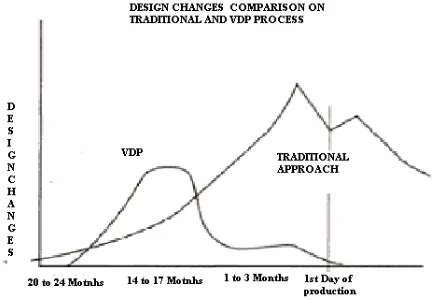
The previous time lines, changes and the design changes were compared with the new trend of using VDP. Previously prototypes were built and engineering changes were evident throughout the design evolution. It costs lot of money and the efforts to re design and manufacture the product at later stages. The VDP using schematics uses lesser time compared to actual design time and schematics developed (which are parametric curves and models) during VDP can be used for further developments of the models. The graph plotted revealed that (“Fig 6”) VDP saved substantial time, quality is improved and when plotted for design changes and time of release to production. The changes were not required at the later stages; money, effort and time were saved while quality was improved.
Fig 6, Comparisons VDP and conventional methods
[image:3.595.313.530.49.189.2] [image:3.595.54.285.61.175.2] [image:3.595.306.528.421.571.2] [image:3.595.57.276.453.534.2]concurrent design and challenges of sustainable product designs in 21st century.
VI. DISCUSSIONS AND SUMMARY
In general product design needs suitable validation before it is manufactured. Mostly extra costs and efforts needed to redesign and modify the manufactured products are high. This research used the VDP tool in cutting down the design time, improving the design quality of the product design by validating the design at the early stages of the life cycle. It also cuts down prototyping costs and additionally the schematics, models used to create VDP acts as input for the detailed design and drafting. The process consists of schematic layout of the cars and the car carrier, which were animated to meet the design constrains. This approach supports collaborative engineering which is major advancement essential for globalisation. Successful outcomes from this research encourage studies on VDP applications focused on sustainable agenda.
ACKNOWLEDGMENT
Kulkarni A thanks Kerren Smith and Kevin Mc Donnel from JSS, and Tolls for initiating and assisting with funding for research.
REFERENCES
[1] G. L. Oakes, A. J. Felton, D. Heesom et al., “The Virtual Reality Design Process Model: A Framework For Teaching Design Virtually,” Design Principles and Practices: An International Journal vol. 3, no. 3, pp. 467-478, 2006.
[2]
L. Wang
,W. Shen
,H. Xie
et al.,“Collaborative conceptual design-State of the art and future trends,” Computer Aided design, vol. 34, 2002.
[3] J. Dong, and G. Arndt, “A review of current research on disassembly sequence generation and computer aided design for disassembly,” Proceedings of the Institution of Mechanical Engineers, Part B: Journal of Engineering Manufacture vol. 217, no. 3, pp. 299-312, 2003.
[4] D. Cheshire, M. Evans, and C. Dean, “Haptic Modeling an alternative industrial design
methodology?,” in Euro Haptics, 2001, pp. 124-9. [5] P. Sener, P. Wormald, and R. Campbell, "Evaluating
a haptic modeling system with industrial designers." pp. 165-9.
[6] Chen C. J., “The design, development and evaluation of a virtual reality based learning environment’.” Australasian Journal of Educational Technology, vol. 22, pp. 39-63, 2006.
[7] J. Verlinden, and I. Horvath, "Augmented
Prototyping as a Design Means for Industrial Design - a Multiple Case Analysis."
[8] R. Clarke, National Falls from Heights in the Heavy Vehicle Sector Report, Work safe Authority V2.0, 2006.
[9] Vehicle Configuration and dimensions Motor vehicle standard Act, 1989.
[10] Eric Holsinger, and Nevin Berger, How Multimedia works, California: Ziff-Davis press, 1994.
[11] M. Don, and M. Foley, Animation tips and tricks for windows And Mac: Peach pit press, 1997 PP 39-40 [12] R. E. Mayer, Multimedia Learning: Cambridge
University Press, 2002.
[13] O. Akin, “How do architects design?,” Artificial Intelligence and Pattern Recognition in Computer Aided Design, North Holland, 1978.
[14] E. Do, L. Yi, M. D. Gross et al., “‘Intentions in and relations among design drawings’,” Design Studies vol. 21, no. 5 pp. 483-503, 2000.
[15] D. A. Schon, The Reflective Practitioner Temple Smith, 1987.
[16] G. Goldschmidt, “The dialectics of sketching,” Creativity Research Journal vol. 4 no. 2, pp. 123-143, 1991.
[17] M. Suwa, T. Purcell, and J. S. Gero, “Macroscopic analysis of design processes based on a scheme for coding designers cognitive actions,” Design Studies, vol. 19, no. 4, pp. 455-483, 1998.
[18] M. Kavakli, M. Suwa, J. Gero et al., “Sketching interpretation in novice and expert designers in J S Gero and B Tversky(eds) Visual and Spatial Reasoning in Design,,” Key Center of Design Computing and Cognition, University of Sydney, pp. 209-219, 1999.
[19] M. Suwa, J. Gero, and T. Purcell, “Unexpected discoveries and S-invention of design requirements: important vehicles for a design process,” Design Studies, vol. 21, no. 6, pp. 539-567, 2000.
[20] M. Tovey, and J. Owen, “Sketching and direct CAD modelling in automotive design,” Design Studies, vol. 21, no. 6, pp. 569-588, 2000.
[21] J. R. Rossignac, and J. J. Kim, “Computing and visualizing pose-interpolating 3D motions,” Computer-Aided Design, vol. 33, no. 4, pp. 279-291, 2001.
[22] M. Hachet, F. Decle, S. Knödel et al., “Navidget for 3D interaction: Camera positioning and further uses,” International Journal of Human-Computer Studies, vol. 67, no. 3, pp. 225-236, 2009. [23] C. Ware, and S. Osborne, "Exploration and virtual
camera control in virtual three dimensional environments." pp. 175-183.
[24] M. Chen, S. J. Mountford, and A. Sellen, "A study in interactive 3-d rotation using 2-d control devices." pp. 121-129.
[25] P. S. Strauss, and R. Carey, “An object-oriented 3d graphics toolkit,” in Proceedings of the 19th Annual Conference on Computer Graphics and Interactive Techniques SIGGRAPH ’92, NY, USA, 1992, pp. 341-349.
[26] A. Khan, B. Komalo, J. Stam et al., “Hovercam: interactive 3D navigation for proximal object inspection,” in Proceedings of SI3D ’05, New York, 2005, pp. 73-80.
[27] N. Burtnyk, A. Khan, G. Fitzmaurice et al., “Stylecam: interactive stylized 3D navigation using integrated spatial & temporal controls,” in
Proceedings of UIST ’02, New York, 2002, pp. 101-110.
[29] W. Hsu, and I. M. Y. Woon, “Current research in the conceptual design of mechanical products,” Computer-Aided Design, vol. 30, no. 5, pp. 377-389, 1998.