Nonsymbolic Text Representation
Hinrich Sch¨utze
CIS, LMU Munich, Germany
Abstract
We introduce the first generic text repre-sentation model that is completely non-symbolic, i.e., it does not require the avail-ability of a segmentation or tokenization method that attempts to identify words or other symbolic units in text. This applies to training the representations as well as to using them in an application. We demon-strate better performance than prior work on entity typing and text denoising.
1 Introduction
Character-level models can be grouped into three classes. (i) End-to-end models learn a separate model on the raw character (or byte) input for each task; these models estimate task-specific pa-rameters, but no representation of text that would be usable across tasks is computed. Throughout this paper, we refer to r(x) as the “representa-tion” of x only if r(x) is a generic rendering of x that can be used in a general way, e.g., across tasks and domains. The activation pattern of a hidden layer for a given input sentence in a mul-tilayer perceptron (MLP) is not a representation according to this definition if it is not used out-side of the MLP. (ii) Character-level models of words derive a representation of a word w from the character string of w, but they are symbolic in that they need text segmented into tokens as input. (iii) Bag-of-character-ngram models, bag-of-ngram modelsfor short, use character ngrams to encode sequence-of-character information, but sequence-of-ngram information is lost in the rep-resentations they produce.
Our premise is that text representations are needed in NLP. A large body of work on word embeddings demonstrates that a generic text rep-resentation, trained in an unsupervised fashion on
large corpora, is useful. Thus, we take the view that group (i) models, end-to-end learning with-out any representation learning, is not a good gen-eral approach for NLP.
We distinguishtrainingand utilization of the text representation model. We use “training” to refer to the method by which the model is learned and “utilization” to refer to the application of the model to a piece of text to compute a representa-tion of the text. In many text representarepresenta-tion mod-els, utilization is trivial. For example, for word embedding models, utilization amounts to a sim-ple lookup of a word to get its precomputed em-bedding. However, for the models we consider, utilization is not trivial and we will discuss differ-ent approaches.
Both training and utilization can be either sym-bolic ornonsymbolic. We define a symbolic ap-proach as one that is based on tokenization, i.e., a segmentation of the text into tokens. Symbol iden-tifiers (i.e., tokens) can have internal structure – a tokenizer may recognize tokens like “to and fro” and “London-based” that contain delimiters – and may be morphologically analyzed downstream.1
We define a nonsymbolic approach as one that is tokenization-free, i.e., no assumption is made that there are segmentation boundaries and that each segment (e.g., a word) should be represented (e.g., by a word embedding) in a way that is in-dependent of the representations (e.g., word em-beddings) of neighboring segments. Methods for training text representation models that require to-kenized text include word embedding models like word2vec (Mikolov et al., 2013) and mostgroup
1The position-embedding representation of a text intro-duced below is a sequence of position embeddings. An em-bedding that represents a single character must be viewed as symbolic since a character is a symbol – just like a represen-tation of text as a sequence of word embeddings is symbolic since each word corresponds to a symbol. But position em-beddings do not represent single characters. See§4.
(ii) methods, i.e., character-level models like fast-Text skipgram (Bojanowski et al., 2016).
Bag-of-ngram models, group (iii) models, are text representation utilization models that typ-ically compute the representation of a text as the sum of the embeddings of all character ngrams occurring in it, e.g., WordSpace (Sch¨utze, 1992) and CHARAGRAM (Wieting et al., 2016). WordSpace and CHARAGRAM are examples of mixed training-utilization models: training is per-formed on tokenized text (words and phrases), uti-lization is nonsymbolic.
We make two contributions in this paper. (i) We propose the first generic method for training text representation models without the need for tok-enization and address the challenging sparseness issues that make this difficult. (ii) We propose the first nonsymbolic utilization method that fully rep-resents sequence information – in contrast to uti-lization methods like bag-of-ngrams that discard sequence information that is not directly encoded in the character ngrams themselves.
2 Motivation
Chung et al. (2016) give two motivations for their work on character-level models. First, tokeniza-tion (or, equivalently, segmentation) algorithms make many mistakesand are brittle: “we do not have a perfect word segmentation algorithm for any one language”. Tokenization errors then prop-agate throughout the NLP pipeline.
Second, there is currently no general solu-tion for morphologyin statistical NLP. For many languages, high-coverage and high-quality mor-phological resources are not available. Even for well resourced languages, problems like ambigu-ity make morphological processing difficult; e.g., “rung” is either the singular of a noun meaning “part of a ladder” or the past participle of “to ring”. In many languages, e.g., in German, syncretism, a particular type of systematic morphological ambi-guity, is pervasive. Thus, there is no simple mor-phological processing method that would produce a representation in which all inflected forms of “to ring” are marked as having a common lemma; and no such method in which an unseen form like “aromatizing” is reliably analyzed as a form of “aromatize” whereas an unseen form like “anti-trafficking” is reliably analyzed as the compound “anti+trafficking”.
Of course, it is an open question whether
non-symbolic methods can perform better than mor-phological analysis, but the foregoing discussion motivates us to investigate them.
Chung et al. (2016) focus on problems with the tokens produced by segmentation algorithms. Equally important is the problem that tokeniza-tion fails to capture structure across multiple tokens. The job of dealing with cross-token struc-ture is often given to downstream components of the pipeline, e.g., components that recognize mul-tiwords and named entitites in English or in fact any word in a language like Chinese that uses no overt delimiters. However, there is no linguistic or computational reason in principle why we should treat the recognition of a unit like “electromechan-ical” (containing no space) as fundamentally dif-ferent from the recognition of a unit like “electrical engineering” (containing a space). Character-level models offer the potential of uniform treatment of such linguistic units.
3 Text representation model: Training 3.1 Methodology
Many text representation learning algorithms can be understood as estimating the parameters of the model from a unit-context matrix C where each row corresponds to a unit ui, each column to a context cj and each cellCij measures the degree of association betweenuiandcj. For example, the skipgram model is closely related to an SVD fac-torization of a pointwise mutual information ma-trix (Levy and Goldberg, 2014). Many text rep-resentation learning algorithms are formalized as matrix factorization (e.g., (Deerwester et al., 1990; Hofmann, 1999; Stratos et al., 2015)), but there may be no big difference between implicit (e.g., (Pennington et al., 2014)) and explicit factoriza-tion methods; see also (Mohamed, 2011; Rastogi et al., 2015).
Our goal in this paper is not to develop new ma-trix factorization methods. Instead, we will focus on defining the unit-context matrix in such a way that no symbolic assumption has to be made. This unit-context matrix can then be processed by any existing or still to be invented algorithm.
segmentation is needed. We then used a skipgram-type objective for learning embeddings that at-tempts to predict, from ngram g1, an ngram g2
ing1’s context. Results were poor because many
training instances consist of pairs(g1, g2)in which
g1 and g2 overlap, e.g., one is a subsequence of
the other. So the objective encourages trivial pre-dictions of ngrams that have high string similarity with the input and nothing interesting is learned.
In this paper, we propose an alternative way of defining units and contexts that supports well-performing nonsymbolic text representation learn-ing: multiple random segmentation. A pointer moves through the training corpus. The current positioniof the pointer defines the left boundary of the next segment. The lengthlof the next move is uniformly sampled from[kmin, kmax]wherekmin andkmaxare the minimum and maximum segment lengths. The right boundary of the segment is then i+l. Thus, the segment just generated isci,i+l, the
subsequence of the corpus between (and includ-ing) positionsiandi+l. The pointer is positioned ati+l+1, the next segment is sampled and so on. An example of a random segmentation from our experiments is “@he@had@b egu n@to@show @his@cap acity@f” where space was replaced with “@” and the next segment starts with “or@”. The corpus is segmented this way m times (wheremis a parameter) and themrandom seg-mentations are concatenated. The unit-context matrix is derived from this concatenated corpus.
Multiple random segmentation has two advan-tages. First, there is no redundancy since, in any given random segmentation, two ngrams do not overlap and are not subsequences of each other. Second, a single random segmentation would only cover a small part of the space of possible ngrams. For example, a random segmentation of “a rose is a rose is a rose” might be “[a ros][e is a ros][e is][a rose]”. This segmentation does not contain the segment “rose” and this part of the corpus can then not be exploited to learn a good embedding for the fourgram “rose”. However, with multiple random segmentation, it is likely that this part of the corpus does give rise to the segment “rose” in one of the segmentations and can contribute infor-mation to learning a good embedding for “rose”.
We took the idea of random segmentation from work on biological sequences (Asgari and Mofrad, 2015; Asgari and Mofrad, 2016). Such sequences have no delimiters, so they are a good model if
one believes that delimiter-based segmentation is problematic for text.
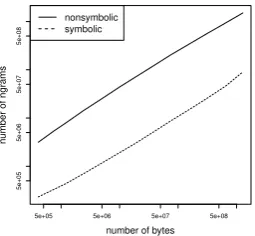
3.2 Ngram equivalence classes/Permutation Form-meaning homomorphism premise. Non-symbolic representation learning does not prepro-cess the training corpus by means of tokenization and considers many ngrams that would be ignored in tokenized approaches because they span token boundaries. As a result, the number of ngrams that occur in a corpus is an order of magnitude larger for tokenization-free approaches than for tokenization-based approaches. See supplemen-tary for details.
We will see below that this sparseness impacts performance of nonsymbolic text representation negatively. We address sparseness by defining ngram equivalence classes. All ngrams in an equivalence class receive the same embedding.
The relationship between form and meaning is mostly arbitrary, but there are substructures of the ngram space and the embedding space that are systematically related by homomorphism. In this paper, we will assume the following homomor-phism:
g1 ∼τ g2 ⇔~v(g1)∼=~v(g2)
where g1 ∼τ g2 iff τ(g1) = τ(g2) for string
transduction τ and~v(g1) ∼= ~v(g2) iff |~v(g1)−
~v(g2)|2< .
As a simple example consider a transduction τ that deletes spaces at the beginning of ngrams, e.g., τ(@Mercedes) = τ(Mercedes). This is an example of a meaning-preservingτ since for, say, English,τ will not change meaning. We will pro-pose a procedure for learningτ below.
We define∼= as “closeness” – not as identity
– because of estimation noise when embeddings are learned. We assume that there are no true syn-onyms and therefore the direction g1 ∼τ g2 ⇐
~v(g1) ∼= ~v(g2) also holds. For example, “car”
and “automobile” are considered synonyms, but we assume that their embeddings are different be-cause only “car” has the literary sense “chariot”. If they were identical, then the homomorphism would not hold since “car” and “automobile” can-not be converted into each other by any plausible meaning-preservingτ.
(ii) delete charactera1 if its immediate
predeces-sor is character a2, (iii) delete charactera1 if its
immediate successor is charactera2. The learning
procedure takes a set of ngrams and their embed-dings as input. It then exhaustively searches for all pairs of ngrams, for all pairs of charactersa1/a2,
for each of the three templates. When two match-ing embeddmatch-ings exist, we compute their cosine. For example, for the operation “delete space be-fore M”, an ngram pair from our embeddings that matches is “@Mercedes” / “Mercedes” and we compute its cosine. As the characteristic statistic of an operation we take the average of all cosines; e.g., for “delete space before M” the average co-sine is .7435. We then rank operations according to average cosine and take the firstNoas the defi-nition ofτwhereNois a parameter. For characters that are replaced by each other (e.g., 1, 2, 3 in Ta-ble 1), we compute the equivalence class and then replace the learned operations with ones that re-place a character by the canonical member of its equivalence class (e.g., 2→1, 3→1).
Permutation premise. Tokenization algo-rithms can be thought of as assigning a particular function or semantics to each character and mak-ing tokenization decisions accordmak-ingly; e.g., they may disallow that a semicolon, the character “;”, occurs inside a token. If we want to learn represen-tations from the data without imposing such hard constraints, then characters should not have any particular function or semantics. A consequence of this desideratum is that if any two characters are exchanged for each other, this should not af-fect the representations that are learned. For ex-ample, if we interchange space and “A” throughout a corpus, then this should have no effect on learn-ing: what was the representation of “NATO” be-fore, should now be the representation of “N TO”. We can also think of this type of permutation as a sanity check: it ensures we do not inadvertantly make use of text preprocessing heuristics that are pervasive in NLP.2
LetAbe the alphabet of a language, i.e., its set of characters, π a permutation onA, C a corpus andπ(C)the corpus permuted byπ. For example, ifπ(a) =e, then all “a” inCare replaced with “e” inπ(C). The learning procedure should learn
2An example of such an inadvertant use of text prepro-cessing heuristics is that fastText seems to default to low-ercase ngrams if embeddings of upplow-ercase ngrams are not available: when fastText is trained on lowercased text and then applied to uppercased text, it still produces embeddings.
identical equivalence classes on C and π(C). So, if g1 ∼τ g2 after running the learning
proce-dure onC, thenπ(g1)∼τ π(g2)after running the
learning procedure onπ(C).
This premise is motivated by our desire to come up with a general method that does not rely on spe-cific properties of a language or genre; e.g., the premise rules out exploiting the fact through fea-ture engineering that in many languages and gen-res, “c” and “C” are related. Such a relationship has to be learned from the data.
3.3 Experiments
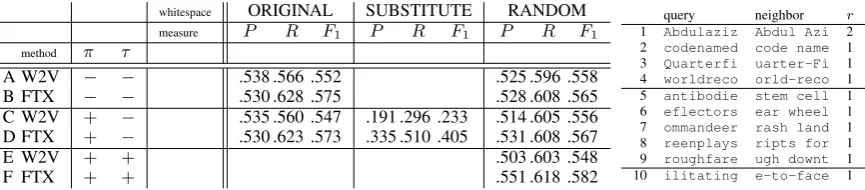
We run experiments on C, a 3 gigabyte English Wikipedia corpus, and train word2vec skipgram (W2V, (Mikolov et al., 2013)) and fastText skip-gram (FTX, (Bojanowski et al., 2016)) models on C and its derivatives. We randomly generate a permutation π on the alphabet and learn a trans-duction τ (details below). In Table 2 (left), the columns “method”, π and τ indicate the method used (W2V or FTX) and whether experiments in a row were run onC,π(C)orτ(π(C)). The val-ues of “whitespace” are: (i) ORIGINAL (white-space as in the original), (ii) SUBSTITUTE (what πoutputs as whitespace is used as whitespace, i.e., π−1(“ ”) becomes the new whitespace) and (iii)
RANDOM (random segmentation with parame-tersm= 50,kmin = 3,kmax= 9). Before random segmentation, whitespace is replaced with “@” – this character occurs rarely in C, so that the ef-fect of conflating two characters (original “@” and whitespace) can be neglected. The random seg-menter then indicates boundaries by whitespace – unambiguously since it is applied to text that con-tains no whitespace.
We learnτ on the embeddings learned by W2V on the random segmentation version of π(C)
(C-RANDOM in the table) as described in §3.2 for No = 200. Since the number of equiva-lence classes is much smaller than the number of ngrams, τ reduces the number of distinct char-acter ngrams from 758M in the random segmen-tation version of π(C) (C/D-RANDOM) to 96M in the random segmentation version of τ(π(C))
(E/F-RANDOM).
substitution 2→1
predeletion
/r →r
postdeletion
‡@ →‡
3→1 @‡ →‡ e@ →e
: →. @‡ →‡ l@ →l
; →. @H→H m@→m
E→e @I →I ml →m
[image:5.595.82.254.73.153.2]C→c
Table 1: String operations that on average do not change meaning. “@” stands for space. ‡ is the left or right boundary of the ngram.
in the table (E→e, C→c) were the only ones that were learned (we had hoped for more). The post-deletion rule ml→m usefully rewrites “html” as “htm”, but is likely to do more harm than good. We inspected all 200 rules and, with a few excep-tions like ml→m, they looked good to us.
Evaluation. We evaluate the three models on an entity typing task, similar to (Yaghoobzadeh and Sch¨utze, 2015), but based on an entity dataset released by Xie et al. (2016) in which each en-tity has been assigned one or more types from a set of 50 types. For example, the entity “Harri-son Ford” has the types “actor”, “celebrity” and “award winner” among others. We extract men-tions from FACC (http://lemurproject. org/clueweb12/FACC1) if an entity has a mention there or we use the Freebase name as the mention otherwise. This gives us a data set of 54,334, 6085 and 6747 mentions in train, dev and test, respectively. Each mention is annotated with the types that its entity has been assigned by Xie et al. (2016). The evaluation has a strong cross-domain aspect because of differences be-tween FACC and Wikipedia, the training corpus for our representations. For example, of the 525 mentions in dev that have a length of at least 5 and do not contain lowercase characters, more than half have 0 or 1 occurrences in the Wikipedia cor-pus, including many like “JOHNNY CARSON” that are frequent in other case variants.
Since our goal in this experiment is to eval-uate free learning, not tokenization-free utilization, we use a simple utilization base-line, the bag-of-ngram model (see§1). A mention is represented as the sum of all character ngrams that embeddings were learned for. Linear SVMs (Chang and Lin, 2011) are then trained, one for each of the 50 types, on train and applied to dev and test. Our evaluation measure is microF1 on
all typing decisions; e.g., one typing decision is:
“Harrison Ford” is a mention of type “actor”. We tune thresholds on dev to optimizeF1and then use
these thresholds on test.
3.4 Results
Results are presented in Table 2 (left). Overall performance of FTX is higher than W2V in all cases. For ORIGINAL, FTX’s recall is a lot higher than W2V’s whereas precision decreases slightly. This indicates that FTX is stronger in both learn-ing and application: in learnlearn-ing it can generalize better from sparse training data and in application it can produce representations for OOVs and better representations for rare words. For English, pre-fixes, suffixes and stems are of particular impor-tance, but there often is not a neat correspondence between these traditional linguistic concepts and internal FTX representations; e.g., Bojanowski et al. (2016) show that “asphal”, “sphalt” and “phalt” are informative character ngrams of “asphaltic”.
Running W2V on random segmentations can be viewed as an alternative to the learning mecha-nism of FTX, which is based on character ngram cooccurrence; so it is not surprising that for RAN-DOM, FTX has only a small advantage over W2V. For C/D-SUBSTITUTE, we see a dramatic loss in performance if tokenization heuristics are not used. This is not surprising, but shows how pow-erful tokenization can be.
C/D-ORIGINAL is like C/D-SUBSTITUTE ex-cept that we artificially restored the space – so the permutation π is applied to all characters ex-cept for space. By comparing C/D-ORIGINAL and C/D-SUBSTITUTE, we see that the space is the most important text preprocessing feature em-ployed by W2V and FTX. If space is restored, there is only a small loss of performance compared to A/B-ORIGINAL. So text preprocessing heuris-tics other than whitespace tokenization in a nar-row definition of the term (e.g., downcasing) do not seem to play a big role, at least not for our en-tity typing task.
For tokenization-free embedding learning on random segmentation, there is almost no differ-ence between original data (A/B-RANDOM) and permuted data (C/D-RANDOM). This confirms that our proposed learning method is insensitive to permutations and makes no use of text prepro-cessing heuristics.
perfor-whitespace ORIGINAL SUBSTITUTE RANDOM
measure P R F1 P R F1 P R F1
method π τ
A W2V − − .538 .566 .552 .525 .596 .558
B FTX − − .530 .628 .575 .528 .608 .565
C W2V + − .535 .560 .547 .191 .296 .233 .514 .605 .556 D FTX + − .530 .623 .573 .335 .510 .405 .531 .608 .567
E W2V + + .503 .603 .548
F FTX + + .551 .618 .582
query neighbor r
1 Abdulaziz Abdul Azi 2
2 codenamed code name 1
3 Quarterfi uarter-Fi 1
4 worldreco orld-reco 1
5 antibodie stem cell 1
6 eflectors ear wheel 1
7 ommandeer rash land 1
8 reenplays ripts for 1
9 roughfare ugh downt 1
[image:6.595.90.523.73.168.2]10 ilitating e-to-face 1
Table 2: Left: Evaluation results for named entity typing. Right: Neighbors of character ngrams. Rank r= 1/r= 2: nearest / second-nearest neighbor.
mance for F-RANDOM (F1of .582) is better than
tokenization-based W2V and FTX performance. Thus, our proposed method seems to be an effec-tive free alternaeffec-tive to tokenization-based embedding learning.
3.5 Analysis of ngram embeddings
Table 2 (right) shows nearest neighbors of ten character ngrams, for the A-RANDOM space. Queries were chosen to contain only alphanumeric characters. To highlight the difference to symbol-based representation models, we restricted the search to 9-grams that contained a delimiter at po-sitions 3, 4, 5, 6 or 7.
Lines 1–4 show that “delimiter variation”, i.e., cases where a word has two forms, one with a de-limiter, one without a dede-limiter, is handled well: “Abdulaziz” / “Abdul Azi”, “codenamed” / “code name”, “Quarterfinal” / “Quarter-Final”, “world-record” / “world-“world-record”.
Lines 5–9 are cases of ambiguous or polyse-mous words that are disambiguated through “char-acter context”. “stem”, “cell”, “rear”, “wheel”, “crash”, “land”, “scripts”, “through”, “downtown” all have several meanings. In contrast, the mean-ings of “stem cell”, “rear wheel”, “crash land”, “(write) scripts for” and “through downtown” are less ambiguous. A multiword recognizer may find the phrases “stem cell” and “crash land” auto-matically. But the examples of “scripts for” and “through downtown” show that what is accom-plished here is not multiword detection, but a more general use of character context for disambigua-tion.
Line 10 shows that a 9-gram of “face-to-face” is the closest neighbor to a 9-gram of “facilitating”. This demonstrates that form and meaning some-times interact in surprising ways. Facilitating a meeting is most commonly done face-to-face. It is not inconceivable that form – the shared trigram “fac” or the shared fourgram “faci” in “facilitate”
/ “facing” – is influencing meaning here in a way that also occurs historically in cases like “ear” ‘or-gan of hearing’ / “ear” ‘head of cereal plant’, orig-inally unrelated words that many English speakers today intuit as one word.
4 Utilization: Tokenization-free representation of text
4.1 Methodology
The main text representation model that is based on ngram embeddings similar to ours is the bag-of-ngram model. A sequence of characters is rep-resented by a single vector that is computed as the sum of the embeddings of all ngrams that oc-cur in the sequence. In fact, this is what we did in the entity typing experiment. In most work on bag-of-ngram models, the sequences consid-ered are words or phrases (see (Schuetze, 2016) for citations). In a few cases, the model is ap-plied to longer sequences, including sentences and documents; e.g., (Sch¨utze, 1992), (Wieting et al., 2016).
The basic assumption of the bag-of-ngram model is that sequence information is encoded in the character ngrams and therefore a “bag-of” ap-proach (which usually throws away all sequence information) is sufficient. The assumption is not implausible: for most bags of character sequences, there is only a single way of stitching them to-gether to one coherent sequence, so in that case information is not necessarily lost (although this is likely when embeddings are added). But the as-sumption has not been tested experimentally.
Here, we propose position embeddings, character-ngram-based embeddings that more fully preserve sequence information.3 The simple idea is to represent each position as the sum of all ngrams that contain that position. When we set
POS r= 1 r= 2 r= 3 r= 4 r= 5
2 e wealthies accolades bestselle bestselli Billboard
3 s estseller wealthies bestselli accolades bestselle
15 o fortnight afternoon overnight allowance Saturdays
16 n fortnight afternoon Saturdays Wednesday magazines
23 o superhero ntagraphi adventure Astonishi bestselli
24 m superhero ntagraphi anthology Daredevil Astonishi
29 o anthology paperback superhero Lovecraft tagraphic
30 o anthology paperback tagraphic Lovecraft agraphics
34 u antagraph agraphics paperback hardcover ersweekly
[image:7.595.78.423.73.184.2]35 b ublishing ublishers ublicatio antagraph aperbacks
Table 3: Nearest ngram embeddings (rankr ∈[1,5]) of the position embeddings for “POS”, the posi-tions 2/3 (best), 15/16 (monthly), 23/24 (comic), 29/30 (book) and 34/35 (publicaposi-tions) in the Wikipedia excerpt “best-selling monthly comic book publications sold in North America”
kmin = 3, kmax = 9, this means that the position is the sum of(P3≤k≤9k) ngram embeddings (if all of these ngrams have embeddings, which gen-erally will be true for some, but not for most po-sitions). A sequence ofncharacters is then rep-resented as a sequence ofnsuch position embed-dings.
4.2 Experiments
We again use the embeddings corresponding to A-RANDOM in Table 2. We randomly selected 2,000,000 contexts of size 40 characters from Wikipedia. We then created a noise context for each of the 2,000,000 contexts by replacing one character at position i (15 ≤ i ≤ 25, uniformly sampled) with space (probability p = .5) or a random character otherwise. Finally, we selected 1000 noise contexts randomly and computed their nearest neighbors among the 4,000,000 contexts (excluding the noise query). We did this in two different conditions: for a bag-of-ngram represen-tation of the context (sum of all character ngrams) and for the concatenation of 11 position embed-dings, those between 15 and 25. Our evaluation measure is mean reciprocal rank of the clean con-text corresponding to the noise concon-text. This simu-lates a text denoising experiment: if the clean con-text has rank 1, then the noisy concon-text can be cor-rected.
Table 4 shows that sequence-preserving po-sition embeddings perform better than
bag-of-bag-of-ngram position embeddings
MRR .64 .76
Table 4: Mean reciprocal rank of text denoising experiment for bag-of-ngram text representation and position embedding text representation
[image:7.595.308.531.249.334.2]exchange@f ic@exchang ing@exchan (in exchange for) (many contexts) (many contexts) exchange@f 1.000 0.008 -0.056 ic@exchang 0.008 1.000 0.108 ing@exchan -0.056 0.108 1.000 xchange@ra ival@rates rime@rates (exchange rates) (survival rates) (crime rates) xchange@ra 1.000 0.036 0.050 ival@rates 0.036 1.000 0.331 rime@rates 0.050 0.331 1.000
Table 6: Cosine similarity of ngrams that cross word boundaries and disambiguate polysemous words. The tables show three disambiguating ngrams for “exchange” and “rates” that have dif-ferent meanings as indicated by low cosine sim-ilarity. In phrases like “floating exchange rates” and “historic exchange rates”, disambiguating ngrams overlap. Parts of the word “exchange” are disambiguated by preceding context (ic@exchang, ing@exchan) and parts of “exchange” provide context for disambiguating “rates” (xchange@ra).
ngram representations.
Table 5 shows an example of a context in which position embeddings did better than bag-of-ngrams, demonstrating that sequence informa-tion is lost by bag-of-ngram representainforma-tions, in this case the exact position of “Seahawks”.
Table 3 gives further intuition about the type of information position embeddings contain, show-ing the ngram embeddshow-ings closest to selected posi-tion embeddings; e.g., “estseller” (the first 9-gram on the line numbered 3 in the table) is closest to the embedding of position 3 (corresponding to the first “s” of “best-selling”). The kNN search space is restricted to alphanumeric ngrams.
5 Discussion
cov-rep. space similarity r left context center right context
1 correct ks and Seattle Skeahawks thkat led to publik
[image:8.595.76.509.73.137.2]2 noise (query) ks and Seattle Skeahawks t kat led to publik 3 position-emb .761 1 ks and Seattle Skeahawks thkat led to publik 4 bag-of-ngram .904 1 karted 15 games kfsr the Sekahawks, leadingk 5 bag-of-ngram .864 6 ks and Seattle Skeahawks thkat led to publik Table 5: Illustration of the result in Table 4. “rep. space” = “representation space”. We want to correct the error in the corrupted “noise” context (line 2) and produce “correct” (line 1). The nearest neighbor to line 2 in position-embedding space is the correct context (line 3,r = 1). The nearest neighbor to line 2 in bag-of-ngram space is incorrect (line 4,r= 1) because the precise position of “Seahawks” in the query is not encoded. The correct context in bag-of-ngram space is instead at rankr= 6(line 5). “similarity” is average cosine (over eleven position embeddings) for position embeddings.
erage of the space of possible segmentations. An alternative approach would be to attempt to find a
single optimal segmentation.
Our intuition is that in many cases overlap-ping segments contain complementary informa-tion. Table 6 gives an example. Historic exchange rates are different from floating exchange rates and this is captured by the low similarity of the ngramsic@exchanganding@exchan. Also, the meaning of “historic” and “floating” is non-compositional: these two words take on a special-ized meaning in the context of exchange rates. The same is true for “rates”: its meaning is not its gen-eral meaning in the compound “exchange rates”. Thus, we need a representation that contains over-lapping segments, so that “historic” / “floating” and “exchange” can disambiguate each other in the first part of the compound and “exchange” and “rates” can disambiguate each other in the second part of the compound. A single segmentation can-not capture these overlapping ngrams.
What text-type are tokenization-free ap-proaches most promising for? The reviewers thought that language and text-type were badly chosen for this paper. Indeed, a morphologically complex language like Turkish and a noisy text-type like Twitter would seem to be better choices for a paper on robust text representation.
However, robust word representation methods like FTX are effective for within-token general-ization, in particular, effective for both complex morphology and OOVs. If linguistic variability and noise only occur on the token level, then a tokenization-free approach has fewer advantages.
On the other hand, the foregoing discussion ofcross-tokenregularities and disambiguation ap-plies to well-edited English text as much as it does to other languages and other text-types as the example of “exchange” shows (which is
dis-ambiguated by prior context and provides disam-biguating context to following words) and as is also exemplified by lines 5–9 in Table 2 (right).
Still, this paper does not directly evaluate the different contributions that within-token charac-ter ngram embeddings vs. cross-token characcharac-ter ngram embeddings make, so this is an open ques-tion. One difficulty is that few corpora are avail-able that allow the separate evaluation of white-space tokenization errors; e.g., OCR corpora gen-erally do not distinguish a separate class of white-space tokenization errors.
Position embeddings vs. phrase/sentence em-beddings. Position embeddings may seem to stand in opposition to phrase/sentence embed-dings. For many tasks, we need a fixed length rep-resentation of a longer sequence; e.g., sentiment analysis models compute a fixed-length represen-tation to classify a sentence as positive / negative.
To see that position embeddings are compatible with fixed-length embeddings, observe first that, in principle, there is no difference between word embeddings and position embeddings in this re-spect. Take a sequence that consists of, say, 6 words and 29 characters. The initial representation of the sentence has length 6 for word embeddings and length 29 for position embeddings. In both cases, we need a model that reduces the variable length sequence into a fixed length vector at some intermediate stage and then classifies this vector as positive or negative. For example, both word and position embeddings can be used as the input to an LSTM whose final hidden unit activations are a fixed length vector of this type.
a more effective representation.
A more specific form of this argument con-cerns architectures that compute fixed-length rep-resentations of subsequences on intermediate lev-els, e.g., CNNs. The difference between position-embedding-based CNNs and word-embedding-based CNNs is that the former have access to a
vastly increased range of subsequences, includ-ing substrinclud-ings of words (makinclud-ing it easier to learn that “exchange” and “exchanges” are related) and cross-token character strings (making it easier to learn that “exchange rate” is noncompositional). Here, the questions are: (i) how useful are sub-sequences made available by position embeddings and (ii) is the increased level of noise and de-creased efficiency caused by many useless subse-quences worth the information gained by adding useful subsequences.
Independence of training and utilization. We note that our proposed training and utiliza-tion methods are completely independent. Posi-tion embeddings can be computed from any set of character-ngram-embeddings (including FTX) and our character ngram learning algorithm could be used for applications other than position em-beddings, e.g., for computing word embeddings.
Context-free vs. context-sensitive embed-dings.Word embeddings are context-free: a given wordwlike “king” is represented by the same em-bedding independent of the context in which w occurs. Position embeddings are context-free as well: if the maximum size of a character ngram is kmax, then the position embedding of the center of a stringsof length2kmax−1is the same indepen-dent of the context in whichsoccurs.
It is conceivable that text representations could be context-sensitive. For example, the hidden states of a character language model have been used as a kind of nonsymbolic text representation (Chrupala, 2013; Evang et al., 2013; Chrupala, 2014) and these states are context-sensitive. How-ever, such models will in general be a second level of representation; e.g., the hidden states of a char-acter language model generally use charchar-acter em-beddings as the first level of representation. Con-versely, position embeddings can also be the basis for a context-sensitive second-level text represen-tation. We have to start somewhere when we rep-resent text. Position embeddings are motivated by the desire to provide a representation that can be computed easily and quickly (i.e., without taking
context into account), but that on the other hand is much richer than the symbolic alphabet.
Processing text vs. speech vs. images.Gillick et al. (2016) write: “It is worth noting that noise is often added . . . to images . . . and speech where the added noise does not fundamentally alter the in-put, but rather blurs it. [bytes allow us to achieve] something like blurring with text.” It is not clear to what extent blurring on the byte level is useful; e.g., if we blur the bytes of the word “university” individually, then it is unlikely that the noise gen-erated is helpful in, say, providing good training examples in parts of the space that would other-wise be unexplored. In contrast, the text repre-sentation we have introduced in this paper can be blurred in a way that is analogous to images and speech. Each embedding of a position is a vector that can be smoothly changed in every direction. We have showed that the similarity in this space gives rise to natural variation.
Prospects for completely tokenization-free processing. We have focused on white-space tokenization and proposed a whitewhite-space- whitespace-tokenization-free method that computes embed-dings of higher quality than tokenization-based methods. However, there are many properties of edited text beyond whitespace tokenization that a complex rule-based tokenizer exploits. In a small explorative experiment, we replaced all non-alphanumeric characters with whitespace and re-peated experiment A-ORIGINAL for this setting. This results in anF1of .593, better by .01 than the
best tokenization-free method. This illustrates that there is still a lot of work to be done before we can obviate the need for tokenization.
6 Conclusion
References
Ehsaneddin Asgari and Mohammad R. K. Mofrad.
2015. Protvec: A continuous distributed
rep-resentation of biological sequences. CoRR,
abs/1503.05140.
Ehsaneddin Asgari and Mohammad R. K. Mofrad. 2016. Comparing fifty natural languages and twelve genetic languages using word embedding language divergence (WELD) as a quantitative measure of
language distance. CoRR, abs/1604.08561.
Piotr Bojanowski, Edouard Grave, Armand Joulin, and Tomas Mikolov. 2016. Enriching word vectors with
subword information. CoRR, abs/1607.04606.
Chih-Chung Chang and Chih-Jen Lin. 2011.
LIB-SVM: A library for support vector machines. ACM
TIST, 2(3):27:1–27:27.
Grzegorz Chrupala. 2013. Text segmentation
with character-level text embeddings. CoRR,
abs/1309.4628.
Grzegorz Chrupala. 2014. Normalizing tweets with edit scripts and recurrent neural embeddings. In
Proceedings of the 52nd Annual Meeting of the As-sociation for Computational Linguistics, ACL 2014, June 22-27, 2014, Baltimore, MD, USA, Volume 2: Short Papers, pages 680–686. The Association for Computer Linguistics.
Junyoung Chung, Kyunghyun Cho, and Yoshua Ben-gio. 2016. A character-level decoder without ex-plicit segmentation for neural machine translation. InProceedings of the 54th Annual Meeting of the As-sociation for Computational Linguistics, ACL 2016, August 7-12, 2016, Berlin, Germany, Volume 1: Long Papers. The Association for Computer Lin-guistics.
Scott C. Deerwester, Susan T. Dumais, Thomas K. Lan-dauer, George W. Furnas, and Richard A. Harshman.
1990. Indexing by latent semantic analysis. JASIS,
41(6):391–407.
Kilian Evang, Valerio Basile, Grzegorz Chrupala, and Johan Bos. 2013. Elephant: Sequence labeling for
word and sentence segmentation. InProceedings of
the 2013 Conference on Empirical Methods in Natu-ral Language Processing, EMNLP 2013, 18-21 Oc-tober 2013, Grand Hyatt Seattle, Seattle, Washing-ton, USA, A meeting of SIGDAT, a Special Interest Group of the ACL, pages 1422–1426. ACL.
Dan Gillick, Cliff Brunk, Oriol Vinyals, and Amarnag Subramanya. 2016. Multilingual language process-ing from bytes. In Kevin Knight, Ani Nenkova,
and Owen Rambow, editors,NAACL HLT 2016, The
2016 Conference of the North American Chapter of the Association for Computational Linguistics: Hu-man Language Technologies, San Diego California, USA, June 12-17, 2016, pages 1296–1306. The As-sociation for Computational Linguistics.
Thomas Hofmann. 1999. Probabilistic latent
seman-tic indexing. In SIGIR ’99: Proceedings of the
22nd Annual International ACM SIGIR Conference on Research and Development in Information Re-trieval, August 15-19, 1999, Berkeley, CA, USA, pages 50–57. ACM.
Nal Kalchbrenner, Lasse Espeholt, Karen Simonyan, A¨aron van den Oord, Alex Graves, and Koray Kavukcuoglu. 2016. Neural machine translation in
linear time.CoRR, abs/1610.10099.
Omer Levy and Yoav Goldberg. 2014. Neural word
embedding as implicit matrix factorization. In
Zoubin Ghahramani, Max Welling, Corinna Cortes, Neil D. Lawrence, and Kilian Q. Weinberger,
ed-itors, Advances in Neural Information Processing
Systems 27: Annual Conference on Neural Informa-tion Processing Systems 2014, December 8-13 2014, Montreal, Quebec, Canada, pages 2177–2185. Tomas Mikolov, Ilya Sutskever, Kai Chen, Gregory S.
Corrado, and Jeffrey Dean. 2013. Distributed rep-resentations of words and phrases and their compo-sitionality. In Christopher J. C. Burges, L´eon Bot-tou, Zoubin Ghahramani, and Kilian Q. Weinberger,
editors,Advances in Neural Information Processing
Systems 26: 27th Annual Conference on Neural In-formation Processing Systems 2013. Proceedings of a meeting held December 5-8, 2013, Lake Tahoe, Nevada, United States., pages 3111–3119.
Shakir Mohamed. 2011. Generalised Bayesian
ma-trix factorisation models. Ph.D. thesis, University of Cambridge, UK.
Jeffrey Pennington, Richard Socher, and Christo-pher D. Manning. 2014. Glove: Global vectors for word representation. In Alessandro Moschitti,
Bo Pang, and Walter Daelemans, editors,
Proceed-ings of the 2014 Conference on Empirical Methods in Natural Language Processing, EMNLP 2014, Oc-tober 25-29, 2014, Doha, Qatar, A meeting of SIG-DAT, a Special Interest Group of the ACL, pages 1532–1543. ACL.
Pushpendre Rastogi, Benjamin Van Durme, and Ra-man Arora. 2015. Multiview LSA: representation learning via generalized CCA. In Rada Mihalcea,
Joyce Yue Chai, and Anoop Sarkar, editors,NAACL
HLT 2015, The 2015 Conference of the North Amer-ican Chapter of the Association for Computational Linguistics: Human Language Technologies, Den-ver, Colorado, USA, May 31 - June 5, 2015, pages 556–566. The Association for Computational Lin-guistics.
Hinrich Schuetze. 2016. Nonsymbolic text
representa-tion.CoRR, abs/1610.00479.
Hinrich Sch¨utze. 1992. Word space. In Stephen Jose Hanson, Jack D. Cowan, and C. Lee Giles, editors,
Karl Stratos, Michael Collins, and Daniel J. Hsu. 2015. Model-based word embeddings from
decomposi-tions of count matrices. InProceedings of the 53rd
Annual Meeting of the Association for Computa-tional Linguistics and the 7th InternaComputa-tional Joint Conference on Natural Language Processing of the Asian Federation of Natural Language Processing, ACL 2015, July 26-31, 2015, Beijing, China, Volume 1: Long Papers, pages 1282–1291. The Association for Computer Linguistics.
John Wieting, Mohit Bansal, Kevin Gimpel, and Karen Livescu. 2016. Charagram: Embedding words and sentences via character n-grams. In Jian Su, Xavier
Carreras, and Kevin Duh, editors,Proceedings of the
2016 Conference on Empirical Methods in Natural Language Processing, EMNLP 2016, Austin, Texas, USA, November 1-4, 2016, pages 1504–1515. The Association for Computational Linguistics.
Ruobing Xie, Zhiyuan Liu, Jia Jia, Huanbo Luan, and Maosong Sun. 2016. Representation learning of knowledge graphs with entity descriptions. In Dale
Schuurmans and Michael P. Wellman, editors,
Pro-ceedings of the Thirtieth AAAI Conference on Arti-ficial Intelligence, February 12-17, 2016, Phoenix, Arizona, USA., pages 2659–2665. AAAI Press. Yadollah Yaghoobzadeh and Hinrich Sch¨utze. 2015.
Corpus-level fine-grained entity typing using
con-textual information. In Llu´ıs M`arquez, Chris
Callison-Burch, Jian Su, Daniele Pighin, and
Yu-val Marton, editors,Proceedings of the 2015
5e+05 5e+06 5e+07 5e+08
5e+05
5e+06
5e+07
5e+08
number of bytes
n
umber of ngr
ams
[image:12.595.78.206.87.205.2]nonsymbolic symbolic
Figure 1: The graph shows how many different character ngrams (kmin = 3, kmax = 10) oc-cur in the firstn bytes of the English Wikipedia for symbolic (tokenization-based) vs. nonsym-bolic (tokenization-free) processing. The number of ngrams is an order of magnitude larger in the nonsymbolic approach. We counted all segments, corresponding tom=∞. For the experiments in the paper (m = 50), the number of nonsymbolic character ngrams is smaller.
A Supplementary material A.1 Related work
The related work section appears in the long ver-sion of this paper (Schuetze, 2016).
A.2 Acknowledgments
This work was supported by DFG (SCHUE 2246/10-1) and Volkswagenstiftung. We are grateful for their comments to: the anonymous reviewers, Ehsan Asgari, Annemarie Friedrich, Helmut Schmid, Martin Schmitt and Yadollah Yaghoobzadeh.
A.3 Sparseness in tokenization-free approaches
Nonsymbolic representation learning does not pre-process the training corpus by means of tokeniza-tion and considers many ngrams that would be ig-nored in tokenized approaches because they span token boundaries. As a result, the number of ngrams that occur in a corpus is an order of mag-nitude larger for tokenization-free approaches than for tokenization-based approaches. See Figure 1. A.4 Experimental settings
W2V hyperparameter settings. size of word vectors: 200, max skip length between words: 5, threshold for occurrence of words: 0, hierarchi-cal softmax: 0, number of negative examples: 5,
threads: 50, training iterations: 1, min-count: 5, starting learning rate: .025, classes: 0
FTX hyperparameter settings. learning rate: .05, lrUpdateRate: 100, size of word vectors: 200, size of context window: 5, number of epochs: 1, minimal number of word occurrences: 5, num-ber of negatives sampled: 5, max length of word ngram: 1, loss function: ns, number of buck-ets: 2,000,000, min length of char ngram: 3, max length of char ngram: 6, number of threads: 50, sampling threshold: .0001
We ran some experiments with more epochs, but this did not improve the results.
A.5 Other hyperparameters
We did not tuneNo = 200, but results are highly sensitive to the value of this parameter. IfNois too small, then beneficial conflations (collapse punc-tuation marks, replace all digits with one symbol) are not found. If No is too large, then precision suffers – in the extreme case all characters are col-lapsed into one.
We also did not tunem = 50, but we do not consider results to be very sensitive to the value of m if it is reasonably large. Of course, if a larger range of character ngram lengths is chosen, i.e., a larger interval [kmin, kmax], then at some point m = 50 will not be sufficient and possible seg-mentations would not be covered well enough in sampling.

![Table 3: Nearest ngram embeddings (rank rtions 2/3 (best), 15/16 (monthly), 23/24 (comic), 29/30 (book) and 34/35 (publications) in the Wikipedia∈[ 1, 5] ) of the position embeddings for “POS”, the posi-excerpt “best-selling monthly comic book publications sold in North America”](https://thumb-us.123doks.com/thumbv2/123dok_us/1314597.661660/7.595.78.423.73.184/nearest-embeddings-publications-wikipedia-position-embeddings-publications-america.webp)