Sequence-Level Knowledge Distillation
Yoon Kim
Alexander M. Rush [email protected]
School of Engineering and Applied Sciences Harvard University
Cambridge, MA, USA
Abstract
Neural machine translation (NMT) offers a novel alternative formulation of translation that is potentially simpler than statistical ap-proaches. However to reach competitive per-formance, NMT models need to be exceed-ingly large. In this paper we consider applying knowledge distillationapproaches (Bucila et al., 2006; Hinton et al., 2015) that have proven successful for reducing the size of neural mod-els in other domains to the problem of NMT. We demonstrate that standard knowledge dis-tillation applied to word-level prediction can be effective for NMT, and also introduce two novel sequence-level versions of knowledge distillation that further improve performance, and somewhat surprisingly, seem to elimi-nate the need for beam search (even when ap-plied on the original teacher model). Our best student model runs 10 times faster than its state-of-the-art teacher with little loss in per-formance. It is also significantly better than a baseline model trained without knowledge distillation: by4.2/1.7BLEU with greedy de-coding/beam search. Applying weight prun-ing on top of knowledge distillation results in a student model that has 13×fewer param-eters than the original teacher model, with a decrease of0.4BLEU.
1 Introduction
Neural machine translation (NMT) (Kalchbrenner and Blunsom, 2013; Cho et al., 2014; Sutskever et al., 2014; Bahdanau et al., 2015) is a deep learning-based method for translation that has recently shown promising results as an alternative to statistical
ap-proaches. NMT systems directly model the proba-bility of the next word in the target sentence sim-ply by conditioning a recurrent neural network on the source sentence and previously generated target words.
While both simple and surprisingly accurate, NMT systems typically need to have very high ca-pacity in order to perform well: Sutskever et al. (2014) used a4-layer LSTM with1000hidden units per layer (herein4×1000) and Zhou et al. (2016) ob-tained state-of-the-art results on English→ French
with a16-layer LSTM with512units per layer. The sheer size of the models requires cutting-edge hard-ware for training and makes using the models on standard setups very challenging.
This issue of excessively large networks has been observed in several other domains, with much fo-cus on fully-connected and convolutional networks for multi-class classification. Researchers have par-ticularly noted that large networks seem to be nec-essary for training, but learn redundant representa-tions in the process (Denil et al., 2013). Therefore compressing deep models into smaller networks has been an active area of research. As deep learning systems obtain better results on NLP tasks, compres-sion also becomes an important practical issue with applications such as running deep learning models for speech and translation locally on cell phones.
Existing compression methods generally fall into two categories: (1)pruningand (2)knowledge dis-tillation. Pruningmethods (LeCun et al., 1990; He et al., 2014; Han et al., 2016), zero-out weights or entire neurons based on an importance criterion: Le-Cun et al. (1990) use (a diagonal approximation to)
the Hessian to identify weights whose removal min-imally impacts the objective function, while Han et al. (2016) remove weights based on threshold-ing their absolute values.Knowledge distillation ap-proaches (Bucila et al., 2006; Ba and Caruana, 2014; Hinton et al., 2015) learn a smallerstudentnetwork to mimic the originalteachernetwork by minimiz-ing the loss (typicallyL2or cross-entropy) between the student and teacher output.
In this work, we investigate knowledge distilla-tion in the context of neural machine transladistilla-tion. We note that NMT differs from previous work which has mainly explored non-recurrent models in the multi-class prediction setting. For NMT, while the model is trained on multi-class prediction at the word-level, it is tasked with predicting complete sequence out-puts conditioned on previous decisions. With this difference in mind, we experiment with standard knowledge distillation for NMT and also propose two new versions of the approach that attempt to ap-proximately match the sequence-level (as opposed to word-level) distribution of the teacher network. This sequence-level approximation leads to a sim-ple training procedure wherein the student network is trained on a newly generated dataset that is the result of running beam search with the teacher net-work.
We run experiments to compress a large state-of-the-art 4×1000LSTM model, and find that with sequence-level knowledge distillation we are able to learn a2×500LSTM that roughly matches the per-formance of the full system. We see similar results compressing a2×500model down to2×100on a smaller data set. Furthermore, we observe that our proposed approach has other benefits, such as not requiring any beam search at test-time. As a re-sult we are able to perform greedy decoding on the 2×500model10times faster than beam search on the4×1000model with comparable performance. Our student models can even be run efficiently on a standard smartphone.1 Finally, we apply weight pruning on top of the student network to obtain a model that has13×fewer parameters than the origi-nal teacher model. We have released all the code for the models described in this paper.2
1https://github.com/harvardnlp/nmt-android 2https://github.com/harvardnlp/seq2seq-attn
2 Background
2.1 Sequence-to-Sequence with Attention Lets= [s1, . . . , sI]andt= [t1, . . . , tJ]be (random variable sequences representing) the source/target sentence, with I and J respectively being the source/target lengths. Machine translation involves finding the most probable target sentence given the source:
argmax
t∈T
p(t|s)
whereT is the set of all possible sequences. NMT
models parameterizep(t|s)with anencoderneural network which reads the source sentence and a de-coderneural network which produces a distribution over the target sentence (one word at a time) given the source. We employ the attentional architecture from Luong et al. (2015), which achieved state-of-the-art results on English→German translation.3
2.2 Knowledge Distillation
Knowledge distillation describes a class of methods for training a smaller student network to perform better by learning from a larger teacher network (in addition to learning from the training data set). We generally assume that the teacher has previously been trained, and that we are estimating parame-ters for the student. Knowledge distillation suggests training by matching the student’s predictions to the teacher’s predictions. For classification this usually means matching the probabilities either via L2 on the log scale (Ba and Caruana, 2014) or by cross-entropy (Li et al., 2014; Hinton et al., 2015).
Concretely, assume we are learning a multi-class classifier over a data set of examples of the form (x, y) with possible classes V. The usual training criteria is to minimize NLL for each example from the training data,
LNLL(θ) =− |V| X
k=1
1{y=k}logp(y=k|x;θ)
where 1{·} is the indicator function and p the distribution from our model (parameterized by θ).
3Specifically, we use the global-general attention model
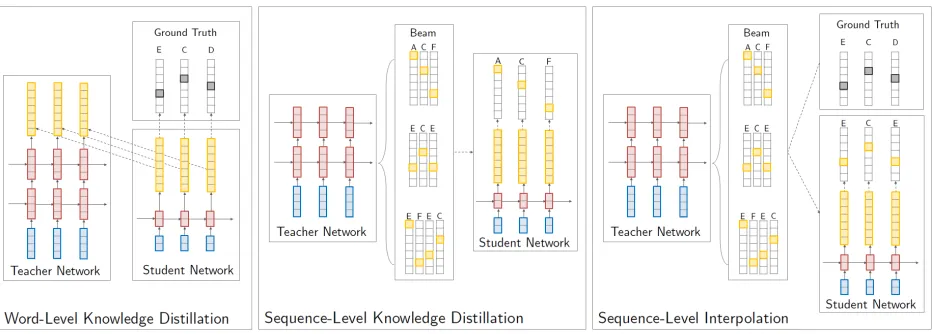
Figure 1: Overview of the different knowledge distillation approaches. In word-level knowledge distillation (left) cross-entropy is minimized between the student/teacher distributions (yellow) for each word in the actual target sequence (ECD), as well as between the student distribution and the degenerate data distribution, which has all of its probabilitiy mass on one word (black). In sequence-level knowledge distillation (center) the student network is trained on the output from beam search of the teacher network that had the highest score (ACF). In sequence-level interpolation (right) the student is trained on the output from beam search of the teacher network that had the highestsimwith the target sequence (ECE).
This objective can be seen as minimizing the cross-entropy between the degenerate data distribution (which has all of its probability mass on one class) and the model distributionp(y|x;θ).
In knowledge distillation, we assume access to a learned teacher distribution q(y|x;θT), possibly trained over the same data set. Instead of minimiz-ing cross-entropy with the observed data, we instead minimize the cross-entropy with the teacher’s prob-ability distribution,
LKD(θ;θT) =− |V| X
k=1
q(y=k|x;θT)×
logp(y=k|x;θ)
whereθT parameterizes the teacher distribution and remains fixed. Note the cross-entropy setup is iden-tical, but the target distribution is no longer a sparse distribution.4 Training on q(y|x;θ
T) is attractive since it gives more information about other classes for a given data point (e.g. similarity between classes) and has less variance in gradients (Hinton et al., 2015).
4In some cases the entropy of the teacher/student
distribu-tion is increased by annealing it with a temperature termτ >1
˜
p(y|x)∝p(y|x)τ1
After testingτ∈ {1,1.5,2}we found thatτ= 1worked best.
Since this new objective has no direct term for the training data, it is common practice to interpolate between the two losses,
L(θ;θT) = (1−α)LNLL(θ) +αLKD(θ;θT) whereαis mixture parameter combining the one-hot distribution and the teacher distribution.
3 Knowledge Distillation for NMT
The large sizes of neural machine translation sys-tems make them an ideal candidate for knowledge distillation approaches. In this section we explore three different ways this technique can be applied to NMT.
3.1 Word-Level Knowledge Distillation
NMT systems are trained directly to minimize word NLL, LWORD-NLL, at each position. Therefore if we have a teacher model, standard knowledge distil-lation for multi-class cross-entropy can be applied. We define this distillation for a sentence as,
LWORD-KD=−
J X
j=1 |V| X
k=1
q(tj =k|s,t<j)×
logp(tj =k|s,t<j) where V is the target vocabulary set. The student
LWORD-KDandLWORD-NLL. In the context of NMT, we refer to this approach as word-level knowledge distillation and illustrate this in Figure 1 (left).
3.2 Sequence-Level Knowledge Distillation Word-level knowledge distillation allows transfer of these local word distributions. Ideally however, we would like the student model to mimic the teacher’s actions at the sequence-level. The sequence distri-bution is particularly important for NMT, because wrong predictions can propagate forward at test-time.
First, consider the sequence-level distribution specified by the model over all possible sequences
t∈ T,
p(t|s) = J Y
j=1
p(tj|s,t<j)
for any lengthJ. The sequence-level negative log-likelihood for NMT then involves matching the one-hot distribution over all complete sequences,
LSEQ-NLL=−X
t∈T
1{t=y}logp(t|s)
= −
J X
j=1 |V| X
k=1
1{yj =k}logp(tj =k|s,t<j)
= LWORD-NLL
where y = [y1, . . . , yJ]is the observed sequence. Of course, this just shows that from a negative log likelihood perspective, minimizing word-level NLL and sequence-level NLL are equivalent in this model.
But now consider the case of sequence-level knowledge distillation. As before, we can simply replace the distribution from the data with a prob-ability distribution derived from our teacher model. However, instead of using a single word prediction, we use q(t|s) to represent the teacher’s sequence distribution over the sample space of all possible se-quences,
LSEQ-KD =−X
t∈T
q(t|s) logp(t|s)
Note that LSEQ-KD is inherently different from
LWORD-KD, as the sum is over an exponential
num-ber of terms. Despite its intractability, we posit
that this sequence-level objective is worthwhile. It gives the teacher the chance to assign probabilities to complete sequences and therefore transfer a broader range of knowledge. We thus consider an approxi-mation of this objective.
Our simplest approximation is to replace the teacher distributionqwith its mode,
q(t|s)∼1{t= argmax
t∈T
q(t|s)}
Observing that finding the mode is itself intractable, we use beam search to find an approximation. The loss is then
LSEQ-KD ≈ −X
t∈T
1{t= ˆy}logp(t|s)
= −logp(t= ˆy|s)
whereyˆis now the output from running beam search with the teacher model.
Using the mode seems like a poor approximation for the teacher distribution q(t|s), as we are ap-proximating an exponentially-sized distribution with a single sample. However, previous results showing the effectiveness of beam search decoding for NMT lead us to belief that a large portion ofq’s mass lies in a single output sequence. In fact, in experiments we find that with beam of size1, q(ˆy|s)(on aver-age) accounts for 1.3% of the distribution for Ger-man→English, and2.3%for Thai→English (Ta-ble 1:p(t= ˆy)).5
To summarize, sequence-level knowledge distil-lation suggests to: (1) train a teacher model, (2) run beam search over the training set with this model, (3) train the student network with cross-entropy on this new dataset. Step (3) is identical to the word-level NLL process except now on the newly-generated data set. This is shown in Figure 1 (center).
5Additionally there are simple ways to better approximate
q(t|s). One way would be to consider aK-best list from beam search and renormalizing the probabilities,
q(t|s)∼P q(t|s) t∈TKq(t|s)
whereTK is the K-best list from beam search. This would
increase the training set by a factor of K. A beam of size 5 captures2.8% of the distribution for German → English, and3.8%for Thai→English. Another alternative is to use a Monte Carlo estimate and sample from the teacher model (since LSEQ-KD=Et∼q(t|s)[−logp(t|s) ]). However in practice we
3.3 Sequence-Level Interpolation
Next we consider integrating the training data back into the process, such that we train the student model as a mixture of our sequence-level teacher-generated data (LSEQ-KD) with the original training
data (LSEQ-NLL),
L= (1−α)LSEQ-NLL+αLSEQ-KD =−(1−α) logp(y|s)−αX
t∈T
q(t|s) logp(t|s)
whereyis the gold target sequence.
Since the second term is intractable, we could again apply the mode approximation from the pre-vious section,
L=−(1−α) logp(y|s)−αlogp(ˆy|s)
and train on both observed (y) and
teacher-generated (yˆ) data. However, this process is non-ideal for two reasons: (1) unlike for standard knowl-edge distribution, it doubles the size of the training data, and (2) it requires training on both the teacher-generated sequence and the true sequence, condi-tioned on the same source input. The latter concern is particularly problematic since we observe thaty
andyˆare often quite different.
As an alternative, we propose a single-sequence approximation that is more attractive in this setting. This approach is inspired bylocal updating (Liang et al., 2006), a method for discriminative train-ing in statistical machine translation (although to our knowledge not for knowledge distillation). Lo-cal updating suggests selecting a training sequence which is close toy andhas high probability under
the teacher model,
˜
y= argmax
t∈T
sim(t,y)q(t|s)
where simis a function measuring closeness (e.g. Jaccard similarity or BLEU (Papineni et al., 2002)). Following local updating, we can approximate this sequence by running beam search and choosing
˜
y≈argmax
t∈TK
sim(t,y)
where TK is the K-best list from beam search. We takesimto be smoothed sentence-level BLEU (Chen and Cherry, 2014).
We justify training ony˜from a knowledge distil-lation perspective with the following generative pro-cess: suppose that there is a true target sequence (which we do not observe) that is first generated from the underlying data distributionD. And further
suppose that the target sequence that we observe (y)
is a noisy version of the unobserved true sequence: i.e. (i)t ∼ D, (ii)y ∼ (t), where (t)is, for ex-ample, a noise function that independently replaces each element intwith a random element inV with some small probability.6 In such a case, ideally the student’s distribution should match the mixture dis-tribution,
DSEQ-Inter ∼(1−α)D+αq(t|s)
In this setting, due to the noise assumption,Dnow
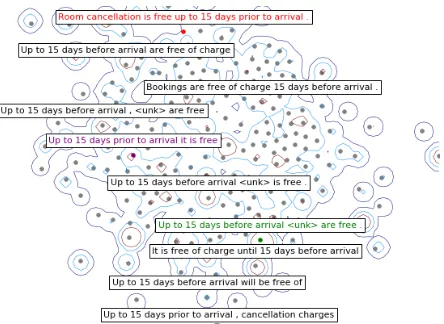
has significant probability mass around a neighbor-hood ofy(not just aty), and therefore theargmax of the mixture distribution is likely something other thany(the observed sequence) oryˆ(the output from beam search). We can see thaty˜is a natural approx-imation to the argmax of this mixture distribution between D and q(t|s) for some α. We illustrate this framework in Figure 1 (right) and visualize the distribution over a real example in Figure 2.
4 Experimental Setup
To test out these approaches, we conduct two sets of NMT experiments: high resource (English→ Ger-man) and low resource (Thai→English).
The English-German data comes from WMT 2014.7 The training set has4m sentences and we take newstest2012/newstest2013 as the dev set and newstest2014 as the test set. We keep the top50k most frequent words, and replace the rest with UNK. The teacher model is a4×1000LSTM (as in Lu-ong et al. (2015)) and we train two student models: 2×300and2×500. TheThai-Englishdata comes from IWSLT 2015.8 There are90k sentences in the
6While we employ a simple (unrealistic) noise function for
illustrative purposes, the generative story is quite plausible if we consider a more elaborate noise function which includes addi-tional sources of noise such as phrase reordering, replacement of words with synonyms, etc. One could view translation hav-ing two sources of variance that should be modeled separately: variance due to the source sentence (t∼ D), and variance due to the individual translator (y∼(t)).
7http://statmt.org/wmt14
Figure 2: Visualization of sequence-level interpolation on an example German→English sentence: Bis 15 Tage vor An-reise sind Zimmer-Annullationen kostenlos. We run beam search, plot the final hidden state of the hypotheses using t-SNE and show the corresponding (smoothed) probabilities with con-tours. In the above example, the sentence that is at the top of the beam after beam search (green) is quite far away from gold (red), so we train the model on a sentence that is on the beam but had the highestsim(e.g. BLEU) to gold (purple).
training set and we take 2010/2011/2012 data as the dev set and 2012/2013 as the test set, with a vocabu-lary size is25k. Size of the teacher model is2×500 (which performed better than4×1000,2×750 mod-els), and the student model is2×100. Other training details mirror Luong et al. (2015).
We evaluate on tokenized BLEU with
multi-bleu.perl, and experiment with the following variations:
Word-Level Knowledge Distillation (Word-KD) Student is trained on the original data and addition-ally trained to minimize the cross-entropy of the teacher distribution at the word-level. We tested α∈ {0.5,0.9}and foundα= 0.5to work better.
Sequence-Level Knowledge Distillation (Seq-KD) Student is trained on the teacher-generated data, which is the result of running beam search and tak-ing the highest-scortak-ing sequence with the teacher model. We use beam size K = 5(we did not see improvements with a larger beam).
Sequence-Level Interpolation (Seq-Inter) Stu-dent is trained on the sequence on the teacher’s beam that had the highest BLEU (beam sizeK = 35). We
adopt a fine-tuning approach where we begin train-ing from a pretrained model (either on original data or Seq-KD data) and train with a smaller learning rate (0.1). For English-German we generate Seq-Inter data on a smaller portion of the training set (∼50%) for efficiency.
The above methods are complementary and can be combined with each other. For example, we can train on teacher-generated data but still in-clude a word-level cross-entropy term between the teacher/student (Seq-KD + Word-KD in Table 1), or fine-tune towards Seq-Inter data starting from the baseline model trained on original data (Baseline+ Seq-Inter in Table 1).9
5 Results and Discussion
Results of our experiments are shown in Table 1. We find that while word-level knowledge dis-tillation (Word-KD) does improve upon the base-line, sequence-level knowledge distillation (Seq-KD) does better on English → German and
per-forms similarly on Thai → English. Combining them (Seq-KD+Word-KD) results in further gains for the 2×300and2×100models (although not for the2×500model), indicating that these meth-ods provide orthogonal means of transferring knowl-edge from the teacher to the student: Word-KD is transferring knowledge at the the local (i.e. word) level while Seq-KD is transferring knowledge at the global (i.e. sequence) level.
Sequence-level interpolation (Seq-Inter), in addi-tion to improving models trained via Word-KD and Seq-KD, also improves upon the original teacher model that was trained on the actual data but fine-tuned towards Seq-Inter data (Baseline+Seq-Inter). In fact, greedy decoding with this fine-tuned model has similar performance (19.6) as beam search with the original model (19.5), allowing for faster decod-ing even with an identically-sized model.
We hypothesize that sequence-level knowledge distillation is effective because it allows the student network to only model relevant parts of the teacher distribution (i.e. around the teacher’s mode) instead of ‘wasting’ parameters on trying to model the entire
9For instance, ‘Seq-KD+Seq-Inter+Word-KD’ in Table
Model BLEUK=1 ∆K=1 BLEUK=5 ∆K=5 PPL p(t= ˆy)
English→German WMT 2014
Teacher Baseline4×1000(Params:221m) 17.7 − 19.5 − 6.7 1.3% Baseline+Seq-Inter 19.6 +1.9 19.8 +0.3 10.4 8.2% Student Baseline2×500 (Params:84m) 14.7 − 17.6 − 8.2 0.9%
Word-KD 15.4 +0.7 17.7 +0.1 8.0 1.0%
Seq-KD 18.9 +4.2 19.0 +1.4 22.7 16.9%
Baseline+Seq-Inter 18.5 +3.6 18.7 +1.1 11.3 5.7%
Word-KD+Seq-Inter 18.3 +3.6 18.5 +0.9 11.8 6.3%
Seq-KD+Seq-Inter 18.9 +4.2 19.3 +1.7 15.8 7.6%
Seq-KD+Word-KD 18.7 +4.0 18.9 +1.3 10.9 4.1%
Seq-KD+Seq-Inter+Word-KD 18.8 +4.1 19.2 +1.6 14.8 7.1% Student Baseline2×300 (Params:49m) 14.1 − 16.9 − 10.3 0.6%
Word-KD 14.9 +0.8 17.6 +0.7 10.9 0.7%
Seq-KD 18.1 +4.0 18.1 +1.2 64.4 14.8%
Baseline+Seq-Inter 17.6 +3.5 17.9 +1.0 13.0 10.0%
Word-KD+Seq-Inter 17.8 +3.7 18.0 +1.1 14.5 4.3%
Seq-KD+Seq-Inter 18.2 +4.1 18.5 +1.6 40.8 5.6%
Seq-KD+Word-KD 17.9 +3.8 18.8 +1.9 44.1 3.1%
Seq-KD+Seq-Inter+Word-KD 18.5 +4.4 18.9 +2.0 97.1 5.9%
Thai→English IWSLT 2015
Teacher Baseline2×500 (Params:47m) 14.3 − 15.7 − 22.9 2.3% Baseline+Seq-Inter 15.6 +1.3 16.0 +0.3 55.1 6.8% Student Baseline2×100 (Params:8m) 10.6 − 12.7 − 37.0 1.4%
Word-KD 11.8 +1.2 13.6 +0.9 35.3 1.4%
Seq-KD 12.8 +2.2 13.4 +0.7 125.4 6.9%
Baseline+Seq-Inter 12.9 +2.3 13.1 +0.4 52.8 2.5%
Word-KD+Seq-Inter 13.0 +2.4 13.7 +1.0 58.7 3.2%
Seq-KD+Seq-Inter 13.6 +3.0 14.0 +1.3 106.4 3.9%
Seq-KD+Word-KD 13.7 +3.1 14.2 +1.5 67.4 3.1%
[image:7.612.75.541.60.481.2]Seq-KD+Seq-Inter+Word-KD 14.2 +3.6 14.4 +1.7 117.4 3.2%
Table 1:Results on English-German (newstest2014) and Thai-English (2012/2013) test sets. BLEUK=1: BLEU score with beam
sizeK = 1(i.e. greedy decoding);∆K=1: BLEU gain over the baseline model without any knowledge distillation with greedy
decoding; BLEUK=5: BLEU score with beam sizeK= 5;∆K=5: BLEU gain over the baseline model without any knowledge
distillation with beam sizeK= 5; PPL: perplexity on the test set;p(t= ˆy): Probability of output sequence from greedy decoding (averaged over the test set). Params: number of parameters in the model. Best results (as measured by improvement over the baseline) within each category are highlighted in bold.
space of translations. Our results suggest that this is indeed the case: the probability mass that Seq-KD models assign to the approximate mode is much higher than is the case for baseline models trained on original data (Table 1: p(t = ˆy)). For example, on English → German the (approximate) argmax for the 2 × 500 Seq-KD model (on average) ac-counts for16.9%of the total probability mass, while the corresponding number is0.9%for the baseline.
This also explains the success of greedy decoding for Seq-KD models—since we are only modeling around the teacher’s mode, the student’s distribution is more peaked and therefore the argmax is much easier to find. Seq-Inter offers a compromise be-tween the two, with the greedily-decoded sequence accounting for7.6%of the distribution.
Model Size GPU CPU Android Beam = 1 (Greedy)
4×1000 425.5 15.0 −
2×500 1051.3 63.6 8.8 2×300 1267.8 104.3 15.8
Beam= 5
4×1000 101.9 7.9 −
2×500 181.9 22.1 1.9 2×300 189.1 38.4 3.4
Table 2:Number of source words translated per second across GPU (GeForce GTX Titan X), CPU, and smartphone (Samsung Galaxy 6) for the various English→German models. We were unable to open the4×1000model on the smartphone.
higher BLEU, our results indicate that this is not necessarily the case. The perplexity of the baseline 2×500English→German model is8.2while the perplexity of the corresponding Seq-KD model is 22.7, despite the fact that Seq-KD model does sig-nificantly better for both greedy (+4.2 BLEU) and beam search (+1.4BLEU) decoding.
5.1 Decoding Speed
Run-time complexity for beam search grows linearly with beam size. Therefore, the fact that sequence-level knowledge distillation allows for greedy de-coding is significant, with practical implications for running NMT systems across various devices. To test the speed gains, we run the teacher/student mod-els on GPU, CPU, and smartphone, and check the average number of source words translated per sec-ond (Table 2). We use a GeForce GTX Titan X for GPU and a Samsung Galaxy 6 smartphone. We find that we can run the student model 10 times faster with greedy decoding than the teacher model with beam search on GPU (1051.3vs101.9words/sec), with similar performance.
5.2 Weight Pruning
Although knowledge distillation enables training faster models, the number of parameters for the student models is still somewhat large (Table 1: Params), due to the word embeddings which dom-inate most of the parameters.10 For example, on the
10Word embeddings scale linearly while RNN parameters
scale quadratically with the dimension size.
Model Prune% Params BLEU Ratio 4×1000 0% 221m 19.5 1×
2×500 0% 84m 19.3 3×
2×500 50% 42m 19.3 5× 2×500 80% 17m 19.1 13× 2×500 85% 13m 18.8 18× 2×500 90% 8m 18.5 26×
Table 3:Performance of student models with varying%of the weights pruned. Top two rows are models without any pruning. Params: number of parameters in the model; Prune%: Percent-age of weights pruned based on their absolute values; BLEU: BLEU score with beam search decoding (K= 5) after retrain-ing the pruned model; Ratio: Ratio of the number of parameters versus the original teacher model (which has221m parameters).
2×500 English → German model the word em-beddings account for approximately63%(50m out of84m) of the parameters. The size of word em-beddings have little impact on run-time as the word embedding layer is a simple lookup table that only affects the first layer of the model.
We therefore focus next on reducing the mem-ory footprint of the student models further through weight pruning. Weight pruning for NMT was re-cently investigated by See et al. (2016), who found that up to 80 −90% of the parameters in a large NMT model can be pruned with little loss in perfor-mance. We take our best English→German student model (2×500Seq-KD+Seq-Inter) and prunex% of the parameters by removing the weights with the lowest absolute values. We then retrain the pruned model on Seq-KD data with a learning rate of 0.2 and fine-tune towards Seq-Inter data with a learning rate of 0.1. As observed by See et al. (2016), re-training proved to be crucial. The results are shown in Table 3.
Our findings suggest that compression benefits achieved through weight pruning and knowledge distillation are orthogonal.11 Pruning 80% of the weight in the 2 ×500 student model results in a model with13×fewer parameters than the original teacher model with only a decrease of 0.4 BLEU. While pruning90%of the weights results in a more appreciable decrease of 1.0 BLEU, the model is
11To our knowledge combining pruning and knowledge
drastically smaller with 8m parameters, which is 26×fewer than the original teacher model.
5.3 Further Observations
• For models trained with word-level knowledge distillation, we also tried regressing the student network’s top-most hidden layer at each time step to the teacher network’s top-most hidden layer as a pretraining step, noting that Romero et al. (2015) obtained improvements with a similar technique on feed-forward models. We found this to give comparable results to stan-dard knowledge distillation and hence did not pursue this further.
• There have been promising recent results on
eliminating word embeddings completely and obtaining word representations directly from characters with character composition models, which have many fewer parameters than word embedding lookup tables (Ling et al., 2015a; Kim et al., 2016; Ling et al., 2015b; Jozefowicz et al., 2016; Costa-Jussa and Fonollosa, 2016). Combining such methods with knowledge dis-tillation/pruning to further reduce the memory footprint of NMT systems remains an avenue for future work.
6 Related Work
Compressing deep learning models is an active area of current research. Pruningmethods involve prun-ing weights or entire neurons/nodes based on some criterion. LeCun et al. (1990) prune weights based on an approximation of the Hessian, while Han et al. (2016) show that a simple magnitude-based pruning works well. Prior work on removing neurons/nodes include Srinivas and Babu (2015) and Mariet and Sra (2016). See et al. (2016) were the first to ap-ply pruning to Neural Machine Translation, observ-ing that that different parts of the architecture (in-put word embeddings, LSTM matrices, etc.) admit different levels of pruning. Knowledge distillation
approaches train a smaller student model to mimic a larger teacher model, by minimizing the loss be-tween the teacher/student predictions (Bucila et al., 2006; Ba and Caruana, 2014; Li et al., 2014; Hin-ton et al., 2015). Romero et al. (2015) addition-ally regress on the intermediate hidden layers of the
student/teacher network as a pretraining step, while Mou et al. (2015) obtain smaller word embeddings from a teacher model via regression. There has also been work on transferring knowledge across differ-ent network architectures: Chan et al. (2015b) show that a deep non-recurrent neural network can learn from an RNN; Geras et al. (2016) train a CNN to mimic an LSTM for speech recognition. Kuncoro et al. (2016) recently investigated knowledge distil-lation for structured prediction by having a single parser learn from an ensemble of parsers.
Other approaches for compression involve low rank factorizations of weight matrices (Denton et al., 2014; Jaderberg et al., 2014; Lu et al., 2016; Prab-havalkar et al., 2016), sparsity-inducing regularizers (Murray and Chiang, 2015), binarization of weights (Courbariaux et al., 2016; Lin et al., 2016), and weight sharing (Chen et al., 2015; Han et al., 2016). Finally, although we have motivated sequence-level knowledge distillation in the context of training a smaller model, there are other techniques that train on a mixture of the model’s predictions and the data, such as local updating (Liang et al., 2006), hope/fear training (Chiang, 2012), SEARN (Daum´e III et al., 2009), DAgger (Ross et al., 2011), and minimum risk training (Och, 2003; Shen et al., 2016).
7 Conclusion
In this work we have investigated existing knowl-edge distillation methods for NMT (which work at the word-level) and introduced two sequence-level
variants of knowledge distillation, which provide improvements over standard word-level knowledge distillation.
References
[Ba and Caruana2014] Lei Jimmy Ba and Rich Caruana. 2014. Do Deep Nets Really Need to be Deep? In Proceedings of NIPS.
[Bahdanau et al.2015] Dzmitry Bahdanau, Kyunghyun Cho, and Yoshua Bengio. 2015. Neural Machine Translation by Jointly Learning to Align and Translate. InProceedings of ICLR.
[Bucila et al.2006] Cristian Bucila, Rich Caruana, and Alexandru Niculescu-Mizil. 2006. Model Compres-sion. InProceedings of KDD.
[Chan et al.2015a] William Chan, Navdeep Jaitly, Quoc Le, and Oriol Vinyals. 2015a. Listen, Attend and Spell. arXiv:1508.01211.
[Chan et al.2015b] William Chan, Nan Rosemary Ke, and Ian Laner. 2015b. Transfering Knowledge from a RNN to a DNN. arXiv:1504.01483.
[Chen and Cherry2014] Boxing Chen and Colin Cherry. 2014. A Systematic Comparison of Smoothing Tech-niques for Sentence-Level BLEU. In Proceedings of the Ninth Workshop on Statistical Machine Transla-tion.
[Chen et al.2015] Wenlin Chen, James T. Wilson, Stephen Tyree, Kilian Q. Weinberger, and Yixin Chen. 2015. Compressing Neural Networks with the Hashing Trick. InProceedings of ICML.
[Chiang2012] David Chiang. 2012. Hope and Fear for Discriminative Training of Statistical Translation Models. InJMLR.
[Cho et al.2014] Kyunghyun Cho, Bart van Merrienboer, Caglar Gulcehre, Dzmitry Bahdanau, Fethi Bougares, Holger Schwenk, and Yoshua Bengio. 2014. Learning Phrase Representations using RNN Encoder-Decoder for Statistical Machine Translation. InProceedings of
EMNLP.
[Costa-Jussa and Fonollosa2016] Marta R. Costa-Jussa and Jose A.R. Fonollosa. 2016. Character-based Neu-ral Machine Translation. arXiv:1603.00810.
[Courbariaux et al.2016] Matthieu Courbariaux, Itay Hubara, Daniel Soudry, Ran El-Yaniv, and Yoshua Bengio. 2016. Binarized Neural Networks: Training Neural Networks with Weights and Activations Constrained to+1or−1.arXiv:1602.02830.
[Daum´e III et al.2009] Hal Daum´e III, John Langford, and Daniel Marcu. 2009. Search-based Structured Prediction. Machine Learning.
[Denil et al.2013] Misha Denil, Babak Shakibi, Laurent Dinh, Marc’Aurelio Ranzato, and Nando de Freitas. 2013. Predicting Parameters in Deep Learning. In Proceedings of NIPS.
[Denton et al.2014] Emily L. Denton, Wojciech Zaremba, Joan Bruna, Yann LeCun, and Rob Fergus. 2014. Ex-ploiting Linear Structure within Convolutional Neural
Networks for Efficient Evaluation. InProceedings of NIPS.
[Geras et al.2016] Krzysztof J. Geras, Abdel rahman Mo-hamed, Rich Caruana, Gregor Urban, Shengjie Wang, Ozlem Aslan, Matthai Philipose, Matthew Richard-son, and Charles Sutton. 2016. Blending LSTMs into CNNs. InProceedings of ICLR Workshop.
[Gillick et al.2016] Dan Gillick, Cliff Brunk, Oriol Vinyals, and Amarnag Subramanya. 2016. Multilin-gual Language Processing from Bytes. InProceedings
of NAACL.
[Han et al.2016] Song Han, Huizi Mao, and William J. Dally. 2016. Deep Compression: Compressing Deep Neural Networks with Pruning, Trained Quantization and Huffman Coding. InProceedings of ICLR. [He et al.2014] Tianxing He, Yuchen Fan, Yanmin Qian,
Tian Tan, and Kai Yu. 2014. Reshaping Deep Neu-ral Network for Fast Decoding by Node-Pruning. In Proceedings of ICASSP.
[Hinton et al.2015] Geoffrey Hinton, Oriol Vinyals, and Jeff Dean. 2015. Distilling the Knowledge in a Neural Network.arXiv:1503.0253.
[Jaderberg et al.2014] Max Jaderberg, Andrea Vedaldi, and Andrew Zisserman. 2014. Speeding up Convo-lutional Neural Networks with Low Rank Expansions. InBMCV.
[Jozefowicz et al.2016] Rafal Jozefowicz, Oriol Vinyals, Mike Schuster, Noam Shazeer, and Yonghui Wu. 2016. Exploring the Limits of Language Modeling. arXiv:1602.02410.
[Kalchbrenner and Blunsom2013] Nal Kalchbrenner and Phil Blunsom. 2013. Recurrent Continuous Transla-tion Models. InProceedings of EMNLP.
[Kim et al.2016] Yoon Kim, Yacine Jernite, David Son-tag, and Alexander M. Rush. 2016. Character-Aware Neural Language Models. InProceedings of AAAI. [Kuncoro et al.2016] Adhiguna Kuncoro, Miguel
Balles-teros, Lingpeng Kong, Chris Dyer, and Noah A. Smith. 2016. Distilling an Ensemble of Greedy Dependency Parsers into One MST Parser. In Proceedings of
EMNLP.
[LeCun et al.1990] Yann LeCun, John S. Denker, and Sara A. Solla. 1990. Optimal Brain Damage. In Pro-ceedings of NIPS.
[Li et al.2014] Jinyu Li, Rui Zhao, Jui-Ting Huang, and Yifan Gong. 2014. Learning Small-Size DNN with Output-Distribution-Based Criteria. InProceedings of
INTERSPEECH.
[Liang et al.2006] Percy Liang, Alexandre Bouchard-Cote, Dan Klein, and Ben Taskar. 2006. An End-to-End Discriminative Approach to Machine Translation.
InProceedings of COLING-ACL.
[Lin et al.2016] Zhouhan Lin, Matthieu Coubariaux, Roland Memisevic, and Yoshua Bengio. 2016. Neural Networks with Few Multiplications. InProceedings of ICLR.
[Ling et al.2015a] Wang Ling, Tiago Lui, Luis Marujo, Ramon Fernandez Astudillo, Silvio Amir, Chris Dyer, Alan W Black, and Isabel Trancoso. 2015a. Finding Function in Form: Composition Character Models for Open Vocabulary Word Representation. In
Proceed-ings of EMNLP.
[Ling et al.2015b] Wang Ling, Isabel Trancoso, Chris Dyer, and Alan W Black. 2015b. Character-based Neural Machine Translation.arXiv:1511.04586. [Lu et al.2016] Zhiyun Lu, Vikas Sindhwani, and Tara N.
Sainath. 2016. Learning Compact Recurrent Neural Networks. InProceedings of ICASSP.
[Luong et al.2015] Minh-Thang Luong, Hieu Pham, and Christopher D. Manning. 2015. Effective Approaches to Attention-based Neural Machine Translation. In
Proceedings of EMNLP.
[Mariet and Sra2016] Zelda Mariet and Suvrit Sra. 2016. Diversity Networks. InProceedings of ICLR.
[Mou et al.2015] Lili Mou, Ge Li, Yan Xu, Lu Zhang, and Zhi Jin. 2015. Distilling Word Embeddings: An En-coding Approach. arXiv:1506.04488.
[Murray and Chiang2015] Kenton Murray and David Chiang. 2015. Auto-sizing Neural Networks: With Applications to N-Gram Language Models. In
Pro-ceedings of EMNLP.
[Och2003] Franz J. Och. 2003. Minimum Error Rate Training in Statistical Machine Translation. In Pro-ceedings of ACL.
[Papineni et al.2002] Kishore Papineni, Slim Roukos, Todd Ward, and Wei-Jing Zhu. 2002. BLEU: A Method for Automatic Evaluation of Machine Trans-lation. InProceedings of ICML.
[Prabhavalkar et al.2016] Rohit Prabhavalkar, Ouais Al-sharif, Antoine Bruguier, and Ian McGraw. 2016. On the Compression of Recurrent Neural Networks with an Application to LVCSR Acoustic Modeling for Embedded Speech Recognition. In Proceedings of
ICASSP.
[Romero et al.2015] Adriana Romero, Nicolas Ballas, Samira Ebrahimi Kahou, Antoine Chassang, Carlo Gatta, and Yoshua Bengio. 2015. FitNets: Hints for Thin Deep Nets. InProceedings of ICLR.
[Ross et al.2011] Stephane Ross, Geoffrey J. Gordon, and Drew Bagnell. 2011. A Reduction of Imitation Learn-ing and Structured Prediction to No-Regret Online Learning. InProceedings of AISTATS.
[Rush et al.2015] Alexander M. Rush, Sumit Chopra, and Jason Weston. 2015. A Neural Attention Model for Abstractive Sentence Summarization. InProceedings
of EMNLP.
[See et al.2016] Abigail See, Minh-Thang Luong, and Christopher D. Manning. 2016. Compression of Neu-ral Machine Translation via Pruning. InProceedings of CoNLL.
[Serban et al.2016] Iulian V. Serban, Allesandro Sordoni, Yoshua Bengio, Aaron Courville, and Joelle Pineau. 2016. Building End-to-End Dialogue Systems Using Generative Hierarchical Neural Network Models. In Proceedings of AAAI.
[Shen et al.2016] Shiqi Shen, Yong Cheng, Zhongjun He, Wei He, Hua Wu, Masong Sun, and Yang Liu. 2016. Minimum Risk Training for Neural Machine Transla-tion. InProceedings of ACL.
[Srinivas and Babu2015] Suraj Srinivas and R. Venkatesh Babu. 2015. Data-free Parameter Pruning for Deep Neural Networks. BMVC.
[Srivastava et al.2015] Nitish Srivastava, Elman Mansi-mov, and Ruslan Salakhutdinov. 2015. Unsupervised Learning of Video Representations using LSTMs. Proceedings of ICML.
[Sutskever et al.2014] Ilya Sutskever, Oriol Vinyals, and Quoc Le. 2014. Sequence to Sequence Learning with Neural Networks. InProceedings of NIPS.
[Vinyals and Le2015] Oriol Vinyals and Quoc Le. 2015. A Neural Conversational Model. In Proceedings of
ICML Deep Learning Workshop.
[Vinyals et al.2015a] Oriol Vinyals, Lukasz Kaiser, Terry Koo, Slave Petrov, Ilya Sutskever, and Geoffrey Hin-ton. 2015a. Grammar as a Foreign Language. In Pro-ceedings of NIPS.
[Vinyals et al.2015b] Oriol Vinyals, Alexander Toshev, Samy Bengio, and Dumitru Erhan. 2015b. Show and Tell: A Neural Image Caption Generator. In Proceed-ings of CVPR.
[Xu et al.2015] Kelvin Xu, Jimma Ba, Ryan Kiros, Kyunghyun Cho, Aaron Courville, Ruslan Salakhutdi-nov, Richard Zemel, and Yoshua Bengio. 2015. Show, Attend and Tell: Neural Image Caption Generation with Visual Attention. InProceedings of ICML. [Zhou et al.2016] Jie Zhou, Ying Cao, Xuguang Wang,