287
An Analysis of Encoder Representations in
Transformer-Based Machine Translation
Alessandro Raganato and J¨org Tiedemann Department of Digital Humanities
University of Helsinki
{alessandro.raganato,jorg.tiedemann}@helsinki.fi
Abstract
The attention mechanism is a successful tech-nique in modern NLP, especially in tasks like machine translation. The recently proposed network architecture of the Transformer is based entirely on attention mechanisms and achieves new state of the art results in neu-ral machine translation, outperforming other sequence-to-sequence models. However, so far not much is known about the internal prop-erties of the model and the representations it learns to achieve that performance. To study this question, we investigate the information that is learned by the attention mechanism in Transformer models with different transla-tion quality. We assess the representations of the encoder by extracting dependency rela-tions based on self-attention weights, we per-form four probing tasks to study the amount of syntactic and semantic captured information and we also test attention in a transfer learn-ing scenario. Our analysis sheds light on the relative strengths and weaknesses of the vari-ous encoder representations. We observe that specific attention heads mark syntactic depen-dency relations and we can also confirm that lower layers tend to learn more about syntax while higher layers tend to encode more se-mantics.
1 Introduction
Machine translation (MT) is one of the promi-nent tasks in Natural Language Processing, tack-led in several ways (Bojar et al., 2017). Neural MT (NMT) has become the de-facto standard with a performance that clearly outperforms the alter-native approach of Statistical Machine Transla-tion (Luong et al.,2015b;Bojar et al.,2016; Ben-tivogli et al.,2016). NMT also improves training procedures due to the end-to-end fashion without tedious feature engineering and complex setups. During recent years, a lot of research has been
done on NMT, designing new architectures, start-ing from the plain sequence-to-sequence model (Sutskever et al.,2014;Cho et al.,2014), to an im-proved version featuring an attention mechanism (Bahdanau et al., 2015; Luong et al., 2015a), to models that only use attention instead of recurrent layers (Vaswani et al.,2017) and models that ap-ply convolution networks (Gehring et al.,2017a,b). Among the different architectures, the Transformer (Vaswani et al.,2017) has emerged as the dominant NMT paradigm.1 Relying only on attention mech-anisms, the model is fast, highly accurate and has been proven to outperform the widely used recur-rent networks with attention and ensembling (Wu et al., 2016) by more than 2 BLEU points. Im-proved translation quality is typically related to bet-ter representation of structural information. While other approaches make use of external information to improve the internal representation of NMT mod-els (Arthur et al.,2016;Niehues and Cho, 2017; Alkhouli and Ney,2017), the Transformer seems to be able to encode a lot of structural informa-tion without explicitly incorporating any structural constraints. However, being a rather new architec-ture, little is known about what the model exactly learns internally. A better understanding of the in-ternal representations of neural models has become a major challenge in NMT (Koehn and Knowles, 2017).
In this work we investigate the kind of linguistic information that is learned by the encoder. We start by training the Transformer system from English to seven languages, with different training set sizes, resulting in models that are not only trained for different target languages but also with expected differences in translation quality. First, we visu-ally inspect the attention weights of the encoders,
1Most submissions for the WMT18 shared task on news
in order to find linguistic patterns. As the next step, we exploit the attention weights of the net-work to build a graph and induce tree structures for each sentence, showing whether syntactic depen-dencies between words have been learned or not in the spirit ofWilliams et al.(2018) andLiu and Lapata (2018). Additionally, following previous studies on how to analyze the internal representa-tion of neural systems (Adi et al.,2016;Shi et al., 2016;Belinkov et al.,2017a), we probe the encoder weights of the trained models to address different sequence labeling tasks: Part-of-Speech tagging, Chunking, Named Entity Recognition and Seman-tic tagging. We evaluate the quality of the decoder on a given task to assess how discriminative the encoder representation is for that task. Lastly, in order to check whether the learned information can be transferred across models, we use the encoder weights of a high-resource language pair to initial-ize a low-resource language pair, inspired by the work of Zoph et al.(2016). We show that, also for the Transformer, the knowledge of an encoder representation can be shared with other models, helping them to achieve better translation quality.
Overall, our analysis leads to interesting insights about strengths and weaknesses of the attention weights of the Transformer, giving more empirical evidence about the kind of information the model is learning at each layer:
• We find that each layer has at least one atten-tion head that encodes a significant amount of syntactic dependencies.
• Consistent with previous findings on the sequence-to-sequence paradigm, probing the encoder to four different sequence labeling tasks reveals that lower layers tend to encode more syntactic information, whereas upper layers move towards semantic tasks.
• The information about the length of the input sentence starts to vanish after the third layer.
• The study corroborates that attention can be used to transfer knowledge between high- and low-resource languages.
2 Architecture
[image:2.595.337.493.66.292.2]The architecture of the Transformer system follows the so called encoder-decoder paradigm, trained in an end-to-end fashion. Without using any recurrent layer, the model takes advantage of the positional
Figure 1: The Transformer architecture (illustration fromVaswani et al.(2017)).
embedding as a mechanism to encode order within a sentence. The encoder, typically stacks 6 iden-tical layers, in which each of them makes use of the so called multi-head attention and of a 2 sub-layers feed-forward network, coupled with layer normalization and residual connection (see Figure 1). The multi-head attention mechanism computes attention weights, i.e., a softmax distribution, for each word within a sentence, including the word itself. Specifically:
Attention(Q, K, V) =sof tmax(QK T √
dk
)V (1)
where the input consists of queriesQand keys
K of dimensiondk, and valuesV of dimension dv. The queries, keys and values are linearly
pro-jectedhtimes, to allow the model to jointly attend to information from different representation, con-catenating the result,
M ultiHead(Q, K, V) =Concat(head1, ..., headh)WO
where headi=Attention(QWiQ, KW K i , V W
V i )
with parameter matrices WiQ ∈ Rdmodel×dk,
WiK∈Rdmodel×dk,WV
i ∈Rdmodel×dvandWO∈
Rhdv×dmodel.2
2As hyper-parameters we used the
On top of the multi-head attention there is a feed-forward network that consists of two layers with a ReLU activation in between. Each encoder layer takes as input the output of the previous layer, allowing it to attend to all positions of the previous layer.
The decoder has the same architecture as the encoder, stacking 6 identical layers of multi-head attention with feed-forward networks. However, here there are two multi-head attention sub-layers: i) a decoder self-attention and ii) a encoder-decoder attention. The decoder self-attention attends on the previous predictions made step by step, masked by one position. The second multi-head attention performs an attention between the final encoder representation and the decoder representation.
To summarize, the Transformer model consists of three different attentions: i) the encoder self-attention, in which each position attends to all po-sitions in the previous layer, including the position itself, ii) the encoder-decoder attention, in which each position of the decoder attends to all posi-tions in the last encoder layer, and iii) the decoder self-attention, in which each position attends to all previous positions including the current position.
In this work, we focus on analyzing the structure that is learned by the first type of attention weights of the model, i.e., the encoder self-attention, across different models with different target language and translation quality.
3 Methodology
We aim at analyzing the encoder representation of different models by assessing their quality through several experiments: i) by visualizing the attention weights (Section5), ii) by inducing tree structure from the encoder weights (Section6), iii) by prob-ing the encoder as input representation for various prediction tasks (Section 7), and iv) by transfer-ring the knowledge of one encoder to another (Sec-tion8). We start by looking for linguistic patterns through the visualization of the heat-maps of the en-coder weights. Next, we use the softmax weights extracted from the multi-head attention to build maximum spanning trees from the input sentences, assessing the quality of the induced tree through dependency parsing. Additionally, we evaluate the ability of the decoder, using a fixed encoder rep-resentation as input, on several sequence labeling tasks, measuring how important the input features are for various tasks. As test bed we use four
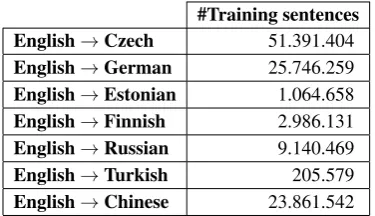
dif-#Training sentences
English→Czech 51.391.404
English→German 25.746.259 English→Estonian 1.064.658 English→Finnish 2.986.131 English→Russian 9.140.469
English→Turkish 205.579
[image:3.595.323.511.62.170.2]English→Chinese 23.861.542
Table 1: Number of training instances used to train each system.
newstest 2017 newstest 2018 English→Czech 18.11 17.36
English→German 23.37 34.46
English→Estonian – 13.05
English→Finnish 15.06 10.32
English→Russian 21.30 18.96
English→Turkish 6.93 6.22
English→Chinese 23.10 23.75
Table 2: BLEU score for the newstest2017 and new-stest2018 test data.
[image:3.595.310.521.231.331.2]4 Model setup
We trained Transformer models3 from English to seven languages, Czech, German, Estonian, Finnish, Russian, Turkish and Chinese, using the parallel data provided by the WMT18 shared task on news translation.4The parallel data come from different sources, mainly from Europarl (Koehn, 2005), News Commentary (Tiedemann,2012) and ParaCrawl.5
The data sets are partially noisy, especially ParaCrawl being on its first release, and to fil-ter out potentially incorrect parallel sentences we used a language identifier6to tag each source and target sentence, discarding the sentences that do not match across languages (Stymne et al.,2013; Zarin¸a et al.,2015). As development set we used the provided newsdev data from the shared task, while using the newstest from WMT 2017 and 2018 as test data. A widely used technique to allow an open vocabulary is byte pair encoding (Sennrich et al.,2016), in which the source and target words are split into subword units. However, in this work we prefer to use the full word forms, allowing us to evaluate and compare the internal representation on standard sequence labeling benchmarks tagged with gold labels on the full word forms. Therefore, we use a large vocabulary of 100K words per lan-guage. General statistics on the training data are given in Table 1. As can be seen, we ended up having an heterogeneous amount of data, ranging from 200K for Turkish up to 51M for Czech. We trained each model for maximum 20 epochs, tak-ing the best one accordtak-ing to the development set as model to evaluate. The BLEU score7 of each model is shown in Table2. Even though the scores seem low for the Transformer architecture for the MT task, we have to note that each model is trained using full word forms in order to facilitate the anal-ysis of the encoder representation (our results are in line with the comparison between subword units and full word forms done bySennrich et al.(2016)).
3
We used the OpenNMT framework (Klein et al.,2017). 4
The provided data are already preprocessed and freely available athttp://data.statmt.org/wmt18/ translation-task/preprocessed/.
5
https://paracrawl.eu/
6We used the fasttext language identifier tool (Joulin
et al., 2016b,a) from https://fasttext.cc/docs/ en/language-identification.html
7We used the
SACREBLEU script (Post, 2018), with signature BLEU+case.mixed+lang.en-{targetLanguage}+numrefs.1+smooth.exp+test.wmt{17,18}+ tok.13a+version.1.3.0
We do not aim at beating the best system on the test data, as our main point is to analyze different en-coder representations across models with different translation quality and target language.
5 Encoder Evaluation: Visualization
One of the most straightforward ways of under-standing the weights of a neural network is by vi-sualizing them. In its base setting, the Transformer employs 6 layers with 8 different attention heads for each of them, making complete visualization difficult. Therefore, we focus only on attention weights with high scores that are visually inter-pretable.
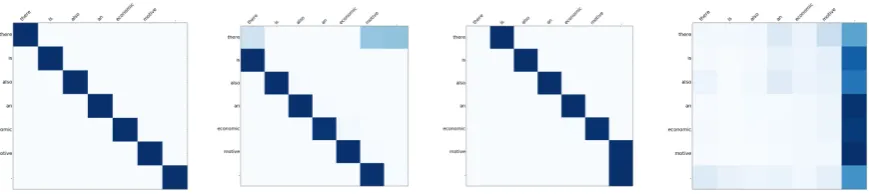
We discovered four different patterns shared across models: paying attention to the word itself, to the previous and next word and to the end of the sentence (Figure2). We found that, usually on the first layer, i.e., layer 0, more attention heads focus their weights on the word itself, while on the subsequent layers the network moves the attention more on other words, e.g., on the next and previous word, and to the end of the sentence. This suggests that the transformer tries to find long dependencies between words on higher layers whereas it tends to focus on local dependencies in lower layers.
6 Encoder Evaluation: Inducing Tree Structure
The architecture of the Transformer, linking each word with each other with an attention weight, can be seen as a weighted graph in which the words are the nodes and from which tree structure can be extracted. Even though the models are not trained to produce any trees or to a specific syntax task, we used the attention weights in each layer to extract a tree of the input sentences and inspect whether they reflect a dependency tree.
We evaluated the induced trees on the English PUD treebank from the CoNLL 2017 Shared Task (Zeman et al.,2017). The PUD treebank consists of 1000 sentences randomly taken from on-line newswire and Wikipedia. We measure the perfor-mance as Unlabeled Attachment Score (UAS) with the official evaluation script8from the shared task,
using gold segmentation and tokenization. Plus, given that our weights have no knowledge about the root of the sentence, we decided to use the gold root as starting node for the maximum spanning
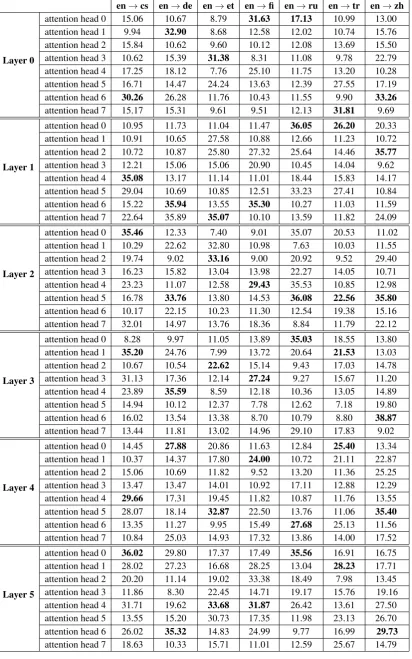
en→cs en→de en→et en→fi en→ru en→tr en→zh
Layer 0
attention head 0 15.06 10.67 8.79 31.63 17.13 10.99 13.00 attention head 1 9.94 32.90 8.68 12.58 12.02 10.74 15.76 attention head 2 15.84 10.62 9.60 10.12 12.08 13.69 15.50 attention head 3 10.62 15.39 31.38 8.31 11.08 9.78 22.79 attention head 4 17.25 18.12 7.76 25.10 11.75 13.20 10.28 attention head 5 16.71 14.47 24.24 13.63 12.39 27.55 17.19 attention head 6 30.26 26.28 11.76 10.43 11.55 9.90 33.26
attention head 7 15.17 15.31 9.61 9.51 12.13 31.81 9.69
Layer 1
attention head 0 10.95 11.73 11.04 11.47 36.05 26.20 20.33 attention head 1 10.91 10.65 27.58 10.88 12.66 11.23 10.72 attention head 2 10.72 10.87 25.80 27.32 25.64 14.46 35.77 attention head 3 12.21 15.06 15.06 20.90 10.45 14.04 9.62 attention head 4 35.08 13.17 11.14 11.01 18.44 15.83 14.17 attention head 5 29.04 10.69 10.85 12.51 33.23 27.41 10.84 attention head 6 15.22 35.94 13.55 35.30 10.27 11.03 11.59 attention head 7 22.64 35.89 35.07 10.10 13.59 11.82 24.09
Layer 2
attention head 0 35.46 12.33 7.40 9.01 35.07 20.53 11.02
attention head 1 10.29 22.62 32.80 10.98 7.63 10.03 11.55
attention head 2 19.74 9.02 33.16 9.00 20.92 9.52 29.40
attention head 3 16.23 15.82 13.04 13.98 22.27 14.05 10.71 attention head 4 23.23 11.07 12.58 29.43 35.53 10.85 12.98 attention head 5 16.78 33.76 13.80 14.53 36.08 22.56 35.80 attention head 6 10.17 22.15 10.23 11.30 12.54 19.38 15.16 attention head 7 32.01 14.97 13.76 18.36 8.84 11.79 22.12
Layer 3
attention head 0 8.28 9.97 11.05 13.89 35.03 18.55 13.80 attention head 1 35.20 24.76 7.99 13.72 20.64 21.53 13.03 attention head 2 10.67 10.54 22.62 15.14 9.43 17.03 14.78 attention head 3 31.13 17.36 12.14 27.24 9.27 15.67 11.20 attention head 4 23.89 35.59 8.59 12.18 10.36 13.05 14.89 attention head 5 14.94 10.12 12.37 7.78 12.62 7.18 19.80 attention head 6 16.02 13.54 13.38 8.70 10.79 8.80 38.87 attention head 7 13.44 11.81 13.02 14.96 29.10 17.83 9.02
Layer 4
attention head 0 14.45 27.88 20.86 11.63 12.84 25.40 13.34 attention head 1 10.37 14.37 17.80 24.00 10.72 21.11 22.87 attention head 2 15.06 10.69 11.82 9.52 13.20 11.36 25.25 attention head 3 13.47 13.47 14.01 10.92 17.11 12.88 12.29 attention head 4 29.66 17.31 19.45 11.82 10.87 11.76 13.55 attention head 5 28.07 18.14 32.87 22.50 13.76 11.06 35.40 attention head 6 13.35 11.27 9.95 15.49 27.68 25.13 11.56 attention head 7 10.84 25.03 14.93 17.32 13.86 14.00 17.52
Layer 5
[image:5.595.95.508.66.726.2]attention head 0 36.02 29.80 17.37 17.49 35.56 16.91 16.75 attention head 1 28.02 27.23 16.68 28.25 13.04 28.23 17.71 attention head 2 20.20 11.14 19.02 33.38 18.49 7.98 13.45 attention head 3 11.86 8.30 22.45 14.71 19.17 15.76 19.16 attention head 4 31.71 19.62 33.68 31.87 26.42 13.61 27.50 attention head 5 13.55 15.20 30.73 17.35 11.98 23.13 26.70 attention head 6 26.02 35.32 14.83 24.99 9.77 16.99 29.73 attention head 7 18.63 10.33 15.71 11.01 12.59 25.67 14.79
Figure 2: Four examples of the discovered patterns through visualization for the sentence: ”there is also an economic motive .”.
Sample tree from the attention head 1, layer 3 Sample tree from the attention head 4, layer 3
Figure 3: Sample trees induced by the attention weights from the English-Czech model.
tree algorithm. Specifically, we run the Chu-Liu-Edmonds algorithm (Chu,1965;Edmonds,1967) for each attention head of each layer of the models to extract the maximum spanning trees. Table3 shows the F1-score of the induced structures. For comparison purposes, in this dataset, a state of the art supervised parser (Dozat et al.,2017) reaches 88.22 UAS F1-score and our random baseline, i.e., induced trees with random weights and gold root, achieves 10.1 UAS F1-score on average.9 Given our findings in Section5, we also computed a left-and right- branching baseline (with golden root), obtaining 10.39 and 35.08 UAS F1-score respec-tively.
Although our models are not trained to produce trees, the best dependency trees induced on each layer are far better than the random baseline, sug-gesting that the models are learning some syntac-tic relationships. However, the best scores do not achieve results much beyond the right branching baseline, showing that it is difficult to encode more complex and longer dependencies.
Overall, for all language pairs we notice the same performance trend across layers. Comparing
9Even though not comparable in this setting, unsupervised
systems developed to build dependency trees achieve on an English dataset UAS F1-score ranging from 27.9 to 51.4 when using the output of a PoS tagger system (Alonso et al.,2017).
our low resource language pair, English-Turkish, to the other high resource languages, we can see that the models trained with larger dataset are able to induce better syntactic relationships, while among high resource languages all models are in the same ballpark, without any specific correlation with BLEU score, suggesting that it becomes more difficult to induce better dependency relations at a certain point. Figure3 shows some examples of induced dependency trees. Interestingly enough, we can see that the trees with higher scores fol-low the patterns found in Section5, in which each word is linked to the next one, so encoding most compounds and multi-word expressions. From vi-sualizing other trees, even if they do not belong to the best attention head, we can see that they try to capture longer dependencies, as fordressandstuffy in the example in Figure3.
7 Encoder Evaluation: Probing Sequence Labeling Tasks
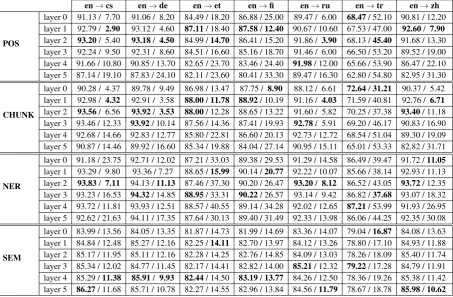
de-en→cs en→de en→et en→fi en→ru en→tr en→zh
POS
layer 0 91.13 / 7.70 91.06 / 8.20 84.49 / 18.20 86.88 / 25.00 89.47 / 6.00 68.47/ 52.10 90.81 / 12.20 layer 1 92.79 / 2.90 93.12 / 4.60 87.11/ 18.40 87.58/12.40 90.67 / 10.60 67.53 / 47.00 92.60/ 7.90
layer 2 93.20/ 5.40 93.18/ 4.50 84.99 /14.70 86.41 / 15.20 91.86 / 3.90 68.13 /45.40 91.68 / 13.30 layer 3 92.24 / 9.50 92.31 / 8.60 84.51 / 16.60 85.16 / 18.70 91.46 / 6.00 66.50 / 53.20 89.52 / 19.00 layer 4 91.66 / 10.80 90.85 / 13.70 82.65 / 23.70 83.46 / 24.40 91.98/ 12.00 65.66 / 53.90 86.47 / 22.10 layer 5 87.14 / 19.10 87.83 / 24.10 82.11 / 23.60 80.41 / 33.30 89.47 / 16.30 62.80 / 54.80 82.95 / 31.30
CHUNK
layer 0 90.28 / 4.37 89.78 / 9.49 86.98 / 13.47 87.75 / 8.90 88.12 / 6.61 72.64/31.21 90.37 / 5.42 layer 1 92.98 / 4.32 92.91 / 3.58 88.00/11.78 88.92/ 10.19 91.16 / 4.03 71.59 / 40.81 92.76 / 6.71
layer 2 93.56/ 6.56 93.92/ 3.53 88.00/ 12.28 88.65 / 13.22 91.60 / 5.82 70.25 / 37.38 93.40/ 11.18 layer 3 93.46 / 12.33 93.92/ 10.14 87.56 / 14.36 87.41 / 19.93 92.78/ 5.91 69.20 / 46.17 90.83 / 16.90 layer 4 92.68 / 14.66 92.83 / 12.77 85.80 / 22.81 86.60 / 20.13 92.73 / 12.72 68.54 / 51.04 89.30 / 19.09 layer 5 90.87 / 14.46 89.92 / 16.60 85.34 / 19.88 84.04 / 27.14 90.95 / 15.11 65.01 / 53.33 82.82 / 31.71
NER
layer 0 91.18 / 23.75 92.71 / 12.02 87.21 / 33.03 89.38 / 29.53 91.29 / 14.58 86.49 / 39.47 91.72 /11.05
layer 1 93.29 / 9.80 93.36 / 7.27 88.65 /15.99 90.14 /20.77 92.22 / 10.07 85.66 / 38.14 92.93 / 11.13 layer 2 93.83/ 7.11 94.13 /11.13 87.46 / 37.30 90.20 / 26.47 93.20/ 8.12 86.52 / 43.05 93.72/ 12.35 layer 3 93.23 / 16.53 94.32/ 14.85 88.95/ 33.31 90.22/ 26.57 93.14 / 9.42 86.82 /37.68 93.07 / 18.32 layer 4 93.72 / 11.81 93.93 / 12.51 88.57 / 40.55 89.14 / 34.28 92.02 / 12.65 87.21/ 53.99 91.93 / 26.95 layer 5 92.62 / 21.63 94.11 / 17.35 87.64 / 30.13 89.40 / 31.49 92.33 / 13.98 86.06 / 44.25 92.35 / 30.08
SEM
[image:7.595.74.532.61.361.2]layer 0 83.99 / 13.56 84.05 / 13.35 81.87 / 14.73 81.99 / 14.69 83.36 / 14.07 79.04 /16.87 84.08 / 13.63 layer 1 84.84 / 12.48 85.27 / 12.16 82.25 /14.11 82.70 / 13.97 84.12 / 13.26 78.80 / 17.10 84.93 / 11.88 layer 2 85.17 / 11.95 85.11 / 12.16 82.28 / 14.25 82.76 / 14.85 84.09 / 13.03 78.26 / 18.09 85.40 / 11.74 layer 3 85.34 / 12.02 84.77 / 11.45 82.17 / 14.41 82.82 / 14.00 85.21/ 12.32 79.22/ 17.28 84.79 / 11.91 layer 4 85.29 /11.38 85.91/ 9.93 82.44/ 14.50 83.19/13.77 84.26 / 12.50 78.36 / 19.26 85.38 / 11.42 layer 5 86.27/ 11.68 85.71 / 10.78 82.27 / 14.55 82.96 / 13.84 84.56 /11.79 78.67 / 18.78 85.98/10.62
Table 4: Results in terms of precision for each test set (↑, on the left side of each cell), together with the error rate on the sentence length (↓, on the right side of each cell).
#labels #training #testing average sentences sentences sent. length
PoS 17 12543 1000 21.2
Chunk 22 8042 2012 23.5
NER 9 14987 3684 12.7
SEM 80 62739 4351 6.4
Table 5: Statistics of the evaluation benchmarks used for the probing task.
coder layer using one attention head and one feed-forward layer. We then assess the quality of the encoder representation across stacked layers.
Evaluation Benchmarks. We used a standard
benchmark for each task: the Universal Depen-dencies English Web Treebank v2.0 (Zeman et al., 2017) for PoS tagging, the CoNLL2000 Chunking shared task (Tjong Kim Sang and Buchholz,2000), the CoNLL2003 NER shared task (Tjong Kim Sang and De Meulder, 2003), and the annotated data from the Parallel Meaning Bank (PMB) for Seman-tic tagging (Abzianidze et al.,2017). Each bench-mark provides its own training, development and test data, except chunking in which we use 10% of the training corpus as validation, and the PMB
in which we used the silver portion for training and the gold portion for test and dev (following the 80-20 split).10Table5reports general statistics on each benchmark, regarding the granularity of each task, the number of training and testing instances, and the average length of the test sentences.
Evaluation Results. Table4reports the perfor-mance for each task and stacked layers, together with the error rate for sentence length prediction. For each language pair, we can see that the syntax information, i.e., the PoS task, is encoded mostly in the first 3 layers, corroborating the results in Sec-tion6, while moving towards more semantic tasks, as NER and SEM we can see that in general the decoder needs more encoder layers to achieve bet-ter results. Another inbet-teresting finding is provided by the length mismatch between the output of the models and the gold labels. Clearly the models encode the information about the sentence length in the first three layers, and then the information starts to vanish with an increase of the error rate. The only exception is given by the SEM task, but as can be seen from the statistics in Table5, the
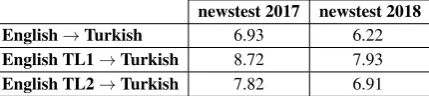
[image:7.595.76.530.63.360.2] [image:7.595.74.293.416.492.2]newstest 2017 newstest 2018 English→Turkish 6.93 6.22
English TL1→Turkish 8.72 7.93
[image:8.595.78.293.64.112.2]English TL2→Turkish 7.82 6.91
Table 6: BLEU score for the newstest2017 and new-stest2018 test data for the transfer learning experi-ment.
average sentence length is very short and so it is easier to predict. Overall, comparing the perfor-mance reached on these probing tasks with the BLEU score of each model, we can see again that the high resource language pairs achieve better re-sults compared to our low resource language pair. Moreover, we notice that in general higher BLEU score correspond to higher probing results, confirm-ing the trend that encodconfirm-ing lconfirm-inguistic proprieties within the encoder representation go on par with better translation quality (Niehues and Cho,2017; Kiperwasser and Ballesteros,2018).
8 Encoder Evaluation: Transfer learning
To assess whether the knowledge encoded in the attention units can help other models in a low re-source scenario, we additionally carried out an eval-uation of the encoder representation in a transfer learning task. Similar to Zoph et al.(2016), we used the encoder weights from one high resource language, i.e., English-German, to train a Trans-former system for our low resource language pair, English-Turkish. We provide two experiments: i) initializing and fine tuning the encoder weights (TL1), ii) initializing and keeping the encoder weights fixed (TL2). Table 6 shows the BLEU scores of the systems evaluated with and without transferring the encoder parameters. Both transfer learning settings are helpful to the decoder to reach a better translation quality, with almost 2 BLEU point more on the best scenario. Starting with a better encoder representation, taken from a high resource language pair, and then fine tuning the pa-rameters on the low resource language achieves the best result, matching and corroborating previous findings on recurrent networks (Zoph et al.,2016).
9 Related Work
The problem of interpreting and understanding neu-ral networks is attracting more and more interest and work, with so many models and new architec-tures being published continuously each year. One
of the first techniques to examine a neural network involves the analysis of activation patterns of the hidden layers (Elman, 1991; Giles et al., 1992). Nowadays, given its popularity, recurrent neural networks are the most evaluated networks, mainly investigated on the structures and linguistic proper-ties they are encoding (Linzen et al.,2016; Engue-hard et al.,2017;Kuncoro et al.,2017;Gulordava et al.,2018).
Traditionally, a common way to inspect neural networks is by visualizing the hidden representa-tion trained for a specific task (Ding et al.,2017; Strobelt et al.,2018a,b), and to evaluate them by assessing the properties through downstream tasks (Chung et al.,2014;Greff et al.,2017).
Other recent studies look for hidden linguistic units that provide information on how the network works (Karpathy et al., 2015; Qian et al., 2016; K´ad´ar et al.,2017), while another line of analysis probes the representation learned by a neural net-work as input to a classifier of another task (Shi et al.,2016;Adi et al.,2016;Belinkov et al.,2017a; Tran et al.,2018).
The most closely related work is by Belinkov et al.(2017b), in which they investigate the repre-sentation learned by the encoder of a sequence-to-sequence NMT system across different languages. Unlike them, we studied a neural network with-out any recurrent layers, which allows us to in-duce a tree representation from the input sentence, probing the encoder representation towards more downstream tasks, and showing that the attention weights can also be used to transfer knowledge to low-resource languages.
10 Conclusion
behavior across layers. In future work, we plan to extend the analysis with probing tasks to evaluate other linguistic properties (Conneau et al.,2018) as well as to a recent evaluation dataset (Sennrich, 2017), tackling also the attention weights between the encoder and the decoder.
Acknowledgments
The work in this paper is supported by the Academy of Finland through project 314062 from the ICT 2023 call on Computation, Machine Learning and Artificial Intelligence. We would also like to ac-knowledge NVIDIA and their GPU grant.
References
Lasha Abzianidze, Johannes Bjerva, Kilian Evang, Hessel Haagsma, Rik van Noord, Pierre Ludmann, Duc-Duy Nguyen, and Johan Bos. 2017. The par-allel meaning bank: Towards a multilingual corpus of translations annotated with compositional mean-ing representations. InProceedings of the 15th Con-ference of the European Chapter of the Association for Computational Linguistics: Volume 2, Short Pa-pers, pages 242–247, Valencia, Spain. Association for Computational Linguistics.
Yossi Adi, Einat Kermany, Yonatan Belinkov, Ofer Lavi, and Yoav Goldberg. 2016. Fine-grained anal-ysis of sentence embeddings using auxiliary predic-tion tasks.arXiv preprint arXiv:1608.04207.
Tamer Alkhouli and Hermann Ney. 2017. Biasing attention-based recurrent neural networks using ex-ternal alignment information. InProceedings of the Second Conference on Machine Translation, pages 108–117.
H´ector Mart´ınez Alonso, ˇZeljko Agi´c, Barbara Plank, and Anders Søgaard. 2017. Parsing universal depen-dencies without training. InProceedings of the 15th Conference of the European Chapter of the Associa-tion for ComputaAssocia-tional Linguistics: Volume 1, Long Papers, volume 1, pages 230–240.
Philip Arthur, Graham Neubig, and Satoshi Nakamura. 2016. Incorporating discrete translation lexicons into neural machine translation. In Proceedings of the 2016 Conference on Empirical Methods in Natu-ral Language Processing, pages 1557–1567, Austin, Texas. Association for Computational Linguistics.
Dzmitry Bahdanau, Kyunghyun Cho, and Yoshua Ben-gio. 2015. Neural Machine Translation by Jointly Learning to Align and Translate. InICLR Workshop.
Yonatan Belinkov, Nadir Durrani, Fahim Dalvi, Hassan Sajjad, and James Glass. 2017a. What do neural ma-chine translation models learn about morphology? In Proceedings of the 55th Annual Meeting of the Association for Computational Linguistics (Volume 1: Long Papers), volume 1, pages 861–872.
Yonatan Belinkov, Llu´ıs M`arquez, Hassan Sajjad, Nadir Durrani, Fahim Dalvi, and James Glass. 2017b. Evaluating layers of representation in neural machine translation on part-of-speech and semantic tagging tasks. InProceedings of the Eighth Interna-tional Joint Conference on Natural Language Pro-cessing (Volume 1: Long Papers), volume 1, pages 1–10.
Luisa Bentivogli, Arianna Bisazza, Mauro Cettolo, and Marcello Federico. 2016. Neural versus phrase-based machine translation quality: a case study. In Proceedings of the 2016 Conference on Empirical Methods in Natural Language Processing, pages 257–267, Austin, Texas. Association for Computa-tional Linguistics.
Ondˇrej Bojar, Rajen Chatterjee, Christian Federmann, Yvette Graham, Barry Haddow, Shujian Huang, Matthias Huck, Philipp Koehn, Qun Liu, Varvara Logacheva, et al. 2017. Findings of the 2017 confer-ence on machine translation (wmt17). In Proceed-ings of the Second Conference on Machine Transla-tion, pages 169–214.
Ondrej Bojar, Rajen Chatterjee, Christian Federmann, Yvette Graham, Barry Haddow, Matthias Huck, An-tonio Jimeno Yepes, Philipp Koehn, Varvara Lo-gacheva, Christof Monz, et al. 2016. Findings of the 2016 conference on machine translation. In ACL 2016 First Conference on Machine Translation (WMT16), pages 131–198. The Association for Com-putational Linguistics.
Kyunghyun Cho, Bart van Merrienboer, Caglar Gul-cehre, Dzmitry Bahdanau, Fethi Bougares, Holger Schwenk, and Yoshua Bengio. 2014. Learning phrase representations using rnn encoder–decoder for statistical machine translation. InProceedings of the 2014 Conference on Empirical Methods in Nat-ural Language Processing (EMNLP), pages 1724– 1734, Doha, Qatar. Association for Computational Linguistics.
Yoeng-Jin Chu. 1965. On the shortest arborescence of a directed graph. Scientia Sinica, 14:1396–1400.
Junyoung Chung, Caglar Gulcehre, KyungHyun Cho, and Yoshua Bengio. 2014. Empirical evaluation of gated recurrent neural networks on sequence model-ing.arXiv preprint arXiv:1412.3555.
Alexis Conneau, Germ´an Kruszewski, Guillaume Lam-ple, Lo¨ıc Barrault, and Marco Baroni. 2018. What you can cram into a single vector: Probing sentence embeddings for linguistic properties. In Proceed-ings of the 56th Annual Meeting of the Association for Computational Linguistics (Volume 1: Long Pa-pers), pages 2126–2136. Association for Computa-tional Linguistics.
Linguistics (Volume 1: Long Papers), volume 1, pages 1150–1159.
Timothy Dozat, Peng Qi, and Christopher D Manning. 2017. Stanford’s graph-based neural dependency parser at the conll 2017 shared task. Proceedings of the CoNLL 2017 Shared Task: Multilingual Pars-ing from Raw Text to Universal Dependencies, pages 20–30.
Jack Edmonds. 1967. Optimum branchings. Journal of Research of the National Bureau of Standards, B, 71:233–240.
Jeffrey L Elman. 1991. Distributed representations, simple recurrent networks, and grammatical struc-ture. Machine learning, 7(2-3):195–225.
´
Emile Enguehard, Yoav Goldberg, and Tal Linzen. 2017. Exploring the syntactic abilities of rnns with multi-task learning. InProceedings of the 21st Con-ference on Computational Natural Language Learn-ing (CoNLL 2017), pages 3–14.
Jonas Gehring, Michael Auli, David Grangier, and Yann Dauphin. 2017a. A convolutional encoder model for neural machine translation. In Proceed-ings of the 55th Annual Meeting of the Association for Computational Linguistics (Volume 1: Long Pa-pers), volume 1, pages 123–135.
Jonas Gehring, Michael Auli, David Grangier, Denis Yarats, and Yann N Dauphin. 2017b. Convolu-tional sequence to sequence learning. arXiv preprint arXiv:1705.03122.
C Lee Giles, Clifford B Miller, Dong Chen, Guo-Zheng Sun, Hsing-Hen Chen, and Yee-Chun Lee. 1992. Extracting and learning an unknown grammar with recurrent neural networks. InAdvances in neural in-formation processing systems, pages 317–324.
Klaus Greff, Rupesh K Srivastava, Jan Koutn´ık, Bas R Steunebrink, and J¨urgen Schmidhuber. 2017. Lstm: A search space odyssey. IEEE transactions on neu-ral networks and learning systems, 28(10):2222– 2232.
Kristina Gulordava, Piotr Bojanowski, Edouard Grave, Tal Linzen, and Marco Baroni. 2018. Colorless green recurrent networks dream hierarchically. In Proceedings of the 2018 Conference of the North American Chapter of the Association for Computa-tional Linguistics: Human Language Technologies, Volume 1 (Long Papers), volume 1, pages 1195– 1205.
Armand Joulin, Edouard Grave, Piotr Bojanowski, Matthijs Douze, H´erve J´egou, and Tomas Mikolov. 2016a. Fasttext.zip: Compressing text classification models. arXiv preprint arXiv:1612.03651.
Armand Joulin, Edouard Grave, Piotr Bojanowski, and Tomas Mikolov. 2016b. Bag of tricks for efficient text classification. arXiv preprint arXiv:1607.01759.
Akos K´ad´ar, Grzegorz Chrupała, and Afra Alishahi. 2017. Representation of linguistic form and func-tion in recurrent neural networks. Computational Linguistics, 43(4):761–780.
Andrej Karpathy, Justin Johnson, and Li Fei-Fei. 2015. Visualizing and understanding recurrent networks. arXiv preprint arXiv:1506.02078.
Eliyahu Kiperwasser and Miguel Ballesteros. 2018. Scheduled multi-task learning: From syntax to trans-lation. Transactions of the Association for Computa-tional Linguistics, 6:225–240.
Guillaume Klein, Yoon Kim, Yuntian Deng, Jean Senel-lart, and Alexander M. Rush. 2017. OpenNMT: Open-source toolkit for neural machine translation. InProc. ACL.
Philipp Koehn. 2005. Europarl: A parallel corpus for statistical machine translation. In MT summit, vol-ume 5, pages 79–86.
Philipp Koehn and Rebecca Knowles. 2017. Six chal-lenges for neural machine translation. In Proceed-ings of the First Workshop on Neural Machine Trans-lation, pages 28–39.
Adhiguna Kuncoro, Miguel Ballesteros, Lingpeng Kong, Chris Dyer, Graham Neubig, and Noah A. Smith. 2017. What do recurrent neural network grammars learn about syntax? In Proceedings of the 15th Conference of the European Chapter of the Association for Computational Linguistics: Volume 1, Long Papers, pages 1249–1258, Valencia, Spain. Association for Computational Linguistics.
Tal Linzen, Emmanuel Dupoux, and Yoav Goldberg. 2016. Assessing the ability of LSTMs to learn syntax-sensitive dependencies. Transactions of the Association for Computational Linguistics, 4:521– 535.
Yang Liu and Mirella Lapata. 2018. Learning struc-tured text representations. Transactions of the Asso-ciation for Computational Linguistics. To appear.
Thang Luong, Hieu Pham, and Christopher D Manning. 2015a. Effective approaches to attention-based neu-ral machine translation. InProceedings of the 2015 Conference on Empirical Methods in Natural Lan-guage Processing, pages 1412–1421.
Thang Luong, Ilya Sutskever, Quoc Le, Oriol Vinyals, and Wojciech Zaremba. 2015b. Addressing the rare word problem in neural machine translation. In Pro-ceedings of the 53rd Annual Meeting of the Associa-tion for ComputaAssocia-tional Linguistics and the 7th Inter-national Joint Conference on Natural Language Pro-cessing (Volume 1: Long Papers), volume 1, pages 11–19.
Matt Post. 2018. A call for clarity in reporting bleu scores. arXiv preprint arXiv:1804.08771.
Peng Qian, Xipeng Qiu, and Xuanjing Huang. 2016. Analyzing linguistic knowledge in sequential model of sentence. InProceedings of the 2016 Conference on Empirical Methods in Natural Language Process-ing, pages 826–835.
Rico Sennrich. 2017. How grammatical is character-level neural machine translation? assessing mt qual-ity with contrastive translation pairs. InProceedings of the 15th Conference of the European Chapter of the Association for Computational Linguistics: Vol-ume 2, Short Papers, volVol-ume 2, pages 376–382.
Rico Sennrich, Barry Haddow, and Alexandra Birch. 2016. Neural machine translation of rare words with subword units. InProceedings of the 54th Annual Meeting of the Association for Computational Lin-guistics (Volume 1: Long Papers), volume 1, pages 1715–1725.
Xing Shi, Inkit Padhi, and Kevin Knight. 2016. Does string-based neural mt learn source syntax? In Pro-ceedings of the 2016 Conference on Empirical Meth-ods in Natural Language Processing, pages 1526– 1534.
Hendrik Strobelt, Sebastian Gehrmann, Michael Behrisch, Adam Perer, Hanspeter Pfister, and Alexander M Rush. 2018a. Seq2seq-vis: A vi-sual debugging tool for sequence-to-sequence mod-els. arXiv preprint arXiv:1804.09299.
Hendrik Strobelt, Sebastian Gehrmann, Hanspeter Pfis-ter, and Alexander M Rush. 2018b. Lstmvis: A tool for visual analysis of hidden state dynamics in recur-rent neural networks. IEEE transactions on visual-ization and computer graphics, 24(1):667–676.
Sara Stymne, Christian Hardmeier, J¨org Tiedemann, and Joakim Nivre. 2013. Tunable distortion limits and corpus cleaning for smt. InWMT 2013; 8-9 Au-gust; Sofia, Bulgaria, pages 225–231. Association for Computational Linguistics.
Ilya Sutskever, Oriol Vinyals, and Quoc V Le. 2014. Sequence to sequence learning with neural networks. In Advances in neural information processing sys-tems, pages 3104–3112.
J¨org Tiedemann. 2012. Parallel data, tools and inter-faces in opus. InProceedings of the Eight Interna-tional Conference on Language Resources and Eval-uation (LREC’12), Istanbul, Turkey. European Lan-guage Resources Association (ELRA).
Erik F Tjong Kim Sang and Sabine Buchholz. 2000. Introduction to the conll-2000 shared task: Chunk-ing. InProceedings of the 2nd workshop on Learn-ing language in logic and the 4th conference on Computational natural language learning-Volume 7, pages 127–132. Association for Computational Lin-guistics.
Erik F Tjong Kim Sang and Fien De Meulder. 2003. In-troduction to the conll-2003 shared task: Language-independent named entity recognition. In Proceed-ings of the seventh conference on Natural language learning at HLT-NAACL 2003-Volume 4, pages 142– 147. Association for Computational Linguistics.
Ke Tran, Arianna Bisazza, and Christof Monz. 2018. The importance of being recurrent for modeling hierarchical structure. arXiv preprint arXiv:1803.03585.
Ashish Vaswani, Noam Shazeer, Niki Parmar, Jakob Uszkoreit, Llion Jones, Aidan N Gomez, Łukasz Kaiser, and Illia Polosukhin. 2017. Attention is all you need. InAdvances in Neural Information Pro-cessing Systems, pages 5998–6008.
Adina Williams, Andrew Drozdov, and Samuel R Bow-man. 2018. Do latent tree learning models iden-tify meaningful structure in sentences? Transac-tions of the Association of Computational Linguis-tics, 6:253–267.
Yonghui Wu, Mike Schuster, Zhifeng Chen, Quoc V Le, Mohammad Norouzi, Wolfgang Macherey, Maxim Krikun, Yuan Cao, Qin Gao, Klaus Macherey, et al. 2016. Google’s neural machine translation system: Bridging the gap between hu-man and machine translation. arXiv preprint arXiv:1609.08144.
Ieva Zarin¸a, P¯eteris N¸ ikiforovs, and Raivis Skadin¸ˇs. 2015. Word alignment based parallel corpora eval-uation and cleaning using machine learning tech-niques. InProceedings of the 18th Annual Confer-ence of the European Association for Machine Trans-lation.
Daniel Zeman, Martin Popel, Milan Straka, Jan Ha-jic, Joakim Nivre, Filip Ginter, Juhani Luotolahti, Sampo Pyysalo, Slav Petrov, Martin Potthast, et al. 2017. Conll 2017 shared task: multilingual parsing from raw text to universal dependencies. Proceed-ings of the CoNLL 2017 Shared Task: Multilingual Parsing from Raw Text to Universal Dependencies, pages 1–19.