Abstract— Selecting proper household remedies for such symptoms are an essential challenge for Thai citizens who may confront this situation in everyday life. Besides the diversity of available medicines in the retail market, a lack of reliable documentations in the Thai healthcare system also causes an inconvenience to Thai citizens. Most healthcare information was limited its accessibility to Thai citizens in the effortless way. The dispersion of data and services leads to the cost raising and the increased medical errors. This paper presents a skillful medicine recommendation system initiate from Thai Household Remedy (THR) and Monthly Index of Medical Specialties (MIMS) information. We devise a Household Remedies Ontology, a model which illustrates relationships between personal information, indications of illness (symptom), its related household remedies for medication. The model allows ontology inferences and knowledge discovery to aid in selecting the proper medications for the diagnosed symptoms. We correlate THR, MIMS, and patient's personal information with the purpose to determine the semantical relationships among symptoms, medicines, its dose, drug interaction, and taken indication. Generally, the medicine selected by symptoms and the dose personalized by each patient. As a result of the development, we evaluated the satisfactory performance of the presented system through the review of Thai citizens. The result shows that the Thai household remedy recommendation system is a useful approach to help Thai citizens reaching out the proper household remedies or medicines.
Index Terms—Drug Ontology, Ontology, Recommendation System, Thai Household Remedies
I. INTRODUCTION
SING of the right medicine for the symptoms of the disease is very important. If patients used the medicine incorrectly, it is possible that they shall got a side-effect and bring a severe disease of the patient unconditionally.
At the present, medicines, used for curing or treating the disease, are abundant for patient to choose according to their needs. Same medicines are produced and distributed by many manufacturers with different trademark names. Also, there are various dosages of the same medicine which are available in the market. By this reason, it makes patients confuse while choosing the proper THR medicine with the proper dosage based on their symptoms.
Selecting the proper THR medicine is one of the toughest
Manuscript received Jan 08, 2019; revised Jan 20, 2019.
N. Pothong is with the Department of Computer Engineering, Faculty of Engineering, Chulalongkorn University, Bangkok, Thailand (email [email protected])
W. Vatanawood is with the Department of Computer Engineering, Faculty of Engineering, Chulalongkorn University, Bangkok, Thailand (email [email protected])
challenges. Besides the diversity of all available medicines, the lack of unified reference in the healthcare system still causes an inconvenience to Thai citizens since the most of health information is currently a paper-based and requires many processes to access. Furthermore, the choice of medicines also has many factors related to the disease. The patient or medical professionals should realize the effect of medicine to their body based on the patient personal information, such as a history of drugs allergy, age, weight, and other medical history of the patients.
Previous researches have introduced ontology for supporting drugs and diseases but with some limitations [1], T.M. Swe et al. [2] have proposed an ontology on diagnosis of the tuberculosis disease and recommend the relevant treatments. This ontology can be determined as a disease ontology that contains only the tuberculosis disease information. However, the main problem of their proposed model is it cannot expand easily to the other diseases.
An anti-diabetic drugs recommendation system has been offered by R. C. Chen et al. [3] to guide clinicians to select the right anti-diabetics drugs by proposing two ontologies, i.e. patient data ontology, and anti-diabetic drugs ontology. Although the system still limits its capability to be generalized to other diseases.
A. M. Iqbal et al. [4] have developed an ontological system for chronic disease management based on medical records. They mapped some concepts from electronic health record model and chronic disease management model into computer-based patient record [5]. According to their result, they were not able to offer any medication or treatment for the chronic diseases, however, the mapping concepts between different sources of knowledge are useful.
An ontology-based approach to gain support for research into genetic human diseases were proposed by M. Hadzic et al. [6] Diseases, symptoms, treatments, and genetic & environmental cases are the four categories of their ontology. Therefore, the treatments of the ontology are too common and cannot lead to a drug recommendation.
The purpose of this paper is to design and develop a system for the Thai household medicine. It guides Thai citizens to select the proper THR medicines by using ontology as a model for the management of semantic knowledge based on index of medical product information available in Thailand. The proposed model can recommend the dosage and the reaction of each drug to each patient explicitly. By developing Ontology structure, it will contain information about the household remedies as in Fig. 1.
Recommendation System for Thai Household
Remedies Using Ontology
Nathorn Pothong and Wiwat Vatanawood
MIMS
Ministry of Public Health Announcement
Selected Data
Selected Use to
OWL
Export
Fuseki Server Selected Data
Filter
Precision and Recall
Rules
Ontology Schemas
Device
Enter Information Retrieve Information
Patient
Call API
Validate Data
Specific Requirements
Use for
Import Design Design
Design
Protégé
Fig. 1. An Overview of Research Methodology
II. BACKGROUND
A. Thai Household Remedy
Thai Household Remedy (THR) is a collection of traditional and modern medicines that the ministry of public health had announced as a government gazette. Citizen can purchase these medicines at pharmacy store without any prescription from physicians to provide basic self-care or to promote well-being. It can be said that these Thai household remedies are no harm to life except some improper usage. These medicines are labeled “Household Remedy” in a green frame [7]. In this paper, THR used for determining the extent of medicines in Thailand.
B. Monthly Index of Medical Specialties
Monthly Index of Medical Specialties (MIMS) is a guideline to pharmaceutical references, first published in the United Kingdom in 1959 [8]. The guideline includes trademark names, generic names, taken indications, drug interactions, and dosages of all drugs in the UK which physicians or pharmacists can use as their references. The guideline shall re-publish in every 3 months. At this moment, MIMS has expanded its coverage to 26 countries worldwide, including Thailand. This research used MIMS as a reference of drug properties.
C. Ontology
Ontology is a representation of knowledge and its semantic in any specific domain of interest. It is a set of conceptual attributes or concepts with semantic relationships among those concepts/attributes [9,10]. To construct an ontology, it requires the definition of terms with classes, the determination of their associations, properties, and instances. Classes are used to explain detail of concepts. Properties are defined relations between classes. Instances are members of classes which hold the inherited properties. The more perfect of ontology is, the more accurate information can be provided [11]. Currently, to facilitate the representation of complex knowledge and relationships between them, Web Ontology Language (OWL) is introduced. In the context of usage, OWL applications process and interpret web contents to produce a set of ontology relationships. This paper uses the ontology to represent relationships between Thai household remedy and symptoms in OWL syntax as shown in Fig 2.
<owl:Class rdf:ID="DrugName"/> <owl:Class rdf:ID="Dosage"/> <owl:Class rdf:ID="Symptom"/> <owl:ObjectProperty rdf:ID="hasDosage">
<rdfs:comment rdf:datatype="&xsd;string">
This relationship specifies that each drugname has dosage of that drug. </rdfs:comment> <rdfs:domain>
<owl:Restriction>
<owl:onProperty rdf:resource="hasDosage"/> <owl:someValuesFrom rdf:resource="DrugName"/> </owl:Restriction>
</rdfs:domain> <rdfs:range> <owl:Restriction>
<owl:onProperty rdf:resource="hasDosage"/> <owl:someValuesFrom rdf:resource="Dosage"/> </owl:Restriction>
</rdfs:range> </owl:ObjectProperty>
<owl:ObjectProperty rdf:ID="useFor"> <rdfs:comment rdf:datatype="&xsd;string">
This relationship specifies that which drugname is use for which symptom. </rdfs:comment> <rdfs:domain>
<owl:Restriction>
<owl:onProperty rdf:resource="useFor"/> <owl:someValuesFrom rdf:resource="DrugName"/> </owl:Restriction>
</rdfs:domain> <rdfs:range> <owl:Restriction>
<owl:onProperty rdf:resource="useFor"/> <owl:someValuesFrom rdf:resource="Symptom"/> </owl:Restriction>
[image:2.595.58.296.49.223.2]</rdfs:range> </owl:ObjectProperty>
Fig. 2. OWL syntax
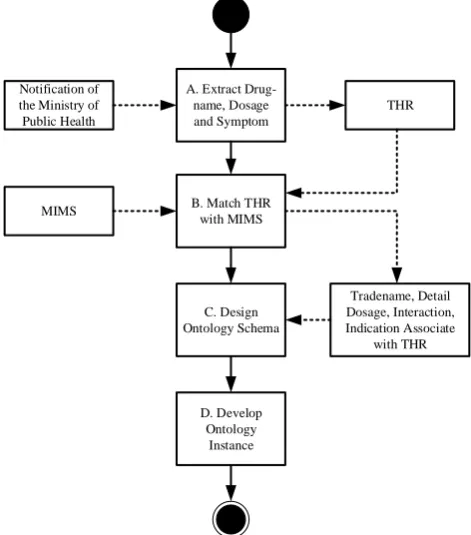
III. PROPOSED THAI HOUSEHOLD REMEDIES ONTOLOGY An overview of the construction of Thai Household Remedy Ontology is depicted in Fig. 3. This research compiles a set of THR medicines from the latest notification of Thailand’s Ministry of Public Health and matches with MIMS using the drug name. The matching helps identifying trademark name, detailed dosage, drug interaction and taken indication of THR medicines. It will be later used to define the ontology schemas and instances respectively.
B. Match THR with MIMS Notification of
the Ministry of Public Health
MIMS
Tradename, Detail Dosage, Interaction, Indication Associate
with THR C. Design
Ontology Schema
D. Develop Ontology
Instance A. Extract
Drug-name, Dosage and Symptom
[image:2.595.308.544.471.739.2]THR
TABLEI
EXAMPLE OF THRMEDICINES MAPPING TO SYMPTOMS FROM THE
NOTIFICATION OF THAILAND’S MINISTRY OF PUBLIC HEALTH
Symptom Drug Name Dosage Form
Pain and Fever
Paracetamol Tablet Aspirin Tablet
Flatulence Asafoetida Tincture Liquid (External Apply) Mixture Stomachica Liquid
Sodamint Liquid / Tablets / Suspensions Cough Ammonium
Carbonate and Glycyrrhiza
Liquid
Brown Mixture Liquid …
A. Extract Drug-name, Dosage and Symptom
First, we extracted THR medicines name from the notification of the Thailand’s Ministry of Public Health. The notification defined 53 THR medicines under 20 symptoms (Coated Tongue, Cough, Diarrhea, Dizzy, Pain and Fever, Flatulence, Fresh Wound, Headache, Insect Bite, Itch, Constipation, Pediculosis, Pink Eyes, Running Nose, Scaled, Sore Throat, Stomachache, Stuffy Nose, Tinea, Toothache) as shown in Table I
B. Match THR with MIMS
In this step, we study the THR medicines in detail and collect MIMS that indicates a list of symptom-drug pairs. By doing a systematic study, we found out that the MIMS specifies related drugs to the specific symptoms as an example shown below.
Symptom: Pain and Fever Drug Name: Paracetamol Dosage Form: Tablet
With regarding to the MIMS specifications, we match the THR medicines to all related drugs defined in the MIMS by considering drag name, trademark name, drug indication and dosage as matching criteria. Table II displays an example result of the mapping while focuses on drugs named “Paracetamol” and “Aspirin”
C. Design Ontology Schema
As mentioned earlier, ontology is a model that represent
TABLEIII
THRMEDICINES CLASS DEFINITIONS AND ITS RELATIONSHIPS
Relationship Name Class Associated with Class
hasDosage Drug Dosage hasIndication Drug Indication hasInteraction Drug Interaction
hasName Drug Name
hasForm Drug Form
hasTradename Drug Tradename hasSymptom Patient Symptom hasAge Patient Age hasAllergy Patient Allergy hasDisorder Patient Disorder
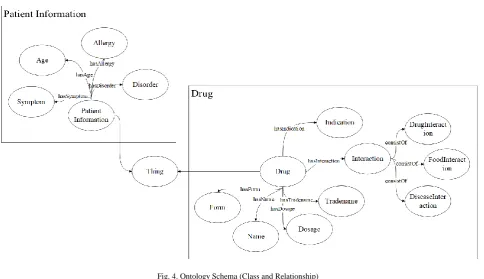
the semantic relationships among classes. Therefore, we use the analysis of the mapping of THR medicines and MIMS from the previous step to define classes and relationships. It turns out that there are 12 classes and 10 relationships extracted from the mapping. However, due to the performance concern, we are encouraged to use sub-classes instead of class where the semantic is clearly defined. As a result, the class definition consists of the following list,
• 9 classes defined (Name, Form, Dosage, Tradename, Indication, Symptom, Patient Age, Allergy, and Disorder)
• 3 sub-classes for Interaction class (DrugInteraction, DiseaseInteraction and FoodInteraction)
• 10 relationships (hasDosage, hasForm, hasName, hasIndication, hasInteraction, hasTradename, hasSymptom, hasAge, hasAllergy and hasDisorder) The detail definition has shown in Table III and the example of ontology is depicted in Fig. 4.
D. Develop Ontology Instance
Since a class definition shows the abstraction of its semantic, the instance shall define the concrete semantic to the association from MIMS and THR medicines. There are 53 instances of Drug Name, 20 instances of Symptom, 4 instances of Patient, 17 instances of Dosage, 1 instance of FoodInteraction, 13 instances of DiseaseInteraction, 14 instances of DrugInteraction and 6 instances of Indication. An example of instance shows in Table IV and an example of Ontology instance of Paracetamol shows in Fig 5.
TABLEII
EXAMPLE OF THRASSOCIATED WITH MIMS
THR MIMS
Symptom Drug Name Dosage
Form Indication Dosages MIMS Dosage Details Administration Trademark name Dosage form
Pain and Fever
Paracetamol Tablet Mild to
moderate pain and Fever 250 mg and 500 mg
Child: 6-8 years, max 250 mg 4-6 hourly Child: 8-12 years, max 500 mg 4-6 hourly Child: 12-16 years, 500 mg, max 750 mg 4-6 hourly
Adult: 500 mg, max 1000 mg 4-6 hourly
Taken with food
A-Mol, Cemol, Cetamol, Denamol, Panadol, Paracap, Paracetamol GPO, Sara, Tylenol
Drug (Decrease)
Colestyramine, rifampicin, phenytoin, phenobarbital, carbamazepine, primidone Drug (Enhanced) warfarin, metoclopramide, Domperidone, chloramphenicol Food (Enhanced) Alcohol Food (Decrease) St. John wort Disease All Liver Disease
Aspirin Tablet Mild to
moderate pain and Fever
325 mg Child: (use baby aspirin instead)
Adult: 235 mg,
Taken with food
Asatab, Ascot, Aspent, Aspirin BD, Empirin, Pirin
Drug (Enhanced)
Corticosteroids, analgin, phenylbutazone, oxyphenbutazone
Food (Enhanced)
Vitamin-rich foods increase urinary excretion Disease
Hypersensitivity, asthma, urticaria, rhinitis, haemophilia, haemorrhagic disorders, gout, Pregnancy, lactation
TABLE IV
EXAMPLE OF INSTANCE
Class Instance
Name Ammonium Carbonate and Glycyrrhiza
Name Aspirin
Name Paracetamol …
Symptom Coated Tongue Symptom Cough Symptom Headache …
Age Baby
Age Children
Age Adult
…
Dosage 325 mg Dosage 500 mg Dosage 15 ml ..
TABLEIV
EXAMPLE OF INSTANCE (CONT.)
Class Instance
Dosage 15 ml Dosage Apply on Area …
FoodInteraction Alcohol DiseaseInteraction Alkalosis DiseaseInteraction Asthma DiseaseInteraction Dengue …
DrugInteraction Amphetamine DrugInteraction Antibiotics DrugInteraction Cardiac glycoside …
[image:4.595.56.541.48.327.2]Indication As need Indication BID Indication Every 4 hours Fig. 4. Ontology Schema (Class and Relationship)
[image:4.595.55.537.64.802.2]IV. SUPPORTING TOOL
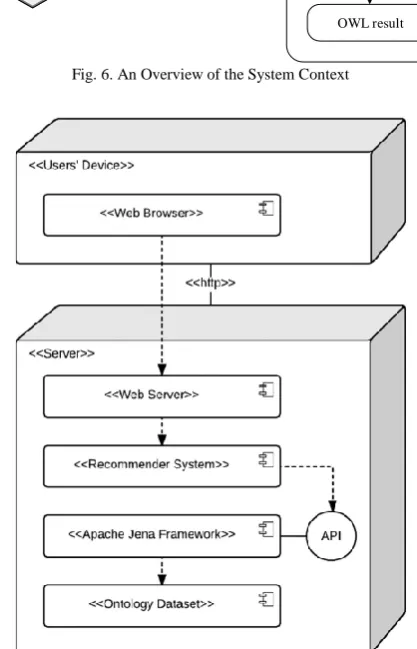
In order to prove the usability of the proposed Ontology, a supporting tool was prototyped, and developed for recommending the THR medicine based on the input symptoms. It is capable to suggest the proper THR medicines even in the situation of partial incomplete information as shown in Fig. 6. The proposed THR recommendation system is developed as a web application by using a monolith web architecture. Patient, as a major user, access the system via any web browser. The front-end user interfaces shall collect user inputs that will be encapsulated in a HTTP request. It will later send to a back-end server for processing certain recommback-ending services. In the technical aspect, the web application adopts Apache Jena Framework which helps the application to connect to Fuseki Server where the ontology is processed as shown in Fig. 7.
Thai Household Remedy Recommendation System
Input Data from User
SPARQL query
OWL result
Web Application
[image:5.595.49.292.283.387.2]Fuseki Server
Fig. 6. An Overview of the System Context
Fig. 7. A Deployment Diagram Described the System Architecture
V. CASE STUDY
With the purpose of exercising the proposed ontology model, a case study is used for demonstrating how this THR ontology works. We conduct an experiment to suggest a proper THR medicines by using patient information, i.e.
patient’s age, symptom found, patient disorder record, and allergy. This information will be fetched into the system to identify drug name and dosage of the THR medicine from the proposed ontology. The advantage of this model is that the resulted THR medicine is strongly tailor to each patient. The result also provides the information, e.g. drug trademark name to patients which is greatly useful if they are going to the pharmacy store to purchase their own THR medicine.
After a system received patient information, it maps the symptoms and patient agewith THR medicine to identify the proper dosage as the example shown in Table V. Then, the system passed patient information and the processed dosage to Fuseki server to generate SPARQL query which will be used to retrieve data from the proposed ontology. Fig. 8 shows an example of a SPARQL query for retrieving THR medicine and dosage related to headache symptom. Finally, the result of the system will be compared with the manual mapping result from the THR medicines and MIMS. The comparison result shows that the recommendation system suggests the proper THR medicines as same as in the document, for instance, children with age 12 who has a fever requires a 250 mg of Paracetamol to relief their symptom. The system result reveals that the 250 mg Paracetamol is a result when the input is ‘age 12’ and ‘fever’. Therefore, the ontology can imply the relationships between the ‘patient information’ and ‘Thai Household Remedies’ correctly
TABLEV
EXAMPLE OF SYMPTOM MAPPING WITH THR
Alu
m
in
a
an
d
M
agn
es
ia
As
p
irin
B
rown
M
ixt
u
re
P
ar
ac
et
am
ol
S
en
n
a
S
od
a
M
in
t
S
tom
ac
h
ic
M
ixt
u
re
Constipation, 12 30 mg
Cough, 30 10 cc
Fever, 12 250 mg 250 mg
Fever, 35 500 mg 500 mg
Flatulence, 10 300 mg 5 cc
Flatulence, 25 500 mg 900 mg 10 cc
[image:5.595.63.272.361.686.2]Moderate Pain, 28 500 mg 500 mg
[image:5.595.302.546.394.776.2]VI. CONCLUSION
Given its satisfactory performance, the proposed automated THR recommendation system is usable for supporting Thai citizens to find out the proper THR medicines related to their symptom. The proposed model can indicate where the weaknesses are in the drug, dosage, drug interaction, or indication. Even though the context of this paper is the Thai household remedy, so we still believe that the proposed model can be applied to other countries where building of the recommendation system is desirable. To further improve in performance, we plan to do the experiment with in-depth detail of patient information, for example, body’s weight, or allergy to suggest THR medicines and related medicine. Manual correction is also acceptable for adjusting the system
REFERENCES
[1] figures. If you want reprints o Rodriguez, A., Jimenez, E., Fernandez, J., Eccius, M., Gomez, J.M., Alor-Hernandez, G., Posada-Gomez, R., Laufer, C.: “SemMed: Applying Semantic Web to Medical Recommendation Systems.” In: First International Conference on Intensive Applications and Services, pp. 47–52. Valencia (2009).
[2] Mya Swe, T.M., Moon Kham, N.S.: “Case-based Medical Diagnostic Knowledge Structure Using Ontology.” In: 2nd International Conference on Computer and Automation Engineering (ICCAE), pp. 729–733. Singapore (2010)
[3] Chen, R.C., Chiu, J.Y., Bau, C.T.: “The Recommendation of Medicines based on Multiple Criteria Decision Making and Domain Ontology- an Example of Anti-Diabetic Medicines.” In: 2011 International Conference on Machine Learning and Cybernetics (ICMLC), pp. 27–32. Guilin (2011)
[4] Iqbal, A.M., Shepherd, M., Abidi, S.S.R.: “An Ontology-Based Electronic Medical Record for Chronic Disease Management.” In: 44th Hawaii International Conference on System Sciences (HICSS), pp. 1–10. Kauai (2011)
[5] “Computer-Based Patient Record Ontology.” In: World Wide Web Consortium, Available: http://code.google.com/p/cpr-ontology/ [6] Hadzic, M., Chang, E.: “Ontology-Based Support for Human Disease
Study.” In: 38th Annual Hawaii International Conference on System Sciences, pp. 143–149. (2005)
[7] Ministry of Thai Public Health, Government Gazette of Thai Household Remedies Issue 5, (2012).
[8] MIMS Thailand. “Drug Information System”. In: World Wide Web Consortium, Available: http://www.mims.com/Thailand/.
[9] “W3C Semantic Web Activity.” In: World Wide Web Consortium, Available: http://www.w3.org/2001/sw/
[10] Gruber, T., Liu, L., Ozsu, M.T.: “Ontology.” The Encyclopedia of Database Systems, Springer-Verlag (2009).