27.1 Asexual reproduction results in the
generation of genetically identical offspring
• Although every individual animal has a relatively short life span, species transcend this time limit because of reproduction, the creation of new individuals from existing ones.
• Animals reproduce in a great variety of ways, but there are two modes:
1. asexual and
27.1 Asexual reproduction results in the
generation of genetically identical offspring
• Asexual reproduction is the creation of
genetically identical offspring by one parent.
• Asexual reproduction can proceed via
• budding, the outgrowth and eventual splitting off of a new individual from a parent,
• fission, the separation of a parent into two or more offspring of about equal size, or
• fragmentation/regeneration, the breaking of the parent body into several pieces, followed by
27.2 Sexual reproduction results in the
generation of genetically unique offspring
27.2 Sexual reproduction results in the
generation of genetically unique offspring
• The male gamete, the sperm,
• is relatively small and
• moves by means of a flagellum.
• The female gamete, the egg,
• is a much larger cell and
27.2 Sexual reproduction results in the
generation of genetically unique offspring
• Some organisms, such as sea anemones, can reproduce both
• asexually and
27.2 Sexual reproduction results in the
generation of genetically unique offspring
• Some animals exhibit hermaphroditism, in which an individual has both female and male
reproductive systems.
• Hermaphroditism makes it easier to find a mate for
animals that are solitary or less mobile.
• Hermaphrodites may
• exchange gametes with other individuals or
27.2 Sexual reproduction results in the
generation of genetically unique offspring
• External fertilization is used by many aquatic invertebrates, fish, and amphibian species.
• Eggs and sperm are discharged near each other.
• Fertilization occurs in the water.
• Internal fertilization is used by some fish and amphibian species and nearly all terrestrial
animals.
27.3 The human female reproductive system
includes the ovaries and structures that
deliver gametes
• Both sexes in humans have
• a set of gonads, the organs that produce gametes,
• ducts that store and deliver gametes, and
27.3 The human female reproductive system
includes the ovaries and structures that
deliver gametes
• Ovaries contain follicles that
• nurture eggs and
• produce the female sex hormone estrogen.
• An immature egg is ejected from the follicle in a process called ovulation, about every 28 days.
• After ovulation, what remains of the follicle grows within the ovary to form a solid mass called the
27.3 The human female reproductive system
includes the ovaries and structures that
deliver gametes
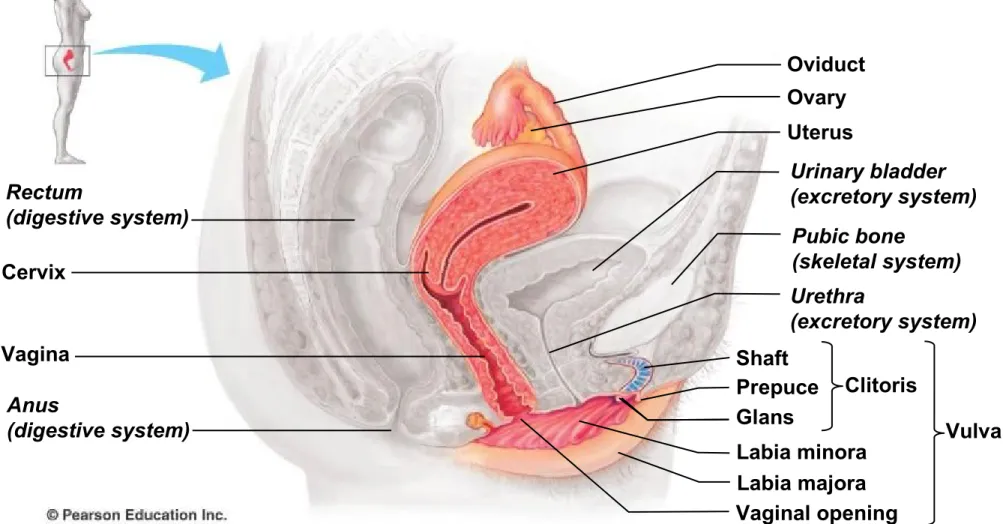
• Oviducts
• collect eggs after ovulation,
• are the typical site of fertilization, and
• convey eggs to the uterus, where a fertilized egg develops.
• The uterus
• has a thick muscular wall,
• is lined by the endometrium, richly supplied with blood vessels,
Figure 27.3a
Oviduct Ovaries
Uterus
Cervix
(“neck” of uterus)
Vagina Endometrium (lining of uterus) Wall of uterus Corpus luteum
Figure 27.3b
Ovary Egg
27.3 The human female reproductive system
includes the ovaries and structures that
deliver gametes
• The term embryo is used for the stage in
development from the first division of the zygote
until body structures begin to appear, about the 9th week in humans.
• From the 9th week until birth, a developing human is called a fetus.
• An ectopic pregnancy
• results when the embryo implants somewhere other than the uterus and
27.3 The human female reproductive system
includes the ovaries and structures that
deliver gametes
• The female reproductive anatomy consists of
• the vulva, the collective term for the external female genitalia,
• a pair of slender skin folds, the labia minora, which border the openings, and
• a pair of thick, fatty ridges, the labia majora, which protect the vaginal opening.
• Until sexual intercourse or vigorous physical activity ruptures it, a thin piece of tissue called the hymen partly covers the vaginal opening.
• The clitoris consists of a short shaft supporting a rounded
glans, or head, covered by a small hood of skin called the
27.4 The human male reproductive system
includes the testes and structures that
deliver gametes
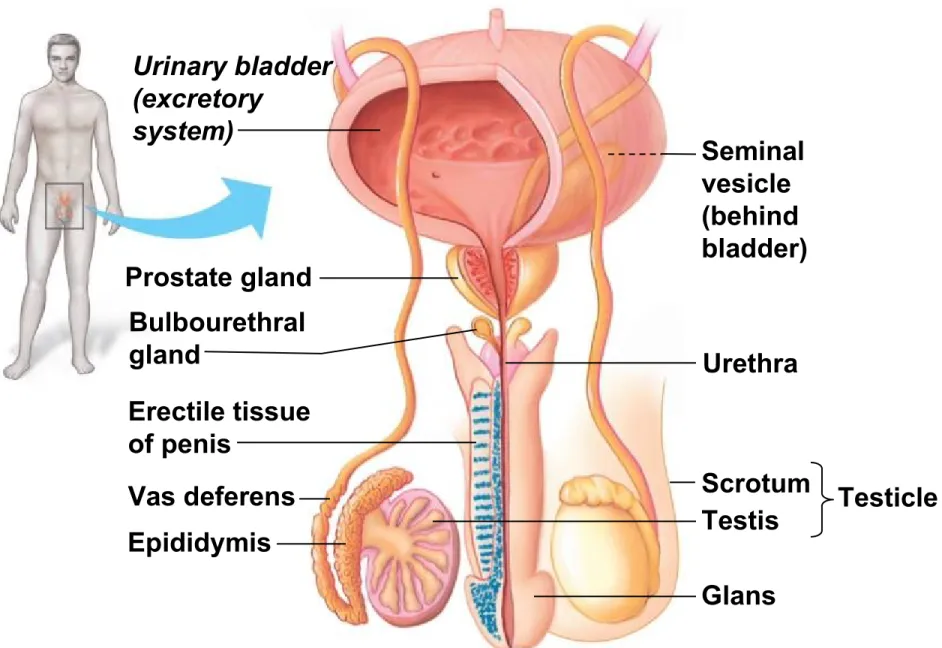
• Testes (singular, testis) are each housed outside the abdominal cavity in a sac called the scrotum.
• The scrotum keeps the sperm-forming cells about 2°C cooler, which allows them to function normally.
• A testis within a scrotum is called a testicle.
• The epididymis stores sperm as they develop further.
27.4 The human male reproductive system
includes the testes and structures that
deliver gametes
• Several glands contribute to semen, the fluid ejaculated from the penis during male orgasm.
• The seminal vesicles secrete a thick fluid that contains mucus and the sugar fructose, which provides most of the energy used by the sperm as they propel
themselves through the female reproductive tract.
• The prostate gland secretes a thin, milky fluid that further nourishes the sperm.
Figure 27.4a
Glans Testis
Scrotum Testicle Urethra
Seminal vesicle (behind bladder)
Urinary bladder (excretory
system)
Prostate gland Bulbourethral gland
Erectile tissue of penis
Figure 27.4b Penis Glans Urethra Erectile tissue Pubic bone (skeletal system) Urinary duct (excretory system) Urinary bladder (excretory system) Rectum (digestive system) Seminal vesicle Vas deferens Ejaculatory duct Prostate gland Bulbourethral gland Anus
27.4 The human male reproductive system
includes the testes and structures that
deliver gametes
• The human penis consists mainly of cylinders of erectile tissue that can fill with blood to cause an erection during sexual arousal.
• During ejaculation,
• contractions in multiple glands force secretions into the urethra and propel sperm from the epididymis,
• a sphincter muscle at the base of the bladder contracts, preventing urine from leaking into the urethra from the bladder, and
27.4 The human male reproductive system
includes the testes and structures that
deliver gametes
• Sperm production by the testes is controlled by hormones from
• the hypothalamus and
Figure 27.4c
Brain
Stimuli from other areas in the brain
27.5 The formation of sperm and egg cells
requires meiosis
• Both sperm and egg are haploid (n) cells that develop by meiosis from diploid (2n) cells in the gonads.
• There are significant differences in
27.5 The formation of sperm and egg cells
requires meiosis
• Spermatogenesis occurs in seminiferous tubules.
• Primary spermatocytes are formed by mitosis and divide by meiosis I to produce secondary
spermatocytes.
• Secondary spermatocytes divide by meiosis II to produce round spermatids, and spermatids
Figure 27.5a-0
Penis
Mitotic divisions continuously
produce new cells Epididymis Seminiferous tubule Testis Testis Scrotum
Cross section of seminiferous tubule
Mature sperm released into center
(haploid) Sperm cells Developing sperm cells (haploid) Secondary spermatocyte (diploid; in prophase
of meiosis I) Primary spermatocyte
Diploid cell
Differentiation and onset of meiosis I
Meiosis I completed Meiosis II Cellular differentiation 2n 2n n n
n n n n
27.5 The formation of sperm and egg cells
requires meiosis
• Oogenesis begins before birth when a diploid cell in each developing follicle begins meiosis.
• About every 28 days,
• follicle stimulating hormone (FSH) from the pituitary stimulates one of the dormant follicles to develop,
• one primary oocyte resumes meiosis,
• a secondary oocyte arrested at metaphase of meiosis II is ovulated, and
Figure 27.5b-0 Ovary Primary oocyte within follicle Growing follicle Mature follicle Ruptured follicle Ovulated secondary oocyte Corpus luteum Degenerating Before birth Diploid cell in embryo Differentiation and onset of meiosis I
Completion of meiosis I
and onset of meiosis II
Primary oocyte (arrested in prophase of meiosis I; present at birth
First polar body
Secondary oocyte (arrested at metaphase of meiosis II; released from ovary)
Entry of sperm triggers completion of meiosis II
27.5 The formation of sperm and egg cells
requires meiosis
• Oogenesis and spermatogenesis are alike in that both produce haploid gametes but different in that
• oogenesis produces only one mature egg and polar bodies that degenerate,
• spermatogenesis produces four mature gametes, and
27.6 Hormones synchronize cyclic changes
in the ovary and uterus
• Oogenesis is one part of a female mammal’s
reproductive cycle, a recurring sequence of events that
• produces gametes,
• makes them available for fertilization, and
27.6 Hormones synchronize cyclic changes
in the ovary and uterus
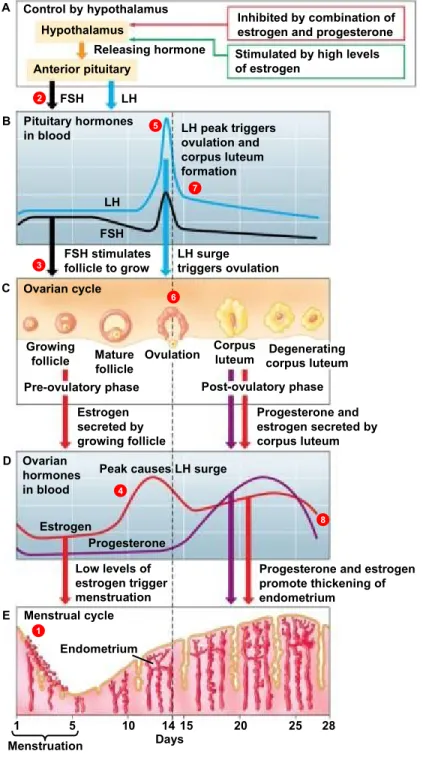
• The reproductive cycle is actually two closely linked cycles.
1. The ovarian cycle controls the growth and release of an egg.
2. During the menstrual cycle, the uterus is prepared for possible implantation of an embryo.
• Hormonal messages coordinate the two cycles,
synchronizing follicle growth in the ovaries and ovulation with the establishment of a uterine lining that can support a growing embryo.
Figure 27.6-0
Control by hypothalamus
1 2 3 4 5 6 7 8 Hypothalamus Anterior pituitary Releasing hormone
Inhibited by combination of estrogen and progesterone Stimulated by high levels of estrogen
FSH LH A
B Pituitary hormones
in blood LH peak triggersovulation and corpus luteum formation LH
FSH FSH stimulates follicle to grow
LH surge triggers ovulation C Ovarian cycle
Growing
follicle Mature follicle
Ovulation Corpusluteum Degenerating corpus luteum Pre-ovulatory phase Post-ovulatory phase
D Ovarian hormones in blood
Peak causes LH surge
Estrogen
Progesterone Low levels of estrogen trigger menstruation
Progesterone and estrogen promote thickening of endometrium E Menstrual cycle
Endometrium Estrogen secreted by growing follicle
Figure 27.6-1
Control by hypothalamus
2
Hypothalamus
Anterior pituitary
Releasing hormone
Inhibited by combination of estrogen and progesterone
Stimulated by high levels of estrogen
FSH LH
Figure 27.6-2
B Pituitary hormones
in blood LH peak triggersovulation and
corpus luteum formation
LH
FSH
FSH stimulates follicle to grow
Figure 27.6-3 Menstruation Days 28 25 20 15 14 10 5 1 FSH stimulates follicle to grow
LH surge
triggers ovulation
3
6
C Ovarian cycle
Growing
follicle Mature
follicle
Ovulation Corpusluteum Degenerating corpus luteum
Pre-ovulatory phase Post-ovulatory phase
Estrogen secreted by
growing follicle
Figure 27.6-4 28 25 20 15 14 10 5 1 4
Pre-ovulatory phase Post-ovulatory phase
Estrogen secreted by
growing follicle
Progesterone and estrogen secreted by corpus luteum
8
D Ovarian hormones in blood
Peak causes LH surge
Estrogen
Progesterone
Low levels of estrogen trigger menstruation
Progesterone and estrogen promote thickening of
Figure 27.6-5
Menstruation Days
28 25
20 15
14 10
5 1
1
Low levels of estrogen trigger menstruation
Progesterone and estrogen promote thickening of
endometrium E Menstrual cycle
27.7 SCIENTIFIC THINKING: Sexual activity
can transmit disease
• Sexually transmitted diseases (STDs)
• are also called sexually transmitted infections (STIs) and
• are contagious diseases spread by sexual contact.
• Not all STDs can be treated equally.
• Those caused by bacteria, protozoans, and fungi can be cured with medications.
• Viral STDs cannot.
27.7 SCIENTIFIC THINKING: Sexual activity
can transmit disease
• Chlamydia
• is the most common bacterial STD,
• often produces no symptoms, and
27.7 SCIENTIFIC THINKING: Sexual activity
can transmit disease
• Viral diseases such as genital herpes,
27.7 SCIENTIFIC THINKING: Sexual activity
can transmit disease
• AIDS, caused by HIV, poses one of the greatest health challenges in the world today.
• In the United States, there are 56,000 new
infections each year, one-third of which result from heterosexual contact.
• Latex condoms, relatively cheap and easily
27.7 SCIENTIFIC THINKING: Sexual activity
can transmit disease
• One study, published in 2007 by the World Health Organization of the United Nations, followed more than 800 couples in which one partner was HIV-positive and the other was not.
• Of these couples, 587 reported always using condoms, while 276 reported never using
condoms.
Figure 27.7
Always Never
27.7 SCIENTIFIC THINKING: Sexual activity
can transmit disease
• Although viral STDs cannot be cured, many other STDs can be effectively treated if addressed early.
• If left untreated, an STD may lead to long-term problems or even death.
• Anyone who is sexually active should
• have regular medical exams,
• be tested for STDs, and
27.7 SCIENTIFIC THINKING: Sexual activity
can transmit disease
• STDs are most prevalent among teenagers and young adults.
• Nearly two-thirds of infections occur among people under 25.
• The best way to avoid the spread of STDs is, of course, abstinence.
27.8 CONNECTION: Contraception can
prevent unwanted pregnancy
• Contraception is the deliberate prevention of pregnancy.