Unsupervised Improving of Sentiment Analysis Using Global Target
Context
Tom´aˇs Brychc´ın Ivan Habernal
NTIS – New Technologies for the Information Society, and Department of Computer Science and Engineering, Faculty of Applied Sciences, University of West Bohemia,
Univerzitn´ı 8, 306 14 Plzeˇn, Czech Republic {brychcin,habernal}@kiv.zcu.cz
Abstract
Current approaches to document-level sentiment analysis rely on local informa-tion, e.g., the words within the given doc-ument. We try to achieve better perfor-mance by incorporating global context of the sentiment target (e.g., a movie or a product). We assume that sentiment la-bels of reviews about the same target are often consistent in some way. We model this consistency by Dirichlet distribution over sentiment labels and use it together with Maximum entropy classifier to gain significant improvement. This unsuper-vised extension increases the classification F-measure by almost 3% absolute on both Czech and English movie review datasets and outperforms the current state of the art.
1 Introduction
Sentiment analysis on the document level has been one of the most targeted research topic in the past decade (Liu and Zhang, 2012). Given a document (e.g. a review, a blog post, or a tweet), the goal is to automatically obtain its sentiment which is mostly considered as a binary value (positive and negative) or is more granular (e.g. positive, neg-ative, and neutral or a number on the pre-defined scale).
Since the pioneering research by Pang et al. (2002), movie reviews have represented a very popular domain for evaluating sentiment analy-sis systems, mainly because of abundance of la-beled data from existing on-line movie databases.1
1
One might argue that if movie or product databases al-ready contain reviews labeled with e.g. number of stars, it is useless to try to estimate it automatically; however, not all databases are alike, e.g., the Polish movie database has no such star rating and contains only pure text reviews.
Large datasets are crucial for employing machine learning approaches.
Both approaches to sentiment analysis (machine learning-based and vocabulary-based) attempt to estimate the polarity of the document taking into account only its content (e.g. words, morphology patterns, syntax, and other features). Other exter-nal information, such as the sentiment target, the author, and others, are mostly ignored in the po-larity estimation step. This means that the distri-bution of sentiment for each target is considered as random.
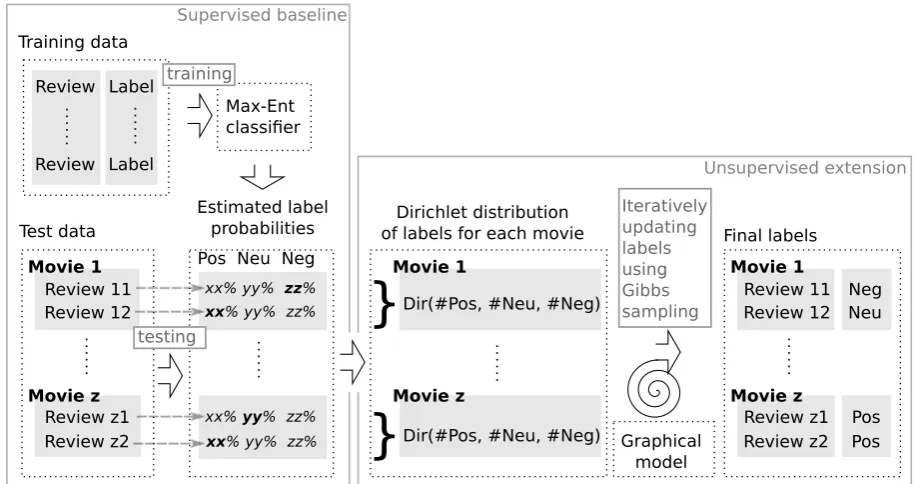
We assume that sentiment labels for each tar-get are not independent of each other. This means that given a movie with the majority of positive reviews, there is a chance that the next unknown review will be positive as well. We model this as-sumption as a Dirichlet distribution over sentiment labels for each target. In summary, our approach to sentiment analysis consists of two steps. In the first step, we employ a supervised Maximum en-tropy classifier in order to estimate sentiment la-bel probabilities for each review. In the second (unsupervised) step, these labels are iteratively up-dated using Gibbs sampling in order to maximize the probability of sentiments of each target.2
A big challenge in the sentiment analysis task are non-mainstream languages,3 mostly because of the lack of precise polarity lexicons, annotated datasets, and other resources. Morphologically rich languages may also require different treat-ment than English, because of their rich vocabu-lary. Therefore, we report our result on two movie review datasets in two languages — the English IMDB and Czech CSFD datasets.
2
Through the rest of the paper, we will use target and movieinterchangeably.
3Majority of research in sentiment analysis focuses on
En-glish or Chinese.
Figure 1: Diagram describing our sentiment model.
Smn∼
θm(s)PME(Smn=s|Tmn)
P
i∈S
θ(mi)PME(Smn=i|Tmn)
, (2)
whereθm(s) is the probability of sentiment
la-bel s in target Tm and PME(s|Tmn) is the
label probability of the current review given by Maximum entropy model. The probability distribution, from which the labels Smn are
sampled, is given by probabilityθ(ms)rescaled
by the score from Maximum entropy classi-fier.
M Nm
α θm Smn ME
Figure 2: Plate notation representing our senti-ment model. ME circle means the output from Maximum entropy classifier.
Plate representation of our generative model is shown in figure 2.
The Gibbs sampler needs to compute
P(Smn|S¬mn, Tmn,α), the probability of a
sentiment label Smn that is being assigned to a
reviewTmn, given all other labels assignments to
all other reviews in appropriate review targetTm.
Gibbs sampling of the Dirichlet-multinomial distribution, already derived for LDA by Griffiths and Steyvers (2004), results in simple formula
P(Smn=s|S¬mn,α)
= c
(s)
¬mn+αs
P
i∈S
c(¬mni) +αi
∝c(¬mns) +αs, (3)
whereS¬mnmeans all sentiment labels except the
one at positionninm-th review target. Thec(¬mns)
denotes the number of times that the sentiment la-belswas assigned to the review inm-th target ex-cept the positionn.
We use Maximum entropy classifier to rescale these probabilities. Final formula for sampling sentiment labels combines the information from particular review as well as contextual information about other reviews in appropriate review target
P(Smn=s|S¬mn, Tmn,α)
∝
c(¬mns) +αs
PME(s|Tmn)
P
i∈S
c(¬mni) +αi
PME(i|T
mn)
∝ c(¬mns) +αs
Figure 3: Histogram of reviews per target on CSFD dataset. Frequency (y axis) means how many targets have the given number of reviews (x
axis).
5 Datasets
We perform our experiments on two datasets in the movie review domain. An English dataset from the Internet Movie Database (IMDB), provided by (Maas et al., 2011), contains 25k training and 25k test examples labeled with either positive or neg-ative sentiment. There are also another 50k addi-tional unlabeled reviews. All reviews are accom-panied with their corresponding movies’ URLs.
A Czech dataset from the Czech Movie Database (CSFD), provided by (Habernal et al., 2013), consists of≈90k reviews equally split into positive, negative, and neutral ones. As the pro-vided dataset did not contain information about the target movies, we tried to match the reviews and movies automatically. Unfortunately, in few cases we were not able to find the appropriate movie given the review, thus the resulting dataset slightly differs from the one from (Habernal et al., 2013). However, we report all results on the new dataset (where the reviews are paired with their movies) and also provide it for any further research.4
5.1 Data statistics
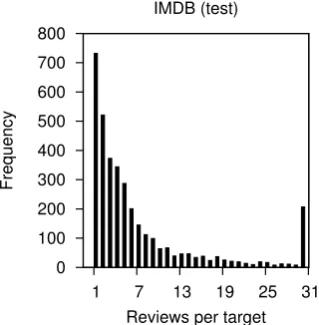
Figures 3 and 4 display statistics for the CSFD and IMDB test datasets, respectively, in terms of the frequency of targets with a particular number of reviews. In both datasets, the overall trend is that most of the movies have 1–10 reviews. The mean is 8.6 reviews per movie in CSFD and 7.0 in IMDB, respectively. The reason of the large peak
4http://liks.fav.zcu.cz/sentiment
Figure 4: Histogram of reviews per target on IMDB test dataset.
at 30 in IMDB is the restriction of maximum re-views per movie to 30 by Maas et al. (2011).
To support our idea of some consistency in sen-timent related to one target, we captured the per-centage of the major sentiment label for each tar-get, as shown in Figure 5. Each ‘bin’ on the Y
axis deals with targets having a certain number of reviews, i.e., 1–10, 11–20, etc. For each bin, we compute the ratio of the major sentiment (i.e., if a movie has 7 positive, 2 neutral, and 1 negative review, the ratio is 0.7) and plot it as a probabil-ity distribution. It actually corresponds to consis-tency of reviews per target. Obviously, for targets with 1–5 or 1–10 reviews (the first Y axis bin), the graph is skewed towards 1.0. This is caused by targets with only a single review, thus the prob-ability of major sentiment for these targets is al-ways 1.0. With increasing number of reviews per target, the sentiment becomes a mixture where the prevalence of the major sentiment declines, yet it remains dominant (as can be seen in Figure 5).
Note that we show these statistics only on test data in the IMDB dataset, as our extension does not involve the training data.
6 Results and discussion
We perform our experiments in 10-fold cross val-idation manner on the CSFD dataset. For the IMDB dataset, the training and test data are al-ready separated.
In our experiment we used symmetric Dirich-let distribution, which do not favor any sentiment label over another. Results obtained by 100 it-erations of Gibbs sampling and hyper-parameters
1.0-0.9 0.9-0.8
0.8-0.7 0.7-0.6
0.6-0.51-10 10-20
20-30 30-40
40-50 50-60 1.0
0.8 0.6 0.4 0.2
0.0
Sig
nif
ican
ce
of
m
a
jo
r
se
nt
im
ent
Proportionality
of major sentim ent
Review sper
movie
(a) CSFD
1.0-0.9 0.9-0.8
0.8-0.7 0.7-0.6
0.6-0.51-5 6-10
11-15 16-20
21-25 26-30
> 30 1.0
0.8 0.6 0.4 0.2 0.0
Sig
nif
ican
ce
of
m
ajo
r
se
nt
im
ent
Prop ortio
nality of major se
ntim ent
Reviews per mo
vie
(b) IMDB
Figure 5: Proportionality of major sentiments for various numbers of reviews per target.
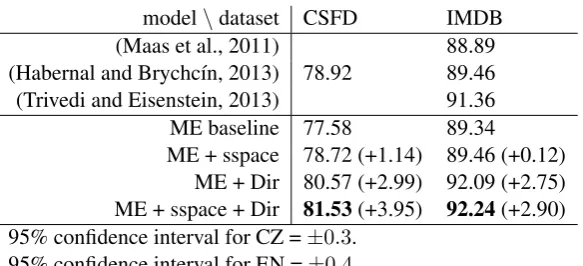
model\dataset CSFD IMDB (Maas et al., 2011) 88.89 (Habernal and Brychc´ın, 2013) 78.92 89.46 (Trivedi and Eisenstein, 2013) 91.36 ME baseline 77.58 89.34
ME + sspace 78.72 (+1.14) 89.46 (+0.12) ME + Dir 80.57 (+2.99) 92.09 (+2.75) ME + sspace + Dir 81.53(+3.95) 92.24(+2.90) 95% confidence interval for CZ =±0.3.
95% confidence interval for EN =±0.4.
We also experimented with the number of itera-tions needed for sufficient inference (Figure 6) and concluded that 100 iterations is far enough. Note that the improvements in Figures 6 and 7 are al-ways taken against the same model without global context, i.e. ME+sspace+Dir is compared to the
ME+sspace, not to theME.
0.024 0.026 0.028 0.03 0.032
1 10 100 1000
F-measure imp
rovement
Number of iterations ME (cz) ME+sspace (cz) ME (en) ME+sspace (en)
Figure 6: Improvement in F-measure depending on number of iterations of Gibbs sampling.
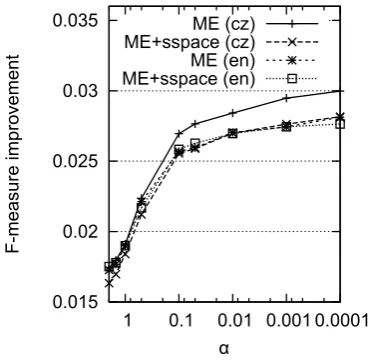
The selection of appropriate hyper-parameters of Dirichlet distribution can be important for such a task. The improvements in F-measure depend-ing on different αs are shown in figure 7. Lower
αs achieves higher improvement in performance.
With lowerαs, the Dirichlet distribution is sharper
and also the more consistent the review labels are expected to be in average.
We suppose this is caused mainly by the fact that many review targets have only one review (100% consistency). See Figures 3 and 4 for de-tailed statistics on datasets. Thus the global con-text should help in widely reviewed targets. In cases where the target has only one review, our extension has no effect on the final sentiment label (the label is only determined by Maximum entropy classifier).
7 Summary
7.1 Future work
In future work we would like to investigate an-other combinations of document level information together with global context information. We ex-pect that linear interpolation with weights tuned on held-out data would be an efficient combination of such sources of information.
0.015 0.02 0.025 0.03 0.035
0.0001 0.001 0.01 0.1 1
F-measure imp
rovement
α ME (cz) ME+sspace (cz) ME (en) ME+sspace (en)
Figure 7: Improvement in F-measure depending on the parameter of Dirichlet distribution.
Another interesting idea is to use Dirichlet dis-tribution with different hyper-parameters for tar-gets with different number of reviews, as the Dirichlet distribution is supposed to have differ-ent shape for sparsely reviewed targets, compared to the targets with many reviews.
7.2 Conclusion
In this work we investigated global target context as a new source of information for sentiment ana-lysis. We placed the Dirichlet distribution on sen-timent labels belonging to the same review target. We combined the global target context informa-tion together with the document level classifica-tion (Maximum entropy classifier) and used Gibbs sampling for inference the sentiment labels. Our extension satisfies the unsupervised fashion and significantly improves classification F-measure by almost 3% which yields new state-of-the-art re-sults.
Acknowledgments