Implementation of Modified CRT Algorithm for
Packet Routing Evaluation to Improved Energy
Saving and Reliability in Wireless Sensor
Networks
Kamana Singh
#1, Ankur Goyal
*2#M. Tech student, Yagyavalkya Institute of Technology, Jaipur *Assistant Professor, Yagyavalkya Institute of Technology, Jaipur
ABSTRACT - Sensor networks offer a powerful combination of distributed sensing, computing and communication. In this paper an analytical model for proposed forwarding algorithm based on the Chinese Remainder Theorem has been introduced. Because the energy consumption per node is proportional to the amount of bits received and subsequently forwarded, by applying the proposed technique it is possible to reduce significantly the energy consumed for each node and consequently to increase the network lifetime of the wireless sensor network. Furthermore, the trade-off between energy consumption and reliability of the method has been investigated.
KEYWORDS -CRT (Chinese Remainder Theorem), GCD (Greatest Common Divisor), MERF (Maximum Energy Reduction Factor), MPS (Minimum Primary Set), RSA Algorithm (Ron Rivest, Adi Shamir and Leonard Adleman).
I.INTRODUCTION
Wireless Sensor Network (WSN) consists of spatially distributed autonomous sensors to co-operatively monitor physical or environmental conditions such as temperature, sound, vibration, pressure, motion or pollutants”. WSNs have various applications that are widely used by researchers, exploration teams, military etc. The lifetime of the networks can be increased by efficiently using the energy and increasing the message transfer reliability. Protocols already proposed for ad hoc networks do not fully fit the requirements of the sensor networks, and several modifications or new approaches have been introduced [1][2]. At the network layer a significant subset of routing protocols for wireless sensor networks is based on a multipath approach [5]. However, multiple paths could remarkably consume more energy than the shortest path and several copies of the same packet could reach the destination. In order to reduce the overhead introduced with multipath routing,authors in [7] have proposed a new mechanism that splits the original data packets into a number of subpackets equal to the number of disjoint paths from source to destination. With the aim of reducing energy
consumption while taking the algorithmic complexity into account, we propose a novel approach that splits the original messages into several packets such that each node in the network will forward only small sub packets.The CRT technique is well known in cryptography [9], number theory, signal processing and channel coding [3].The sensors are battery-operated with diverse capabilities and types and are empowered with limited data processing engines. The mission for these sensors is dynamically changing to serve the need of one or multiple command nodes. Command nodes can be stationary or mobile.
II. MOTIVATION FOR RESEARCH
This work can be summarized as these solutions are not suitable for applying to any networks without event loss and same time improved reliability and reduced energy usage. The followings are the limitations noticed in the literature review.
1. There algorithms proposed are not suitable for execution in Wireless sensor network because they consume more time.
2. Movement of sensor nodes or nodes is proposed which is not practical in all networks.
So the new innovative idea is proposed by authors Giuseppe Campobello, Alessandro Leonardi, and Sergio Palazzo, that is Improving Energy Saving and Reliability in Wireless Sensor Networks Using a Simple CRT-Based Packet-Forwarding Solution has been implemented in this paper work[1].
III. RELATED WORK
A. The Chinese Remainder Theorem
Packets are split into sub packets using Chinese Remainder Theorem. Let x1, x2,…, xk be the prime numbers. (pair wise relatively prime integers)[9]. If y1,y2 ,…,yk are any integers, then there exist a unique integer p modulo Z = x1*x2*…*xk that satisfies the system of linear Congruencies,
A ≅y1 (mod x1)
A ≅ y2 (mod x2) …
A ≅ yk (mod xk)
Moreover p ≅ x1Z1b1 + x2Z2b2 + … + xkZkbk (mod Z) where Zi = Z/xi and Zibi = 1 (mod xi) for i=1,2,…,k .There are conditions where xi’s are not pairwise coprime. In such a case the simultaneous congruencies of p exists iff yi ≅ yj ( mod gcd(xi,xj))
for all i and j.For instance It is considered that the system:
m = 1 (mod 3)
m = 4 (mod 5) m = 1 (mod 7)
It is simple to prove that m = 64 solve the system and that it can be obtained by the above equations. According to the CRT, the number m can be alternatively identified with the set of numbers mi provided that pi are known. However, it is worth noting that in the above example 7 bits are needed to represent m, while no more than 3 bits are needed to represent each mi. Therefore if, instead of m, mi numbers, with mi = m (mod pi), are forwarded in a wireless sensor network, the maximum energy consumed by each node for the transmission can be substantially reduced.
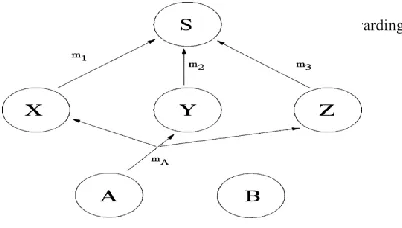
For instance, consider Fig.1. If X, Y, and Z receive a message mA from A, each of them, applying the procedure shown above, can transmit a message mi, with i ∈ {1, 2, 3}, to the sink instead of mA. Furthermore, the sink, knowing pi, with i ∈ {1, 2, 3}, and using the CRT approach, will be able to reconstruct mA.
B. GCD Algorithm
In CRT algorithm when there are conditions where no pair wise co prime exists GCD algorithm is taken into account[4][5]. The algorithm is stated as :
Begin algorithm
Function greatest common divisor (x, y) While value of x is not equal to y (x ≠ y) Thenif value of x is greatest than that of y (x>y)
x := x -y else y := y – x
The value of x or y obtained is taken as output.
The recursive version of the GCD algorithm of successive remainders can be stated as:
function greatest common divisor (a, b).if the value of y = 0 then return the value of x as output
elsereturn greatest common divisor (y, x mod y)
C. RSA Algorithm
RSA algorithm is developed Ron Rivest, Adi Shamir and Leonard Adleman in the year 1977. RSA is used as an internet authentication and encryption system which is used as a part of web browsers[7].
The algorithm mainly involves two large prime numbers which are multiplied and constitutes of public key and private key operations[6]. The originally randomly considered prime numbers can be discarded once the two keys are developed. The encryption and decryption procedure uses these public and private keys in order to transmit the confidential data. Concept of RSA algorithm is used to find random numbers:
1. Choose two distinct prime numbers p and q
2. Compute n = pq.n is used as the modulus for both the public and private keys. Its length, usually expressed in bits, is the key length
3. Compute z= (p − 1)(q − 1).
4. Choose an integer e such that 1 < e < z 5. Determine d as (d*e)mod z = 1. Finally,
Encryption: c=m^e mod n Decryption: c^d mod n
D. Metrics for energy efficiency
MERF =w – Wcrtmax/w.
For instance, in the previous example is MERF =7−3/7≈0.57, this means that about 57% of the energy could be saved by considering the proposed forwarding scheme.However, it is worth noting that in the above example the total number of bits transmitted has been reduced too (i.e. only 1+3+1=5 bits are need to forward m instead of the original 7 bits). Therefore, even in the worst case where all the components of the previous example have to be forwarded by the same node, we have an energy reduction factor equal to7−5/7≈ 0.29.Although this last result is dependent on the particular value of m, on the basis of the above example, we can roughly state that CRT-based splitting is more efficient than a simple splitting (i.e. packet chunking) or other FEC-based splitting techniques (where redundancy have to be added to the original packet by increasing the total number of bits).the MERF is rarely obtained and the expected energy reduction factor (ERF) have to be expressed taking into account both the actual number of bits forwarded by a normal forwarding algorithm and our proposed CRT-based forwarding algorithm In particular, for comparison purposes, the Shortest Path with Load Balancing (SP) is considered by assuming that a sensor node having a packet to forward chooses randomly as next-hop a node belonging to the shortest path towards the sink.
The expected energy reduction factor can be expressed by considering the mean energy consumed by a node in the case of the proposed CRT-based and the SP forwarding technique, i.e. ECRT = nc 𝜔 CRT and ESP = npw respectively, where nc and np are the mean number of forwarded packets with the above forwarding schemes and 𝜔 CRT is the mean number of bits needed to represent the CRT components:
ERF = ESP −ECRT
ESP = 1 - nc 𝜔 CRT
npw (1)
The above metrics(equation) well be used throughout the paper. Obviously the primes set should be chosen in order to maximize MERF and ERF.
E. Choosing Prime Numbers
The number of bits needed is represented using the prime numbers. Prime numbers are selected as small as possible and primary numbers are chosen arbitrarily. The MERF may be maximized as the result of selecting small prime numbers. The set of smallest consecutive primes are used to indicate throughout the paper that satisfies the condition, the set is called as Minimum Primes Set (MPS).
It is considered that primes set {10313, 10321, 10331, 10333}. These are the smallest consecutive primes that satisfy the condition 𝜋ipi ≥ 240 even if one of primes is removed. We call this set as the Minimum Primes Set
with one admissible failure (the name will be better clarified below) and we will indicate it as MPS -1. In general, throughout the paper we will indicate with MPS-f the Minimum Primes Set with f admissible failures. When compared with the previous MPS it is possible to observe that
The number of components in MPS-1 is not changed (i.e. the same number of nodes is needed to forward the message).
The MERF obtained with the new set is 0.65 i.e. MERF is reduced by about 11%. However with this choice it is possible to reconstruct the original message m even if a component is lost (i.e. if we have one failure). In fact, whatever is the lost component mj , the product of the primes associated with the received components satisfies the condition M’ = 𝑖≠𝑗𝑝𝑖 > 240
and therefore it respects the hypopaper of the CRT theorem.
For instance if the last component m4 is not received it is again possible to obtain m as m =
𝑐𝑖. 𝑚𝑖 (𝑚𝑜𝑑 𝑀′)
3
𝑖=1 where M’ = 3𝑖=1𝑝𝑖 is the
product of the first three primes, and c1, c2, c3 are the first three CRT coefficients computed for the MPS-1 on the basis of the CRT algorithm.The previous example can be extended in order to consider a greater number of failures f. Therefore, the parameter f allows a trade-off between reliability and energy saving that will be investigated in this paper.
F. Phases of Algorithm
There are two phases in this algorithm which are temporal. The initialization phase and the forwarding phase.
1) Initialization
Fig. 2 Initialization procedure
The initialization procedure is performed only when the network is activated for the first time and it is not needed to run it when either a new node joins the network or a node belonging to a certain cluster goes out of energy.
2) Forwarding phase:
In this paper the forwarding procedure is actually applied.when the procedure is applied to a wireless sensor network, the number NXof primes corresponds to
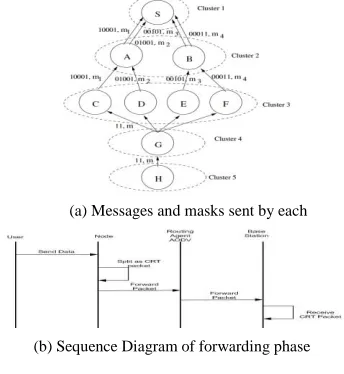
considered that the network shown in Fig.3 (a) where clusters are obtained according to the initialization procedure already described in the previous section. The figure shows the messages and masks sent by each node when the source node H sends a message m to the sink S.
Because there is a unique MPS (unique set of primes) for each NX, it is not necessary for the sink to receive the prime numbers used to split the packet but only the number of components on which it is splitted (i.e. NX). For example if w=40 and f=1, the MPS-1 is {10313,10321,10331,10333}so that these are also used as prime numbers for {C,D,E,F}respectively.Nodes A and B know that the received messages were already splitted (by checking the mask) and therefore they simply forward the received packets to one of the potential next-hops.
When the sink receives a component mi, it identifies the number of expected components on the basis of the mask and therefore it calculates the MPS-f. Then, according to the CRT algorithm, the sink nodes calculates the coefficients ci needed to reconstruct the original message[8].
Finally, when the sink receives at least N−f components of the original message, it can reconstruct the message by m = 𝑐𝑖𝑚𝑖𝑖 (mod M’).
IV. Result (Output)
A. Analytical Result
In this section we will derive some analytical results regarding the proposed method.The main results are :
1)In this section we consider choice of the number of CRT components.
TABLE 1: Nmax vs w
the maximum number of components is limited by the node density of the network, but in this section we prove that, by fixing w, a maximum number of CRT components, Nmax, means ERF decreases from eq.(1)we know that, it is possible to state that the ERF is maximized if the product nc・𝜔 CRT is minimized.When the number of CRT components for each message,
W Nmax
32 10
40 12
64 16
100 22
150 30
200 37
(b) Sequence Diagram of forwarding phase
Fig. 3 Forwarding Example (a) Messages and masks sent by each
node (a) Sink node
sends IM with
SN=2
(c) Nodes CLID=2
retransmit both the IM
with increased SN=3
and their address (b) Nodes CLID=2
retransmit both IM
and address
can be received by a node, nc, increases.if we consider that the number of bits of the i-th component is
⌈log2(pi)⌉, the mean number of bits for the CRT components can be evaluated as
𝜔 CRT = 𝑁𝐶𝑅𝑇𝑖=1 [𝑙𝑜𝑔2 (𝑝𝑖)] / NCRT (2)
if the minimum prime number of the first MPS is p1 = 2 a left extension cannot be done and therefore any increase of the NCRT increases the 𝜔 CRT too. Thus, fron the previous statements, we can conclude that it is convenient to increase the number of CRT components until the MPS does not contain the prime number 2and therefore, for a specific value of w, the maximum valueto be used for NCRT is the minimum value N that satisfies 𝑁𝑖=1𝑝𝑖>= 2 , with p1 = 2. In Table 1shows the values of Nmax for different values of w.
According to our proposed forwarding algorithm, the sink will not be able to reconstruct the original message if more than f components are not received, consequently, if we consider NCRT components, this happens with probability
PN = 𝑁𝐶𝑅𝑇
𝑖 𝑁𝐶𝑅𝑇
𝑖=𝑓+1 𝑝𝑛𝑖(1-pn)NCRT – i
Therefore, the reliability can be related to both the erasure probability, pe, and the number of failures, f, as follows:
PR = 1 − PN = 𝑁𝐶𝑅𝑇 𝑁𝐶𝑅𝑇𝑖
𝑖=𝑓+1 𝑝𝑛𝑖(1-pn)NCRT – I (3)
2) analytical model is used to estimate the mean energy reduction factor i.e achieved by using proposed forwarding scheme.When a large number of nodes and messages are considered, the proposed algorithm is able to reduce the mean energy consumption by about the 37%.From the Eq.(1) we considering that nc and np can be expressed on the basis of the number of sent messages Nm and the mean number of nodes used to forward the messages to the next cluster in the case of CRT and SP schemes, NHcrt and NHsp respectively. In fact, the mean number of packets forwarded by a node is np = Nm / NHsp for the SP forwarding algorithm and nc = NmNCRT / NHcrt for the proposed CRT-based forwarding algorithm (considering NCRT packets for each message), so that Nc/np = NCRT (NHsp/NHcrt) Accordingly, the ERF can be evaluated as
ERF = 1 – NCRT NHsp
NHsp 𝜔 CRT
𝑊 (5)
If we considered only the nodes of the second cluster, NT can be easily obtained by NT = 𝜌𝜋R
2
where R is the transmission range of the sink and 𝜌 is the network density.finally we say that:
if Nm is fixed and NT tends to infinity it follows that ERF = MERF
if both NT and Nm tend to infinity and NCRT
𝜔 CRT ≈ w, then ERF ≈ 1 − 1−e−1 / 1−e−NCRT≈ e−1, i.e. the ERF is about 0.37.
3) An analytical model that can be used to estimate the mean energy reduction factor achievable with the
proposed forwarding scheme is derived and it is proved that, under proper conditions, the proposed forwarding algorithm is able to reduce the mean energy consumption by about the 37%.
B. Performance Evaluation
We consider a sensor network where nodes are randomly distributed in a square area of size GridSize = [300m × 300m] with density 𝜌 = 0.03. we evaluate the reduction of maximum energyconsumption in percentage, calculated as
ERF=(ESP-ECRT)/ESPor
ERF = (1- NcWCRT)/ NPW or by directly using eq(5). considering three different values of ρ. We haveconsidered 100 different topologies, S=[1, 100], and we havesorted them so that the corresponding values of E(S) resultordered from the highest to the smallest value. We observethat CRT achieves better results if compared to SP in 90% ofthe different topologies considered. In the remaining 10% oftopologies CRT shows worse performance.In fig: 4 we see that if MNN=20 When w increases, CRT achieves a higher reduction of energyconsumption if compared to SP and the effect of CRT splittingis more evident.Sensor nodes are considered static as usual in most application scenarios[1].
Fi g . 4Reduction of maximum energy consumption (SP - CRT) vs. sorted
topologies, S, with different values of w.
the energy consumption per node is proportional to the amount of bits received and subsequently forwarded, by applying the proposed technique it is possible to reduce significantly the energy consumed for each node and consequently to increase the network lifetime of the wireless sensor network. Furthermore, the trade-off between energy consumption and reliability of the method has been investigated.
V.CONCLUSION
In this paper, we have provided with a novel forwarding technique based on the Chinese Remainder Theorem (CRT) in WSN’s.we have provided a method in which there is minimum energy consumption and remarkable improvement in performance. Starting from choosing the CRT algorithm parameters in order to keep the processing complexity low, then we have derived trade-offs between energy consumption and reliability. The prime numbers are obtained and the algorithm is run and the resulting output is shown. The obtained output clearly shows that the performance of the CRT based algorithm is better than Non-CRT based algorithm.
VI. ACKNOWLEDGEMENTS
First we thank God Almighty for his blessings for this
providing constant support and motivation during the term of the paper and for his time, valuable input and feedback during the different phases of the paper. Without their vision and versatility, this report and its implementation would not have been feasible right from the formulation of the report. We thank this opportunity to express my hearty thanks to my parents and friends for the moral support, encouragement to make this as a success.
VII. REFERENCES
[1] I. F. Akyildiz, W. Su, Y. Sankarasubramaniam, and E. Cayirci, “A survey on sensor networks,” IEEE Commun. Mag., vol. 40, no. 8, pp.102–114, Aug. 2002.
[2] K. Akkaya, M. Younis. A Survey of Routing Protocols in Wireless Sensor Networks. Elsevier Ad Hoc Network Journal. Vol. 3, No. 3, pp. 325-349, May 2005.
[3] O. Goldreich, D. Ron, M. Sudan. Chinese remaindering with errors. Proc. of the thirty-first annual ACM symposium on Theory of computing (STOC ’99), Atlanta, USA, May 1999.
[4] Comparing Several GCD Algorithms T. Jebelean RISC-Linz, A-4040 Austria.
[5] Parallel Extended GCD Algorithm Pou-Yah Wu and Julian Chuen-Liang Chen Dept. of Information Management, Kaohsiung Polytechnic Institute.
[6] File encryption and decryption system based on RSA algorithm Suli Wang Ganlai Liu School of Information Engineering Support Center Jingdezhen Ceramic Institute Jingdezhen Telecom Jingdezhen, Jiangxi Province, China Jingdezhen, Jiangxi Province, China.
[7] S. Dulman, T. Nieberg, J. Wu, P. Havinga. Trade-Off between Traffic Overhead and in Multipath Routing for Wireless Sensor Networks. Proc. Of WCNC Conference, New Orleans, USA, March 2003.
[8] A. Menezes, et al., Handbook of Applied Cryptography, CRC Press, Oct.1996.
[9] J.-H. Hong, C.-H. Wu, C.-W. Wu. RSA Cryptosystem Based on the Chinese Remainder Theorem. Proc. of Asia and South Pacific Design Automation Conference (ASP-DAC), Yokohama, Japan, January 2001.
[10] A.M. Gittelsohn. An Occupancy Problem. The American Statistician, Vol.23, No. 2, pp. 11-12, April 1969.
Fig.5 Number of bits forwarded from nodes belonging to CLID=2, when Grid Size = [300m, 300m], w=100 bits and ρ=0.03