SYNTHESIS AND CHARACTERIZATION OF HOT-PRESSED SOLID POLYMER ELECTROLYTES:
(1-x) PEO: x KBrO
Research Article
3
ANGESH CHANDRA
1 *, ARCHANA CHANDRA
2, SANTOSH THAKUR
21Department of Applied Physics, Shri Shankaracharya Institute of Professional Management & Technology, Raipur 492015, C.G., India, 2
Received: 17 Nov 2011, Revised and Accepted: 28 Dec 2011
Department of Applied Chemistry, Shri Shankaracharya Engineering College, Bhilai 490020, C.G., India. Email: [email protected]
ABSTRACT
Synthesis and ion transport characterizations on hot-pressed solid polymer electrolytes (SPEs): (1-x) PEO: x KBrO3, where x in wt. (%), are
reported. The compositional (x) dependent conductivity (σ) studies revealed SPE film: (70PEO: 30KBrO3) as the Optimum Conducting Composition
(OCC) with room temperature conductivity σ ~ 4.36× 10⁻⁷ Scm-1, which is more than two orders of magnitude higher than that of pure PEO. To
understand the ion transport behavior in SPE films, the measurement on some basic ionic parameters viz. ionic conductivity (σ), ionic mobility (μ)
and mobile ion concentration (n) have been carried out using different experimental techniques. Material characterizations were done with the help of XRD, SEM, DSC and TGA techniques. The activation energies (Ea
Keywords: Solid polymer electrolyte, Hot-press technique,Ionic mobility, XRD, SEM, DSC, TGA, Solid-state polymeric battery.
) values have been computed from ‘log σ - 1/T’ Arrhenius plots. Thin film solid-state polymeric batteries were also fabricated using SPE OCC as electrolyte and the cell-potential discharge characteristics were studied under different load conditions.
INTRODUCTION
The development of new polymer electrolytes is one of the important areas of research in the last 35 years. Among the known polymer electrolytes, the ion conducting Solid Polymer Electrolytes (SPEs) having great technological relevance’s in the fabrication of all-solid-state electrochemical devices such as batteries, fuel cells, electro-chromic displays, smart windows, sensors etc.1-7 SPEs
possess both the liquid like conductivity and solid like mechanical stability including flexibility, which are the characteristic materials advantages favoring them for the thin film devices of desirable shape/ sizes. The first ion conducting polymeric material was discovered in 19735. Since then, a large numbers of polymer
electrolytes involving variety of mobile ions viz. H+, Li+, Ag+, K+, Na+
etc., as principal charge carriers, have been reported in the last nearly three and half decades. PEO has been commonly employed as polymeric host for salt complexation as it possesses exceptional ability to dissolve high concentrations of variety of salts 8,9. Solid
polymer electrolytes are traditionally prepared by solution-cast method. Recently, a solvent-free, hot-press method has been developed for casting polymer electrolyte membranes 10-15. The
present paper reports, synthesis and ion transport property studies of new solid polymer electrolytes (SPEs): (1-x) PEO: x KBrO3
For synthesis of SPEs: (1-x) PEO: x KBrO
, casted by hot-press technique. Based on this hot-pressed SPE OCC, solid state thin film battery fabrication, discharge characteristics and cell parameters were also studied under different load conditions.
MATERIALS AND METHODS
3, where x = 0, 5, 10, 15, 20,
25, 30, 35, 40, 50 (wt. %), AR grade precursor chemicals: poly (ethylene oxide) PEO (105 Mw, Aldrich, USA) and KBrO3 (purity >
98%, Merck, India) were used. Dry powders of constituent chemicals in appropriate wt. (%) ratios were homogeneously mixed for ~ 30
min at room temperature then heated separately ~ 70 0C (close to
the melting point of PEO) for ~ 30 min with mixing continued. It resulted into a soft lump/ slurry which was then pressed (~ 1.25
ton/ cm2) between two SS- cold blocks, giving rise to a uniform film
of thickness ~ 0.013 cm. The details related to hot- press casting of SPEs have been given elsewhere in the literature.11-15 Material
characterizations were done with the help of XRD (model: Shimadzu), SEM (model: JEOL, JXA-8100, Japan), DSC (model: Perkin Elmer) and TGA (model: SDT Universal) techniques. The conductivity (σ) -measurements were carried out on different samples at a fixed frequency (i.e. 5 kHz) using an LCR- bridge (model: HIOKI 3520- 01, Japan). Ionic mobility (μ) was determined
directly employing dc polarization Transient Ionic Current (TIC) technique using an x-y-t recorder (model: Graphtec WX 2300-1L, Japan)16. Subsequently, mobile ion concentration (n) was evaluated from σ and μ data. The activation energy (Ea
K (Anode)
) values were also determined by temperature dependent conductivity studies. Thin film solid-state polymeric batteries were fabricated in the following cell configuration:
(70PEO: 30KBrO3 (C+I ) (SPE OCC membrane) 2+Electrolyte) (Cathode film)
The cell performances were studied under different load conditions at room temperature and the important cell parameters were calculated from the plateau of the discharge profiles.
RESULTS AND DISCUSSION
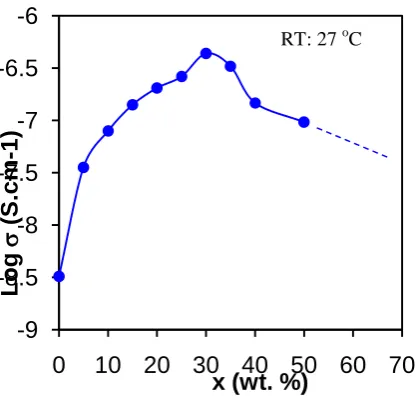
The room temperature conductivity (σ) variation with different salt concentration for hot-pressed solid polymer electrolytes (SPEs): (1-x) PEO: x KBrO3,as shown in Figure 1. The ionic conductivity (σ)
increased abruptly (~102 times) after the addition of salt in the host
polymer. However, a moderate sized σ-maxima appeared at x = 30 wt.(%) and then decreases on further addition of salts. SPE films beyond 50 wt. (%) salt concentration were brittle and appeared physically less stable. SPE film: (70PEO: 30KBrO3), with room
temperature conductivity (σ ~ 4.36 × 10⁻⁷ S/cm), exhibited optimum
conductivity and this has been referred to as Optimum Conducting Composition (OCC). The similar system has also been reported, prepared by usual solution-cast technique with room temperature conductivity (σ ~ 7.74 × 10 -8 S/cm)4. The reason for conductivity
enhancement in the present hot-pressed SPE OCC film has been
identified from the ionic mobility (μ) and mobile ion concentration
(n) measurements on different SPE films at room temperature, as mentioned in Section 2. Figure 2 shows ‘log μ-x’ and ‘log n – x’ plots for SPE films: (1-x) PEO: x KBrO3
It can be clearly noted that ionic mobility (μ) slightly increased and a maxima was obtained for mobile ion concentration (n) at: x = 30 (wt. %), akin to that of ‘log σ – x’ plot of Figure 1. The room temperature values of all these ionic parameters: σ, μ, n, are listed in Table 1
along with the activation energy (E .
a
RT: 27
oC
82
-9
-8.5
-8
-7.5
-7
-6.5
0
10
20
30
40
50
60
70
Log
σ
(S
.c
m
-1)
x (wt. %)
0 10 20 30 40 50 60
-4.0 -3.5 -3.0 -2.5 -2.0 -1.5
RT: 27 o
C ionic mobility
mobile ion concentration
x (wt. %)
L
og
µ
(
cm
2.V -1.s -1)
13.0 13.5 14.0 14.5 15.0 15.5
L
og n
(
c
m
-3
)
Fig. 1: ‘Log – x’ plots for SPEs: (1-x) PEO: x KBrO3 Fig. 2: ‘Log μ – x’ and ‘log n – x’ plots for SPEs: (1-x) PEO: x KBrO3
Table 1: Room temperature values of some important ionic parameter: σ, μ, n & Ea
Film
for SPE OCC and σ-value of pure PEO.
σ (S/cm) μ(cm2 V-1 s-1) n (cm-3) Ea (eV)
Pure: PEO 3.2 × 10⁻⁹ - - -
SPE OCC: (70PEO: 30KBrO3) 4.36 × 10⁻⁷ 2.12 × 10⁻³ 1.28 × 10¹⁵ 0.35
Fig. 3: XRD patterns: (a) KBrO3, (b) pure PEO, (c) SPE OCC: (70PEO: 30KBrO3
One can obviously note from the table 1 that the reason for the overall increase in conductivity of SPE OCC has been predominantly
due to the increase in both μ and n which can be attributed as a
consequence availability of relatively larger number of mobile ions at this composition.
)
The x-ray diffraction patterns for the SPE OCC: [70PEO: 30KBrO3],
pure PEO and pure KBrO3 is shown in Figure 3. One can clearly note
that from the figure, the some peaks became relatively broader as
well as less prominent/ feeble after salt complexation in SPE OCC and this is the indicative of formation of new complex compound as well as polymer-salt complexation. The surface morphology of SPE OCC was observed by scanning electron micrograph (SEM), as shown in Figure 4. The smooth surface morphology of SPE OCC is clearly indication of increase in degree of amorphicity/ reduction in the degree of crystalline of pure PEO after salt complexation. This is due to the cross-linking with polymer and salts, as always observed by the Chu et al17.
RT: 27
oC
(a)
(b)
83
Fig. 4: SEM image of SPE OCC: (70PEO: 30KBrO3)
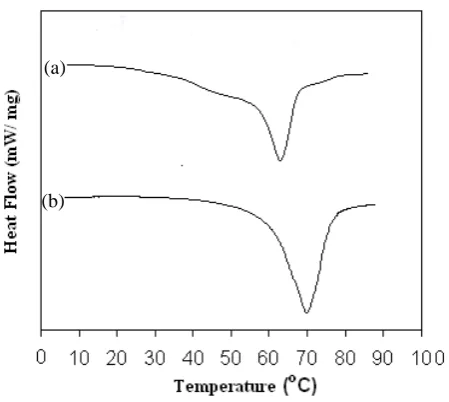
Fig. 5: DSC thermogrames: (a) pure PEO, (b) SPE OCC: (70PEO: 30KBrO3)
Figure 5 shows the DSC thermogrames for the pure PEO and SPE OCC. The broad endothermic peak was observed in SPE OCC at ~ 69 -70 oC and it is corresponding to the melting point
temperature of pure PEO. The slightly shifting in the melting
point temperature towards higher side is due to the complexation of K+ ion to the ether oxygen of pure PEO and it is
also indicative the confirmation of polymer-salt complexation.
Fig. 6: TGA curves: (a) pure PEO and (b) SPE OCC: (70PEO: 30KBrO3
(a)
)
(b)
(b)
84
Figure 7 shows the temperature dependent conductivity measurements on SPE films: (1-x) PEO: x KBrO
from the figure that the total weight loss for pure PEO is larger as compared to both SPE host and NCPE OCC. The total weight loss for
pure PEO is ~ 95 % and SPEOCC is ~ 70 %. The thermal stability of polymer is improved by the polymer-salt complexation
3. The conductivity
The sudden jump in conductivity at this temperature corresponds to semi-crystalline to amorphous phase transition temperature (Tm) of
pure PEO. The linear portion of ‘log σ -1/T’ plots below Tm
log σ = log σ
can be expressed by Arrhenius type equation:
o exp (- Ea/ kT) [Scm-1] (1)
-8
-7.5
-7
-6.5
-6
-5.5
-5
-4.5
-4
-3.5
-3
2.6
2.8
3
3.2
3.4
Log
σ
(S
/c
m
)
1000/T (K
-1)
Fig. 7: ‘Log - 1/T’ plots for SPEs: (1-x) PEO: x KBrO3. x = 5 (□), 10 (▲), 15 (×), 20 (■), 25 (o), 30 (●), 35 (+)
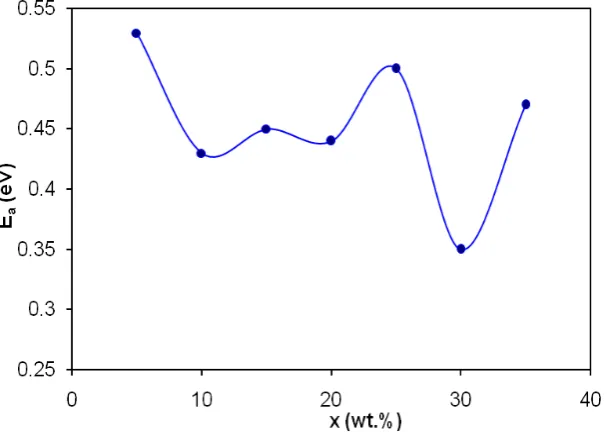
Fig. 8: Variation of activation energy (Ea) as a function of x
where σo is the pre-exponential factor, k is the Boltzmann constant
and Ea is the activation energy (in eV). The Ea values, for all the
compositions, were computed from linear least square fitting of the above equation and plotted as a function of x, as shown in Figure 8. The SPE OCC shows low activation energy Ea~ 0.35 eV, is due to the
increase in degree of amorphicity as compared to the other
85
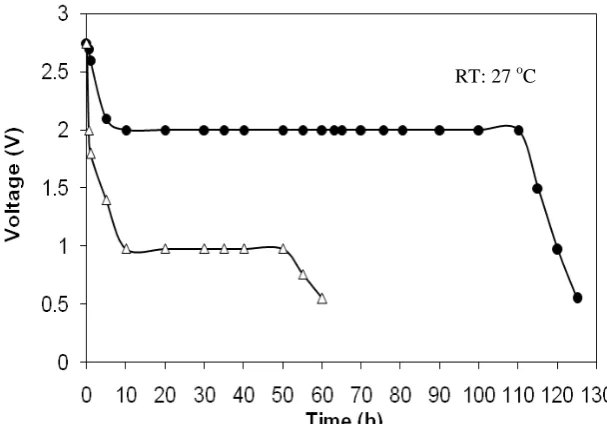
Fig. 9: Cell potential discharge profiles for the thin film solid state battery: K / (70PEO: 30KBrO3) / (C+I2
[
+Electolyte) under 100 kΩ (●)
and 50 kΩ (Δ) loads
The initial sharp decrease in voltage of these thin film solid-state batteries may be due to the initial cell polarization effect and/ or the formation of a thin layer of potassium salt at the electrode/ electrolyte interface. The some important cell parameters calculated
in the plateau region of the discharge profiles are listed in Table 2. On the basis of cell parameter studies, one can clearly note that the performances of the batteries have been relatively superior and quit satisfactorily during low current drain states.
[
Table 2: Some important cell parameters for the thin film solid state battery Load(kΩ) Working Voltage(V) Current Density
(μA.cm-2) Discharge Capacity (μA.h) Power Density (mW.kg-1) Energy Density(mWh.kg-1)
100 2.00 1.6 228 24.53 2797
50 0.98 0.78 44.1 5.89 265.14
[
CONCLUSION
A new hot-pressed solid polymer electrolyte: (70PEO: 30KBrO3
1. Scrosati B. Applications of electroactive polymers. London: Chapman and Hall; 1993.
) (wt. %) has been synthesized. The conductivity enhancement in SPE OCC is due to the increase in both ionic mobility and mobile ion concentration. XRD, SEM, DSC, TGA studies have been confirmed the polymer-salt complexation. The ion conduction mechanism in SPE film has been explained on the basis of experimental studies on some basic ionic parameters viz. σ, μ and n. A thin film solid-state battery discharge characteristics have been studied under varying load conditions and the cell performed quit satisfactorily under low current drain states.
REFERENCES
2. Armand MB, Chabagno JM, Duclot JM, editors. Fast Ion Transport in Solids. North Holland; 1979.
3. Khan MS, Shaoor A, Nisar J. Conductance study of PEO and PPO-based polymer electrolytes. Ionics 2010; 16: 539.
4. Sreekanth T, Reddy MJ, Rao UVS. Polymer electrolyte system based on (PEO+KBrO3
5. Fenton DE, Parker JM, Wrigth PV. Complexes of alkali metal ions with PEO. Polymer 1973; 14: 589.
) -its application as an electrochemical cell. J Power Sources 2001; 93: 268.
6. Armand MB. Polymer Electrolyte Reviews. London:
Amsterdam; 1987.
7. Hashmi SA, Chandra S. Experimental investigations on a
sodium ion conducting polymer electrolyte based on PEO complexed with NaPF6
8. Bhide A, Kariharan K. A new polymer electrolyte system
(PEO)n: NaPO
. J Materials Sci and Engg B 1995; 34: 18.
3
9. Mohapatra SR, Thakur AK, Choudhary RNP. Studies on
PEO-based sodium ion conducting composite polymer films. Ionics
2008; 14: 255.
. J Power Source 2006; 159: 1450.
10. Appetecchi GB, Hasson J, Scrosati B, Salomon M, Cassel F
114:
105.
11. Agrawal RC, Chandra A. Ion transport and electrochemical cell
performance studies on hot-press-synthesized Ag+
12. Agrawal RC, Chandra A, Bhatt A, Mahipal YK. Investigations on ion transport property and battery discharge characteristics studies on hot-pressed Ag
ion conducting electroactive polymeric membranes: (1-x) PEO : x [0.7(0.75AgI:0.25 AgCl):0.3 MI]. J Phys D Appl Phys 2007; 40:
7024.
+ ion conducting nano-composite
polymer electrolytes: (1-x) [90PEO:10AgNO3] : x SiO2
13. Chandra A, Agrawal RC, Mahipal YK. Ion transport property studies on PEO-PVP blended solid polymer electrolyte membranes. J Phys D Appl Phys 2009; 42: 135107.
. New J Physics 2008; 10: 043023.
14. Chandra A. Hot-pressed polymer electrolytes: Synthesis and characterization. Germany: Lambert Academic Publisher; 2010. 15. Chandra A. Hot-pressed Na+ ion conducting solid polymer
electrolytes: (1-x) PEO: x NaPO3
16. Watanable M, Sanui K, Ogata N, Kobayashi T, Ontaki Z . Eur Phys J Appl Phys 2010; 50: 21103.
1985; 57: 123.
17. Chu PP, Reddy JM, Kao HM. Novel composite polymer
electrolyte comprising mesoporous structured SiO2 and
PEO/Li. Solid State Ionics 2003; 156: 141.