Wavelet-Based Digital Image Fusion
on Reconfigurable
FPGA Using Handel-C Language
R. Arunmozhi M.E.
Assistant Professor, Department of Electrical Engineering Annamalai University, India
Email: [email protected]
Dr. G. Mohan
Professor, Department of Electrical Engineering Annamalai University, India
Email: [email protected]
Abstract - Field Programmable Gate Array (FPGA)
technology has become a viable target for the implementation of real time algorithms in different fusion methods have been proposed mainly in the fields of remote sensing and computer vision. Image fusion is basically a process where multiple images (more than one) are combined to form a single resultant fused image. This fused image is more productive as compared to its original input images. In most paper image fusion algorithms were implemented in simulation level only. In this paper Wavelet based Image fusion algorithm is employed and implemented on a Field-Programmable-Gate-Array-based hardware system using a Xilinx Platform Studio EDK 11.1 FPGA Spartan 3E is implemented. The FPGA technologies offer basic digital blocks with flexible interconnections to achieve high speed digital hardware realization. The FPGA consists of a system of logic blocks, such as Look up Tables, gates, or flip-flops and some amount of memory. The algorithm will be transferred from computer to FPGA board using JTAG cable. In this proposed work algorithm is developed by using Handle –C language to performing wavelet based image fusion. The result will be transferred back to system to analyze hardware resource taken by FPGA.
Keywords — Image Fusion, Field Programmable Gate Array (FPGA), Image Processing Algorithms, MATLAB Simulation, Embedded Development Kit, Advanced RISC Machine.
I. INTRODUCTION
1.1 Image Fusion
Image fusion is an important research topic in many related areas such as computer vision, automatic object detection, remote sensing, image processing, robotics, and medical imaging. Multi-sensor image fusion is the process of combining relevant information from several images into one image. The final output image can provide more information than any of the single image as well as reducing the Signal-to-Noise Ratio. The user can collect useful information without gazing at and comparing images from multiple sensors. The fast development of the technique of sensors, micro-electronics, and communication requires more attention on information fusion. Several situations in image processing require high spatial and high spectral resolution in a single image. For example, the traffic monitoring system, satellite image system, and long range sensor fusion system all use image processing.
Several situations in image processing require high spatial and high spectral resolution in a single image. For example, the traffic monitoring system, satellite image system, and long range sensor fusion system all use image
processing. However, the majority of available equipment is not capable of providing this type of data convincingly. The sensor in the surveillance system can only provide the scenery view in a narrow depth for a particular focus, yet the demanding application of this system requires a clear view with a high depth of the field. Image fusion provides the possibility of combining different sources of information.
1.2 Evolution of fusion techniques
The evolution of the research work into the field of image fusion can be broadly put into the following three stages
Simple Image Fusion
Pyramid Decomposition based fusion
Discrete Wavelet transform based fusion
The algorithms implemented and discussed here are such that all the three of the above categories are covered for assessment. The primitive fusion schemes [9] perform the fusion right on the source images. This would include operations like averaging, addition, subtraction and omission of the pixel intensities of the input images to be fused. These methods often have serious side effects such as reducing the contrast of the image as a whole. But these methods do prove good for certain particular cases wherein the input images have an overall high brightness and high contrast. The primitive fusion methods considered were
Averaging Method
Select Maximum
Select Minimum
With the introduction of pyramid transform in mid-80's, some sophisticated approaches began to emerge. People found that it would be better to perform the fusion in the transform domain. Pyramid transform appears to be very useful for this purpose. The basic idea is to construct the pyramid transform of the fused image from the pyramid transforms of the source images, and then the fused image is obtained by taking inverse pyramid transform. Pyramid transform could provide information on the sharp contrast changes, to which the human visual system is particularly sensitive to and It could also provide both spatial and frequency domain localization. The pyramid fusion methods considered here were
Laplacian Pyramid
Ratio-of-low-pass Pyramid
Gradient Pyramid
FSD Pyramid Morphological Pyramid etc.
Copyright © 2013 IJECCE, All right reserved support. The couple of wavelet transform methods
considered here are
Haar Wavelet transform method
Daubechies wavelet transform method.
II. FIELD
PROGRAMMABLE
GATE
ARRAY
2.1 Introduction to FPGA
The FPGA provides large arrays of programmable logic resources that can be programmed an unlimited number of times. The Configurable Logic Blocks (CLBs) inside each FPGA chip can be used to implement sequential or combinational logic. The CLBs of the Xilinx 4000 family chip contain two flip-flops and two function generators. The functionality of the CLB is established by programming Static Random Access Memory (SRAM) bits within the CLB that control multiplexers for signal routing or look-up tables to define the function generators. More complicated sequential or combinational logic functions can be implemented by programming the interconnections and logic of the CLBs in the array. Input/Output Blocks (IOBs), allow connection to the pins of the chip. Spartan-3 EDK Development Board utilizes Xilinx Spartan-3 XC3S200-4TQ144 device.
In the fields of remote sensing and computer vision applications we require image fusion technique. In this work such technique will be implemented in FPGA platform using Handel C language. The image will be transferred from computer to FPGA board using JTAG cable. After performing the required process the result will be transferred back to comuter. Both Matlab and FPGA results will be validated. The implementation uses basic blocks registers, adders, multipliers, control logic, UART transmitter and receiver etc. The work aims to setup an image processing platform on FPGA hardware. The results shall demonstrate the performed operation on FPGA, and validate the implemented architecture.
2.2 FPGA using Handel-C
FPGAs have traditionally been configured by hardware engineers using a Hardware Design Language (HDL). The two principal languages used are Verilog HDL (Verilog) and Very High Speed Integrated Circuits (VHSIC) HDL (VHDL) which allows designers to design at various levels of abstraction. Verilog and VHDL are specialized design techniques that are not immediately accessible to software engineers, who have often been trained using imperative programming languages. Consequently, over the last few years there have been several attempts at translating Algorithmic oriented programming languages directly into hardware descriptions.
Given the importance of digital image processing and the significance of their implementations on hardware to achieve better performance, this work addresses implementation of image processing algorithms like on wavelet base image fusion on FPGA using Handel-C language. Also novel architectures for the above mentioned image processing algorithms have been proposed. The wavelet based image fusion algorithm implementation is compared at simulation and synthesis
levels with other hardware descriptive languages. The Handel-C implementation is compared with Verilog.
2.3 Discrete Wavelet Transform Techniques
The two-dimensional discrete wavelet transform is becoming one of the standard tools for image fusion. The DWT is computed by successive low pass and high pass filtering of the digital image or images. This is called the Mallat algorithm or Mallat-tree decomposition. Its significance is in the manner it connects the continuous time multi resolution to discrete-time filters. The principle of image fusion using wavelets is to merge the wavelet decompositions of the two original images using fusion methods applied to approximations coefficients and details coefficients.
Fig.1. Block diagram of a generic wavelet-based image Fusion approach.
The source image is decomposed in rows and columns by low-pass (L) and high-pass (H) filtering and subsequent down sampling at each level to get approximation (LL) and detail (LH, HL and HH) coefficients. Scaling function is associated with smooth filters or low pass filters and wavelet function with high-pass filtering.
1,2,3---Decomposed Level H--- High Frequencey Band L--- Low Frequencey Band
Wavelet transforms provide a framework in which an image is decomposed, with each level corresponding to a coarser resolution band.
III. DESIGN
IMPLEMENTED ON
FPGA
Processing IP and Micro Blaze Soft Processor Core -Pre-verified IP catalog, including a wide variety of processing peripheral cores for customizing your embedded systems as well as the flexible Micro Blaze 32-bit soft processing core. The Micro Blaze processor offers memory management and FPU configuration options enabling commercial grade RTOS support, unique for a soft processor
3.1 Hardware Development
Xilinx FPGA technology allows you to customize the hardware logic in your processor subsystem. Such customization is not possible using standard off-the-shelf
microprocessor or controller chips. The term “Hardware platform” describes the flexible, embedded processing subsystem you are creating with Xilinx technology for your application needs. The hardware platform consists of one or more processors and peripherals connected to the processor buses. XPS captures the hardware platform description in the Microprocessor Hardware Specification (MHS) file. The MHS file is the principal source file that maintains the hardware platform description and represents in ASCII text the hardware components of our embedded system. When the hardware platform description is complete, the hardware platform can be exported for use by SDK.
3.2 Software Development
A Board Support Package (BSP) is a collection of software drivers and, optionally, the operating system on which to build by our application. The created software image contains only the portions of the Xilinx library you use in your embedded design. You can create multiple applications to run on the BSP. The hardware platform must be imported into SDK prior to creation of software applications and BSP.
IV. ALGORITHM
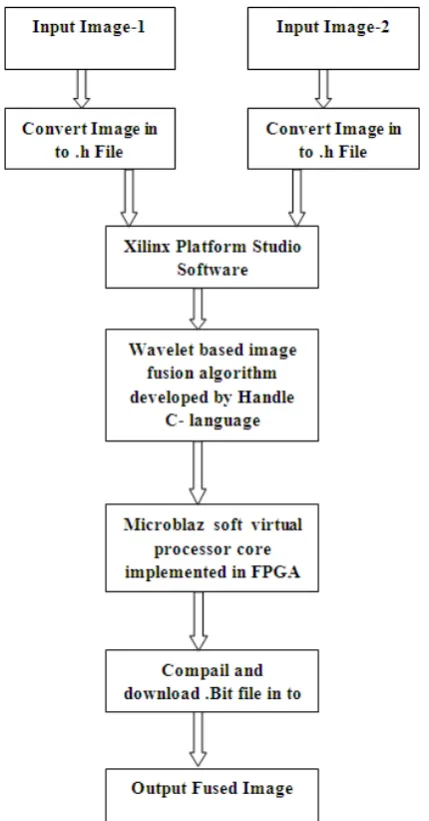
Step I: Input image: 1 is preprocessed by Matlab and converted in to matrix format. (Image size 256 x 256).
Step II: Input image: 2 is preprocessed by Matlab and converted in to matrix format. (Image size 256 x 256).
Step III: Xilinx Platform Studio is used to implement software core processor.
Step IV: HDL Coding is developed in Handle C language.
Step V: Compile HDL coding by using Xilinx Platform Studio to create .bit file and download into FPGA.
Step VI: Output of FPGA is stored in SRAM and post processed by Matlab. (Output image size 256x256)
Step VII: The output of SRAM feed to MATLAB to analyze output fused image.
V. RESULTS/ANALYSIS OF
WAVELET
BASED
IMAGE
FUSION
METHOD
Pixel level image fusion methods are affected by blurring effect which directly affect on the contrast of the image. These methods are generally time consuming as they require more number of computations. The number of
Fig 2 Proposed Block diagram of design implemented on FPGA
Field-Copyright © 2013 IJECCE, All right reserved Programmable-Gate-Array-based hardware system using a
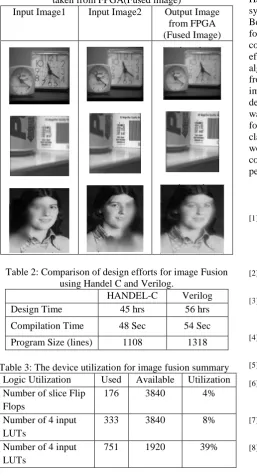
Xilinx Platform Studio EDK 11.1 FPGA Spartan 3E is implemented, the system is connected to a USB port of a personal computer, which in that way form a powerful and low-cost design station. Image processing algorithms are conventionally implemented in DSP, ARM processors and some special purpose processors. However all these implementation styles are limited by throughput which becomes very critical parameter for several image processing applications. The image will be transferred from computer to FPGA board using JTAG cable. After performing the required process the output fused image will be transferred back to computer .In this work Output image from FPGA, hardware resource of the FPGA Spartan 3E and Comparison of design efforts for wavelet based image fusion using Handel C and Verilog is shown in Table1, 2 & 3.
Table 1: Input image1, Input image2 and Output image taken from FPGA(Fused image)
Input Image1 Input Image2 Output Image from FPGA (Fused Image)
Table 2: Comparison of design efforts for image Fusion using Handel C and Verilog.
HANDEL-C Verilog
Design Time 45 hrs 56 hrs
Compilation Time 48 Sec 54 Sec
Program Size (lines) 1108 1318
Table 3: The device utilization for image fusion summary Logic Utilization Used Available Utilization Number of slice Flip
Flops
176 3840 4%
Number of 4 input LUTs
333 3840 8%
Number of 4 input LUTs
751 1920 39%
Total Number of 4 input LUTs
1700 3840 42%
Number used as Logic
890 Number used as Shift registers
162 Number of bonded
IOBs
85 141 60%
IOB Flip Flops 10
Number of GCLKs 1 8 12%
VI. CONCLUSION
In this work, wavelet based image fusion algorithm implemented on Xilinx platform studio EDK 11.1 FPGA Spartan 3E . It has been observed from the results that Handel-C performance for wavelet based image fusion in synthesis level is better than Verilog implementations. Besides, Handel-C language is introduced as a language for Software Engineers to quickly prototype software concepts in hardware using behavioral model. Our current efforts to efficiently implement image processing algorithms in both input image and output image taken from FPGA and synthesizing. proposed wavelet based image fusion processor on Xilinx Spartan3 FPGA chip demonstrated the efficiency of proposed architecture for wavelet based image fusion gray scale 256×256 images for real-time image processing applications.. However, the class of image processing algorithms considered in our work is limited to basic algorithm and further work on complex image processing algorithms need to be performed.
R
EFERENCES[1] Dimitrios Besiris, Vassilis Tsagaris, Member, IEEE, Nikolaos Fragoulis, Member, IEEE, and Christos Theoharatos, Member:,”An FPGA-Based Hardware Implementation of Configurable Pixel-Level Color Image Fusion” IEEE Transactions On Geoscience And Remote Sensing, Vol. 50, No. 2, February 2012.
[2] Arash Nosrat , Yousef S. Kavian “Hardware Description of Multi-Directional Fast Sobel Edge Detection Processor by VHDL for” IJCAVolume 47–No.25, June 2012 .
[3] Z. Zhang, R.S. Blum, A categorization of multiscalede
composition- based image fusion schemes with performance study for a digital camera application, Proc. IEEE87 (8) (1999) 1315–1326.
[4] Ramesh, K.P., Gupta, S., Blasch, E.P., "Image Fusion Experiment for Information Content," Proc, Information Fusion, 2007 10thInternational Conference: 1 - 8,2007.
[5] Filip Šroubek, Jan Flusser, Barbara Zitová,” Image fusion: a powerful tool for object identification," 2007”.
[6] Nguyen, D., Halupka, D., Aarabi, P. and Sheikholeslami, A. 2006. Real-Time Face Detection and Lip Feature Extraction Using Field-Programmable Gate Arrays. IEEE Transactions on Systems, Man, and Cybernetics.
[7] Ramesh, K.P., Gupta, S., Blasch, E.P., "Image Fusion Experiment for Information Content," Proc, Information Fusion, 2007 10th International Conference: 1 - 8,2007.
[9] V. Tsagaris, V. Anastassopoulos, and G. Lampropoulos, “Fusion of hyper spectral data using segmented PCT for enhanced color representation,”IEEE Trans. Geosci. Remote Sens., vol. 43, no. 10, pp. 2365–2375, Oct. 2005.
[10] V. Tsagaris and V. Anastassopoulos, “Multispectral image fusion for improved RGB representation based on perceptual attributes,”Int. J. Remote Sens., vol. 26, no. 15, pp. 3241–3254, Aug. 2005.
AUTHOR
’
SPROFILE
R. Arunmozhi
received B.E. in Electrical Engineering in 2005 and ME in Process Control and Instrumentation from Annamalai University, Annamalai Nagar, Chidambram in 2010. He is working as an Assistant Professor in Department of Electrical Engineering, Annamalai University, Annamalai Nagar, Tamil Nadu. His research interest is in the area of Image processing and VLSI design.