INTRODUCTION
T
he field of education cannot deny the importance of life sciences, which are constantly not only used to understand and make sense of nature but also accepted to be the fundamentals of natural sciences. There have been several studies conducted with the aim of teaching life sciences better (Osborne et al., 2003). Despite all these efforts, the academic success of students is often not at the desired level (Aksakalli et al., 2016). It could be argued that education, which is generally accepted as a fundamental right based on its contribution to personal development and human enrichment and provided by the state as a public service, has gained a pragmatic and functional nature (Sağıroğlu, 2008). In this sense, it is desired that education and training have central role in an individual’s adaptation to the changes they encounter. They should be able to make these changes by gaining the necessary knowledge and skills from their education. Education should encourage individuals to gain new information. Therefore, education is expected to provide the knowledge and skills that will allow individuals to adapt to the information society, the learning society, and changes and transformations in economics and technology. This situation leads to an increase in the importance paid to education, and in parallel to this, it leads capital sources to consider education as a new investment area, a profitable sector (Ercan, 1998). The increasingly prevalent nature of education as a tool of investment rather than a public service leads the individual to see the education as a private tool for investment. In other words, education cannot go beyond a perception of profit forproducers (Ercan, 1998). Thus, it is defined as an individualistic concept by an approach based on profitability, effectiveness, efficiency, and rationality, and it turns into merchandise that is utilized to the extent of the costs covered. In this process where education turns into a market, the entire responsibility in science education and education in general are considered to belong to the individual. Rubenson (2009) argued that paying attention to learning rather than education holds the individual entirely responsible for learning, and this rationalizes individuals’ behavior to hold themselves responsible for failure in both education and business, as well as negative feedbacks. Marketization of education leaves schools in the hands of the markets and the resulting transformation of schools into businesses. This presents a reality that may be neglected by parents and students who are some of the main partners of the process of education and training. The position of education as a new investment tool and a high-value merchandise for capital has led to transformations in the content of science education. This approach is an obstacle between the individual and science education, which is required to understand both nature and self. This instrumentalizes education and turns toward more profit rather than serving people of knowledge and social development (Ball, 2007). In other words, education loses its social quality and becomes merchandise, and science education becomes something that is marketed with the necessity of achieving economic development and gaining competitive advantage internationally (Ercan and Uzunyayla, 2009). As a result of this, it will inevitably encounter outcomes that will fall out of favor and be excluded from education (Ercan, 1998).
Purpose: This study used the qualitative method of a case study with the purpose of investigating the effects of science teaching based on critical pedagogy principles on the classroom climate. Method: The samples of the study consisted of 20 eighth-grade students enrolled in a middle school located in the Yakutiye district of the province of Erzurum, Turkey. This school was chosen with the non-random sampling method of convenience sampling. The science and technology course was provided to the students during 1 year of the study (32 weeks). This course was based on critical pedagogy principles. The study used observations to collect data. Findings: As a result, it was found that science education based on critical pedagogy principles affected the classroom climate positively and the classroom climate showed improvements in the positive direction through time. Recommendations are provided as a result of this study.
KEY WORDS:classroom climate; critical pedagogy; science education; middle school
The Effects of Science Teaching based on Critical Pedagogy
Principles on the Classroom Climate
Ayhan Aksakalli*
Science Teacher, Ministry of Education, Erzurum, Turkey
*Corresponding author: [email protected]
The neoliberal approach aims to change the contents and goals of education, making it more compliant with the needs of the economy. This has been referred to by the phrase “form a curriculum with the mind of a business.” Schools are increasingly acting like a typical company, and considering their students as passive primates of the curriculum (Ball, 2007).
When it is thought that neoliberal concerns are not only limited to education but also that society is changing at a rapid pace, it is concluded that critical brains are created, and individuals must realize themselves, increase the quality of education, and liberate education from the marketplace to capture a liberating environment (Giroux, 2007). The global transformation process, in which changes and transformations are experienced for political, economic, cultural, scientific, and social spheres, also affected science education and the individuals representing it (i.e., students and teachers). The neoliberal concerns mentioned above made the necessity for a new paradigm an issue of consideration by causing these changes in all areas of the society (Kesik and Bayram, 2015 ). Nevertheless, it is a fact that the process of making the desired changes in the behaviors of individuals has emerged (Ertürk, 1972; Sönmez, 1998). Because of many criticisms (Öngel, 2003), education needs new definitions, supported by these critics and different disciplines. Here, an alternative education model arises in the approach of critical pedagogy, which acts with the purpose of individuals being able to self-realize within science education, develop a critical point of view for the reality they are in, and find a pragmatic equivalent for it in the outside world (Sağıroğlu, 2013).
Critical Pedagogy
I would argue that humans are constantly evolving and that we cannot ignore this, and as a result, traditional pedagogy is criticized. The basic argument of traditional pedagogy is based on the behavioral approach (Baum, 2005). According to this pedagogy, education is defined as the process of changing behavior in the desired direction. That is, education is limited to shaping the individuals. However, this definition of education is considered to keep the individual away from the power of critical thinking. There are two parts of this approach that I argue need to be questioned: who wants these behavioral changes and the ambiguous meaning of the word “shaping” (Yılmaz and Altınkurt, 2011). For example, İllich (2009) who supports a deschooled society and Baker (2006) who opposed compulsory education argue that schools are often a form of moral and religious formatting done on individuals by persons who have certain interests. According to libertarian educators, schools managed by the state and the curricula used in these schools train or shape individuals who are not able to express themselves, are shy and obedient, and have low self-esteem (Chomsky, 2007). However, education should be a tool of liberation rather than formatting. In this sense, theoreticians of libertarian pedagogy see education as a tool of humanization. One of the movements considered as liberating pedagogy is critical pedagogy (Yılmaz and Altınkurt, 2011).
We may consider critical pedagogy, in general, as an interpretation of education which discusses problems in education (Yılmaz and Altınkurt, 2011). Critical pedagogy aims to create a new interpretation of education by reevaluating the existing definitions of education. In this process, it looks for the answers to these questions: (i) Why are we doing the things we do in education? (ii) Why are we doing these with the known classical or traditional approach? And (iii) What is the actual purpose of the state while providing education? (Giroux, 2009). According to McLaren (1993), educational institutions such as schools are not only areas of indoctrination, socialization, or education but also they appear as a cultural area that may empower students and encourage them to transform themselves. Critical pedagogy problematizes education, politics, and educational practices, and the relationship between reproductions of power relations in daily life and classrooms (Fischman and McLaren, 2005). In addition, critical pedagogy argues that the curriculum in schools approaches information in a technical way by isolating of it from power, and the curriculum does not include the fact that information is an ideological construct that is related to certain interests and social relationships. Moreover, critical theory asserts that the information obtained in school is never objective or impartial, as it is organized and structured in certain forms (McLaren, 2003). According to Althusser (1991), the school, therefore, education, is the strongest among ideological instruments in terms of its effects, and it provides the students with accepted ideological templates through teachers and textbooks. Therefore, it accompanies the policies of the groups that form and plan the dominant paradigm by approving the values of this paradigm (İnal, 2010).
Education is an arena, an area of fighting and compromise where power and ideology are intertwined, and it has an ideological role in shaping the thoughts of individuals (Apple, 2004). It achieves this shaping through strict inspection practices and curricula which make it possible to indoctrinate everyone with uniform and desired values. Nevertheless, the curriculum makes it possible to hold students and teachers responsible by measurements over tangible outputs in the areas of skill in question and shape them around accepted phenomena and factual information, while the things that determine the transformation in the curriculum are the marked and liberal economic policies (Apple and Beane, 2011).
large supermarket (Apple, 1982). With the same logic, Giroux (2009) argued that citizenship and the market are considered in the same sense, and young people are turning into consuming subjects instead of thinking and critical subjects. In such a system, education is naturally turned into an object of trade that can be bought and sold (Apple, 2009).
According to Freire (2009), an educator who defends critical pedagogy is a libertarian educator. In both traditional and libertarian pedagogues, the fundamental goal is to provide individuals with skills and qualities (Yılmaz and Altınkurt, 2011). However, while the traditionalist education system does this based on its conservations, the libertarian educator tries to do this by considering student expectations (Freire, 2009). The libertarian educator is focused more on concepts of autonomy of the individual, self-realization, self-management and control, knowing oneself, self-esteem, and multidimensional development of personality. In addition to the work of education as an economic issue, the educator pays more importance to its social, cultural, and educational characteristics. In addition, the critical educator achieves development of an individual in a way that will ensure their multidimensional and autonomous improvement and provide qualities of being able to determine their future (Özsoy, 2004).
For Giroux (2009), the purpose of critical pedagogy is to transform educational practices and schools with the aim of creating an environment in which students and teachers are able to question effectively and discuss the relationships between theory and practice, critical analysis and common sense, and learning and social transformation. In terms of student and teacher relations, there are significant differences between traditional and critical pedagogues. In traditional pedagogy, the relationships between the teacher and students are authoritarian and they resemble the power and status relationships in the society. There is a hierarchical order in the education environment. In traditional pedagogy, students accept the information provided to them without much questioning. In other words, not only are their critical skills not improved but also this improvement is not encouraged (Yılmaz and Altınkurt, 2011). According to Freire (2010), traditional pedagogy is based more on memorization. In this system, students are rather seen as empty containers to be filled by teachers. The more the teacher fills the container, the better the teacher they are. Freire (2010) defined this type of education as the banking concept of education. In such as system, education is a savings investment, students are investment objects, and teachers are investors. Freire (2010) summarized student and teacher roles in this model as follows: 1. The teacher teaches, and the students take lessons, 2. The teacher knows everything, and the students know
nothing,
3. The teacher thinks, and the students are thought about, 4. The teacher speaks, and the students calmly listen, 5. The teacher disciplines, and the students are disciplined, 6. The teacher chooses, and the students comply,
7. The teacher chooses the curriculum, and the students
conform,
8. The teacher is the subject of the learning process, and the students are only objects of it.
The traditional banking model of education considers people as beings that are to be influenced. In this model, as students are busy with memorizing the information provided to them, they lose their critical thinking skills (Yılmaz and Altınkurt, 2011). As opposed to the banking model of education which prevents creativity and domesticates students, the critical approach sees the student as the subject of learning how to read and write as an act of knowing and creating (Freire and Macedo, 1998). In the critical approach, the main concept is “dialogue.” According to Freire (2006), dialogue is an existential necessity. We humanize ourselves through dialogue with others (Roberts, 2003). Critical thinking is essential for dialogue to turn into a humanizing praxis (Sağıroğlu, 2013). Freire (2006) argued that dialogue is a confrontation in which dialoguers direct their common thoughts and act toward a world to be transformed and humanized. Therefore, dialogue cannot be reduced to an act of one person loading their ideas onto the other or a simple exchange of ideas that are consumed by debaters. Dialogue imagines dialectical change where ideas shape and change while learners are thinking about their thoughts or interpreting their interpretations (Berthoff, 1998). The critical approach has led to the birth of a new approach by eliminating the terms “the teacher of the students” and “the students of the teacher.” Teachers are no longer the ones who teach and students are no longer the ones who are taught, and education becomes a process where both the teacher and students are teaching and learning. In this process, students are no longer passive listeners, and they become partners of critical inquiry in dialogue with the teacher. The teacher provides the material to the students, and while thinking on this material and expressing comments, the teacher re-evaluates prior convictions (Freire, 2006).
Classroom Climate and the Objective of the Study
that is directly affected by various variables such as the physical conditions of the classroom, its organization, social variables related to the class, and materials in the classroom (Adelman and Taylor, 2005). In addition to the above, classroom climate is also intertwined with the political, social, cultural, and economic context surrounding the school (Adelman and Taylor, 2005; Lee, 2005). The use of the concept of “class climate” has been deemed appropriate for this research. A search of the literature has found no study which investigated the effects of science teaching based on critical pedagogy principles on the classroom climate. Hence, this study sought to answer the following questions:
1. How does science teaching based on critical pedagogy affect the classroom climate?
2. How does science teaching based on critical pedagogy transform the classroom climate over time?
METHODS
The qualitative method of a case study was used in this study. A case study is a qualitative research approach in which the researcher investigates a certain case or cases in a certain time using data collection tools such as observations, interviews, documents, and reports, where cases and themes related to the cases are defined (Merriam, 2009). While a case study design can investigate a case, a practice such as the one that is the focus of this study is suitable for case study (Marshall and Rossman, 2006). The researcher has been working as a science teacher for 21 years.
Why Used the Case Study for this Research?
Hayes (2000) noted that the case study method often involves simply observing what happens to or reconstructing “the case history” of a single participant or group of individuals (such as a school class or specific social group). Case studies allow a researcher to investigate a topic in far more detail than might be possible if they were trying to deal with a large number of research participants. The case study is not itself a research method, but researchers select the methods of data collection and analysis that will generate material suitable for case studies such as qualitative techniques (semi-structured interviews, participant observation, and diaries), personal notes (e.g., letters, photographs, and notes), or official document (e.g., case notes, clinical notes, and appraisal reports). The data collected can be analyzed using different theories (e.g., grounded theory), interpretative phenomenological analysis, text interpretation (e.g., thematic coding) etc. The data collected in this study were analyzed by using descriptive statistics. The findings were presented to the reader with the help of tables and graphs.
The Sample
The sample for this study consisted of 20 eighth-grade students enrolled in the same class in a state school in the province of Erzurum, Turkey. These students were 14-year old, of which twelve were male and eight were female.
Data Collection Tools
The students were observed to observe the effects of science teaching based on critical pedagogy on the classroom climate. The researcher developed a structured observation form for the study, where the method of participant observation was used. In the process of developing the observation form, the scales developed by Fraser (1998) and Beamon (1993) were examined, and these scales were utilized while forming the items and categories. The observation form consisted of four categories: The role of the teacher, student reflections, subject-object distinction, and the curriculum. The items in the observation form were created by three educators who hold a doctorate in physics education. A total of 64 items in the four categories mentioned above were analyzed by a professor who is an expert in their field, and the number of items was reduced to 51. These categories included 21, 11, 11, and 8 items, respectively. These items were in the form of a 5-point Likert-type scale: Always, usually, sometimes, rarely, or never. This observation form was filled out by the researcher once a week. This resulted in a total of 32 observation forms for the 32-week study.
Data Analysis
The items in the observation form were coded as 5 for “always,” 4 for “usually,” 3 for “sometimes,” 2 for “rarely,” and 1 for “never,” and they were transferred to the Statistical Package for the Social Sciences software version 20. The data were analyzed using descriptive statistics, and mean and standard deviation values were calculated. The obtained data are discussed in the finding section separately for the given categories.
Validity and Reliability
Validity and reliability are two significant criteria that are used frequently in research to establish the credibility of the results. An important component validity includes the detailed reporting of how the data were collected and the way the researcher reached the conclusions (Miles and Huberman, 1994; Merriam and Tisdell, 2015). According to Yıldırım and Şimşek (2008), credibility and transferability are needed for validity. Methods of longitudinal interaction, depth-based data collection, diversification and expert analysis may be used to achieve credibility (internal validity). This study used the methods of longitudinal interaction and expert analysis. Longitudinal interaction was aimed with the observations that lasted for 32 weeks. The method of expert analysis was used to establish the observation form and analyze the data. According to Miles and Huberman (1994), internal consistency coefficient may be calculated to show that the data obtained from the observation form are reliable. For this study, the Cronbach’s alpha coefficient was calculated to be 0.93.
Procedure
To comply with the principles of critical pedagogy, the following procedures were carried out:
organization of desks and the seating plan for the students were entirely left to the decision of the students. While the students generally preferred a “U” shape for the seating plan, they chose the classical seating order in some weeks. 2. In the beginning of the school year, the students were
given a list of the subjects that were going to be taught during the year. The teacher and students organized the listing of the subjects together. This way, while there is a certain amount of limitation, the students expressed their opinions and requests about the curriculum. It was seen that, while the students were shaping the listing of subjects, they wanted to discuss the subjects that they encountered and heard about in daily life more frequently at earlier times.
3. While teaching science based on critical pedagogy, the issues concerning the teacher are maximizing students’ skills of asking questions, increasing their self-esteem, ensuring their opportunity to ask questions whenever they want and on whichever subject they want, and providing them with skills of approaching both the teacher and the course materials critically. The content of the class was not entirely dependent on the teacher. The class was carried out sometimes by the teacher, sometimes by one student, and sometimes by student groups of three or four. 4. An environment was created to be suitable for critical
approach of other students to the student or group carrying out the lecture and the students used their critical rights under democratic rules.
FINDINGS AND INTERPRETATIONS
Findings in the Role of the Teacher CategoryTable 1 shows the items included in the category “the role of the teacher” and the mean and standard deviation values for the comments of the observer during 32 weeks.
Table 1 shows that the mean values for all items were >4 (i.e., usually). This may be interpreted as that the teaching was carried out based on critical pedagogy principles, and the science teaching activity had a positive effect on the classroom climate. The mean values for the fifth, sixth, tenth, fifteenth, and sixteenth items on Table 1 turned out to be higher than those of the others. The common characteristic of these items was that the teacher and students approached issues critically. This is a desired situation for critical classrooms. On the other hand, the 1st, 4th, 12th, 19th, and 21st items had
relatively lower mean values. The items are related more to the cognitive skills of students and the teacher’s presentation style. While the teacher and students approached the class and content critically, this shows that they were not able to free themselves completely from previous years experiencing classical pedagogy.
Findings in the Student Reflection Category
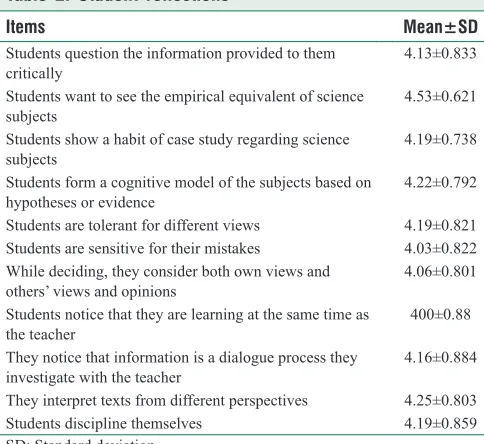
Table 2 shows the 11 items included in the category “student reflections.” Based on Table 2, it may be stated that the expectation of the students from a critical teacher who carried
out science teaching based on critical pedagogy was generally met. Accordingly, it was observed that the relationship between the student and teacher in a critical classroom, as well as expectations, had a positive nature. Especially considering the mean of the second item, it was found that the students
Table 1: The role of the teacher
Items Mean±SD
Does not present information as a piece of data 4.09±0.641 Supports creative and liberating science education 4.22±0.608 Copes with the complex social state of the classroom
environment 4.13±0.660
Holds students above the curriculum 4.09±0.689 Promotes students’ imagination 4.38±0.609 Makes students think about the subject 4.47±0.671 Leads students to make constructive criticisms 4.31±0.859 Allows students to analyze their own thinking processes 4.25±0.762 Aims to turn the relationship between theory and
practice into educational practices 4.22±0.659 Makes the right to speak available 4.44±0.619 Makes critical language available 4.38±0.66 Teaches students to interpret phenomena and events
based on available information 4.09±0.777 Analyzes prejudices and prediction regarding the
science class 4.41±0.665
Avoids oversimplification 4.31±0.693
Considers different interpretations among students 4.59±0.712 Prepares an environment that allows active participation
of all students 4.38±0.707
Ensures that students are always active 4.22±0.706 Increases the possibility of desired behavior 4.16±0.723 Allows students’ usage of their cognitive skills 4.09±0.734 Allows students to evaluate their own ways of thinking 4.28±0.634 Contributes to development of students’ skills of
analysis 4.06±0.982
SD: Standard deviation
Table 2: Student reflections
Items Mean±SD
Students question the information provided to them
critically 4.13±0.833
Students want to see the empirical equivalent of science
subjects 4.53±0.621
Students show a habit of case study regarding science
subjects 4.19±0.738
Students form a cognitive model of the subjects based on
hypotheses or evidence 4.22±0.792
Students are tolerant for different views 4.19±0.821 Students are sensitive for their mistakes 4.03±0.822 While deciding, they consider both own views and
others’ views and opinions 4.06±0.801
Students notice that they are learning at the same time as
the teacher 400±0.88
They notice that information is a dialogue process they
investigate with the teacher 4.16±0.884
They interpret texts from different perspectives 4.25±0.803
Students discipline themselves 4.19±0.859
preferred the experimental opportunities rather than the theoretical information. It is seen that the eighth item in Table 2
had a relatively lower mean. The low mean value of this item suggests that the critical teacher maintained some traditional learning style concerns.
Findings in the Subject-object Distinction Category
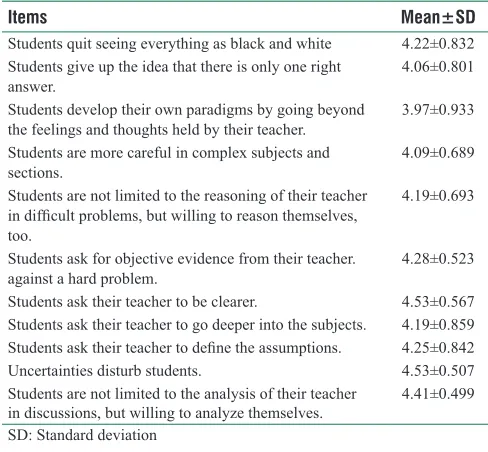
Table 3 shows the 11 items included in the category “subject-object distinction.” The high mean values of the items given
in Table 3 suggest that, in science teaching based on critical pedagogy, students were no longer objects, they questioned both the teacher and the theoretical information provided to them, they approached this theoretical information critically, and they transformed into subjects of the learning environment. A possible reason for the mean value of the third item being relatively lower could be the result of the students’ inexperience in developing paradigms as they had not been previously exposed to critical pedagogy.
Findings in the Curriculum Category
Table 4 shows the 8 items included in the category “curriculum.”
Based on Table 4, I argues that the curriculum structured based on critical pedagogy principles created a positive influence on the classroom climate. Considering the third and fourth items, the social life equivalents of the curriculum content in the critical classroom created awareness in students through the critical teacher with the critical curriculum, and this awareness was a feedback from the students. The mean value of the first item being lower than those of others may suggest that, although the curriculum was restructured with a critical approach, the contents of the curriculum narrowed the working field of the critical teacher.
The Change in the Classroom Climate Based on Time
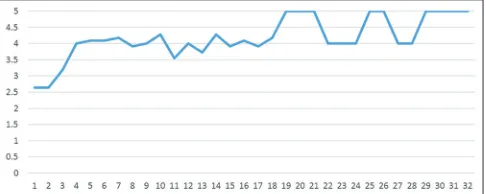
To observe how the classroom climate changed over time, the mean scores of the items in the categories were calculated for each of the 32 weeks. Line charts of these mean scores were formed. Figure 1 shows the change in the mean scores obtained in the “role of the teacher” category based on weeks.
Figure 1 shows that the teacher contributed positively to the classroom climate over the study. It is noteworthy that the mean scores showed a sharp decline in the 7th and 27th weeks. The
decline in the 7th week was due to the teachers and students
not fully complying with the process that week. The decline in the 27th week, however, was due to complete adaptation of
the students to the process, which led to their complacency and monotony. Figure 2 shows the change in the mean scores obtained in the “student reflections” category based on weeks. It may be concluded from Figure 2 that the students developed a positive reflex to the ideas and in-class approaches of the critical teacher. This suggests that student reflections for critical pedagogy give rise to a positive outcome. That is, it may be stated that improvements were seen over time in both the students’ interactions among each other and their dialogue with the teacher. The fluctuations in the mean scores toward the last
weeks may be explained by the students getting accustomed to the process. Figure 3 shows the change in the mean scores obtained in the “subject-object distinction” category based on weeks.
Table 3: Subject-object distinction
Items Mean±SD
Students quit seeing everything as black and white 4.22±0.832 Students give up the idea that there is only one right
answer. 4.06±0.801
Students develop their own paradigms by going beyond
the feelings and thoughts held by their teacher. 3.97±0.933 Students are more careful in complex subjects and
sections. 4.09±0.689
Students are not limited to the reasoning of their teacher in difficult problems, but willing to reason themselves, too.
4.19±0.693
Students ask for objective evidence from their teacher.
against a hard problem. 4.28±0.523
Students ask their teacher to be clearer. 4.53±0.567 Students ask their teacher to go deeper into the subjects. 4.19±0.859 Students ask their teacher to define the assumptions. 4.25±0.842 Uncertainties disturb students. 4.53±0.507 Students are not limited to the analysis of their teacher
in discussions, but willing to analyze themselves. 4.41±0.499 SD: Standard deviation
Table 4: The curriculum
Items Mean±SD
The teacher sees the curriculum not only as a fixed
reality, but also as a transformation in progress. 4.03±0.897 The subjects in the curriculum are listed in an order
based on fields that are dominant in the society or generally accepted.
4.13±0.793
The curriculum allows measurement of children based
on tangible criteria. 4.34±0.653
The content of the curriculum leads to social change
in learning 4.13±0.793
The curriculum aims for students to find the
equivalents of what they learned at school in public life 4.22±0.751 The curriculum creates a perception in students for the
reality they are in. 4.34±0.602
The curriculum allows students to improve their
potential 4.16±0.92
The curriculum allows students to think relationally 4.09±0.893 SD: Standard deviation
Considering Figure 3, in the beginning of the process, the teacher saw himself as the center of teaching process, i.e., a more traditional teacher approach. As the study progressed, the teacher internalized the principles of critical pedagogy and demonstrated a shift from the teacher to the students as the focus of teaching. This was noticed by the students and they started to see teaching as a combination of the two fundamental elements of the teacher and the students constantly changing place within the process. Figure 4 shows the change in the mean scores obtained in the “curriculum” category based on weeks. Figure 4 shows that the mean values fluctuated a lot. The higher rate of fluctuation in the “curriculum” category may be explained by the mandated curriculum prepared by the Turkish Ministry of National Education. In addition, a positive change was observed over time in the teacher and the students who adapted to the changes they made together in exploring the curriculum.
DISCUSSION
In this study, it was seen that, over the 32 weeks of study, generally positive changes were made in the classroom
climate. Considering the observation results in terms of the category named “the role of the teacher,” the teacher showed a transformation over time from a type of classical or traditional teacher into a more critical teacher. Indeed, I would argue that the teacher turned into one who wants their students to imagine constantly does not like the student that says yes to everything in a submissive way. More specifically, a teacher who liberates the student’s right to speak up considers different interpretations and prepares an environment for the students’ active participation. Despite all these positive developments, it was noted that not all traditional concerns were completely eliminated.
Considering the current system and the education programs in Turkey which supports teacher conservative approaches, this study teacher made an effort toward being critical. It was seen that, on occasion, their traditional identity did emerge. As a part of this traditional identity, this study highlighted instances of presented information as a piece of data, undesired levels of effort spent to elevate students over the curriculum, dominance of the authoritarian identity in teaching the students how to interpret phenomena and events, undesired levels of creating the necessary opportunities for students to use cognitive skills, and indifferent in development of analysis skills. In spite of these more traditional teaching episodes, I would argue that the teacher was generally successful in supporting critical thinking as the dominant classroom climate. This teacher created an environment similar to Seferoğlu and Akbıyık’s (2006) study by creating awareness through making learning more conscious. This study teacher did not reduce science thinking to the toolbox of a pre-packaged course and revealed a life view that is based on dialectic and in-class relations. In this sense, the study teacher was a critical teacher who noticed that they were the main implementer rather than an organic intellectual and was concerned that their discourse was not always misleading by reaching the perception that theory is independent from practice (McLaren, 2011).
This study observed a considerable change in terms of the students in the classroom based on the results of the student reflections category. Especially the critical teacher’s provision of theory and practice in a dialectical relationship and keeping these completely separate from each other appeared as a situation that was seen by the students for the first time. Accordingly, in all cases, the students stated that they wanted to see the empirical equivalent of the subjects of science that were taught. As a result of this, growth was seen over time in the macro goals of the students, as well as their desire to have a wider social reality regarding the methods, content, and structure of the course.
The efforts of the students to escape from the state of being an object in the critical classroom were not noticed. It was a noteworthy observation that they evaluated their behaviors and the information they learned based on their own interests and expectations. Gutek (2009) argued that this situation is a result that should arise in modern classrooms. Whenever possible, the students informed the critical teacher that they
Figure 2: Weekly mean values of the items in the student reflections category
Figure 3: Weekly mean values of the items in the subject-object distinction category
wanted the teacher to refer to their senses and minds. Spring (1997) interpreted this outcome as students underlying wish that the teacher gives up their authority in the classroom and gains a softer personality. Considering that the mean score in the item “the students learn at the same time as the teacher” (Table 2, item #8) in the observation form was lower than those in other items, and this is an indicator that the students were right in their complaints about this issue. Findings about critical student reflections in the critical classroom were also observed in this study. In a critical classroom, critical students tried to break the perception of an authoritarian teacher by presenting the codes of a different educational approach. They refused to rote memorize the things presented. In other words, they refused to turn into empty vessels, jugs, or containers that need to be filled by the teacher. As a result, they were far from being an investment object and seeing their teacher as an investor (Yıldırım, 2013).
In terms of the subject-object distinction category, observations were obtained to indicate the development of an awareness that they are not the objects but the subjects of teaching. In line with this result, Giroux (1979) emphasized that, at some points in the classroom environment, the teacher should transform into an object rather than a subject, and the students should transform into a subject by leaving the state of an object. There was a concern for acting together as a teacher and students, and the teacher saw student mistakes only as a problem caused by expression. The teacher observed the statement by Hegel “mistakes are the dynamics of reality.” The teacher was not only a person who injected compulsory doctrines into the students, but they were a cultural element in terms of achieving power outcomes (McLaren, 2011).
Another interesting observation in this category was the teacher-student relations in the critical classroom. The lecturing subject and the object that patiently listen were replaced by elements that are switching places and questioning. Whether the things that were told were values or empirical dimensions of reality (Yıldırım, 2013), these did not have a tendency in the process of telling to fade away or become ambiguous. The students do not want the teacher to talk about science as if it is fixed, distinct, or predictable. It was observed that, in line with the reactions from the students, the critical teacher refrained from making long, detailed explanations on subjects that were outside the existential experience of the students. The students did not want the critical teacher to “fill” them with content that was separated from their reality. Another result of the observations for the category was that the teacher turned into one who is in dialogue with the students. In particular, the teacher ceased to see objects of cognition as his private property and began to see himself and the students as objects of thought (Freire, 2006).
Despite these positive results of observations, a negative finding was that the students were not able to establish effective paradigms about the world in which they live. As a result, these students continued to see science as a constant phenomenon but not as a reality that progresses in the process.
Based on the observations obtained in the category of the curriculum, the students prepared a curriculum based on their life experiences and opportunities they may find in the public space. While the curriculum they prepared created a pleasant classroom atmosphere, it also allowed them to dialectically question the opportunities that may be provided by science teaching, which is directly concerned by life. Thus, one of the most frequent observations in this category was the goals of the students to find the public life equivalents of science subjects. As indicated in Özmen’s study (2003), to achieve permanent learning during the course of education and be able to use the learned information in new situations, it should be possible to associate the learned information with events in everyday life. Due to this, the critical curriculum and the subjects in it encouraged the students in being able to make use of these in a wider area in social life. These did not reduce science thinking to the toolbox of a pre-packaged course and revealed a life view that is based on dialectic and in-class relations.
Therefore, in the study, it was another important finding that the critical curriculum provided the opportunity of evaluating students on tangible outputs. This result of observation is supported by Hudson’s (1998) statement that students do not take information in a frozen, solid, and given form, but they actively create it. Another interesting observation was that the critical curriculum helped the students to realize themselves by creating awareness in them about the powers they possess (Kneller, 1964). It led them to an understanding in which they can improve themselves more and express their freedom-intensifying opinions. It, especially, made students take rational steps in making choices in the available subjects, ordering them, and limiting them (Postman, 1995). They shaped the curriculum based on a pragmatic approach and turned it into a perspective that they may need in their lives. A negative observation about the curriculum category was that the teacher did not see the curriculum as a transformation in progress rather than a fixed reality. This may be due to the teacher’s lack of understanding of the curriculum as an abstract universal curriculum, his lack of awareness that he has power, his lack of understanding of the reality that concepts and skills may surpass a certain content, or his failure to notice that it established a correlation between universal cognitive principles and real-life conditions.
CONCLUSION
To make critical pedagogy applicable for classrooms, first, teachers need to adopt its language. As Henry Giroux (1979) stated, it is necessary to integrate the language of criticism with the language of possibility. Teachers should establish languages of analysis that will transform the daily educational activities of the classroom, conflicts, or possibilities into change (McLaren, 2011). In other words, not only in-service teachers but also prospective teachers should look at education with a revolutionary approach. In this context, Aronowitz and Giroux (2003) highlighted two arguments for the aim of modernizing schools: (i) Seeing schools as freer public spaces and (ii) consider teachers as transformative intellectuals.
Seeing schools as free public spaces is dependent on seeing them as the main spaces where students learn the necessary information and skills and achieve liberation. Classrooms should not only be defined as an extension of various markets but also democratic public areas that promote meaningful dialogue and action and are able to provide students with opportunities to meet social expectation. As asserted by Giroux (1979), considering schools as public institutions harboring democratic teacher activities and defending progressive pedagogy presents the right justification for defending their existence. Teachers that are recognized as transformative intellectuals appear as a personality in the classroom who is concerned about the pains, struggles, and expectations of the students (McLaren, 2011). Thus, teachers establish a dialogue with students by understanding that students may also criticize, and they establish information as a structure that is meaningful and libertarian for students.
Our study questioned the curriculum in the current Turkish education system. Therefore, teachers should be willing to use and improve critical language both inside and outside the school. According to Giroux (1979), critical language not only increases teachers’ capacity but also it associates their profession with pedagogic information such as critical learning and social empowerment. It is thought to be needed to the development of a new critical discourse for the educators in Turkey push education into more radical dimensions and liberate it. Such a discourse has critical significance for educational scientists and others in terms of our school gaining a new identity. Considering the status quo we are in right now, we are aware of how many risks these discourses carry. However, to improve education and liberate it, we think that these risks are worth taking.
In this study, even though it included a small sample population, I believe that it liberated critical language for at least part of the 32 weeks. However, I believe that it is more important for this language to be more dominant in all of our schools and among all teachers. I argue that it is possible for the system to understand the teachers, the teachers to understand the students, and in general, for the society to understand each other, with the help of critical and dialogue-based language. Toward this goal, I hope that
the subjective parts of the human nature such as love, faith, connection, and loyalty are determinant; different values and opinions are accepted; the passivity of these in the iron cage of centralism and bureaucracy is broken; the understanding of a single truth is questioned (Kesik, 2014), and the desired and expected case of the transition from objects to the subjects in classroom interaction is achieved. With all these expectation, I may state the following: A sharp turn of direction may be achieved in terms of the history of education with the help of critical pedagogy, radical beginnings may take root, and a new argument of education liberated from traditional issues may be created, and this may create a difference for the schools that found themselves in the boulevards of education (McLaren, 2011) that is stuck in hopelessness and pain.
RECOMMENDATIONS
I do not have the intention of generalizing the results obtained in this study, which was conducted with only 20 eighth-grade students for 32 weeks. However, I feel that this could be considered as a pioneering study for future studies as it was carried out with the aim of guiding teachers who are thinking of employing critical pedagogy in their classroom. Considering the results obtained, the following recommendations are provided:
1. Primarily the general establishment that we call the system or the status quo should not shield itself from critical language. In this sense, teachers should be provided with this language when they are still in the institutions that educate teachers. Accordingly, while the institutions that prepare teachers should have the critical language necessary for it to become dominant among prospective teachers, they should employ the methods and techniques suitable for this.
2. In the classroom, teachers should provide their students with the opportunity to evaluate their peers, their teacher, and the curriculum applied in the course from a critical point of view (Emir, 2012).
3. Curricula should include practices and ways of evaluation that improve students’ thinking skills and pragmatic expectations of social life.
4. Specifically for the Turkish context, the Ministry of
National Education should include modern education
programs among its goals to make critical language prominent in schools and also include practices that are toward improving the higher level thinking skills of teachers.
Students who graduate from school should not have the following characteristics: Parrot learning fashion, obedient, and cannot self-actualization. It should not be acceptable to
REFERENCES
Adelman, H.S., & Taylor, L. (2005). Classroom Climate. In: Lee, S.W., (Ed.), Encyclopedia of School Psychology. Thousand Oaks, CA: Sage Publications. pp. 88-90.
Aksakalli, A., Salar, R., & Turgut, U. (2016). Investigation of the reasons of negative perceptions of undergraduate students regarding the modern physics course. European Journal of Science and Mathematics
Education, 4(1), 44-55.
Althusser, L. (1991). İdeoloji ve Devletin İdeolojik Aygıtları. İstanbul: İttihaki Yayınları.
Apple, M. (2004). Neoliberalizm ve Eğitim Politikaları Üzerine Eleştirel Yazılar. (Çev. Fatma Gök, Meral Apak, Banu Can, Dilek Çankaya, Filiz Keser, Hüseyin Ala). Ankara: Eğitim Sen Yayınları.
Apple, M., & Beane, J.A. (2011). Demokratik Okullar: Güçlü Eğitimden Dersler (Çev. Mediha Sarı). Ankara: Dipnot Yayıncılık.
Apple, M.W. (1982). Education and Power. London: Routledge and Kegan Paul.
Apple, M.W. (2009). Müfredatın ve Eğitimin Yeniden Yapılnadırılması/ Neo- Liberalizmin ve Yeni Muhafazarkarlığın Gündemi. Eleştirel Pedagoji Söyleşileri. (Çev. E.Ç. Babaoğlu). İstanbul: Kalkedon Yayınları.
Aronowitz, S., & Giroux, H.A. (2003). Education Under Siege: The Conservative, Liberal and Radical Debate Over Schooling. London: Routledge and Kegan Paul.
Baker, C. (2006). Zorunlu Eğitime Hayır. (Çev. A. Sönmezay). İstanbul: Ayrıntı Yayınları.
Ball, S.J. (2007). Education Plc: Understanding Private Sector Participation in Public Sector Education. London: Routledge.
Baum, W.M. (2005). Understanding Behaviorism: Behavior, Culture, and Evolution. 2nd ed. Malden, MA: Blackwell.
Beamon, G.W. (1993). Is your classroom “SAFE” for thinking? Introducing an observation instrument to assess classroom climate and teacher questioning strategies. Research in Middle Level Education, 17(1), 91-110.
Berthoff, A.E. (1998). Okuryazarlık: Sözcükleri ve Dünyayı Okuma. (Çev. Serap Ayhan). Ankara: İmge Yayıncılık.
Chomsky, N. (2007). Chomsky, Demokrasi ve Eğitim. (Çev. E. Abaoğlu). İstanbul: BGST Yayınları.
Demirbolat, A. (2000). Sınıf Ortamı ve Grup Etkileşimi. In: Küçükahmet, L., (Ed.), Sınıf Yönetimi. Ankara: Nobel Yayınları.
Emir, S. (2012). Critical thinking tendencies of the faculty of education.
Hasan Ali Yücel Faculty of Education Journal, 17, 34-57.
Ercan, F. (1998). Eğitim ve Kapitalizm: Neo- Liberal Eğitim Ekonomisinin Eleştirisi. İstanbul: Bilim.
Ercan, F., & Uzunyayla, F. (2009). A Class Perspective on the New Actors and their Demands from the Turkish Education System. New York: Routledge.
Ertürk, S. (1972). Eğitimde Program Geliştirme. Ankara: Yelkentepe Yayınları.
Fischman, G.E., & Mclaren, P. (2005). Rethinking critical pedagogy and the Gramscian and Freirean legacies: From organic to committed intellectuals or critical pedagogy, commitment, and praxis. Cultural
Studies-Critical Methodologies, 5(4), 425-447.
Fraser, B.J. (1998). Classroom environment instruments: Development, validity, and applications. Learning Environments Research, 1, 7-33. Freiberg, H.J. (Ed.). (1999). School Climate: Measuring, Improving and
Sustaining Healthy Learning Environments. Philadelphia, PA: Falmer Press.
Freire, P. (2006). Ezilenlerin Pedagojisi. (Çev. Dilek Hattatoğlu, Erol Özbek). 6th Baskı. İstanbul: Ayrıntı Yayınları.
Freire, P. (2009). Dönüşümün Riskleri ve Hissettirdiği Korkular. Eleştirel Pedagoji Söyleşileri. (Çev. E.Ç. Babaoğlu). İstanbul: Kalkedon Yayınları.
Freire, P. (2010). Ezilenlerin Pedagojisi. (Çev. D. Hattaoğlu ve E. Özbek). İsyanbul: Ayrıntı Yayınları.
Freire, P., & Macedo, D. (1998). Okuryazarlık: Sözcükleri ve Dünyayı Okuma. (Çev. Serap Ayhan). Ankara: İmge Yayıncılık.
Giroux, H.A. (1979). Paulo Freire’s approach to radical educational reform.
Curriculum Inquiry, 9(3), 257-272.
Giroux, H.A. (2007). Eleştirel Pedagoji ve Neoliberalizm. İstanbul: Kalkedon.
Giroux, H.A. (2009). Dil/Kültürel İncelemeler Alanında Eleştirel Pedagojinin Bir Rolü Varmıdır? Eleştirel Pedagoji Söyleşileri. (Çev. E.Ç. Babaoğlu). İstanbul: Kalkedon Yayınları.
Gutek, G.L. (2009). New Perspectives on Philosophy and Education. New York: Pearson College Division.
Hayes, N. (2000). Doing Psychological Research. Gathering and Analysing Data. Buckingham: Open University Press.
Hudson, A.H. (1988). Towards communication praxis: Reflections on the pedagogy of Paulo Freire and educational change in Grenada. Journal
of Education, 170(2), 9-27.
İllich, I. (2009). Okulsuz Toplum. (Çev. M. ÖZAY). İstanbul: Şule Yayınları. İnal, K. (2010). Eğitim ve İktidar. Ankara: Ütopya Yayınevi.
Kesik, F. (2014). A Pluralisic Voice in Educational Administration: Critical Theory. KALEM International Journal of Educational and Human Sciences, 4(2), 93-133.
Kesik, F., & Bayram, A. (2015). The Evaluation of Education System from the Perspective of Critical Pedagogy. Mersin University Journal of the Faculty of Education, 11(3), 900-921.
Kneller, F.G. (1964). Introduction the Philosophy of Education. Milton, Queensland, Australia: John Willey & Sons, Inc.
Lee, S.W. (Ed.). (2005). Encyclopedia of School Psychology. London: Sage Publications.
Marshall, C., & Rossman, G. (2006). Designing Qualitative Research. 4th ed. Thousand Oaks, CA: Sage.
McLaren, P. (1993). Schooling as a Ritual Performance: Towards a Political Economy of Educational Symbols and Gestures. New York: Routledge. McLaren, P. (2011). Okullarda Yaşam. Eleştirel Pedagojiye Giriş. 4th Baskı.
Ankara: Anı Yayıncılık.
McLaren, P.L. (2003). Revolutionary Pedagogy in Post Revolution Times. Rethinking the Political Economy of Critical Education. New York: Routledge Falmer.
Merriam, S.B. (2009). Qualitative Research: A Guide to Design and Interpretation. San Francisco, CA: Jossey-Bass.
Merriam, S.B., & Tisdell, E.J. (2015). Qualitative Research: A Guide to Design and Implementation. 4th ed. San Francisco, CA: Jossey-Bass. Miles, M.B., & Huberman, A.M. (1994). Qualitative Data Analysis:
A Sourcebook. Beverly Hills, CA: Sage Publications.
Öngel, Ü. (2003). Şekerli Eğitim: Davranışçılığın Eğitim Uygulamalarındaki Sakıncaları ve Alternatif Modeler. XII Eğitim Bilimleri Kongre Kitapçığı.
Ankara: Gazi Üniversitesi Yayınları.
Osborne, J., Simon, S., & Collins, S. (2003). Attitudes towards science: A review of the literature and its implications. International Journal of
Science Education, 25(9), 1049-1079.
Özmen, H. (2003). Chemistry Student Teachers’ Levels of Linking Their Knowledge with Daily Life about Acid and Base Concepts. Kastamonu
Education Journal, 11(2), 317-324.
Özsoy, S. (2004). Village institutes as an equitable educational experience.
Education Science Society Journal, S, 2(7), 4-25.
Penick, J.E., & Bonnstetter, R.J. (1993). Classroom climate and instruction: New goals demand new approaches. Journal of Science Education and
Technology, 2(2), 389-395.
Postman, N. (1995). Çocukluğun Yok Oluşu. (Çev. Kemal İnal). Ankara: İmge Yayınları.
Roberts, P. (2003). Knowledge, Dialouge and Humanization. Critical Theory and the Human Condition. New York: Peter Lang.
Rowe, E.W., Kim, S., Baker, J.A., Kamphaus, R.W., & Horne, A.M. (2010). Student personal perception of classroom climate: exploratory and confirmatory factor analyses. Educational and Psychological
Measurement, 70(5), 858-879.
Rubenson, K. (2009). Lifelong Learning: Between Humanism and Global Capitalism. London: Routledge.
Sağıroğlu, N.A. (2008). A quest for emancipatory education: Critical pedagogy school. Education Science Society Journal, 6 (24), 50-51. Sağıroğlu, N.A. (2013). Search for emancipatory education: village institutes
and critical school of pedagogy. Journal of Public Administration, 46 (1), 81-98.
Şendur, E.P. (1999). Sınıf Atmosferi ve Öğrenci Güdüsü. (Yüksek Lisans Tezi). İzmir: Dokuz Eylül Üniversitesi.
Sönmez, V. (1998). Gelecekteki Olası Eğitim Sistemleri ve Bazı Araştırmalar. Ankara: Anı Yayıncılık.
Spring, G. (1997). Özgür Eğitim. (Çev. Ayşen Ekmekçi). 2nd Baskı. İstanbul: Ayrıntı Yayınları.
Turnbull, R.G. (1983). Epistemology and delusion: Some reflections on Eleatic and heraclitean themes in Plato. Essays in Ancient Greek
Philosophy, 2, 1-19.
Yıldırım, A. (2013). Eleştirel Pedagoji. 3nd Baskı. Ankara: Anı Yayıncılık. Yıldırım, A., & Şimşek, H. (2008). Sosyal Bilimlerde Nitel Araştırma
Yöntemleri. 6th Baskı. Ankara: Seçkin Yayıncılık.