Published by Central Fisheries Research Institute (SUMAE) Trabzon, Turkey in cooperation with Japan International Cooperation Agency (JICA), Japan
R E S E A R C H P A P E R
Host Range and Vertical Transmission of Cyprinid herpesvirus 2
Min Zhu
1, Kun Li
1, Yinming Xuan
2, Zhenli Sun
1, Bo Liu
1, Dhiraj Kumar
1, Ming
Jiang
2, Yunsheng Pan
2, Yiming Zhang
2, Yeping Gong
2, Xiaoping Lu
2, Deshan Yu
2,
Xiaolong Hu
1, Guangli Cao
1, Renyu Xue
1, Chengliang Gong
1,*1Soochow University, School of Biology & Basic Medical Science, Suzhou 215123, China. 2 Aquaculture Technical Extension Station of Kunshan City, Suzhou 215300, China.
Article History
Received 05 March 2018 Accepted 18 July 2018 First Online 30 July 2018
Corresponding Author
Tel.: +86.512 65880183 E-mail: [email protected]
Keywords
Cyprinid herpesvirus 2 (CyHV-2); Host range
Vertical transmission; molecular detection
Electron microscopy
Abstract
In recent years, an epizootic causing severe mortality among the Allogynogenetic crucian carp (ACC), designated as haemorrhagic disease of ACC gill, occurred in the Yancheng city of Jiangsu province of China. A herpesvirus, Cyprinid herpesvirus 2 (CyHV-2) was found in diseased ACCs and regarded as a pathogen, but the host range and vertical transmission of CyHV-2 remained unknown. In present study, we conducted loop-mediated isothermal amplification (LAMP) assay, PCR and real-time PCR to detect CyHV-2 in the eggs of diseased Carassius auratus,and specific products could be amplified from the extracted DNAs from eggs of the diseased fish. RT-PCR result indicated that helicase gene of CyHV-2 could express in eggs. Moreover, the CyHV-2 virus-like particles, ranged between 170 to 220 nm in diameter, could be observed by electron microscopy in eggs of the diseased fish. These results suggested that CyHV-2 probably transmitted vertically to offspring. Additionally, instead of the usual host, the goldfish, Carassius auratus and Carassius auratus gibelio, CyHV-2 was also detected in Aristichthys nobilis, Erythroculter ilishaeformis,Hypophthalmichthys molitrix and Mylopharyngodon piceus with gill haemorrhagic disease characterized by LAMP assay and electron microcopy examination. Therefore, our experimental results indicated that CyHV-2 can cross-infection among the different species of fishes.
Introduction
Cyprinid herpesvirus 2 (CyHV-2) is a DNA virus, also known as goldfish haematopoietic necrosis virus (GFHNV) or herpesviral haematopoietic necrosis virus (HHNV). It is a lethal pathogen of goldfish and Carassius auratus (Goodwin et al., 2006). In 1992, first time it was reported in Japan as a fatal pathogen of goldfish and later named as Cyprinid herpesvirus 2 (Jung & Miyazaki, 2010). CyHV-2 is a member of the genus Cyprinivirus of family Alloherpesviridae, which also includes carp pox virus (CyHV-1) and cyprinid herpesvirus 3 (CyHV-3) (Hanson, Dishon , & Kotler, 2011). To date, CyHV-2, regarded as a pathogen, has been reported worldwide, including Japan (Ito et al, 2013), USA (Goodwin et al., 2006a; Goodwin, Merry, & Sadler, 2006b; Groff, LaPatra, Munn, & Zinkl, 1998) Taiwan (Chang, Lee, Chiang, &
Jong, 1999), Australia (Stephens, Raidal, & Jones, 2004), UK (Ito et al., 2013), China (Xu et al., 2013) and France (Boitard et al., 2016), and responsible for huge economic loss of aquaculture industry.
of China. Owing to serious outbreak of CyHV-2 infection and enormous financial losses, studies involved in CyHV-2 have been given additional attention. So far, researchers were mainly focused in the identification and detection of CyHV-2(Goodwin et al., 2009; Waltzek, Kurobe, Goodwin, & Hedrick, 2009; Wang et al., 2012; Wu et al., 2013; Zhou et al., 2015; Zhu et al., 2015), gene function of CyHV-2(Du et al., 2015), genomic DNA sequence of CyHV-2(Davison et al., 2013;Li et al., 2015), protective immunity in gibel carp and Carassius auratus gibelio of the truncated ORF25, ORF25C, and ORF25D of CyHV-2 expressed in Pichia pastoris (Zhou et al., 2015). Determining the host range and transmission of pathogens are also extremely important for the prevention of infectious diseases, however, literatures are scanty related to host range and vertical transmission of CyHV-2. In the present investigation, the loop-mediated isothermal amplification (LAMP) assay, PCR, real-time PCR and electron microscopy were used to detect the diseased fish with gill hemorrhage and found CyHV-2 in the eggs of the diseased Carassius auratus and in the tissues of the diseased bighead carp (Aristichthys nobilis), Culter alburnus (Erythroculter ilishaeformis), silver carp (Hypophthalmichthys molitrix), black carp (Mylopharyngodon piceus). To the best of our knowledge, it was reported for the first time that CyHV-2 can transmit vertically to offspring and can infect the other species besides gold fish, Carassius auratus and Carassius auratus gibelio.
Materials and Methods
Fish Samples
The diseased fish with gill haemorrhage including bighead carp (Aristichthys nobilis), culter alburnus (Erythroculter ilishaeformis), silver carp (Hypophthalmichthys molitrix), black carp (Mylopharyngodon piceus), Hemibarbus maculatus Bleeker and Carassius auratus were collected from commercial grow-out ponds in the Kunshan city of Jiangsu province of China between August to September in 2014 and May to June in 2015.
Detection of CyHV-2 with LAMP
The sequences of FIP, BIP, F3, B3, and loop primers (LF and LB) used in the LAMP assay were the same as
that in our previous report (Zhu et al., 2015). The template DNA for the LAMP assay was prepared usinga boiling lysis according our earlier study (Zhu et al., 2015). Briefly, hepatic tissue about the size of a grain of rice was added into 1.5ml microcentrifugation tube equipped with 100μl LAMP reaction buffer (NEB, MA, USA), and incubated in a boiling water bath for 10 min. After boiling, samples were centrifuged at 12 000 ×g for 1 min, subsequently, the supernatant was used as a template for LAMP assay, whereas the plasmid pMD-hel containing helicase gene sequence of CyHV-2 and distilled water were respectively used as a positive and negative control. The LAMP reaction protocol was carried out following our previous investigation (Zhu et al., 2015). Amplification products of LAMP were not only analyzed by electrophoresis through 1% agarose gels with Gelred, but also observed directly under UV stained with SYBR Green I (Zhu et al., 2015). To explore, whether CyHV-2 can pass to offspring by vertical transmission, eggs of the diseased Carassius auratus were also detected by LAMP assay following our previous methods (Zhu et al., 2015).
Standard Curve for Amplifying CyHV-2 DNA
The concentration of recombinant plasmid pMD-hel DNA was determined by (NanoDrop 2000, Thermo, USA), then serially diluted from 105 down to 10 copies
per reaction. The PCR efficiency and correlation coefficient were calculated from the standard curve (CFX96TM Real-Time system, Bio-Rad). Real-time PCR for
CyHV-2 was performed in 20 μl reactions containing 1 μl
of template, 1 μl of mixture of primers CyHV2-Qhel-1
and CyHV2-Qhel-2 (1 μM each) (Table 1), 10μl of SYBR
Green PCR Master Mix (TransGen Biotech, Beijing,
China), and 8μl of double distilled water. The PCR
thermal profile consisted of an initial incubation of 2 min at 95°C followed by 35 cycles of 45 s at 58°C, 45 s at 72°C, and 30 s at 95°C, and a final extension of 2 min at 72°C.
Detection of CyHV-2 in Eggs
In order to further confirm whether the eggs carry CyHV-2, we first disinfected the eggs by SDS 1%(Zhu et al., 2015), then extracted the genomic DNA of eggs, and then detected the DNA fragment of CyHV-2 helicase gene by PCR with primers CyHV2-h1and CyHV2-h2 (Table 1), and by real-time PCR with primers CyHV2-Qhel-1 and CyHV2-Qhel-2(Table 1). To prove that the
Table 1 The primers used in this study
Name of gene Primers Sequence (5′-3′)
CyHV-2 Helicase CyHV2-h1 ATGCTCACGGGTCCCATGCTG
CyHV2-h2 CGCTCGTCCGGGTTCTGCACG
CyHV-2 Helicase CyHV2-Qhel-1 GGGTGAGGACTTGCGAAGAG
CyHV2-Qhel-2 CGCTCGTCCGGGTTCTGCACG
Gibel carp actin Cara-actin-q-F2 TGTCCCTGTATGCCTCTGGT
fish eggs were thoroughly disinfected, we also examined the presence of CyHV-2 in 1% SDS after washing fish eggs by PCR. Moreover, we also detected CyHV-2 in a single egg by real-time PCR. Firstly, 40 eggs from the fish with obvious hemorrhagic symptoms or no obvious symptoms were collected separately and then were disinfected by 1% SDS (Zhu et al., 2015). Then, the individual egg was placed in a microcentrifuge tube
containing 6μl LAMP reaction buffer and mashed by
toothpick before incubation in a boiling water bath for 10 min, and followed by centrifugation at 12 000 ×g for 1 min, and the supernatant was collected as the template for real-time PCR .Real-time PCR products amplified from the eggs were detected by agarose gel electrophoresis, and the recovered PCR products from the gel were cloned into a T-vector (Takara, Dalian, China) for sequencing by Sangon Biotech (Shanghai) Co., Ltd. Then, the obtained sequence is aligned with the sequence of CyHV-2 helicase gene (Accession number: JQ815364) using the BLAST program online (http://www.ncbi.nlm.nih.gov/BLAST). The viral load was estimated by the prepared standard curve. Additionally, to detect the expression level of CyHV-2 helicase gene in the eggs relative to actin gene by real-time PCR, 0.15 grams of eggs were collected from normal fish and diseased fish, respectively. Total RNA from the eggs were isolated using RNAiso plus (Takara, Dalian, China), and cDNA was synthesized with the TransScriptROne-Step gDNA Removal and cDNA
Synthesis SuperMix (Transgen Biotech, Beijing, China) from 2μg of RNA. The primers actin-q-F2 and Cara-actin-q-R2 were used to detect actin gene expression.
Electron Microscopy Examination
The kidney, spleen, liver and egg were collected from the spontaneous diseased moribund fish, fixed in 2.5% glutaraldehyde and rinsed for 6 hr in 0.1 M sodium cacodylate by replacing every 2 h, and then post-fixed for 2 h in 1% osmium acid. The specimens were washed twice with 0.1 M sodium cacodylate buffer, followed by dehydration through a graded series of ethanol, and embedded in the epoxy resin (Epon 812). The ultrathin section of 50–60 nm thickness was prepared using microtome machine (Leica UC7, Germany) and mounted on uncoated copper grids, and stained with 2% uranyl
acetate and Reynolds’s lead citrate (Zhu et al., 2015).
Grids were observed with a transmission electron microscope (HITACHI-H7650, Japan).
Results
Clinical Examination
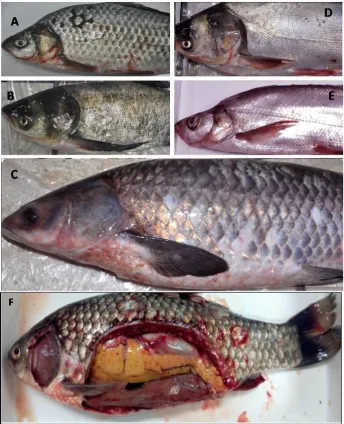
The moribund fishes collected from commercial grow-out ponds in the Kunshan city of Jiangsu province of China, showed symptoms of hemorrhages on the body surface with various levels (Figure 1A-E). Bighead
carp displays slight hemorrhages around the base of pelvic fin (Figure 1B). Silver carp (Figure 1D), Carassius auratus (Figure 1A), Culter alburnus (Figure 1E) and black carp (Figure 1C) besides the bases of fin, emerges more hemorrhagic symptom including the opercula, anterior abdominal area (Figure 1A, 1C-E). Internally, gills of Carassius auratus were extreme pale and covered with excess mucus, severe haemorrhage was recorded in the visceral organs;there were petechiae on the liver surface (Figure 1F). According to the clinical examination, we suspected that all the sampled fishes might have infected by CyHV-2.
LAMP Assay
In order to confirm our speculation, we performed LAMP assay to rapidly detect CyHV-2 in the fishes. Hepatic tissue collected from silver carp, Culter alburnus, Carassius auratus and black carp were positive by LAMP assay, which confirmed that there were CyHV-2 in these diseased fish, whereas Hemibarbus maculatus Bleeker was negative (Figure 2A, C), indicating the diseased fish was not caused by CyHV-2 infection. Products of LAMP assay could be visualized by staining with SYBR Green I (Figure 2B), the results were consistent with the those of electrophoresis detection (Figure 2B). The two Carassius auratus with hemorrhagic symptom wereinspected with LAMP assay, the one was positive and another was negative, which demonstrated that one of the diseased fishes with hemorrhagic symptom were infected by other pathogens besides CyHV-2.
Detection of CyHV-2 in Eggs by PCR and Real-Time PCR
helicase gene(Accession number: JQ815364) sequences of CyHV-2(Figure 3E), suggesting eggs from the diseased fish carry CyHV-2. Additionally, the copies of CyHV-2 DNA in a single egg was determined by the standard curve and found there were about 5.69 copies of CyHV-2 in a single egg. Moreover, the CyHV-CyHV-2 helicase gene could express in fish eggs, and the expression level of CyHV-2 helicase gene relative to actin gene in the diseased fish eggs was 359 times higher than that of normal fish eggs. (Figure 3F).
Electron Microscopy Observation
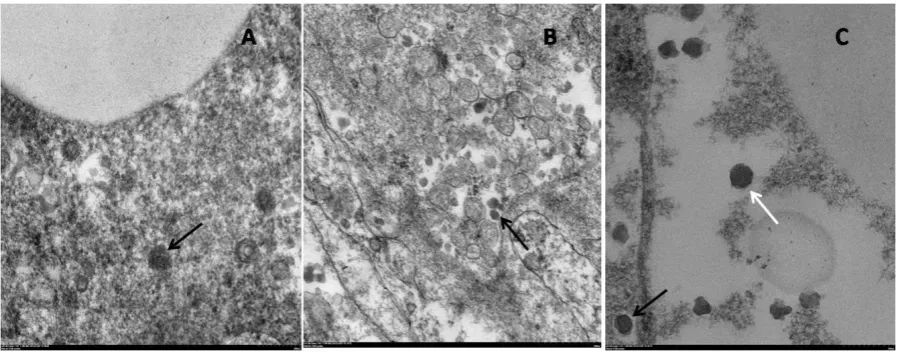
CyHV-2 nucleocapsids-like particles ranged between 115–117 nm in diameter and obvious pathological changes were found in liver tissues from the diseased silver carp, Culteralburnus and black carp
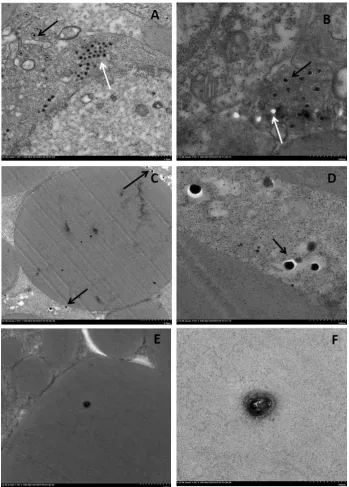
by electron microscopy observation (Figure 4A-C). In kidney and spleen cells of the infected Carassius auratus, the virion morphology and size consistent with CyHV-2 were observed. The developing virion showed an outer membrane and an electron lucent centre, while mature virion illustrated an electron dense core particle (Figure 5A, B). It’s noteworthy that some of virus-like particles were displayed in the eggs of diseased Carassius auratus (Figure 5C, D), which suggesting CyHV-2 may be transmitted to offspring by eggs.
Discussion
At present, gill haemorrhagic disease caused by CyHV-2 is a serious epidemic threat to aquaculture in the Jiangsu province of China. Finding out the ways of prevention, treatment and cure of CyHV-2 infection is
still pressing. To date, the gill hemorrhagic disease of Carassius auratus gibelio is not controlled effectively and occurs as usual even with mixed farming mode and low-density culture. Eliminating infections source and
cut off the route of transmission play a significant role in controlling epidemic of the infectious disease. Epidemiological investigation suggesting hemorrhagic disease of gill can cause severe mortality among tiny size
Figure 2. LAMP detection of CyHV-2 in the fish from commercial farm in Kunshan city.
A, Electrophoresis of LAMP products from different kinds of fish. Lanes A1–A6 represent hypophthalmichthys molitrix, Bighead carp, Hemibarbus maculatus Bleeker,Carassiusauratus,Carassiusauratus, Erythroculter ilishaeformis. Lane A7 as positive control [plasmid pMD-hel]. B, LAMP products stained with SYBR Green under UV. Tubes B1–B6 represents the LAMP products for hypophthalmichthys molitrix, Bighead carp,Hemibarbus maculatus Bleeker,Carassiusauratus,Carassiusauratus, Erythroculter ilishaeformis. Tube B7 as positive control [plasmid pMD-hel].C, Electrophoresis of LAMP products from mylopharyngodon piceus. Lane C1 represents negative control [distilled water], Lanes C2 and C3 represent mylopharyngodon piceus.
Figure.3. Detection of CyHV-2 in eggs by PCR and real-time PCR.
of Carassius auratus even in good quality water, so we suspected that the Carassius auratus fry carry CyHV-2?
It was reported that channel catfish Ictalurid herpesvirus1 could be transmitted to offspring by egg (Thompson, Khoo, Wise, & Hanson, 2005). Previous study showed that CyHV-2 could be found in the offspring seed, breeding fish, disinfected eggs and fry of goldfish, suggesting that CyHV-2 transmit vertically to offspring in the goldfish (Goodwin et al., 2009). In our present report, the CyHV-2 can be found in the egg of the diseased Carassius auratus with hemorrhagic disease by LAMP assay, PCR, real-time PCR and electron microscopy examination. Sequences of the PCR products s shared 100% identity to helicase gene (Accession number: JQ815364) sequences of CyHV-2. This result tells us the virus strain, which provides a theoretical basis for the further use of molecular methods to control the disease. Moreover, the expression of CyHV-2 helicase gene could be also found in eggs, suggesting the gill hemorrhagic disease of Carassius auratus can be vertically transmitted to offspring by eggs carrying CyHV-2. Therefore, it is necessary that the female parent fish must be inspected in advance to supply diseased free fry without CyHV-2 for Carassius auratus industry. In addition, it was found that one diseased fish with hemorrhagic symptom was not infected by CyHV-2, and hemorrhage may be caused by other causes. In aquaculture, there are four kinds of hemorrhagic diseases in fish: stress hemorrhage, toxic hemorrhage, bacterial infection hemorrhage and viral hemorrhage. In the process of fish disease prevention and treatment, it is important to find out the cause of the disease, and then to find a reasonable solution.
Previous work revealed that the gold fish (Goodwin et al., 2006a, 2006b, 2009; Jeffery et al., 2007), Carassiu sauratus (Fichi et al., 2013) and Carassius auratus gibelio (Li, Luo, Liu, Gu, & Yuan., 2013; Zhu et al., 2015) could
be infected by CyHV-2, and some infectious disease could be spread by cross transmission between different species. In the spring season of 2015, we noted that diseased fishes including silver carp, black carp, bighead carp, Hemibarbus maculatus bleeker and culter alburnus occurred in the Kunshan city of Jiangsu province of China, also have similar clinical features such as those were suffering from gill hemorrhagic disease of Carassius auratus gibelio. We suspected that these diseased fishes were caused by infection of CyHV-2. Both LAMP assay and electron microscopy examination confirmed that silver carp, Culter alburnus, Carassius auratus and black carp were positive, whereas Hemibarbus maculatus bleeker was negative. These results indicating the infection of CyHV-2 is not limited to the gold fish, Carassius auratus and Carassius auratus gibelio, whereas, silver carp culter alburnus and black carp can also be infected by CyHV-2. It is not suitable to polyculture Carassius auratus with silver carp, Culter alburnus and black carp. It has been confirmed by quantitative PCR that CyHV-2 has incubative infection among goldfish (Goodwin et al., 2009). In our prior finding, we exposed that CyHV-2 can be detected in the Allogynogenetic crucian carp without clinical symptoms of haemorrhagic disease of the gill from commercial farms of the Dafeng City, Jiangsu province, China, which is an epidemic area of CyHV-2. This indicates CyHV-2 might have incubative infection among Allogynogenetic crucian carps (Zhu et al., 2015), consequently, decreasing the stress reaction of fish may improve the occurrence of gill haemorrhagic disease in the aquaculture industry.
As there are no effective drugs or vaccines are available for the gill haemorrhagic disease caused by CyHV-2, therefore, focus should be on the prevention of this disease rather than to cure. The results of this study provide new perspectives for us to prevent the gill
Figure 4. Electron micrograph of infected liver from diseased fish.
haemorrhagic disease and save economic losses of aquaculture industry of China.
Acknowledgements
We acknowledge the financial supports from the Project of Science and Technology Support Program (Agriculture) of Jiangsu Province (BE2016322), from the Triple-New Project of Aquaculture of Jingsu Province (D2015-12), and from Bureau of Science and Technology of Suzhou Municipality (SYN201408), and a project
funded by the Priority Academic Program of Development of Jiangsu Higher Education.
Conflicts of Interest
The authors declare no conflicts of interest.
References
Boitard, P.M., Baud, M., Labrut, S., de Boisséson, C., Jamin, M., & Bigarré, L. (2016). First detection of Cyprinid Figure 5. Electron micrograph of infected tissues and eggs from a naturally infected Carassiusauratus.
herpesvirus 2 (CyHV‐2) in goldfish (Carassius auratus) in France. Journal of Fish Diseases, 39(6),673-680. https://doi.org/10.1111/jfd.12400.
Chang, P.H., Lee, S.H., Chiang, H.C., & Jong, M.H. (1999). Epizootic of herpes-like virus infection in goldfish,
Carassius auratus in Taiwan. Fish Pathology, 34(4),209– 210.
https://ci.nii.ac.jp/lognavi?name=crossref&id=info:doi/ 10.3147/jsfp.34.209.
Davison, A.J., Kurobe, T., Gatherer, D., Cunningham, C., Korf, I.,
Fukuda, H., …Waltzek, T.B. (2013). Comparative
genomics of carp herpesviruses. Journal of Virology, 87(5), 2908-2922. https://doi.org/10.1128/JVI.03206-12.
Du, M., Chen, M., Shen, H., Wang, W., Li, Z., Wang, W., … Chen, J. (2015). CyHV-2 ORF104 activates the p38 mapk pathway. Fish & Shellfish Immunology, 46(2),268-273. https://doi.org/10.1016/j.fsi.2015.06.011.
Fichi, G., Cardeti, G., Cocumelli, C., Vendramin, N., Toffan, A., Eleni, C., … Susini, F. (2013). Detection of Cyprinid herpesvirus 2 in association with an aeromonas sobria infection of Carassius carassius (L.), in italy. Journal of
Fish Diseases, 36(10), 823–830.
https://doi.org/10.1111/jfd.12048.
Goodwin, A.E., Khoo, L., LaPatra, S.E., Bonar, C., Key, D.W., Garner, M., … Hanson, L. (2006a). Goldfish hematopoietic necrosis herpesvirus (Cyprinid herpesvirus 2) in the USA: molecular confirmation of isolates from diseased fish. Journal of Aquatic Animal Health, 18(1), 11–18. https://doi.org/10.1577/H05-007.1.
Goodwin, A.E., Merry, G.E., & Sadler, J. (2006b). Detection of the herpesviral hematopoietic necrosis disease agent (Cyprinid herpesvirus 2) in moribund and healthy goldfish: validation of a quantitative PCR diagnostic method. Diseases of Aquatic Organisms, 69(2-3),137-143. https://doi.org/10.3354/dao069137.
Goodwin, A.E., Sadler, J., Merry, G.E., & Marecaux, E.N. (2009). Herpesviral haematopoietic necrosis virus (CyHV-2) infection: case studies from commercial goldfish farms.
Journal of Fish Diseases, 32(3), 271–278. https://doi.org/10.1111/j.1365-2761.2008.00988.x. Groff, J.M., LaPatra, S.E., Munn, R.J., & Zinkl, J.G. (1998). A viral
epizootic in cultured populations of juvenile goldfish due to a putative herpesvirus etiology. Journal of Veterinary Diagnostic Investigation, 10(4),375-378. https://doi.org/10.1177/104063879801000415. Hanson, L., Dishon, A., & Kotler M. Herpesviruses that infect
fish. (2011). Viruses. 3(11), 2160-91. https://doi.org/10.3390/v3112160.
Ito, T., Kurita, J., Ozaki, A., Sano, M., Fukuda, H., & Ototake M. (2013).Growth of cyprinid herpesvirus 2 (CyHV-2) in cell culture and experimental infection of goldfish Carassius auratus. Diseases of Aquatic Organisms, 105(3),193-202. https://doi.org/10.3354/dao02627.
Jeffery, K.R., Bateman, K., Bayley, A., Feist, S.W., Hulland, J., Longshaw, C., … Way, K. (2007). Isolation of a Cyprinid herpesvirus 2 from goldfish, Carassius auratus (l.), in the
UK. Journal of Fish Diseases, 30(11), 649-656. https://doi.org/10.1111/j.1365-2761.2007.00847.x. Jung, S.J., & Miyazaki, T. (2010). Herpesviral haematopoietic
necrosis of goldfish, Carassius auratus (L.). Journal of
Fish Diseases, 18(3), 211-220.
https://doi.org/10.1016/j.vetmic.2014.11.005.
Li, L., Luo, Y., Gao, Z., Huang, J., Zheng, X., Nie, H., … Yuan, J.(2015). Molecular characterisation and prevalence of a new genotype of Cyprinid herpesvirus 2 in mainland China. Canadian Journal of Microbiology, 61(6), 381-387. https://doi.org/10.1139/cjm-2014-0796.
Li, L., Luo, Y., Liu, X., Gu, Z., & Yuan, J. (2013). Molecular surveillance of Cyprinid herpesvirus 2 in goldfish cultured in china. Journal of Huazhong Agricultural University, 32, 92-96.
Stephens, F.J., Raidal, S.R., & Jones, B. (2004). Haematopoietic necrosis in a goldfish (Carassius auratus) associated with an agent morphologically similar to herpesvirus.
Australian Veterinary Journal, 82(3),167–169. https://doi.org/10.1111/j.1751-0813.2004.tb12650.x. Thompson, D.J., Khoo, L.H., Wise, D.J., & Hanson, L.A. (2005).
Evaluation of channel catfish virus latency on fingerling production farms in Mississippi. Journal of Aquatic
Animal Health, 17(3), 211–215.
https://doi.org/10.1577/H04-048.1.
Waltzek, T.B., Kurobe, T., Goodwin, A.E., & Hedrick, R.P. (2009). Development of a polymerase chain reaction assay to detect Cyprinid herpesvirus 2 in goldfish. Journal of Aquatic Animal Health, 21(1), 60–67. https://doi.org/10.1577/H08-045.1.
Wang, L., He, J., Liang, L., Zheng, X., Jia, P., Shi, X., … Xu, P. (2012). Mass mortality caused by Cyprinid Herpesvirus 2 (CyHV-2) in Prussian carp (Carassius gibelio) in china.
Bulletin- European Association of Fish Patholog, 32(5),164-173.
Wu, T., Ding, Z., Ren, M., An, L., Xiao, Z., Liu, P., … Wang, W. (2013). The histo- and ultra-pathological studies on a fatal disease of Prussian carp (Carassius gibelio) in mainland china associated with cyprinid herpesvirus 2 (CyHV-2). Aquaculture, 412-413(6), 8–13. https://doi.org/10.1016/j.aquaculture.2013.07.004. Xu, J., Zeng, L., Zhang, H., Zhou, Y., Ma, J., & Fan, Y. (2013).
Cyprinid herpesvirus 2 infection emerged in cultured gibel carp, Carassius auratus gibelio in china. Veterinary
Microbiology, 16691-2), 138-144.
https://doi.org/10.1016/j.vetmic.2013.05.025.
Zhou, Y., Jiang, N., Ma, J., Fan, Y., Zhang, L., Xu, J., & Zeng, L. (2015). Protective immunity in gibel carp, Carassius gibelio of the truncated proteins of Cyprinid herpesvirus 2 expressed in Pichia pastoris. Fish & Shellfish
Immunology, 47(2), 1024-1031.
https://doi.org/10.1016/j.fsi.2015.11.012.
Zhu, M., Liu, B., Cao, G.L., Hu, X.L., Wei, Y.H., Yi, J., … Gong, C.L. (2015). Identification and rapid diagnosis of the pathogen responsible for haemorrhagic disease of the gill of allogynogenetic crucian carp. Journal of Virological
Methods, 219, 67–74.