Research Journal
Volume 11, Issue 3, September 2017, pages 187–195
DOI: 10.12913/22998624/76067 Research Article
THE USE OF LEAN MANUFACTURING TECHNIQUES – SMED ANALYSIS
TO OPTIMIZATION OF THE PRODUCTION PROCESS
Dusan Sabadka1, Vieroslav Molnar2, Gabriel Fedorko2
1 Technical University of Kosice, Faculty of Mechanical Engineering, Department of Automotive Production, Masiarska 74, 040 01 Kosice, Slovakia, e-mail: [email protected]
2 Technical University of Kosice, Faculty of Mining, Ecology, Process Control and Geotechnology Logistics
Institute, Letna 9, 042 00 Kosice, Slovak Republic, e-mail: [email protected]; [email protected]
ABSTRACT
Lean is a culture of real and continuous optimization. As a concept of continuous optimization in the midst of limited resources, it must be practiced continuously as a long-term organizational norm. This paper revels why changeover time reduction is important in manufacturing industries and from the various tools and techniques avail-able within Lean manufacturing describes mainly SMED (Single Minute Exchange of Dies) for changeover time reduction and its application in Shaft manufacturing
indus-try. This paper also describes principles, benefits, procedures and practical application of SMED. Theoretical bases are verified in a practical part that describes the analysis
and design optimization of non-productive time at changeover honing machine in a selected shaft manufacturing company. The output is the structural design of universal palettes and an evaluation of productivity due to optimization of operations of time honing gear shafts. The results achieved show considerable reduction in delay arising out of machine setting time, batch-setting time and demonstration delay.
Keywords: Lean manufacturing, SMED, changeover times.
INTRODUCTION
Lean Manufacturing is considered to be a waste reduction technique as suggested by many authors, but in practice lean manufacturing maxi-mizes the value of the product through the mini-mization of waste [1]. Van Goubergen et al. [2] indicated three main reasons why set-up reduc-tion initiatives can be appropriate for any com-pany: to increase flexibility by conducting more changeovers and reducing lot size; to increase bottleneck capacities in order to maximize the line availability for production; and to minimize the cost, since production costs are related to equipment effectiveness.
According to Chiarini [3], the most impor-tant LM tools to eliminate the different kinds of waste in production are value stream map,
cellu-lar manufacturing, total productive maintenance and single minutes Exchange of dies (SMED). A great amount of literature has addressed the first four tools [4], while information on SMED is a bit scarce.
SMED is a tool developed by Shingo [1] as a proposal to reduce bottlenecks caused by stamp-ing presses in Toyota. By the time SMED was de-veloped, the machines were not working at full capacity and, thus, were not bringing the expect-ed benefites. Nowadays, as Utulas [5] points out, SMED is one of many LM tools for waste reduc-tion in producreduc-tion processes, since it offers a fast and efficient way to decrease changeover times.
Single Minute Exchange of Dies (SMED)/ One-Touch exchange of Die (OTED) is sys-tematic of the reduction of changeover time by converting possible internal setting time
Received: 2017.05.15
(Carry out during machine stoppage) to ex-ternal time (performed while the equipment is running) and to simplify and streamline the re-maining activity [1].
„Changeover times“ is defined as the period between the last good product from previous pro-duction order leaving the machine and the first good product coming out from the following pro-duction order [6,7]. Changeover time is defined as the time needed to set up a given production system to run a different product with all the re -quirements [8, 18], and they are a typical example of waste, since changeover is a non-added value activity that incurs hidden costs [2]. Therefore, because machines remain inactive during change-over times, this process must be reduced as much as possible [8].
SMED is a practical LM tool that helps maxi-mize the product value by reducing setup time and improves setup processes and provides a setup time reduction of up to 90% with moderate investments. Setup operation is the preparation or post adjustment that is performed once before and once after each lot is processed [1].
Shingo [1] bases his method on categorizing all setup activities into internal and external ones. With internal activities being ones that can only be performed when the machine is shut down, and external being those that can be conducted dur-ing the normal operation of the machine while it is still running. SMED methodology is formed by four single stages [1]; a preliminary stage where the internal and external set-up conditions are not distinguished; the first stage were separating in -ternal and ex-ternal set-up takes place; the second stage where internal activities are converted to ex-ternal ones; and finally the third stage focusing on streamlining all aspects of the set-up operation.
Based on time/video study Shingo [1] sepa-rated the changeover (C/O) time into internal and external set-up time. The activities performed by stopping the machine are called internal set-up time and on the other hand when the activities are performed without stopping the machine, these activity are called external set-up time. Yama-zumi chart is used to analyze the internal (on-line activity) and external (off-(on-line) set-up time. Based on these analysis possible internal set-up time are converted to external set-up and internal set-up times are streamlined by introducing multi operator working parallel during On-line activity and one touch set-up adjustments to convert the C/O time to single minutes.
METHODOLOGY
Optimization means reducing the produc-tion process time as much as possible to increase production productivity [9, 19]. The main task is therefore to analyze the individual times of the op-eration of the production process, to find the time that most affects the length of the rebuilding and to find ways to reduce it. As these times are divided into production and non-productive, respectively. Productive and unproductive times, we focus mainly on non-productive production time.
As mentioned above, according to several au-thors [1, 2, 3, 8] SMED is a method for shortening the time of rebuilding production facilities. We minimize waiting times in a systematic process. For example workspace preparation, between the processing of two successive different types of production batches or products. For example, this method is about shortening the time for mold replacement, machine tool or production line re-building [9, 14].
The whole SMED method is based on a very thorough analysis of the redevelopment that we usually perform by direct observation at the workplace. Radically shortening conversion times from several hours to several minutes can be achieved, for example, in these ways:
• Classification and categorization of all rede -velopment activities,
• Changing the organization of the reconstruc-tion,
• Standardizing the conversion process,
• The training of each worker who performs the redevelopment,
• Special devices,
• Technical modifications of the machine [1]. This method is used in workplaces that are narrow where we often carry out rebuilding and the times required for rebuilding can result in sig-nificant losses of line capacity or machine capac -ity [10, 11, 19].
modifications and methodology improvements, the outcomes can be acceptable with moderate investment [12, 18].
A long time for rebuilding also creates prob-lems such as increased waiting times for process-ing or consumprocess-ing critical capacities with regard to dose waiting [9].
The optimization project was implemented in a selected engineering company focusing on the production of gears. The SMED analysis tool was used to solve the optimization of the times that entered the production process of honing. SMED analyzes individual redevelopment times that represent the unproductive time of honing select-ed toothselect-ed shafts. Among the factors that directly affect the production process of honing in terms of productivity features [13]:
• input raw material - untreated shaft,
• machine technical options - machining param-eters,
• tool - honing wheel (depends on the hardness of the disc).
Among the factors that indirectly influence the process of honing in terms of productivity features [2, 20]:
• reconstruction - derivative change,
• dose size - frequent reorgani zation of deriva-tive changes,
• operator - experience,
• technical condition of the machine - malfunc-tion.
After the set up of an SMED team, a video re-cording of the machine‘s manufacturing process (from the H3 shaft to the H2 shaft) was made, based on which the individual operations of the redevelopment were analyzed and included in the individual categories and the specified times of the individual operations.
The basic categories of redevelopment opera-tions are: Clapmping, Cleaning, Control panel, Dressing, Loading/material, Measuring, Honing Head, Automation, Setting/Adjustment, Teach-ning, Try out, Waiting, Walking, Searching.
SMED analysis results showed that the aver-age rebuilding consists of 94 operations and its total average time is 1 hour and 19 seconds, rep-resenting a non-productive time to be reduced. Selected parts of SMED rebuilding analysis is presented in Figure 2. After merging the opera-Fig. 1. Limits and costs of changeover improvement
strategies [9]
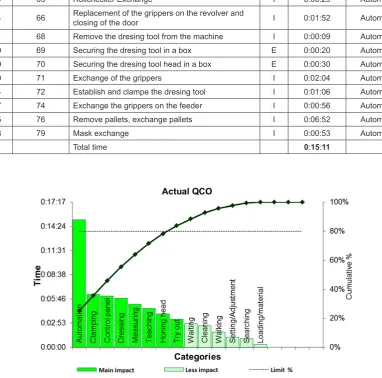
tions of each category into a separate table, the total times of these categories were then identi-fied and the pareto graph created. Table 1 shows an operation from the automation category.
After adding the total time of the individual categories, a Pareto graph was drawn up (Fig. 3), which identified that the automation category had the greatest impact on the length of machine re-building and hence the productivity of the toothed shaft production.
In order to reduce the total time of this catego-ry, and thus reduce the total unproductive time in the gearing process, it was necessary to determine which operation is the longest and can be adjusted so that the total time drops to the lowest possible value. An analysis of all operations in the automa-tion category has shown that operaautoma-tion with order
number 76 - „remove pallets, pallet exchange“ takes the longest, even from all the operations of the whole reconstruction. This operation time is 6 minutes 52 seconds.
Optimizing operations - analysis of the current situation
In order to optimize the aforementioned pro-cess of machine rebuilding of the selected op-eration or shortening of time, it was necessary to modify the preparations so that they do not have to be replaced and replaced at each conver-sion to individual types of gears. A toothed shaft is mounted on the assembly jig, which is then moved over the belt into the honing machine. At present, a different type of assembly jig is used
Table 1. Operations from the automation category
Elapsed
time Rebuilding observation Subsequent analysis
0:00:05 0:18:15
number description of operations I/E duration Cathegory
65 Rollchecker Exchange I 0:00:29 Automation
0:18:44 66 Replacement of the grippers on the revolver and closing of the door I 0:01:52 Automation
0:20:51 68 Remove the dresing tool from the machine I 0:00:09 Automation 0:21:00 69 Securing the dresing tool in a box E 0:00:20 Automation 0:21:20 70 Securing the dresing tool head in a box E 0:00:30 Automation
0:21:50 71 Exchange of the grippers I 0:02:04 Automation
0:23:54 72 Establish and clampe the dresing tool I 0:01:06 Automation 0:25:27 74 Exchange the grippers on the feeder I 0:00:56 Automation 0:26:35 76 Remove pallets, exchange pallets I 0:06:52 Automation
0:33:48 79 Mask exchange I 0:00:53 Automation
Total time 0:15:11
for each type of toothed shaft (5 types), result -ing in increased conversion time. The goal of the optimization was to design a universal assembly jig for all 5 types of toothed shaft, replacing the current types (examples on Fig. 4 and Fig. 5).
The starting conditions for the solution, design of the universal palette
The task of the new assembly jig is to ensure that it is not necessary to exchange the
prepara-tion in any machine rebuilding, and this has led to a reduction in unproductive time while eliminat-ing the disadvantages of current pallets. Since the production process of honing takes place on four machines, two universal devices have been de-signed because of the very complex construction of only one. First - for input shafts marked H1 and H2, second - output shafts H3, H4 and H5 re -verse gear. The CAD system with support for 3D modeling was used to create the design, namely the Catia V5 program with Part design modules, Assembly design, and Drafting.
Fig. 4. Toothed shaft mounted on the pallet
Fig. 5. Selected old pallet type
Fig. 6. 3D model of universal pallet for
Fig.7. 3D model of universal pallet for shaft shaft
H1, H2, H3, H4, H5
Fig. 8. Universal palette for shafts H1, H2
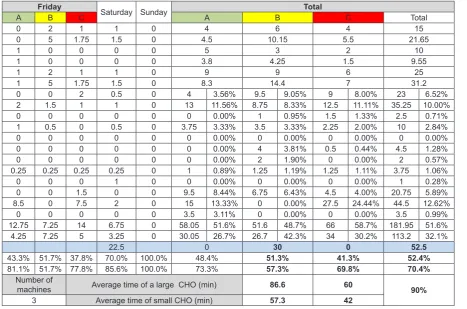
Table 2a. Preview of JPH Analysis for the 9th Week
Reason/day Monday Tuesday Wenesday Thursday
Work shift A B C A B C A B C A B C
CHO large-number 2 0 0 2 3 2 0 0 0 0 1 1
CHO large-time 2 0 0 2.5 4 2.5 0 0 0 0 1.15 1.25
CHO small-munber 1 1 1 0 0 0 2 2 0 1 0 1
CHO small-time 0.7 0.75 0.75 0 0 0 1.6 3.5 0 0.5 0 0.75
CHO total-number 3 1 1 2 3 2 2 2 0 1 1 2
CHO total-time 2.7 0.75 0.75 2.5 4 2.5 1.6 3.5 0 0.5 1.15 2
Maintenance 1 0 0 0 0 0 2 2 4 1 7.5 3
Adjustment 4 1.5 1.25 3.5 1.25 4 2.5 1.5 3.75 1 3 2.5
Profilling 0 0 0.5 0 0 1 0 0 0 0 1 0
Clamps/Runout 0.25 1 0.75 0.5 1 1.25 1 0.5 0.25 1 0.5 0
Rework 0 0 0 0 0 0 0 0 0 0 0 0
Sercos 0 0 0 0 1 0 0 3 0.5 0 0 0
Maintenance
assistance. tests 0 1.5 0 0 0 0 0 0.5 0 0 0 0
Cleaning the
centrifuge 0.5 0.25 0.25 0 0.25 1.25 0 0.25 0.25 0.25 0.25 0.25
Unfulfilled cycle
time 0 0 0 0 0 0 0 0 0 0 0 0
Waitting for parts 0 4 0 3.5 2 1 5 0 0 1 0.75 2
Without operator 0 0 7.5 0 0 4 0 0 4.5 6.5 0 4
Planned shutdown 1 0 0 0.5 0 0 2 0 0 0 0 0
Losses (hours) 9.45 9 11 10.5 9.5 14 14.1 11.25 13.25 11.25 14.15 13.75 Losses of
machines (hours) 8.45 5 3.5 6.5 7.5 9 7.1 11.25 8.75 3.75 13.4 7.75
Extra hours 7.5 7.5 7.5 7.5
Effectiveness 58.0% 60.0% 51.1% 53.3% 57.8% 37.8% 37.3% 50.0% 41.1% 50.0% 37.1% 38.9%
Machine
effectiveness 62.4% 77.8% 84.4% 71.1% 66.7% 60.0% 68.4% 50.0% 61.1% 83.3% 40.4% 65.6%
Number of
machines 3A B2 C3 5Number of days5 5 112.5 Working time105 112.5 352.5 Number of shifts15
Table 2b. Preview of JPH Analysis for the 9th Week
Friday Saturday Sunday Total
A B C A B C Total
0 2 1 1 0 4 6 4 15
0 5 1.75 1.5 0 4.5 10.15 5.5 21.65
1 0 0 0 0 5 3 2 10
1 0 0 0 0 3.8 4.25 1.5 9.55
1 2 1 1 0 9 9 6 25
1 5 1.75 1.5 0 8.3 14.4 7 31.2
0 0 2 0.5 0 4 3.56% 9.5 9.05% 9 8.00% 23 6.52%
2 1.5 1 1 0 13 11.56% 8.75 8.33% 12.5 11.11% 35.25 10.00%
0 0 0 0 0 0 0.00% 1 0.95% 1.5 1.33% 2.5 0.71%
1 0.5 0 0.5 0 3.75 3.33% 3.5 3.33% 2.25 2.00% 10 2.84%
0 0 0 0 0 0 0.00% 0 0.00% 0 0.00% 0 0.00%
0 0 0 0 0 0 0.00% 4 3.81% 0.5 0.44% 4.5 1.28%
0 0 0 0 0 0 0.00% 2 1.90% 0 0.00% 2 0.57%
0.25 0.25 0.25 0.25 0 1 0.89% 1.25 1.19% 1.25 1.11% 3.75 1.06%
0 0 0 1 0 0 0.00% 0 0.00% 0 0.00% 1 0.28%
0 0 1.5 0 0 9.5 8.44% 6.75 6.43% 4.5 4.00% 20.75 5.89%
8.5 0 7.5 2 0 15 13.33% 0 0.00% 27.5 24.44% 44.5 12.62%
0 0 0 0 0 3.5 3.11% 0 0.00% 0 0.00% 3.5 0.99%
12.75 7.25 14 6.75 0 58.05 51.6% 51.6 48.7% 66 58.7% 181.95 51.6%
4.25 7.25 5 3.25 0 30.05 26.7% 26.7 42.3% 34 30.2% 113.2 32.1%
22.5 0 30 0 52.5
43.3% 51.7% 37.8% 70.0% 100.0% 48.4% 51.3% 41.3% 52.4%
81.1% 51.7% 77.8% 85.6% 100.0% 73.3% 57.3% 69.8% 70.4%
Number of
machines Average time of a large CHO (min) 86.6 60 90%
The creation of 3D models of universal pallets was based on the requirements and dimensions of the individual shafts [15, 16, 17]. Fig. 6 and Fig. 7 illustrate the 3D models of the proposed universal pallets. Changes to the current type of pallets:
• the prisms have been replaced by fixed locat -ing bodies on which the shaft is stored,
• a T-shaped groove has been formed in the base plate for displacing the compression spring on the body to provide a fixed position by means of a spring piston,
• creating new shapes of fixed stands.
After modeling all the components and cre-ating in the Catia program, the individual pallet components were then manufactured with appro-priate technologies and completed into prototypes (Fig. 8 and Fig. 9).
RESULTS AND DISCUSSION
From the results of the SMED analysis, the longest time to rebuild the honing machine is that of changing the assembly jig. By modifying or creating new universal pallet, a total of 6.87 min-utes was saved on one rebuild. The time of one rebuild has therefore decreased from an average of 1.01 hours to 0.89 hours, which is a time opti-mization of 11.9%.
Observed JPH (Job per Hour) analysis over the 9-week period revealed the following:
• the average number of conversions per week: 18.
• average weekly rebuilding time: 1.01 hours x
18 = 18.18 hours.
• weekly rebuilding time after optimizing its time: 18.18 hours – (18x6.87 min) = 16.12 hours.
• weekly saving time after optimizing of re-building time: 18.18 hours – 16.12 hours = 2.06 hours.
Productivity evaluation
Weekly production of toothed shafts produced on 3 machines at 18 changeover operations:
• 76,4 ks/hour x 3machines x (18x8 hours) = 33 004 pcs.
Annual output at 100% machine efficiency:
• 33004 pcs x 46 weeks = 1 518 184 pcs/year. Increase the productivity of toothed shaft pro-duction after optimizing the weekly rebuilding time:
• 76.4 pcs/hour x 2.06 hours ≐ 157 pcs.
Annual production after increased production productivity:
• (33004 pcs + 157 pcs) x 46 weeks = 1 525 406 pcs/year.
By optimizing of time rebuilding honing machine was increased annual productivity gear shafts about 7222 units produced, an in-crease of 0.48%.
Taking account of the machine efficiency
The efficiency of the machine influences the overall productivity of production and should therefore be taken into account when determining it. The following factors influence the efficiency of the machine: maintenance, adjustment outside of rebuilding, profiling, splinters / throwing, re -work, sercos, maintenance assistance, tests, cen-trifuge cleaning, unfulfilled cycle time, part wait, no operator, scheduled outage.
From the JPH analysis, the average machine efficiency was 70%.
Table 4. Comparison of productivity before and after optimization of time rebuilding
Before optimization After optimization Difference Average rebuilding time per week 18.18 hours 16.12 hours 2.06 hours Weekly production
(100% effectiveness) 33 004 pcs 33 161 pcs 157 pcs
Annual production
(100% effectiveness) 1 518 184 pcs 1 525 406 pcs 7222 pcs
Annual production
(70% effectiveness) 1 062 729 pcs 1 067 784 pcs 5055 pcs
Table 3. Productivity of toothed shaft manufacturing
Type of toothed shaft pcs/hour
Input shaft H1 73
Input shaft H2 72
Output shaft H3 75
Output shaft H4 73
Reverse shaft H5 89
The annual output of the production toothed shafts after optimization with respect to the ef-ficiency of the machine:
• 7222 pcs/year x 70% ≐ 5055 pcs/year.
CONCLUSIONS
Single Minute Exchange of Dies is system-atic reduction of changeover time by converting possible internal setting time to external time and to simplify and streamline the remaining activity [18,21].
The paper was dedicated to optimizing the timing of the shaft manufacturing operations in the selected company. The goal was to optimize the unproductive time of honing these shafts, thereby increasing production productivity.
Based on an analysis of the production pro-cess, it was found that productivity is most af-fected by non-productive activities that gener-ate non-productive times. These are activities that are linked to the rebuilding of the honing machine. The unproductive time arises during the rebuilding of these machines to manufactur-ing of another type of shaft, so the analysis was aimed at optimizing the times of rebuilding.
For the analysis of the rebuilding the SMED tool was used, where every single operation was recorded by video. The rebuilding consists of a total of 94 operations and takes 1 hour and 19 seconds. Individual operations were categorized into 14 categories, showing that the automation category had the greatest impact on conversion.
There was selected operation no. 76 - pallet pallets, pallet exchange, which has the longest time not only in its category, but in all the op-erations of the entire rebuilding, lasting 6 min-utes 52 seconds. This operation is best suited for optimization, due to the fact that all other operations are necessary and unchangeable. The optimization of this operation consisted in the construction design of new universal pallets, which need not be exchanged, whereas so far for each type of shaft used a different type of preparation. This saves the entire time of this operation, bringing the optimization of the time of this operation to 11.9%.
After implementing changes in production, overall production of the shafts increased. Pro-ductivity evaluation and analysis was performed by monitoring the production process during a 9 week period, where the data were recorded and recorded in the JPH analysis, which showed that
the average weekly rebuilding were 18 and thus 18.18 weekly unproductive.
Thanks to new universal pallets, this time is reduced by 2.06 hours. For this time it is possible to produce 157 pieces more. Annual production increases by 0.48%, which is 7222 units by 100% machine efficiency. But since the efficiency of machines is 70%, the overall increase in shafts‘ productivity is 5055 units more than before.
Acknowledgements
This contribution is the result of the projects VEGA 1/0403/18, VEGA 1/0063/16, VEGA 1/0708/16, KEGA 018TUKE-4/2016.
REFERENCES
1. Shingo S. A revolution in manufacturing: The SMED system. Productivity Press, Stanford, CT.
1985
2. Goubergen D.V. and Landeghem H.V. Rules for integrating fast changeover capabilities into new equipment design. Robotics and Computer
Inte-grated Manufacturing 18, 2002, 205-214.
3. Chiarini A. Sustainable manufacturing-greening
processes using specific lean production tools: An
empirical observation from European motorcycle component manufacturers. J. Clean. Prod. 2014, 226–233.
4. García-Alcaraz J.L., Maldonado-Macías A.A. and Cortes-Robles G. Lean Manufacturing in the De-veloping World: Methodology, Case Studies and Trends from Latin America; Springer: Cham,
Swit-zerland, 2014, pp. 1–584.
5. Ulutas B. 2011. An application of SMED method -ology. Int. Sch. Sci. Res. Innov. 2011, 1194–1197. 6. Gest G., Culley S.J., McIntosh R.I., Mileham A.R.
and Owen G.W. Review of fast tool change sys-tems. Computer Integrated Manufacturing
Sys-tems 8, 1995, 205-210.
7. Coimbra E.A. Total Flow Management: Achieving Excellence with Kaizen and Lean Supply Chains. Kaizen Institute. 2009
8. Sousa R.M., Lima R.M., Carvalho J.D. and Alves A.C. An industrial application of resource con-strained scheduling for quick changeover. In Pro-ceedings of the 2009 IEEE International Confer-ence on Industrial Engineering and Engineering Management, Hong Kong, China, 8–11 December 2009, 189–193.
10. Wang J. Perspectives and Techniques for Improv-ing Information Technology Project Managment.
USA: Montclair State University, 2013.
11. McIntosh R.I., Culley S.J., Mileham A.R. and Owen G.W. Changeover improvement: A mainte-nance perspective. International Journal of
Produc-tion Economics 73, 2001, 153-163.
12. Ferradás P.G. and Salonitis K. Improving changeover time: a tailored SMED approach for welding Cells. Forty Sixth CIRP Conference on Manufacturing
Systems 2013. Procedia CIRP 7. 2013. 598 – 603.
13. Mrkvica I. Speciální technologie: Výroba
ozubených kol II. Ostrava: VŠB-TU Ostrava,
1.vyd., 2009.
14. Jachowicz T.: Construction of clamping units of
in-jection molding machines. Polimery 2005, 2 (50),
110-117..
15. Madáč K., Durkáč V., Kráľ J. Design of applica -tions for CAD system Creo Parametric 1.0. Int. Sci. Her., 4, 2012, 278–284.
16. Mantič M., Kuľka J., Krajňák J., Kopas M., Sch
-neider M. Influence of selected digitization meth
-ods on final accuracy of 3D model. In: Majerník, M., Daneshjo, N., and Bosák, M. (eds.)
Produc-tion Management and Engineering Sciences. pp.
475–480. CRC Press Taylor and Francis Group A
Balkema Book, 2016.
17. Debski H., Koszalka G., Ferdynus M. Application of FEM in the analysis of the structure of a trailer supporting frame with variable operation
param-eters. Eksploatacja i Niezawodnosc – Maintenance
and Reliability, 14, 2012, 107–113.
18. Díaz-Reza J.R., García-Alcaraz J.L., Martínez-Loya V., Blanco-Fernández J., Jiménez-Macías E.
and Avelar-Sosa L. The Effect of SMED on Bene
-fits Gained in Maquiladora Industry. Sustainability
— Open Access Journal 2016
19. Gregor M. and Mičieta B. Productivity and Inno
-vations. Žilina: Slovenské centrum produktivity,
2010.
20. Vasilko K., Havrila M., Novák-Marcinčin J., Mádl J., Zajac J. Top trendy v obrábaní, III. Časť – Tech
-nológia obrábania. Žilina. Media/ST, 2006.
21. Sundar R., Balaji A.N., SatheeshKumar R.M. A
Review on Lean Manufacturing Implementation Techniques. 12th Global congress on manufactur-ing and management, gcmm 2014. Procedia
![Fig. 1. Limits and costs of changeover improvement strategies [9]](https://thumb-us.123doks.com/thumbv2/123dok_us/8807394.1775313/3.595.72.526.521.745/fig-limits-costs-changeover-improvement-strategies.webp)