
Formulation and evaluation of delayed release pellets of rabeprazole sodium
5
0
0
Full text
(2) 183. were angle of repose, bulk density and tapped density, Hausner’s ratio and drug excipients compatibility study for 4 weeks at accelerated conditions, 40±2oC /75%RH±5% RH. Formulation development of core pellets of Rabeprazole sodium The drug suspension was prepared by mixing Rabeprazole sodium, sodium carbonate, crosspovidone and Hydroxypropylmethyl cellulose in purified water. The suspension was then placed into the spray gun system of Glatt fluid bed processor machine and sprayed onto the sugar core pellets while the Glatt machine was set in running condition. This would allow the drug to be evenly coated onto the core pellets to form drug – coated spherical pellets. The drug – coated pellets were dried under warm air within the Glatt machine. The proportion of different batches of Rabeprazole sodium core pellets are given in table 1. Preparation of Coating solution of Opadry clear To prevent interaction between Rabeprazole sodium and enteric coating layer, seal coating of Rabeprazole sodium pellets was done by Opadry clear until weight gain 8-10%. Coating solution was prepared by dissolving Opadry clear in mixture of Iso Propyl Alcohol (IPA) and Mehtylene Dichloride (MDC) under constant stirring for 15-20 minutes by using propeller stirrer.. drug – coated pellets while the Glatt machine was set in running condition. After the coating was completed, the protective coating-covered pellets were again dried under warm air within the Glatt machine. Finally, an enteric coating was prepared by mixing Eudragit L100-55 in a mixture of Isopropyl alcohol and Methylen dichloride. This coating was placed into the spray gun of the Glatt machine and sprayed onto the protective coating-covered pellets to form the pharmaceutical pellets before final drying of the granules to complete the process of making the enteric coating-covered pellets. Coating of pellets was done using Glatt fluid bed processor machine. First fixed quantity (1Kg) pellets were put in the product chamber which was pre adjusted at 50oC temperature for 5 – 10 minutes. Various parameters like spray rate ( 8 to 25 gm/min), inlet air temperature (20 to 50oC), atomizing air pressure (1 to 3 bar), % fludization (10 to 30%) and percent solids content 7% were adjusted and optimized. After finishing of the coating pellets were dried at 40o C and at 10% fluidization. The coated pellets were removed and evaluated by various parameters. Evaluation parameters The prepared coated pellets were evaluated and compared with the marketed product.. Preparation of Coating solution of enteric coating solution Required quantities of solvents were weight in the beaker or other suitable vessel. Propeller stirrer was used for preparation of coating solution. Propeller was kept in the center and as close to the bottom of the vessel as possible, stir the mixture of solvents to form a vortex without entrapment of air in to the liquid. After that required quantity of Eudragit L100-55 (for 30% weight gain) was added in the water and kept continuous stirring for 15-20 minutes.. Physical examination A Micromeritic property of API is given in table 2. Pellets were examined visually and observation was recorded and given in table 3. The Retention time of the major peak in the chromatogram of the sample preparation corresponds to that of the standard preparation. As obtained in the Assay.. Coating of core pellets A protective coating solution was prepared by mixing Opadry clear slowly in the solvent mixture of IPA and MDC (60:40). This coating was then placed into the spray gun of the Glatt machine and sprayed onto the. In vitro dissolution studies Dissolution studies of Rabeprazole sodium enteric coated pellets were performed according to USP XXIII type II apparatus in 0.1N HCl for 2 hrs and in pH 8.0 sodium phosphate buffer 0.5% SLS for 30 min.. Int. J. Pharm & Ind. Res. Vol - 01. Moisture content The moisture content in the pellets was determined Karl Fischer titrator. Issue - 03. Jul - Sep 2011.
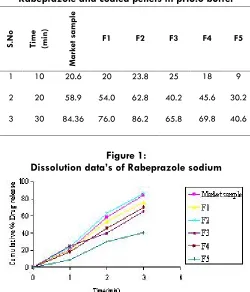
(3) 184. Table 1: Formulation of different batches of Rabeprazole sodium core pellets. Table 4: Comparison of Dissolution profiles of Rabeprazole and coated pellets in pH8.0 buffer S.No. Time (min). Market sample. Formulations. F1. 1. 10. 20.6. 20. 23.8. 25. 18. 9. 80. 2. 20. 58.9. 54.0. 62.8. 40.2. 45.6. 30.2. ---. ---. 3. 30. 84.36. 76.0. 86.2. 65.8. 69.8. 40.6. 150. 375. (quantities in gms). Ingredients F1. F2. F3. F4. F5. Rabeprazole sodium. 285. 285. 285. 285. 285. Sodium carbonate. 150. 225. 150. 225. 0. 80. 80. 80. 80. Polyplasdone INF 10. 225. 150. ---. Polyplasdone XL 10. ---. ---. 225. Sugar spheres. 660. 660. 660. 660. 660. Talc. 100. 100. 100. 100. 100. Hydroxy propyl methyl cellulose. F2. F3. F4. F5. Figure 1: Dissolution data’s of Rabeprazole sodium. Sample. Angle of repose (θ). Bulk density (g/ml). Tapped density (g/ml). Compressib ility Index (%). Hausner’s ratio. Table 2: Micromeritic properties of API. API. 34. 0.352. 0.512. 31.25. 1.45. Table 3: Drug excipient compatibility study (Physical observation). 2 3. 4 5 6 7. 8. RS. Off White. RS+ Mannitol RS + Sodium carbonate RS + Titanium dioxide RS + Opadry clear. 1:10. White. White. Table 5: Stability studies data. 1:10. White. White. RS + Talc RS+ Crospovidone RS + Hydroxy Propyl Cellulose. D:E Ratio. Final description 1M/ (400C / 75%RH 7 days). Off White. Initial observation. -. Drug-Excipients combination. Batch no. 1. The temperature was maintained at 37±0.5°C and the rotation speed was 100 rpm. The samples were withdrawn at 2hrs in acid and 10, 20, 30 min in buffer and analyzed HPLC (SHIMADZU). The in vitro data’s are shown in figure 1. The table 4 and figure 2 shows the data’s reveals the Comparison of Dissolution profiles of Rabeprazole and coated pellets in pH 8.0 buffer.. Time. Test (%). Temperature 40ºC / 75% RH. 1:0.25. White. White. 1:0.25. Fine white. Off white Fine white. 1:1. White. White. 1:1. 1:1. Int. J. Pharm & Ind. Res. White. White. White. Vol - 01. Initial. 1 month. 2 months. Assay. 11.72. Acid resistance. 99.75. %DR. 86.24. Assay. 11.6. Acid resistance. 99.10. %DR. 85.80. Assay. 11.5. Acid resistance. 98.6. %DR. 85.0. Issue - 03. Jul - Sep 2011.
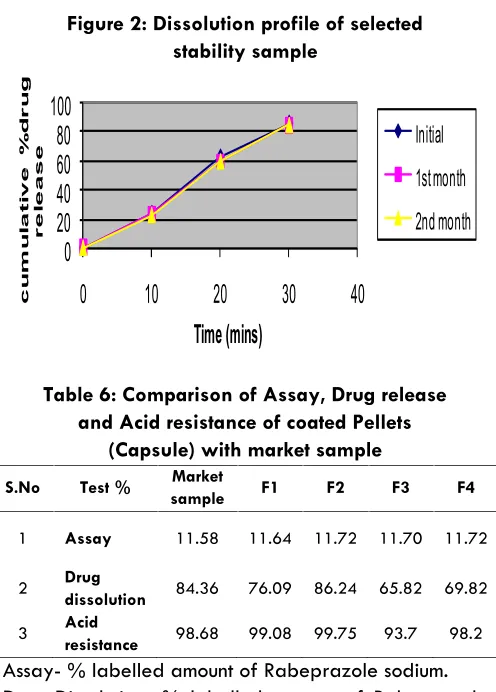
(4) 185. cumulative %drug release. Dissolution profile of selected stability sample Figure 2: Dissolution profile of selected stability sample 100 80 60 40 20 0. Initial 1st month 2nd month. 0. 10. 20. 30. 40. Time (mins). 1 2 3. Test % Assay Drug dissolution Acid resistance. Market sample. F1. F2. F3. F4. 11.58. 11.64. 11.72. 11.70. 11.72. 84.36. 76.09. 86.24. 65.82. 69.82. 98.68. 99.08. 99.75. 93.7. 98.2. Assay- % labelled amount of Rabeprazole sodium. Drug Dissolution- % labelled amount of Rabeprazole sodium released in Buffer. Acid resistance test-% labelled amount of Rabeprazole sodium retained in acid. Stability Studies Stability studies were conducted at 40ºC / 75% RH for about 3 months in stability chamber (thermo lab) 8. Samples were collected at 1, 2 and 3 months. The Stability studies data’s are given in the table 5.. Results and discussion Preformulation studies From the results of Micromeritic studies of the Rabeprazole sodium it was conclude that Rabeprazole sodium has poor flow property and compressibility property. From the physical observation, no significant Drug-Excipient interaction was observed. So it was concluded that drug and other excipients were compatible with each other.. Int. J. Pharm & Ind. Res. Vol - 01. Accelerated stability study of the optimized batch From the results of the accelerated stability of the final formulation for 3 months, it was concluded that storage conditions were not found any significant changes in final formulation dissolution profile with market sample.. Conclusion. Table 6: Comparison of Assay, Drug release and Acid resistance of coated Pellets (Capsule) with market sample S.No. Evaluation parameters of the optimized batch of Rabeprazole sodium From the results of comparative study of dissolution profile of final batch with market preparations. It was concluded that final formulation was shown good similarity with market product.. In coating process the enteric coating was done with the percentage build ups of 22, 24, 26, and 28 with 8% sub coating. Acid resistance was failed up to 26% but at 28% build up acid resistance was passed. But for safer side, we coated up to 30% with 8% sub coating. For optimizing coating process further trails were conducted with increasing sub coat and decreasing enteric coating. From the above results, we found that F1, F2, F3 and F4 batches were passed in assay and acid resistance tests. Batch F5 is not meeting the specification in terms of dissolution due to the super-disintegrant particle size and lack stabilizing agent (Alkali). Based on results F2 formulation was found to be satisfactory with the market sample dissolution profile. So finally F2 was found to be best formula for formulation of Rabeprazole sodium delayed release pellet.. References 1. Goodman and Gilman: The pharmacological basis of Therapeutics, 10th edition. 2003, 1007 – 1008. 2. Cole G.C. Pharmaceutical Coating Technology Taylor and Francis Ltd; 1998, 46-52. 3. Libermen H.A., Lachman L. Pharmaceutical Dosage Forms: Tablet. N.Y.: Marcel Dekker Inc., Vol-1, 1989, 85-143. 4. Lachman L, Lieberman HA, Kanig JL. The theory and practice of industrial pharmacy. 3rd ed. Mumbai: Varghese Publishing House; 1987. 371372.. Issue - 03. Jul - Sep 2011.
(5) 186. 5. Cooper J, Gun C. Powder Flow and Compaction, Inc Carter SJ, Eds. Tutorial Pharmacy. New Delhi: CBS Publishers and Distributors; 1986, 211-233. 6. Aulton ME, Wells TI. Pharmaceutics; The Science of Dosage Form Design. London, England; Churchill Livingston; 1998, 247. 7. Martin A. Micromeretics. In: Martin A, ed. Physical pharmacy. Baltimores, MD; Lippincott Williams and Wilkins; 2001, 423-454. 8. Baerschi S.W. Pharmaceutical stress testing, Predicting drug degradation. Taylor and Franscis group; 2005, 344-350. 9. Brittain G. Physical characterization of Pharmaceutical solid, Marcel Dekker series: 1995, 223252. 10. Heralgi, R.V., Simpi, C.C., Kalyane, N.V., Karajgi, S.R., Simulataneous spectrophotometric estimation of rabeprazole sodium and itopride hydrochloride in capsule formulations Asian journal of Pharmaceutics, 2(3), 2008, 148-149. 11. Shan R., Mi-jin P., Hongkee S., Beom J.L., Effect of pharmaceutical excipients on aqueous stability of Rabeprazole sodium, International journal of Pharmaceutics, 350; 2008; 197-204.. Int. J. Pharm & Ind. Res. Vol - 01. 12. Ramakrishna. N.V.S., Vishwottam, K.N., Wishu, S., Koteshwara, M., Suresh Kumar, S. Highperformance liquid chromatography method for the quantification of Rabeprazole in human plasma using solid-phase extraction. Journal of Chromatography B., 8, 2005, 209-214. 13. Garcia, C.V., Paim, C.S., Steppe, M., Elfrides E.S. Development and validation of a dissolution test for rabeprazole sodium in coated tablets. Journal of Pharmaceutical and Biomedical Analysis; 46; 2006, 833-837. 14. Jain, R., Jindal, C., Singh, S. Pharmaceutical composition comprising of proton pump inhibitor and prokinetic agent. U.S. Patent No. US 2007/0160664 A1; 2007. 15. Dietrich, R., Ney, H. Oral administration form for pyridine-2-methyl-sulfinyl-1H-Nenzimidazoles. U.S. patent No. US 7041313B1; 2006.. Issue - 03. Jul - Sep 2011.
(6)
Figure
Related documents
The opportunity for this application can be given to the prospective teacher in the programme of internship in teaching where the student teacher is working
In some waveg- uide based switches, by linear or nonlinear changing of the refractive indices in a homogenous Kerr medium of the waveguide and choosing a suitable wavelength and
ITACA, working together with the Italian Hereditary Angioedema Patients ’ Association, col- lected data from C1-INH-HAE patients referring to 17 centers active in Italy.. Here
Methods: Using one years ’ data from the US Federal Drug Administrations Adverse Event Reporting System, we identified MedDRA preferred terms that collectively accounted for 95% of
Additionally, RAR β promoter hypermethylation significantly increased in smoking NSCLC patients compared to nonsmoking NSCLC patients, indicating that smoking induced gene
Table 4: Traverse control points (Elevations determined using Digital Level).. TESTS AND RESULTS 4.1 Total station Test
Indian reality often show a sustained presence in the minds of television viewers through entertainment value, being closer to real life of viewers, it covers all age
Considering that knowledge sharing processes and probable multicultural influences are contextual, the purpose of the article is to establish the extent of knowledge flows in
