CrossMark
Published by DiscoverSys
Low dose ketamin
Made Wiryana,1 I Ketut Sinardja,2 I Gede Budiarta,3 Tjokorda Gde Agung Senapathi,4 Made Widnyana,5 I Wayan Aryabiantara,6
I Gusti Agung Gede Utara Hartawan,7 Pontisomaya Parami,8 Ni Putu Novita Pradnyani,9 Adinda Putra Pradhana10
INTRODUCTION
Nociceptive stimulation cause hyper- excitability with the activation of N-methyl-D-aspartate (NMDA) receptor, a process that involved in acute pain pathophysiology. Ketamine, a non-competitive NMDA antagonist, used in sub-anesthetic dose can result in specific NMDA blockage and modulate central sensitization hence cause anti hyper-algesic effect.1
Ketamine has been used as an intravenous anesthetic. Ketamine has also been used as anal-gesic for acute and chronic pain in sub-anesthetic dose. Ketamine has several benefits as an anal-gesic. Ketamine does not depress cardiovascular function, protective larynx reflects, less depress ventilation compare to opioid, and reduce airway resistance. Thus, ketamine has significant role in postoperative pain management by reducing the total opioid needed, possible side effects, and giving hemodynamic and respiratory stability.2
Ketamine also has immune modulator prop-erty. Ketamine can prevent exacerbation and local inflammation expansion without disturbing inflammation resolution. Immune cell produc-ing inflammation cytokine does not affected by ketamine if there is no inflammation stimulus. The immune regulation effect clearly can be seen if ketamine is used before the inflammation. This is one of reasons that ketamine is commonly used for induction before surgery.3
Small dose ketamine given before noxious stim-ulus can have benefit as well by preventing central sensitization which lead in decreasing the need for post operative analgesic.4
NMDA (N-methyl-D-aspartate) Antagonist Receptor
Inotropic receptor divided into three subtypes based on the action of selective agonist: α -ami-no-3-hidroxy-5-methylisoxasole-4-propionic acid (AMPA), kainic acid (KA), and N-methyl-D-aspartate (NMDA). Among those, NMDA receptor gets special consideration because its role in sympa-thetic stimulation transmission, plasticity, and central nervous system (CNS) neurodegenerative. This receptor is located in all neurons.5
NMDA (N-methyl-D-aspartate) receptor antag-onist administered as an additional medication pain management. Receptor N-methyl-D Aspartate receptors are ligand-gated ion channel which allows the entry of calcium, sodium, potassium into cells. The receptor is activated by glutamate and glycine and is not opened when the membrane resting potential. Glutamate is the major excitatory neurotransmitter in the central nervous system has a significant role in the modulation of pain at the spinal cord level. This role in particular in sensiti-zation of nociceptors after exposure to pain stimu-lation that increases the magnitude and duration of neurogenic responses to pain, even after the initials of a peripheral has been discontinued. These drugs carry antinociception effect by inhibiting central sensitization to pain stimulation.6
Ketamine
Ketamine is a phencyclidine derivative (anesthetic used in veterinary medicine), noncompetitive NMDA receptor antagonist. Ketamine is used for intravenous induction of anesthesia in the world, especially in circumstances in which sympathetic 1Professor, 2-8Senior Lecturer,
9-10Resident, Department of
Anesthesiology, Pain Management and Intensive Care, Udayana University, Sanglah General Hospital, Denpasar-Bali, Indonesia
*Correspondence to: Dr. Ni Putu
Novita Pradnyani, Resident of Anesthesiology, Pain Management and Intensive Care, Udayana University, Sanglah General Hospital, Kesehatan Street No 1 Denpasar-Bali, Indonesia
Ph/Fax: +62 361 257361/235980
Volume No.: 1
Issue: 1
First page No.: 13
E-ISSN.2549-2276
Doi: http://dx.doi.org/10.15562/bjoa.v1i1.4
ORIGINAL ARTICLE
ABSTRACT
Ketamine binds non-competitive against a phencyclidine receptors bound N-methyl-D-aspartate (NMDA), a receptor that is involved in the pathophysiology of acute pain. Ketamine has been used as an intravenous anesthesia, analgesia for acute and chronic pain at a dose of subanaesthetic. Ketamine is a dissociative anesthetic produces a state with a characteristic strong analgesia, amnesia, and catalepsy. Dissociative components
resulting from the effect on the limbic system and talamoneokortikal. Low-dose ketamine as known as analgesia Low-dose ketamine or subanestesia Low-dose is 0.2 to 0.75 mg / kg IV. At low doses, ketamine does not increase the effect psychomimetic like dissociation or deep sedation. The combination with midazolam provides satisfactory sedation, amnesia and analgesia without significant cardiovascular depression.
Keyword:ketamin, low dose, pain, analgesia, dissociative
stimulation is needed (hypovolemia, trauma). When intravenous access is not available, it can be used by intramuscular ketamine for induction in pediatric or adult who is not cooperative. Ketamine can be combined with other drugs (such as propo-fol or midazolam) in a small dose bolus or infu-sion for sedation during peripheral nerve blocks, endoscopy, and others. sub-anesthetic doses of ketamine can cause hallucinations (depending on dose), though in daily practice this effect is not so noticeable because of the provision of a combina-tion with midazolam (or similar drugs) for amnesia and sedation.7
Ketamine is a dissociative anesthetic drug that produces, which is then marked by the dissociation of EEG between thalamocortical and limbic system. Dissociation anesthesia resembles cataleptic condi-tion where the eyes are still open and slow nystag-mus. Patients unable to communicate, even though he appeared conscious. Reflexes still maintained as the corneal reflex, cough reflex and swallowing reflex, but all these reflexes should not be consid-ered as a protection against the airway. Hypertonus level variations and certain skeletal muscle move-ments often occur and are not dependent on the surgical stimulation.8
Chemical structure
Ketamine, 2-(o-chlorophenyl) -2- (methylamino) -cyclohexanonehydrochloride, a arylcycloalkyl-amine which is structurally related to phencyclidine (PCP) and cyclohexamine. Ketamine hydrochloride is an water-soluble molecules, with a molecular weight of 238 and a pKa of 7.5. Although soluble in water, soluble in fat ten times compared with thiopentone, so quickly distributed to many organs, including the brain and heart, and then redistrib-uted to organs with less perfusion. The existence of asymmetric carbon atoms produce two opti-cal isomers of ketamine namely S (+) ketamine and R (-) ketamine. Commercial dosage forms of
racemic ketamine form containing both enantio-mers in equal concentrations. Each enantiomer has a different potential. S (+) ketamine analgesia stronger, faster metabolism and recovery, lack of secretion of saliva and a low incidence of emergence reaction or nightmares / hallucinations than the R (+) ketamin.9
Mechanism of action
Ketamine binds non-competitively against a phen-cyclidine receptors bound N-methyl-D-aspartate (NMDA), a subtype of glutamate receptors, which are located in the ion channel. Ketamine inhibits the transmembrane ion flow. NMDA receptor is a receptor calcium channels. Endogenous agonist of the receptors are excitatory neurotransmitters such as glutamic acid, aspartic acid, and glycine. Activation of the receptor results in the opening of the ion channel and depolarization of the neuron. NMDA receptors are involved in the sensory input at the spinal level, thalamic, limbic and cortical bone. Ketamine inhibit or interfere with the sensory input to the central higher than the central nervous system, where there is an emotional response to the stimulus and the place for learning and memory. Ketamine inhibits activation of NMDA receptors by glutamate, reducing the release of glutamate in presynaptic and enhance the effects of the inhibi-tory neurotransmitter GABA.10
Ketamine also interact with mu receptors, delta and kappa opioid. Effects of ketamine analgesia may be caused by activation of this receptor in the central and spinal.9
Some effects of ketamine can be caused by work on the catecholamine system, by increasing dopa-mine activity. Dopadopa-minergic effects may be related to the euphoric effects, addiction and psychotomi-metic of ketamine. The work of ketamine is also caused by the effect of adrenergic agonists on the receptor α and β, antagonistic effect on muscarinic receptors in the central nervous system, and the effects on receptor agonists σ.10
PHAMACOKINETIC
a) AbsorptionKetamine can be used via the oral, nasal, rectal, subcutaneous, and epidural, even though in daily practice ketamine used intravenously or intra-muscularly. Peak plasma levels achieved within 5-15 minutes after intramuscular injection, in 1 min after intravenous injection, and 30 minutes after oral administration. Absorption via the rectal ketamine in pediatric in a study can reach 45 minutes. Norketamine metabolite plasma concentrations higher than ketamine alone after oral administration.5
b) Distribution
Ketamine is more soluble in fat and less protein bound (12%) compared to thiopental, which facil-itates the transfer through the blood-brain barrier. Ketamine is distributed to a network with such high perfusion of the brain to reach the level of 4-5x higher than plasma. These characteristics increase cerebral blood flow and cardiac output, resulting in a rapid uptake by the brain and subsequent redistribution (half distribution of 10-15 minutes). Employment effects of ketamine disappeared with redistribution from rich network of blood vessels to less tissue blood vessels. Awakening due to redistri-bution of the brain compartment perifer.6
c) Metabolism
Ketamine is metabolized in the liver into several metabolites, one of which is norketamin which retains the anesthetic activity. The most important metabolic pathways involving N-demethylation by cytochrome p450 into norketamin. Norketamin then hydroxylated and conjugated into water soluble components that will be excreted in the urine. Uptake liver (hepatic extraction ratio of 0.9) describes the elimination half-life of ketamine relatively short (1-2 hours) and depends on the hepatic blood flow changes. Co-administration with diazepam can extend the half-life of ketamine and its metabolite.6
d) Excretion
Ketamine metabolic end products excreted through the kidneys, with a small percentage is found in the urine in the form intact. Elimination half-life 2 hours, which is due to a combination of rapid clearance and volume of distribution were great. It has been reported in pediatric research studies that the elimination of ketamine two times faster than adult.11,12
PHARMACODYNAMIC
a) Central Nervous System.Ketamine produces a state described as a disso-ciative anesthetic with characteristics of strong analgesia, amnesia, and catalepsy. The dissosiative components resulting from the effect on the limbic system and thalamoneocortical. In this condition it is said that the brain fails transduction afferent impulses properly because of interference with the normal communication between the sensory and cortical association areas. The result resembles catalepsy that both eyes remain open with nystag-mus, and corneal reflexes are intact. Patients are generally non-communicative although they are awake. Varying degrees of skeletal muscle hyper-tonus may occur. Involuntary skeletal muscle
contraction can occur during surgery. The ketamine users has its own difficulties in assessing the level of sedation or anesthesia because it cannot use the sign of eyes movement, muscle tone or movement of the patient as an indicator. Effects of ketamine on the above characteristics are not consistent with the classic signs of anesthesia. Ketamine interacts with more than one type of receptors to produce a variety of effect.11
Some part of analgesia effect are mediated by opioid receptors in the brain, spinal and peripheral. Ketamine also interact with opioid receptors sigma / phenyclyclinidine binding sites. Sigma component may mediate dysphoria generated by ketamine.7
Place of work involving NMDA receptor ketamine (N-methyl-D-aspartate). This receptor plays a major role in the transmission of sensory information and mediates the excitation of neurons in the central nervous after the arrangement of interacting with excitatory neurotransmitter. Inhibition of NMDA gives effect of catalepsy.7
Ketamine produces anti-nociceptive effect through interactions with mu receptors on the spine, antagonis NMDA receptors, and activation of descending mono-aminergic pain inhibitory pathways. Affinity in NMDA receptors greater than against mu receptors, and is much larger than the monoamnine receptor or other non-NMDA receptors (e.g. sigma receptor and acetylcholines-terase), which causes the smaller dose of ketamine are increasingly selective NMDA receptors interact with ketamine.6
Potential effects of ketamine disabling muscle depends in large doses. This mechanism may involve cholinergic muscarinic receptors. Ketamine can turn on a wave of epilepticform in patients with convulsion disorders.11
Emergence is the most frequent side effects reported. The reaction was described as a sense of drift, dream that seem obvious, hallucinations, and delirium. To this effect the incidence ranges from 5-30%. Benzodiazepine uses can reduce this effect.12
intracranial pressure. Psychotomimetic side effects (like a bad dream and delirium) when emergence is rare in pediatric patients or those with profopol or benzodiazepine.12
b) Respiration
In patients with spontaneous breath, dispensing other general anesthesia can cause a rapid decrease in FRC (Functional Residual Capacity). With the decrease in lung volume during expi-ration, the small and thin-walled airway on the dependent lung has a tendency to collapse. The volume in which the airway closes so-called closing capacity. The effect of maintaining the FRC is guar-antee the openness of the dependent part remains in the lung. This is important especially for pedi-atric, where closing capacity slightly less to the FRC than adults. In pediatrics, a small decrease of FRC may lead to closure of the airway for normal breathing, which can cause ventilation perfusion abnormalities were clinically shown as decreased oxygen saturation. Ketamin is considered unique in that it can sustain the FRC during induction of anesthesia.12 During the administration of ketamine
in patients breathing spontaneously, minute venti-lation is maintained almost the same as the patient is awake. Minimal changes occurred in the absence of gas exchange and the incidence of atelectasis and shunting. This is because the skeletal muscle tone is maintained during the administration of ketamine (unlike in patients with volatile anesthetics) then atelectasis, ventilation-perfusion changes, and the FRC did not happen. Breathing is affected mini-mally by ketamine. Ketamine has other beneficial effects, including increased lung expansion and decreases airway resistance. The working mecha-nism of these effects has yet to be fully understood. Bronchodilatation is the result of inhibition of calcium channels by ketamine. Racemic ketamine is a poten bronchodilator, making it a good induction agent for asthma patients; however, S (+) ketamine has a minimal bronchodilator effect ketamine by continuous infusion is used as an asthma therapy that is unresponsive to conventional approaches. Airway reflexes preserved intact, but the partial airway obstruction may occur. Hypersalivation caused by ketamine may be reduced by adminis-tering anticholinergic agents such as premedication glycopyrrolate and atropine.11,12
c) Cardiovascular
In contrast with other anesthetic agents, ketamine increases blood pressure, heart rate, and cardiac output, especially after rapid bolus injection. These indirect effects on cardiovascular due to central stimulation of the sympathetic nervous system and norepinephrine reuptake inhibition after being
released at the nerve terminals. Ketamine depress myocardial contractility, but this effect was offset by sympathetic stimulation. In addition, the ability of ketamine improves concentration inhibits the neuronal reuptake of catecholamines to also cover the negative inotropic effect of ketamine. Therefore, high doses of ketamine bolus injection should be administered with caution in patients with coronary heart disease, uncontrolled hypertension, conges-tive heart disease, blood vessel or aneurysm.7,12
These sympathomimetic effects will increase myocardial oxygen demand, therefore, ketamine is contraindicated in patients with ischemic heart disorders. Cardiac dysrhythmia is rare in the administration of ketamine, although studies in animals declared ketamine sensitize the myocar-dium causing effects such dysrhytmogenic with epinephrine. Based on cardiovascular effects, especially the ability to maintain blood pressure, ketamine administration is indicated in pediatric congenital cyanotic heart disease, patients with hypovolemic, and cardiogenic shock. In pediatric with cyanotic congenital heart disease, the amount of oxygen that can be taken by the lungs depends on pulmonary blood flow. Ketamine is used to lower the right to left shunt, which will maximize blood flow and pulmonary arterial pressure of oxygen.12
d) Temperature
In the past, there is concern that ketamine trigger malignant hyperthermia. This is because ketamine can increase catecholamine circulation, which is regarded as the originator of malignant hyper-thermia. Nevertheless ketamine does not trigger malignant hyperthermia in a study using a pig. This is reinforced by the recommendation of Malignant Hyperthermia Association of the United States.12
e) Inflammatory
influence of histamine and leukotrienes, vascular permeability increases. Immune cells that are on the site of infection or injury will get rid of foreign objects with phagocytosis. At the same time it will release cytokines and other mediators begin the healing process.3,13
Regulation of inflammatory reactions occur at the level of the peripheral and central level. At the peripheral level, anti-inflammatory cytokines (receptor antagonist IL-1, IL-4, IL-10, interferon alfa) will be released by immune cells that would antagonize the inflammatory reaction (IL-1, IL-6, TNF α) kill the inflammatory cells. Il-6 will stimu-late production of CRP (C-Reactive Protein) in the liver by activating kinase pathway. At the central level, when there is inflammation of peripheral there will be communication between immune cells and the central nervous system. The central nervous system is informed that there is ‘something’ in the periphery. Then modulation the central nervous system inflammation that this reaction occurs only in the peripheral alone. This is expressed by the dominance of Th-2 (anti-inflammatory) to the Th-1 (pro-inflammatory).3
Ketamine is said to affect inflammation. Ketamine significantly reduced the production of inflammatory cytokines without affecting the production of anti-inflammatory cytokines. Ketamine reduces exacerbation inflammatory reac-tions and hastens the resolution of inflammation by helping the inflammatory cell apoptosis. Ketamine had no effect on immune cells that produce inflam-matory cytokines when there are no inflaminflam-matory stimulus. This regulatory effect is more meaningful when ketamine administered before inflamma-tion. This is also the reason why ketamine given at induction of anesthesia before surgery. Ketamine at a dose of 0.5 mg/kg increase the ratio of Th1 / Th2 thus improving the patient’s immune function. In some studies, ketamine lowers TNF α, IL-6, IL-1
and IL-8, which in turn provide results such as reducing the acidosis and improve cure rates.3
CLINICAL APPLICATIONS
Ketamine can be used for preoperative and intra-operative sedation, balance anesthesia, adjuvant regional anesthesia and postoperative analgesia. Ketamine is used for preoperative to reduce anxiety and facilitate the induction of general anesthesia. Intramuscular administration used in pediatrics. One study suggests intramuscular administra-tion at a dose of 2 mg/kg resulted in rapid onset of dissociative effects begin at 2.7 minutes. Rectal administration at a dose of 10 mg/kg body weight for induction of general anesthesia preceded by premedication midazolam and atropine. Loss of consciousness occurs within 9-15 minutes. Ketamine has also been used for regional anesthesia and epidural.7
For sedation and analgesia, ketamine adminis-tered at subanesthetic dose of 0.2 to 0.75 mg/kg intra-venous continuous infusion of 5-20 mcg/kg/min, 2-4 mg/kg intramuscularly. Ketamine’s effect of analgesia achieved in plasma concentrations of 100-150ng/ml. A study says that analgesia is achieved by administering ketamine 125-250 mcg/ kg. This dose is sufficient to achieve plasma concen-trations of 100-150 ng/ml. Provision of ketamine 50 mcg/kg did not provide sufficient analgesia, but enough to make the drowsiness, the lowest dose provides analgesia is 75 mcg/kg.14 Plasma
concen-trations can be achieved by a continuous infusion at a dose of 3-4 mcg/kg/min after the initial bolus and 14 mcg/kg/min without loading dose.15 For general
anesthesia, ketamine given at a dose of 1 to 4.5 mg/kg intravenously, 6.5-10 mg/kg intramuscularly.16
Subanesthetic Dose of Ketamine (Low Dose Ketamin)
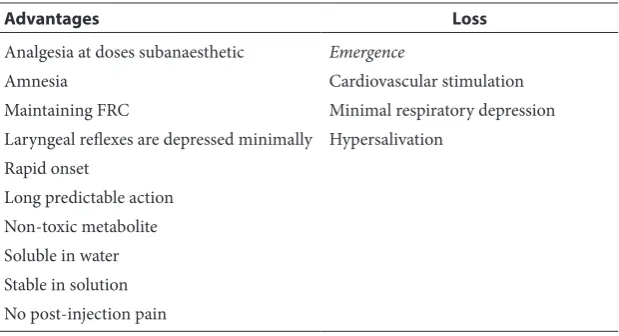
Low-dose ketamine also known as analgesia dose or subanesthetic dose is 0.2 to 0.75 mg/kg IV. Other literature mentions doses of analgesia achieved at 0.2-0.5 mg/kg IV. The analgesic effect is more pronounced in visceral pain than somatic pain. Ketamine effect is caused by activity in the thala-mus and the limbic system is responsible for the interpretation of pain. At doses of 0.25-0.5 mg/kg IV given after midazolam 0.07 to 0.15 mg/kg IV ketamine is said to provide a satisfactory sedation, amnesia, and analgesia without significant cardio-vascular depression. The incidence of emergency, the side effects of ketamine does not increase with small doses of ketamine. At a dose of 0.15 to 1 mg/kg IV did not increase psychomimetic effects such as hallucinations or deep sedation. The addition of Table 1 Advantages and disadvantages of ketamine.6
Advantages Loss
Analgesia at doses subanaesthetic Emergence
Amnesia Cardiovascular stimulation
Maintaining FRC Minimal respiratory depression
Laryngeal reflexes are depressed minimally Hypersalivation Rapid onset
small doses of ketamine 0.5 mg/kg for induction propofol 1.5 mg/kg IV can reduce the incidence of desaturation and apnea.15
At a dose of 0.1-0.5 mg / kg IV ketamine provide satisfactory analgesia during surgery and the management of post-surgical pain, without any sedation or changes in hemodynamic and respira-tory. Effects of nausea and vomiting are also much reduced at this dose.16
The use of low-dose ketamine with local anes-thetic also has been widely applied with giving ketamine 0.05 mg/kg/hour IV infusion in addition to continuous epidural ropivacaine and morphine and obtained results that ketamine enhances the effects of ropivacaine-morphine analgesia and reduces pain post-thoracotomy.16
For the prevention of occurrence shivering in general anesthesia, ketamine prophylactic dose of 0.5 mg/kg IV given 20 minutes before the oper-ation is over, have proven effective in preventing postoperative shivering. In spinal anesthesia, ketamine 0.5 mg/kg IV or ketamine 0.25 mg/kg IV+midazolam 37.5 mcg/kg IV can prevent the incidence of shivering after administration of 15 mg of bupivacaine.10
Ketamine given before incision has an effect on postoperative pain and reduce the need for analgesics. Put pain impulses during surgery and postoperative causes continuous stimulation of C fibers nociceptors and causes the release of gluta-mate. Glutamate is the primary neurotransmitter excitatory in the central nervous system which acti-vates postsynaptic NMDA receptors. Activation of NMDA receptors contributes to processes such as wind-up pain and central sensitization. Activation of these receptors constantly plays a role in inflam-matory and neuropathic pain process, which will lead to secondary hyperalgesia. Intervention anal-gesic before the pain stimulation may inhibit sensi-tization and reduce acute pain.4,17
The wind-up phenomenon is the basis of pre- emptive analgesia, which provides an analgesic before the onset of pain. By suppressing acute pain response as early as possible, pre-emptive analgesia may prevent or at least reduce the possibility of “wind-up”. Ideally, analgesics has begun before surgery.10
DRUG INTERACTIONS
Ketamine interacts synergistically with the vola-tile agent, propofol, benzodiazepines, and other agents mediated by GABA receptors. Diazepam and midazolam alter cardiac simultaneous effects of ketamine and diazepam extend the elimi-nation half-life of ketamine. Nondepolarizing muscle relaxants are potentiated by ketamine.
The combination of theophylline with ketamine may predispose patients to seizures. Halothane slows down distribution and inhibits the hepatic metabolism of ketamine, thus prolonging the effect of ketamine on the central nervous system. N2O reducing the dosage of ketamine and shorten recov-ery time of ketamine.9
CONCLUSION
Ketamine is a phencyclidine derivative (an anesthetic used in veterinary medicine), non- competitive NMDA receptor antagonist. The chemical struc-ture of ketamine, 2- (o-chloro- cyclohexanone hydrochloride, an arylcycloalkylamine which is structurally related to phencyclidine (PCP) and cyclohexamine. Ketamine non- competitively binds against a phencyclidine receptors bound N-methyl-D-aspartate (NMDA). Ketamine inhibits or inter-feres the sensory input to the central higher than the central nervous system, as well as inhibiting the activation of NMDA receptors by glutamate, reduc-ing the release of glutamate in presynaptic and enhance the effects of the inhibitory neurotrans-mitter GABA. Ketamine also interacts with mu receptors, delta and kappa opioid.
Pharmacokinetics of ketamine is rapid onset, relatively short duration and high lipid solubility. Ketamine is not bound significantly in plasma and distributed quickly to the organs. Ketamine is metabolized in the liver by the hepatic microsomal enzymes through N-demethylation of ketamine by the cytochrome P-450 into nor ketamine (metab-olite I), then hydroxylated become hydroxy-nor ketamine. This product is conjugated to glucuro-nide derivatives that are soluble in water and are excreted in the urine.
Pharmacodynamics ketamine in the central nervous system, which produces a dissociative anesthesia state with characteristic strong analgesia, amnesia, and catalepsy. In the respiratory system can cause a rapid decrease in FRC (Functional Residual Capacity). In the cardiovascular system to stimulate the cardiovascular system ketamine causes an increase in blood pressure, cardiac output, heart rate, systemic vascular resistance, pulmonary artery pressure and pulmonary vascular resistance.
Ketamine interacts synergistically with the vola-tile agent, propofol, benzodiazepines, and agents mediated by GABA receptors other.
REFERENCES
1. Carstensen M, Moller AM. Adding ketamine to morphine for intravenous patient-controlled analgesia for acute post-operative pain: a qualitative review of randomized trials. Br JAnaesth. 2010;104(4):401-6.
2. JaveryKB, Ussery TW, Steger HG, Coclough GW. Comparison of morphine and morphine with ketamine for postoperative analgesia. Can J Anesth. 1996;43(3):212-5. 3. Kock M, Loix S, Lavand’homme P. Ketamine and
periph-eral inflammation. CNS Neurosci Ther. 2013;19(6):403-10.
4. Singh H, Kundra S, Singh RM, Grewal A, Kaul TK, Sood D.
Preemptive analgesia with ketamine for laparoscopic cho-lecystectomy. J Anaesth. 2013:29(4):478.
5. Petrenko AB, Tomohiro Y, Hiroshi B, Koki S. The role of N-Methyl-D-Aspartate (NMDA) receptor in pain: areview. Anesth Analg. 2003;97:1108-16
6. Price DD, Mayer DJ, Mao J, Caruso FS. NMDA-receptor antagonists and opioid receptor interactions as related to analgesia and tolerance. J Pain Symptom Manage. 2000;19(1):7-11.
7. Hirota K, Lambert DG. Ketamine: new use for an old drug?.Br JAnaesth. 2011;107(2):123-6.
8. Ahmed S, Hossain MM, Khatun US. Pre-emptive analgesia: effect of low dose Ketamine as pre-emptive analgesia in postoperative pain management after lower abdominal surgery. Journal of the Bangladesh Society of Anaesthesiologists. 2004;17(1):17-22.
9. Parikh B, Maliwad J, Shah VR. Preventive analgesia: effectof small dose of ketamine on morphine require-ment after renal surgery. J AnaesthesiolClinPharmacol. 2011;27(4):485-90.
10. Michelet P, Guervilly C, Helaine A, Avaro JP, Blayac D,
Gaillat F, et al. Adding ketamine to morphine for
patient-controlled analgesia after thoracic surgery: influ-ence on morphine consumption, respiratory function, and nocturnal desaturation. Br JAnaesth. 2007;99(3):396-403. 11. Haas DA, Harper DG. Ketamine: A review of its
phar-macology properties and use in ambulatory anesthesia. AnesthProg. 1992;39:61-8.
12. Rosenquist RW, Vrooman BM. Chronic painmanagement. In: Butterworth JF, Mackey DC, Wasnick JD. Morgan
and Mikhail’s Clinical Anesthesiology. 5th Edition. USA:
McGraw-Hill Education; 2013.p. 1023-86.
13. Kawamata T, Omote K, Sonoda H, Kawamata M, Namiki A. Analgesic mechanisms of ketamine in the presence and absence of peripheral inflammation. Anesthesiology. 2000; 93(2): 520-8.
14. Suzuki M, Tsueda K, Lansing PS, Tolan MM, FuhrmanTM, Ignacio CI, Sheppard RA. Small-dose ketamine enhances morphine-induced analgesia after outpatient surgery. Anesthesia & Analgesia. 1999;89(1):98-103.
15. Kochs E, Scharein E, Möllenberg O, Bromm B, Schulte AEJ. Analgesic efficacy of low-dose ketamine, somatosenso-ry-evoked responses in relation to subjective pain ratings. Anesthesiology. 1996;85(2):304-14.
16. Rowland LM. Subanestheticketamine: howit altersphys-iology and behavior in humans. Aviat SpaceEnv Med. 2005;76(7):C52-8.
17. Helmy N, Badawy AA, Hussein M, Reda H. Comparison of the preemptive analgesia of low dose ketamine versus mag-nesium sulfate on parturient undergoing cesarean section under general anesthesia. Eg J Anaesth. 2015;31(1):53-8.