ISSN: 2306-9007 Rani, Suradi & Yusoff (2014) 1984
I
www.irmbrjournal.com December 2014I
nternationalR
eview ofM
anagement andB
usinessR
esearchVol. 3 Issue.4
R
M
B
R
An Analysis of Technology Acceptance Model, Learning
Management System Attributes, E-satisfaction, and
E-Retention
NAZATUL SHIMA ABDUL RANI
UniKL Business School, Universiti Kuala Lumpur
Email: [email protected]/[email protected]
ZURINAH SURADI
Institute of Product Design and Manufacturing (IPROM) Universiti Kuala Lumpur
Email: [email protected]
NOOR HASLINA YUSOFF
UniKL Business School Universiti Kuala Lumpur
Email: [email protected]
Abstract
This paper discusses on an analysis of Technology Acceptance Model of Learning Management System for an ODL university in Malaysia towards the e-satisfaction and e-retention of the students. The factors being used to measure the satisfaction and retention of students are perceived ease of use, perceived usefulness, enjoyment, design features, security and privacy, and internet connection. The result of the study indicated that for the LMS factors, the Internet connection and security and privacy have a significance positive influence on e-satisfaction. Although the design feature of LMS was demonstrated to have little influence on e-satisfaction, this factor may have influence on specific type of e-learning system. In contrast, only Internet connection has a significance positive influence on e-retention, while the design features and the security and privacy are shown to have less influence on e-retention.
Key Words: Teachnology Acceptance Model, Learning Management System, E-Satisfaction, E-Retention, Malaysia, Adult learner, On-line learning.
Introduction
ISSN: 2306-9007 Rani, Suradi & Yusoff (2014) 1985
I
www.irmbrjournal.com December 2014I
nternationalR
eview ofM
anagement andB
usinessR
esearchVol. 3 Issue.4
R
M
B
R
and most ODL providers extensively utilize Learning Management System as a method to deliver learning materials, activities and assessments (Abdul Karim and Hashim, 2004; Ramayah and Lee, 2014).
In Malaysia, this particular ODL University is one of the dual-mode international universities (face to face and e-learning) in Asia that was formed under the Asia Cooperation Dialogue (ACD), and it is an initiative of Malaysia to be the first mover for dual mode learning. Currently the university comprises of School of Management, School of ICT, School of Education, School of Arts and Humanities, and School of Graduate Studies. As such, the purpose of this paper is to present an analysis of their student on the technology acceptance towards learning management systems that will lead to e-satisfaction and e-retention.
Literature Review
Learning Management System (LMS)
LMS allows communication, information sharing, assignment submission, on line quizzes and other learning activities between learners and lecturers (Al-hawari and Mouakket, 2010; Abdul Karim and Hashim, 2004). The success of On-line Distance Learning is highly dependent on the learner and the environment that supports the delivery of lifelong learning either through learning management system (LMS) or e-learning system. In China the e-learning is believed to be an option to deliver high quality education for students (Wang, Chen and Yan, 2009), in fact in Canada the learning and content management systems development are user friendly and complete (Casey, 2005; McGreal and Anderson, 2007).
As mentioned by earlier researcher Lindeman in 1926 on adult education, he had emphasised that adult learner highly dependent on the learner and its environment (Casey, 2005). As such the success of ODL highly dependent on the learner and the environment that supports the delivery of the formal lifelong learning via its learning management system (LMS) or e-learning system. In fact, in Canada the learning and content management systems development are more robust and people friendly (McGreal and Anderson, 2007). In China, the e-learning is believed as an optional mode to deliver high quality education to students (Wang, Chen and Yan, 2009).
LMS can be in the form of Moodle, Blackboard, and any other similar system that allows communication, sharing of information, submission of assignments, attempting quizzes and other related learning activities between learners and lecturers (Al-hawari and Mouakket, 2010; Abdul Karim and Hashim, 2004; Chanchary and Islam, 2011). However, there was a study conducted by Nathan (2008) that suggested to build a learning system whereby the cultural considerations have to be addressed such as individualism vs. collectivism, gender, relationship of student and instructor, age and generation, focus on time and inductive (process) vs. deductive (results) reasoning.
Framework on TAM, LMS, e-Satisfaction and e-Retention
Technology Acceptance
The e-learning allows for time and location flexibility, cost and time savings, self-paced or just in time learning experience, collaborative learning environment, better access to the instructors, and unlimited usage of learning materials (Pantazis, 2002; Zhang and Nunamaker, 2003).
ISSN: 2306-9007 Rani, Suradi & Yusoff (2014) 1986
I
www.irmbrjournal.com December 2014I
nternationalR
eview ofM
anagement andB
usinessR
esearchVol. 3 Issue.4
R
M
B
R
computer based systems, software, and hardware acceptance. The model was used due to its simplicity and easiness. Igbaria (1993) pointed out that TAM attitudinal determinants were observed to outperform the TRA’s as much larger set of measures can be done.
Perceived Ease of Use
Perceived ease of use is the degree to which the student believes that using the learning management system is free of effort. This is an important aspect for online students since an easy system to use will lead to satisfaction and reuse of the system. A difficult system will lead to more effort required by the student to use the system. This may make students feel unsatisfied and leave the course s/he is attending. Most research have shown that perceived ease of use has significance influence on e-satisfaction (Calli et al., 2013; Sun et al , 2008). As such these hypotheses are forwarded:
H1: The LMS user at this university is perceived as easy to be used, and
H2: The ease of use is highly correlated with the e-retention of LMS for adult learner.
Perceived Usefulness
Perceived Usefulness is the degree to which the student believes that using the learning management system would enhance his or her grade performance. Since most of the student attended ODL University are adult learners, as mentioned by Papastergiou (2006) the adult learner requires more flexible and self-paced learning that match their individual characteristics and learning styles. Hence, LMS is a powerful tool to allow the user to assess the system 24/7 at their convenience. As such these hypotheses are forwarded:
H3: Perceived usefulness is highly correlated with the e-satisfaction of LMS for adult learner, and
H4: Perceived usefulness is highly correlated with the e-retention of LMS for adult learner.
Enjoyment
Perceived enjoyment is the extent to which the activity of using a specific system is perceived to be enjoyable in its own right, aside from any performance consequences resulting from system use. In a research done by Papastergiou (2006), it showed that students show positive attitudes such as appreciating the online interaction between student- student and student-lecturer. As such these hypotheses are forwarded:
H5: Enjoyment is highly correlated with the e-satisfaction of LMS for adult learner, and
H6: Enjoyment is highly correlated with the e-retention of LMS for adult learner.
Learning Management System
ISSN: 2306-9007 Rani, Suradi & Yusoff (2014) 1987
I
www.irmbrjournal.com December 2014I
nternationalR
eview ofM
anagement andB
usinessR
esearchVol. 3 Issue.4
R
M
B
R
Design Features
The design features of LMS include simple layout, clarity, menu structure, user friendliness and navigation (Zhang and Nunamaker, 2003). The design features of the LMS might also influence the e-satisfaction and e-retention of the student, as such, these hypotheses are forwarded:
H7: Design features are highly correlated with the e-satisfaction of LMS for adult learner, and
H8: Design features are highly correlated with the e-retention of LMS for adult learner.
Privacy and Security
Information security and privacy is open for attack either internally or externally, as such the learning management system administrator must provide effective system interface that will cater to the needs of the user (Chen, Shaw and Yang, 2006). As such, these hypotheses are forwarded:
H9: Security and privacy is highly correlated with the e-satisfaction of LMS for adult learner, and
H10: Security and privacy is highly correlated with the e-retention of LMS for adult learner.
Internet Connection
Internet connection also might influence the e-satisfaction and e-retention of student in using the LMS (Pantazis, 2002; Wang, Zhu, Chen, and Yan 2009; Zhang and Nunamaker, 2003), as such, these hypotheses are forwarded:
H11: Internet connection is highly correlated with the e-satisfaction of LMS for adult learner, and
H12: Internet connection is highly correlated with the e-retention of LMS for adult learner.
Student Retention (E-Satisfaction and E-Retention)
Student retention highly dependent on the satisfaction, as such it is crucial to analyse whether learning management system at this ODL university able to contribute towards e-satisfaction and e-retention of a student (Casey, 2005; McGreal and Anderson, 2007). Logically, if the students are satisfied with the learning management system, they will repeat using it for the purpose of their studies, however, whether this is applied on highly on-line mode of learning is yet to be tested. As such, this hypothesis is forwarded:
H13: Students who are satisfied with the LMS are positively correlated with the e-retention.
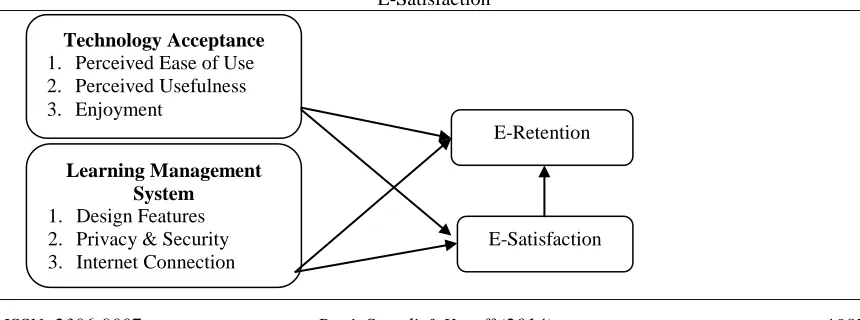
Figure 1: Theoretical Framework for Technology Acceptance, Learning Management System, E-Retention, E-Satisfaction
Learning Management System
1. Design Features
2. Privacy & Security
3. Internet Connection
E-Satisfaction E-Retention Technology Acceptance
1. Perceived Ease of Use
2. Perceived Usefulness
ISSN: 2306-9007 Rani, Suradi & Yusoff (2014) 1988
I
www.irmbrjournal.com December 2014I
nternationalR
eview ofM
anagement andB
usinessR
esearchVol. 3 Issue.4
R
M
B
R
Methodology
Sampling
The questionnaires are distributed to all ODL students from the chosen university for this study in Malaysia either via e-mail or hardcopy. About 200 questionnaires printed and distributed where145 sets were returned. Only 5 students responded via e-mail giving a total of returned questionnaires is 150 copies. Out of this total, about 5 questionnaires were non-usable due to non-respond to few items in the questionnaires. Hence a total of 145 questionnaires were usable for this study (Refer to Table 1).
Table 1: Sampling
Distributed Return Non-Usable Usable
Questionnaire 200 150 5 145
Reliability Analysis
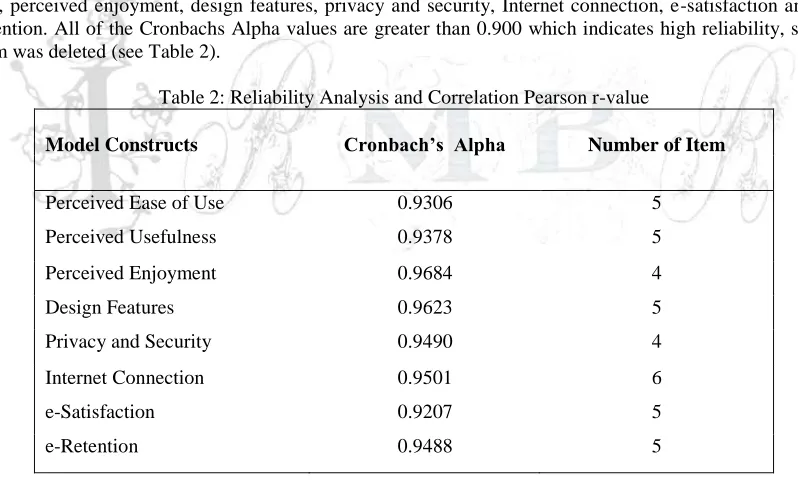
From Table 2, it showed that reliability of the items to measure each construct are highly reliable. Reliability test were performed on all the constructs that made up perceived usefulness, perceived ease of use, perceived enjoyment, design features, privacy and security, Internet connection, satisfaction and e-retention. All of the Cronbachs Alpha values are greater than 0.900 which indicates high reliability, so no item was deleted (see Table 2).
Table 2: Reliability Analysis and Correlation Pearson r-value
Model Constructs Cronbach’s Alpha Number of Item
Perceived Ease of Use 0.9306 5
Perceived Usefulness 0.9378 5
Perceived Enjoyment 0.9684 4
Design Features 0.9623 5
Privacy and Security 0.9490 4
Internet Connection 0.9501 6
e-Satisfaction 0.9207 5
e-Retention 0.9488 5
Results and Findings
Demographic Profiles
ISSN: 2306-9007 Rani, Suradi & Yusoff (2014) 1989
I
www.irmbrjournal.com December 2014I
nternationalR
eview ofM
anagement andB
usinessR
esearchVol. 3 Issue.4
R
M
B
R
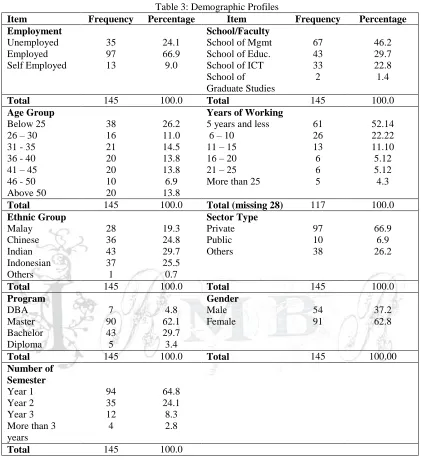
Table 3: Demographic Profiles
Item Frequency Percentage Item Frequency Percentage
Employment Unemployed Employed Self Employed 35 97 13 24.1 66.9 9.0 School/Faculty School of Mgmt School of Educ. School of ICT School of Graduate Studies 67 43 33 2 46.2 29.7 22.8 1.4
Total 145 100.0 Total 145 100.0
Age Group Below 25 26 – 30 31 - 35 36 - 40 41 – 45 46 - 50 Above 50 38 16 21 20 20 10 20 26.2 11.0 14.5 13.8 13.8 6.9 13.8
Years of Working 5 years and less 6 – 10 11 – 15 16 – 20 21 – 25 More than 25
61 26 13 6 6 5 52.14 22.22 11.10 5.12 5.12 4.3
Total 145 100.0 Total (missing 28) 117 100.0
Ethnic Group Malay Chinese Indian Indonesian Others 28 36 43 37 1 19.3 24.8 29.7 25.5 0.7 Sector Type Private Public Others 97 10 38 66.9 6.9 26.2
Total 145 100.0 Total 145 100.0
Program DBA Master Bachelor Diploma 7 90 43 5 4.8 62.1 29.7 3.4 Gender Male Female 54 91 37.2 62.8
Total 145 100.0 Total 145 100.00
Number of Semester Year 1 Year 2 Year 3 More than 3 years 94 35 12 4 64.8 24.1 8.3 2.8
Total 145 100.0
Regression Analysis
Regression analyses were used to test the influence of independent variables: perceived usefulness, perceived ease of use, perceived enjoyment, design features, Internet connection and privacy and security against the dependent variables e-satisfaction and e-retention.
ISSN: 2306-9007 Rani, Suradi & Yusoff (2014) 1990
I
www.irmbrjournal.com December 2014I
nternationalR
eview ofM
anagement andB
usinessR
esearchVol. 3 Issue.4
R
M
B
R
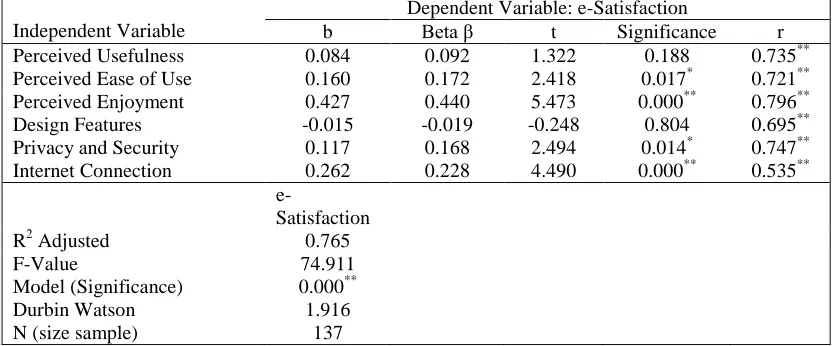
Table 4: Regression Results on Combine Influence of Independent Variables upon e-Satisfaction
Independent Variable
Dependent Variable: e-Satisfaction
b Beta β t Significance r
Perceived Usefulness 0.084 0.092 1.322 0.188 0.735**
Perceived Ease of Use 0.160 0.172 2.418 0.017* 0.721**
Perceived Enjoyment 0.427 0.440 5.473 0.000** 0.796**
Design Features -0.015 -0.019 -0.248 0.804 0.695**
Privacy and Security 0.117 0.168 2.494 0.014* 0.747**
Internet Connection 0.262 0.228 4.490 0.000** 0.535**
e-Satisfaction
R2 Adjusted 0.765
F-Value 74.911
Model (Significance) 0.000**
Durbin Watson 1.916
N (size sample) 137
Note: ** Significance at 0.01 level or * Significance at 0.05 level. Sample size reduced from 145 to 137 due casewise diagnostics analysis.
Specifically the main influence is contributed by perceived enjoyment which has β = 0.444. On the hand, there is no contribution from the design features and the least contribution is from perceived usefulness. While perceived ease of use, privacy and security, and Internet connection have a significance contribution towards e-satisfaction,
Table 5: Regression Results on Combine Influence of Independent Variables upon e-Retention
Independent Variable
Dependent Variable: e-Retention
b Beta β T Significanc
e
r
Perceived Usefulness 0.263 0.267 3.664 0.000** 0.763**
Perceived Ease of Use 0.280 0.280 3.748 0.000** 0.751**
Perceived Enjoyment 0.101 0.145 1.718 0.088 0.708**
Design Features 0.035 0.040 0.507 0.613 0.616***
Privacy and Security 0.080 0.107 1.515 0.132 0.701**
Internet Connection 0.285 0.231 4.329 0.000** 0.571**
e-Retention
R2 Adjusted 0.740
F-Value 65.680
Model (Significance) 0.000***
Durbin Watson 2.054
N (size sample) 137
Note: *** Significance at 0.01 level, ** Significance at 0.05 level, or Significance at 0.10level. Sample size reduced from 145 to 137 due to casewise diagnostics analysis.
The next model is e-retention against the independent variables. The results showed that DW is about 2.0 which imply that no collinearity exists among the independent variables and the model is significance (see
Table 5). For this model, an R2 = 0.74 was recorded from the analysis which means 74% of the variability
ISSN: 2306-9007 Rani, Suradi & Yusoff (2014) 1991
I
www.irmbrjournal.com December 2014I
nternationalR
eview ofM
anagement andB
usinessR
esearchVol. 3 Issue.4
R
M
B
R
Table 6: Regression Results on Combine Influence of Independent Variables upon e-Retention
Independent Variable
Dependent Variable: E-Retention
b Beta β T Significance R
e-Satisfaction 0.909 0.848 18.557 0.000** 0.848**
R2-Adjusted 0.716
F-value 344.444
Model (Significance) 0.000**
Durbin Watson 1.754
N (size sample) 137
Note: ** Significance at 0.01 level
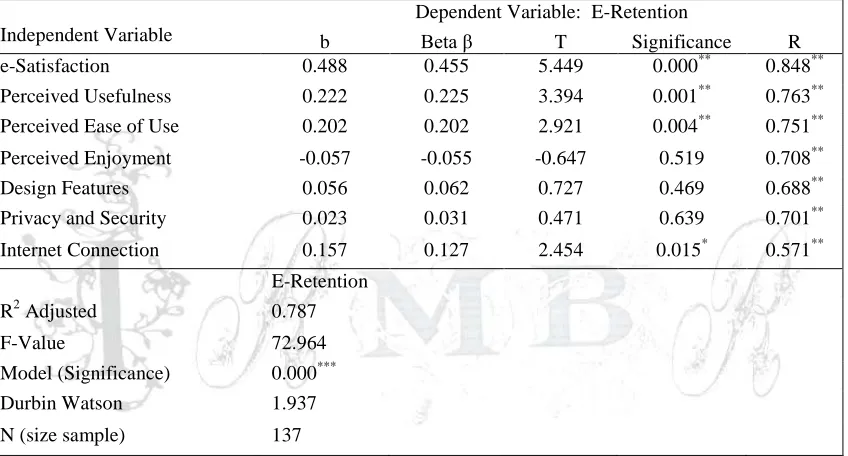
Table 6: Regression Results on Combine Influence of Independent Variables upon e-Retention
Independent Variable
Dependent Variable: E-Retention
b Beta β T Significance R
e-Satisfaction 0.488 0.455 5.449 0.000** 0.848**
Perceived Usefulness 0.222 0.225 3.394 0.001** 0.763**
Perceived Ease of Use 0.202 0.202 2.921 0.004** 0.751**
Perceived Enjoyment -0.057 -0.055 -0.647 0.519 0.708**
Design Features 0.056 0.062 0.727 0.469 0.688**
Privacy and Security 0.023 0.031 0.471 0.639 0.701**
Internet Connection 0.157 0.127 2.454 0.015* 0.571**
E-Retention
R2 Adjusted 0.787
F-Value 72.964
Model (Significance) 0.000***
Durbin Watson 1.937
N (size sample) 137
Note: ** indicates significance at 0.01 level, and * indicates significance at 0.05 level, Sample size was reduced from 145 to 137 due to casewise collinearity diagnostics analysis.
The model above is e-retention was regress against e-satisfaction and the rest of independent variables. The results indicate that DW is around 2.0 which show that there is no collinearity exists among the
independent variables (see Table 6). The model is significance and R2 = 0.787. This means that 78.7% of
variability is explainable the independent variables. In this model, the main influenced is contributed by e-satisfaction (β = 0.488), followed by perceived usefulness (β = 0.225), next perceived ease of use (β = 0.225), and lastly Internet connection (β = 0.127). On the other hand, design features and privacy and security have the least contribution towards variability.
ISSN: 2306-9007 Rani, Suradi & Yusoff (2014) 1992
I
www.irmbrjournal.com December 2014I
nternationalR
eview ofM
anagement andB
usinessR
esearchVol. 3 Issue.4
R
M
B
R
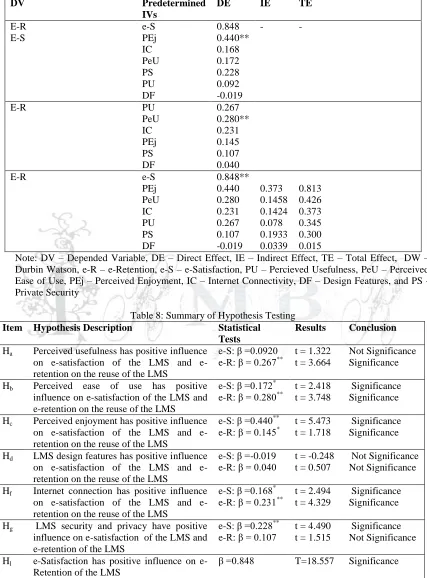
Table 7: Path Analysis for pattern of relationship between DV and IVs
DV Predetermined
IVs
DE IE TE
E-R e-S 0.848 - -
E-S PEj 0.440**
IC 0.168
PeU 0.172
PS 0.228
PU 0.092
DF -0.019
E-R PU 0.267
PeU 0.280**
IC 0.231
PEj 0.145
PS 0.107
DF 0.040
E-R e-S 0.848**
PEj 0.440 0.373 0.813
PeU 0.280 0.1458 0.426
IC 0.231 0.1424 0.373
PU 0.267 0.078 0.345
PS 0.107 0.1933 0.300
DF -0.019 0.0339 0.015
Note: DV – Depended Variable, DE – Direct Effect, IE – Indirect Effect, TE – Total Effect, DW – Durbin Watson, e-R – e-Retention, e-S – e-Satisfaction, PU – Percieved Usefulness, PeU – Perceived Ease of Use, PEj – Perceived Enjoyment, IC – Internet Connectivity, DF – Design Features, and PS - Private Security
Table 8: Summary of Hypothesis Testing
Item Hypothesis Description Statistical
Tests
Results Conclusion
Ha Perceived usefulness has positive influence
on satisfaction of the LMS and e-retention on the reuse of the LMS
e-S: β =0.0920 e-R: β = 0.267**
t = 1.322 t = 3.664
Not Significance Significance
Hb Perceived ease of use has positive
influence on e-satisfaction of the LMS and e-retention on the reuse of the LMS
e-S: β =0.172* e-R: β = 0.280**
t = 2.418 t = 3.748
Significance Significance
Hc Perceived enjoyment has positive influence
on satisfaction of the LMS and e-retention on the reuse of the LMS
e-S: β =0.440** e-R: β = 0.145*
t = 5.473 t = 1.718
Significance Significance
Hd LMS design features has positive influence
on satisfaction of the LMS and e-retention on the reuse of the LMS
e-S: β =-0.019 e-R: β = 0.040
t = -0.248 t = 0.507
Not Significance Not Significance
Hf Internet connection has positive influence
on satisfaction of the LMS and e-retention on the reuse of the LMS
e-S: β =0.168* e-R: β = 0.231**
t = 2.494 t = 4.329
Significance Significance
Hg LMS security and privacy have positive
influence on e-satisfaction of the LMS and e-retention of the LMS
e-S: β =0.228** e-R: β = 0.107
t = 4.490 t = 1.515
Significance Not Significance
Hl Satisfaction has positive influence on e-Retention of the LMS
β =0.848 T=18.557 Significance
ISSN: 2306-9007 Rani, Suradi & Yusoff (2014) 1993
I
www.irmbrjournal.com December 2014I
nternationalR
eview ofM
anagement andB
usinessR
esearchVol. 3 Issue.4
R
M
B
R
Technology Acceptance
Perceived usefulness is significant with the reuse of the LMS, it showed that if the student feels that the LMS is useful he/she will use the system again and again (see Table 8). This result also show that perceived usefulness play an important role in retaining students to reuse the LMS. However, perceived usefulness is not contributed towards the student e-satisfaction. Nevertheless, perceived usefulness has a positive effect on e-satisfaction.
Perceived ease of use and perceived enjoyment are significantly contributes towards e-satisfaction and retention of a student. This indicates that both factors are important to for e-satisfaction and e-retention. LMS which is perceived to of easy to use and enjoyable will lead to high satisfaction and retention. As such, we can make an assumption that an adult and on-line learner are more satisfied and will use the LMS again for their studies if they perceived or experience using the LMS as easy and enjoyable.
Learning Management System
The learning management system can be measured in terms of its design features, internet connection and security and privacy of the user. From the test, it showed that the design features are not significant towards the e-satisfaction and e-retention of a student. As such, we can make an assumption that, the student will still use the LMS for their studies despites the design features of the LMS.
Internet connection is significantly contributes towards the e-satisfaction and also e-retention of LMS from the test or analyses conducted. This implies that a good internet connection is a necessary factor in influencing satisfaction and retention. As such, we can make an assumption that, a good internet connection is essential in supporting the delivering of LMS materials and will lead to the e-satisfaction and e-retention of on-line and adult learner.
Security and privacy of LMS analyses showed that the security and privacy is significantly contributes towards the satisfaction, however security and privacy is not significantly contributes towards the e-retention of the student. This shows that a high quality of security and privacy policy will lead to high satisfaction. Even though security and privacy is not significance upon e-retention, it still shows positive towards retention. As such we can make an assumption that, an adult and on-line student are satisfied if the LMS can ensure the security and privacy of the user.
E-Satisfaction and E-Retention
From the test it showed that e-satisfaction significantly contribute towards e-retention of the student to use the learning management system again. In short, we can make an assumption that with the e-satisfaction of LMS, an adult and on-line student will use again LMS for his/her study.
Discussion and Recommendation
E-Retention
ISSN: 2306-9007 Rani, Suradi & Yusoff (2014) 1994
I
www.irmbrjournal.com December 2014I
nternationalR
eview ofM
anagement andB
usinessR
esearchVol. 3 Issue.4
R
M
B
R
and Mouakket (2010) who suggested that ease of use promote e-retention. A system which is easy to use will attract students to reuse the system provided by the university. In addition, the Internet connection has a strong positive direct effect on e-retention. This points out that a good Internet infrastructure should be made available by Internet service provider companies. Besides that the university providing this kind of learning environment must ensure that their Internet connectivity is always accessible for 24 hours a day and 7 days a week (Simba, et al., 2009). This indicates that students demand for high availability and accessibility to the system highly critical in an ODL university setting.
Privacy and security is an important issue to look into even though it was shown not to be a significant predictor but it is positive related to e-retention. This can be considered as a push factor for students to be retained and reuse of the LMS. In turn, it could be seen as one of the encouragement factors for students to use and reuse the LMS. On the hand, the design features of the LMS are at the acceptable level since students found it easy to navigate within the LMS.
E-Satisfaction
Perceived ease of use has a significant direct effect on e-satisfaction (Sun et al., 2008). This suggests that ease of use the LMS will lead to high satisfaction towards the system. This will be one of the factors to be considered when university is acquiring and implementing an LMS for the use of their students. Further, perceived enjoymenthad a significant positive direct effect on satisfaction(Calli et al., 2013). This implies that an enjoyable experience in using the LMS, will advocate system satisfaction. Both, security and privacy and Internet connection had a significant positive direct effect on e-Satisfaction, however it is not a significant factor for e-Retention.
Perceived usefulness has positive effect on e-satisfaction but not significant. Even though this finding is opposite of earlier findings (Bhattacherjee, 2001), it is still important to consider this aspect since it is
related to students' perceived learning and performance. The finding also shows that the design feature of
the system was positive related to e-satisfaction. This implies that students are comfortable with the present design feature of the LMS. Nevertheless, system developer still has to find ways to develop a learning management system which are having acceptable design features.
E-Satisfaction has a significant direct effect on e-retention (Ramayah and Lee, 2012). This implies that high e-satisfaction will promote high e-retention of the use and reuse of the LMS.
Conclusion
The purpose of this research is to investigate the influences of TAM2 factors and LMS factors on the satisfaction and retention of e-learning system. In general, the TAM factors – perceived usefulness, perceived ease of use and perceived enjoyment have a significance positive influence on e-retention. In contrast only perceived ease of use and perceived enjoyment have a significance positive influence on satisfaction. Although perceived usefulness is not shown to have significance positive influence towards e-satisfaction, they are positively related. These reflect that TAM2 is a good predictor for e-satisfaction and e-retention of LMS.
ISSN: 2306-9007 Rani, Suradi & Yusoff (2014) 1995
I
www.irmbrjournal.com December 2014I
nternationalR
eview ofM
anagement andB
usinessR
esearchVol. 3 Issue.4
R
M
B
R
References
Abdul Karim, M.R., & Hashim, Y. (2004). The experience of the E-learning implementation at the Universiti Pendidikan Sultan Idris, Malaysia, Malaysia Online Journal of International Technology, 1(1),50-59.
Al-hawari, M.A., & Mouakket, S. (2010). The influence of technology acceptance model (TAM) factors on
students’ e-satisfaction and e-retention within the context of UAE e-learning, Education, Business, and
Society: Contemporary Middle Eastern Issues, 3(4), 299-314.
Bhattacherjee, A. (2001), Understanding information systems continuance: an expectation-confirmation
model, MIS Quarterly, 25(3), 351-370.
Blueprint on Enculturation of Lifelong Learning 2011-2020 (2011). Ministry of Higher Education, Perpustakaan Negara Malaysia, Univision Press Sdn Bhd.
Calli, L., Balcikanli, C., Calli, F., Cebeci, H. I., & Seymen, O. F. (2013). Identifying factors that contribute
to the satisfaction of students in e-learning, Turkish Online Journal of Distance
Education-TOJDE,14(1), 85-101.
Chanchary, F.H., Islam, S., (2011). Is Saudi Arabia Ready for E-Learning : A Case Study, Najran University, KSA.
Chen, C.C., Shaw, R.S., &Yang, S.C. (2006). Mitigating information security risks by increasing user
security awareness: a case study of an information security awareness system, Information Technology,
Learning, and Performance Journal, Spring, 24(1), 1-14.
Casey, A. (2005). Enhancing individual and organizational learning, Management Learning, July,
36(2),131-147.
Dealtry, R. (2009). The design and management of an organisation’s lifelong learning curriculum, Journal
of Workplace Learning, 21(2), 156-165.
Ho, C.H. (2010). Continuance Intention of e-learning platform: toward an integrated model, International
Journal of Electronic Business Management, 8(3), 206-215.
Igbaria, M. (1993). Acceptance of microcomputer technology: An empirical test, OMEGA International
Journal of Management Science, 21(1), 73-90.
McGreal, R., & Anderson, T. (2007). E –learning in Canada, Journal of Distance Education Technologies,
5(1),1-6.
Al-hawari, M. A., Al-hawari, & Mouakket, S. (2010). The influence of technology acceptance model (TAM) factors on students' e-satisfaction and e-retention within the context of UAE e-learning,
Education, Business and Society: Contemporary Middle Eastern Issues, 3(4), 299 – 314.
Nathan, E.P.(2008). Global Organizations and E-learning: Leveraging Adult Learning in Different
Cultures, Performance Improvement, 47(6), 18-24.
Pantazis, C. (2002). Maximizing E-learning to Train the 21st Century Workforce, Public Personnel
Management, Spring, 31(1), 21-26.
Papastergiou, M. (2006). Course management systems as tools for the creation of online learning environments: evaluation from a social constructivist perspective and implications for their design,
International Journal on ELearning, 5(4), 593-622.
Ramayah, T. Lee, W. C. (2012) System characteristics, satisfaction and e-learning usage: a structural
equation model (SEM), The Turkish Online Journal of Educational Technology, 11(2), 196-206.
Sun, P. C., Tsai. R. J., Finger, Glenn F., Chen, Y. Y. &Yeh, D. (2008). What drives a successful
e-Learning? An empirical investigation of the critical factors influencing learner satisfaction, Computers
& Education, 50, 1183-1202.
Simba, F., Trojer, L., Mvungi, N. H., Mwinyiwiwa, B. M., & Mjema, E. M. (2009). Strategies for Connectivity Configuration to Access e-Learning Resources: Case of Rural Secondary Schools in
Tanzania, World Academy of Science, Engineering and Technology, 54, 630-635.
Sung, M. S. (2010) E-learning: Investigating students' acceptance of Online learning in hospitality programs, Unpublish Thesis, Iowa State University.
ISSN: 2306-9007 Rani, Suradi & Yusoff (2014) 1996
I
www.irmbrjournal.com December 2014I
nternationalR
eview ofM
anagement andB
usinessR
esearchVol. 3 Issue.4
R
M
B
R
Yang, B. (2004), Can Adult Learning Theory Provide a Foundation for Human Resource Development? ,
Advances in Developing Human Resources, 6(2), 129-145.
Yau, H.K., Ngai, E.W.T., & Cheng, T.C.E. (2005). Conceptual framework and architecture for
agent-oriented knowledge management supported e-learning systems, International Journal of Distance
Education Technologies, Apr-Jun, 3(2), 48-67.
Zhang, D., & Nunamaker, J.F. (2003). Powering learning in the New Millennium: An Overview of