ISSN 2466-4294 (online) | rad-journal.org Vol. 3 | Issue 2 | pp. 128–132, 2018 doi: 10.21175/RadJ.2018.02.021 Original research paper
PERFORMING THE FIRST SINGLE EVENT EFFECT TESTS USING THE METU DEFOCUSING BEAM
LINE IN TURKEY: CHARACTERIZATION OF THE SYSTEM AND MONTE CARLO STUDIES
*Ç. Yazgan
1**, M. B. Demirköz
1, M. Yiğitoğlu
1, S. Niğdelioglu
1, P. Uslu
1, I. Efthymiopoulos
21Middle East Technical University, Physics Department, Ankara, Turkey 2CERN, Geneva, Switzerland
Abstract. METU-Defocusing Beam Line (METU-DBL) project aims to perform Single Event Effect (SEE) tests for space, nuclear and other applications. Turkish Atomic Energy Authority (TAEA) has a cyclotron which can accelerate protons up to 30 MeV kinetic energy at the Proton Accelerator Facility (PAF) mainly for radioisotope production and for research and development (R&D) purposes. In the facility, the stable proton beam current is variable between 0.1 µA to 1.2 mA and the beam size is nearly 1 cm x 1 cm. METU-DBL pre-test setup, which has been installed in the R&D room, enlarges the beam size with two quadrupole magnets and it reduces the proton flux with a collimator. The pretest setup beam size is about 10 cm x 10 cm and the beam flux is 108 p/cm2/s. The first tests of electronic cards, detectors and also commercial and experimental solar cells have been performed using this setup. Also, the final configuration of METU-DBL is now under construction to provide a beam according to ESA ESCC No. 25100 standard. MCNP Monte Carlo codes were used for the calculations of secondary particles (neutrons, gammas) and residuals.
Key words:Irradiation facility, beam line design, radiation simulation, MCNP, Monte Carlo
* This paper was presented at the Sixth International Conference on Radiation and Applications in Various Fields of Research
(RAD 2018), Ohrid, Macedonia, 2018.
1.INTRODUCTION
METU-DBL (defocusing beam line) is being constructed at Turkish Atomic Energy Authority (TAEA) SANAEM Proton Accelerator Facility (PAF). PAF has a proton cyclotron providing a 15-30 MeV continuous proton beam to produce radioisotopes. It was inaugurated in May 2012. There are four irradiation rooms at the facility and one of them is reserved for R&D purposes. In R&D irradiation room, a 5-port switching magnet is placed to enable different experimental setups for different research groups. The beam current can vary between 0.1 μA and 1.2 mA [1]. METU-DBL pre-test setup, shown in Fig. 1, aims to irradiate electronic cards and semiconductor devices for use in space and in other high radiation environments. The proton beam enters from the left in Fig. 1. Beam size at the entrance of R&D room is 1 cm in diameter and even at the lowest current setting, the proton flux provided is high for space irradiation tests. In Fig. 1, first, there is a movable beam stopper to stop the beam in case of accelerator problems or to control the irradiation time of the samples at the test and measurement table. Next, there is a vacuum shutter which will close if there is a problem with the vacuum in either the accelerator or METU-DBL. A collimator protects the ensuing quadrupole magnets from stray
protons. These magnets enlarge the angular distribution of the beam and the beam continues to widen in the 4meter long flight path that comes after these quadrupoles. After a 50 µm titanium vacuum window, there is a test and measurement system. Three different detectors are used to scan the DUT (Device Under Test) area in order to measure flux and uniformity of the beam, where test area of the DUT (Device Under Test) is scanned with three different detectors to measure flux and uniformity of the beam.
Figure 1. METU-DBL pre-test setup. The proton beam enters from the left. The METU-DBL consists of a movable beam
stopper and a vacuum shutter for safety, a collimator protecting two quadrupole magnets which enlarge the beam,
129
The R&D room of TAEA SANAEM PAF was foreseen to be used by 5 different experiments. Delivery of a 5-port switching magnet to which the beam to 5 different stations at (-40°, -20°, 0°, 20°, 40°) was to be sent was delayed for one year. During this time, a preliminary setup of METU-DBL was installed in the R&D room. Within pre-setup of METU-DBL, many radiation tests are made. System will be upgraded for the final design with the delivery of third magnet.
In R&D room, secondary neutron and gamma production occurs due to the interaction of incoming proton beam and several METU-DBL components, such as the collimator, the vacuum window and detectors. A neutron and a gamma probe are used to measure the secondary radiation during irradiation.
In this study an MCNP [2] Monte Carlo simulation was used to calculate the flux and energy distribution of the proton, gamma and neutron radiation. Monte Carlo simulation of pre-setup is useful to specify shielding requirements of beam line. Simulations were carried out with the aim of selecting suitable materials for the reduction of secondary radiation and the optimization 0f the geometry of shielding. Also, Monte Carlo simulation is used to calculate total absorbed dose of tested components.
1.1. Radiation Effects and ESA-ESCC No. 25100 Standard-Single Event Effect Test Method and Guidelines
Space radiation can cause damage in electronic devices that can lead to temporary or permanent operational failure [3]. The performance of electronic devices in space radiation environment is often limited by three effects:
Total Ionizing Dose (TID) changes the performance of the electronics or the character of the materials due to the long-term exposure to ionizing dose in space.
Displacement Damage (DD) is the result of nuclear interactions, especially scattering, which causes lattice defects.
Single Event Effects (SEE) are radiation induced errors in electronic circuits caused when a single high energy proton or heavy ion produces a high, localized ionization of the medium.
Ground-based tests are used to determine and evaluate the radiation risk of electronics used in space applications [4]. ESA 25100 specification defines the basic requirements for Single Event Effect testing for space applications using energetic heavy ions or protons [5]. The purpose of METU-DBL final design is to perform Single Event Effect tests in Turkey according to ESA25100 specifications.
Test specifications according to standard:
Proton kinetic energy: between 20 MeV and 200 MeV
Proton flux:
ranging from 105 p/cm2/s to at least 108
p/cm2/s
Radiation area: 15.40 cm × 21.55 cm
Uniformity: ±10%
Fluence should reach 1011 p/cm2 in one test
METU-DBL project will provide a large area (15.40 cm × 21.55 cm) with selectable flux for SEE tests in Turkey. 15-30 MeV protons from the TAEA SANAEM PAF have sufficient energy to leave behind electron-hole pairs in semiconductor components [6]. Radiation damage due to these particles in sensitive electronics can be destructive or nondestructive [7].
2.METU-DBL PRELIMINARY TESTS
Due to the geometry of the R&D room, pre-setup beamline had to be shorter, only 6 meters, compared with the final design, 8 meters, which includes three quadrupole magnets. Third magnet, which is significantly larger than the first two, was produced in Turkey and tested at Large Magnet Facility (LMF) at CERN. The pre-test setup with only two quadrupole magnets fits inside the 6 meters allowed by the geometry of the room and enlarges the beam to a size of 6 cm × 8 cm. Some electronic components were tested between December 2017 to March 2018 to gain experience with the corresponding proton beam which does not fit to ESA 25100 requirements. Radiation damage to electronic components is still being analyzed.
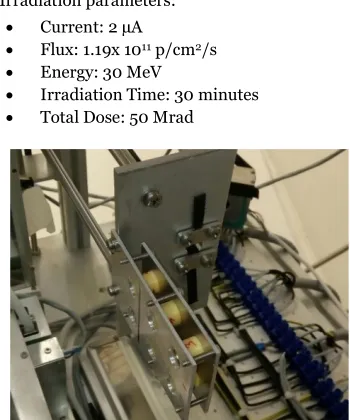
The first test in December 2017 was of pin diodes. As seen in Fig. 2, a holder for the 6-pin diodes was produced for irradiation of the specimens and placed on the moving test table. Aluminum-6082 is preferred because of its radiation resistance and low activation.
Irradiation parameters:
Current: 2 µA
Flux: 1.19x 10¹¹ p/cm2/s
Energy: 30 MeV
Irradiation Time: 30 minutes
Total Dose: 50 Mrad
Figure 2. Pin Diode test setup, as seen in December 2017. The DUT is moved in and out of the test area by a robotic system.
Other tested components include
GanFETs
Solar cells and solar cell cover glasses
Solar cell battery anode and cathodes
130
In total, 9 different materials and electronics were being tested in a pre-test campaign and provided useful experience to both the METU-DBL and user teams. This experience and feedback from the users will be used to re-design the test and measurement table for the final version of METU-DBL.
2.1. Detector Measurements
Timepix3, diamond and fiber scintillator detectors are used for METU-DBL proton measurements. Neutron and gamma secondary production occurs as a result of protons interaction with materials close to the beam. For this reason, the amount of secondary radiation is measured by gamma and neutron probes placed inside the irradiation room.
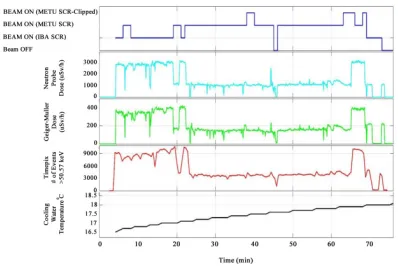
Figure 3. Beam status and various radiation monitoring (neutron, Geiger-Müller and Timepix3) measurements as well as cooling temperature measurement during a 70 minute long run. Different materials used in the IBA and METU screen result in significantly different number of secondary particles
being produced.
Gamma and neutron detectors as well as the Timepix3 (used as a background monitor) were used to measure time-dependent proton, gamma and neutron activity in the R&D room and the comparative measurements results obtained during a 70 minutes long run are given in Fig. 3. The state of the beam can be seen on the top panel. The neutron dose is seen on the lower panel, followed by the gamma detector (Geiger-Müller counter) and the number of events seen about a 50.57 keV threshold by the Timepix3 detector in a 30 second window. Timepix3 detectors are hybrid active pixel detectors. Primary proton beam can be stopped by two different screens to visualize the beam shape, namely, the IBA and METU screens. These screens are placed into beam pipe with 45° angle to the beam axis, so screens can be seen by a window on the pipe. By recording the screens with camera beam shape can be analysed during irradiation. As a result of interaction between proton and screens, unwanted secondary gamma and neutron production occurred. The IBA screen is made of 2.2 cm copper and 200-300 µm of Al2O3 active material deposited on the copper,
while the METU screen has a thin 1.5 mm plate of Al2O3 attached to a 3-5 cm thick Stainless Steel 304
plate. When the beam hits Al2O3, scintillation photons
are emitted and are recorded by cameras through a sapphire window. The IBA screen produces three times more secondary gamma and neutron radiation than the
METU screen, due to copper being used instead of steel. The lowest panel shows how the temperature of the cooling water of the METU screen increases during irradiation, as expected.
The secondary particle production rate during irradiations can be carefully monitored as demonstrated here. This is important to limit the secondary dose received by the DUTs and to ensure that any effects seen during tests are caused by the primary protons.
3.SHIELDING SIMULATIONS WITH THE MONTE CARLO
METHOD
Simulations of materials used for radiation shielding of METU-DBL were performed using MCNP, which calculates the radiation transport by the Monte Carlo method. SuperMC code [8] is used to create models for MCNP. It was developed by the FDS team (INES, Chinese Academy of Sciences) and was used for modeling Monte Carlo-based codes.
MCNP is a general-purpose Monte Carlo code developed by the Los Alamos National Laboratory. With MCNP6, 37 different radiation types can be used for criticality, shielding, dosimetry, detector and many other applications.
Simplified METU-DBL and sandwich shielding material (polyethylene sandwiched between layers of aluminum) shown in Fig. 4 are modelled for radiation transport simulations with MCNP code. Such shielding is especially necessary for the readout electronics of Timepix3, diamond and fiber scintillator detectors which scan the beam area. This beamline model is also used for total dose calculations received by DUTs when/if the material information is shared by users requesting tests.
Figure 4. MCNP model of simplified METU-DBL. Two quadrupole magnets and 5 cm thick scoring plane is modelled
by one mm thick layers.
A 30 MeV proton source was modeled at the beginning of METU-DBL and directed to the test area at the end where shielding material is placed. To simulate magnetic field effects on the beam, “bfld QUAD FIELD” option is used to model quadrupole magnets. “bfld QUAD FIELD” is the MCNP input parameter to apply quadrupole magnet effect to the defined volume of the pipe. Mix and match technique is used to apply physics model for the interaction.
131
cells using the F4 tally and using appropriate energy bins.
Relative errors are kept below 5% by increasing number of source particles used in simulations and variance reduction techniques such as splitting, Russian roulette and cutoff. MCNP manual states that the relative error must be kept below 10% for realistic results [9].
3.1. Proton and Neutron Flux Distributions
When a proton enters a material, its energy deposition per unit length changes as a function of depth. In Fig. 5, a sudden decrease in the proton flux was observed at a thickness of 4-5 mm Al as expected due to most protons stopping right after the Bragg peak. Aluminum outside the polyethylene in the shielding sandwich was increased from 2.5 mm to 5 mm to stop 30 MeV proton beam inside the aluminum.
Figure 5. 30 MeV proton flux suddenly decreases after traversing 5 mm of aluminum.
The interaction of proton beam with 5 mm of aluminum results in the secondary neutron production. As shown in Fig. 6, the flux of neutrons per source proton increases in 5 mm of aluminum. Due to the backscattering effect, the maximum flux of neutrons is calculated in the middle of the aluminum plate.
Figure 6. Calculated secondary neutron flux from 30 MeV protons, inside 5 mm of aluminum followed by 5 cm of
polyethylene. Each layer here is 1 mm thick.
To moderate and stop the secondary neutrons produced in the aluminum layer, 5 cm of polyethylene follows the aluminum plate and the neutron flux is
calculated. The neutron flux decreases nearly linearly inside 5 cm of polyethylene, scored with 1 mm thick layers. For this reason, the shielding structure for METU-DBL is a sandwich made of aluminum with polyethylene in the middle.
3.2. Proton and Neutron Energy Spectrums
Proton energy spectrum at different depths of aluminum is calculated. It is seen at Fig. 7, average energy of the proton beam inside each layer is decreasing with the increasing layers. This calculation can be used in future studies to obtain proton beams at lower energies.
Figure 7. Proton energy spectrum calculated at different depths of aluminum shielding.
The produced neutron spectrum inside a 5 mm thick aluminum shield is shown logarithmically against energy as seen in Fig. 8. Most of the neutrons produced have energies less than 1 MeV and the spectrum does not change significantly with the depth of aluminum. For this reason, a good moderator like polyethylene must be mixed with absorbing materials such as boron and cadmium to stop low-energy neutrons. This will ensure that the high-energy neutrons will lose energy in the moderator and that resulting low-energy neutrons will be stopped in the absorber material.
Figure 8. Calculated secondary neutron spectrum from 30 MeV protons, inside 5 mm of aluminum, shown logarithmically. Most of the neutrons produced have energies
132
4.CONCLUSION
In this article, METU-DBL project for space radiation tests, being built in R&D room in TAEA, SANAEM Proton Accelerator Facility is presented. Experimental radiation measurements from the pre-test of METU-DBL as well as Monte Carlo calculations of secondary particles produced by 30 MeV primaries were discussed and a new shielding sandwich was designed for the final version of METU-DBL. Both simulations and experimental measurements will continue to better shield electronics, both against the primary protons and secondary particles. METU-DBL irradiation facility when complete will be the first of its kind in Turkey made available to researchers, local and international.
Acknowledgements: The paper is a result of the
research done within the METU-DBL project (Grant no: 2015K121190). We would like to thank Ministry of Development of Turkey and colleagues from TAEA SANAEM Proton Accelerator Facility, as well as Prof. Selahattin Özdemir for his collaboration on the pin-diode test. The results of that test will be published separately.
REFERENCES
1. Proton hizlandiricisi tesýsý, Türkýye atom enerjýsý kurumu, Ankara, Türkiye, 2012. (Proton Accelerator Facility, Turkish Atomic Energy Authority, Ankara, Turkey, 2012.)
Retrieved from:
http://www.taek.gov.tr/tr/component/remository/func-startdown/629/lang,tr-tr/?Itemid=301;
Retrieved on: May 6, 2018
2. T. Goorley, “MCNP™ 6.1.1 - Beta Release Notes (LA-UR-14-24680),” Los Alamos National Laboratory: Los Alamos (NM), USA, 2014.
Retrieved form: https://laws.lanl.gov/vhosts/mcnp.lanl.g ov/pdf_files/la-ur-14-24680.pdf;
Retrieved on: Jun. 14, 2018
3. E. Petersen, Single Events Effects in Aerospace, Hoboken (NJ), USA: Wiley-IEEE Press, 2011.
DOI: 10.1002/9781118084328
4. K. A. LaBel et al., “Compendium of Single Event Effects, Total Ionizing Dose, and Displacement Damage for Candidate Spacecraft Electronics for NASA,” in
Proc.2014 IEEE Radiation Effects Data Workshop (REDW), Paris, France, 2014, pp. 1 – 12.
Retrieved from: https://ntrs.nasa.gov/archive/nasa/casi. ntrs.nasa.gov/20120015010.pdf;
Retrieved on: Jun. 11, 2018
5. Single Event Effects Test Method and Guidelines, ESCC Basic Specification No. 25100, ESA, Paris, France, 2014. Retrieved from: https://escies.org/download/webDocum entFile?id=62690;
Retrieved on: Jun. 12, 2018
6. A. Stoica et al., “Evolutionary recovery from radiation induced faults on reconfigurable devices,” in Proc. 2004 IEEE Aerospace Conference, Big Sky (MT), USA, 2004, pp. 2449 – 2457.
Retrieved from: https://trs.jpl.nasa.gov/bitstream/handl e/2014/38488/03-3499.pdf?sequence=1;
Retrieved on: Jun. 13, 2018
7. J. M. Lauenstein, “Standards for Radiation Effects Testing: Ensuring Scientific Rigor in the Face of Budget Realities and Modern Device Challenges,” presented at the Hardened Electronics and Radiation Technology Conference (HEART 2015), Chantilly (VA), USA, Apr. 2015.
Retrieved from: https://ntrs.nasa.gov/archive/nasa/casi. ntrs.nasa.gov/20150011462.pdf;
Retrieved on: Jun. 13, 2018
8. Y. Wu et al., “CAD-based Monte Carlo program for integrated simulation of nuclear system SuperMC,”
Annals of Nuclear Energy, vol. 82, pp. 161 – 168, Aug. 2015.
DOI: 10.1016/j.anucene.2014.08.058
9. J. K. Shultis, E. E. Faw, An MCNP Primer, Kansas State University, Manhattan (KS), USA, 2011.
Retrieved from: http://www.mne.k-state.edu/~jks/MCNPprmr.pdf;