http://www.sciencepublishinggroup.com/j/acm doi: 10.11648/j.acm.20170602.11
ISSN: 2328-5605 (Print); ISSN: 2328-5613 (Online)
The Global Exponential Stability Analysis of Nonlinear
Dynamic System and Application
Li Xiao
*, Junjie Bao, Xi Shi
Department of Mathematics and Information Engineering, Chongqing University of Education, Chongqing, PR China
Email address:
[email protected] (Li Xiao) *Corresponding author
To cite this article:
Li Xiao, Junjie Bao, Xi Shi. The Global Exponential Stability Analysis of Nonlinear Dynamic System and Application. Applied and Computational Mathematics. Vol. 6, No. 2, 2017, pp. 68-74. doi: 10.11648/j.acm.20170602.11
Received: January 31, 2017; Accepted: February 14, 2017; Published: March 6, 2017
Abstract:
This paper studies the global exponential stability for a class of nonlinear dynamical systems. A new state feedback controller is designed, which can effectively stabilize this kind of nonlinear system to the equilibrium point at exponential rate. The feasibility of the method is proved theoretically, and an algorithm is systematically proposed to configure the related parameters of the controller. Then simulation results show the effectiveness of the proposed control method.Keywords:
Nonlinear System, Exponential Stability, Unified System, Chaotic Masking1. Introduction
Over the past decade, many scholars have studied the stability problem of nonlinear dynamical systems and obtained some extraordinary nice conclusions [1]-[20], and these research results have been fully reflected in the practical application [5]-[7]. Among these, the most representative is the good application of chaos in secure communication field, biology field, medicine field and etc [8]-[10]. It is mainly because as the special behavior of nonlinear dynamical systems, Chaotic time series have the characteristics of extreme sensitivity to the initial value, wide power spectrum and noise like characteristic, which makes the chaotic time series’ characteristic have the feature of unpredictable and hidden. Now, synchronization and control of chaotic systems have become a hot topic, and then a variety of chaotic synchronization methods have been proposed, such as coupling synchronization method [1], variable structure synchronization method [2], adaptive synchronization method[3], linear and nonlinear feedback synchronization method [4]-[6], pulse synchronous method [7], [8], projective synchronization method [9], [10], fractional synchronization method [11] and the other methods [12]-[31]. Actually, most of the present methods which have been proposed focus on how to make the two chaotic systems asymptotically achieve synchronization, but the research on the optimization of
Based on existing research results, this paper’s main target is the convergence rate, and the global exponential stability of a class of nonlinear dynamical systems is studied. Under the condition that the system satisfies the global Lipschitz condition, on the basis of the stability theory, we designed a suitable nonlinear state feedback controller which can make the global exponential of the controlled system stable to the equilibrium point. The feasibility of the method is analyzed theoretically, and an algorithm is systematically given to configure the related parameters of the controller. At last, according to the example of the synchronization of two unified chaotic systems and its application in the secure communication, simulation results further show the effectiveness of the proposed method.
2. Priliminaries
Considering a nonlinear dynamical system with the following forms:
( ) ( ) ( ( )),
x tɺ =Ax t + f x t x(0)=x0, (1)
We denote x t( )∈Rn as system state which is
n-dimensional real column vector, where A∈Rn n× is constant system matrix, f x t( ( )) :Rn→Rn is a continuous nonlinear mapping which satisfies the following global Lipschitz condition, which is that for any two vectors
, n,
x y∈R there exists a normal number ξ which can make the following established inequality hold
( ) ( )
f x −f y ≤
ξ
x−y , (2)a vector’s Euclidean norm is indicated by ⋅ . Be aware of (0) 0
f = , that is, x t( )=0 is the equilibrium point of the system (1).
Assuming controlled system is
( ) ( ) ( ( )) ( ( )),
x tɺ = Ax t +Bf x t +U x t x(0)=x0, (3)
Where U x t( ( )) is the external control input. The goal of this paper is to use the system state variable x t( ) as input by designing a suitable controller, so that the state vector x t( ) tends to zero at an exponential rate as time goes to infinity, that is
( ) (0) exp( ),
e t ≤ e −
β
t(4)
where β>0. (3) should be treated as an error system, When the synchronization of two chaotic systems are taken into consideration. It is necessary to introduce the following lemma before we come to our conclusion.
Lemma 1 ([14]): If V t( ) is continuous and its corresponding differential equation satisfies
( ) ( , ( ))
V tɺ =g t V t , (5)
whose solution is a unique. If for t∈[0,tf], V t′( ) is the
solution of the system (5) and V t′′( ) is a solution of
inequality V tɺ( )≤g V t t( ( ), ) , their initial values meet the condition that V′′(0)≤V′(0), and then for t∈[0,tf], we have the following inequality holds
( ) ( )
V t′′ ≤V t′ . (6)
Lemma 2 ([16]): the differential equation
( ) ( ) exp( ),
V tɺ = −
λ
V t +ε
−α
t (7)where λ ε α, , >0, the solution of (7) has the following form
(
)
(0) exp( ) exp( ), ,
( ) exp( ) exp( )
(0) exp( ) , .
V t t t
V t t t
V t
λ ε λ λ α
ε α λ
λ λ α
λ α
− + − =
= − − −
− + ≠
−
(8)
and V t( ) has the global exponential stability, that is
lim ( ) 0
t→∞V t = .
Based on lemma 1 and lemma 2, we can obtain a theorem with exponential stability as follow.
Theorem 1 ([16]). For a given continuous nonlinear system
( ) ( , ( ))
x tɺ = f t x t , (9)
Where x t( )∈Rn . If there exists a Lyapunov function
( ( ), )
V x t t which has the following properties, for arbitrary
(
t x t, ( ))
∈R+×Rn, we have the following inequalities hold.2 2
2 2
1 x t( ) V x t t( ( ), ) 2 x t( )
λ ≤ ≤λ , (10)
3
( ( )) ( ( )) exp( )
V x tɺ ≤ −
λ
V x t +ε
−α
t , (11)where λ λ λ1, 2, 3,ε and α are normal numbers, the system (9) has the global exponential stability and satisfies the following inequalities:
( )
1
2 2
2
3 2 3 3
1 1
1
2 2
2
3 2 3 3
1 1 3
(0) exp( ) exp( ) , ,
( )
(0) exp( ) exp( ) exp( ) , . ( )
t
x t t
x t
x t t t
λ λ ε λ λ α
λ λ
λ λ ε α λ λ α
λ λ λ α
− + − =
≤
− + − − − ≠
−
(12)
3. The Design of Controller
Based on the above conclusions, we design a nonlinear state feedback controller with the following form.
2 T
( ) ( ) ( )
( ( )) ( ) ,
( ) ( ) exp( )
C x t x t Px t U x t BKx t
C x t Px t ε αt
= − −
+ − (13)
control parameters to be designed.
Theorem 2. For continuous system (1), under the condition of global Lipschitz, if there exists a constant matrix B∈Rn×1
which has the follow property Rank A AB[ , , ...,An−1B]=n, there also exists a positive definite matrix P∈Rn n× and a
matrix K∈R1×n make (A BK− )TP+P A BK( − ) become a negative definite matrix, and then under the action of the controller (13), the state variables of the system (1) are globally exponentially stable at the origin.
Proof of theorem 1: The Lyapunov function is constructed as follows:
T
1
( ( )) ( ) ( ), 2
V e t = x t Px t (14)
where P is a positive definite matrix. Let
1 min
1
( )
2 P
λ = λ , 2 max
1
( )
2 P
λ = λ , then V e t( ( ))
should satisfy the following inequality
2 2
2 2
1 x t( ) V x t( ( )) 2 x t( )
λ ≤ ≤λ . (15)
Along the system (1), the form of the derivative of V x t( ( ))
about time t is as follows
(
)
(
)
(
)
(
(
)
(
)
)
T T
T T
T
T T T
2 T T
T T 2 T T 1 ( ( )) ( ) ( ) ( ) ( ) 2 1 ( ( )) ( ) ( ( )) ( ) 2 1 1 ( ( )) ( ( )) 2 2 1 ( )
2 exp( )
1 .
( )
2 exp( )
V x t x t Px t x t Px t
Ax f x t U t Px x P Ax f x t U t
x A P PA x f x t Px x P f x t
x xx P
x BK Px
x Px t
x x Px
x P BK x
x Px t
ξ
ξ ε α
ξ
ξ ε α
= + = + + + + + = + + + + − − + − + − − + −
ɺ ɺ ɺ
(
)
(
(
)
(
)
)
(
)
T
T T T
2 2 2 T T 2 2 2 T 1 1 ( ( )) ( ( )) 2 2 1 ( ) ( )
2 exp( )
1 1
2 2 exp( )
x A P PA x f x t Px x P f x t
x Px
x BK P P BK x
x Px t
x Px
x Qx x Px x Px
x Px t
ξ
ξ ε α
ξ
ξ ξ
ξ ε α
= + + + + − + − − + − ≤ − + + − + − 2 2 2 T T 2 min exp( ) exp( ) exp( )
( ) exp( ),
x Px
x Qx x Px
x Px t
x Px t
e Qe
x Px t
Q x t
ξ
ξ ξ ε α
ξ ε α
ξ ε α
λ ε α
≤ − + − + − × − ≤ − + + − ≤ − + −
where 1 ( )T ( )
2
Q= − A BK− P+P A BK− . According to
(15), we have
min 2 2
( )
( ( )) Q ( ( )) exp( )
V x t λ V x t ε αt
λ
≤ − + −
ɺ . (16)
Let min
2 2
( )Q λ λ
λ
= , we can obtain the inequality
( ( )) ( ( )) exp( )
V e tɺ ≤ −
λ
V e t +ε
−α
t . According to theorem 1, we can draw the following inequalities hold.( ) 1 2 2 2 2 1 1 1 2 2 2 2 1 1
(0) exp( ) exp( ) , ,
( )
(0) exp( ) exp( ) exp( ) , . ( )
t
x t t
x t
x t t t
λ λ ε λ λ α
λ λ
λ λ ε α λ λ α
λ λ λ α
− + − = ≤ − + − − − ≠ −
In the process of parameter design of control input U t( ), the most important step is how to find the matrices B K P, , to meet the requirement. In the light of theorem 2, The choice of matrix B K P, , should make the matrix
T
(A BK− ) P+P A BK( − ) became a negative definite matrix. In order to achieve this goal, we need to use the following lemma.
Lemma 3 ([16]): Suppose the matrix A and B satisfy the controllable conditions, that is Rank A AB[ , , ...,An−1B]=n, the matrix P∈Rn n× is positive definite against matrix. If there exist positive definite matrices D∈Rn n× and
m m
R∈R × , which satisfy the following Ricatti equation
T 1 T
0
D A P PA PBR B P−
− − − + = . Define K=R B P−1 T ,all the eigenvalues of A−BK have the negative real part, that is to say, (A BK− ) is negative definite matrix.
Thus, we can give a systematic method to design the controller parameters. Let's first select a constant matrix
1 n
B∈R × , which makes Rank A AB[ , , ...,An−1B]=n ; Secondly, we need to choose positive definite constant matrices n n
C∈R × and R∈Rm m× (m≤n) ;Then, we can find a positive definite matrix P by solving the Ricatti equation − −D A PT −PA+PBR B P−1 T =0; After that, let's calculate 1 T
K=R B P− and 1 ( )T ( ) 2
Q= − A BK− P+P A BK− .
Finally, we choose the appropriate normal numbers ξ α ε, , . The control parameters designed by the above steps can meet the requirements.
4. Numerical Simulation
To demonstrate the correctness and practicability of the proposed method, the simulation design is carried out according to the synchronization scheme of the unified chaotic system. The mathematic model of the unified chaotic system
1 2 1
2 1 1 3 2
3 1 2 3
( ) (25 10)( ( ) ( )),
( ) (28 35 ) ( ) ( ) ( ) (29 1) ( ), ( ) ( ) ( ) (8 ) 3 ( ),
x t a x t x t
x t a x t x t x t a x t
x t x t x t a x t
where system parameter a∈[0, 1] , the unified chaotic system is of global chaos characteristic in this range. When
[0, 0.8)
a∈ ,the system is a descriptor Lorenz system. When (0.8, 1]
a∈ , the system is a descriptor Chen system. And when a=0.8, the unified chaotic system belongs to Lü system. When a=0.56, the system is belong to descriptor Lorenz system characterized as chaos. Its chaotic attractors are shown in figure 1.(a)-(c).
(a)
(b)
(c)
Figure 1. (a) the phase diagram of chaotic attractors in plane x1-x2, (b) the phase diagram of chaotic attractors in plane x1-x3,(c) the phase diagram of chaotic attractors in plane x2-x3
Think of system (16) as the drive system, and the homogeneous response system is the following control system
1 2 1 1
2 1 1 3 2 2
3 1 2 3 3
( ) (25 10)( ( ) ( )) ( ),
( ) (28 35 ) ( ) ( ) ( ) (29 1) ( ) ( ), ( ) ( ) ( ) (8 ) 3 ( ) ( ),
x t a x t x t U t
x t a x t x t x t a x t U t
x t x t x t a x t U t
= + − +
= − − + − +
= − + +
ɺɶ ɶ ɶ
ɺɶ ɶ ɶ ɶ ɶ
ɺɶ ɶ ɶ ɶ
(18)
Here we divide (17) and (18) into two parts: one is linear part and the other is non-linear parts, the coefficient matrix and the nonlinear term of the liner part as follows
1 3
1 2
1 3
1 2
25 10 25 10 0 28 35 29 1 0 ,
0 0 (8 ) 3
0 ( ) ( ) ( ) ,
( ) ( )
0 ( ( )) ( ) ( ) .
( ) ( )
a a
A a a
a
f x x t x t
x t x t
f x t x t x t
x t x t
− − +
= − −
− +
= −
= −
ɶ ɶ ɶ
ɶ ɶ
(19)
Then, selecting a=0.56,ξ =60,α =2.5,ε =1, T
[0, 1, 1] , {1, 1, 1}, 5
B= D=diag R= , according to the above method, we can obtain the following matrices
7.3273 38.1410 0.0584 38.1410 199.0274 0.3050 ,
0.0584 0.3050 0.1746 P
−
= −
− −
3
0.1455 0.7568 0.0005 10 0.7568 3.9496 0.0026 ,
0.0005 0.0026 0.0005 Q
− −
= − −
−
[
7.6165 39.7445 0.0261]
K= − ,
where
1 min
1
( ) 0.0935
2 P
λ = λ = ,
2 max
1
( ) 10.1572
2 P
λ = λ = ,
min max
( ) 0.0024 ( )
Q P λ
λ=λ = . Because
λ α
≠ , the error vector e t( )satisfies
( )
1
2 2
2
3 2
1 1
( ) (0) exp( ) exp( ) exp( )
( )
e t λ e λt ε αt λt
λ λ λ α
≤ − + − − −
−
(20)
Take the above parameters into
T
1 2 3
( ) [ ( ), ( ), ( )]
U t = U t U t U t -the controller of Theorem 2, and
define the synchronization error 3 2 1
( ) i ( ( )i i( ))
E t =
∑
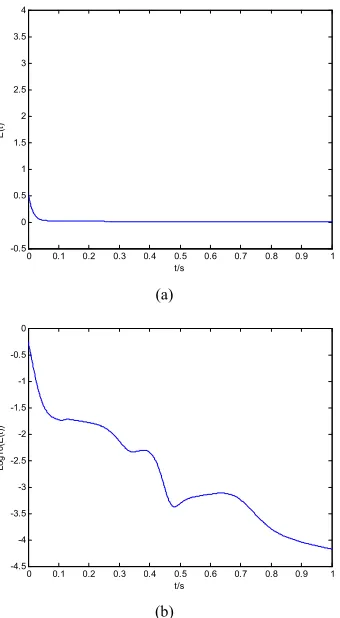
= x t −x tɶwhose time-domain plot shows in 2(a); It is difficult to estimate the performance of synchronization by directly observe how the synchronization error changes over time, we take log of E t( ) in order to inspect the performance of exponential synchronization more effectively, the result is shown in Figure 2.(b). It shows that the two chaotic systems achieve synchronization in a short time.
-30 -20 -10 0 10 20 30
-30 -20 -10 0 10 20 30 40
x1(t) x2
(t
)
-30 -20 -10 0 10 20 30
0 10 20 30 40 50 60
x 1(t)
x3
(t
)
-30 -20 -10 0 10 20 30 40
0 10 20 30 40 50 60
x2(t) x3
(t
(a)
(b)
Figure 2. Synchronization Error, (a) time-domain figure of E t ; (b) ( )
time-domain figure of log10E t( )
Bellow we apply this exponential synchronization method to chaos secure communication. The chaotic masking secure communication is an earlier studied secure communication technique. In the transmitter, there is a chaotic systems superimposing the transmitted signals on output chaotic signals, and the synthesized signals are transmitted via a transmission channel. In the receiver, there is a chaotic system equivalent to the transmitter, which is driven by the received signals, so as to achieve the synchronization between the local chaotic system and the receiver chaotic system, then subtract the received synthesized signals by the reconstructed signals to get the information transmitted. We denote the information signals as m t( ).Here we firstly normalize m t( ) in order to prevent the impact of the oversize amplitude of m t( ) on the chaotic signals, that is m t′( )=m t M( ) . Superimposing tighter m t( ) and three chaotic signals, we have
1 2 3
( ) ( ) ( ) ( ) ( )
s t =m t′ +x t +x t +x t ,then transmit s t( ) in the channel. The response system synchronized with the drive system in the receiver ensures that useful information transmitted can be acquired. The decrypted signal in the receivers is m t1( )=M s t( ( )−x tɶ1( )−x tɶ2( )−x tɶ3( )) . In the simulation, we select m t( )=10sin(πt) to represent the original signal, and the amplitudeM =10; The transmission signal s t( ) as shown in Figure 3.(b); The decrypted signal as shown in Figure 3.(c); The error signal m t( )−m t1( ) as shown in Figure 3.(d).
(a)
(b)
(c)
(d)
Figure 3. (a) the original signal; (b) the transmission signal; (c) the decrypted signal; (d) the error signal.
0 0.1 0.2 0.3 0.4 0.5 0.6 0.7 0.8 0.9 1
-0.5 0 0.5 1 1.5 2 2.5 3 3.5 4
t/s
E
(t
)
0 0.1 0.2 0.3 0.4 0.5 0.6 0.7 0.8 0.9 1
-4.5 -4 -3.5 -3 -2.5 -2 -1.5 -1 -0.5 0
t/s
L
o
g
1
0
(E
(t
))
0 2 4 6 8 10 12 14 16 18 20
-10 -5 0 5 10 15
t/s
m
(t
)
0 2 4 6 8 10 12 14 16 18 20
-20 0 20 40 60 80 100 120
t/s
s
(t
)
0 2 4 6 8 10 12 14 16 18 20
-10 -5 0 5 10 15
t/s
m1
(t
)
0 2 4 6 8 10 12 14 16 18 20
-0.2 0 0.2 0.4 0.6 0.8 1 1.2
t/s
误
The simulations show that the useful signal performs prefer masking property under the mark of chaotic signal. In the receiver, the useful signal recovering can be achieved less than 0.5s, it contributes to the exponential synchronization method, which further demonstrates the efficacy of exponential synchronization method. Hence, it can be effectively applied to signal transmission for secure communication with better practicability and higher security.
5. Conclusion
This paper researches a method of exponential synchronization for chaotic systems. Numerical simulation shows that the proposed method is easily implemented in practice with a higher synchronous speed and confidentiality. Hence, the method possesses evident practicability and application value in secure communications.
Acknowledgements
This work described in this paper was supported in part by the Natural Science Foundation Project of Chongqing CSTC under grant cstc2014jcyjA40041, in part by the Scientific and Technological Research Program of Chongqing Municipal Education Commission under KJ1501401.
References
[1] M. Siddique, M. Rehan, “A concept of coupled chaotic synchronous observers for nonlinear and adaptive observers-based chaos synchronization”, Nonlinear Dynamics, 2016, 84(4): 1-22.
[2] X. Yin, Y. Ren, X. Shan. “Synchronization of discrete spatiotemporal chaos by using variable structure control,” Chaos, Solitons & Fractals, 2002, 14(7): 1077-1082.
[3] X. Han, J. Lu, X. Wu. “Adaptive feedback synchronization of Lü system,” Chaos, Solitons & Fractals, 2004, 22(1): 221-227. [4] C. Tao, J. Lu, J. Lü. “The feedback synchronization of a unified chaotic system,” Acta Physica Sinica, 2002, 21(7): 1497-1501. [5] Z. Chen, K. Sun, T. Zhang. “Nonlinear feedback synchronization control of Liu chaotic system,” Acta Physica Sinica, 2005, 54(6): 2580-2583.
[6] S. Nazhan, Z. Ghassemlooy K. Busawon,”Chaos synchronization in vertical-cavity surface-emitting laser based on rotated polarization-preserved optical feedback”, Chaos, 2016, 26(1): 013109.
[7] S. Chen, Q. Yang, C. Wang. “Impulsive control and synchronization of unified chaotic system,” Chaos, solitons & fractals, 2004, 20(4): 751-758.
[8] J. Sun, Y. Zhang. “Impulsive control of Rössler systems,” Physics Letters A, 2003, 306(5): 306-312.
[9] J. Liu, S. Chen, J. Lu. “Projective synchronization in a unified chaotic system and its control,” Acta Physica Sinica, 2003, 52(7): 1595-1599.
[10] X. Wang, Y. Wang. “Projective synchronization of autonomous
chaotic system based on linear separation,” Acta Physica Sinica, 2007, 56(5): 2498-2503.
[11] G. Wu, D. Baleanu, H. Xie, F. Chen, “Chaos synchronization of fractional chaotic maps based on the stability condition”, Physica A, 2016, 460: 374-383.
[12] S. Yang, C. Chen, H. Yau. “Control of chaos in Lorenz systems,” Chaos, Solitons and Fractals, 2002, 13(4): 767-780.
[13] X. Guan, Y. Tang, Z. Fan, et al. “Neural network based robust adaptive synchronization of a chaotic system,” Acta Physica Sinica, 2001, 50(11): 2112-2115.
[14] D. Dawson, Z. Qu, J. Carroll. “On the state observation and output feedback problems for nonlinear uncertain dynamic systems,” Systems & Control Letters, 1992, 18(3): 217-222. [15] Z. Qu, D. Dawson. “Continuous state feedback control
guaranteeing exponential stability for uncertain dynamical systems,” in Proceedings of the 30th IEEE Conference on Decision and Control, IEEE, 1991: 2636-2638.
[16] M. Chen M, C. Wang, H. Zhang. “Chaotic Synchronization of Exponent Stability Based on Nonlinear State Observer,” International Conference on Mechatronics and Automation, IEEE, 2007: 657-662.
[17] X. Wu, H. Wang, H. Lu. “Hyperchaotic secure communication via generalized function projective synchronization,” Nonlinear Analysis Real World Applications, 2011, 12(2): 1288-1299.
[18] N. Li, J. Li. “Generalized projective synchronization of chaotic system based on a single driving variable and its application in secure communication,” Acta Physica Sinica, 2008, 57(10): 6093-6098.
[19] D. Yang, H. Zhang, A. Li. “Generalized synchronization of two non-identical chaotic systems based on fuzzy model,” Acta Physica Sinica, 2007, 56(6): 3121-3126.
[20] H. Zhang, T. Ma, J. Fu, S. Tong. “Robust lag synchronization between two different chaotic systems via dual-stage impulsive control,” Chinese Physics B, 2009, 18(9): 3751-3757. [21] J. Meng, X. Wang. “Phase synchronization of chaotic systems
based on nonlinear observers,” Acta Physica Sinica, 2007, 56(9): 5142-5148.
[22] H. Zhang, D. Liu, and Z. Wang. “Controlling Chaos: Suppression, Synchronization and Chaotification,” New York: Springer-Verlag, 2009, 184.
[23] T. Ma, H. Zhang, Z. Wang. “Impulsive synchronization for unified chaotic systems with channel time-delay and parameter uncertainty,” Acta Physica Sinica, 2007, 56(7): 3796-3802. [24] X. Wang, X. Wu. “Chaos anti-synchronization of a class of
chaotic systems based on state observer design,” Acta Physica Sinica, 2007, 56(4): 1988-1993.
[25] X. Wang, Y. He. “Projective synchronization of the fractional order unified system,” Acta Physica Sinica, 2008, 57(3): 1485-1492.
[26] X. Yan, D. Liu. “Control and projective synchronization of fractional-order chaotic systems based on sliding mode control,” Acta Physica Sinica, 2009, 58(6): 3747-3752.
[28] F. Jia, X. Wei, D. Lin. “Generalized synchronization of different orders of chaotic systems with unknown parameters and parameter identification,” Acta Physica Sinica, 2007, 56(10): 5640-5647.
[29] Y. Sun, J. Ruan. “Synchronization between two different chaotic systems with noise perturbation,” Chinese Physics B, 2010, 19(7): 150-155.070513
[30] L. Guo, Z. Xu, M. Hu. “Adaptive coupled synchronization of non-autonomous systems in ring networks,” Chinese Physics B, 2008, 17(3): 836-841.