http://mojem.um.edu.my
92
Corresponding Author:
Faculty of Education, University of
Malaya, Malaysia .
E-mail: [email protected]
ABSTRACT
In Malaysia, there is a Nature Education School (NES) conducting Environmental Educational Programs (EEP) in Janda Baik, Pahang since year 2011. Basically, EEP integrates the teaching of environmental content knowledge within the natural resources in the village. In terms of growth, the NES have witnessed increasing demand of EEP from both public and private schools due to the need to support students’ learning experience that are not achievable in the classrooms. This phenomenon has led to the purpose of research to explore the unique strategies, benefits, and challenges of the NES while dealing with EEP in their context. In terms of research design, it is an explorative case study using the method of participant-observation, prolonged engagement, purposive sampling and data collection from 16 key respondents that includes interviews with the Principal of NES and the middle management, online surveys with selected members from the village’s Private Resort Operators’ Association (PROA) and 10 facilitators who had been actively involved in the planning, organizing, leading and the monitoring of EEP in the last 5 years. For data analyses, the respondents’ transcripts were coded through open, axial and selective coding. In addition, triangulation method was used to compare between with field-notes, on-site interviews and online surveys to improve the credibility, dependability, and confirmability of data. As findings, the NES in the case study experienced both contextual benefits and challenges that require unique educational management and leadership strategies in their EEP. Discussion from this case study suggests four unique strategies used by the NES to implement EEP successfully: (a) Planning the EEP module must be visionary and capitalize on environmental content knowledge through links with field experts and universities, organisational learning and training; (b) Organizing of EEP must consider the people, task, content, processes and the availability of natural resource; (c) Leading visitors to focus on sustainable use of natural resource and contributing to future programs of EEP; and (d) Monitoring the organisation’s systems, visibility and specialisation in EEP. As for future suggestions of research, the tasks of evaluating the quality of EEPs ought to consider other factors such as; (a) exploring andragogy for adult participants in EEP, (b) creating advance EEP modules for the facilitators, and (c) Creative and innovative use of natural resources for EEP.
Keywords: Environmental Education Program (EEP), Strategies, Challenges, Social Engagement, Sustaining the Environment, Human and Community Development, Malaysia.
APRIL 2019, VOLUME 7, ISSUE 2, 92-121
E-ISSN NO: 2289 – 4489
https://doi.org/10.22452/mojem.vol7no2.5
IMPLEMENTATION OF ENVIRONMENTAL EDUCATION
PROGRAM (EEP) IN A NATURE EDUCATION SCHOOL (NES):
http://mojem.um.edu.my
93
INTRODUCTION
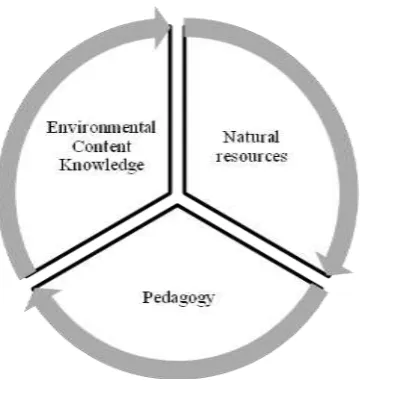
Environmental Education Programs (EEP) have long been promoted in various forms and functions across the globe, especially in the United Kingdom (Mullenbach, & Green, 2018; García-Martín, Plieninger, & Bieling, 2018; Moseley, Summerford, Paschke, Parks, & Utley, 2019). Early environmental education programs were informally designed and usually passed down among communities, while some programs were institutionalized, like the Scouts movement (Loynes, 2018), and the initiation of “Forest Schools’ (Leather, 2018; Coates & Pimlott‐Wilson, 2019) because of the multifold benefits to the cognitive, affective and health benefits to students (Bogar et al., 2018). Where there are both benefits and challenges of EEPs, one distinct feature of EEP is that it incorporated three vital elements: (a) Natural resources; (b) Pedagogy (or Andragogy); and (c) Environmental content knowledge. Teaching and learning are embedded in the nature-related field such as Ecology, Biology, Forestry and Environmental Science. EEP places its importance to highlight the interdependencies between mankind and nature while creating future generations who are responsible users of natural resources (Ardoin, Bowers, Roth, & Holthuis, 2018; Braun, Cottrell, & Dierkes, 2018).
The village of Janda Baik, Pahang is blessed with cool-mountainous rainforest and natural resources for recreation, agriculture, and eco-tourism. Much of the uniqueness of this village has been featured in research journals for its rich ecosystem and medicinal potential of floras and faunas (Chan, Lim, & Lim, 2007; Fanelli, Boomsma, & Turillazzi, 2005; Muul, Liat, & Walker, 1975; Onn & Grismer, 2010). While the villagers can be proud of its natural and vast reserves of tropical forests, the influx of tourists and recreationists in recent years have led to two physical impacts: (a) degradation of the environment (Azrina, Yap, Ismail, Ismail, & Tan, 2006); and (b) rapid constructions that results in breaching the carrying capacity in environmental sensitive sites (Mohamad & Marzuki, 2018).
In terms of Environmental Educational Programs (EEP), the combination of the school curriculum with visits to nature sites has also witnessed increasing demand from both public and private school students due to the reasonable time, access and distance to the city of Kuala Lumpur, Malaysia. As the operational definition of EEP in this study, it is defined as any program(s) that incorporates the use of natural resources, pedagogy and environmental content knowledge that aims to transform the attitudes, knowledge, and skills of the student(s) towards specific objectives. Hence, a Nature Education School (NES) has been the reference point to provide ample opportunities for students to enjoy EEP in the natural setting of the village. However, there will be a disastrous impact if these activities do not consider future sustainability, threats from illegal logging and constructions, and excessive outdoor recreational activities. To mitigate this impact in the long term, Environmental Education Programs (EEP) is an antidote to reduce the impact resulting from overuse and development of human activities (Abdullah, Hamid, Shafii, Wee, & Ahmad, 2018).
http://mojem.um.edu.my
94
evidence and knowledge on how EEP is carried out by field-practitioners (Braun et al., 2018). Conversely, if there are more references to it, valuable lessons can be learned through the empirical approach to understanding the reality of environmental education management in Malaysia (Dreyer, Yahya, & Kadir, 2018). While the central focus of this study is on the key implementer of EEP that is not specific to any school, the NES consists of field-practitioners and private resort operators who have carried out curriculum-based teaching and learning for both public and private international students in Kuala Lumpur. EEP providers are also very niche operators in the locality. Uniquely, the NES integrates the resort operators together with the natural resources to deliver EEP to Public/Private International Schools. Public and Private International schools in Kuala Lumpur prefers to work with the NES where they already have the personnel, expertise, facilities and natural resources to implement EPP without developing it from scratch. Subsequently, this symbiotic relationship allowed members from the village’s Private Resort Operators’ Association (PROA) to offer their unique vicinity as EEP sites for students to learn, experience and apply environmental education first-hand. Considering the phenomenal accomplishments of the NES, therefore, the purpose of this research is to primarily explore and explain how the NES applied their strategies of managing EEP in the context of the case study. On a specific note, the following research questions are designed for this case study;
1. What are the unique strategies used by the Nature Education School (NES) to implement
Environmental Education Program (EEP)?
2. What are the contextual benefits and challenges encountered by the Nature Education School (NES)
in implementing the Environmental Education Program (EEP)?
THEORETICAL FOUNDATIONS
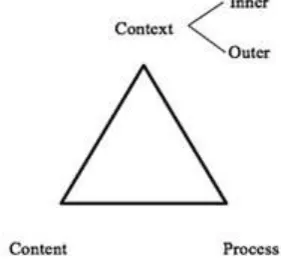
The theoretical foundation presented in this study will be focused on the unit of analysis as indicated in the research objectives. Firstly, the researcher will need to explain about Pettigrew’s (1997) processual framework (see Figure 1). It is a generic model for readers to grasp the relationship between content, context and the process that is described by the respondents in NES. Useful for organizational case studies, Pettigrew’s (1997) is referred to as the underlying theoretical framework to assist qualitative researchers who are interested in understanding case studies without imposing any pre-assumptions or biases on their perspectives.
Figure 1. Processual Framework (Pettigrew, 1997)
http://mojem.um.edu.my
95
Secondly, as the study narrows down to exploring the unique strategies Nature Education School (NES) uses in implementing Environmental Education Program (EEP), the researcher would have to consider organizational management theories in relation to the field of educational leadership and management (Bush, 2003). It is found that most theories on educational leadership and management are also very context-dependent from studies across different continents (Harris & Jones, 2018), and across different times (Hallinger, 2011). Therefore, leadership and management need to be adapted to fit the needs and expectations of the specific school context (Bush, 2018). Hence, there is a tension between theory, reality, and practice in explaining the phenomenon of the NES because its context is different than a normal Malaysian school (Bush, Abdul Hamid, Ng, & Kaparou, 2018). However, most education institutions consist of three levels that consist of: (a) the top management (such as Principal/Headmasters and Senior Assistants); (b) the middle management (such as Heads of Department); and (c) the operational staff (mainly teachers). Collectively, each level carries out the functions of management to achieve the goal(s) of the education institution. In this study, respondents from all three levels of management in the NES will be interviewed, with addition to three external partners who work closely with NES. Thereafter, the implementation of EPP will be explained through a qualitative approach to address the research questions of this study.
Thirdly, Lewin's Force Field Analysis (1951) theory is explored to explain the contextual benefits and challenges encountered by the Nature Education School (NES) in implementing Environmental Education Program (EEP). According to this theory, transformations of organisation would need to be described on two opposing forces; mainly one that pushes the change while the other side is against it. This to relate to the perceived benefits that move NES forward, while on the other side restraining challenges that push NES backward. In the context of schools, the challenges and issues pertaining to educational transformations may consist of administration, teachers, students, and parents (Ghavifekr, Hoon, Ling, & Ching, 2017). Yet, there is more to explore in that these challenges are similar (or different) in terms of the NES.
For a case study, theoretical foundations are useful to explain reality in action, but not for predicting hypotheses or other forms of deductive approach. In other words, theories are means to understanding the world, but they are not the end itself because qualitative data analyses are dependent on the inductive approach (Cohen & Manion, 2000). For the researcher, the other aim of presenting these theories above is to assist in the discussion sections when data is analysed at the end of the article for theoretical triangulations as described by Denzin (2012). It is also important to highlight that as qualitative researchers, there must be pre-caution that theories cannot pre-determine the paradigm of the researcher (Creswell & Miller, 2000; Yin, 2011). In other words, theories cannot be imposed on researchers’ understanding of reality especially in the setting and subjects of the study. However, theories can be used to explain reality through theoretical triangulations after data analyses (Denzin, 2012).
METHOD
Research Design
http://mojem.um.edu.my
96
Population and Sampling
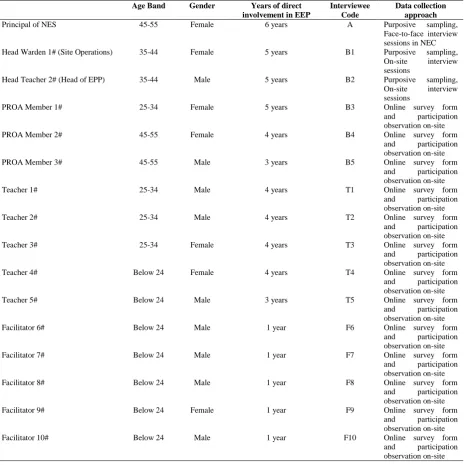
The respondents involved in this study totalled to sixteen people. They consist of the Principal of NES, the Head Warden of Site Operations, the Head Teacher of EPP, three members from the Private Resort Operators Association (PROA), 5 teachers and 5 facilitators who had been actively involved in the implementation of EEP. These facilitators consist of student-interns from public universities, while the teachers were graduates from the same university who has been absorbed as employees with the NES. Altogether, all stakeholders involved in this study manage and innovate EEP as an integrative plan to benefit the community there.
Approach
Prior to the interview, the researcher had explored this case study by becoming a participant observer in a no less than five EEPs for the period of one year. To some degree, the researcher was also involved in the process of prolonged engagement because he has extended time with respondents in NES to gain a better understanding of their behaviour, values, and social relationships in a social context. For the EEP, the participants are mainly students from public and private international school.
Data Collection Process
While the field visits are ongoing, the researcher had also carried out the data collection method through a pilot study conducted with an independent EEP provider in another location and to evaluate the feasibility of conducting the real study with the actual subjects of study. During the actual data collection, all other processes of conducting this research were documented in the reflective journal (or memo) through an interactive process, and thus enabling the researcher to explore, improve and understand how EEP is implemented by the NES to enhance the educational content, exposure, and experience of the participants. The audio-recorded interviews were subject to the availability and readiness of the respondents. However, data was also recorded at certain times through field written notes because of the nature of outdoor activities in the EEP. To ensure their responses were valid and reliable, the respondents were asked to verify the final transcripts before data analyses.
The unstructured interview would usually begin with the ‘what’ questions because it is easier for respondents
to reply. As respondents began to warm up and becoming more open about the topic of conversation, the researcher subsequently proceed with in-depth questioning into the unit of analyses that concerns the
questions of who, when, how, why and why not. The series of open-ended questions were asked to
respondents while allowing time for them to recall and reflect on their opinions and experiences (Yin, 2011). The researcher also promoted free, impromptu and unlimited discussions surrounding the core themes of the study. Although the respondents have responded lengthily on other matters that are not concerning the unit of analyses, this article only concentrates on EEP as implemented by NES in the context this case study. Other than the face-to-face interviews, data was also collected through online surveys and pictures pertaining to the event of EEP as a means of triangulation as mentioned by Denzin (2012).
Data Analyses
http://mojem.um.edu.my
97
sub-themes are critically evaluated if they are credible, dependable and confirmable (Lincoln & Guba, 1982, 1985, 1990, 2000, 2002) to address the unit of analyses in this research.
Reliability and Validity
According to Lincoln and Guba (1982, 1985, 1990, 2000, 2002), while a qualitative case study is never used for generalization as compared to a quantitative study, the effect of transferability is present when readers can relate to the phenomenon under study and use the findings to understand or make better decisions in their own contextual circumstances. Differentially compared with the usual terms of validity and reliability in quantitative research, they posit that trustworthiness of a research study is important to evaluate its worth. Trustworthiness involves establishing:
Credibility - confidence in the 'truth' of the findings
Transferability - showing that the findings have applicability in other contexts
Dependability - showing that the findings are consistent and could be repeated
Confirmability - a degree of neutrality or the extent to which the findings of a study are shaped by the
respondents and not researcher bias, motivation, or interest.
In presenting the analysis from this organization case study, the researcher will relate to the four terms of trustworthiness in presenting the facts while addressing the research questions. The subsequent sections will present the results of this research.
FINDINGS
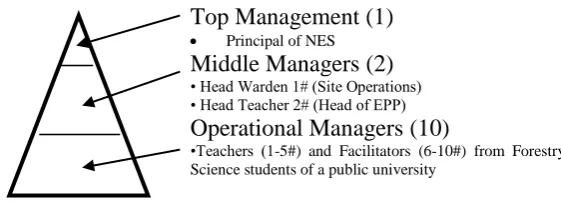
The core data collection in the NES is rooted in the interviews with people who have worked directly in organization R since its infancy years between 2011-2015. It is important to have an overview of the organisation structure that is consists of the common levels of management (see Figure 1). At the time of research, a total number of staffs in the NES (including the Principal) is thirteen people.
Top Management (1)
Principal of NESMiddle Managers (2)
• Head Warden 1# (Site Operations) • Head Teacher 2# (Head of EPP)Operational Managers (10)
•Teachers (1-5#) and Facilitators (6-10#) from Forestry Science students of a public university
Figure 1. Organisational Structure for the NES
http://mojem.um.edu.my
98
Table 1
Demographic profiles of the interviewees involved in this study
Age Band Gender Years of direct
involvement in EEP
Interviewee Code
Data collection approach Principal of NES 45-55 Female 6 years A Purposive sampling,
Face-to-face interview sessions in NEC Head Warden 1# (Site Operations) 35-44 Female 5 years B1 Purposive sampling,
On-site interview sessions
Head Teacher 2# (Head of EPP) 35-44 Male 5 years B2 Purposive sampling, On-site interview sessions
PROA Member 1# 25-34 Female 5 years B3 Online survey form and participation observation on-site PROA Member 2# 45-55 Female 4 years B4 Online survey form
and participation observation on-site
PROA Member 3# 45-55 Male 3 years B5 Online survey form
and participation observation on-site
Teacher 1# 25-34 Male 4 years T1 Online survey form
and participation observation on-site
Teacher 2# 25-34 Male 4 years T2 Online survey form
and participation observation on-site
Teacher 3# 25-34 Female 4 years T3 Online survey form
and participation observation on-site Teacher 4# Below 24 Female 4 years T4 Online survey form
and participation observation on-site
Teacher 5# Below 24 Male 3 years T5 Online survey form
and participation observation on-site Facilitator 6# Below 24 Male 1 year F6 Online survey form
and participation observation on-site Facilitator 7# Below 24 Male 1 year F7 Online survey form
and participation observation on-site Facilitator 8# Below 24 Male 1 year F8 Online survey form
and participation observation on-site Facilitator 9# Below 24 Female 1 year F9 Online survey form
and participation observation on-site Facilitator 10# Below 24 Male 1 year F10 Online survey form
and participation observation on-site
http://mojem.um.edu.my
99
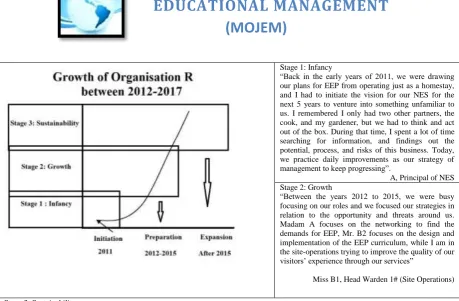
Stage 1: Infancy
“Back in the early years of 2011, we were drawing our plans for EEP from operating just as a homestay, and I had to initiate the vision for our NES for the next 5 years to venture into something unfamiliar to us. I remembered I only had two other partners, the cook, and my gardener, but we had to think and act out of the box. During that time, I spent a lot of time searching for information, and findings out the potential, process, and risks of this business. Today, we practice daily improvements as our strategy of management to keep progressing”.
A, Principal of NES Stage 2: Growth
“Between the years 2012 to 2015, we were busy focusing on our roles and we focused our strategies in relation to the opportunity and threats around us. Madam A focuses on the networking to find the demands for EEP, Mr. B2 focuses on the design and implementation of the EEP curriculum, while I am in the site-operations trying to improve the quality of our visitors’ experience through our services”
Miss B1, Head Warden 1# (Site Operations)
Stage 3: Sustainability
“Between the years of 2012 to 2015, our programs were refined and eventually completed with the help of our partners, especially forestry student-interns from the University. Thereafter, we were repeating and refining the programs on other schools that includes both public and international school students. By improving our systems on the existing programs, the news of our EEP travels fast to other schools. I would say that we solidified our system of management, and we have expanded steadily after 2015 to the present day. We hope to continue this momentum”.
Mr B2, Head Teacher 2# (Head of EPP)
Figure 2. Organisational phenomenal growth between 2011-2015
As the data analyses progress into the core areas of the study, the researcher will present the findings in two major sections according to the research questions. Each section will first introduce the major themes in accordance with what the respondents said, and subsequently, the researcher will present the sub-themes that branches out from the major theme in tables.
Research Question 1: What are the unique strategies used by the Nature Education School (NES) to implement Environmental Education Program (EEP)?
http://mojem.um.edu.my
100
1990) where the themes and sub-themes proved to be credible, dependable and confirmable by most of the
respondents.
Theme 1: Planning
As the transcripts were analysed through axial coding, the respondents’ quotation could be grouped into the theme planning. In essence, planning encompasses the codes that reveal expressions, behaviours and opinions to what they did at the beginning of the NES such as defining their mission, vision and goals for NES. The responses to the theme of planning seemed to concentrate on the top and middle management of NES because they were instrumental in the early days to put their ideas into action. Madam A, the Principal spoke about the importance of vision in the preparation and design of the EEP content.
“There is no planning without first imagining what is it like to conduct EEP in NES. We had some information on what is EEP is, but it took a lot of imagination on how to transfer those ideas to written form, and also communicating it to our people” (A-20082018-299-301).
As a unique strategic plan, the Principal hired four student interns who later became their teachers (T1, T2, T3, T4 and T5). The pilot batch of students majored in Forestry Science and were involved in the planning of EEP in NES. They were hired to apply their ideas and what they have learned in their university. As time progresses, she became more informed about what EEP can deliver, and how it should be done. She highlighted the essence of the planning of EEP that involves the wise use of natural resources, pedagogy, and content knowledge.
“Planning of EEP involves the science and the art. It is science because of the knowledge on the environment; it is art because we need to learn how to teach the information to the students, especially the ones that can touch students’ heart to change. As we plan our EEP, it is also important to look at the natural resources in Janda Baik, and ensure that it can continue to be there as they are being utilized for educational programs”
(A-20082018-307-311).“
http://mojem.um.edu.my
101
Table 2
Unique strategies in Planning of EEP in NES Theme 1:
Planning
Respondents Researcher’s
reflection from the memo
A B1 B2 B3 B4 B5 T1 T2 T3 T4 T5 F6 F7 F8 F9 F1
0
Triangulation between respondents
∕ ∕ ∕ ∕ ∕ ∕ ∕ ∕ ∕ ∕ ∕ ∕ ∕ ∕ ∕ ∕ The responses to the theme of planning seemed to concentrate on the top and middle management. Madam A, Principal of NES
spoke lengthily about the preparation of designing the content to be delivered in the EEP. The Principal of NES hired four pilot batch of student interns (T1, T2, T3, T4 and T5) majoring in Forestry Science to apply what they have learnt in their university. They were also contributing to the planning in terms of the preparation for the facilities, activities and the process of implementation. Subtheme 1.1: Preparation of content of EEP
a. c. * * * *
Subtheme 1.2: Preparation of people for EEP
a. * * h. * d. * * * *
Subtheme 1.3: Preparation of site-facilities for EEP
* b. * i. * e. * * *
Subtheme 1.4 Preparation of activities for EEP
* c. j. * f. * *
Subtheme 1.5 Preparation in the process- implementati on of EEP
* c. * * * g. * *
Supporting quotations
The symbol (*) indicates that the sub-themes were corroborated with other respondents but they are not shown as supporting quotations below.
a. “During the planning stage, we knew we were short of knowledge and technical skill to handle school visits, and I had to source for the relevant people to be part of this team. We were experimenting with many ideas. Through one of my contacts, he mentioned that a local university was looking for prospective employers to send their forestry science students for internship. I quickly wrote to the university and after 4 months we received the first batch of students. We got straight to work by brainstorming for the ideas in content, and activities to deliver the content in EEP”
Madam A, Principal of NES
b. “I had to anticipate the students’ readiness and behaviours to participate in EEP. I had to think thoroughly to enhance the visitor experience in aspects of accommodation, classroom preparation, and food to enhance their stay here. It has to be properly planned as some of the participants could be staying away from their home in nature for their first time in their lives”
Miss B1, Head Warden 1# (Site Operations)
c. “Most of the ideas during planning stage was on trial and error as we had no formal training on what to do and how to do it. We had to pick the most feasible activity to be conducted and we practice before we handle our first batch of students”
Mr. B2, Head Teacher 2# (Head of EPP)
d. “We have to decide who among us will be best to lead the activities for the students, and we would rehearse among ourselves before we conduct the real training”.
Facilitator 1# e. “I had to help ensure the site is safe for our nature walk so that we are familiar with the routes before leading the
http://mojem.um.edu.my
102
Facilitator 2#
f. “We brainstorm for activities that are most suitable to address the objectives of EEP. We listed them down and we consider the pros and cons according to our resources”
Facilitator 3#
g. “We run through the process of implementation by rehearsing with one another before the actual EEP” Facilitator 4#
h. “We have to anticipate in terms of who is the best person to handle the activity on our site. Sometimes we have to plan with NES if we are short of hand.
Miss B3, PROA Member 1#
i. “I was planning to add some information board for the benefits of our participants since we are allocating our site for educational purpose”
Miss B4, PROA Member 2#
j. “The activities that we run together with NES must be student-friendly. So, we have to plan it that way” Mr. B5, PROA Member 3#
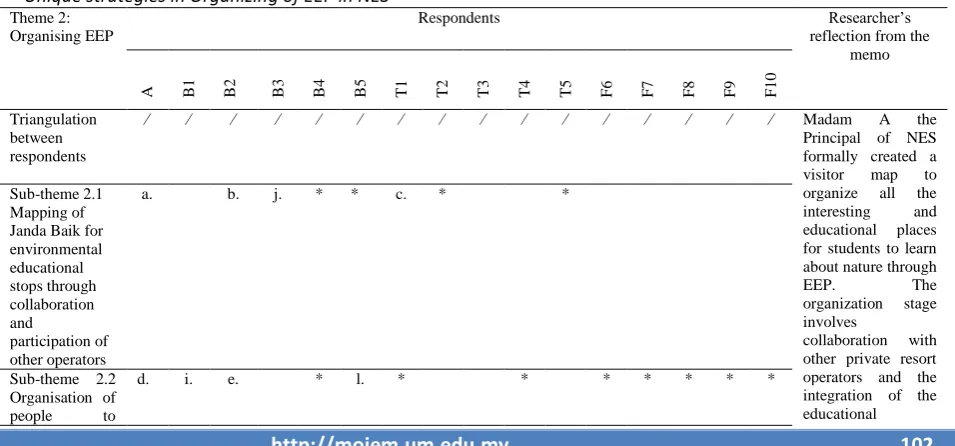
Theme 2: Organizing
In the subsequent theme of organizing, the researcher identified and encompass the codes that reveal expressions, behaviours and opinions to the definition and categorization of information, processes and people management of EEP. The output from the stage of organizing for NES amongst others; consists of a map that determined the EEP sites, EEP-content files, and other developed systems, processes and organizational structure after planning for communication, effectiveness, and efficiency in NES. When asked about the importance of organizing in NES, the principal interestingly said,
“If NES does not have a proper system to work with, we will be bringing on ourselves with unnecessary problems. Planning is drawing out the map for our destination, organizing is knowing how to read the map when you need it!” (A-20082018-366-368).
As for the rest of the sub-themes that emerged from the theme of organizing, they are indicated as shown in Table 3 below.
Table 3
Unique strategies in Organizing of EEP in NES Theme 2:
Organising EEP
Respondents Researcher’s
reflection from the memo
A B1 B2 B3 B4 B5 T1 T2 T3 T4 T5 F6 F7 F8 F9 F1
0
Triangulation between respondents
∕ ∕ ∕ ∕ ∕ ∕ ∕ ∕ ∕ ∕ ∕ ∕ ∕ ∕ ∕ ∕ Madam A the Principal of NES formally created a visitor map to organize all the interesting and educational places for students to learn about nature through EEP. The organization stage involves
collaboration with other private resort operators and the integration of the educational Sub-theme 2.1
Mapping of Janda Baik for environmental educational stops through collaboration and
participation of other operators
a. b. j. * * c. * *
Sub-theme 2.2 Organisation of people to
http://mojem.um.edu.my
103
conduct EEP at the designated environmental educational stops
resources onto the map.
The organization phase involved the people, the tasks involved and the content knowledge so that they are properly
documented to enable it to be referred to and used continually. In addition, the management of NES also tries to put in place the Standard operating
procedures for the staff to follow. This is to enable faster decision-making and problems solving. The organization of content, task, and procedures are apparent among younger student-interns who later joined the NES. Sub-theme 2.3
Organisation of tasks to conduct EEP at the designated environmental educational stops
a. i. e. * * * * * * * *
Sub-theme 2.4 Organisation of content to conduct EEP at the designated environmental educational stops
d. k. f. * * * * * * *
Sub-theme 2.5 Organisation of processes and systems
i. e. * * * *
Supporting quotations
The symbol (*) indicates that the sub-themes were corroborated with other respondents but they are not shown as supporting quotations below.
a. “We approached the Private Resort Operators Association to map out the unique stops for environmental education. I reasoned that if there is a synchronization of programs and activities that are put in place for visitors to experience and learn, it would enhance the visibility of Janda Baik. No lesser than 20 interesting educational stops were identified and organized around the village. We successfully created the paths on the map for visitors to stop and learn.
Madam A, Principal ofNES
b. “Some of the interesting sites that were planned in the map includes the cultural village of the Orang Asli (Indigenous people), the aquaculture ponds, the multi-level waterfall and others that should be highlighted as hidden gems of Janda Baik”.
Mr. B2, Head Teacher 2# (Head of EPP)
c. “We travelled to the site, took the pictures, and also estimates the distance from one station to another. In the end, we had a very interesting and user-friendly map that we could even sell them in NES as an additional source of income”
Facilitator 1# d. “We had to organize who and what to be taught to the participants. Sometimes, I have to train the staff to teach the
students in EEP. I know I have to learn the tricks and trade fast because I am the leader in this organization and time is a cost to me. One of the important aspects of organizing EEP is to identify and select the best person at the job. Since we do not have experience in the early years, we had to consistently get feedback from our visitors, and groom the people for the job through peer coaching and mentoring”.
Madam A, Principal of NES
e. “When we implement the EEP, we are not afraid of the content has gone wrong because we did a proper job at managing the what is to be delivered to the students. We were more concerned on the who and how because of the different backgrounds of the learners we have to deal with unexpected outcomes and reactions from participants. I was also thinking constantly on improving the delivery system setting up the SOPs for the organization so that our staff and participants can follow”
Mr. B2, Head Teacher 2# (Head of EPP)
http://mojem.um.edu.my
104
continue to use them again and again. We make sure that the content is accessible when we need them, and we worked in partners so that there more than one person who is capable to deliver the content. It is through repetition that we refined ourselves and this has led to the creation of a workable system that we can follow”.
Facilitator 2#
g. “We follow the decision of our boss whenever we are not sure of what to do. After we are familiar with the process, we will usually follow the same decision whenever we face the same problems in the future”
Facilitator 3#
h. “It is important for us to have our standard operating procedures so that we do not need to always consult Mr. B2 on petty and common matters”
Facilitator 4#
i. “In the early years, I was always short of staff and I have to delegate the job to the right people and at the right time. I teach my staff to be multi-tasking since we are a small company, but lately, when our team grows, I am able to improve the service quality with better management process”
Miss B1, Head Warden 1# (Site Operations)
j. “I truly agreed with the mapping of interesting places in Janda Baik. It is good to organize it for the convenience of visitors so that they are more aware of the specialty of our natural resources”
Miss B3, PROA Member 1# k. “Since my aqua-farm is going to be used for educational purposes, I need to organize the information so that students
can easily understand my sharing”
Miss B4, PROA Member 2#
l. “Ensuring the right staff who can do a good job in communication is important. Some of our staff may know a lot about vegetable farming, but they cannot teach!”
Mr. B5, PROA Member 3#
Theme 3: Leading
For the theme of leadership, the researcher identified and encompass the codes that reveal respondents’ expressions, behaviours and opinions to unique strategies that involve managing change, challenges and risks from EEP. It was observable from the data that leadership is distributed in NES, and their staff is empowered to implement EEP in a collegial culture. Not just the staff, the PROA members was also impacted by the positive values of NES. Elements of mentoring, coaching, support, trust and collaboration stem vividly in the codes. Leadership is groomed in the positive culture of the NES, and their people saw the importance and benefits of personal and organizational change. The principal gave one another interesting comment,
“If you were to ask me if I built this NES by myself, it’s obviously not. I just imagined NES as a place where people are inspired to be the best of themselves, and gets that support from other people around” A-20082018-437-439).
http://mojem.um.edu.my
105
contribute further in their job. For the rest of the sub-themes that emerged from the main theme of leadership, they are presented in Table 4 below.
Table 4
Unique strategies in Leadership of EEP in the NES Theme 3:
Leadership in EEP
Respondents Researcher’s
reflection from the memo
A B1 B2 B3 B4 B5 T1 T2 T3 T4 T5 F6 F7 F8 F9 F1
0
Triangulation between respondents
∕ ∕ ∕ ∕ ∕ ∕ ∕ ∕ ∕ ∕ ∕ ∕ ∕ ∕ ∕ ∕ Leadership in NES is not just about leading their staff to change but involves the transformation to the content of EEP, the service quality on site-facilities, the implementation of activities and the decision-making process of the organization. Leadership is also concerning problem-solving in the context of the NES, and this inculcates
organizational learning through independence and interdependence culture to ensure survival and sustainability of NES Subtheme
3.1:
Leadership in people for EEP
a. e. b. p. * * * f. * u.
Subtheme 3.2: Leadership in content for EEP
g. k. q. * * s. * *
Subtheme 3.3: Leadership in site-facilities for EEP
h. o. l. d. c. * * r. * * * t. * *
Subtheme 3.4 Leadership in activities for EEP
i. m. d. * * * f. * * v.
Subtheme 3.5 Leadership in the process- implementati on of EEP
j. n. d. e. * * *
Supporting quotations
The symbol (*) indicates that the sub-themes were corroborated with other respondents, but they are not shown as supporting quotations below.
a. “I share the vision with all my staff that they should increase in their knowledge. In organization R, I have a list of books about the subject of leadership, interpersonal skills and business skills that I made all my staff read. Every two weeks, we have a roundtable sharing session on what they have read, and how they applied in their professional growth as a facilitator. I noticed the changes in every staff in the NES. Most of them have improved in their English language and communication skills too, and this is invaluable to serve the clients who do not know how to converse in the Malay Language”.
Madam A, Principal of NES
b. “My role is to support the Principal of NES on how to identify potential talents who will continue to serve and thrive in this organization. Managing people takes a lot of effort and time, but putting passion to work with the right values and belief system is the way forward. When people are appreciated and feel a sense of belonging, there is not much manage except to perform. We make sure that our staff doesn’t just follow us because of our position, but because of their own inspiration”.
Mr. B2, Head Teacher 2# (Head of EPP)
c. “After we had agreed to participate in EEP for a greater cause, we realized that we could work better and leverage on the strengths of each other. What I couldn’t so in my own business I can now use the strengths of others, while I concentrate on what I do best that is showcasing my aqua-culture to the students. Most of them even return to my farms with their families and friends because they liked it”
http://mojem.um.edu.my
106
d. “We agreed to work together not because we have to, but we want to. I saw that the benefits are greater than the cost, and I am seeing more results now as compared to operating my team-building resort alone. If one of our partners cannot handle a certain and specific request by our clients, we can pass to others who are more specialized in the EEP activity and still benefit as a whole group in the long run”.
Miss B3, PROA Member 1#
e. “I am more confident in solving problems related to the teaching and learning of EEP now. Last time, I always refer to Mr. B2 for every decision, but since I have grown in my knowledge and skills to solve the similar problem, many times I do not need to trouble Mr. B2 so that he can concentrate on bigger problems instead”.
Miss B1, Head Warden 1# (Site Operations)
f. “Yes, I believe in my potential as a leader because I get a lot of support and mentoring from my bosses. I just hope that one day I can be like them to manage larger groups of people, and I see myself growing in my character, ability, and passion in what I do”
Facilitator 5#
g. “As we progress in the development and improvements of our EEP, we accumulated many more content-resources that we could compile and repackage under our in-house brand. We have created our own copyrights of modules where we can deliver to the students. I am proud of the team and their hard-work finally pays-off”.
h. “Nature Education School (NES) is our base where visitors can stop by because we have put up all the brochures, maps, and programs that can be offered in the community of Janda Baik. It has become our one-stop center for tourists too”.
i. ” We will not stop thinking of new programs and designing it to meet the demands of our schools. EEP is getting more important in the future because of threats on the environment, and that natural resources are the fast deteriorating”
j. “Looking back, I had used many strategies. Some succeeded, while some failed. The main idea is to keep moving forward no matter what critics say. After encountering and solving each problem, we have to reflect and refine our organizational systems. In short, this organization must continue to learn and relearn.
Madam A, Principal of NES
k. “Our program must be relevant to students’ level of learning. We have to consider what they are learning in school and create out EEP syllabus that will supplement their content, not just repeating it so that gives true value in educating them”.
l. “Students also expect variety and new experiences. We cannot conduct the same activity on the same site as it could cause environmental impacts such as the widening of trails and other degradation to the natural resource. We have to ensure sustainability”.
m. “The activities that we carry out in EEP must also match the ability and maturity of students. For example, we cannot teach young students to handle the machete”.
n. “When it comes to unexpected situations and threats concerning safety and health issues, we must prepare our facilitators by sending them to learn first aid or life-saving skills”.
Mr. B2, Head Teacher 2# (Head of EPP)
o. “I have to make a lot of decisions in the kitchen and also at the student accommodation site. Most of the time, I have to deal tactfully with complaints from our visitors and try my best to solve their wants and needs. I have grown in my own leadership through the lessons learned from handling these demands”
Miss B1, Head Warden 1# (Site Operations)
p. “Leadership is important because the success and failure of the program depend on the leader!
Miss B3, PROA Member 1#
q. “We cannot always share about the same thing, because visitors may get bored. We have to continue to add more interesting content so that students will get fascinated with our lessons”
Mr. B5, PROA Member 3#
r. “We have to anticipate if the place for activity can fit the appropriate number of people. Otherwise, we will have problems in group management”
Facilitator 4#
http://mojem.um.edu.my
107
Student Facilitator 7#
t. “We have to ensure the safety of our participants, and as leaders, we have a heavy responsibility for it”
Student Facilitator 8#
u. “Leading students are not asking them to follow our instructions, but to inspire them”
Student Facilitator 9#
v. “It is not just the activities that create an impact on students, it is the leadership behind that makes the difference”
Student Facilitator 10#
Theme 4: Monitoring
For the fourth theme on monitoring, the researcher identified and encompass the codes that reveal respondents’ expressions, behaviours and opinions to unique strategies that involve regular observation, documentation or recording of activities taking place in EEP. Data analysis have indicated that NES and PROA members took necessary actions to ensure that the EEP continues to improve with cyclical monitoring. The stage of monitoring for NES is important because they need to keep up their momentum to perform continuously year on year. This is explained by their unique features to set standards that motivate and rewards their people to perform. Evidently, the principal mentioned,
“NES should always know how to monitor progress; where it is now, what should be achieved, and what should be done if we are falling behind the road to achievement” (A-20082018-535-536).
NES is also aware of its own learning, and subsequently makes decisions based on data as facts that are resulted from in-house assessments and evaluations from external parties like schools and PROA members. They also work collaboratively as a system that is not separated from the community and are sensitive to changing external demands such as economic threats, customers’ safety and satisfaction, and other environmental risks.
“NES is not immune to economic, geographical or political threats. We are just like any other organization. Only through learning and resolving the problems quickly, we can continue to progress” (A-20082018-541-543).
In the unique strategies of monitoring, the staff in NES are changing in the aspect of attitudes, skills, and knowledge so that they can seize the opportunities to thrive in the field of EEP. Evaluation after programs is to also prevent natural resources from depleting due to the activities in EEP. Additionally, NES continually monitors their systems, structures, and culture to achieve their vision and yearly goals as the preferred EEP provider in this case study. Table 5 below presents the findings of the unique strategies in Monitoring of EEP in the NES.
Table 5
Unique strategies in Monitoring of EEP in the NES Theme 4:
Monitoring in EEP
Respondents Researcher’s reflection from the memo
A B1 B2 B3 B4 B5 T1 T2 T3 T4 T5 F6 F7 F8 F9 F1
0
Triangulation between respondents
http://mojem.um.edu.my
108
Subtheme 4.1:
Monitoring of people for EEP
a. * b. c. * * * e. f. g. i. achievements, and evaluate its EEP on a frequent basis through self-constructed measurement, and feedback from participants. They evaluated in aspects of the content in EEP, the facilitators and visitors, the natural resources that are available, and the management
systems/work culture within their organization. Much of the organizational decision-making is based on data that are shared within and between partners involved in EEP, and eventually recycled back into the R&D unit for innovation and creativity. Subtheme 4.2: Monitoring of content for EEP
a. b. d. * * * g. *
Subtheme 4.3: Monitoring of site-facilities for EEP
a. * b. * c. m. * * e. f. *
Subtheme 4.4 Monitoring of activities for EEP
a. b. * l. d. * e. f. g.
Subtheme 4.5 Monitoring of process- implementati on of EEP
a. * b. * m. k * * e. f. g.
Subtheme 4.6 Monitoring of resources for EEP
k. c. * *
Supporting quotations
The symbol (*) indicates that the sub-themes were corroborated with other respondents but they are not shown as supporting quotations below.
a. “I am glad that our systems and work culture in the NES has stabilized positively over time. Just because business is booming, this does not mean we can be comfortable. There is always the need to monitor our progress in terms of quality of service, ensuring new programs and activities are created with creativity and innovation and make strategic decisions based on data collected from our participants after the event is conducted. To be professional in what we do, I have also sent all my facilitators to be certified in aspects of first aid, swimming and outdoor education programming as ways to monitor the delivery and after-delivery of EEP.
A, Principal of NES
b. “Yes, we do have our own measurement and evaluation of success and failures. We have our in-house Research and Development (R&D) unit because it is the think-tank department to create new and long-term sustainable ideas. We need to monitor our management style, our achievements, our resources, and continually mark on new standards year on year during our annual company strategic planning. During the event, we also acknowledge and reward our staff who has contributed to the growth of our organization because they are ones who have helped us achieved our yearly goals”.”.
Mr. B2, Head Teacher 2# (Head of EPP)
c. “Every half-year we would sit together to have a nice dinner while discussing ways to improve our businesses. If there is any shortfall to achieving the standard, we will discuss this openly for the benefit of all. We monitor the quality of service at our own sites, and we think of ways to enrich the learning experiences of our visitors by matching between natural resources, facilities, and activities. We would help those operators who are left behind in creating more value-added facilities and service by offering creative ideas”
Miss B4, PROA Member 2#
d. “Through collaboration and monitoring of the EEP programs, we could decide what and how much is our next investment in our own sites. We do not want to waste our financial resources by implementing the same thing that other resort operators already have. In that way, we can specialize in our abilities to offer a unique experience for our visitors”. Mr. B5, PROA Member 3#
e. “I can share my perspective with other facilitators to determine the best decision to a problem. Sometimes, I have to deal with students with learning disabilities or teachers who complain. It is not an easy task to know what our customers want or to monitor students’ behaviours and learning outcomes. It is better to work closely with the team and also teachers who brought the students to join our EEP because my assumptions could be wrong”.
Student Facilitator 6#
http://mojem.um.edu.my
109
the scene, I could have become the blame for negligence. We took precautions to forewarn students on certain dangers along the nature trail. We have to report close as possible on incidents like this”
Student Facilitator 7#
g. “I evaluate myself a lot most of the time during and after the event. This allows me to improve myself on the areas of weakness, while I use my strengths to become a better and stronger person. I do not deny the importance of the evaluation form even though sometimes there are personal comments that hurt me”.
Student Facilitator 8#
h. “Through constant evaluation and monitoring on my performance, I can find out the areas of my weakness and strengths. Not just evaluation on myself, I also contribute ideas for the improvements of my peers and eventually to the Organisation”.
Student Facilitator 9#
i. “I realized that each time the principal encourages us to change, it is always for a better reason and for the benefit for my own. I see monitoring as truthful feedback on my personality, character, strengths, and weakness that sometime my friends would not even tell me. In this organization, I am happy because the culture is positive and open to each and everyone’s suggestions and ideas”.
Student Facilitator 10#
j. “Monitoring the camp-site for safety, cleanliness, and comfort is my priority. If visitors do not get a good impression on the accommodation and food, it can upset the whole outing. I have to also ensure my assistants are ready to help the visitors whenever they need any kind of help.”
Miss B1, Head Warden 1# (Site Operations)
k. “We have to rotate our educational spots in our site. Too much of the same spot can affect the natural surroundings. We have to be alert to avoid this problem”
Miss B3, PROA Member 1#
l. “Activities must be evaluated after the event so that we can improve our services and also avoid future mistakes” Miss B4, PROA Member 2#
m. “We have to prepare our visitors properly before they use our place. Prevention is better than cure”
Miss B5, PROA Member 3#
The second part of the findings will be centralized on the contextual benefits and challenges encountered by the Nature Education School (NES) in implementing Environmental Education Program (EEP).
Research Question 2: What are the contextual benefits and challenges encountered by the Nature Education School (NES) in implementing the Environmental Education Program (EEP)?
The following findings from data analysis are catered to highlight the benefits and challenges associated with the implementation of EEP. It is noteworthy to state that the benefits and challenges listed in Table 6 below are based on the personal perspective that is closely linked to the context of NES, and therefore should not be regarded as a representation of the rest of the population who are not involved in this study. Additionally, most of the individuals’ responses were collected from online survey forms where the open-ended question was asked in the benefits of EEP.
In addressing the second research question, the researcher identified and encompass the codes that reveal respondents’ expressions, behaviours and opinions to the benefits of EEP. As seen in Table 6, the themes that emerged as benefits consist of:
(a) Five centric-stakeholder benefits: Staff (in NES), Organisational (NES/PROA), Teachers, Students,
Community, and Environment
(b) Benefits to the Staff, Teachers, Students: Cognitive, Psychomotor, and Affective
(c) Benefits to the Organisation: Staff Competency
(d) Benefits to Environment: Preservation and Conservation
http://mojem.um.edu.my
110
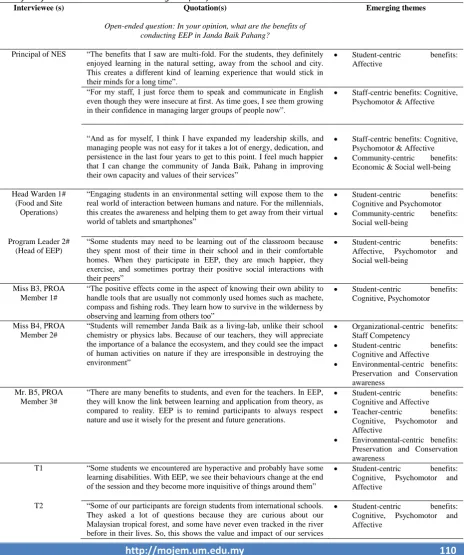
Each of the benefits above is self-explanatory. For readers’ reference, the quotations from each respondent are presented in Table 6, while the emerging themes are placed in the far-right column in corresponding to their quotations.
Table 6
Benefits of Environmental Education Program (EEP)
Interviewee (s) Quotation(s)
Open-ended question: In your opinion, what are the benefits of conducting EEP in Janda Baik Pahang?
Emerging themes
Principal of NES “The benefits that I saw are multi-fold. For the students, they definitely enjoyed learning in the natural setting, away from the school and city. This creates a different kind of learning experience that would stick in their minds for a long time”.
Student-centric benefits: Affective
“For my staff, I just force them to speak and communicate in English even though they were insecure at first. As time goes, I see them growing in their confidence in managing larger groups of people now”.
Staff-centric benefits: Cognitive, Psychomotor & Affective
“And as for myself, I think I have expanded my leadership skills, and managing people was not easy for it takes a lot of energy, dedication, and persistence in the last four years to get to this point. I feel much happier that I can change the community of Janda Baik, Pahang in improving their own capacity and values of their services”
Staff-centric benefits: Cognitive, Psychomotor & Affective Community-centric benefits:
Economic & Social well-being
Head Warden 1# (Food and Site
Operations)
“Engaging students in an environmental setting will expose them to the real world of interaction between humans and nature. For the millennials, this creates the awareness and helping them to get away from their virtual world of tablets and smartphones”
Student-centric benefits: Cognitive and Psychomotor Community-centric benefits:
Social well-being
Program Leader 2# (Head of EEP)
“Some students may need to be learning out of the classroom because they spent most of their time in their school and in their comfortable homes. When they participate in EEP, they are much happier, they exercise, and sometimes portray their positive social interactions with their peers”
Student-centric benefits: Affective, Psychomotor and Social well-being
Miss B3, PROA Member 1#
“The positive effects come in the aspect of knowing their own ability to handle tools that are usually not commonly used homes such as machete, compass and fishing rods. They learn how to survive in the wilderness by observing and learning from others too”
Student-centric benefits: Cognitive, Psychomotor
Miss B4, PROA Member 2#
“Students will remember Janda Baik as a living-lab, unlike their school chemistry or physics labs. Because of our teachers, they will appreciate the importance of a balance the ecosystem, and they could see the impact of human activities on nature if they are irresponsible in destroying the environment”
Organizational-centric benefits: Staff Competency
Student-centric benefits: Cognitive and Affective Environmental-centric benefits:
Preservation and Conservation awareness
Mr. B5, PROA Member 3#
“There are many benefits to students, and even for the teachers. In EEP, they will know the link between learning and application from theory, as compared to reality. EEP is to remind participants to always respect nature and use it wisely for the present and future generations.
Student-centric benefits: Cognitive and Affective Teacher-centric benefits:
Cognitive, Psychomotor and Affective
Environmental-centric benefits: Preservation and Conservation awareness
T1 “Some students we encountered are hyperactive and probably have some learning disabilities. With EEP, we see their behaviours change at the end of the session and they become more inquisitive of things around them”
Student-centric benefits: Cognitive, Psychomotor and Affective
T2 “Some of our participants are foreign students from international schools. They asked a lot of questions because they are curious about our Malaysian tropical forest, and some have never even tracked in the river before in their lives. So, this shows the value and impact of our services
http://mojem.um.edu.my
111
to them”.
T3 “I have never imagined myself leading a group of people in nature walks and talks. I am more confident now to speak in English, and I think I have improved a lot since working here while conducting and training EEP to students.
Staff-centric benefits: Cognitive, Affective Psychomotor Organizational-centric benefits:
Staff Competency T4 “There are benefits to my knowledge and skills in the field of my study,
and I do appreciate the job opportunity here as it improves my personality and professionalism”.
Staff-centric benefits: Cognitive, Affective Psychomotor Organizational-centric benefits:
Staff Competency
T5 “EEP allows Janda Baik to be more visible in terms of the natural resources and the unique hidden gems that we have here in this village. This will encourage more people to come and enjoy nature here, and care about our environment while improving the economy here”
Environmental-centric benefits: Preservation and Conservation awareness
Community-centric benefits: Economic and Social well-being F6 “I have learned to put my knowledge that I have learned in my university
to practice here. The benefits are plentiful and depends on the beneficiary of the EEP. For students, I think they benefit the most about learning outdoor, and they will remember the lessons because it is of a different experience. As I am a facilitator, I think I have grown in my character, responsibility and leadership skills”
Staff-centric benefits: Cognitive, Affective and Psychomotor Student-centric benefits:
Cognitive, Psychomotor and Affective
F7 “EEP is great because it takes into consideration preservation and conservation of the environment. While there are many tourists coming here to Janda Baik, most of them are consuming the natural resources through their recreational activities like team-building, fishing, and expedition of 4WD. Only EEP can cultivate responsible use of the environment”
Environmental-centric benefits: Preservation and Conservation awareness
F8 “The benefits are many, and to all the parties involved in the implementation of EEP. For me, the most important benefit is the changing of attitudes of the students when they see that environment can be destroyed because of human greed irresponsibility”
Student-centric benefits: Cognitive, Psychomotor and Affective
Environmental-centric benefits: Preservation and Conservation awareness
F9 “The benefits are definitely way beyond classroom teaching. For teachers and facilitators like me, I see myself as very important to impart knowledge that is to instil values and moral to their students with EEP”
Staff-centric benefits: Cognitive, Affective and Psychomotor Teacher-centric benefits:
Cognitive, Psychomotor and Affective
F10 “I feel that teachers have more passion in when they see that their students are learning a lot out of the classroom setting. I also felt that the teachers were reflecting own themselves when they see us teaching EEP unconventionally to their students”.
Teacher-centric benefits: Cognitive and Affective
It is apparent that benefits from EEP is holistic and reaches all parties involved in the program, and in the major aspect of the individual, organization, community and the environment. For teachers, students and staff of NES, EEP contributes to an individual’s Cognitive, Affective and Psychomotor level. For the Principal in NES, she was asked for further comments on the aspect. In one unique comment, she mentioned,
“The teaching of EEP programs is motivating our staff, who are all science graduates, and mostly from forestry. By giving this opportunity to them, they feel that they are utilizing the knowledge they learned in university, and it makes the facilitator role more meaningful for them” (A-20082018-716-720).
http://mojem.um.edu.my
112
“EEP visitors tend to be engaged in activities which help the environment, such as river and trail clean-ups. Longer term the program creates the awareness and call to action to protect the environment, by bringing people closer to nature, and face-to-face with the threats to nature. This is true both amongst visitors as well as the hosts (the orang kampong who are hosting the visitors” (A-20082018- 722-726).
For the community, EEP contributes towards their economic & social well-being. The Principal of NES further highlighted,
“EEP programs bring extra revenues to the local community, by opening up small farms and other local businesses to run programmes. For example, we have done this with the goat farm, the organic farm and the plant nursery in Janda Baik. EEP also brings jobs such as local guides and facilitators. With these added revenues, comes a bigger desire for them to preserve their natural environment, especially the rivers and waterfalls that are such an attraction for Janda Baik” (A-20082018-722-726).
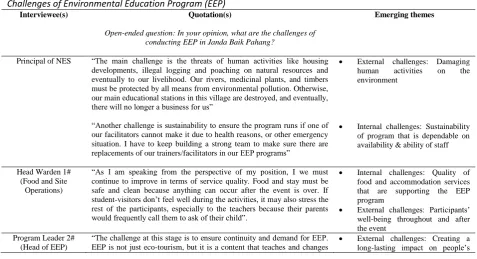
Table 7 in the subsequent section presents the challenges of EEP as quoted by each respondent through their online surveys. Similar to Table 6, the Principal of NES was further probed in the areas of challenges, while most of the individuals’ responses were collected from online survey forms containing the open-ended question in challenges of EEP. Codes on challenges are grouped into two themes:
a) Internal challenge(s): Any respondents’ expressions, behaviours and opinions that are indicating
challenge(s) that occur within NES.
b) External challenge(s): Any respondents’ expressions, behaviours and opinions that are indicating
challenge(s) that occur external to NES.
Similar to the presentation style in Table 6, the emerging themes are also placed in the far-right column corresponding to their quotations.
Table 7
Challenges of Environmental Education Program (EEP)
Interviewee(s) Quotation(s)
Open-ended question: In your opinion, what are the challenges of conducting EEP in Janda Baik Pahang?
Emerging themes
Principal of NES “The main challenge is the threats of human activities like housing developments, illegal logging and poaching on natural resources and eventually to our livelihood. Our rivers, medicinal plants, and timbers must be protected by all means from environmental pollution. Otherwise, our main educational stations in this village are destroyed, and eventually, there will no longer a business for us”
“Another challenge is sustainability to ensure the program runs if one of our facilitators cannot make it due to health reasons, or other emergency situation. I have to keep building a strong team to make sure there are replacements of our trainers/facilitators in our EEP programs”
External challenges: Damaging human activities on the environment
Internal challenges: Sustainability of program that is dependable on availability & ability of staff
Head Warden 1# (Food and Site
Operations)
“As I am speaking from the perspective of my position, I we must continue to improve in terms of service quality. Food and stay must be safe and clean because anything can occur after the event is over. If student-visitors don’t feel well during the activities, it may also stress the rest of the participants, especially to the teachers because their parents would frequently call them to ask of their child”.
Internal challenges: Quality of food and accommodation services that are supporting the EEP program
External challenges: Participants’ well-being throughout and after the event
Program Leader 2# (Head of EEP)
“The challenge at this stage is to ensure continuity and demand for EEP. EEP is not just eco-tourism, but it is a content that teaches and changes