http://ijessr.com Page 165 NUTRITIONAL PRACTICES OF THE ELDERLY IN GHANA: EVIDENCE FROM ATEITU AND WINNEBA ZONGO COMMUNITIES IN THE EFFUTU MUNICIPALITY
Linda Atta-Boison
University of Education, Winneba, Ghana
ABSTRACT
Good nutrition is an important indicator of longevity and good health of the elderly. Hence, this study assessed the nutritional practices with regard to the consumption of breakfast, lunch and supper by the elderly in Ateitu and Winneba Zongo communities in the Effutu Municipality. Descriptive survey design was adopted for this study. A total of one hundred (100) elderly people aged 60 years and above, were selected via snowball and purposive sampling techniques for the study. A pre-tested and contextually prepared structured questionnaire (Cronbach’s alpha reliability coefficient =0.78) and observation checklist were used to conduct the survey. The Statistical Package for Social Sciences (SPSS) version 22 was used to analyse the data quantitatively using frequency count and percentage. The findings indicate that although many elderly people in Ateitu and Winneba Zongo communities regulalrly ate nutritious and balanced meals for breakfast, lunch and supper at the right time; a few (4%) of them skipped lunch. It is, therefore, recommended that the Ministry of Gender and Social Protection (MoGSP) through the Effutu Municipal Assembly and Social Welfare Department should extend the Livelihood Empowerment Against Poverty (LEAP)programmeto the elderly who are in abject poverty in these communities. Caretaker family members and social support networks should regularly feed the elderly with nutritious and balanced three square meals regularly at the right time.
KEYWORDS: Nutritional practice, breakfast, lunch, supper, elderly, longevity.
INTRODUCTION
http://ijessr.com Page 166
people is associated with a good breakfast, regular meals, adequate sleep (7-hours long per day), weight control, regular exercise, not smoking “big cigarettes”, and moderate alcohol consumption. Poor nutrition is a serious challenge to the health of the elderly. Therefore, the elderly need good nutritional care as regards intake of nutritious, regular and timely breakfast, lunch and supper.
Statement of the problem
Most elderly people in Ateitu and Winneba Zongo communities are nutritionally vulnerable and at risk of diet related health problems. The nutritional care that the elderly in these communities should be provided with, in some cases remain elusive. It has been reported by the National Ageing Policy [NAP] (2010) of Ghana that most often the elderly in society complain of health problems which are linked to the diet which they eat. Arguably, this phenomenon has been under-researched. This implies that little attention is paid to this phenomenon in Ghana. More importantly, there is absence of empirical data on the subject matter in the study settings, and this creates a knowledge and contextual gap which needs to be filled by the current work.
Purpose of the study
The purpose of this study was to examine the nutritional practices of the elderly in Ateitu and Winneba Zongo communities in the Effutu Municipality.
Objective of the study
This study found out the feeding practices with regard to breakfast, lunch and supper meals of the elderly in Ateitu and Winneba Zongo communities.
Research question
The following research question guided this study: What meals are eaten for breakfast, lunch and supper by the elderly in Ateitu and Winneba Zongo communities?
Significance of the study
Theoretically, this research would contribute to the on-going debate about nutritional practices of the elderly to fill the gap in contemporary literature. The study would provide nutritionists and social workers additional information on nutritional care for the elderly.
Hypothesizing nutrition in the elderly
http://ijessr.com Page 167
to eat. However, Owusu (2005) cautions those looking after the elderly to seek professional advice to be sure of giving a balanced diet.
The diet of an individual is what they eat, which is largely determined by the availability, processing and palatability of foods. This implies that food can only be eaten when it is available and accessible. The kind of diet eaten by a person contributes immensely to the nutritional and health status of that particular individual or family (Adigbo & Maddah, 2011). Food habit also known as dietary practice is explained by Adigbo and Maddah (2011) as the way in which any group of people select, prepare, serve and eat food as well as the number of times meals are eaten in a day. In the perspectives of Amoako-Kwakye (2010), dietary practice as the typical behaviours of specific groups of persons or an individual in relation to food intake.
According to Barasi (2003), there is no reliable data about the specific nutritional needs of the elderly. Experts, however, proposed that every meal of the elderly must be balanced with elements from the five food groups (New Zealand Ministry of Health, 2013; Directorate of Public Health, 2002). The experts of the Dundee City Council Directorate of Public Health (2005) also proposed that breakfast for the elderly in nursing and private homes must be served early. Owusu (2005) also recommended that lunch for elderly citizens must be taken between 12 noon and 3pm. He also recommended that supper must be taken before 8pm to allow food enough time to digest properly. The elderly are also encouraged to consume adequate quantity of fluid, especially water to aid digestion and to control body temperature (Wardlaw & Smith, 2011). They indicated that the diet of the elderly should contain fibre as well as fruits to reduce constipation. Older people are at risk of certain nutrient deficiencies. These are vitamins C, folic acid, iron and vitamin D Deficiency of vitamin C. These deficiencies relate to a low intake of fruit and vegetables. Therefore, older adults require increased intake of folic acid, vitamins D, B12, and B6 and calcium which can be found in liver, pulses, fortified breakfast cereals bread, green leafy vegetables and citrus fruits. Of these, Culross (2008) recommends B12 exclusively to those over the age of 50 as a supplement because of the decreased absorption rate. Vitamins D supplements should be considered for those who are housebound and in long term care (Sahay & Sahay, 2012).
METHODOLOGY The research design
The study adopted the descriptive survey design.
Population, sample and sampling techniques
http://ijessr.com Page 168
sampling techniques were used to sample 100 elderly people. In the first stage, snowball sampling technique was used to identify the 115 elderly people. The National Health Insurance (NHIS) card was used to crosscheck and confirm the ages. In the second stage, purposive sampling was used to sample 100 male and female elderly persons who were without health challenges such as diabetes, hypertension and stroke at the time of the study. This implies that 15 elderly persons with health problems were excluded from the study.
Instrumentation
The data collection techniques for this study were administration of questionnaire and observation. Thus, questionnaire and observation checklist were used as data collection tools to gather data for the study. The questionnaire was pilot tested on 10 elderly people at Kojo Bedu, a suburb of Effutu Municipality. The response from the pilot test of the questionnaire was subjected to Cronbach’s alpha reliability analysis method via Statistical Package for Social Sciences (SPSS) version 22 which yielded reliability coefficients (r) of 0.78.
Data analysis and presentation
The data were described using descriptive statistics (frequency count and percentage). The data is presented and analysed under the theme: nutritional practices of the elderly.
RESULTS
The nutritional practices of the elderly in Ateitu and the Winneba Zongo communities
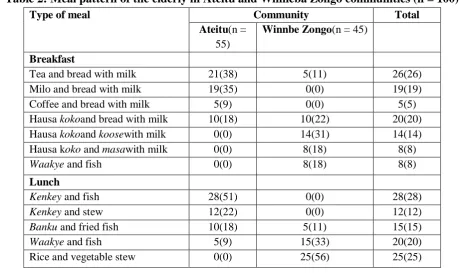
Table 2: Meal pattern of the elderly in Ateitu and Winneba Zongo communities (n = 100)
Type of meal Community Total
Ateitu(n = 55)
Winnbe Zongo(n = 45)
Breakfast
Tea and bread with milk 21(38) 5(11) 26(26)
Milo and bread with milk 19(35) 0(0) 19(19)
Coffee and bread with milk 5(9) 0(0) 5(5)
Hausa kokoand bread with milk 10(18) 10(22) 20(20) Hausa kokoand koosewith milk 0(0) 14(31) 14(14)
Hausa koko and masawith milk 0(0) 8(18) 8(8)
Waakye and fish 0(0) 8(18) 8(8)
Lunch
Kenkey and fish 28(51) 0(0) 28(28)
Kenkey and stew 12(22) 0(0) 12(12)
Banku and fried fish 10(18) 5(11) 15(15)
Waakye and fish 5(9) 15(33) 20(20)
http://ijessr.com Page 169
*Supper n = 85 n = 83
Fufu and soup 25(29) 0(0) 25 (14.8)
Banku and soup 18(22) 20(24) 38(22.6)
Banku and okro stew 22(26) 0(0) 22(13.1)
Kenkey and fish 20(23) 18(22) 38(22.6)
Rice balls (omo tuo)and vegetable soup
0(0) 45(54) 45(26.8)
Meal time
Breakfast (6am – 9am) 55(100) 45(100) 100)
Lunch (12 noon – 2pm) 55(100) 45(100) 100)
Supper (6pm– 8pm) 55(100) 45(100) (100)
Source: Field data (2018).
Note: The figures in parentheses are in percentage; *Multiple response for supper ——n= supper > 55 and 45 due to multiple responses.
Hausa koko - local porridge prepared from millet and maize; Koose – local doughnut prepared from fermented millet and beans.
It is evident in Table 2 that tea and bread with milk (26%), followed by Hausa kokoand breadwith milk(20%), milo and bread with milk (19%) are consumed as breakfast meals by the elderly in Ateitu and Winneba Zongo communities. Of these meals, Hausa kokoand bread or koosewith bread is mostly consumed as breakfast meal by the elderly in Winneba Zongo, while beverage (milo, tea) and bread with milk is mostly consumed as breakfast by the elderly in Ateitu. The addition of tin or fresh milk to the beverage and koko makes breakfast quite nutritious. The composition of breakfast in the two communities did not differ significantly as they are balanced with elements from the five food groups. Arguably, there are five kinds of food nutrients even though there are six food groups as espoused by Adigbo and Maddah (2011).It is also evident from the results that the elderly in both communities ate breakfast early —between 6.00 am and 9.00 am. This is a good practice as it validates the recommendation by the Dundee City Council Directorate of Public Health (2002) that breakfast for the elderly in nursing and private homes must be served early.
http://ijessr.com Page 170
satisfactorily meet the requirements of a balanced meal. This buttresses the views of experts in the New Zealand Ministry of Health (2013) which proposed that every meal of the elderly must be balanced with elements from the five food groups.
The result of this study found that rice balls (omo tuo) and vegetable soup (26.8%), banku with palm nut, groundnut or light soup (22.6%), kenkey and fish (22.6%) were regularly eaten as supper meals by the elderly in Ateitu and Winneba Zongo communities. The study found that the elderly in these communities mostly ate supper between 6.00 pm and 8.00 pm. This finding also validates the recommendation by Owusu (2005) that eating supper before 8.00 pm allows food enough time to digest properly. Generally, it is evident from the findings of this study that the elderly in Ateitu and Winneba Zongo communities regularly ate nutritious meals for breakfast, lunch and supper. This is a good practice for positive health and longevity. This observation is in line with the findings of the Human Population Laboratory of the California Department of Health (1962) which established a positive correlation between health and longevity of the elderly and such variables as good and regular breakfast, lunch and supper meals.
KEY FINDING
The main finding of this study shows that over 96% of the elderly citizens of Ateitu and Winneba Zongo regularly ate nutritious and balanced meals for breakfast, lunch and supper at the right time. However, a few (4%) of the elderly skipped lunch because of financial reasons.
CONCLUSION
The evidence gathered from this study indicates that health and longevity of elderly people is linked to good or healthy nutritional practicessuch as regularly and timely intake of nutritious and balanced meals combined from the various food and food nutrient groups in a single meal for breakfast, lunch and supper. Data from this study indicate that the elderly in Ateitu and Winneba Zongo communities engaged in healthy nutritional practices. They relied on locally available foods for their breakfast, lunch and supper meals which theyregularly eat at the right time.
RECOMMENDATIONS
The study reveals that some elderly persons in the two communities skipped lunch mainly for financial reasons. In view of this finding, it is recommended that the Ministry of Gender and Social Protection (MoGSP) through the Effutu Municipal Assembly and Social Welfare Department should extend the LEAP programme to the elderly in these communities to alleviate their problems. Furthermore, caretaker family members and other social support networks should feed the elderly with nutritious and balanced three square meals regularly at the right time.
REFERENCES
http://ijessr.com Page 171
Amoakoh-Kwakye, F. Y. (2010). Food and food-related practices of cultural groups in Southern Ghana. Accra, Ghana: Ghana University Press.
Barasi. M. E. (2003). Human nutrition: A health perspective (2nd ed.). Great Britain: Hodder Headline Group.
Culross, B. (2008). Nutrition: Meeting the needs of the elderly. Gerontology update, ARN Network, 7, 2-5.
Directorate of Public Health (2002). Nutrition guidelines for older people: Good practice guidelines for careers of older people in Tayside. Dundee City:Tayside NHS Board, Directorate of Public Health, Specialist Health Promotion Service.
Lamptey, A., & Donwazum, I. (2014). 2010 population and housing census district analytical report: Effutu Municipality. Accra: GSS/DFATD/DANIDA.
National Ageing Policy of Ghana (2010). National ageing policy: Ageing with security and dignity. Accra: Ministry of Employment and Social Welfare.
New Zealand Ministry of Health (2013). Healthy for healthy adults. New Zealand: Ministry of Health.
Owusu, F. (2005). Planning for changing livelihood strategies in African cities. A presentation at the 46th Annual Conference of the Association of Collegiate Schools of Planning (ACSP). Kansas City, MO: ACSP).
Sayhay, M., & Sahay, R. (2012). Rickets–vitamin D deficiency and dependency. Indian Journal of Endocrinology and Metabolism. 16(2),164–176.
Selivanova, A., & Cramm, J. M. (2014). The relationship between healthy behaviors and health outcomes among older adults in Russia. BMC Public Health, 14, 1183-1186.
Saunders, M., Lewis, P., & Thornhill, A. (2007). Research methods for business students. London: Pearson Professional Limited.
Wardlaw, G. M., & Smith, A. M. (2011). Contemporary nutrition (8th ed.). New York, NY: McGraw-Hill.
APPENDIX A: QUESTIONNAIRE FOR ELDERLY PEOPLE
Types of meals consumed for breakfast, lunch and time of serving
Instruction: Please tick [√] or write as applicable per the Likert scale items
1. Do you usually eat breakfast Yes [ ] No [ ]
2. If no why?……… ……… 3. If yes, what food items do you normally eat?... 4. Do you usually eat lunch? Yes [ ] No [ ]
5. If Yes what food items do you take?………..……… 6. If no, please explain why?………
http://ijessr.com Page 172
8. If yes, what food items do you normally eat?... 9. If no, please explain why?………... 10. At what time do you usually take:
a. Breakfast ……… b. Lunch ………... c. Supper………
APPENDIX B: OBSERVATION CHECKLIST
Instruction: Please tick [√] or write as applicable per the items
Type of breakfast meal Time of meal
Tea and bread with milk Milo and bread with milk Coffee and bread with milk Hausa koko and bread with milk Hausa koko and koose with milk Hausa koko and masa with milk
Waakye and fish
Type of lunch meal
Kenkey and fish
Kenkey and stew
Banku and fried fish
Waakye and fish
Rice and vegetable stew
Type of meal for supper Fufu and soup
Banku and soup
Banku and okro stew
Kenkey and fish