METHODOLOGY
An optimised CRISPR/Cas9 protocol to create
targeted mutations in homoeologous genes
and an efficient genotyping protocol to identify
edited events in wheat
Xiucheng Cui
1,2, Margaret Balcerzak
1, Johann Schernthaner
1, Vivijan Babic
3, Raju Datla
3, Elizabeth K. Brauer
1,
Natalie Labbé
1, Rajagopal Subramaniam
1and Thérèse Ouellet
1*Abstract
Background: Targeted genome editing using the Clustered Regularly Interspaced Short Palindromic Repeats (CRISPR)/Cas9 system has been applied in a large number of plant species. Using a gene-specific single guide RNA (sgRNA) and the CRISPR/Cas9 system, small editing events such as deletions of few bases can be obtained. However larger deletions are required for some applications. In addition, identification and characterization of edited events can be challenging in plants with complex genomes, such as wheat.
Results: In this study, we used the CRISPR/Cas9 system and developed a protocol that yielded high number of large deletions employing a pair of co-expressed sgRNA to target the same gene. The protocol was validated by targeting three genes, TaABCC6, TaNFXL1 and TansLTP9.4 in a wheat protoplast assay. Deletions of sequences located between the two sgRNA in each gene were the most frequent editing events observed for two of the three genes. A compara-tive assessment of editing frequencies between a codon-optimized Cas9 for expression in algae, crCas9, and a plant codon-optimized Cas9, pcoCas9, showed more consistent results with the vector expressing pcoCas9. Editing of
TaNFXL1 by co-expression of sgRNA pair was investigated in transgenic wheat plants. Given the ploidy of bread wheat, a rapid, robust and inexpensive genotyping protocol was also adapted for hexaploid genomes and shown to be a useful tool to identify homoeolog-specific editing events in wheat.
Conclusions: Co-expressed pairs of sgRNA targeting single genes in conjunction with the CRISPR/Cas9 system produced large deletions in wheat. In addition, a genotyping protocol to identify editing events in homoeologs of
TaNFXL1 was successfully adapted.
Keywords: CRISPR/Cas9, Wheat, Gene editing in homoeologous genes, sgRNA, Transgenic plants, Genotyping
© Her Majesty the Queen in Right of Canada as represented by the Minister of Agriculture and Agri-Food Canada 2019, corrected publication 2019. This article is distributed under the terms of the Creative Commons Attribution 4.0 International License (http://creat iveco mmons .org/licen ses/by/4.0/), which permits unrestricted use, distribution, and reproduction in any medium, provided you give appropriate credit to the original author(s) and the source, provide a link to the Creative Commons license, and indicate if changes were made. The Creative Commons Public Domain Dedication waiver (http://creativecommons.org/ publicdomain/zero/1.0/) applies to the data made available in this article, unless otherwise stated.
Background
The type II prokaryotic Clustered Regularly Interspaced Short Palindromic Repeats (CRISPR)/CRISPR-associated (Cas) system was initially identified in 2007 [1], and the unique features of this system have been explored widely in both Eubacteria and Archaea [2]. The first application
of CRISPR as a gene editing tool was reported in human and mouse cells, demonstrating that Cas9 nucleases could induce precise cleavage at targeted genome loci with the presence of short RNA guiding sequences [3, 4]. In plants, this technology has been shown to have a high potential for gene editing both in monocot and dicot plants [5]. To date, several genes targeted in model plants such as Arabi-dopsis thaliana and tobacco (Nicotiana tabacum) have been successfully edited using this technology [6]. Also, this technology has been successfully applied for gene editing
Open Access
*Correspondence: [email protected]
1 Ottawa Research and Development Centre, 960 Carling Avenue, Ottawa,
ON K1A 0C6, Canada
in several crops including rice (Oryza sativa), maize (Zea mays) and sorghum (Sorghum bicolor) genomes [6–8].
Bread wheat (Triticum aestivum) plays a central role in global food and feed crop consumption and is one of the most widely cultivated crops around the world. The wheat genome comprises three subgenomes (A, B and D), each representing a set of seven chromosomes. The size of the wheat genome is approximately 16 Gb; over 80% of it is composed of highly repetitive sequences and transposable elements and estimated to encode 108,000 high-confidence protein-coding loci [9].
Editing events obtained in wheat using CRISPR/Cas9 and one single guide RNA (sgRNA) are often associated with single nucleotide deletion/addition or small dele-tions [10–13]. However loss-of-function mutants with larger deletion, preferably in most of the homoeologs for a given gene, are desired to observe a phenotypic change in wheat., The use of paired sgRNA for CRISPR/ Cas9 editing of a targeted gene has been shown to result in larger deletions in Arabidopsis thaliana, rice and kiwi-fruit [14–16]; however this method has not been tested in wheat. Here, we explore this approach, and present a protocol for targeted deletion of gene fragments using paired sgRNA and the CRISPR/Cas9 system in wheat and validate it for three wheat genes in a wheat protoplast system: an ABC transporter (TaABCC6), a lipid transfer protein (TansLTP9.4) and a putative transcription repres-sor named TaNFXL1. These three genes were previously identified to be associated with susceptibility (TaABCC6, TaNFXL1) and resistance (TansLTP9.4) to Fusarium head blight (FHB), a devastating fungal disease of wheat [17, 18]. In addition, a direct comparison of editing efficiency in wheat protoplasts was performed with two modified nucleases Cas9, crCas9 and pcoCas9, both derived from the Streptococcus pyogenes Cas9 [6, 19].
The utility of paired sgRNA-based approach for tar-geted editing of homoeologous genes has been tested in transgenic wheat plants for TaNFXL1. Identifying specific editing events in transgenic wheat plants is challenging due to the high homology of genes among the three subgenomes and the number of duplication events for those genes [9]. Sequencing of homoeolog-specific amplicons is most often used for this. Here we present a rapid, inexpensive screening method for edited genes in transgenic wheat plants. This method, adapted from a single-tube, nested PCR method using two sequence specific primers and a universal fluores-cent-labeled primer [20], exploits single nucleotide pol-ymorphisms (SNP) present in TaNFXL1 homoeologs.
Results
sgRNA design and vector construction
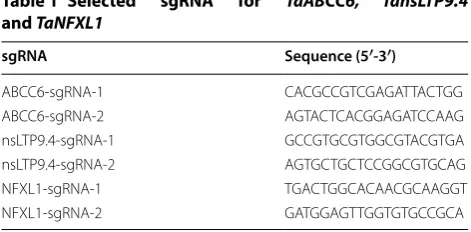
Three genes of interest, herein referred to as TaABCC6, TansLTP9.4 and TaNFXL1, were selected for evaluat-ing targeted gene editevaluat-ing. For each gene, two sgRNA were designed, targeting the conserved homoeologous sequences in wheat subgenomes (Table 1). The sgRNA were designed using the genomic sequence informa-tion available in the Wheat Sequence Survey V2 [21], combined with expressed sequence tags (EST) avail-able in a local database of assembled public wheat ESTs [22] and amplicon sequencing obtained from the spring wheat cultivar Fielder (unpublished observations). Using the wheat genomic sequence RefSeq v1.0 [9] two closely related genes on each of the three subgenomes were identified for TaABCC6 and TaNFXL1, while TansLTP9.4 was encoded by a single gene per subge-nome. Additional file 1 provides the list of homoeolo-gous genes, together with the sequences best matching to each sgRNA. The efficacy of the designed sgRNA to guide Cas9 to specifically cut the target sequence was tested using an in vitro assay [23]. As shown in Addi-tional file 2, two smaller DNA fragments with expected sizes were clearly observed after cleavage with each sgRNA. Each pair of sgRNA targeting the same gene was cloned into a single expression vector, together with one of two Cas9 (see below), as illustrated in Addi-tional file 3 and described in “Methods”.
Assessment of editing frequency for three pairs of co‑expressed sgRNA
Wheat protoplasts isolation and transformation proce-dures using the cultivar Roblin routinely yielded around 60% transfection efficiency (Additional file 4), similar to the frequencies obtained by Shan et al for protoplasts from shoot tissues of the wheat cultivar Bobwhite [24]. The protoplast system was used to determine the edit-ing frequency and specificity of the selected sgRNA as well as to compare the differences in editing between two modified version of the Cas9 isolated from S. pyogenes,
Table 1 Selected sgRNA for TaABCC6, TansLTP9.4 and TaNFXL1
sgRNA Sequence (5′‑3′)
ABCC6-sgRNA-1 CAC GCC GTC GAG ATT ACT GG
ABCC6-sgRNA-2 AGT ACT CAC GGA GAT CCA AG
nsLTP9.4-sgRNA-1 GCC GTG CGT GGC GTA CGT GA
nsLTP9.4-sgRNA-2 AGT GCT GCT CCG GCG TGC AG
NFXL1-sgRNA-1 TGA CTG GCA CAA CGC AAG GT
one that is codon-optimized for expression in the algae Chlamydomonas reinhardtii (referred to as crCas9) [6] and one that is codon-optimized for expression in plants (called pcoCas9) [19].
To estimate the editing frequency for each gene, genomic DNA from protoplasts were isolated from three independent transformation experiments (Additional file 5) and were used to amplify a fragment of each tar-get gene that included both sgRNA tartar-get sites (Addi-tional file 6). High throughput sequencing (HTS) of the amplicons was performed to quantify targeted mutations by crCas9 on all three target genes (samples ABCC6-1 to -5, nsLTP9.4-1 to -5 and NFXL1-1 to -5) and by pco-Cas9 on TaNFXL1 (samples pcoNFXL1-1 to -5). Overall, more than 90% of the reads were successfully mapped to the reference sequences, except for samples ABCC6-1 to -5 where about only 80% of the reads were mapped to the reference sequences (unpublished observations). Although the ABC transporters constitute a large gene family in wheat, no reads mapped to other ABC trans-porter genes than the six ABCC6 homoeologs. Analysis showed that editing frequency of TaABCC6 was consist-ent between transformation evconsist-ents while for TansLTP9.4 and particularly TaNFXL1, editing frequency varied from 0% (no editing) up to 42% (Table 2). The variations observed could be in part associated with the batch of isolated protoplasts (Additional file 5). Total editing fre-quency was also compared between the two modified nucleases crCas9 and pcoCas9. As shown, the editing frequencies in the samples transformed with the vector expressing pcoCas9 were more consistent (coefficient of variation, CV = 38%) than those transformed with the vector expressing crCas9 (CV = 87%); however, none of the TaNFXL1 samples edited by pcoCas9 reached the high level of editing observed with crCas9 (42.2%) (Table 2).
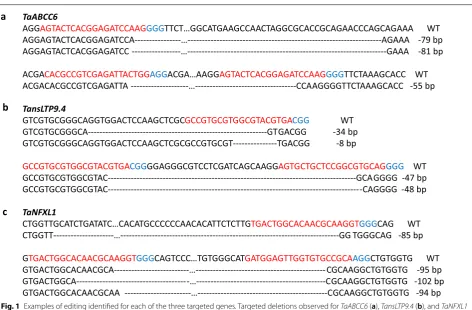
The major type of editing observed in the transformed protoplasts was deletion of fragments larger than 40 bp. Representative examples are presented in Fig. 1 and the complete list of editing observed is detailed in Additional
file 7, sections A to F. A higher percentage (five to six-fold) of deletions was obtained for the regions flanked by the two sgRNA, especially for the genes TaABCC6 and TansLTP9.4, where the distance between the sgRNA tar-get sites was smaller (Additional files 6, 7E). In addition to deletions, sequence insertion was observed only for TaN-FXL1 samples, and with high frequency, when exposed to both versions on the Cas9 nuclease (Additional file 7F). After taking into account total editing frequency, we did not observe significant differences in frequency in any of the modification types between the two Cas9 (crCas9 and pcoCas9) nucleases.
The HTS data from the transformed protoplasts also allowed the quantification of editing events targeted by each sgRNA (Additional file 8). The editing efficiencies for sgRNA-1 and -2 were very consistent between inde-pendent transformation events. In samples ABCC6-1 to -5 and nsLTP9.4-1 to -4, similar frequencies of editing were observed for sgRNA-1 and -2. However, there was a higher editing efficiency at the NFXL1-sgRNA-2 site than at the NFXL1-sgRNA-1 site in samples NFXL1-1 to -4 and pcoNFXL1-1 to -5. The differences in edit-ing efficiency between these two sgRNA may have con-tributed to the infrequent occurrence of deletion of the fragment located between the two sgRNA in TaNFXL1 samples, observed in only one of 10 samples (Additional file 7E). Differences in total editing frequencies for TaN-FXL1 between crCas9 and pcoCas9 were reflected in the results with individual sgRNA (Additional file 8).
With the recent availability of the wheat genomic sequence RefSeq v1.0 [9], the HTS amplicon data was reanalysed to identify the reads associated with each homoeolog of TaABCC6 and TaNFXL1, using the sam-ples with the highest total editing frequency (ABCC6-4, NFXL1-3, pcoNFXL1-4) as well as a control sample from non-edited Fielder protoplasts. For both TaABCC6 and TaNFXL1, two of the homoeologs with a perfect match to sgRNA-1 and sgRNA-2 were represented in the HTS data (Table 3A, Additional file 1). The total number of reads that could be mapped with confidence to each of
Table 2 Estimated total editing frequency for TaABCC6, TansLTP9.4 and TaNFXL1
a Editing frequency (%) = (reads with modification/(mapped reads + reads with modification)) × 100 b pcoCas9 was used instead of crCas9 for the samples pcoNFXL1-1 to 5
c No modification was detected in those samples
Sample Editing
frequencya Sample Editing frequency Sample Editing frequency Sample Editing frequency
ABCC6-1 9.3 nsLTP9.4-1 9.1 NFXL1-1 8.4 pcoNFXL1-1b 10.2
ABCC6-2 6.6 nsLTP9.4-2 1.9 NFXL1-2 18.3 pcoNFXL1-2 8.6
ABCC6-3 9.1 nsLTP9.4-3 11.3 NFXL1-3 42.2 pcoNFXL1-3 15.0
ABCC6-4 13.0 nsLTP9.4-4 11.9 NFXL1-4 22.8 pcoNFXL1-4 21.2
these homoeolog varied by three to 15-fold, indicating differences in efficiency of amplification between homoe-ologs; however, editing efficiency could be measured for each of those homoeologs. Fairly consistent editing fre-quency was observed between the two homoeologs of TaABCC6 and TaNFXL1 (≤ 2-fold difference), especially when crCas9 was used (Table 3A).
The HTS amplicon data also contained sequences for three (TaABCC6) and one (TaNFXL1) homoeologs which have target sites containing mismatches with the sgRNA (Table 3B, Additional file 1). No editing was detected in the TaABCC6 homoeolog with 2 mismatches to sgRNA-1 and 1 to sgRNA-2 nor the TaNFXL1 homoe-olog with 3 mismatches to sgRNA-1, suggesting that edit-ing was below 0.6%. Of the two TaABCC6 homoeolog with only one mismatched base to one or both sgRNA, TraesCS2B01G472800 showed a notable level of editing, only 2.6- to 4-fold lower than for homoeologs with per-fect match to the sgRNA, while no editing was detected for TraesCS2D01G451300 even though sgRNA-2 had a perfect match to it.
Editing of TaNFXL1 in transgenic plants using a co‑expressed pair of sgRNA
Transient silencing experiments indicated that reduced expression of the gene TaNFXL1 was associated with reduced susceptibility to FHB of wheat [17, 18]. To con-firm those results, CRISPR editing of TaNFXL1 was per-formed in planta. For that purpose, a cassette containing the crCas9 coding sequence as well as the gBlock pair containing the two sgRNA was assembled in a binary vector for wheat transformation; the cloning strategy as well as the final transformation vector are presented in Additional file 9 and described in “Methods”. Progeny from four transgenic plants expressing crCas9 and the two sgRNA were characterized for editing events.
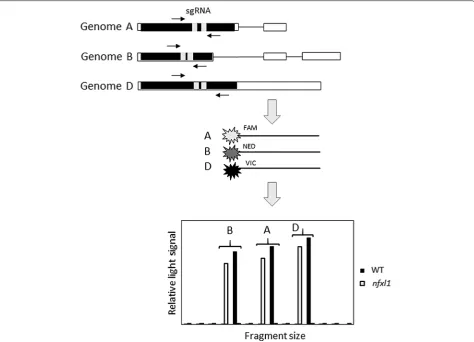
A genotyping protocol adapted from Schuelke et al [20] was designed to identify editing events in any of the 6 homoeolog genes for TaNFXL1; a schema of the two-step protocol is presented in Fig. 2 and details are provided in “Methods”. Briefly, SNP between the homoeologs were exploited to amplify homoeolog-specific gene ments that included both sgRNA target sites; then frag-ments from each of two groups (gene X and Y groups) of three homoeologs were individually labeled in a second PCR amplification using one gene-specific primer and a TaABCC6
AGGAGTACTCACGGAGATCCAAGGGGTTCT…GGCATGAAGCCAACTAGGCGCACCGCAGAACCCAGCAGAAA WT AGGAGTACTCACGGAGATCCA---…---AGAAA -79 bp AGGAGTACTCACGGAGATCC ---…---GAAA -81 bp
ACGACACGCCGTCGAGATTACTGGAGGACGA…AAGGAGTACTCACGGAGATCCAAGGGGTTCTAAAGCACC WT ACGACACGCCGTCGAGATTA ---…---CCAAGGGGTTCTAAAGCACC -55 bp
TansLTP9.4
GTCGTGCGGGCAGGTGGACTCCAAGCTCGCGCCGTGCGTGGCGTACGTGACGG WT GTCGTGCGGGCA---GTGACGG -34 bp GTCGTGCGGGCAGGTGGACTCCAAGCTCGCGCCGTGCGT---TGACGG -8 bp
GCCGTGCGTGGCGTACGTGACGGGGAGGGCGTCCTCGATCAGCAAGGAGTGCTGCTCCGGCGTGCAGGGG WT GCCGTGCGTGGCGTAC---GCAGGGG -47 bp GCCGTGCGTGGCGTAC---CAGGGG -48 bp
TaNFXL1
CTGGTTGCATCTGATATC…CACATGCCCCCCAACACATTCTCTTGTGACTGGCACAACGCAAGGTGGGCAG WT CTGGTT---…---GG TGGGCAG -85 bp
GTGACTGGCACAACGCAAGGTGGGCAGTCCC…TGTGGGCATGATGGAGTTGGTGTGCCGCAAGGCTGTGGTG WT GTGACTGGCACAACGCA---…---CGCAAGGCTGTGGTG -95 bp GTGACTGGCA---…---CGCAAGGCTGTGGTG -102 bp GTGACTGGCACAACGCAA ---…---CGCAAGGCTGTGGTG -94 bp
a
b
c
universal primer labelled with one of three fluorescent dyes (FAM, NED and VIC), combined and separated by capillary electrophoresis along a size standard, provid-ing size measurement of the PCR amplicons and thereby determination of the size of the deletion (insertion) in each edited homoeolog. This method was much cheaper than HTS for genotyping of a large number of progeny due to the reduced costs of separation by capillary elec-trophoresis rather than sequencing and to the use of labeled universal primers rather than a labeled, gene-spe-cific primer.
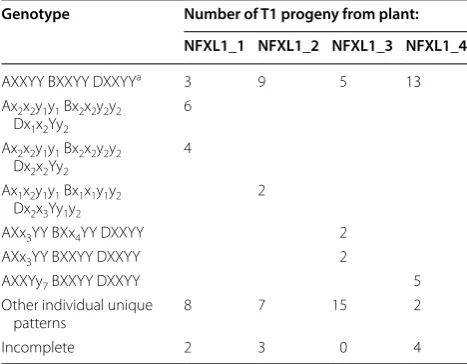
A nomenclature was developed to report the complex editing events observed in TaNFXL1 homoeologs in the first generation (T1) from transgenic plants expressing Cas9 and the two sgRNA, with the wild type genotype of Fielder being described as AXXYY BXXYY DXXYY. X and Y represent the TaNFXL1 genes from groups X and Y on each of the three subgenomes A, B and D (Additional file 1); lower case x and y indicate edited alleles and subscript numbers distinguish between dif-ferent editing events in those alleles (Table 4, Addi-tional file 10).
We observed editing events at a frequency of 87, 52, 79 and 29%, respectively, in the T1 progeny from plants NFXL1_1, NFXL1_2, NFXL1_3 and NFXL1_4 (Table 4, Additional file 10). Editing of TaNFXL1 was particularly frequent in progeny of NFXL1_1 and NFXL1_2; at least
18 out of 23 progeny of NFXL1_1 showed editing in one or both alleles of every homoeolog, while 11 out of 21 progeny of NFXL1_2 were edited in one or both alleles of one to six homoeologs. Mono-allelic editing events were mostly observed in progeny from NFXL1_-3 and -NFXL1_4. There was a large number of progeny harbor-ing unique editharbor-ing patterns while some editharbor-ing patterns were common to 2 to 6 progeny from the same trans-genic plant. A few progeny from NFXL1_2 and NFXL1_3 had three genotyping amplicons for a given homoeolog (eg gene DY in NFXL1_2_5, gene BX in NFXL1_3_2), suggesting the presence of chimeric tissues. In progeny of NFXL1_1 and NFXL1_2, the most frequent deletion in five of the 6 homoeologs was a deletion of about 95 bp, the same size as the distance between the two sgRNA, while most other deletions were between 3 and 54 bp and most likely associated with editing at only one of the two sgRNA targets.
Discussion
Targeted gene editing is increasingly being used in plants to generate diverse gene variants, including loss of function alleles for defining functionalities, and also to remove deleterious alleles in crops. However the use of single gRNA to edit the gene of interest primarily pro-duces small deletions and do not necessarily result in null alleles. In this study, we have developed and investigated
Table 3 Evaluation of editing accuracy for TaABCC6 and TaNFXL1 using homoeologs with perfect match (A) or mismatched bases (B) to the sgRNA
N/A not applicable
a Only genes for which a specific fragment was PCR-amplified and sequenced are presented here. See Additional file 1 for more details b The number of reads mapping perfectly to the corresponding target or off-target sequence
c Editing frequency (%) = (reads with modification/(mapped reads + reads with modification)) × 100
(A)
Gene On‑target gene IDa Total mapped
readsb Reads with modifications Editing frequency c
TaABCC6 TraesCS2A01G451300 14,718 1059 7.2
TraesCS2D01G451100 5337 235 4.4
TaNFXL1 (edited by crCas9) TraesCS7A01G518800 1780 294 16.50
TraesCS7B01G434700 26,991 4142 15.30
TaNFXL1 (edited by pcoCas9) TraesCS7A01G518800 3479 357 10.3
TraesCS7B01G434700 22,519 1062 4.7
(B)
Gene Off‑target Gene IDa Total mapped readsb Reads
with modifications Editing frequencyc Edited by crCas9 Edited by pcoCas9
TaABCC6 TraesCS2B01G472800 15205 N/A 252 1.7
TraesCS2A01G451500 1722 N/A 0 < 0.06
TraesCS2D01G451300 1987 N/A 0 < 0.05
the use of pairs of co-expressed sgRNA targeting a single gene using the CRISPR/Cas9 system in wheat. A proto-plast system was used to characterize the editing events. The key findings from these experiments showed that deletion of sequences between the two sgRNA occurred more frequently than any other type of deletions. Con-sistent with this, results from transgenic plants confirmed that deletion of the sequence between the two sgRNA in TaNFXL1 was a frequent event. Taken together, these results demonstrate the usefulness of the approach with two sgRNA to produce larger deletions in targeted wheat genes.
The editing frequencies that we have observed were of the same order as the results obtained by Wang et al using co-expressed single sgRNA to simultaneously target four genes in a similar wheat protoplast system [25]. Variation in editing frequency between protoplast
isolation batches, as observed in our experiments, have been noted before and high quality isolated protoplasts are considered to be a bottle-neck in CRISPR/Cas9 appli-cations [26]. In our protoplast and in planta experiments, deletion of the fragment between the two sgRNA target-ing the same gene was observed most frequently. Larger deletions associated with the use of paired sgRNA was also observed in the diploid species Arabidopsis and rice; in those two species, deleted fragments up to 459 bp and 170 kbp, respectively, were successfully obtained [14, 16]. Our results showed that similar editing events can be produced in wheat, including on multiple homoeologs. In the protoplast system, there was a large difference in frequency of deletion of the fragment located between the two sgRNA for TaNFXL1 when compared to those for TaABCC6, TansLTP9.4; those fragments were respec-tively of 95, 56 and 47 bp. However that low frequency
of edition of the large fragment was not observed in the transgenic plants edited in TaNFXL1. More experiments will need to be conducted to ascertain if the distance between the paired sgRNA affects the frequency of edi-tion of large fragments. Similarly, addiedi-tional investigaedi-tion may clarify if a larger distance between the paired sgRNA contributes to a larger frequency of sequence insertion, as observed for TaNFXL1.
In the protoplast system, there was less variation in editing frequencies between samples when using pco-Cas9 than when using crpco-Cas9. Those two pco-Cas9 have not been compared in wheat before. A number of dif-ferences exist between the constructs expressing either Cas9. The crCas9 gene in the pCambia vector was driven by a 35S promoter, while pcoCas9 was under the control of a 35SPPDK promoter (constitutive 35S enhancer fused to the maize C4 pyruvate orthophos-phate dikinase (C4PPDK) basal promoter) [6, 19]. The different promoters used in the two vectors may have affected Cas9 expression levels, leading to different editing efficiencies. In addition, an intron was inserted in the Cas9 gene during its original modification to pcoCas9 [19]; inclusion of such introns in a gene have been shown to increase mRNA accumulation and translation in transgenic plants [27].
In addition to editing events in the homoeologs with perfect match to both sgRNA, editing at lower fre-quency was observed in the protoplast system for one of the TaABCC6 homoeolog with one base mismatch to each sgRNA while no editing was observed for the
homoeolog with two mismatches to one of the sgRNA. This is consistent with the findings of Anderson et al [28], who showed in human cells that lower editing frequency was associated with sgRNA carrying one mismatch to the targeted sequence. Our results with transgenic plants confirm that editing from sequence with imperfect match to sgRNA can be observed in wheat and underscore the importance of avoiding the use of sgRNA for which up to three mismatch bases can be found in other parts of the genome. Now that a full sequence of the wheat genome for the cultivar Chinese Spring is available [9], it will be easier to design spe-cific wheat sgRNA. Resequencing of amplicons for the targeted genes in the desired cultivar is recommended before the design of sgRNA, until genome sequence for a larger number of wheat cultivars becomes available.
Identification of specific editing events in plant species with a complex genome can present a significant chal-lenge. In wheat, 55% of the genes have an homoeolog in each of the three subgenomes and 27% are present as tandem duplicates [9]. In our study, six homoeologs have been considered to characterize the editing events in TaNFXL1 in the transgenic plants. Even though HTS is a very powerful technique that allows the identification of editing events in multiple genes when co-amplified, technical difficulties with amplification of fragments for sequencing with similar efficiency for all genes targeted and the high cost per sample of the procedure led us to adapt an alternate protocol for genotyping of a large number of progeny. The protocol was initially developed by Schuelke for genotyping populations with a large number of microsatellite markers [20]. The genotyping procedure presented here also present advantages on a screening method recently published [29] because it does not require the design and optimisation of gene-specific primers able to recognize the CRISPR target sequence only when not edited. Our results showed that the geno-typing method presented here was a robust and powerful tool to characterize CRISPR/Cas9 gene editing events in T1 progeny of transgenic plants. The protocol will also be applicable to other plant species with a complex genome.
Conclusions
In this study, we present a protocol to co-express pairs of sgRNA targeting the same gene using the CRISPR/Cas9 system and successfully validate its use to generate larger deletions in an optimized wheat protoplast system and in transgenic plants. In addition, we have developed a rapid and inexpensive genotyping protocol, allowing the iden-tification of editing events in all homoeologs of a gene in complex genomes such as that of wheat. Integration of these two protocols will contribute to accelerating func-tional gene studies in wheat.
Table 4 Number of T1 progeny with indicated genotypes from four transgenic wheat plants that contained Cas9 and sgRNA pairs for TaNFXL1
a Genotype code: A, B and D: wheat subgenomes; X: the two alleles for the
gene X group in each subgenome, with X as the wild type allele in Fielder and xn for an allele with a distinct editing n; Y and y: alleles for the gene Y group. See
Additional file 10 for complete genotyping data
Genotype Number of T1 progeny from plant: NFXL1_1 NFXL1_2 NFXL1_3 NFXL1_4
AXXYY BXXYY DXXYYa 3 9 5 13
Ax2x2y1y1 Bx2x2y2y2 Dx1x2Yy2
6
Ax2x2y1y1 Bx2x2y2y2 Dx2x2Yy2
4
Ax1x2y1y1 Bx1x1y1y2
Dx2x3Yy1y2 2
AXx3YY BXx4YY DXXYY 2
AXx3YY BXXYY DXXYY 2
AXXYy7 BXXYY DXXYY 5
Other individual unique
patterns 8 7 15 2
Methods
Design of sgRNA pairs
SgRNA were designed using an online program, sgRNA Designer [30] and each sgRNA received a score from 0 to 1, based on its predicted efficiency. For each gene, two sgRNA with high score and located within 100 bp of each other were selected. Specificity of sgRNA was further verified in wheat genomic sequence RefSeqv1.0 once it became available [31].
In vitro test for individual sgRNA
For each gene, a genomic DNA fragment including the two selected sgRNA sites was amplified from the spring wheat cultivar Fielder; attention was paid to designing primers that generated a fragment producing asymmetry after the cleavage reaction (Additional file 6, Additional file 11). Those genomic fragments were amplified by PCR using the following reaction: 1× PfuTurbo Cx PCR buffer
(Agilent, CA), 0.5 µM each of forward and reverse prim-ers, 0.2 mM dNTPs, 50 ng of Fielder genomic DNA and 1.25 U of high-fidelity PfuTurbo Cx Hotstart DNA pol-ymerase in a final volume of 25 µL. The PCR amplifica-tion protocol was set up as follows: incubaamplifica-tion at 94 °C for 3 min, followed by 35 cycles using 94 °C for 30 s, 60 °C for 30 s and 72 °C for 1 min, and final elongation was at 72 °C for 10 min. PCR products were purified with PureLink® Quick PCR Purification Kit (Invitrogen/
Thermo Fisher Scientific, MA), following the manufac-turer’s instructions.
The sgRNA in vitro transcription and in vitro digestion of purified PCR products with a Cas9 nuclease were per-formed using the ‘Guide-it Complete sgRNA Screening System’ kit (Clontech, Mountain View, CA), following the manufacturer’s instructions.
Assembly and cloning of sgRNA pairs into an expression vector for expression in protoplasts
Before cloning into an expression vector, each sgRNA was assembled into a functional module referred to as a gBlock. Each gBlock included a wheat U6 promoter, a gene specific sgRNA sequence, and a sgRNA scaffold and a terminator (Additional file 12) [32]. All gBlocks were designed using Lasergene 10 (DNASTAR, Madison, WI) and synthetized by Integrated DNA Technologies (Cor-alville, IA) [33]. The two gBlocks targeting the same gene were assembled into a single cloning unit using Gib-son assembly [34] as follows: 25 ng of each gBlock and 10 μL of Gibson Master Mix (New England Biolabs Ltd, Whitby, ON) in a 20-μL volume were incubated at 50 °C for 1 h. Primers with EcoRI and KpnI restriction enzyme sites (Additional file 11) were used to amplify the assem-bled gBlock pairs by PCR using the PfuTurbo Cx Hot-start DNA Polymerase reaction and conditions described
above. The assembly was confirmed on agarose gel fol-lowed by gel purification of the PCR products with the QIAquick Gel Extraction kit (Qiagen, Toronto, Canada).
About 50 ng of purified assembled gBlock pair was ligated with 2.5 U of T4 DNA ligase (Promega, WI) to 25 ng of linearized pJet1.2/blunt vector (Thermo Fisher Scientific), following the manufacturer’s instructions. The recombinant vectors were chemically transformed into TOP10 Escherichia coli competent cells (Thermo Fisher Scientific) and positive clones were confirmed by Sanger sequencing using the primers indicated in Additional file 11.
A modified pCambia 1302 vector containing a Cas9 nuclease, which originated from S. pyogenes and was codon-optimized for expression in C. reinhardtii (crCas9), was used [6]. The pCambia and pJet 1.2-sgRNA recombinant vectors were both digested with EcoRI and KpnI (Thermo Fisher Scientific), according to manufac-turer’s instructions. An additional vector expressing a plant codon-optimized version of spCas9, pFGC-pco-Cas9, was a gift from Jen Sheen (Addgene plasmid # 52256 [19, 35]); it was used in combination with the pair of gBlocks for editing of TaNFXL1. In this case, a dif-ferent reverse primer with an XmaI restriction enzyme site and the same Gib_assem_EcoRI-1F forward primer (Additional file 11) were used to amplify the assembled TaNFXL1 gBlock pair in order to insert it into the pFGC-pcoCas9 vector. The digested vectors were gel purified as described above. Each digested, assembled gBlock pairs (21 ng) was ligated into the digested pCambia 1302 or pFGC-pcoCas9 vector (100 ng) using 3 U of T4 DNA Ligase (Promega, WI) as described above. Additional file 3 shows a schematic representation of the region of the modified pCambia 1302 vector containing Cas9 and the gBlock pair. Chemical transformation and Sanger sequencing verification were as described above. Large amounts of each expression plasmid were extracted from 100-mL E. coli cultures using NucleaBond Xtra Midi kit (Clontech), according to manufacturer’s instructions, and DNA final concentrations adjusted to 1000 ng/μL.
Protoplast isolation and transformation to test sgRNA pairs editing efficiency
a growth chamber at 21 °C under 16 h-light/8 h-dark light cycle, with approximately 450 μmol m−2s−1 pho-tosynthetic photon flux density for 12 days. Twenty to 25 leaves were harvested from 12-day-old seedlings, cut into thin strips (~1 mm), transferred to a Petri dish containing 12.5 mL enzyme solution [0.6 M mannitol, 10 mM CaCl2, 20 mM MES pH 5.8, 10 mM KCl, and freshly added 0.1% bovine serum albumin (BSA; Sigma-Aldrich, MO), 1.5% cellulose R10 (Yakult, Japan) and 0.75% macerozyme R10 (Yakult, Japan)], or sufficient amount to cover the leaf strips, vacuum infiltrated for 40 min in the dark and incubated as described in [24]. After tissue incubation, the liquid was gently poured through an EASYstrainer™ Cell Strainer (70 µm mesh size, Greiner Bio-One, NC) over a 50 mL Falcon cen-trifuge tube (Thermo Fisher Scientific). The Petri dish was rinsed twice with 20 mL of W5 solution (154 mM NaCl, 125 mM CaCl2, 2 mM MES pH 5.8, 5 mM KCl) and the liquid collected into the same 50 mL tube for centrifugation at 100g for 2 min at room temperature. The final protoplast pellet was gently resuspended in 10 mL of W5, kept on ice in the dark for at least 30 min; meanwhile cell density was determined. After one more centrifugation at 100g for 1 min, protoplast pellet was gently resuspended in MMG solution (0.4 M mannitol, 15 mM MgCl2, 4 mM MES pH 5.8) at a cell density of only 2.5 × 10⁵/mL.
For protoplast transformation, a modified version of [24] was followed, using a half-volume recipe with 10 μg of recombinant expression plasmids (1 μg/μL), 100 μL (~2.5 × 10⁴ cells) of protoplasts and 110 μL of freshly prepared PEG solution (40% polyethylene glycol (PEG, molecular weight = 4000), 200 mM mannitol, 100 mM CaCl2). Protoplasts were incubated in the dark for only 5 min before adding 440 μL of W5 and centrifuging at 100g for 2 min. The transformed protoplasts were resus-pended in 2 mL of W5 and incubated as described in [24]. Two individual transformations were pooled for DNA extraction using “Illustra Nucleon Phytopure Genomic DNA Extraction Kit” (GE Healthcare Life Sciences, MA), following the manufacturer’s instructions.
Frequency of transformation was estimated for each batch of protoplasts using pMDC32-ZsGreen vector expressing a green fluorescent protein (ZsGreen) (Addi-tional file 13). Vector pMDC32-ZsGreen was prepared by removing the attR1-ccdB-attR2 cassette from pMDC32 [36] (The Arabidopsis Information Resource) by diges-tion with XbaI and replacing it with a XbaI fragment containing the ORF of ZsGreen [37] from pZsGreen1-1 (Clontech). Transformed protoplasts were resuspended in only 200 μL of W5 and 10 μL of cell suspension was observed using an Axio Scope.A1 (Item No. 430035-9100-000; Carl Zeiss, USA) connected to a Colibri.2
light source (Carl Zeiss, USA). The protoplasts were observed 2 days after transformation at 200× magnifica-tion. For fluorescence microscopy, a 505 nm wavelength was selected on the light source while the filter No.3 was chosen on the microscope. The transformation frequency was estimated by calculating the ratio of the number of fluorescent cells counted in the dark field, to the total number of cells counted in the same but bright field. Pho-tos were taken using a Canon EOS 60D camera.
Quantification of gene editing in transformed protoplasts by high throughput sequencing
Genomic DNA isolated from transformed protoplasts as well as from untransformed protoplasts (control) were used to amplify gene fragments including the sgRNA sites. The TansLTP9.4 DNA fragments were amplified with TraesCS5A01G147000-specific primers (Additional file 11), using CloneAmp™ HiFi PCR Premix (Clontech) as follows: 95 °C for 3 min, followed by 35 cycles of 98 °C for 10 s, 60 °C for 15 s and 72 °C for 10 s. Amplicons were purified as described above and sequenced by Analysis of Genome Evolution & Function (University of Toronto, Canada). Fragments for TaABCC6 and TaNFXL1 were amplified with primers designed from conserved regions, based on the sequence information publicly available at the time of design (Additional file 11). A two-round PCR amplification was performed using KOD Hot Start DNA Polymerase (Novagen, Canada) at 95 °C for 2 min, fol-lowed by 35 cycles of 95 °C for 20 s, 60 °C (1st round) or 65 °C (2nd round) for 10 s and 70 °C for 15 s. Gene-specific primers were used for the first round of ampli-fication, PCR products purified and 10 ng of purified products used for the second round of amplification. Cocktails of modified forward and reverse primers at 20 µM each were used for that second step; for those, overhang adapter sequences as well as 0–3 “N” bases in between the adapter and the gene-specific sequences were added to the 5’ of the gene-specific primers (Addi-tional file 11) to make PCR products compatible with the protocol used by the HTS service, Molecular Micro-biology & Next Generation Sequencing Service (Ottawa Research and Development Centre, Canada). MiSeq sys-tems (Illumina, USA) were used by each HTS service.
options with settings set as: P-value threshold = 0.0001, maximum number of mismatch = 3, minimum quality score and minimum relative consensus sequence cover-age = 0, and “Ignore broken pairs”. For each sample, four individual files were generated, including InDel, Struc-tural Variants and Breakpoint analyses, and a report for Structural Variants. The results of InDel and Breakpoint analyses were exported in excel files and different types of deletions or insertions were mapped to the reference sequences manually. Editing frequency was calculated as (number of reads with modification divided by the sum of mapped reads + reads with modification) × 100.
A second analysis of the HST data was performed for three samples to look at gene editing in specific homoeol-ogous genes. About 300 bp of sequences surrounding the sgRNA pairs for each of the six homoeologs of TaABCC6 and TaNFXL1 (Additional file 1) were retrieved from IWGSC Reference Sequence v1.0 [31]. To determine if each homoeolog was edited, some of the HTS data was reanalysed using the Cas-Analyzer tool [38, 39]. Settings were set at ‘use both ends’ for comparison range, mini-mum frequency 5, wild type marker 5; the aligned reads were then manually selected for analysis. Sequences from each homoeolog were used as the reference sequences for the analyses.
Cloning of TaNFXL1 sgRNA pair into an expression vector for expression in transgenic wheat
The contiguous crCas9 and sgRNA blocks cassette in the recombinant, modified pCambia 1302 vector was amplified using primers including the Not1 and Asc1re-striction sites (Additional file 11) and cloned into the Gateway entry vector pENTR/D-TOPO (Thermo Fisher Scientific). Two Gateway reactions using the LR Clonase Plus (Thermo Fisher Scientific) were required to recom-bine the Cas9 - sgRNA blocks cassette as well as a wheat ubiquitin promoter into the binary plant transformation destination vector pVB29 (Additional file 9); pVB29 is a modified pPZP200 vector (SnapGene, Chicago) contain-ing the phosphinothricin acetyltransferase (PAT) gene for Basta resistance, controlled by an additional wheat ubiq-uitin promoter. This modified vector pVB29 was trans-formed into Stellar E. coli competent cells (Clontech) and primers containing the sgRNA specific sequences were used for sequencing to confirm identity and integrity of the construct. Plant transformation was performed into Fielder by particle bombardment using an established protocol based on [40]. Green shoots obtained from selection on phosphinothricin (L-PPT) at 2.5 mg/L were rooted on 5 mg/L L-PPT and the transgenic plants were transferred to soil and grown in cabinets. The T1 prog-eny from four plants expressing Cas9 and sgRNA were grown in controlled-environment cabinets with 16 h
light at 20 °C and 8 h dark at 16 °C. Leaf tissues (about 8 cm leaf pieces) were collected from 2-week old seed-lings and DNA extracted using the DNeasy 96 Plant Kit (Qiagen) according to manufacturer instructions. DNA concentrations were determined fluorometrically using Quant-iT dsDNA Assay kit (Invitrogen/Thermo Fisher Scientific) and FLUOstar Omega microplate reader (BMG LABTECH/Mandel Scientific Co, Guelph, Canada).
Genotyping of transgenic wheat to identify editing events in TaNFXL1 homoeologous genes
A rapid, economic genotyping method was designed to identify editing events in the three wheat subgenomes, adapted from Schuelke [20] (Fig. 2). For a first PCR reaction, primers specific to each of the six TaNFXL1 homoeologous genes were designed from the sequences flanking the target sites for both sgRNA using the wheat genomic sequence RefSeq v1.0 [31] (Additional file 11). The primers were designed with a SNP at the 3′
for the first round were used, except that only 25 cycles of amplification were performed once the annealing temperature reached 58 °C. The PCR products labeled with FAM-, NED-, and VIC- for each gene group were mixed together and separated by capillary electropho-resis on an IBI 3500 Genetic Analyzer with 8-Capillary Array. GeneScan 600 LIZ (20-600 nucleotides, Applied BioSystems) was used as internal size standard. Pat-terns of amplification profiles were analysed by Gen-eMapper v5 (Thermo Fisher Scientific).
Supplementary information
Supplementary information accompanies this paper at https ://doi. org/10.1186/s1300 7-019-0500-2.
Additional file 1. Homoeologous genes from wheat genomic sequence RefSeq v1.0 [9] best matching with TaABCC6, TansLTP9.4 and TaNFXL1. Sequences from Fielder for each of the homoeolog that match to each sgRNA are provided with the number (right column) and identity (in bold) of mismatched bases, when occurring. For TaABCC6 and TaNFXL1, gene X group includes the homoeologs with the best match (97–100% identity) to the NCBI accession used to design the probe sets on the microarray, while gene Y group corresponds to very closely related homoeologs (92-95% identity). * indicates the genes that were not or very poorly (<15 reads) amplified in this study with the primers used.
Additional file 2. In vitro testing of six sgRNA for TaABCC6 (A), TansLTP9.4 (B) and TaNFXL1 (C). 1 kb Plus DNA Ladder (M) was used in all three gel electrophoresis and digested fragments are marked with red arrowheads. Each panel shows the uncleaved DNA template (1), digestions using Cas9 guided by sgRNA-1 (2) and sgRNA-2 (3).
Additional file 3. Schematic representation of the region of modified pCambia 1302 vector containing either crCas9 [6] or pcoCas9 [19] and the elements of the inserted gBlock pair fragment. TaU6 is from [32]. pCambia 1302 itself, not shown, is located between the right (RB) and left (LB) border elements.
Additional file 4. Wheat protoplasts transformed with pMDC32-ZsGreen and visualised in dark field, revealing the green fluoresce (A), and in bright field (B). The observation and the counting were performed 48 h after transformation.
Additional file 5. Protoplast transformation experiments used for the preparation of PCR amplicons for HTS.
Additional file 6. Structure of the PCR-amplified regions for TaABCC6, TansLTP9.4 and TaNFXL1 genes. Introns are indicated by horizontal lines; rectangular boxes represent exons. Positions of sgRNA are marked by vertical yellow lines.
Additional file 7. Complete list of editing observed in the protoplast system. Editing include modifications identified by Breakpoint analysis on target regions in samples (A) ABCC6-1 to -5, (B) nsLTP9.4-1 to -4, (C) NFXL1-1 to -4 and (D) pcoNFXL1-1 to -5 at either sgRNA1 or sgRNA2 site; (E) deletions between sgRNA pairs identified by InDel analysis for ABCC6-1 to -5, nsLTP9.4-1 to -4 and pcoNFXL1-4 and (F) replacements identified by Structural Variant analysis for NFXL1-1 to -4 and pcoNFXL1-1 to -4. Only samples where editing of one type or another were found are mentioned. In (E), the “Deleted sequence” refers to the deleted sequences between two sgRNA sites. Frequency= (Reads with modification)/ (Mapped reads + Reads with modification).
Additional file 8. Estimated editing efficiency in the protoplast system at the individual target sites for sgRNA-1 and sgRNA-2.
Additional file 9. Vector used for wheat transformation. (A) Cloning strat-egy using the Gateway recombination system to introduce two fragments into the vector pVB29. (B) Final vector used for wheat microprojectile bombardment.
Additional file 10. Size (bp) of genotyping amplicons observed for each of the six wheat homoeologs of TaNFXL1 in the T1 progeny of plants trans-formed with a construct expressing Cas9 and two sgRNA. To be conserva-tive with the naming of the edited alleles, amplicons varying by less than 5 bp in size were given the same name. See Table 4 for an explication of the genotype code. N/A in amplicon size columns and ? in the genotype code indicate results not available. Genotype for Fielder, the parent line for the transgenic plants, is highlighted in grey.
Additional file 11. Sequence of the primers used in this study. Additional file 12. gBlock components. (A) Schematic representation of components in a gBlock. Overlap: sequences used for Gibson assembly or cloning; U6 promoter: wheat U6 promoter [32] for transcription of sgRNA and sgRNA scaffold. (B) Full sequences for two gBlocks (gBlocks 1 and 2; 546 bp for one block). In italic: 40 bp overlap with the pCambia vector; underlined: wheat U6 promoter; 20 Ns in blue: position of sgRNA sequence; in green: sgRNA scaffold and terminator; in red: 40 bp overlap-ping sequence between the two gBlocks for Gibson assembly [34]. Additional file 13. Map of the pMDC32-ZsGreen vector. 2x…moter: 2x 35S promoter; ZsGreen: green fluorescent protein from [37]; n…r: NOS terminator; Hygromycin: hygromycin resistance gene; Kan: kanamycin resistance gene.
Abbreviations
Bp: base pair; CRISPR: clustered regularly interspaced short palindromic repeats; HTS: high throughput sequencing; Kbp: kilobase pair; sgRNA: single guide RNA; SNP: single nucleotide polymorphism; T1 progeny: first generation from transgenic plants.
Acknowledgements
We would like to thank Jhadeswar Murmu for his generous help with optimis-ing the wheat protoplast assay, Julie Chapados for technical assistance with HTS, Chris Bonner for help with HTS analysis, Joe Hammerlindl and Allan Kole-novsky for wheat transformation, and Dr. Jas Singh for providing Fielder seeds.
Authors’ contributions
TO and GS conceived the experiments. XC designed sgRNA, and performed cloning, protoplast experiments and bioinformatics analyses. NL contributed advices for the protoplast experiments. VB and RD designed the plant trans-formation vector. XC, VB and NL produced the modified vectors. JS designed the protocol and the primers for the genotyping of the transgenic plants while MB performed the genotyping analyses. EB contributed the genotyp-ing schema. XC and TO drafted the manuscript, which was reviewed by all authors. All authors read and approved the final manuscript.
Funding
TO, GS and JS were funded by Agriculture and Agri-Food Canada’s Genomics Research and Development Initiative (projects J-000008 and J-001580). RD was funded by National Research Council Canada’s Canadian Wheat Flagship project. The funding bodies were not involved in the design of the study, nor in collection, analysis and interpretation of data or in writing the manuscript.
Availability of data and materials
The datasets supporting the conclusions of this article are included within the article (and its supplementary information files).
Ethics approval and consent to participate Not applicable.
Consent for publication Not applicable.
Competing interests
The authors declare that they have no competing interests.
Author details
1 Ottawa Research and Development Centre, 960 Carling Avenue, Ottawa,
ON K1A 0C6, Canada. 2 Department of Biology, University of Ottawa, 75
Development, National Research Council Canada, 110 Gymnasium Place, Saskatoon, SK S7N 0W9, Canada.
Received: 20 June 2019 Accepted: 3 October 2019
References
1. Barrangou R, Fremaux C, Deveau H, Richards M, Boyaval P, Moineau S, et al. CRISPR provides acquired resistance against viruses in prokaryotes. Science. 2007;315:1709–12.
2. Bhaya D, Davison M, Barrangou R. CRISPR-Cas systems in bacteria and archaea: versatile small RNAs for adaptive defense and regulation. Ann Rev Genet. 2011;45:273–97.
3. Cong L, Ran FA, Cox D, Lin S, Barretto R, Habib N, et al. Multiplex genome engineering using CRISPR/Cas systems. Science. 2013;339:819–23. 4. Wang H, Yang H, Shivalila CS, Dawlaty MM, Cheng AW, Zhang F, Jaenisch
R. One-step generation of mice carrying mutations in multiple genes by CRISPR/Cas-mediated genome engineering. Cell. 2013;153:910–8. 5. Pandey PK, Quilichini TD, Vaid N, Gao P, Ziang D. Versatile and multifaceted
CRISPR/Cas gene editing tool for plant research. Semin Cell Develop Biol. 2019. https ://doi.org/10.1016/j.semcd b.2019.04.012.
6. Jiang W, Zhou H, Bi H, Fromm M, Yang B, Weeks DP. Demonstration of CRISPR/Cas9/sgRNA-mediated targeted gene modification in Arabi-dopsis, tobacco, sorghum and rice. Nucleic Acids Res. 2013. https ://doi. org/10.1093/nar/gkt78 0.
7. Feng C, Yuan J, Wang R, Liu Y, Birchler JA, Han F. Efficient targeted genome modification in maize using CRISPR/Cas9 system. J Genet Genom. 2016;43:37–43.
8. Miao J, Guo D, Zhang J, Huang Q, Qin G, Zhang X, et al. Targeted mutagen-esis in rice using CRISPR-Cas system. Cell Res. 2013;23:1233–6.
9. International Wheat Genome Sequencing Consortium (IWGSC). Shifting the limits in wheat research and breeding using a fully annotated reference genome. Science. 2018. https ://doi.org/10.1126/scien ce.aar71 91. 10. Zhang Y, Liang Z, Zong Y, Wang Y, Liu J, Chen K, et al. Efficient and
transgene-free genome editing in wheat through transient expression of CRISPR/Cas9 DNA or RNA. Nat Commun. 2016;7:12617.
11. Howells RM, Craze M, Bowden S, Wallington EJ. Efficient generation of stable, heritable gene edits in wheat using CRISPR/Cas9. BMC Plant Biol. 2018;18:215.
12. Singh M, Kumar M, Albertsen MC, Young JK, Cigan AM. Concurrent modifi-cation in the three homeologs of Ms45 gene with CRISPR/Cas9 lead to rapid generation of male sterile bread what (Triticum aestivum L.). Plant Molec Biol. 2018;97:371–83.
13. Zhang Y, Bai Y, Wu G, Zou S, Chen Y, Gao C, Tang D. Simultaneous modifica-tion of three homoeologs of TaEDR1 by genome editing enhances powdery mildew resistance in wheat. Plant J. 2017;91:714–24.
14. Pauwels L, De Clercq R, Goossens J, Iñigo S, Williams C, Ron M, Britt A, Goossens A. A dual sgRNA approach for functional genomics in Arabidopsis thaliana. G3 Genes Genomes Genet. 2018;8:2603–15.
15. Wang Z, Wang S, Li D, Zhang Q, Li L, Zhong C, Liu Y, Huang H. Optimized paired-sgRNA/Cas9 cloning and expression cassette triggers high-eficiency multiplex genome editing in kiwifruit. Plant Biotechnol J. 2018;16:1424–33. 16. Zhou H, Liu B, Weeks DP, Spalding MH, Yang B. Large chromosomal
dele-tions and heritable small genetic changes induced by CRISPR/Cas9 in rice. Nucleic Acids Res. 2014;42:10903–14.
17. Balcerzak M, Leung W, Ouellet T. Two disease susceptibility genes for FHB in wheat. In: Miller S, editor. Proceedings of the 8th Canadian workshop on fusarium head blight. Ottawa, Canada; 2016. p. 39.
18. Ouellet T, Balcerzak M, Rocheleau H, Wang L, Wojcik P, Dzwinel W. Com-parison of fusarium head blight-resistant and -susceptible wheat using global expression profiling. In: Proceedings of the 7th International Triticeae Symposium. Chengdu, China; 2013. p. 37.
19. Li JF, Zhang D, Sheen J. Targeted plant genome editing via the CRISPR/Cas9 technology. Methods Mol Biol. 2015;1284:239–55.
20. Schuelke M. An economic method for the fluorescent labeling of PCR frag-ments. Nat Biotechnol. 2000;18:233–4.
21. IWGSC BLAST site at URGI. https ://urgi.versa illes .inra.fr/blast _iwgsc /. Accessed throughout Jan 2015.
22. Hattori J, Ouellet T, Tinker NA. Wheat EST sequence assembly facilitates comparison of gene contents among plant species and discovery of novel genes. Genome. 2005;48:197–206.
23. Liu Y, Tao W, Wen S, Li Z, Yang A, Deng Z, Sun Y. In vitro CRISPR/Cas9 system for efficient targeted DNA editing. mBio. 2015. https ://doi.org/10.1128/ mbio.01714 -15.
24. Shan Q, Wang Y, Li J, Gao C. Genome editing in rice and wheat using the CRISPR/Cas system. Nat Protoc. 2014;9:2395–410.
25. Wang W, Akhunova A, Chao S, Akhunov E. Optimizing multiplex CRISPR/ Cas9-based genome editing for wheat. BioRxiv. 2016. https ://doi. org/10.1101/05134 2.
26. Lin C-S, Hsu C-T, Yang L-H, Lee L-Y, Fu J-Y, Cheng Q-W, et al. Application of protoplast technology to CRISPR/Cas9 mutagenesis: from single-cell mutation detection to mutant plant regeneration. Plant Biotechnol J. 2018;16:1295–310.
27. Laxa M. Intron-mediated enhancement: a tool for heterologous gene expression in plants? Front Plant Sci. 2017;7:1977.
28. Anderson EM, Haupt A, Schiel JA, Chou E, Machado HB, Strezoska Ž, et al. Systematic analysis of CRISPR–Cas9 mismatch tolerance reveals low levels of off-target activity. J Biotechnol. 2015;211:56–65.
29. Guo J, Li K, Jin L, Xu R, Miao K, Yang F, et al. A simple and cost-effective method for screening of CRISPR/Cas9-induced homozygous/biallelic mutants. Plant Methods. 2018;14:40. https ://doi.org/10.1186/s1300 7-018-0305-8.
30. Broad Institute Genetic Perturbation Platform Web Portal. http://www.broad insti tute.org/rnai/publi c/analy sis-tools /sgrna -desig n. Accessed throughout Jan 2015 and July 2016.
31. Index of /download/iwgsc/IWGSC_RefSeq_Assemblies/v1.0. https :// urgi.versa illes .inra.fr/downl oad/iwgsc /IWGSC _RefSe q_Assem blies /v1.0/. Accessed Feb to Mar 2017.
32. Shan Q, Wang Y, Li J, Zhang Y, Chen K, Liang Z, et al. Targeted genome modification of crop plants using a CRISPR-Cas system. Nat Biotechnol. 2013;31:686–8.
33. Integrated DNA Technologies gBlocks Gene Fragments. https ://www.idtdn a.com/pages /produ cts/genes /gbloc ks-gene-fragm ents. Accessed through-out Jan 2015 and July 2016.
34. Gibson DG, Young L, Chuang RY, Venter JC, Hutchison CA, Smith HO. Enzymatic assembly of DNA molecules up to several hundred kilobases. Nat Methods. 2009;6:343–5.
35. Addgene, the non-profit plasmid repository—pFGC-pcoCas9. https ://www. addge ne.org/52256 /. Accessed 19 Sept 2016.
36. Curtis MD, Grossniklaus UA. Gateway cloning vector set for high-throughput functional analysis of genes in planta. Plant Physiol. 2003;133:462–9. 37. Matz MV, Fradkov AF, Labas YA, Savitsky AP, Zaraisky AG, Markelov ML,
Luky-anov SA. Fluorescent proteins from nonbioluminescent Anthozoa species. Nat Biotechnol. 1999;17:969–73.
38. CRISPR RGEN Tools/Cas-Analyser. http://www.rgeno me.net/cas-analy zer/#!. Accessed Sept to Dec 2017.
39. Park J, Lim K, Kim JS, Bae S. Cas-analyzer: an online tool for assessing genome editing results using NGS data. Bioinformatics. 2017;33:286–8. 40. Jordon MC. Green fluorescent protein as a visual marker for wheat
transfor-mation. Plant Cell Rep. 2000;19911:1069–75.
Publisher’s Note