Available Online at www.ijpret.com 1435
INTERNATIONAL JOURNAL OF PURE AND
APPLIED RESEARCH IN ENGINEERING AND
TECHNOLOGY
A PATH FOR HORIZING YOUR INNOVATIVE WORK
UNDER WATER IMAGE ENHANCEMENT TECHNIQUE
MS. AKANKSHA R. WATANE, PROF. M.S.BURANGE Department of Computer Science &engg, P. R .Pote (Patil) clg of engg & mang., Amravati, IndiaAccepted Date: 05/03/2015; Published Date: 01/05/2015
Abstract: Light scattering and color change are two major sources of distortion for underwater photography by particles present in the water before reaching the camera. This in turn lowers the visibility and contrast of the image capture change corresponds to the varying degrees of attenuation encountered by light traveling in the water with different wavelengths, ambient underwater environments dominated by a bluish tone. No existing underwater processing techniques can handle light scattering and color change distortions suffered by underwater images, and possible presence of artificial lighting simultaneously. This paper presents approach to enhance underwater images by using integrated color model technique based on the amount of attenuation corresponding to each light wavelength, color change balance.
Keywords: Underwater imaging, image enhancement. Contrast Stretching, Image Enhancement, HSI, RGB
Corresponding Author: MS. AKANKSHA R. WATANE
Access Online On:
www.ijpret.com
How to Cite This Article:
Akanksha R. Watane, IJPRET, 2015; Volume 3 (9): 1435-1441
Available Online at www.ijpret.com 1436 INTRODUCTION
For the last few years, a successful movement has been started towards the direction of the improvement of image processing techniques and methods [1]-[5]. Very little research has been carried out to process underwater images.
The existing research shows that underwater images raise new challenges and impose significant problems due to light absorption and scattering .Exploring, understanding and investigating underwater activities of images are gaining importance for the last few years. Today, effects of the light and inherent structure less environment scientists are keen to explore the mysterious underwater world. However, the area is still lacking in image processing analysis techniques and methods that could be used to improve the quality of underwater images in the past, research in image processing was mainly limited to ordinary images with the exception of few approaches that have been applied to underwater images. Details can be found in [1]-[5]. For the last few years, a growing underwater world
A significant amount of literature is available on image processing, ‘event detection’, ‘detection and tracking of objects’, ‘feature detection’ and so forth.
This paper describes the development work on the techniques and methods for image enhancement.
I. NEED FOR PRE-PROCESSING
The pre-processing is required for underwater images due to poor captured image quality. The following reasons justify why the pre-processing is necessary for underwater images.
i. Underwater image degradation is due to specific transmission properties of light in the water like absorption and scattering
ii. Specificity of environment like light changing, water turbidness, and blue hue is more or less predominant when vehicles move.
iii. Specificity of video captures like unknown rigid scene and unknown color or low light sensitivity due to Marine snow.
Available Online at www.ijpret.com 1437 II. UNDERWATER IMAGE PREPROCESSING
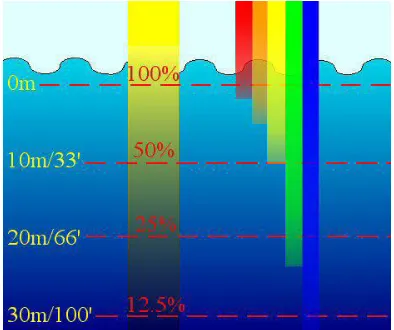
Fig 1: Color appearance in underwater
Regarding color correction, as depth increases, color drop off one by one depending on their wavelength. First of all, red color disappears at the depth of 3 m approximately. At the depth of 5 m, the orange color is lost. Most of the yellow goes off at the depth of 10 m .and finally the green and purple disappear further depth. The blue color travels the longest in the water due to its shortest wavelength. The underwater images are therefore dominated by blue-green color. Also the light source variations will affect the colour perception. As a consequence, a strong and non-uniform colour cast will characterize the typical underwater images.
III. Common techniques Used for UWIE
Available Online at www.ijpret.com 1438 possible presence of an artificial light source into consideration. The performance of the proposed algorithm for wavelength compensation and image dehazing (WCID) is evaluated both objectively and subjectively by utilizing ground-truth color patches Actual implementation results into images with significantly enhanced visibility and superior color fidelity after applying are proposed WCID are obtained.
Flowchart of the WCID technique
Available Online at www.ijpret.com 1439 iii. In 2013 PulungNurtantio, Andono, Ketut Eddy Purnama, MochamadHariadi proposed a paper “Underwater Image Enhancement Using Adaptive Filtering For Enhanced Sift-Based Image Matching”, which says ,Success of scale-invariant feature transform (SIFT) image registration is limited when attempted on camera footage taken under water Rayleigh Distribution.
This is, largely due to the poor image quality inherent to imaging in aquatic environments. In this research they aimed to overcome this shortcoming using a new method of pre-processing of true-color imagery taken under water based on the Contrast Limited Adaptive Histogram image Equalization (CLAHE) algorithm. CLAHE assumes that the distribution function of the pixel intensity values of an underwater-recorded image is dominated by Rayleigh scattering, and that the noise can be removed as a function hereof. Results showed that after applying the CLAHE image enhancement method registration success of SIFT increased by 41% compared to reference method. This research explained the preprocessing step of underwater image registration using image enhancement framework. This paper proposed a method for image enhancement using adaptive filtering base on CLAHE using
IV. RELATED WORK
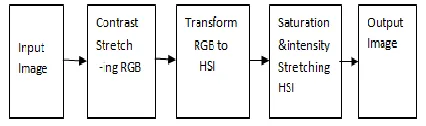
Fig 2: Methodology under water Image Enhancement
Available Online at www.ijpret.com 1440 have the blue color element in the image it is controlled by the ‘S’ and ‘I’ value in order to create the range from pale blue to deep blue, for instance. Using this technique, we can control the contrast ratio in underwater images either by decreasing or increasing the value. This is carried out by employing and redistributing the stretching value over the image variation of the maximum range of the possible values. Furthermore linear stretching from ‘S’ value can provide stronger values to each range by looking at less output values. Here a percentage of the saturating image can be controlled in order to perform better visual displays. The contrast stretching algorithm is used to enhance the contrast of the image. This is carried out by stretching the range of the color values to make use of all possible values.
The contrast stretching algorithm is used enhance the contrast of the image. This is carried out by stretching the range of the color values to make use of all possible values. The contrast stretching algorithm uses the linear scaling function to the pixel values. Each pixel is scaled using the following function:
Po = (Pi – c) x (b – c) / (d – c) + a
“Where
- Po is the normalized pixel value;
- Pi is the considered pixel value;
- a is the minimum value of the desired range;
- b is the maximum value of the desired range;
- c is the lowest pixel value currently present in the image;
- d is the highest pixel value currently present in the image”
V. CONCLUSIONS AND FUTURE WORK
Available Online at www.ijpret.com 1441 images is statistically illustrated through the histograms. Our future work will include further evaluation of the propose approach or .In future it is implemented for 3D images…
Fig3: Comparison of Results before and After Enhancement
REFERENCES
1. Andreas Arnold-Bos, Jean-Philippe Malkasse and illesKervern: “Towards model free-denoising of underwater optical images” In IEEE Conference on Oceans, 2009.
2. Bazeille et al ,A J R Fair weather, M A Hodgetts, A R Greig, “Robust scene interpretation of underwater image sequences”, 2011
3. White, E.M., Partridge, U.C., Church, S.C, “Ultraviolet dermal reflection and mate choice in the guppy”, 2013
4. Iqbal, K.; Odetayo, M.; James, A.; Salam, R.A.; Talib, A.Z.H., "Enhancing the low quality images using Unsupervised Colour Correction Method," Systems Man and Cybernetics (SMC), 2010
5. Luz Abril Torres-Méndez and 1Gregory Dudek, “Color Correction of Underwater Images for Aquatic Robot Inspection” 2011
6. Schechner, Y and Karpel, N., “Clear Underwater Vision”. Proceedings of the IEEE CVPR, 2010