Available Online at www.ijpret.com 965
INTERNATIONAL JOURNAL OF PURE AND
APPLIED RESEARCH IN ENGINEERING AND
TECHNOLOGY
A PATH FOR HORIZING YOUR INNOVATIVE WORKHYBRID TECHNIQUE FOR PAPR REDUCTION IN OFDM USING PARTIAL TRANSMIT
SEQUENCES
MS. SHRADDHA WAGHMARE1, MRS. M. R. PATIL2, MS. ASHWINI REWATKAR1, DR. S. P. MOHANI3
1.Assistant Professor, Electronics & Communication Engineering Dept., Dr. Babasaheb Ambedkar College of Engineering & Research, Nagpur, India.
2.H.O.D & Assistant Professor, Electronics & Communication Engineering Dept., Dr. Babasaheb Ambedkar College of Engineering & Research, Nagpur, India.
3.Professor, Electronics & Telecommunication Engineering Dept., College of Engineering Pune, India.
Accepted Date: 05/03/2015; Published Date: 01/05/2015
\
Abstract: This Orthogonal frequency division multiplexing (OFDM) is a robust and effective multicarrier transmission technique for high speed communication in wireless mobile environment and applications. A major challenging issue in application of OFDM is its high peak to average power ratio (PAPR). Partial transmit sequence (PTS) scheme is an attractive technique for PAPR reduction in OFDM systems. An exhaustive search for phase sequences is needed to obtain desirable PAPR performance, which results in high computational complexity. In this work, a hybrid tree PTS (T-PTS) algorithm is proposed, where real and imaginary parts of the candidate are separately multiplied with phase factors, moreover, PAPR is conjointly optimized in real part and imaginary part. The simulation results of the proposed technique show improved PAPR performance with remarkably reduced computational complexity and bit error rate (BER).
Keywords: Multicarrier Systems, Orthogonal Frequency Division Multiplexing (OFDM), Peak to average
power ratio (PAPR), Partial Transmit sequence (PTS), Quadrature Amplitude Modulation (QAM), IFFT, FFT
Corresponding Author: MS. SHRADDHA WAGHMARE
Access Online On:
www.ijpret.com
How to Cite This Article:
Shraddha Waghmare, IJPRET, 2015; Volume 3 (9): 965-972
Available Online at www.ijpret.com 966 INTRODUCTION
Orthogonal Frequency Division Multiplexing is extensively implemented in various high speed wireless communication standards because of its favorable properties such as high spectral efficiency, robustness to channel fading, capability of handling multipath fading and immunity to impulse interference. Interestingly, OFDM is a combination of modulation and multiplexing.
One major limitation of OFDM is its large Peak to Average Power Ratio (PAPR). These large peaks cause saturation in power amplifiers at the transmitting end, leading to inter-modulation among the subcarriers, which causes an increase in the out of band (OOB) energy of the spectrum. Hence, to design a cost effective and robust system, it is highly desirable to reduce the PAPR.
In this work Partial Transmit Sequence (PTS) technique for PAPR reduction is modified by introducing new set of phase sequences. The proposed phase sequences show enhanced performance with respect to PAPR reduction.
The multicarrier modulation techniques employ several carriers, within the allocated bandwidth, to convey the information from source to destination. Each carrier may utilize one of the several available digital modulation techniques (BPSK, QPSK or QAM) [1].
Generally, an OFDM signal can be represented as:
c t = N−1n=0 sn t sin(2πfnt) (1)
Where:
c(t) : Ofdm Signal Representation In Time Domain
sn t : Symbols Mapped To Chosen Constellation
(Bpsk/Qpsk/Qam)
fn : Represents The Orthogonal Frequencies
Equation (1) can be thought of as an Inverse Fast Fourier Transform (IFFT) where ‘ ’ is the size of IFFT. The Fourier transform breaks a signal into different frequency bins by multiplying the signal with a series of sinusoids.
Available Online at www.ijpret.com 967
domain sample. To acquire the original transmitted signal, FFT is performed at the receiver side [2].
I. Peak to average Power ratio (PAPR)
OFDM has several features which make it an attractive modulation scheme for high speed transmission links. However, one major limitation is its large Peak to Average Power Ratio (PAPR). These large peaks cause saturation in power amplifiers at the transmitting end, leading to inter-modulation among the subcarriers, which causes an increase in the out of band (OOB) energy of the spectrum. Hence, to design a cost effective and robust system, it is highly desirable to reduce the PAPR.
Some of the distortion based techniques for PAPR reduction include clipping and filtering, companding, coding. Selective mapping (SLM), partial transmit sequence (PTS), tone reservation, tone injection, constellation extension are Distortionless Techniques for PAPR reduction. PTS technique improves PAPR statistics of an OFDM signal significantly without any in-band distortion and out-of-band radiation. The selection of proper phase sequences to achieve good PAPR reduction is very important in the PTS technique [3].
II. Partial Transmit Sequence
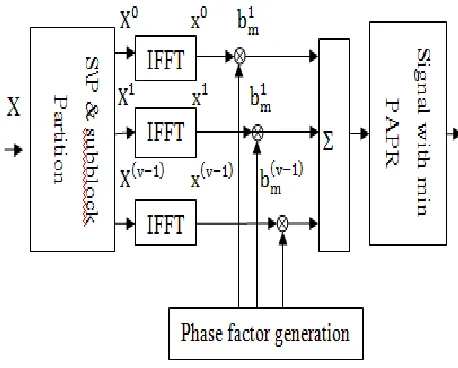
Fig 1. Block Diagram of PTS
Available Online at www.ijpret.com 968
{𝑋𝑚 , 𝑚 = 0,1, … 𝑀 − 1}
Therefore, we can get
𝑋 = 𝑀−1𝑚 =0𝑋(𝑚 ) (2)
where 𝑋𝑚 = [𝑋
𝑜𝑚, 𝑋1𝑚, … . , 𝑋𝑁−1𝑚 ] with 𝑋𝑘𝑚 = 𝑋𝑘or (0 ≤ 𝑚 ≤ 𝑀 − 1).
In general, for PTS scheme, the known subblock partitioning methods can be classified into three categories adjacent partition, interleaved partition and pseudorandom partition.
Then, the subblocks 𝑋𝑚 are transformed into 𝑀 time-domain partial transmit sequences
x𝑚 = 𝑥
0𝑚 𝑥1𝑚… . . 𝑥𝐿𝑁−1𝑚 = 𝐼𝐹𝐹𝑇𝐿𝑁x 𝑁 [𝑋𝑚] (3)
These partial sequences are independently rotated by phase factors𝑏 = {𝑏𝑚 = 𝑒𝑗 𝜃𝑚, 𝑚 =
0,1, … . , 𝑀 − 1}. The objective is to optimally combine the subblocks to obtain the time domain
OFDM signals with the lowest PAPR
x = 𝑀−1𝑚 =0𝑏𝑚𝑋(𝑚 ) (4)
Therefore, there are two important issues should be solved in PTS: high computational complexity for searching the optimal phase factors and the overhead of the optimal phase factors as side information needed to be transmitted to receiver for the correct decoding of the transmitted bit sequence.
Following is an example of phase sequences
[ 1+0i, -1+0i, 0+1i, 0-1i ]
[ -1+0i, -1+0i, 1+0i, 0-1i ]
[ 0+1i, 0+1i, 0+1i, 1+0i ]
[ 0-1i, 1+0i, -1+0i, -1+0i ]
III. Proposed System
Available Online at www.ijpret.com 969
separation is proposed in this work. This technique adaptively generates the real and imaginary phase factors separately by using Tree searching algorithm.
The phase vector is chosen such that the real part of the signal is multiplied with real part of the phase vector and similar operations are done for imaginary part of the IFFTed signal. The possible combinations for real phase vector will be: {1, −1}
Similarly, for imaginary phase vector possible combinations are given as: {𝑗, −𝑗}
Four combinations of the phase vectors along with the first subblock are obtained as follows:
Combination no. 1: RP * 1 + IP * j
Combination no. 2: RP*-1 + IP *j
Combination no. 3: RP * 1 + IP * -j
Combination no. 4: RP * -1 + IP* -j
IV. Results
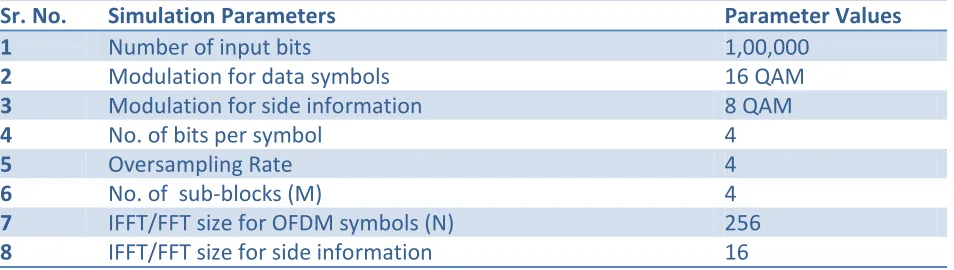
Following are the system specifications used for both unmodified OFDM, conventional PTS, RP-IP separation PTS, T-PTS and proposed Hybrid PTS technique [12]. The simulation is performed using MATLAB.
Table I: System Specification
Sr. No. Simulation Parameters Parameter Values
1 Number of input bits 1,00,000
2 Modulation for data symbols 16 QAM
3 Modulation for side information 8 QAM
4 No. of bits per symbol 4
5 Oversampling Rate 4
6 No. of sub-blocks (M) 4
7 IFFT/FFT size for OFDM symbols (N) 256
8 IFFT/FFT size for side information 16
Available Online at www.ijpret.com 970
1 2 3 4 5 6 7 8 9 10 11 12
10-2 10-1 100
papr, Z dB
P ro b a b il it y ,P (P A P R (d b )) > = Z
CCDF plots of PAPR 256 IFFT (QAM)-PTS
Basic ofdm Basic PTS RP-IP-PTS T-PTS Hybrid RP-IP
1 2 3 4 5 6 7 8 9 10
10-4 10-3 10-2 10-1 100 Eb/No, dB B it E rr o r R a te
Bit Error Probability curve-PTS
Basic ofdm Basic PTS RP-IP-PTS T-PTS Hybrid RP-IP
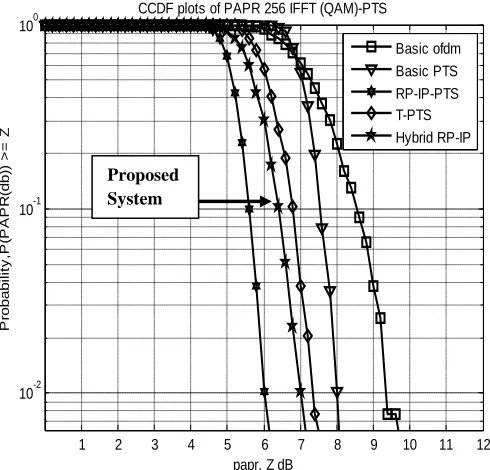
Fig 2. CCDF plots of PAPR using PTS
For the first 10 symbols, Basic PTS shows reduction in PAPR as compared to the Basic OFDM, whereas, RP-IP shows PAPR reduction more than the other considered techniques. The Proposed PTS technique gives better performance than T-PTS. The advantage of Proposed PTS over RP-IP PTS is the computational complexity for finding the phase sequence is reduced comparatively.
Fig 3. BER plots of PTS systems
Proposed System
Available Online at www.ijpret.com 971
The Bit error rate of the system is also a major issue of concern in an OFDM system. The proposed technique shows excellent performance in reception of the data even after it is passed through the AWGN channel. As shown in fig3 significant reduction in the BER is offered by the proposed technique compared to the other techniques considered in this experimentation.
Table II. Computational Complexity
PTS Technique Execution Time (sec.)
Conventional PTS 402.908585
RP-IP PTS 4.886889
Tree PTS 1.747156
Hybrid RP-IP PTS 3.173329
V. CONCLUSION
In this work, a modification in the conventional PTS scheme is proposed. The proposed technique of hybrid combination of Tree-PTS and RP-IP separation shows a significant reduction in PAPR as compared to that offered by individual techniques considered in this experimentation. Computational complexity is reduced by a large factor than the conventional PTS. The proposed technique offers better BER performance than that of all variants of PTS techniques under consideration. Considerable reduction in computational complexity is offered by the proposed technique in finding the phase sequence as compared to the conventional PTS and other PTS techniques considered in this experimentation.
VI. REFERENCES
1. Richard Van Nee, Ramjee Prasad, “OFDM for Wireless Multimedia Communication,” Artech House universal personal communication library, Boston, London, pp. 33–37.
2. Charan Langton, “Intuitive guide to principles of communication, Orthogonal Frequency Division Multiplexing Tutorial,” Copyright 2004.
3. Tao Jiang, and Yiyan Wu “An Overview: Peak-to-Average Power Ratio Reduction Techniques for OFDM Signals,” IEEE Trans. on Broadcasting. vol.54, No.2, June 2008.
Available Online at www.ijpret.com 972
5. Trung Thanh Nguyen and Lutz Lampe, “On Partial Transmit Sequences for PAR Reduction in OFDM Systems”, Revised as Paper for publication in the IEEE Transactions on Wireless Communications, November, 2006.
6. Chusit Pradabpet and Kobchai Dejhan, “A new PAPR reduction in OFDM systems using PTS combined with APPR for TWTA nonlinear HPA”,Songklanakairn journal of Science and Technology. Received 4 April 2007; Accepted 1 May 2008.
7. Jayalath, Dhammika and Tellambura, Chintha (2003), “Side information in PAR reduced PTS-OFDM signals”. In Proceedings 14th IEEE Conference on Personal, Indoor and Mobile Radio Communications, 2003 (PIMRC 2003) 1, pages pp. 226- 230, Beijing, China.
8. Xinchun Wu, Zhigang Mao, Jinxiang Wang, Bin Zhou, ” A Novel PTS Technique with Combinative Optimization in Real Part and Imaginary Part for PAPR Reduction in OFDM Systems”, 2009 Third International Conference on Next Generation Mobile Applications, Services and Technologies.
9. Byung Moo Lee and Rui J. P. de Figueiredo, “An Enhanced Iterative Flipping PTS Technique for PAPR Reduction of OFDM Signals”, Mobile and wireless communication, physical layer development and implementation.
10. Jayalath, Dhammika and Tellambura, Chintha , “Adaptive PTS approach for reduction of peak-to-average power ratio of OFDM signa”, ELECTRONICS LETTERS 6th July 2000 Vol. 36 No. 14, © Copyright 2000 IEEE..
11. ByungMooLee · Rui J. P. deFigueiredo · YoungokKim, A Computationally Efficient Tree-PTS Technique for PAPR Reduction of OFDM Signals”, © Springer Science+Business Media, LLC. 2010.