Available Online At www.ijpret.com
INTERNATIONAL JOURNAL OF PURE AND
APPLIED RESEARCH IN ENGINEERING AND
TECHNOLOGY
A PATH FOR HORIZING YOUR INNOVATIVE WORK
AN APPROACH IN WEB MINING: WEB-BASED LEARNING ENVIRONMENT
VIJAY KHANDAR1, PROF. P. D. DESHMUKH2
1. M.E Student Department of Computer Science and Engineering, P. R. Patil College of Engineering, Amravati.
2. Asst. Professor Department of Computer Science and Engineering, P. R. Patil College of Engineering, Amravati.
Accepted Date:
27/02/2013
Publish Date:
01/04/2013
Keywords
Web Mining,
Web Content Mining,
Web Structure Mining,
Web Usage Mining,
Teaching Resource.
Corresponding Author
Mr. Vijay Khandar
Abstract
This ongoing research focuses on how data mining techniques,
if incorporated into web learning environments, can enhance
the overall qualities of learning. Web mining techniques,
including clustering and association rules mining, could be
applied to extract hidden and interesting knowledge to
facilitate instructional planning and student diagnosis. In this
paper mainly discuss how to make use of web mining
technology to improve distance education platforms. It will
introduce web mining and its application in distance education
Available Online At www.ijpret.com Introduction
With the rapid development of computer
network and multimedia technology,
modern distance education has become a
new kind of teaching model, it breaks the
multiple limitations in terms of personnel,
time and space in traditional education
mode. What's more, it provides an
abundance of open teaching resources, so
that people can teach and learn anytime
and anywhere. Through the distance
education platform, the interaction
between students and teachers can be
realized, such as video courses, answering,
questioning, discussing, testing, homework
submission and other teaching activities.
However, at present, there are also many
shortages in distance education platforms:
1) The use of network teaching resources is
insufficient. That is the system can't provide
the necessary teaching resources to
students efficiently and accurately, and
can't serve students' personalize learning.
2) Education platforms mode are very
single, and low-smart. These models are
system self-centred, rather than
student-centred, the system cannot provide
different learning resources according to
different students' learning, and realize
students' personalize learning [1]. Web
mining in education is not new. It has been
applied to mine aggregate paths for
learners engaged in a distance education
environment to recommend relevant words
to students based on text mining from their
browsed documents to recommend
e-articles for students based on
key-word-driven text mining, and to analyze learners’
learning behaviours. The research proposed
here will go beyond usage mining to
consider the content of the pages that have
been visited. In an e-learning system, both
learners’ browsing behaviours and course
content are important to derive learners’
learning levels, intentions, goals, interests,
or abilities. Incorporating course content
can aid in an understanding of learners’
browsing habits. In particular,
understanding the learners’ browsing
behaviours can facilitate, say, the
personalization of course contents
Available Online At www.ijpret.com 1. Technology in Web Mining
Web mining is a comprehensive technology,
related to web, data mining, computer
linguistics, information theory and other
fields of science. It can be defined as the
analysis of the relation among the content
of document, the use of available
resources, and the resources, to find the
knowledge which is effective, novel,
potentially valuable, and ultimately
understandable, including the non-trivial
process of concepts, patterns, rule,
regularities, constraints and visualizations
and so on [2].
2.1. The Classification of Web Mining
At present, there are three kinds of main
researched web mining technology; they
are web content mining, web usage mining
and web structure mining. Its detailed
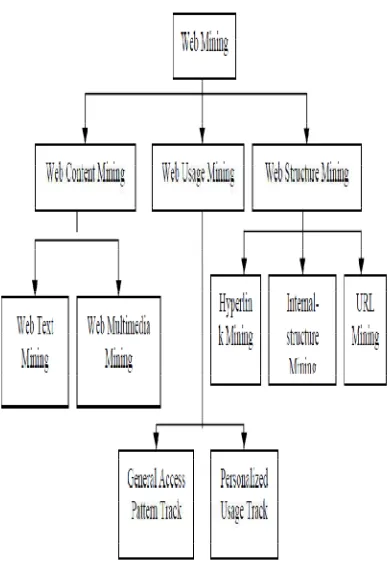
structure is illustrated as Fig.1.Web content
mining refers to the process of mining from
the content of web pages or its description,
and extracting the knowledge. There are
two kinds of web content mining according
to the objects of mining: 1) Text documents
mining, including the text format, HTML
format and so on. 2) Multimedia documents
mining, including image, audio, video and
other media types. Web text mining can
associate analyze, conclude, classify, cluster
the content of a large number of
documents on the web, and make use of
web documents to forecast the trend, etc.
Multimedia documents mining on web
mainly uses multimedia tools for the
extraction of features, and then associate
analyze and classify these features. Web
structure mining refers to derive knowledge
from the organizational structure of WWW
and the relationship of links. As a result of
the interconnection of the documents,
WWW can provide the useful information
besides the content of documents. Making
use of this information, it’s sort the pages
and find the most important pages among
them. On behalf of work in this area have
Page-Rank and CLEVER. Web structure
mining not only includes hyperlink structure
between documents, but also includes the
internal structure of the documents, the
directory path structure in URL, and so on.
Web usage mining refers to mine
information from the access logs left on the
servers when users visit the web. That
Available Online At www.ijpret.com methods of visited web sites in order to find
out the browse patterns when users visit
web sites and the frequency of visiting the
pages. There are two kind tracks in the
analyzing of users' browsing patterns, the
first one is the general access pattern track
for user groups, and the second is the
personalize use record track for single user.
The mining objects are in the serves
including the logs such as ServerLogData.
Figure 1 – classification on Web Mining
1.2. The Realization of Web Mining
Web mining is a branch of data mining. The
methods of data mining can be divided into
two kinds:
1) Based on statistical models and the
technology used includes decision tree,
classification, clustering, association rules,
etc.
2) Establish an artificial intelligence model
mainly based on machine learning, the
methods used include neural network,
natural law calculation method, etc.
• The Technology of Web Content
Mining [4] Web content mining mainly
bases on the text information mining, its
method and function is usually very similar
with plane text mining. Using parts of tags
of web text, such as title, head etc. which
contains additional information can
improve the performance of web text
mining.
Text conclusion. Text conclusion can
extract key information from documents,
and summarize and explain the content of
the documents with a concise form, so that
Available Online At www.ijpret.com The purpose of text conclusion is to
concentrate the text information, and give
out a compact description. For example,
when a user want to search the content
about some knowledge through the
distance education platform, the result of
the search can be the interception of the
first few lines of the description about the
knowledge, through the first few lines
description about the knowledge, users can
get the view to the whole content, so that it
is more convenient for users to search the
resources they need. And now many search
engines also use this method. Current
related technology:
1) Using part of speech tagging to analyze
the segmentation;
2) Using statistical method to extract the
high-frequency words and determine the
summary.
Text classification. It is the core of
text mining. Automatic text classification
refers to use a large number of texts with
class signs to train classification rules or
model parameters, then use the training
result to identify the text of which type is
unknown. It not only allows users to easily
browse documents, but also makes the
search of documents more convenient by
limiting the search scope.
Text clustering. Text clustering
refers to the combination of a group of
objects, and the group of objects can be
divided into several categories according to
similarity. Its purpose is to divide the
document collection into several clusters,
and its request is that the similarity of
document content in the same cluster
should be as much as possible, while the
similarity between different clusters should
be as small as possible. We can use text
clustering to provide the summary of the
large scale document content; identify the
similarity between hidden documents;
reduce the process of browsing related or
similar information.
Associate rules. Discovering the
algorithm of associate rules always has to
go through the following three steps: data
connecting, for the preparation of data;
give minimum support and minimum
reliability, discover associate rules through
the algorithm provided by data mining
tools; visualized display ,understand and
Available Online At www.ijpret.com The Technology of Web Usage
Mining The data for describing users' access
in web usage mining includes IP address,
reference pages, access date and time, web
sites and their configuration information.
There are two kinds method for discovering
usage information: One kind is that analyze
through log files, including two manners:1)
pre-treatment, that is the log data will be
mapped into relationship list and use the
corresponding data mining technology to
access log data. 2) access log data directly
to obtain the users' navigation information.
The other kind is that the users' navigation
behaviour can be discovered through the
collection and analysis of users' click events.
2.3. The Process of Web Mining
Compared with data mining based on
relation database or data warehouse web
data mining is much complex. If think the
web as a huge and distributed database,
each site is an independent data source,
and their data organization forms and
structures are not the same. Therefore, the
information on the web can be regarded as
a heterogeneous database environment. In
addition, apart from the heterogeneous of
different sites, the large number of data on
web pages is always some texts and
multimedia information which is semi
structured or unstructured, because of this,
it is necessary to do some data processing
instead of mining date on web pages
directly.[5] For example, in the distance
education platform we can regard the
resources of each course as an independent
web site, and integrate the independent
course into a comprehensive resource
through web mining. Typical web mining
process is as follows:
1) Find resources: its task is to obtain data
from goal web documents; it is worth
noting that in some case information
resources are not limited to online web
documents, but also include email,
electronic documents, news groups or web
site log data.
2) Selection and pre-treatment of
information: its task is to remove the
useless information from the obtained web
resources, and to take some necessary
editing for the information. For example,
automatically remove the ads, redundant
tag format, automatic identify paragraphs
Available Online At www.ijpret.com data into a logical form even relationship
tables.
3) Pattern discovery: automatically discover
the patterns; it can be achieved within the
same site or between multiple sites.
4) Pattern analysis: verify and explain the
pattern generated by the previous step. It
can be finished automatically by machines,
as well as by the interaction with analysts.
3. The Application of Web Mining in
Distance Education Platform
3.1. Web Content Mining in Distance
Education Platform
The teaching resources in traditional
distance education platform mainly include
courseware, course plans, exercises,
multimedia materials, courses, papers and
other fixed contents. These contents have
been categorized on the server, when the
users want to search the relevant
information, because of the dispersion of
resources, it is necessary to choose and
comprehensively analyze resources of all
parts, and this process will use up a lot of
server resources and consume a large
amount of time. At the same time because
of the differences between the resource
developers and users such as knowledge
structure, expression manner,
understanding ability and so on, the two
kinds people may understand the same
statement of resources much differently,
that cause the problem that users can't
quickly find the information they needed in
the mass of educational resources. In
addition, users' different cultural
backgrounds, language barriers, thinking
manners, the capacity of knowledge
acceptance and the age will also cause the
same problem. It is known to all that
distance education platforms tend to have
these resources such as BBS, test library,
exercises submitted by students or users.
While in traditional platforms always treat
these functions as the interactive way
between students and teachers, actually in
these modules there are a large number of
targeted knowledge. For example, when a
student can't understand a definition,
he/she may write it down on the BBS for
help, and someone will answer it sooner or
later. In fact, this is a very specific
knowledge, the educational resources on
Available Online At www.ijpret.com expanse the entire knowledge base. At the
same time, the analysis of the test, the
correct views to students' homework, etc.
all of these can be treated as a kind of
knowledge which haven't been treated as
knowledge in present platforms. Web
content mining can mine information from
web pages and their descriptions, and web
content mining mainly bases on texts
information. The function of web content
mining is that it can associate analysis,
conclude, classify, cluster the content of a
large number of documents on the web,
and make use of web documents to
forecast the trend, etc. So it can solve the
problems mentioned above. [4]
3.2. Web structure mining in distance
education platform
There will always be some relationships
between different knowledge, while little
relationships have been identified in
current model, even if have been identified
by complex methods, it is inevitable that
there will be omissions. What's more, the
relationships between knowledge points
will become more complex when
knowledge increases, so that it is difficult to
maintain. The platform can classify and tide
up the knowledge automatically by web
content mining, then form a more
structured knowledge base by web
structure mining, and the system will
automatically constitute all of the
association between knowledge, and don't
need to consider the link between
knowledge when add new knowledge
points. So that it not only makes the large
amount of maintenance work be reduced,
but also make the entire knowledge base be
integrated into a whole.
3.3. Web usage mining in distance
education platform
Another prominent issue of current
distance education model is that the system
always regards resources as the core of
education, it shows the same resources to
different students to achieve the aim of
teaching, and ignores the differences
including interests, learning styles, learning
needs as well as learning ability between
different students. Making use of web
usage mining, in one hand can be used as a
reference of knowledge association, so that
Available Online At www.ijpret.com more closely and reasonable. Meanwhile
through the analysis of access frequency
and access time of different knowledge that
the students have been accessed, it’s get a
more intuitive understanding about the
knowledge students are interested in, as a
result of this, it’s recommend their
interested knowledge to them for learning.
On the other hand, when a student study a
course, and spends much time on learning
the knowledge is interested in and ignores
the knowledge is not interested in but very
important to learn this course well, the
system can remind the student properly,
and recommend the missing knowledge to
the student, to some extent, it realizes the
students personalized learning. While
distance education platform in general only
recommend the knowledge students
interested in.
4. The model of web mining process in
distance education platform
Web mining in distance education platform
can be divided into two main parts, the first
is mining from the resources (include fixed
resources and dynamic resources) in the
distance education platform; the second
part is mining from the web logs.
(1) Web mining based on resources
Resource search module Collecting data
from course wares, course plans,
exercises, materials, teaching videos,
papers and other teaching resources in
the distance education platform to form
a original resource base.
Information selection and pretreatment
module Removing the some repetitive
resources, redundant tag format,
automatic identify paragraphs or field
from the original resource base to form
a classified resource base.
Pattern discovery and analysis module
Finding the relationships between all
kinds of knowledge in the classified
resource based on pattern discovery
and analysis.
5. Data Clustering for Web Learning
Among mining techniques of particular
interest in webbased learning environments
is data clustering. It can, for example:
Promote roup-based collaborative learning
Traditionally, learning systems focus more
Available Online At www.ijpret.com delivery. However, in web-based learning
environments where both the number of
students and the size of the information can
be huge, to reduce the cost and the
computational burdens on the system,
group-based learning will also be useful.
Data clustering is a powerful tool to find
clusters of students with similar learning
characteristics based on their path traversal
patterns and the content of each page they
have visited. The clusters of students can be
used to promote effective group learning,
e.g., assigning students from different
clusters so as to form effective learning
groups for collaboration. In addition, after
we find a cluster of learners with similar
browsing paths, we could extract course
contents along the paths to create
fragmented contents (group-based course
content delivery). These fragmented course
contents can also be selected for
recommendation, and the clustered paths
can be used to sequence the curriculum for
other students in the future (group-based
instructional planning). Provide incremental
learner diagnosis Incremental clustering can
be performed to help diagnose learners as
they browse through the system.
6. Conclusion
From the view of data analysis, it can mine,
extract and analyze the massive data in the
distance education platform by web mining
technology, and also able to identify and
extract the implicit information. To some
extent, students and teachers can use this
information for their own learning
strategies and teaching strategies
adjustments. From the perspective of
curriculum design, using web text content
mining to organize the teaching resources
in the platform. For example, using the
classification technology to organize the
resources and form different levels; using
text clustering to achieve reasonable
classification of text content, in order to
facilitate the text browse and retrieval; at
the same time, through web usage mining
we can grasp users interests which may
contribute to personalized teaching and
attract more users. From the perspective of
the function of information retrieval, web
mining technology is a key of the
development of network information
retrieval, it can improve the search results
Available Online At www.ijpret.com References
1. Yang Dingzhong, “The Personalized
Research of Modern Distance Education
Based on Web Mining”, Journal of Yangtze
University (Nat Sci Edit), Vol. 5, No. 3, 2008,
205.
2. Wang Qijun and Shen Ruimin, “Studies
on Web Mining Based Intelligent and
Personalized Distance-learning
Environment”, Computer Engineering, Vol.
26, No. 12, 2000, 158.
3. Zhang Tao and Deng Jun, “The Research
of Modern Distance Education Personalized
Web Mining”, Science Technology and
Engineering, Vol. 7, No. 5, 2007, 742-743.
4. Tu Chengsheng, Lu Mingyu and Lu
Yuchang, “Research on Web Content
Mining”, 2003, 6-8.
5. Li Jian, Xu Chao and Tan Shoubiao,
“Design and Research of a Web Data Mining
Sytem”, Computer Technology and
Development, Vol. 19, No. 2, 2009, 70-72.
6. Agrawal, R., and Srikant, R. 1995. Mining
Sequential Patterns. In Proc. of the Eleventh
International Conference on Data
Engineering (ICDE), 3-14, Taiwan.
7. Chen, M.S.; Park, J.S.; and Yu, P.S. 1998.
Efficient Data Mining for Path Traversal
Patterns. IEEE Trans. Knowledge and Data
Engineering 10(2): 209-221.
8. Cooley, R. 2000. Web Usage Mining:
Discovery and Application of Interesting
Patterns from Web Data. PhD diss., Dept. of
Computer Science, University of Minnesota.
9. Gaul, W., and Schmidt-Thieme, L. 2000.
Mining Web Navigation Path Fragments. In
Proc. of 2000 Workshop on Web Mining for
E-Commerce—Challengers and