Organized by C.O.E.T, Akola. Available Online at www.ijpret.com
459
INTERNATIONAL JOURNAL OF PURE AND
APPLIED RESEARCH IN ENGINEERING AND
TECHNOLOGY
A PATH FOR HORIZING YOUR INNOVATIVE WORK
ASSESSMENT OF GROUNDWATER QUALITY FOR ITS SUITABILITY FOR
IRRIGATION
RAKHI MESHRAM, MAHENDRA KALE
Department of Irrigation and Drainage Engineering, Dr PDKV Akola, Maharashtra - 444104
Accepted Date: 05/09/2017; Published Date: 10/10/2017
Abstract:
The groundwater quality of command area of Telhara distributary of Wan River Project, Akola district was assessed for its suitability for irrigation. Groundwater samples were collected from 15 deep bore wells in the command. The samples were analysed to interpret its quality in terms of electrical conductivity (EC), pH, sodium absorption ratio (SAR), residual sodium carbonate (RSC) and total dissolve solids (TDS). Results confirmed that groundwater in major portion of command have EC >0.75, pH within 6 to 8.5 and SAR<18. About 33.33% water samples categorized in high RSC class and about 93.33% samples show high TDS. Considering these parameters it is concluded that the groundwater from study area can use for irrigation but with one or two irrigations.Keywords
: Electrical conductivity, sodium adsorption ratio, total dissolved salts.
Corresponding Author: RAKHI MESHRAM
Co Author: - MAHENDRA KALE
Access Online On:
www.ijpret.com
How to Cite This Article:
Rakhi Meshram, IJPRET, 2017; Volume 6 (2): 459-464
PAPER-QR CODE
SPECIAL ISSUE FOR
INTERNATIONAL LEVEL CONFERENCE
"ADVANCES IN SCIENCE,
Organized by C.O.E.T, Akola. Available Online at www.ijpret.com
460
INTRODUCTIONWater is essential for life. As a result human communities around the world are increasingly turning to groundwater for their water needs. The quality of groundwater is under intense stress from increasing demand and withdrawal and pollution arising from geological and geochemistry of environment (Edmunds and Smedley, 1996).
Although, groundwater quality in its natural state is relatively free of contaminants and traditionally regarded as having good natural quality (MacDonald and Calow, 2009). For most of the geological environments this is true but this does not mean that natural groundwater is always good. The continued application of untreated and possibly contaminated groundwater to the field will result into formation of saline soils. Particular in arid and semi-arid areas their natural ground water resources were used as poor quality of water for irrigation. In this context irrigation water quality is important for successful crop production. The poor quality of the irrigation water may affect crop yields and soil physical conditions (Talukder et al., 1998). The average yield of wheat decreased by 24% (Datta et al., 2000), rice decreased by 39% (Bai, 1988), vegetables decreased by 30% (Chang et al., 2001), over normal yield when poor quality water was used. The major irrigation water is judged by four important measures of salinity hazard, sodium hazard, toxicity hazard and residual sodium carbonate hazard (Michael, 1978).
In India unfortunately, salinity hazards is extensive irrigation regions problem. In addition, different crops require different irrigation water qualities. Therefore, testing the irrigation water is prior to contribute to effective management and utilization of the groundwater resources by clarifying relations among many hydrogeological considerations. In the present study, the physiochemical quality of groundwater has assessed and dissimilar index methods which were used like EC, pH, SAR, RSC and TDS with reference to their suitability for irrigation.
Therefore the evaluation of groundwater quality is essential for development of civilization and to establish database for future water resources strategic planning and development (Al Harbi et al. 2006).
MATERIAL AND METHOD
The study area was the command area of Telhara distributary of Wan River Project situated near village Wari in Telhara block of Akola district.
Collection of water samples:
Organized by C.O.E.T, Akola. Available Online at www.ijpret.com
461
Fifteen groundwater samples were collected from deeper bore wells in 2016 year for the analysis. The locations from which water samples were collected are given in Fig 1. Collected samples were analyzed in the laboratory at Dr. PDKV Akola to assess the quality parameters like pH, EC, Ca+2+ Mg+2, Na+, CO
3-2 and HCO-3 of groundwater.
METHODOLOGY
Calcium and Magnesium concentrations were determined by Ethylenediaminetetraacetic acid (EDTA) titration using Eriochrome black-T as indicator. Sodium concentrations were determined by ‘flame photometer’. Carbonate and bicarbonate concentrations were measured by acid-base titration. The quality parameters like pH, electrical conductivity, SAR, RSC and TDS were assessed using standard methods and are briefly explained below.
1. pH:
pH is a measure of the acidity or alkalinity of water. To test the pH “EC meter” were used.
2. Electrical conductivity:
In solutions, the conductivity is determined by the number of ions present in solution. It is a measurement of all soluble salts in samples, the most significant water quality standard on crop productivity which was the water salinity hazard. To test the electrical conductivity “EC meter” were used.
3. Sodium adsorption ratio :
It is a significant parameter for the determination of suitability of irrigation water; excess sodium in water produces the undesirable effects of changing soil properties and reducing soil permeability (Biswas et al., 2002). A high sodium concentration leads to development of an alkali soil. The sodium or alkali hazard in the use of water for irrigation is determined by the absolute and relative concentration of cations and is calculated employing the equation (Raghunath, 1987) as:
4. Residual sodium carbonate (RSC):
The concentration of bicarbonate and carbonate also influences the suitability of water for irrigation purpose. One of the empirical approaches is based on the assumption that calcium and magnesium precipitate as carbonate, considering this hypothesis (Eaton, 1950) proposed by the concept of residual sodium carbonate (RSC) for the measurement of high carbonate waters. Its unit is milliequivalents per litre. The parameter RSC is given by
RSC = (CO32− + HCO3−) – (Ca 2+ + Mg 2+) 5. Total dissolves solids (TDS):
Total dissolved solids (TDS) are the total amount of mobile charged ions, including minerals, salts or metals dissolved in a given volume of water, expressed in units of mg per unit volume of water (mg/L), also referred to as parts per million (ppm). The parameter TDS is given by
TDS = EC × 640
Criteria for assessment of suitability of irrigation water
Table 1: Range of various parameters for several classes of irrigation water
SN Irrigability class EC (dS/m) SAR RSC(Meq/l) TDS (ppm)
1 Low < 0.25 <10 <1.25 <200
2 Medium 0.25-0.75 10-18 1.25-2.5 200-500
3 High 0.75-2.25 18-26 >2.5 500-1500
4 Very high 2.25-5.00 >26 >2.5 >1500
Preparation /Development of maps/ ready reckoners
Organized by C.O.E.T, Akola. Available Online at www.ijpret.com
462
Irrigation water quality refers to its suitability for agricultural use. The concentration and composition of dissolved constituents in water determine its quality for irrigation use. Quality of water is an important consideration in any appraisal of salinity or alkali conditions in an irrigated area. Good quality water has the potential to cause maximum yield under good soil and water management practices.
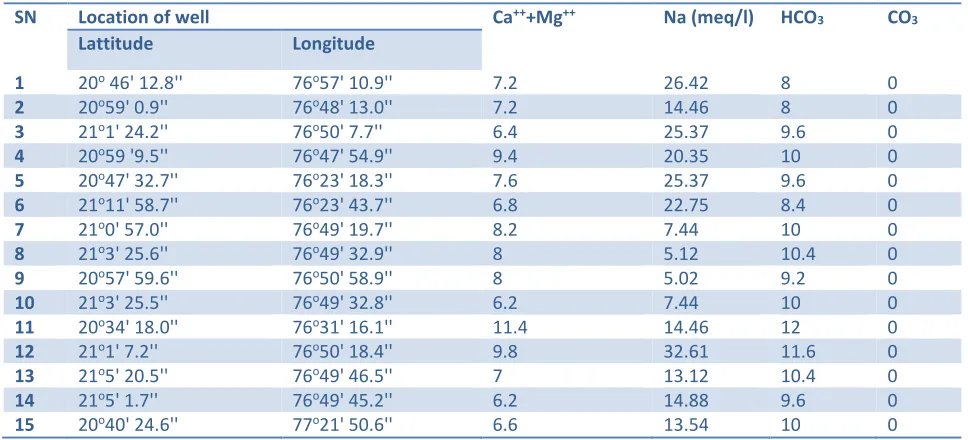
Table 2: Hydro chemical data for groundwater in some of the wells in Telhara distributary command area, Maharashtra, India (year 2016)
Table 3: Water quality indices of command area
SN Location of well Ca+++Mg++ Na (meq/l) HCO
3 CO3
Lattitude Longitude
1 20o 46' 12.8'' 76o57' 10.9'' 7.2 26.42 8 0
2 20o59' 0.9'' 76o48' 13.0'' 7.2 14.46 8 0
3 21o1' 24.2'' 76o50' 7.7'' 6.4 25.37 9.6 0
4 20o59 '9.5'' 76o47' 54.9'' 9.4 20.35 10 0
5 20o47' 32.7'' 76o23' 18.3'' 7.6 25.37 9.6 0
6 21o11' 58.7'' 76o23' 43.7'' 6.8 22.75 8.4 0
7 21o0' 57.0'' 76o49' 19.7'' 8.2 7.44 10 0
8 21o3' 25.6'' 76o49' 32.9'' 8 5.12 10.4 0
9 20o57' 59.6'' 76o50' 58.9'' 8 5.02 9.2 0
10 21o3' 25.5'' 76o49' 32.8'' 6.2 7.44 10 0
11 20o34' 18.0'' 76o31' 16.1'' 11.4 14.46 12 0
12 21o1' 7.2'' 76o50' 18.4'' 9.8 32.61 11.6 0
13 21o5' 20.5'' 76o49' 46.5'' 7 13.12 10.4 0
14 21o5' 1.7'' 76o49' 45.2'' 6.2 14.88 9.6 0
15 20o40' 24.6'' 77o21' 50.6'' 6.6 13.54 10 0
SN Village EC (dS/m) pH SAR RSC (Meq/L) TDS (ppm)
1 Wakodi 0.8 7.52 13.92 0.8 512
2 Wakodi 0.9 7.42 7.62 0.8 576
3 Sheri 0.8 7.47 14.18 3.2 512
4 Wadi adampur 0.9 7.49 9.39 0.6 576
5 Jafrapur 1.1 7.82 13.02 2 704
6 Isapur 0.9 7.47 12.34 1.6 576
7 Sonkhed 0.9 7.36 3.68 1.8 576
8 Kotha 0.7 7.35 2.56 2.4 448
9 Raikhed 0.8 7.53 2.51 1.2 512
10 Changalwadi 0.8 7.33 4.23 3.8 512
11 Malegaon 1.4 7.4 6.06 0.6 896
12 Telhara 1 7.56 14.73 1.8 640
13 Hingni khurd 0.8 7.57 7.01 3.4 512
14 Hayatpur 0.8 8.36 8.45 3.4 512
15 Ramkhed 0.8 7.54 7.45 3.4 512
Organized by C.O.E.T, Akola. Available Online at www.ijpret.com
463
Water quality indices are explained below:
pH
From the Table 2, it is observed that the pH values of the water samples ranged from 7.33 to 8.36 with a mean value of 7.55 in the study area. All the water samples fall in the safe limit of pH standard (6–8.5) for irrigation purpose (Ayers and Westcot 1985).
Electrical conductivity
The US Salinity Laboratory categorized groundwater on the basis of Electrical Conductivity given in Table 1. It indicated that overall water quality of study area was medium to high EC category. The range of EC is from 0.7 to 1.4 with mean of 0.8. All samples are from high salinity class with range 0.75 to 2.25 except one. It indicated that overall the GW of study area has high EC.
Sodium Adsorption Ratio (SAR)
As shown in Table 2, the SAR values of the groundwater samples varied from 2.51 to 14.73 with an average value of 8.48. As all the SAR values are below 18, therefore the water of the studied area are classified as low to medium class for irrigation (Richards 1954). As evident from the SAR values, it is concluded that sodium concentration in GW of study area is less and is suitable for irrigation use.
Residual sodium carbonate (RSC)
The classification for RSC is given (Richards, 1954) in Table 1. From Table 1, it is seen that RSC values from the study area are in the range of 0.6 to 3.4. About 33.33% water samples come in high RSC class whereas 66.66 % come in low to medium class. Therefore from analysis it is revealed that Changalwadi, Hayatpur, Hingni khurd, Ramkhed and Sheri under North command area of Telhara distributary come in high salinity class of RSC.
Total dissolves solids (TDS)
The classification for TDS is given (Richards, 1954) in Table 1. From the Table 1, it is seen that the range of TDS is 448 to 896 with mean 571.73. This range is from medium to high class of salinity. But all the TDS values from the studied area are more than 500 and come under high class except one. From study it is concluded that the study area has high total dissolve solids in groundwater. Therefore, the continuation use of this saline water for irrigation in the long term may increase the salinity hazard in the soils of the studied area.
CONCLUSION
Evaluation of groundwater quality for irrigation was carried out using different index like pH, EC, SAR, RSC and TDS. The pH of water in the study area is good for irrigation. About 93.33% of samples fall under high salinity class gives more electrical conductivity of overall GW. GW from study area has low sodium content. About 66.66% samples fall under low to medium class of RSC. About 93.33% samples show more TDS which means total dissolved solids are more in GW. Therefore, it is concluded that the groundwater from the study area can use for irrigation but with one or two irrigations. High concentration of TDS and electrical conductivity in groundwater results in difficulty for plants to overcome osmotic pressure and further assimilate water and nutrients. This will ultimately result in reduced crop yield and hence, lowering of net benefits.
REFERENCES
1. MacDonald, A.M. and R.C. Calow, 2009. Developing groundwater for secure rural water supplies in Africa. Desalinatio, 248: 546-556.
Organized by C.O.E.T, Akola. Available Online at www.ijpret.com
464
and its recharge by isotopes and solute Chemistry in Wadi Malal, Al-Madinah Al-Munawarah, Saudi Arabia. Pak. J. Biol. Sci., 9: 260-269.
4. Edmunds, W.M. and P.L. Smedley, 1996. Environmental Geochemistry and health with special reference to developing countries. Geological Society Publication House, Wallingford, Oxfordshire, UK.
5. Richards LA (1954). Diagnosis and Improvement of Saline and Alkali Soils. USDA and IBH Pub, Coy Ltd., New Delhi, India. Agric. Handbook 60:98-99.
6. Talukder MSU, Shirazi SM, Paul UK (1998). Suitability of Groundwater for Irrigation at Kirimganj Upazila Kishoreganj. Progress Agric. 9:107-112.
7. Chang Y, Hans MS, Haakon V (2001). The Environmental Cost of Water Pollution in Chongqing, China. Environ. Dev. Econ. 6:313-333.
8. Datta KK, Dayal B (2000). Irrigation with Poor Quality Water: An Empirical Study of Input Use, Economic Loss and Cropping Strategies. Indian J. Agric. Econ. 55(1):26-37
9. Michael AM (1978). Irrigation Theory and Practice. Vikas Publishing House Pvt.Ltd, New Delhi, pp. 713-713. 10.Bai Y (1988). Pollution of Irrigation Water and its Effects, Beijing, China, Beijing Agriculture University Press. 11.Biswas SN, Mohabey H, Malik ML (2002). Assessment Of The Irrigation Water Quality Of River Ganga In Haridwar District. Asian J. Chem., 16.
12.Eaton FM (1950). Significance of Carbonate in Irrigation Water. Soil Sci. 67:112-133.
13.Raghunath HM (1987). Groundwater, 2nd Ed. Wiley Eastern Ltd. New Delhi, India, pp. 344-369.