Sandhya Mamindla*
Institute of Pharmaceutical Technology, Sri Padmavathi Mahila Viswavidyalayam,
Tirupati, Andhra Pradesh, India -517 502 E-mail: [email protected]
*Address for correspondence
Journal of Global Trends in Pharmaceutical Sciences
Original Article
DEVELOPMENT AND VALIDATION OF A NEW SENSITIVE AND RAPID HPLC METHOD FOR DETERMINATION OF PIOGLITAZONE IN RABBIT SERUM AND ITS APPLICATION IN
PHARMACOKINETIC STUDIES
Sandhya Mamindla*, Prasad K.V.S.R.G, Bharathi Koganti
Institute of Pharmaceutical Technology, Sri Padmavathi Mahila Tirupati, Andhra Pradesh, India
A RT IC L E I N F O
Article history: Article history:
Received: 20 Feb 2016 Revised: 25 Feb 2016 Accepted: 15 Mar 2016
Key words: Pioglitazone, Rabbit serum, HPLC, Rosiglitazone
performance liquid chromatographic method was developed for the estimation of pioglitazone in rabbit serum. After liquid
with methanol, sample was determined using a phenomonex C
(250x4.6 mm, 5 μ porous silica spheres) in isocratic mode.0.1M ammonium acetate: acetonitrile: glacial acetic acid in a ratio of 38:60:2 (v/v/v) was used as mobile phase. The flow rate was 1.0mL/min and effluents were monitored at 267nm. The method was
specificity, sensitivity and stability. The retention times of pioglitgazone and rosiglitzone were found to be 5.16 and 3.79 min respectively. Rosiglitazone was used as internal standard and the total run time
approximately 7min. The calibration curves were linear over a concentration range from 10ng/mL
limit of quantitation (LOQ) were 0.0037 and 0.0113 μg/mL respectively. The developed method
pharmacokinetics of pioglitazone in biological samples.
INTRODUCTION
Pioglitazone hydrochloride (±) -5 - {4 pyridyl) ethoxy] benzyl} -2,4-hydrochloride salt (Figure 1), is an oral anti
agent indicated as monotherapy or in combination with other hypoglycemic agents to decrease blood glucose levels in type 2 diabetes mellitus patients when diet and exercise, plus the single agent do not result in adequate glycemic control[1,2].
An Elsevier Indexed Journal
Institute of Pharmaceutical Technology, Sri Padmavathi
517 502 [email protected] Address for correspondence
Journal of Global Trends in Pharmaceutical Sciences
DEVELOPMENT AND VALIDATION OF A NEW SENSITIVE AND RAPID HPLC METHOD FOR DETERMINATION OF PIOGLITAZONE IN RABBIT SERUM AND ITS APPLICATION IN
PHARMACOKINETIC STUDIES
Sandhya Mamindla*, Prasad K.V.S.R.G, Bharathi Koganti
Institute of Pharmaceutical Technology, Sri Padmavathi Mahila Viswavidyalayam, Tirupati, Andhra Pradesh, India -517502
A B S T R AC T
A simple, rapid, specific, accurate and precise reverse phase high performance liquid chromatographic method was developed for the estimation of pioglitazone in rabbit serum. After liquid
with methanol, sample was determined using a phenomonex C
(250x4.6 mm, 5 μ porous silica spheres) in isocratic mode.0.1M ammonium acetate: acetonitrile: glacial acetic acid in a ratio of 38:60:2 (v/v/v) was used as mobile phase. The flow rate was 1.0mL/min and effluents were monitored at 267nm. The method was validated for linearity, accuracy, precision, specificity, sensitivity and stability. The retention times of pioglitgazone and rosiglitzone were found to be 5.16 and 3.79 min respectively. Rosiglitazone was used as internal standard and the total run time
approximately 7min. The calibration curves were linear over a concentration range from 10ng/mL –7.5μg/mL (r2 > 0.999). Limit of detection (LOD) and limit of quantitation (LOQ) were 0.0037 and 0.0113 μg/mL respectively. The developed method was fast and successfully applied to determine the pharmacokinetics of pioglitazone in biological samples.
{4 -[2- (5-ethyl-2--thiazolidinedione hydrochloride salt (Figure 1), is an oral anti-hyperglycemic agent indicated as monotherapy or in combination with other blood glucose levels in type 2 diabetes mellitus patients when diet and exercise, plus the single agent do not result in adequate glycemic control[1,2].
It is a potent and highly selective agonist for peroxisome proliferator-activated-gamma receptor
patients with type 2 diabetes, the decreased insulin resistance results in significantly lower blood glucose concentrations, lower serum insulin levels, and lower HbA1c values. Pioglitazone is rapidly absorbed and extensively metabolized by hydroxylation and oxidation to active and inactive metabolites in the liver [4]. Most of the HPLC methods cited in the literatures for estimation of pioglitazone were found to be cumbersome. The run time of these methods was high which resulted in a time consuming analysis with increased solvent consumption [5,6].
An Elsevier Indexed Journal ISSN-2230-7346
2991 DEVELOPMENT AND VALIDATION OF A NEW SENSITIVE AND RAPID HPLC METHOD FOR
DETERMINATION OF PIOGLITAZONE IN RABBIT SERUM AND ITS APPLICATION IN
Viswavidyalayam,
specific, accurate and precise reverse phase high performance liquid chromatographic method was developed for the estimation of pioglitazone in rabbit serum. After liquid- liquid extraction with methanol, sample was determined using a phenomonex C-18 column (250x4.6 mm, 5 μ porous silica spheres) in isocratic mode.0.1M ammonium acetate: acetonitrile: glacial acetic acid in a ratio of 38:60:2 (v/v/v) was used as mobile phase. The flow rate was 1.0mL/min and effluents were monitored validated for linearity, accuracy, precision, specificity, sensitivity and stability. The retention times of pioglitgazone and rosiglitzone were found to be 5.16 and 3.79 min respectively. Rosiglitazone was used as internal standard and the total run time of analysis was approximately 7min. The calibration curves were linear over a concentration 7.5μg/mL (r2 > 0.999). Limit of detection (LOD) and limit of quantitation (LOQ) were 0.0037 and 0.0113 μg/mL respectively. The was fast and successfully applied to determine the pharmacokinetics of pioglitazone in biological samples.
It is a potent and highly selective agonist for peroxisome gamma receptor (PPARγ)[3]. In
Few methods have involved solid phase extraction techniques along with liquid - liquid extraction which increases the cost of estimation [5,6].Though few methods with short runtimes have been reported the sensitivity was found to be comparitively less [7].
Figure 1. Chemical structure of pioglitazone
Liquid chromatography with tandem mass spectroscopy (LC– MS/MS) methods were also reported for the determination of pioglitazone with a low limit of quantitation [8,9]. The LC-MS/MS determinations are highly sensitive, but the cost and availability have made application of HPLC with UV/PDA detection for quantification of pioglitazone more feasible [10,11]. The main aim of the present study is to develop a simple, sensitive and routine isocratic HPLC method with PDA detection for determination of pioglitazone in rabbit serum. The method uses rosiglitazone as the internal standard. This method is very simple and stable with high sensitivity, selectivity, precision and accuracy. This analytical method has been used in the estimation of pioglitazone in biological samples for the pharmacokinetic studies.
MATERIALS AND METHODS
Chemicals and Reagents
Pioglitazone and rosiglitazone (Internal standard) were the kind gift samples from Mylan Laboratories Ltd. (Hyderabad, India). HPLC grade acetonitrile, methanol and analytical grade ammonium acetate, glacial acetic acid were supplied by Merck (Mumbai, India). Double distilled water for analytical purpose was obtained from milli-Q R-O system.
Experimental animals
Newzealand white male rabbits weighing 2.0-2.5 kg were used in the study. They were obtained from rabbit roof, animal production and welfare centre, Hyderabad and maintained under standard laboratory conditions (12-h light and dark cycle, 26±2 ºC, relative humidity 30-40%). They were fed with pellet diet (Rainbow health care) and water ad libitum. The invivo experimental protocol was approved by the Institutional Animal Ethical committee (CPCSEA/Regd. No.1657/2013/09). Blood was collected from healthy rabbits in eppendroff tubes and serum was separated by centrifugation. The serum was stored at -20 ± 2°C until further analysis.
Instrumentation
The HPLC system consisted of Waters e2695 with PDA Detector e2995 (Waters, Milford, MA). Empower two software was used as processing system.
Chromatographic conditions:
Chromatographic separation was achieved using a reverse phase C18 column (Phenomonex C-18, 250x4.6 mm, 5 μ
porous silica spheres). The mobile phase consists of 0.1M Ammonium acetate: Acetonitrile: Glacial acetic acid in a ratio of 38:60:2 (v/v/v). The mobile phase was degassed and
filtered through 0.45 μm membrane filter. The flow rate was
1.0 mL/min and the effluent was monitored at 267 nm. The total run time of the method was set at 7 min.
Construction of standard graph:
Preparation of standard samples:
The stock solutions of pioglitazone and rosiglitazone were prepared in methanol at a concentration of 1mg/mL each. Rosiglitazone was used as internal standard (IS). By appropriately diluting the stock solutions, different concentrations of pioglitazone (0.01, 0.05, 0.1, 0.5, 1, 2.5, 5,
7.5 μg/mL) & rosiglitazone (50 μg/mL) were prepared. All
these solutions were stored at 4°C.
Preparation of test samples:
To a volume of 100 μL of test rabbit serum, 100 μL of of pioglitazone standard solutions, 100 μL of rosiglitazone (50μg/mL) solution as internal standard and 200 μL of
methanol was added to precipitate the proteins. The mixture was vortex mixed for 2 min after which it was centrifuged at 10,000×g for 10 min. 10 μL of the supernatant was injected
onto the HPLC system for analysis. The calibration curve was obtained by plotting peak area ratios of pioglitazone to rosiglitazone (y-axis) against pioglitazone concentration (x-axis).
Assay validation
The RP-HPLC assay validation was done as per ICH Q2A and Q2B guidelines[12, 13]. These tests included determination of accuracy, precision, linearity, sensitivity and limit of detection, limit of quantification, recovery and stability.
Linearity
Standard calibration samples were prepared by making serial dilutions from the stock solution of Pioglitazone (1 mg/mL).Calibration curve of concentration versus peak area ratio was plotted at concentration range of 0.01 -7.5μg/mL.
Accuracy and Precision:
Intra and inter-day precision expressed as percentage of standard deviation (%RSD) and accuracy expressed as percentage of relative error (%RE) obtained from three levels of samples of pioglitazone. The precision and accuracy of the method was established by using samples at low, medium and
high concentrations i.e 0.01, 2.5 and 10 μg/mL of
Intra-day precision data was obtained by analyzing three sets of samples in a single day, while the inter-day data was obtained by analyzing the samples on three consecutive days of assay. The assay procedure was found to be precise and accurate.
Limit of detection (LOD) and limit of quantification (LOQ): The limit of detection (LOD) was defined as the lowest concentration of Pioglitazone resulting in a peak height greater or equal to three times from background noise (S/N
≥3). The LOQ was investigated in extracted samples from five different days. For the determination of LOQ, the percentage deviation and % RSD are to be less than 20%.
Selectivity:
The selectivity of the assay methodology was established using a minimum of six independent sources of the same matrix. Selectivity was established by injecting six samples at the LLOQ level and each of the six blank serum samples were tested for interference by comparing the mean peak response obtained by injecting blank serum samples to that of mean peak response of LLOQ (0.01 µg/mL).
Recovery:
Recovery of pioglitazone was evaluated by comparing the mean peak areas of three extracted low, medium and high quality control samples to mean peak areas of three neat reference solutions (unextracted). Recovery of rosiglitazone (IS) was evaluated by comparing the mean peak areas of extracted samples to mean peak areas of neat reference solutions (unextracted) of the same concentration.
Stability
In order to determine the stability of pioglitazone in rabbit serum, the samples were stored at three different stability conditions such as room temperature, freeze thaw stability, auto injector stability which were examined by replicate analysis of the low and high serum QC samples. Room temperature stability was carried out by keeping replicates of the low and high serum quality control samples for approximately 24 hr. Freeze–thaw stability of the samples was obtained over three freeze-thaw cycles, by thawing at room temperature for 2 –3 hr and refrozen for 12–24 hr for each cycle. Auto sampler stability of pioglitazone was tested by analysis of processed and reconstituted low and high serum QC samples, which were stored in the auto sampler tray for 24 hr.
Sample collection
To test the applicability of the analytical method to pharmacokinetic studies, the serum concentration of pioglitazone was measured in rabbit serum after administration of an oral single dose of pure drug of pioglitazone. Four rabbits were taken in a group. Blood samples were collected from marginal ear vein at time intervals 0, 0.5, 1.0, 2.0, 4.0, 6.0, 8.0 and 24 hrs after receiving the dose into eppendroff tubes. The serum was
separated by centrifugation using biofuge 13 (Heraeus instruments, Germany) at 10000g/min for 15min and stored at -20°C until further analysis.
Non-compartmental Pharmacokinetic analysis was carried out using Kinetica TM software (version 4.4.1 Thermo Electron Corporation, U.S.A). The following pharmacokinetic parameters were calculated, Cmax , Tmax, t½, AUC0 to n, AUCtot, AUMC, Vd/F, Cl/F and MRT.
The results are expressed as mean ± SEM.
RESULTS:
Optimisation
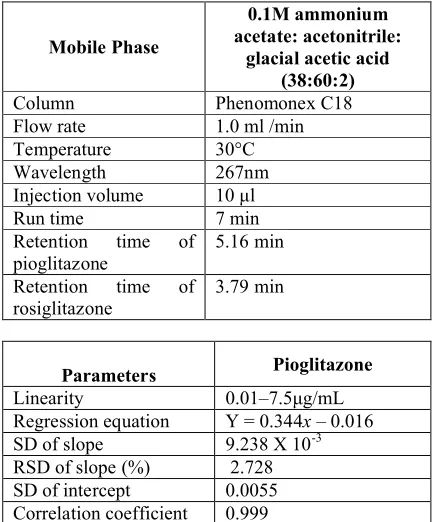
After carrying out initial trials the stationery phase, mobile phase, flow rate, column temperature and wavelength of detection were optimised and the optimised method conditions are given in Table 1
Linearity
Linear detector response for the peak-area ratios of the pioglitazone to internal standard was observed in concentration range between 0.01 – 7.5 µg/mL. An aliquot
(10μl) of each solution was analyzed as described in
chromatographic conditions. Calibration curves were constructed by plotting the peak areas versus concentration and the regression equations were calculated. The results obtained are listed in the Table 2, and these results indicate that the current method is linear for pioglitazone in the range specified above with a correlation coefficients better than 0.999.
Table 1. Optimized method conditions and Table 2. Statistical data of calibration curves of pioglitazone in
spiked serum (n = 3)
Parameters Pioglitazone
Linearity 0.01–7.5μg/mL
Regression equation Y = 0.344x – 0.016 SD of slope 9.238 X 10⁻³ RSD of slope (%) 2.728 SD of intercept 0.0055 Correlation coefficient 0.999
Mobile Phase
0.1M ammonium acetate: acetonitrile:
glacial acetic acid (38:60:2)
Column Phenomonex C18
Flow rate 1.0 ml /min
Temperature 30°C
Wavelength 267nm
Injection volume 10 μl
Run time 7 min
Retention time of
pioglitazone 5.16 min Retention time of
Table 4. Stability of pioglitazone in serum samples
% stability by freeze thaw (-70º
C) 99.17 -105.14
% stability by auto injector
stability (18hr) (4°C) 98.03 -101.47 % stability by bench top
stability (8 hr)
102.11 -105.32
Figure 2: HPLC chromatogram of serum spiked with pioglitazone (5μgm/mL) and rosig;itazone (50μgm/mL)
Figure 3: Mean ± SD of plasma concentration-time curve of pioglitazone
Precision
The intraday and interday precision was evaluated with six sample replicate injections and the % RSD was within 15 %. The results of the method validation study for precision are presented in Table 3.
Accuracy
Accuracy measures the percentage deviation of nominal concentration as compared to the observed concentration. The accuracy values of the LLOQ, medium and high quality control samples of pioglitazone in serum were measured (n=3) and the mean of the concentrations was within the acceptable limits (i.e. 85 - 115 % of nominal concentrations). The results of the method validation study for accuracy are presented in Table 3.
Limit of Detection (LOD) and Limit of Quantitation (LOQ)
LOD and LOQ were experimentally verified by injection of pioglitazone at the appropriate concentrations. The LOD was
calculated to be 0.0044 μg/mL and LOQ was calculated to be 0.013μg/mL respectively. The results of the method validation study for Limit of Detection (LOD) and Limit of Quantitation (LOQ) are presented in Table 4.
Selectivity
The pioglitazone and rosiglitazone (IS) were well separated from the serum under the optimized chromatographic conditions at retention time of 5.16 and 3.79 min and the same was shown in the Figure. 2. The peaks were of good shape with good separation and there were no interferences from the serum matrix at the retention time of pioglitazone and rosiglitazone (IS).
0 0.2 0.4 0.6 0.8
0 10 20 30
co
nc
en
tr
at
io
n
(μ
g/
m
L
)
Time(hrs)
Table 3. Precision and Accuracy of method for determination of pioglitazone in Spiked serum
Pioglitazone Concentarionadded
µg mL-1
Concentration Observed
µg mL-1 RSD (%)* R.E(%)
Intraday Analysis 0.01 0.0112±0.00086 2.0 12.0
2.5 2.593± 0.333 12.86 3.72
7.5 8.446±0.146 1.725 12.88
Interday Analysis 0.01 0.0114±0.00039 3.25 14.0
2.5 2.605±0.226 7.012 5.25
7.5 7.89±0.43 5.454 5.2 * Coefficient of Variance (%) = S.D x 100/mean
Table 5. Limit of detection & limit of quantitation of RP-HPLC method for pioglitazone in rabbit serum
SI. No Parameters S.D Slope(b) Formula (µg/mL)Value
1 LOD 0.000391 0.344 3.3(S.D/slope) 0.0037
Extraction recovery
The proposed method (Mean percentage recovery ±SD) was found to be 96.38 ± 4.25 %. The internal standard % recovery was found to be 91.12 ± 3.12 %. The above values show that the extraction efficiency of the method was consistent.
Stability
The stability of the drug samples spiked at two QC levels (LQC, HQC) from auto injector (18 hr), bench top (8 hr) and freeze thaw (3 cycles) were evaluated. The results given in Table 5 showed that pioglitazone was stable in serum in the following conditions.
Application to pharmacokinetic study
The average serum concentration-time profile of pioglitazone after administration of a single dose 30mg of pure drug to 4 rabbits is shown in Figure 3. The following pharmacokinetic parameters (mean ± SD) were calculated for pioglitazone:
Cmax = 1.0266±0.0232 μg/mL, AUCtotal= 8.1645±0.4234 μg h/mL, Tmax =2hrs, elimination half-life (t1/2) = 8.285±0.7852 h. The observed values of pharmacokinetic parameters were comparable to those reported in previous studies [14].
DISCUSSION
This study presents the optimisation and validation of simple HPLC – DAD method for the determination of pioglitazone in rabbit serum and application of the method to pharmacokinetic studies. Methanol and acetonitrile in different ratios were used as mobile phase. As the concentration of acetonitrile was increased, the retention time of pioglitazone was reduced and peak shape has improved. Further optimisation was done with acetonitrile in combination with a buffer. 0.1M Ammonium acetate was found to reduce the baseline drift and noise and improve the sensitivity. The mobile phase was optimised to 0.1M ammonium acetate: acetonitrile: glacial aceticacid in a ratio of 38:60:2 (v/v/v) after using combinations of different solvents and buffers in different ratios. The optimised mobile phase is aqueous in nature and hence the method is more economical.
The run time of this method is very short i.e 7 min when compared to the reported methods [5,6] where the runtimes were about 20 min. The reduced retention times have two advantages firstly, the solvent consumption is decreased and thereby the cost of the method is reduced secondly, multiple determinations can be carried out in a short time. Though some reported methods have shorter run times comparable to this method the sensitivity of this method is comparatively higher[7,10,11]. Sensitive LC–MS methods are also reported for the determination of pioglitazone in plasma with lower quantitation limits but the cost of estimations were found to be very high[8,9]. Good sample recovery and minimising interfering substances from the matrices is a great challenge in the bioanalytical method development. Protein precipitation with methanol has produced good separation
and resolution of the chromatographic peaks without interferences from matrices and with good percent recoveries. All calibration curves were found to be linear with correlation coefficient greater than 0.999. Moreover, the method showed excellent accuracy, precision, selectivity, stability and reproducibility for determination of pioglitazone in rabbit serum. The pharmacokinetic parameters calculated using the developed method were found to be in agreement with the reported values [14].
CONCLUSION
The new HPLC method developed and validated for the determination of pioglitazone in rabbit serum assured the satisfactory precision and accuracy and is very sensitive allowing multiple determinations in a very short time. The method was found to be simple, accurate, stable and economical, so can be applied for routine analysis in laboratories for the pharmacokinetic studies.
ACKNOWLEDGEMENTS
The authors are grateful to M/s Mylan laboratories ltd., Hyderabad for supplying gift samples of pioglitazone and rosiglitazone.
REFERENCES:
1. Budavari S. The Merck Index., ed. Merck and Co Inc., 13th ed., Whitehouse Station (NJ), 1997, pp. 7537-7541.
2. J. Chilcott, P. Tappenden, M.L. Jones, and J.P. Wight. A systematic review of the clinical effectiveness of pioglitazone in the treatment of type 2 diabetes mellitus. Clin. Ther. 23: 1792–1823 (2001).
3. J.M. Lehmann, T.A. Smith-Oliver, W.O. Wilkison, S.A. Kliewer. An antidibetic thiazolidinedione is a high affinity ligand for peroxisome roliferator-activated receptor gamma (PPAR gamma). J. Biol. Chem. 270: 12953–56 (1995).
4. D.A. Eckland and M. Danhof. Clinical pharmacokinetics of pioglitazaone. Exp. Clin. Endocrinol. Diabetes 108: 234–42 (2000).
5. W.Z. Zhong and M.G. Willams. Simultaneous quantitation of pioglitazone and its metabolites in human serum by liquid chromatography and solid phase extraction. J. Pharm. Biomed. Anal. 14: 465– 73 (1996).
6. K. Yamashita, H. and Motohashi. High performance liquid chromatographic determination of pioglitazone and its metabolites in human serum and urine. J. Chromatogr. B 677: 141–46 (1996).
7. Sripalakit,Neamhom, High performance liquid chromatographic method for the determination of pioglitazone in human plasma using ultraviolet detection and its application to a pharmacokinetic study. J. Chromatogr. B 843:164–69 (2006).
9. Y.J. Xue, K.C. Turner, J.B. Meeker, J. Pursley, M. Arnold, and S. Unger. Quantitative determination of pioglitazone in human serum by direct-injection high-performance liquid chromatography mass spectrometry and its application to a bioequivalence study.J. Chromatogr. B 795: 215–26 (2003).
10. Effat Souri1, Hassan Jalalizadeh, and Shahrooz Saremi. Development and validation of a simple and rapid HPLC method for determination of pioglitazone in human plasma and its application to a pharmacokinetic study. J. of Chromatogr. Sci. Vol. 46, 809-12(2008)
11. CH Ravikanth, A Anil Kumar,V Uday Kiran, Sensitive and Rapid HPLC Method for the Determination of Pioglitazone in Rat Serum. Int. J. of Pharm.Sci. and Drug Research. 3(1): 38-41( 2011)
12. ICH Topic Q2A, Validation of Analytical Methods: Definitions and Terminology, Step 5, CPMP/ICH/381/95.
13. ICH Topic Q2B, Validation of Analytical Procedures: Methodology, Step 4, CPMP/ICH/281/95.
14. H.Wong, Y. Ozalp, In vivo bioequivalence of oral antidiabetic agents: pioglitazone tablets. Arzneimittelforschung. 54: 618–24 (2004)
How to cite this article:
Sandhya Mamindla*, Prasad K.V.S.R.G, Bharathi Koganti, Development and validation of a new sensitive and rapid HPLC method for determination of pioglitazone in rabbit serum and its application in pharmacokinetic
studies, 6 (4): 2991 – 2996 (2016)