MHD FREE CONVECTIVE FLUCTUATING FLOW THROUGH A
POROUS EFFECT WITH VARIABLE PERMEABILITY
PARAMETER
A. K. Gupta*
Department of Applied Mathematics, Geater Noida Institute Technology, Plote 7, Knowledge Park II, Greater Noida, G B Nagar U.P. -201308, India
C.L. Varshney and Sajjan Lal
Department of Mathematics, Shri Varshney College, Aligarh, U.P.-202001, India
*Corresponding Author
(Received: November 17, 2009 – Accepted in Revised Form: March 11, 2010)
Abstract In the present paper, we have studied MHD free convective two dimensional unsteady viscous incompressible flows through a porous effect bounded by an infinite vertical porous plate with constant suction. The permeability of the porous medium fluctuates in time about a constant mean, and the viscosity of fluid is assumed to vary as a linear function of temperature. The flow is permitted under the influence of a uniform transverse magnetic field, whereas the induced magnetic field has little effect on the flow and can be neglected. The governing equations are solved by perturbation technique based on computer extended series solution.
Keywords Free convection, Mathematical model, Permeability parameter, Hartmann number, Magneto- hydrodynamics, Porous medium.
ﮑﭼ
ﻴ
ﻩﺪ
ﺮﺟ،ﺮﺿﺎﺣﻪﻟﺎﻘﻣﺭﺩ ﻳ
ﺎﻫﻥﺎ ﻱ ﺬﭘﺎﻧﻢﮐﺍﺮﺗ ﻳ ﻭﺮ ﻳ ﻏﺯﻮﮑﺴ ﻴﺮ ﻳ ﺪﻌﺑﻭﺩﺖﺧﺍﻮﻨﮑ ﻱ
ﺎﺠﺑﺎﺟ ﻲﻳ ﺩﺍﺯﺁ MHD ﻣﺯﺍ ﻴ ﻥﺎ
ﻳ ﺪﻨﺑﺯﺮﻣﺬﻔﻨﻣﮏ ﻱ
ﺩﻮﻤﻋﺭﺍﺩﺬﻔﻨﻣﻪﺤﻔﺻﺎﺑﻩﺪﺷ ﻱ
ﺑ ﻲ ﺎﻬﻧ ﻳ ﺖﺳﺍﻪﺘﻓﺮﮔﺭﺍﺮﻗﻪﻌﻟﺎﻄﻣﺩﺭﻮﻣﺖﺑﺎﺛﺶﮑﻣﺎﺑﺖ
.
ﺽﺮﻓ
ﺬﭘﺫﻮﻔﻧ ﻪﮐﺖﺳﺍ ﻩﺪﺷ ﻳﺮ
ﻱ ﺎﻫ ﻥﺎﺳﻮﻧ ﻱ ﺤﻣ ﻴ ﺘﻣ ﺖﺑﺎﺛ ﺩﻭﺪﺣﺭﺩ ﻥﺎﻣﺯﺭﺩﻞﺨﻠﺨﺘﻣ ﻂ ﻭ ﻭﻂﺳﻮ
ﻳ ﺯﻮﮑﺴ ﻳ ﺳ ﻪﺘ ﻴ ﻪﺑ ﻝﺎ
ﻌﺑﺎﺗ ﺕﺭﻮﺻ ﻲ
ﻐﺗﺎﻣﺩ ﺯﺍ ﻴﻴ ﻣ ﺮ ﻲ ﺪﻨﮐ
.
ﺮﺟ ﻳ ﺛﺎﺗ ﺖﺤﺗ ﻥﺎ ﻴ
ﺮ ﻳ
ﻣ ﮏ
ﻴ ﻃﺎﻨﻐﻣ ﻥﺍﺪ ﻴ ﺴ ﻲ ﻊﻃﺎﻘﺘﻣ ﻳ ،ﺖﺳﺍ ﺯﺎﺠﻣ ﺖﺧﺍﻮﻨﮑ
ﺎﺟ ﻴﻳ ﻣﻪﮑ ﻴ ﻃﺎﻨﻐﻣﻥﺍﺪ ﻴ ﺴ ﻲ ﺮﺘﻤﮐ ﺮﺛﺍﻩﺪﺷﺀﺎﻘﻟﺍ ﻱ
ﻭﺭ ﻱ ﺮﺟ ﻳ ﻣﻭﺩﺭﺍﺩﻥﺎ ﻲ
ﺷﻮﭘﻢﺸﭼ ﺪﻧﺍﻮﺗ ﻲ
ﺩﻮﺷ
.
ﻢﮐﺎﺣﺕﻻﺩﺎﻌﻣ
ﺎﭘﺮﺑﻝﻼﺘﺧﺍﺵﻭﺭﻂﺳﻮﺗ ﻳ
ﺎﻫﻞﺣﻪ ﻱ ﺮﺳ ﻱ ﻂﺴﺑ ﻳ ﮐﻪﺘﻓﺎ ﭙﻣﺎ ﻴ ﺮﺗﻮ ﻱ ﺖﺳﺍﻩﺪﺷﻞﺣ
.
1.
INTRODUCTIONThe study of MHD free convective flow through a porous medium has become a principal interest in recent years because of its numerous scientific and engineering applications, viz in the fields of agricultural engineering, biomedical engineering, reservoir engineering to study the underground water resources; petroleum technology, geophysics to study the movements of natural gas, oil and water reservoirs, in chemical engineering for filtration and purification process. In recent years, the problems of MHD free convection flow through a porous medium have attracted the attention of researchers working on several geophysical problems. The study of
magneto-hydrodynamics plays an important role in the engineering industries. It has resulted in an unabated exploration of new ideas and avenues in harnessing various convectional energy sources like tidal weir wind power and geothermal energy. Many researchers have worked on MHD convective fluctuating flows. Heuer et al. [1] studied the influence of production rate, permeability variation and wall spacing on solution gas drive performance. Beavers et al. [2] investigated boundary conditions at the naturally permeable wall. They suggested a boundary condition of the form 1
1 2
u k u u
n
α
∂ − =
velocity inside the porous medium in the stream-wise direction,
(
u
1n
∂
∂
)
is the velocity gradient ofthe stream-wise component along the normal to the surface drawn into the fluid, k is the permeability of the porous medium and α the dimensionless constant known as slip parameter believed depending upon the nature of the porous material. Only, Raptis et al. [3] studied the steady free convection flow through a porous medium bounded by an infinite porous plate subject to a constant suction and variable temperature. Singh et al. [4] investigated a free convection along a vertical wall in a porous medium with periodic permeability variation. They obtained analytical expressions for the velocity and temperature using the perturbation technique and showed that the results would be useful in the design of steam displacement process in oil recovery and different geothermal systems. Moreau [5] discussed magneto hydrodynamics for various flow. Shokouhmand and Sayehvand [6] investigated viscous incompressible flow and heat transfer in a square driven cavity was examined using the SIMPLER algorithm. It is shown that flow in the cavity at low Reynolds numbers follows a symmetric pattern while at higher Reynolds numbers, a thin boundary layer formed on the walls and an inviscid core region develops. Kim [7] has considered the case of a semi-infinite moving porous plate in a porous medium in the presence of pressure gradient and constant velocity in the flow direction when the magnetic field is imposed transverse to the plate.
Kumar et al. [8] investigated the unsteady two dimensional laminar flow of a viscous incompressible electrically conducting fluid past a semi-infinite vertical porous moving plate with periodic suction in the presence of transverse magnetic field. They are solutions of governing equations obtained by Perturbation Technique. Kumar et al. [9] studied the flow between annular spaces surrounded by rotating coaxial cylinder with coaxial cylindrical porous medium. Singh and Sharma [10] investigated the effect of periodic permeability on the free convective flow of viscous conducting fluid through highly porous medium. Mehmet et al. [11] studied a free convection flow about a cone under mixed thermal boundary
[23] investigated magneto hydrodynamic (MHD) flow of viscoelastic fluids in converging/diverging channels. Zanchini [28] investigated a mixed convection with variable viscosity in a vertical annulus with uniform wall temperatures. Avedissian et al. [25] investigated free convective heat transfer in an enclosure with an internal louvered blind. It is also study the effects of Rayleigh number, enclosure aspect ratio and blind geometry on the convective heat transfer. Pantokratoras [27] investigated a study of MHD boundary layer flow over a heated stretching sheet with viscosity. The results of this work are obtained with direct numerical solution of the boundary layer equations taking a count both viscosity and Prandtl number variation across the boundary layer. Mishra et al. [26] investigated a flow and heat transfer of an MHD viscous–elastic fluid in a channel with stretching walls.
Padmavathi and Amaranath [29] have considered the problem of general non axi-symmetric Stokes flow past a porous sphere in a viscous incompressible fluid. They have also considered the flow inside the sphere governed by Brinkman’s equation. Kumar and Pant [30] investigated the behaviour of steady flow of visco-elastic liquid between two porous coaxial circular cylinders, where both the cylinders are rotating with different uniform angular velocities about the common axis. Qin, et al [35] have considered a thermal instability problem in a rotating micro polar fluid. It is found that, the rotation has a stabilizing effect depending upon the values of various micro polar parameters and low values of Taylor number.
Rahimi and Jalili [31] considered a transient free convection flow around a sphere with variable surface temperature and embedded in a porous medium. Rena and Rana [32] profounded a theoretical study of the thermal instability of thin layer electrically conducting micro-polar rotating fluid, heated from below in the presence of uniform magnetic field in the porous medium. Mansour et al. [35] investigated analytical studies on MHD flow of a micro polar fluid due to heat and mass transfer through a porous medium bounded by an infinite vertical porous plate in the presence of a transverse magnetic field in slip-flow regime. Kumar et al. [33] investigated the combined wall slip and MHD steady flow of conducting viscous incompressible fluid through a
channel with permeable boundaries. It is disclose that the fluid velocity is reduced by magnetic field and wall slip. Kumar et al. [34] studied a total dispersion tensor in two dimensional packed beds consisting of randomly placed parallel cylinders for porosities between 38% to 90% Pecklet numbers up to 100 and Reynolds numbers up to 20 based on the cylindrical diameter. Mahdy [42] investigated the magneto-hydrodynamic (MHD) free convection flow of a non-Newtonian power-law fluid over a vertical wavy surface with a uniform free-stream of constant velocity and temperature. Asadi et al. [37] developed rising of a single bubble in a quiescent liquid which under microgravity condition was simulated. They related to unsteady incompressible full Navier-Stokes equations which were solved using a conventional finite difference method with a structured staggered grid. Kumar et al. [38] studied the distribution of transverse velocity which was not symmetrical and for non- Newtonian fluid, large recirculation occured at upper disc in comparison with the recirculation at lower disc on increasing value of Reynolds number. Makinde et al. [39] developed a steady, axi-symmetric, magneto hydrodynamic (MHD) flow of a viscous, Newtonian, incompressible, electrically-conducting fluid through an isotropic, homogenous porous medium located in the annular zone between two concentric rotating cylinders in the presence of a radial magnetic field. Khedr et al.[40] considered a steady, laminar, MHD flow of a micro polar fluid past a stretched semi-infinite, vertical and permeable surface in the presence of temperature dependent heat generation or absorption, magnetic field and thermal radiation effects. Kumar et al. [41] studied a MHD three dimensional free convective flow of viscous incompressible fluid through a porous medium. They are solutions of governing equations obtained by Finite difference technique.
2. MATHEMATICAL MODEL AND ANALYSIS:
In the present investigation, we are considering the flow of viscous incompressible fluid in the magnetic effects through a porous medium bounded by an infinite vertical plate with constant suction. The plate is taken in the upward direction along the x*-axis and y*-axis which is taken normal to the plate. The induced magnetic field is neglected. The effects of magnetic field is to control the fluid flow. All the fluid properties are assumed constant expect the influences of the density variation with temperature which are considered only in the body forces terms.
Let the permeability of the porous medium fluctuate under the law:
( )
(
∗∗)
+
=
∗∗
∗ i t
e
K
t
K
01
ε
ω,
(1)where
,
K0*,ω*,t*andε
are the mean permeability of the medium, frequency of fluctuation, time and very small constant quantity, respectively.The flow through a porous medium in the magnetic effects is governed by the following equations:
0
*
*
=
∂
∂
y
v
,
(2)
2 2
* 0
2
* *
*
* *
* *
( * ) *
* * ( *)
u u v t y
B u u
g T T u
y K t
σ υ
β υ
ρ ∞
∂ + ∂ =
∂ ∂
∂
− + − −
∂
,
(3)2
2
*
*
*
*
*
*
p*
T
T
k
T
v
t
y
ρ
C
y
∂
+
∂
=
∂
∂
∂
∂
,
(4)where u
*
and v*
be the velocity components in the direction of x*
and y*
axes ,, ,
, , ,
g
β ν
µ
µ
k
ρ
ρ
=
andC
P areacceleration due to gravity, coefficient of volume expansion, kinematic viscosity, viscosity, thermal conductivity, density and specific heat of the fluidat constant pressure, respectively. In order to complete the formulation of the problem the boundary conditions were specified as:
=
=
→
=
=
∗
=
∗
∞ ∗
*
*
,
0
*
;
0
*
*
,
0
;
0
T
T
u
y
T
T
u
y
ω(5)
where
,
T
ω* andT
∞* arethe temperature of the plate and the temperature of the fluid, respectively far away from the plate at constant pressure in the free stream.Now, integrating equation (2), we get
v
v
*
=
−
,
(6) where, v is a positive constant and negative sign represents that the suction is towards the plate. The following dimensionless variables are introduced as:2
* *
2 * *
*
*
,
,
4
*
4
*
,
,
y
v
t
v
y
t
T
T
u
u
v
v
T
ωT
υ
υ
ω υ
ω
θ
∞∞
=
=
−
=
=
=
−
.
Using these non-dimensional variables, the equations (3) and (4) becomes:
2
2 0
1
4
(1
i t)
u
u
t
y
u
u
G
M u
y
K
e
ωθ
ε
∂
−
∂
=
∂
∂
∂
+
−
−
∂
+
,
(7)2
2
1
4
1
y
P
y
t
r∂
∂
=
∂
∂
−
∂
∂
θ
θ
θ
,
(8)where
,
2* *
)
(
v
T
T
g
G
=
υβ
ω−
∞,
Grashoffnumber
k
C
P
Pr
µ
=
,
Prandtlnumber2 2 0 * 0
0
υ
v
K
and 2 0 2 0
v
B
M
=
σ
υ
,
Hartmannnumber.
The reduced boundary conditions are as follows:
0
,
0
;
0
1
,
0
;
0
=
=
→
=
=
=
θ
θ
u
y
u
y
(9)
In order to solve equations (7) and (8), we assume velocity and temperature as:
...
)
(
)
(
)
,
(
y
t
=
u
0y
+
e
u
1y
+
u
ε
iωt,
(10)...
)
(
)
(
)
,
(
y
t
=
θ
0y
+
ε
e
i tθ
1y
+
θ
ω,
(11)Substituting all these values of the equations (10) and (11) into equations (7) and (8) and equating harmonic and non-harmonic terms, we get
0 0 0 0 0
1
'
'
'
M
u
G
θ
K
u
u
=
−
+
−
+
,
(12)1 0 0 1 0 ' 1 '' 1
1
4
θ
ω
G
K
u
u
M
K
i
u
u
=
−
−
+
+
−
+
,
(13)0
' 0 ''0
+
θ
=
θ
P
r,
(14)0
4
1 '1 ''
1
+
−
θ
=
ω
θ
θ
r rP
i
P
,
(15)where, the primes represent differentiation with respect to y.
The corresponding boundary conditions are reduced as:
=
=
=
=
∞
→
=
=
=
=
=
0
,
0
,
0
,
0
;
0
,
1
,
0
,
0
;
0
1 0 1 0 1 0 1 0θ
θ
θ
θ
u
u
y
u
u
y
(16)
Solving equations (12) to (15) by using boundary conditions (16), we get
)
(
)
(
1 0 y P y r R re
e
P
G
y
u
=
−−
−,
(17)(
2 1)
(
2)
1 0 ( ) 4 1 4 r R R
r y r y r y P y
u y
G i
e e e e
i K P ω P ω
− − − − = − − − −
,
(18)y Pr
e
y
)
=
−(
0
θ
,
(19)0
)
(
1y
=
θ
,
(20)where
2 0 1 2 1 2 0 1 2 0
1
1
4
1
1
4
2
1
4
1
1
4
2
R r r
P
P
P
M
K
r
M
and r
K
M
i
K
ω
=
− −
−
=
+ +
+
=
+
+
+
+
.
Thus, equations (10) and (11) become:
(
1)
(
2 1)
(
2)
0
( , )
4 1
4
r r
r y P y r y r y r y P y i t
R
R
u y t
G i
e e e e e e e
i
P K P
ω ε ω ω − − − − − − = − + − − − − (21) y Pr
e
t
y
,
)
=
−(
θ
,
(22)The velocity profiles can be written in terms of fluctuating parts as:
)
sin
cos
(
)
(
)
,
(
y
t
u
0y
M
t
M
t
u
=
+
ε
rω
−
iω
, (23)where,
u
1(
y
)
=
M
r+
iM
i.
The fluctuating parts are given by
(
) (
)
+
−
−
−
=
− − − − 2 2 016
4
4
2 1 2 R y P y r y r y r R iP
e
e
e
e
P
K
G
M
rω
ω
ω
Thus
,
the expression for the transient velocity for,
2
π
ω
t
=
,
is given byi
M
y
u
y
u
(
,
π
2
ω
)
=
0(
)
−
ε
,
(24) The expression for skin friction at the plate in terms of phase and amplitude isgiven(
)
0
1
|
| cos(
)
y r Ru
y
G
P
r
N
t
P
τ
ε
ω α
=
∂
=
=
∂
− +
+
,
(25)where
,
(
2)
1 2
2 2 0
4 (
)
4
16
R r r i R Ri
P
P
r
i r
r
G
B
iB
K P
P
ω
ω
ω
+
−
−
+
=
−
+
,
r iB
B
=
α
tan
and
N
=
±
B
i2+
B
r2The expression for phase and amplitude is given by
(
)(
)
(
)
22 1 2 2 2 1 2 2 0 16 16 2 r r P r r P r P P K G N R r r R − + + − + − − = ω ω
,
(
)
(
)
(
+
)
−
−
−
−
+
−
=
1 2 2 222 2
16
4
4
16
2
tan
R r r R RP
r
P
r
r
r
P
P
P
ω
ω
ω
ω
α
3. RESULTS AND DISCUSSIONS:
To discuss the physical importance of the problems like velocity profiles and skin friction coefficient, various values of parameter were chosen. The
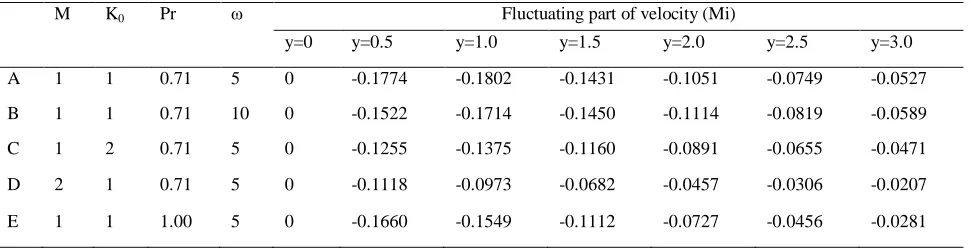
effects of various parameters on fluctuating parts Mr and Mi of velocity profiles are shown in Tables 1 and 2 and also depicted in Figures 1 and 2, respectively. Table 1 and Figure 1 clearly show that by increasing Hartmann number M and frequency ω, the fluctuating part Mr decreases. Also, the flow decelerates with an increase in Hartmann number and the frequency whereas, an increase in permeability parameter K0 and Prandtl number Pr, enhance the fluctuating part which clearly interpret that they help to accelerate the flow. On the other hand, the fluctuating part Mi increases with an increase in Hartmann number M , permeability parameter K0 and Prandtl number Pr. The obtained results also depict that an increase in ω with the condition of (y<1.5) cause an increase in Mi, but; an increase in ω with the condition of (y>1.5) decrease Mi.
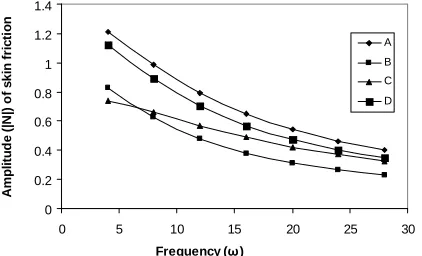
Similarly, Tables 3 and 4 and Figures 3 and 4 show the variations of skin friction amplitude (|N|) and phase (
tan
α
) with the variations of Hartmann number (M), Permeability parameter (K0), Prandtl number (Pr) and frequency (ω). From Table 3 and Figure 3, it is evident that |N| decreases when M, K0 and Pr increase, whereas Table 4 and Figure 4 show thattan
α
diminishes when K0, Pr and ω increase. Also, an increase in Hartmann number results to an increase in the skin friction phase. The professional form the chemical industry may be interested to evaluate this limit of K, M and Gr for the fluid. They are using these values dependent on characteristics of the fluid. It is hope that present work will be helpful for understanding more complex problems involving the various physical effects which is investigated in the present problems. 0 0.05 0.1 0.15 0.2 0.25 0.30 1 2 3 4
y Flu c tu a tin g p a rt ( M r) o f th e ve lo c it y p ro fil e A B C D E
-0.2 -0.18 -0.16 -0.14 -0.12 -0.1 -0.08 -0.06 -0.04 -0.02 0
0 0.5 1 1.5 2 2.5 3 3.5
y
F
lu
c
tu
a
ti
n
g
p
a
rt
(
M
i)
of
t
h
e
v
e
lo
c
it
y
p
ro
fil
e
A B C D E
Figure 2. Fluctuating part (Mi) of velocity profiles at G=5 and ε = 0.2
0 0.2 0.4 0.6 0.8 1 1.2 1.4
0 5 10 15 20 25 30
Frequency (ω)
A
m
pli
tu
d
e
(
|N
|)
o
f
s
k
in
fr
ic
ti
on
A B C D
Figure 3. The amplitude of the skin friction at G=5 and
ε = 0.2
-2.5 -2 -1.5 -1 -0.5 0
0 5 10 15 20 25 30
Frequency (ω)
P
h
a
s
e
(t
an
α
)
o
f
S
k
in
F
ri
c
ti
on
A B C D
Figure 4. The phase of the skin friction at G=5 and ε = 0.2
4. CONCLUSION
The results in the present analysis demonstrate the theoretical evidence to support the field and laboratory observations showing an increase in permeability with magnetic effects of results in velocity profiles and skin friction. Tables and figures show the effects of permeability, Hartmann number and Prandtl number on the velocity and the skin friction, amplitude and phase. With regard to the applications of this analysis, they are to a steam injection process for enhancing oil recovery or to a geothermal process, chemical process. In the near future, we would be glad to compare these theoretical results with those obtained by any one in the same field.
NOMENCLATURE:
0
K
:
Permeabilityparameter Pr : Prandtl numberG : Grashoff number M : Hartmann number T : Temperature
P
C
: Specific heat of the fluidu : Velocity component along x-axis v : Velocity component along y-axis
θ
:
Dimensionless temperature ratioκ
:
Thermal conductivityμ
:
Dynamic viscosityν
:
Kinematic viscosityβ
:
Coefficient of volume expansionρ
:
Density of the fluidT
w:
Temperature of the plateT
∞:
Temperature of the fluidτ
: Skin Friction
ω
: FrequencyTable 1. Fluctuating part (Mr) of the velocity profile for different parameters
M K0 Pr ω
Fluctuating part of velocity (Mr)
y=0 y=0.5 y=1.0 y=1.5 y=2.0 y=2.5 y=3.0
A 1 1 0.71 5 0 0.2419 0.2640 0.2220 0.1700 0.1248 0.0897
B 1 1 0.71 10 0 0.1666 0.1719 0.1388 0.1033 0.0745 0.0529
C 1 2 0.71 5 0 0.1651 0.1828 0.1533 0.1200 0.0886 0.0639
D 2 1 0.71 5 0 0.1437 0.1526 0.1257 0.0949 0.0690 0.0493
E 1 1 1.00 5 0 0.1945 0.1939 0.1472 0.1008 0.0657 0.0416
Table 2. Fluctuating part (Mi) of the velocity profile for different parameters
M K0 Pr ω Fluctuating part of velocity (Mi)
y=0 y=0.5 y=1.0 y=1.5 y=2.0 y=2.5 y=3.0
A 1 1 0.71 5 0 -0.1774 -0.1802 -0.1431 -0.1051 -0.0749 -0.0527
B 1 1 0.71 10 0 -0.1522 -0.1714 -0.1450 -0.1114 -0.0819 -0.0589
C 1 2 0.71 5 0 -0.1255 -0.1375 -0.1160 -0.0891 -0.0655 -0.0471
D 2 1 0.71 5 0 -0.1118 -0.0973 -0.0682 -0.0457 -0.0306 -0.0207
E 1 1 1.00 5 0 -0.1660 -0.1549 -0.1112 -0.0727 -0.0456 -0.0281
Table 3. Amplitude
(|N|)
ofskin friction for different parameters M K0 Pr Amplitude (|N|) of skin frictionω=4 ω=8 ω=12 ω=16 ω=20 ω=24 ω=28
A 1 1 0.71 1.2094 0.9873 0.7921 0.6472 0.5418 0.4636 0.4040
B 1 2 0.71 0.8271 0.6252 0.4779 0.3800 0.3131 0.2653 0.2298
C 2 1 0.71 0.7404 0.6594 0.5689 0.4883 0.4222 0.3692 0.3265
Table4.Phase
(
tan
α
)
ofskinfrictionfordifferentparameters M K0 Pr Phase (tan
α
) of skin frictionω=4 ω=8 ω=12 ω=16 Ω=20 ω=24 ω=28
A 1 1 0.71 -0.3831 -0.7333 -1.0405 -1.3095 -1.5477 -1.7616 -1.9563
B 1 2 0.71 -0.4892 -0.9156 -1.2755 -1.5779 -1.8831 -2.0792 -2.2929
C 2 1 0.71 -0.2668 -0.5214 -0.7571 -0.9725 -1.1692 -1.3494 -1.5156
D 1 1 1.00 -0.4155 -0.7828 -1.0918 -1.3529 -1.5778 -1.7756 -1.9528
5. ACKNOWLEDGEMENTS
Authors are grateful to
Geater Noida Institute
Technology
Greater Noida affiliated to UP technical University, Lucknow (Uttar Pradesh), India and Shri Varshney College Aligarh, affiliated to Dr. Bhim Rao Ambedkar University, Agra (Uttar Pradesh), India, for providing facilities and encouragement to complete this work. Also the corresponding authors are thankful to the learned referees for their fruitful suggestions for improving the presentation of this work. The corresponding author would like to thanks Ridansh, Siddika and Smt. Namita Varshney for providing emotional happiness during this research work.6. REFERENCES
1. Heuer, G.J., Clark, G.C. and Dew, J.N., The influence of production rate, permeability variation and well spacing on solution gas drive performance, Trans. AIME, Vol.222, (1961), 469-482.
2. Beavers, G.S. and Joseph, D.D., The boundary conditions are a naturally permeable wall, Journal of Fluid Mechanics, Vol. 30, (1967), 197- 211.
3. Raptis, A., Unsteady free convection flow through a porous medium, International Journal of Engineering and Science, Vol. 21, (1983) 345-348.
4. Singh, P., Misra, J.K. and Narayan, K.A., Free convection along a vertical wall in a porous medium with periodic permeability variation, International Journal for Numerical and Analytical Methods in Geo-mechanics, Vol. 13, (1989), 443-450.
5. Moreau, R., Magnetohydrodynamics, Kluwer Academic Publishers, Dordrecht (1990).
6. Shokouhmand H. and Sayehvand H., Numerical study of flow and heat transfer in square driven cavity,
International Journal of Engineering, Vol. 17, No. 3, (2004), 301-317
7. Kim, Y.J., Unsteady MHD convective heat transfer past a semi-infinite vertical porous moving plate with variable suction, International Journal of Engineering and Science, Vol. 38, (2000), 833-841.
8. Kumar, Anil; Sharma, G.C. and Jain, M., An unsteady MHD convective heat transfer past with periodic suction vertical porous wall, International Journal of Applied Science and Computation, vol. 9, (2002), 80-89. 9. Kumar, Anil; Sharma, G.C. and Jain, M., The flow
between annular space surrounded by rotating coaxial cylinder with coaxial cylindrical porous medium,
National Conference Proceedings on 67th, Indian Mathematical Society, Deptt. Of Mathematics, AMU, Aligarh, (2002), 67-78.
10. Singh, K.D. and Sharma, R., Three dimensional free convective flow and heat transfer through a porous medium with periodic permeability, Indian Journal of Pure and Applied Mathematics, Vol. 33(6), (2002), 941-949.
11. Mehmet, C.E., Free convection flow about a cone under mixed thermal boundary conditions and a magnetic field,
Applied Mathematical Modelling, Vol. 29, (2005), 1121-1134.
12. Emad, M.; Eldahab, A. and Aziz, M.A.E., Viscous dissipation and Joule heating effects on MHD free convection from a vertical plate with power-law variation in surface temperature in the presence of Hall and ion-slip currents, Applied Mathematical Modelling, Vol. 29, (2005), 579-595.
13. Smolentsev, S. and Abdou, M., Open-surface MHD flows over a curved wall in the 3-D thin-shear-layer approximation, Applied Mathematical Modelling, Vol. 29, (2005), 215-234.
14. Mukhopadhyay, S.; Layek, G.C. and Samad, S.A., Study of MHD boundary layer flow over a heated stretching sheet with variable viscosity, International Journal of Heat Mass Transfer, Vol. 48, (2005), 4460-4466. 15. Pantokratoras, A., The effect of viscous dissipation in
MHD flow of a generalised oldroyd-B fluid with modified Darcy’s law, International Journal of Engineering Science, Vol. 44, (2006), 333-339.
17. Xia, K. and Zhang, Z., Three dimensional finite/infinite elements analysis of fluid flow in porous media, Applied Mathematical Modelling, Vol. 30, (2006), 904-919. 18. Myers, T.G.; Charpin, J.P.F. and Tshehla, M.S., The flow
of a variable viscosity fluid between parallel plates with shear heating, Applied Mathematical Modelling, Vol. 30, (2006), 799-815.
19. Makinde, O.D. and Osalusi, E., MHD steady flow in a channel with slip at the permeable boundaries. Romanian Journal Physics, Vol. 51 (3-4), (2006), 319-328. 20. Kumar, Anil, Varshney, C.L .and Lal, S., Performance
modelling of porous medium flow, International Conference proceedings on IMST and UST, China, 55, (2007).
21. Kumar, Anil, Varshney, C.L. and Lal, S., Viscous flow coaxial cylinder in the presence of magnetic field’,
Proceedings of the 15th International Conference on Interdisciplinary Mathematical and Statistical Technique, , Shanghai, China, (2007).
22. Anderson, H.I. and Dahi, E.N., Gravity driven flow of a visco elastic liquid film along a vertical wall, Journal Physics D: Applied Physics, Vol. 32, (1999), 1557-1562. 23. Sadeghy, K.; Khabazi, N. and Taghavi, S.M.,
Magnetohydrodynamics (MHD) flow of viscoelastic fluids in converging/diverging channels, International Journal of Engineering Science, Vol. 45, (2007), 923-938.
24. Sekhar, T.V.S.; Sivakumar, R.; Kumar, H. and Ravikumar T.V.R., Effect of aligned magnetic field on the steady viscous flow past a circular cylinder, Applied Mathematical Modelling, Vol. 31, (2007), 130-139. 25. Avedissian, T. and Naylor, D., Free convective heat
transfer in an enclosure with an internal louvered blind,
International Journal of Heat and Mass Transfer, Vol. 51, (2008), 283-293.
26. Mishra, J.P., Shit, G.C. and Rath, H.J., ‘Flow and heat transfer of a MHD viscoelastic fluid in a channel with stretching walls’, Computers and Fluids, Vol. 37, No. 1, (2008), 1–11.
27. Pantokratoras, A., Study of MHD boundary layer flow over a heated stretching sheet with variable viscosity: A numerical investigation, International Journal of Heat and Mass Transfer, Vol. 51, (2008) 104-110.
28. Zanchini, E. (2008): Mixed convection with variable viscosity in a vertical annulus with uniform wall temperatures, International Journal of Heat and Mass Transfer, Vol. 51, (2008), 30-40.
29. Padmavathi, B.S. and Amaranath, T., The problem of general no axi-symmetric Stokes flow past a porous sphere in a viscous incompressible fluid, ZAMP, Vol. 44, (1993), 178-184.
30. Kumar, N. and Pant, A., A computational approach to the flow of walter’s liquid B’ through annulus of coaxial porous circular cylinders for high suction parameter,
International of Journal of Engineering, Vol. 22, No. 2, (2009), 119-124.
31. Rahimi, A.B. and Jalali, T., Unsteady free convection from a sphere in porous medium with variable surface temperature, International of Journal of Engineering, Vol. 18, No. 4, (2005), 1-20.
32. Reena and Rana U.S., Thermal convection of rotating micro-polar fluid in hydromegnetics saturating a porous medium, International of Journal of Engineering, Vol. 21, No. 4, (2008), 375-396.
33. Kumar, Anil, Varshney, C.L. and Lal, S., Finite difference technique for MHD steady flow through a channel with the permeable boundaries, Mathema the queen of sciences, Proceedings of National conference on applications of Mathematics in Science, Technology & Management, Department of Mathematics, SRM college of Eng. & Tech., Bareilly, (2008), 52-59. 34. Kumar, Anil, Varshney, C.L. and Lal, S., Analytical
study of effect of disorder on dispersion in steady inertial flows in porous effect, Scientific Research and Essay
Vol. 4(11), (2009), 1392-1402.
35. Qin, Y. and Kaloni, P.N., “A Thermal Instability Problem in a Rotating Micropolar Fluid”, Int. J. Engg. Sci., Vol. 30, (1992), 1117-1126.
36. Mansour, M. A. Mohamed, R. A., Abd-Elaziz, M. M. and Ahmed,S. E., Fluctuating Thermal and mass diffusion on unsteady MHD convection of a micro polar fluid through a porous medium past a vertical plate in slip flow regime,
Int. J. of Appl. Math and Mech., Vol. 3(3), (2007), 99-117.
37. Asadi B., Saidi M.H., Taeibi-Rahni M. and Ahmadi G., Computational simulation of hydrodynamic convection in rising bubble under microgravity condition,
International Journal of Engineering, Vol. 22, No. 3, (2009), 295-305.
38. Kumar, N. Pant A. and Singh R. R. K., Elastico-viscous flow between two rotating discs of different transpiration for high Reynolds number, International Journal of Engineering , Vol. 22, No. 2, (2009), 115-122.
39. Makinde O.D., Beg, O.A.and Takhar H.S., Magneto hydrodynamic viscous flow in a rotating porous medium cylindrical annulus with an applied radial magnetic field,
Int. J. of Appl. Math and Mech., Vol. 5 (6), (2009), 68-81, 2009.
40. Khedr, M.E.M., Chamkha, A. J. and Bayomi, M., MHD Flow of a Micropolar Fluid past a Stretched Permeable Surface with Heat Generation or Absorption, Nonlinear Analysis: Modelling and Control, Vol. 14, No. 1, (2009), 27–40.
41. Kumar, Anil, Varshney, C.L. and Lal, S., Finite difference technique for three-dimensional MHD flow a porous medium bounded by an infinite vertical porous plate, International Journal of Math. Sci. & Engg. Appls., Vol. 3, No. III, (2009), 233-244.
42. Mahdy, A., Mohamed, R.A., and Hady, F.M., Natural convection from a vertical wavy plate embedded in porous media for power law fluids in the presence of magnetic field. Int. J. of Appl. Math. and Mech..