INFLUENCE OF IRRIGATION WATER QUALITY ON SEDIMENT LOSS FROM FURROWS
R. D. Lentz, R. E. Sojka and D. L. Carter, Soil and Water Management Research Unit:, USDA Agricultural Research Service, Kimberly, ID
INTRODUCTION
Agricultural erosion research has focused on rainfall-induced soil loss, with comparatively little attention to furrow irrigation-induced erosion. One rationale for this is that rill erosion is mechanistically similar to erosion in irrigated furrows. However, significant differences exist between the two processes. These are related to soil conditions during initial stream advance, downstream flow rates, and chemical characteristics of the water stream. The salinity and sodicity of water in rills are low, owing to its atmospheric origin, whereas, irrigation water quality varies geographically and seasonally.
Few studies directed at irrigation-induced erosion have attempted to determine how irrigation water quality influences furrow erosion. Previous research suggests that water chemistry may influence both soil erodibility and stream erosiveness. Clay dispersion and aggregate breakdown were enhanced as "rain water" electrical conductivity (EC) decreased (Agassi et al., 1981) and/or sodium adsorption ratio (SAR) increased (Velasco-Molina et al., 1971). But, the dispersive effect of higher SARs was significantly depressed at high ECs (Velasco-Molina et al., 1971). Furrow surfaces become more erodible as clay dispersion increases and aggregate strength diminishes. These conditions also promote development of an impermeable depositional seal at the soil/water interface (Shainberg and Singer, 1985). Soils with <20% clay are most sensitive to seal formation (Ben-Hur et al., 1985). Southern Idaho's irrigated soils generally have low clay contents. In these soils, infiltration in irrigated furrows is largely controlled by deposition of slowly permeable surface seals (Brown et al., 1988; Segeren and Trout, 1991). Rapid formation of surface seals increases flow and, hence, stream erosiveness (at constant inflow rates).
We hypothesized that irrigation water quality would impact sediment loss in furrows via affects on soil cohesion and infiltration. Water with low EC, or high monovalent ion concentrations (high SAR) should promote dispersion and development of a slowly permeable surface seal. This would decrease infiltration and increase stream velocity. Higher stream velocities stimulate detachment and sediment transport processes and increase soil loss from furrows. In addition, these solutions should weaken soil aggregates and decrease the soil's resistance to shear. High-EC/low-SAR water would improve aggregate strength, promote flocculation and development of a more permeable surface seal, stabilize infiltration, and inhibit soil removal and transport processes. In 1991, we conducted a field study to test this hypothesis. This paper presents preliminary results from that investigation.
METHODS
The study was conducted near Kimberly, Idaho, on a 1.6 ha field of fallow Portneuf silt loam (coarse-silty, mixed, mesic, Durixerollic Calciorthids). Slope was 1%, furrow spacing was 0.76 m, and furrow length was 114 m. Four water quality treatments consisted of combinations of the following relative levels: low (0.5 dS m-') or high (2 dS m -') EC, and low (0.7) or high (12) SAR. Water chemistry of furrow streams was adjusted by injecting solutions of NaOH, CaC12, and NaC1 into inflows. The control treatment employed nontreated irrigation water and represented the low-EC/low-SAR water quality group.
Six experiments were run during the 1991 irrigation season. In each, four water quality treatments were applied to two furrow types (wheel track and nonwheel track). The eight treatment combinations were replicated three times in each experiment. Furrows in each experiment were given an initial irrigation and a single repeat irrigation 7-9 days later; thus 288 furrows were monitored in twelve irrigations from June through August. Inflow rate was 19 L min' for all irrigations except for the initial irrigation in the last three experiments; inflow was increased to 23 L min' during these irrigations to promote more rapid furrow stream advance across the drier surface soils in these plots. Runoff was measured using long-throated flumes installed at furrow outflows, and assessed sediment in tail-water samples using the Imhoff cone technique (Sojka et al., 1992).
Analysis of variance (ANOVA) followed by Waller-Duncan tests for mean separation (a = 0.05) were used to compare treatment effects. The error bars in treatment-comparison figures represent 95% confidence intervals.
RESULTS AND DISCUSSION
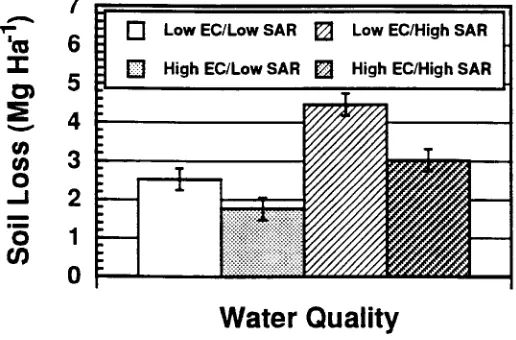
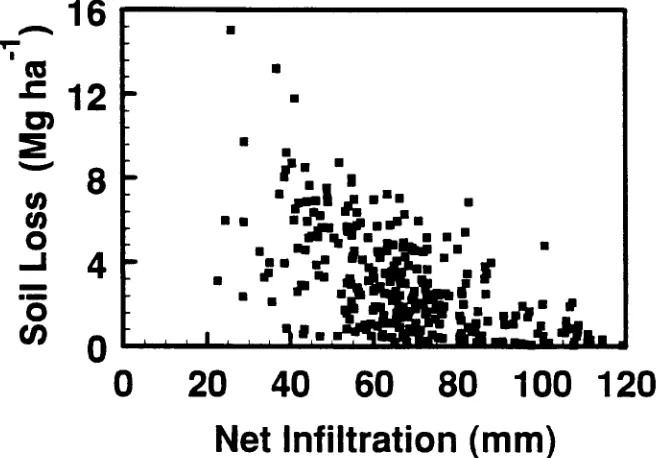
Note that net furrow infiltration, or intake, was greatest (Fig. 2) for those treatments that had the lowest soil losses (Fig. 1). These data suggest the possibility that an inverse relationship exists between intake and furrow erosion. The negative correlation between these factors became evident when all furrows were plotted as a function of net infiltration and soil loss (Fig. 3). The relationship was confirmed via an overall regression analysis (P < 0.001). This evidence supports our hypothesis that irrigation water quality influences furrow erosion through effects on stream erosivity, i.e. soil and aggregate dispersion promotes formation of an impermeable seal, which reduces furrow intake and increases stream velocity. In addition, the weakening of furrow aggregates and increased soil dispersion under low EC and/or high SAR conditions promoted entrainment of sediment in the furrow stream and contributed to increased soil loss.
:-Soil loss for a given treatment varied significantly depending on irrigation type (initial/repeat) and furrow type (nonwheel track/wheel track), but the relationship between water quality treatments remained the same as in the overall analysis. Soil kwaP--s for initial and repeat irrigations using 19 L min -1 inflows (Fig. 4) differed for each water quality
treatment, with greater furrow soil losses from repeat irrigations than from initial irrigations. Wetter soils in furrows during repeat irrigations adsorbed less water than soils in the initial irrigation (Table 1). The resulting runoff and stream velocity increase in the repeat furrows may account for the higher soil losses.
Soil losses from wheel- and nonwheel-track furrows (19 L min t inflows) are presented in Fig. 5. Again, the sediment-loss pattern among water quality treatments was the same for wheel- and nonwheel-track furrows, and identical to the overall analysis (Fig. 1). However, wheel-track furrows generally experienced greater sediment lossps than
nonwheel-track furrows. These compacted furrows had lower water intake. The resulting increase in furrow stream velocities magnified flow-induced erosion.
REFERENCES
Agasai, M., L Sheinberg, and J. Morin. 1981. Effect of electrolyte concentration and soil sodicity on the infiltration rate and crust formation. Soil Sci. Soc. Am. J. 45:848-851.
Ben-Hur, M., L Sheinberg, D. Bakker, and R. Keren. 1985. Effect of soil texture and CaCO, content on water infiltration in crusted soil as related to water salinity. Irrig. Sci. 6:281-294.
Segeren, A. G. and T. J. Trout. 1991. Hydraulic resistance of soil surface seals in irrigated furrows. Soil Sci. Soc. Am. J. 55:640646.
Sheinberg, L and M.J. Singer. 1985. Effect of Electrolytic Concentration on the Hydraulic Properties of Depositional Crust. Soil Sci. Soc. Am. J. 49:1260-1263.
7
,—..
,
'co
6
2
0)
2
U)
ca
0
_1 r
5 1 u)
0
5
4
3
2
q Low EC/Low SAR 0 Low EC/High SAR
O High EC/Low SAR q High EC/High SAR
Water Quality
q Low EC/Low SAR 0 Low EC/High SAR
O High EC/Low SAR 0 High EC/High SAR
Figure 1. Overall influence of water quality on furrow soil loss (mean of 72 furrows).
Water Quality
Figure 2. Overall influence of water quality onnet infiltration in furrows (mean of 72 furrows). E
E C 0
co .,..
4-..6
ti
z
120
100
80
60
40
20
'5
u)
10
0 Low EC/Low SAR 0 Low EC/High SAR
0 High EC/Low SAR 0 High EC/High SAR
2
0
Initial
Repeat
Water Quality
Figure 3. Relationship between net infiltration and sediment loss of all monitored furrows.
Net Infiltration (mm)
r . Figure 5. Furrow soil loss for furrow type and water quality treatment combinations with 19 L min' inflows (mean of fr..- 27 furrows).
Low EC/Low SAR
Low EC/High SAR
0 High EC/Low SAR 121 High EC/High SAR
07
2
O
•_