The Thirty-Third AAAI Conference on Artificial Intelligence (AAAI-19)
Ranking-Based Deep Cross-Modal Hashing
Xuanwu Liu,
1Guoxian Yu,
1,2∗Carlotta Domeniconi,
3Jun Wang,
1Yazhou Ren,
4Maozu Guo
51College of Computer and Information Sciences, Southwest University, Chongqing, China
2Hubei Key Laboratory of Intelligent Geo-Information Processing, China University of Geosciences, Wuhan, China 3Department of Computer Science, George Mason University, Fairfax, USA
4SMILE Lab, School of Computer Science and Engineering, University of Electronic Science and Technology of China, Chengdu, China
5School of Electrical and Information Engineering, Beijing University of Civil Engineering and Architecture, Beijing, China Email:{alxw1007,gxyu,kingjun}@swu.edu.cn, [email protected], [email protected], [email protected]
Abstract
Cross-modal hashing has been receiving increasing interests for its low storage cost and fast query speed in multi-modal data retrievals. However, most existing hashing methods are based on hand-crafted or raw level features of objects, which may not be optimally compatible with the coding process. Be-sides, these hashing methods are mainly designed to handle simple pairwise similarity. The complex multilevel ranking semantic structure of instances associated with multiple labels has not been well explored yet. In this paper, we propose a ranking-based deep cross-modal hashing approach (RDCMH). RDCMH firstly uses the feature and label information of data to derive a semi-supervised semantic ranking list. Next, to expand the semantic representation power of hand-crafted features, RDCMH integrates the semantic ranking informa-tion into deep cross-modal hashing and jointly optimizes the compatible parameters of deep feature representations and of hashing functions. Experiments on real multi-modal datasets show that RDCMH outperforms other competitive baselines and achieves the state-of-the-art performance in cross-modal retrieval applications.
Introduction
With the explosive growth of data, how to efficiently and ac-curately retrieve the required information from massive data becomes a hot research topic and has various applications. For example, in information retrieval, approximate nearest neighbor (ANN) search (Andoni and Indyk 2006) plays a fundamental role. Hashing has received increasing attention due to its low storage cost and fast retrieval speed for ANN search (Kulis and Grauman 2010). The main idea of hashing is to convert the high-dimensional data in the ambient space into binary codes in the low-dimensional Hamming space, while the proximity between data in the original space is preserved in the Hamming space(Wang et al. 2016; 2018; Shao et al. 2016). By using binary hash codes to represent the original data, the storage cost can be dramatically reduced. In addition, we can use hash codes to construct an index and achieve a constant or sub-linear time complexity for ANN
∗
Corresponding author: [email protected](Guoxian Yu) Copyright c2019, Association for the Advancement of Artificial Intelligence (www.aaai.org). All rights reserved.
search. Hence, hashing has become more and more popular for ANN search on large scale datasets.
In many applications, the data can have multi-modalities. For example, a web page can include not only a textual de-scription but also images and videos to illustrate its contents. These different types (views) of data are calledmulti-modal
data. With the rapid growth of multi-modal data in various applications, multi-modal hashing has recently been widely studied. Existing multi-modal hashing methods can be di-vided into two main categories: mutli-source hashing (MSH) and cross-modal hashing (CMH)(Zhu et al. 2013). The goal of MSH is to learn hash codes by utilizing all the infor-mation from multiple modalities. Hence, MSH requires all the modalities observed for all data points, including query points and those in the database. In practice, it is often diffi-cult or even infeasible to acquire all data points across all the modalities, as such the application of MSH is limited. On the contrary, the application scenarios of CMH are more flexible and practical. In CMH, the modality of a query point can be different from the modality of the points in the database. In addition, the query point typically has only one modality and the points in the database can have one or more modalities. For example, we can use text queries to retrieve images from the database, and we can also use image queries to retrieve texts from the database. Due to its wide application, CMH has attracted increasing attention (Kumar and Udupa 2011; Zhang and Li 2014).
codes learning as binary classification problems, and effi-ciently learns the hash functions using a boosting method. Co-regularized hashing (Yi and Yeung 2012) learns a group of hash functions for each bit of binary codes in every modal. Semantic correlation maximization (SCM) (Zhang and Li 2014) optimizes the hashing functions by maximizing the correlation between two modalities with respect to the seman-tic labels. Semanseman-tics Preserving Hashing (SePH)(Lin et al. 2017) generates one unified hash code for all observed views of any instance by considering the semantic consistency be-tween views.
Most supervised hashing are pairwise supervised meth-ods, which leverage labels of instances and pairwise labels of instance-pairs to train the coding functions, such that the label information can be preserved in the Hamming space (Chang et al. 2012). Their objectives, however, may be suboptimal for ANN search, because they do not fully explore the high-order ranking information (Song et al. 2015). For example, a triplet rank contains a query image, a positive image, and a negative image, where the positive image is more similar to the query image than the negative image (Lai et al. 2015). High-order ranking information carries relative similarity ordering in the triplets and provides richer supervision, it often can be more easily obtained than pairwise ranking. Some hashing meth-ods consider the high-order ranking information for hashing learning. For example, deep semantic ranking based hash-ing (Zhao et al. 2015) learns deep hash functions based on CNN (Convolutional neural network)(Krizhevsky, Sutskever, and Hinton 2012), which preserves the semantic structure of multi-label images. Simultaneous feature learning and hash coding (Lai et al. 2015) generates bitwise hash codes for images via a carefully designed deep architecture and uses a triplet ranking loss to preserve relative similarities.
However, these semantic ranking methods just consider one modality, and cannot apply to cross-modal retrieval. Be-sides, the ranking lists are just simply computed by the num-ber of shared labels, which could not preserve the integral ranking information of labels. Furthermore, the ranking lists adopted by these methods ask for sufficient labeled train-ing data, and cannot make use of abundant unlabeled data, whose multi-modal feature information can boost the cross-modal hashing performance. Semi-supervised hashing meth-ods were introduced to leverage both labeled and unlabeled samples (Wang, Kumar, and Chang 2012), but these methods cannot directly be applied on multi-modal data. Almost all these CMH methods are based on hand-crafted (or raw-level) features. One drawback of these hand-crafted feature based methods is that the feature extraction procedure is isolated from the hash-code learning procedure, or the original raw-level features can not reflect the semantic similarity between objects very well. The hand-crafted features might not be opti-mally compatible with the hash-code learning procedure(Cao et al. 2017). As a result, these CMH methods can not achieve satisfactory performance in real applications.
Recently, deep learning has also been utilized to perform feature learning from scratches with promising performance. Deep cross-modal hashing(DCMH)(Jiang and Li 2017) com-bines the deep feature learning with cross-modal retrieval and guides deep learning procedure with labels of
multi-modal objects. Correlation auto-encoder hashing (Cao et al. 2016) adopts deep learning for uni-modal hashing. Their studies show that the end-to-end deep learning architecture is more compatible for hashing learning. However, they still ask for sufficient label information of training data, and treat the parameters of the hash quantization layer and those of deep feature learning layers as the same, which may reduce the discriminative power of the quantification process.
In this paper, we propose a ranking-based deep cross-modal hashing (RDCMH), for cross-cross-modal retrieval applica-tions. RDCMH firstly uses the feature and label information of data to derive a semi-supervised semantic ranking list. Next, it integrates the semantic ranking information into deep cross-modal hashing and jointly optimizes the ranking loss and hashing codes functions to seek optimal parameters of deep feature representations and those of hashing functions. The main contributions of RDCMH are outlined as follows: 1. A novel cross-modal hash function learning framework (RDCMH) is proposed to integrate deep feature learning with semantic ranking to address the problem of preserv-ing semantic similarity between multi-label objects for cross-modal hashing; and a label and feature information induced semi-supervised semantic ranking metric is also introduced to leverage labeled and unlabeled data. 2. RDCMH jointly optimizes the deep feature extraction
process and the hash quantization process to make fea-ture learning procedure being more compatible with the hash-code learning procedure, and this joint optimization indeed significantly improves the performance.
3. Experiments on benchmark multi-modal datasets show that RDCMH outperforms other baselines (Bronstein et al. 2010; Zhang and Li 2014; Lin et al. 2017; Jiang and Li 2017; Cao et al. 2016) and achieves the state-of-the-art performance in cross-modal retrieval tasks.
The Proposed Approach
Suppose X = {x1, x2,· · ·, xn} ∈ Rn×dX and Y =
{y1, y2,· · ·, yn} ∈Rn×dY are two data modalities,nis the number of instances (data points),dX(dY) is the dimension-ality of the instances in the respective moddimension-ality. For example, in the Wiki-image search application,xi is the image fea-tures of the entityi, andyiis the tag features of this entity.
Z∈Rn×mstores the label information ofninstances inX andYwith respect tomdistinct labels.zik∈ {0,1},zik= 1 indicates thatxiis labeled with thek-th label;zik= 0 other-wise. Without loss of generality, suppose the firstlsamples have known labels, whereas otheru=n−l samples lack label information. To enable cross-modal hashing, we need to learn two hashing functions,F1:Rd1 → {0,1}candF
2: Rd2 → {0,1}c, wherecis the length of binary hash codes. These two hashing functions are expected to map the feature vectors in the respective modality onto a common Hamming space and to preserve the proximity of the original data.
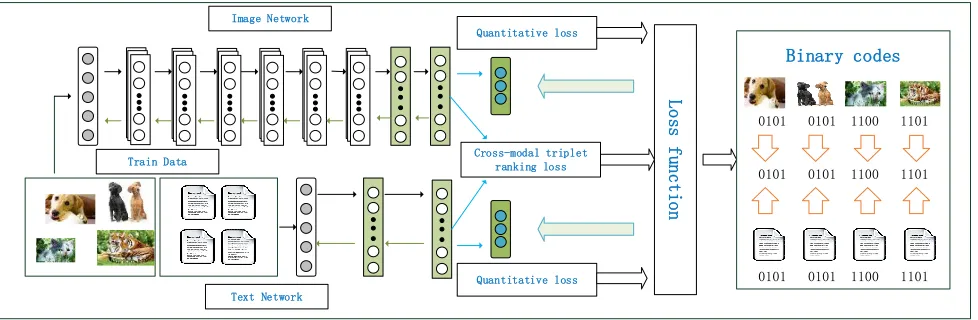
and further introduces an alternative optimization procedure to jointly optimize these learning objectives. The overall workflow of RDCMH is shown in Fig. .
Semi-supervised Semantic Ranking
To preserve the semantic structure, we can force the rank-ing order of neighbors computed by the Hammrank-ing distance being consistent with that derived from semantic labels in terms of ranking evaluation measures. Supposeqis a query point, the semantic similarity level of a database pointx
with respect to q can be calculated based on ranking or-der of label information. Then we can obtain a ground-truth ranking list forqby sorting the database points in de-creasing order of their similarity levels (Zhao et al. 2015; Song et al. 2015). However, this similarity level is just simply derived from the number of shared labels and these semantic ranking-based methods ignore that the labels of training data are not always readily available. Furthermore, these meth-ods work on one modality and can not directly apply on multi-modal data.
To alleviate the issue of insufficient labeled data, we in-troduce a semi-supervised semantic measure that takes into account both the label and feature information of training data. The labels of an instance depend on the features of this instance, and the semantic similarity is positively correlated with the feature similarity of respective instances (Zhang and Zhou 2010; Wang et al. 2009). The semi-supervised semantic measure is defined as follows:
sxxij =
s1ije(s2ij−s 1
ij), |zi|26= 0 and |zj|26= 0
s1ij, otherwise (1)
wheres1
ij is the feature similarity ofxiandxj, whiles2ij is the label similarity, both of them are computed by the cosine similarity. Note,sxx
ij is always in the interval [0,1] and other similarity metrics can also be used. Eq. (1) can account for both the labeled and unlabeled training data. Specifically, for two unlabeled data, the similarity betweenxi and xj is directly computed from the feature information of the respective data. For labeled data, we consider that the label similaritys2
ij is a supplement tos1ij. The larger thes2ij is, the larger thesxx
ij is. In this way, we leverage the label and feature information of training data to account for insufficient labels.
Extending the ranking order to the cross-modal case, we should keep the sematic structure both in the inter-modality and intra-modality. Based onSxx∈
Rn×n, we can obtain a ranking list{xqk}
n
k=1forqby sorting the database points in decreasing order ofsxx
qk. Similarly, we can define the semi-supervised semantic similarity Syy ∈
Rn×n for the data modality Y. To balance the inconsistence of ranking list between two modalities, the semi-supervised semantic simi-larity is averaged as:Sxy=Syx= (Sxx+Syy)/2. Finally, we can obtain three different ranking lists:{rx
i}ni=1,{r
y i}ni=1,
{rixy}n
i=1for each query point.
Unified Objective Function
Deep Feature Representation Most existing hashing
methods first extract hand-crafted visual features (like GIST
and SIFT) from images and then learn ‘shallow’ (usually lin-ear) hash functions upon these features (Bronstein et al. 2010; Zhang and Li 2014; Lin et al. 2017). However, these hand-crafted features have limited representation power and may lose key semantic information, which is important for sim-ilarity search. Here we consider designing deep hash func-tions using CNN (Krizhevsky, Sutskever, and Hinton 2012) to jointly learn feature representations and their mappings to hash codes. This non-linear hierarchical hash function has more powerful learning capability than the shallow one based on features crafted in advance, and thus is able to learn more suitable feature representations for multilevel semantic similarity search. Other representation learning models (i.e., AlexNet) can also be used to learn deep features of images and text for RDCMH. The feature learning part contains two deep neural networks, one for image modality and the other for text modality.
The adopted deep neural network for image modality is a CNN, which includes eight layers. The first six layers are the same as those in CNN-F(Chatfield et al. 2014). The seventh and eighth layer is a fully-connected layer with the outputs being the learned image features. As to the text modality, we first represent each text as a vector with bag-of-words (BOW) representation. Next, the bag-of-words vectors are used as the inputs for a neural network with two fully-connected layers, denoted as “full1 - full2”. The “full1” layer has 4096 neurons, and the second layer “full2” hasc(hashing codes) neurons, The activation function for the first layer is ReLU, and that for the second layer is the identity function.
For presentation, we represent the learnt deep feature rep-resentations ofxandy asϕ(x)and φ(y). The non-linear mapping parameters of these two representations will be discussed later.
Triplet Ranking Loss and Quantitative Loss Directly
optimizing the ranking criteria for cross-modal hashing is very hard. Because it is very difficult to compare the ranking lists and stringently comply with the lists. To circumvent this problem, we use a triplet ranking loss as the surrogate loss. Given a queryqand a ranking list{rx
qi}
n
i=1 forq, we can define a ranking loss on a set of triplets of hash codes as follows:
L(h(q), h({rx qi}
n i=1)) =
n
X
i=1
X
j:sqi>sqj
[δdH(h(q), h(i), h(j))]+ (2)
wherenis the length of the ranking list,sqiandsqjare the similarity between queryqandxiandxj, respectively.h(x) represents the learnt hash codes ofx,[x]+ = max(0, x),
δdH(a1, a2, a3) =dH(a1, a2)−dH(a1, a3),dH(·)is the Hamming distance. This triplet ranking loss is a convex upper bound on the pairwise disagreement, it counts the number of incorrectly ranked triplets.
Eq. (2) equally treats all triplets, but two samples (xiand
xj) of a triplet may have different similarity levels to the queryq. So we introduce the weighted ranking triplet loss based on the ranking list as follows:
L(h(q), h({rx qi}
n i=1)) =
Xn
i=1 X
j:sqi>sqj
1
Cross-modal triplet ranking loss Quantitative loss
Quantitative loss
L
o
ss
f
un
c
t
io
n
0101 0101 1100 1101
0101 0101 1100 1101
0101 0101 1100 1101
Binary codes Image Network
Text Network Train Data
Figure 1: Workflow of the proposed Rank based Deep Cross-Modal Hashing (RDCMH). RDCMH encompasses two steps: (1) an Image CNN network for learning image representations and a Text two-layer Network for learning text representations. (2) Jointly optimize the cross-modal triplet ranking loss and the quantitative loss to seek optimal parameters of deep feature representations and those of hashing functions.
The larger the relevance betweenxiandqthan that between
xj andq is, the larger the ranking loss results in, ifxi is ranked behindxjforq.
As to the cross-modal case, we should balance the incon-sistence of ranking lists between two modalities. To this end, we give the unified objective function that simultaneously ac-count for triplet ranking loss and quantitative loss as follows:
min
Wx,Wy,BL=
X
q∈Q
Xn
i,j=1[(1−s
xx
ij)(δdHxx) + (1−syyij) (δdHyy) + (1−syxij)(δdHyx) + (1−sxyij)(δdHxy)]
+λ
2(||B x−F||2
F+||By−G||2F)
(4)
where
δdHxx=dH(h(xq), h(xi))−dH(h(xq), h(xj))
δdHyy =dH(h(yq), h(yi))−dH(h(yq), h(yj))
δdHxy=dH(h(xq), h(xi))−dH(h(yq), h(yj))
δdHyx=dH(h(yq), h(yi))−dH(h(xq), h(xj)) (5)
h(x) =h(ϕ(x);Wx) =sign(WTxϕ(x))
h(y) =h(φ(y);Wy) =sign(WyTφ(y))
(6)
F∗i= (ϕ(xi);Wx), G∗i= (φ(yi);Wy)
Bx∈ {−1,+1}n×c, By ∈ {−1,+1}n×c (7)
Qis the set of query points,ϕ(x)andφ(y)are the deep fea-tures of images and texts,WxandWy are the coefficient matrices of two modalities, respectively.λis the scalar pa-rameter to balance the triplet ranking loss and quantitative loss.BxandByare the binary hash codes for image and text modality, respectively. In the training process, since different modality data of the same sample share the same label set, and they actually represent the same sample from different viewpoints, we fix the binary codes of same training points from two modalities as the same, namelyBx=By=B.
Eq. (4) simultaneously accounts for the triplet ranking loss and the quantitative loss. The first term enforces the consistency of cross-modal ranking list by minimizing the number of incorrectly ranked triplets, and the second term (weighted byλ) measures the quantitative loss of hashing.
F andGcan preserve the cross-modal similarity inSxx,
SyyandSxy, as a result, binary hash codesBxandBycan also preserve these cross-modal similarities. This exactly coincides with the goal of cross-modal hashing.
Optimization We can solve Eq. (4) via the Alternating
Direction Method of Multipliers (ADMM) (Boyd et al. 2011), which alternatively optimizes one ofWx,Wy, andB, while keeping the other two fixed.
OptimizeWxwithWyandBfixed: We observe that the loss function in Eq. (4) is actually a summation of weighted triplet losses and the quantitative loss. Like most existing deep learning methods, we utilize stochastic gradient descent (SGD) to learnWx with the back-propagation (BP) algo-rithm. In order to facilitate the gradient computation, we rewrite the Hamming distance as the form of inner product:
dH(h(a), h(b)) = c−h(a2)Th(b), where cis the number of hash bits.
More specifically, in each iteration we sample a mini-batch of points from the training set and then carry out our learning algorithm based on the triplet data. For any triplet (q;xi;xj), the derivative of Eq. (4) with respect to coefficient matrix
Wxin the data modalityXis given by:
∂L ∂F∗q
=1
2[(1−s xx
ij)(h(F∗i)−h(F∗j)) + (1−s xy ij)
(h(F∗i)) + (1−syxij)(−h(F∗j))] +λ(F∗q−B∗q) (8)
∂L ∂F∗i
=−1
2[(1−s xx
ij )(h(F∗q))
∂L ∂F∗j
=1
2[(1−s xx
ij )(h(F∗q))
+ (1−sxyij)(h(F∗q))] +λ(F∗j−B∗j)
(10)
We can compute ∂∂LW x with
∂L ∂F∗q,
∂L ∂F∗i and
∂L
∂F∗j using the chain rule. These derivative values are used to update the coefficient matrixWx, which is then fed into six layers CNN to update the parameters ofϕ(x)in each layer via the BP algorithm.
Similar to the optimization ofWx, we optimizeWy on the data modalityYwithWxandBfixed. The derivative values are similarly used to update the coefficient matrix
Wy, which is then fed into the adopted two-layer network to update the parameters ofφ(y)in each layer via the BP algorithm.
OptimizeB with Wx and Wy fixed: When Wx and
Wyare optimized and fixed,FandGare also determined, then the minimization problem in Eq. (4) is equal to a maxi-mization as follows:
max B tr(λB
T(F+G)) =tr(BTU) =X
i,j
BijUij (11)
where B ∈ {−1,+1}n×c,U = λ(F+G). It is easy to observe that the binary codeBijshould keep the same sign asUij. Therefore, we have:
B=sign(U) =sign(λ(F+G)) (12)
The whole procedure of RDCMH and entire iterative pro-cess for solving Eq. (4) are summarized in Algorithm 1.
Algorithm 1RDCMH: Ranking based Deep Cross-Modal
Hashing
Input: Two modality data matrixXandY, and the corre-sponding label matrixZ
Output: Hashing coefficient matricesWx and Wy, the
binary code matrixB.
1: Initialize neural network parameters ofϕ(x)andφ(y), mini-batch sizenx=ny= 128, and the number of itera-tionsiter,t= 1.
2: Calculate the similarity matrixSxx,Syy,SxyandSyx. 3: whilet < iteror not convergeddo
4: Randomly sample nx (ny) triplets fromX (Y) to construct a mini-batch.
5: For each sampled triplet (xq,xi,xj) (or (yq,yi,yj)) in the mini-batch, computeF andGin Eq. (7) by forward propagation;
6: Update coefficient matrixWx,Wyusing Eqs. (8-10); 7: Update the network parameters ofϕ(x)(φ(y)) based
onWx(Wy) and back propagation; 8: UpdateBaccording to Eq. (12); 9: t=t+ 1.
10: end while
Experiment
Datasets
We use three benchmark datasets: Nus-wide, Pascal VOC, and Mirflicker to evaluate the performance of RDCMH. Each dataset include two modalities (image and text), but RD-CMH can also be applied to other data modalities. For≥3 modalities, we just need to compute the ranking lists for each modality and optimize it by minimizing the inconsistency of each ranking list between any pairwise modality.
Nus-wide1contains 260,648 web images, and some images are associated with textual tags. It is a multi-label dataset where each point is annotated with one or several labels from 81 concept labels. The text for each point is represented as a 1000-dimensional bag-of-words vector. The hand-crafted feature for each image is a 500-dimensional bag-of-visual words (BOVW) vector.
Wiki2is generated from a group of 2866 Wikipedia doc-uments. Each document is an image-text pair labeled with 10 semantic classes. The images are represented by 128-dimensional SIFT feature vectors. The text articles are repre-sented as probability distributions over 10 topics, which are derived from a Latent Dirichlet Allocation (LDA) model.
Mirflickr3originally contains 25,000 instances collected from Flicker. Each instance consists of an image and its associated textual tags, and is manually annotated with one or more labels, from a total of 24 semantic labels. The text for each point is represented as a 1386-dimensional bag-of-words vector. For the hand-crafted feature based method, each image is represented by a 512-dimensional GIST feature vector.
Evaluation metric and Comparing Methods
We use the widely used Mean Average Precision (MAP) to measure the retrieval performance of all cross-view hashing methods. A larger MAP value corresponds to a better retrieval performance.
Seven state-of-the-art and related cross-modal hashing methods are used as baselines for comparison, including Cross-modal Similarity Sensitive Hashing (CMSSH) (Bron-stein et al. 2010), Semantic Correlation Maximization (SCM-seq and SCM-orth) (Zhang and Li 2014), Semantics Preserv-ing HashPreserv-ing (SePH) (Lin et al. 2017), Deep Cross-modal Hashing (DCMH) (Jiang and Li 2017), Correlation Hash-ing Network (CHN) (Cao et al. 2016) and Collective Deep Quantization(CDQ)(Cao et al. 2017). Source codes of these baselines are kindly provided by the authors and the input parameters of these baselines are specified according to the suggestion of the papers. As to RDCMH, we set the mini-batch size for gradient descent to 128, and set dropout rate as 0.5 on the fully connected layers to avoid overfitting. The regularization parameterλin Eq. (4) is set to 1, and the num-ber of iterations for optimizing Eq. (4) is fixed to 500. We empirically found RDCMH generally converges in no more than 500 iterations on all these datasets. The length of the
1http://lms.comp.nus.edu.sg/research/NUS-WIDE.htm
2
https://www.wikidata.org/wiki/Wikidata 3
semi-supervised sematic ranking list used for training is set to 5. Namely, we divide the ranking list (i.e.,{rjxy}n
j=1into 5 bins and randomly pick three points from three different bins to form a triplet for training. By doing so, we can not only capture different levels of semantic similarity, but also avoid optimizing too much triplets, whose maximum number is cubic to the number of samples. Our preliminary study shows that DRCMH holds relatively stable performance when the number of bins≥4.
Results and Analysis
Search Accuracies
The MAP results for RDCMH and other baselines with hand-crafted features on MIRFLICKR, NUS-WIDE and Wiki datasets are reported in Table . Here, ‘Image vs. Text’ denotes the setting where the query is an image and the database is text, and ‘Text vs. Image’ denotes the setting where the query is a text and the database is image.
From Table , we have the following observations. (1) RDCMH outperforms almost all the other baselines, which demonstrate the superiority of our method in cross-modal retrieval. This superiority is because RDCMH inte-grates the semantic ranking information into deep cross-modal hashing to preserve better semantic structure infor-mation, and jointly optimizes the triplet ranking loss and quantitative loss to obtain more compatible parameters of deep feature representations and of hashing functions. SePH achieves better results for text to image retrieval on Wiki. That is possible because its adaptability of probability-based strategy on small datasets.
(2) An unexpected observation is that the performance of CMSSH and SCM-Orth decreases as the length of hash codes increase. This may be caused by the imbalance between bits in the hash codes learnt by singular value decomposition or eigenvalue decomposition, these two decompositions are adopted these two approaches.
(3) Deep hashing methods (DCMH, CHN, CDQ and DR-CMH) have an improved performance than the others. This proves that deep feature learned from raw data is more com-patible for hashing learning than hand-crafted features in cross-modal retrieval. DRCMH still outperforms DCMH, CDQ and CHN. This observation corroborates the superiority of ranking-based loss and the necessity of jointly learning deep feature presentations and hashing functions.
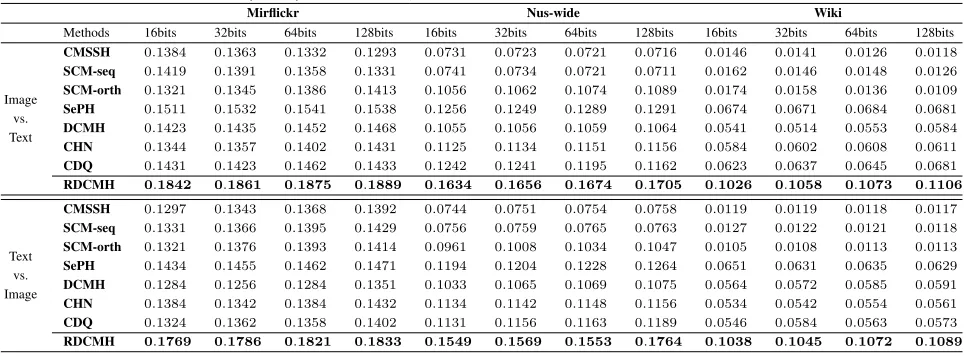
To further verify the effectiveness of RDCMH in semi-supervised situation, we randomly mask all the labels of 70% training samples. All the comparing methods then use the remaining labels to learn hash functions. Table reports the results under different hash bits on three datasets. All these methods manifest sharply reduced MAP values. RDCMH have higher MAP values than all the other baselines, and also outperforms SePH on the Wiki dataset. RDCMH is less affected by the insufficient labels than other methods. For ex-ample, the average MAP value of the second best performer CHN is reduced by 81.9%, and that of RDCMH is 70.2%. This is because label integrity has a significant impact on the effectiveness of supervised hashing methods. In practice, the pairwise semantic similarity between labeled data is reduced
to 9% (3/10×3/10) in this setting. As a result, RDCMH also has a sharply reduced performance. All these comparing methods ask for sufficient label information to guide the hash-ing code learnhash-ing. Unfortunately, these comparhash-ing methods disregard unlabeled data, which contribute to more faithfully explore the structure of data and to reliable cross-modal hash-ing codes. This observation proves the effectiveness of the introduced semi-supervised semantic measure in leveraging unlabeled data to boost the hashing code learning.
We conducted additional experiments on multi-label datasets with 30% missing labels by randomly masking the la-bels of training data. The recorded results show that RDCMH again outperforms the comparing methods. Specifically, the average MAP value of the second best performer (CDQ) is 4% less than that of RDCMH. Due to space limitation, the results are not reported here. Overall, we can conclude that RDCMH is effective in weakly-supervised scenarios.
Sensitivity to Parameters
We further explore the sensitivity of the scalar parameterλ
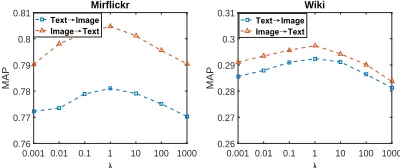
in Eq. (4), and report the results on Mirflickr and Wiki in Fig. , where the code length fixed as 16 bits. We can see that RDCMH is slightly sensitive toλwithλ∈[10−3,103], and achieves the best performance whenλ= 1. Over-weighting or under-weighting the quantitative loss have a negative im-pact to the performance, but not so significant. In summary, an effectiveλcan be easily selected for RDCMH.
0.001 0.01 0.1 1 10 100 1000 0.76
0.77 0.78 0.79 0.8 0.81
MAP
Mirflickr
0.001 0.01 0.1 1 10 100 1000 0.26
0.27 0.28 0.29 0.3 0.31
MAP
Wiki
Figure 2: MAP vs.λon Mirfilcker and Wiki datasets.
16 32 64 128 code length 0.65
0.7 0.75 0.8 0.85
MAP
DRCMH DRCMH-NW DRCMH-ND DRCMH-NS DRCMH-NJ
16 32 64 128 code length 0.65
0.7 0.75 0.8 0.85
MAP
Figure 3: The results of different variants on Mirflicker.
Further Analysis
Table 1: Results (MAP) on Mirflickr , Nus-wide and Wiki dataset.
Mirflickr Nus-wide Wiki
Methods 16bits 32bits 64bits 128bits 16bits 32bits 64bits 128bits 16bits 32bits 64bits 128bits
Image vs. Text
CMSSH 0.5616 0.5555 0.5513 0.5484 0.3414 0.3336 0.3282 0.3261 0.1694 0.1523 0.1447 0.1434 SCM-seq 0.5721 0.5607 0.5535 0.5482 0.3623 0.3646 0.3703 0.3721 0.1577 0.1434 0.1376 0.1358 SCM-orth 0.6041 0.6112 0.6176 0.6232 0.4651 0.4714 0.4822 0.4851 0.2341 0.2411 0.2443 0.2564 SePH 0.6573 0.6603 0.6616 0.6637 0.4787 0.4869 0.4888 0.4932 0.2836 0.2859 0.2879 0.2863 DCMH 0.7411 0.7465 0.7485 0.7493 0.5903 0.6031 0.6093 0.6124 0.2673 0.2684 0.2687 0.2748 CHN 0.7438 0.7485 0.7511 0.7595 0.6012 0.6028 0.6059 0.6121 0.2534 0.2677 0.2681 0.2684 CDQ 0.7604 0.7631 0.7745 0.7738 0.6203 0.6253 0.6274 0.6284 0.2873 0.2834 0.2831 0.2901 RDCMH 0.7723 0.7735 0.7789 0.7810 0.6231 0.6236 0.6273 0.6302 0.2943 0.2968 0.3001 0.3042
Text vs. Image
CMSSH 0.5616 0.5551 0.5506 0.5475 0.3392 0.3321 0.3272 0.3256 0.1578 0.1384 0.1331 0.1256 SCM-seq 0.5694 0.5611 0.5544 0.5497 0.3412 0.3459 0.3472 0.3539 0.1521 0.1561 0.1371 0.1261 SCM-orth 0.6055 0.6154 0.6238 0.6299 0.437 0.4428 0.4504 0.1235 0.2257 0.2459 0.2482 0.2518 SePH 0.6481 0.6521 0.6545 0.6534 0.4489 0.4539 0.4587 0.4621 0.5345 0.5351 0.5471 0.5506
DCMH 0.7827 0.7901 0.7932 0.7956 0.6389 0.6511 0.6571 0.6589 0.2712 0.2751 0.2812 0.2789 CHN 0.7402 0.7435 0.7463 0.7481 0.6415 0.6426 0.6435 0.6478 0.2416 0.2456 0.2483 0.2512 CDQ 0.7856 0.7841 0.7892 0.7931 0.6531 0.6579 0.6613 0.6658 0.2901 0.2847 0.3001 0.3021 RDCMH 0.7931 0.7924 0.8001 0.8024 0.6641 0.6685 0.6694 0.6703 0.2931 0.2956 0.3012 0.3035
Table 2: Results (MAP) on Mirflickr , Nus-wide and Wiki dataset with 70% unlabeled data.
Mirflickr Nus-wide Wiki
Methods 16bits 32bits 64bits 128bits 16bits 32bits 64bits 128bits 16bits 32bits 64bits 128bits
Image vs. Text
CMSSH 0.1384 0.1363 0.1332 0.1293 0.0731 0.0723 0.0721 0.0716 0.0146 0.0141 0.0126 0.0118 SCM-seq 0.1419 0.1391 0.1358 0.1331 0.0741 0.0734 0.0721 0.0711 0.0162 0.0146 0.0148 0.0126 SCM-orth 0.1321 0.1345 0.1386 0.1413 0.1056 0.1062 0.1074 0.1089 0.0174 0.0158 0.0136 0.0109 SePH 0.1511 0.1532 0.1541 0.1538 0.1256 0.1249 0.1289 0.1291 0.0674 0.0671 0.0684 0.0681 DCMH 0.1423 0.1435 0.1452 0.1468 0.1055 0.1056 0.1059 0.1064 0.0541 0.0514 0.0553 0.0584 CHN 0.1344 0.1357 0.1402 0.1431 0.1125 0.1134 0.1151 0.1156 0.0584 0.0602 0.0608 0.0611 CDQ 0.1431 0.1423 0.1462 0.1433 0.1242 0.1241 0.1195 0.1162 0.0623 0.0637 0.0645 0.0681 RDCMH 0.1842 0.1861 0.1875 0.1889 0.1634 0.1656 0.1674 0.1705 0.1026 0.1058 0.1073 0.1106
Text vs. Image
CMSSH 0.1297 0.1343 0.1368 0.1392 0.0744 0.0751 0.0754 0.0758 0.0119 0.0119 0.0118 0.0117 SCM-seq 0.1331 0.1366 0.1395 0.1429 0.0756 0.0759 0.0765 0.0763 0.0127 0.0122 0.0121 0.0118 SCM-orth 0.1321 0.1376 0.1393 0.1414 0.0961 0.1008 0.1034 0.1047 0.0105 0.0108 0.0113 0.0113 SePH 0.1434 0.1455 0.1462 0.1471 0.1194 0.1204 0.1228 0.1264 0.0651 0.0631 0.0635 0.0629 DCMH 0.1284 0.1256 0.1284 0.1351 0.1033 0.1065 0.1069 0.1075 0.0564 0.0572 0.0585 0.0591 CHN 0.1384 0.1342 0.1384 0.1432 0.1134 0.1142 0.1148 0.1156 0.0534 0.0542 0.0554 0.0561 CDQ 0.1324 0.1362 0.1358 0.1402 0.1131 0.1156 0.1163 0.1189 0.0546 0.0584 0.0563 0.0573 RDCMH 0.1769 0.1786 0.1821 0.1833 0.1549 0.1569 0.1553 0.1764 0.1038 0.1045 0.1072 0.1089
triplets; RDCMH-ND denotes the variant without deep fea-ture learning, it directly uses the hand-crafted feafea-tures to learn hashing functions during training. RDCMH-NS simply obtains the ranking list by the number of shared labels, as done by (Song et al. 2015; Zhao et al. 2015). RDCMH-NJ iso-lates deep feature learning and hashing functions learning, it first learns deep features and then generates hash codes based on the learnt features. Fig. shows the results of these variants on the Mirfilcker dataset. The results on other datasets pro-vide similar observations and conclusions, and are omitted here for space limit.
We can see RDCMH outperforms RDCMH-NW. This means the triplet ranking loss with adaptive weights can improve the cross-modal retrieval quality, since it assigns larger weights to more relevant points and smaller weights to the less relevant ones. RDCMH also outperforms RDCMH-NS, which indicates that dividing the ranking lists into dif-ferent levels based on the semi-supervised semantic sim-ilarity Sis better than simply dividing by the number of shared labels, which was adopted by (Zhao et al. 2015;
Lai et al. 2015). Moreover, we can find that RDCMH achieves a higher accuracy than RDCMH-ND and RDCMH-NJ, which shows not only the superiority of deep features than hand-crafted features in cross-modal retrieval, but also the advan-tage of simultaneous hash-code learning and deep feature learning.
Conclusion
Acknowledgments
The authors appreciate the reviewers for their helpful com-ments on improving our work. This work is supported by NSFC (61872300, 61741217, 61873214 and 61871020), NSF of CQ CSTC (cstc2018jcyjAX0228, cstc2016jcyjA0351, and CSTC2016SHMSZX0824), the Open Research Project of Hubei Key Laboratory of Intelligent Geo-Information Processing (KLIGIP-2017A05), and the National Science and Technology Support Program (2015BAK41B03 and 2015BAK41B04).
References
Andoni, A., and Indyk, P. 2006. Near-optimal hashing algo-rithms for approximate nearest neighbor in high dimensions. InFOCS, 459–468.
Boyd, S.; Parikh, N.; Chu, E.; Peleato, B.; and Eckstein, J. 2011. Distributed optimization and statistical learning via the alternating direction method of multipliers.Foundations and Trends in Machine Learning3(1):1–122.
Bronstein, M. M.; Bronstein, A. M.; Michel, F.; and Paragios, N. 2010. Data fusion through cross-modality metric learning using similarity-sensitive hashing. InCVPR, 3594–3601.
Cao, Y.; Long, M.; Wang, J.; and Zhu, H. 2016. Correlation autoencoder hashing for supervised cross-modal search. In
ICMR, 197–204.
Cao, Y.; Long, M.; Wang, J.; and Liu, S. 2017. Collective deep quantization for efficient cross-modal retrieval. InAAAI, 3974–3980.
Chang, S. F.; Jiang, Y. G.; Ji, R.; Wang, J.; and Liu, W. 2012. Supervised hashing with kernels. InCVPR, 2074–2081.
Chatfield, K.; Simonyan, K.; Vedaldi, A.; and Zisserman, A. 2014. Return of the devil in the details: Delving deep into convolutional nets. InBMVC, 1–12.
Jiang, Q. Y., and Li, W. J. 2017. Deep cross-modal hashing. InCVPR, 3270–3278.
Krizhevsky, A.; Sutskever, I.; and Hinton, G. E. 2012. Ima-genet classification with deep convolutional neural networks. InNIPS, 1097–1105.
Kulis, B., and Grauman, K. 2010. Kernelized locality-sensitive hashing for scalable image search. InICCV, 2130– 2137.
Kumar, S., and Udupa, R. 2011. Learning hash functions for cross-view similarity search. InIJCAI, 1360–1365.
Lai, H.; Pan, Y.; Liu, Y.; and Yan, S. 2015. Simultaneous feature learning and hash coding with deep neural networks. InCVPR, 3270–3278.
Lin, Z.; Ding, G.; Han, J.; and Wang, J. 2017. Cross-view retrieval via probability-based semantics-preserving hashing.
IEEE Transactions on Cybernetics47(12):4342–4355.
Rasiwasia, N.; Costa Pereira, J.; Coviello, E.; Doyle, G.; Lanckriet, G. R.; Levy, R.; and Vasconcelos, N. 2010. A new approach to cross-modal multimedia retrieval. InACM MM, 251–260.
Shao, W.; He, L.; Lu, C.-T.; Wei, X.; and Philip, S. Y. 2016. Online unsupervised multi-view feature selection. InICDM, 1203–1208.
Song, J.; Yang, Y.; Yang, Y.; Huang, Z.; and Shen, H. T. 2013. Inter-media hashing for large-scale retrieval from heterogeneous data sources. InSIGMOD, 785–796. Song, D.; Liu, W.; Ji, R.; Meyer, D. A.; and Smith, J. R. 2015. Top rank supervised binary coding for visual search. InICCV, 1922–1930.
Wang, C.; Yan, S.; Zhang, L.; and Zhang, H.-J. 2009. Multi-label sparse coding for automatic image annotation. InCVPR, 1643–1650.
Wang, J.; Liu, W.; Kumar, S.; and Chang, S.-F. 2016. Learn-ing to hash for indexLearn-ing big data – a survey.Proceedings of the IEEE104(1):34–57.
Wang, J.; Zhang, T.; Sebe, N.; and Shen, H. T. 2018. A survey on learning to hash. TPAMI40(4):769–790.
Wang, J.; Kumar, S.; and Chang, S. F. 2012. Semi-supervised hashing for large-scale search. TPAMI34(12):2393–2406. Yi, Z., and Yeung, D. Y. 2012. Co-regularized hashing for multimodal data. InNIPS, 1376–1384.
Zhang, D., and Li, W. J. 2014. Large-scale supervised multimodal hashing with semantic correlation maximization. InAAAI, 2177–2183.
Zhang, Y., and Zhou, Z.-H. 2010. Multilabel dimensionality reduction via dependence maximization. TKDD4(3):14. Zhao, F.; Huang, Y.; Wang, L.; and Tan, T. 2015. Deep se-mantic ranking based hashing for multi-label image retrieval. InCVPR, 1556–1564.