Energy Efficient Routing with MAX-LEACH Protocol in WSN
Nidhi Ghodki1, Neeraj singh2, Deepanjali Joshi3, Mukesh Dikshit4
Radharaman Engineering College Bhopal, India
1
[email protected], [email protected] 3
[email protected], [email protected]
Abstract— Energy efficient communication is likely one of the
main conversation factor in WSN then efficient routing is critical
to makes use of full power consumption and enhance the network
performance. In this research the AOMDV (Ad hoc on demand
Multipath Distance Vector) routing protocol provides route
request flooding and renovation of routing. However one is the
measure undertaking is energy difficulty in this community and
known that mobile node are energy constraint gadgets. Limited
energy is one of the prime concerns in WSN then efficient routing
is fundamental to utilize full energy consumption and increase
the network performance. LEACH is energy based protocol
work on the cluster base mechanism to make use of the energy
consumption. In this research we analyses the performance of
LEACH protocol with reactive on demand multipath AOMDV
protocol to efficaciously make use of the energy constraint in
WSN. Right here proposed scheme aren't evaluate with any prior
existing scheme. The proposed scheme shows that nodes have at
polite imprecise state information, mainly under strong link
establishment. Proposed LEACH and AOMDV routing and in
finding-out harmless route (higher energy base route resolution),
in our concept LEACH generate cluster and offers knowledge
about power of each cluster belongs zone and if power of an of
the node is larger so LEACH choose that specific node for data
transmission that work raises the reliability of communication in
WSN. The efficiency of proposed LEACH-AOMDV protocol is
evaluation on the basis of performance matrices like throughput,
packet supply ratio, energy consumption by way of node and
routing overhead.
Keywords—WSN, Energy, LEACH, MAX-LEACH, AOMDV,
Routing.
I. INTRODUCTION
time in order to balance the energy dissipation of nodes. This decision is made by the node choosing a random number between 0 and 1. The nodes die randomly and dynamic clustering increases lifetime of the system. LEACH is completely distributed and requires no global knowledge of network. However, LEACH uses single-hop routing where each node can transmit directly to the cluster-head and the sink. Therefore, it is not applicable to networks deployed in large regions. Moreover, the idea of dynamic clustering brings extra overhead, e.g. head changes, advertisements etc. Multiple paths can also be used to balance load by forwarding data packets on multiple paths at the same time, though we will not investigate this aspect in our work [5]. Efficient sensor network protocols can support multipath concept with energy constraints to return data effectively without incurring the high operation costs to coordinate and communicate with a large number of small, constrained elements. The original scheme showed an uneven distribution of energy consumption among nodes close to the neighbor and some nodes constantly use more energy than others. Those are nodes that were heavily involved in forwarding packets. If this trend continues, these nodes will die much earlier than the others and will cause the disconnection of the network. Traffic proper balancing is disturbed due to affect the energy. A routing protocol that does not take into account of traffic load balance will result in usage of paths that are already heavy in traffic load. It will add more burdens on the energy consumption to these paths and indirectly lead to imbalanced energy consumption of the whole network. The nodes in a high traffic load path will ‘die’ off faster than nodes in paths that have lower traffic load. Thus load awareness routing provides not only a lower end-to-end delay, but also indirectly leads to more efficient energy distribution routing.
II. LITERATURE SURVEY
In this literature survey we focus on some recent studies that contribute in field of energy in WSN. The previous work is provides the idea and guide lines about the research work that's why an innovative idea of research is proposed. Effective and efficient jamming attack can be executed through a careful selection of jamming rate based on routing protocol operations. Link-quality-based routing can be more resilient against the
impact of intermittent jamming. For the attack method against link-quality-based routing, a grouped-pulse jamming attack can be useful, as it repeats a series of pulse jamming and a period of non-jamming, resulting in route oscillation and data loss. In [6] this paper present centralized AHV-based algorithm to select fault-independent paths, and a distributed AHV-based routing protocol built on top of a classic routing algorithm in ad hoc networks. We take a different viewpoint and focus on protecting against jamming at the network level, i.e., restoring reliability of end-to-end data delivery. In [7] will compare performances of the two ad hoc routing protocols: reactive Ad hoc On Demand Distance Vector (AODV) and proactive Optimized Link State Routing (OLSR) protocols after applying prevention techniques for jamming attack. Paper [8] we present a novel jamming detection algorithm for reactive jamming attacks. The proposed mechanism is capable of detecting jammer either by comparing the behavior of the Delivery Rate across the short-term and the long-term or observing the required number of retransmission attempts in the network. Since the jamming increases the RSS of the received packets, this proposed algorithm clusters the received packets in based on average signal strength. In [9], the design issues of WSNs and classification of routing protocols are presented (2009). Moreover, a few routing protocols are presented based on their characteristics and the mechanisms they use in order to extend the network lifetime without providing details on each of the described protocols. Also, the authors do not present a direct comparison of the discussed protocols. In our work we do not only focus on the energy-efficient protocols but we also discuss the strengths and weaknesses of each protocol in such a way as to provide directions to the readers on how to choose the most appropriate energy-efficient routing protocol for their network. The paper in [10] presents the challenges in the design of P
Set Routing= AOMDV MAX_Leach_method
Periodical_RX energy information from all node’s Save MAX_Energy node info value EM
{
If (Node Energy = =Max) // Select the higher level of energy Form cluster; // clusters are forming on the basis of communication requirement
Select cluster head contain MAX energy; // higher energy level node is
}
Rreq_bcast(S, R, pkts)
If (radio-range <= 550 m && cluster-head ==true && energy== Em)
{Receives routing packet and send to next hop; If (Next_hop== R)
{
receives routing packet; Send ACK_pkt to sender; }
Else
{ receiver not exist ;} Else
{
node out of range or node is died }
Terminate session;
III. SIMULATION TOOL &PERFORMANCEMETRICS After To evaluate the performance of proposed E-AOMDV protocol, we present simulations using network simulator 2 (NS2–2.34) [12]. The operation system is windows 7. NS-2 is not support windows then install 'cygwin' to provide Linux environment in windows.
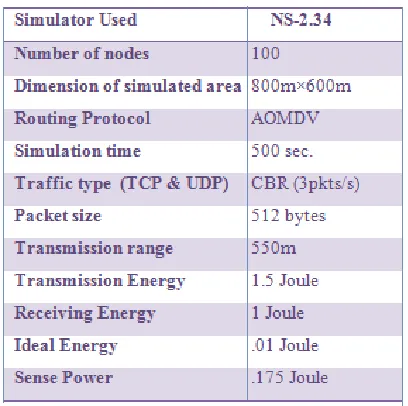
Table 1 Simulation parameters will uses for simulation
The computer configuration is listed as following: CPU: i 1.86G, Memory: 2G, Hard disc: 250G. The simulation parameters that are used in the experiments are shown in table 1.The NS instructions can be used to define the topology structure of the network and the motion mode of the nodes, to configure the service source and the receiver etc.
a. Performance Parameter
There are following different performance metrics have been considered to make the comparative study of these routing protocols through simulation.
i. Routing overhead: This metric describes how many routing packets for route discovery and route maintenance need to be sent so as to propagate the data packets. ii. Average Delay: This metric represents average
end-to-end delay and indicates how long it took for a packet to travel from the source to the application layer of the destination.
iii. Throughput: This metric represents the total number of bits forwarded to higher layers per second. It is measured in bps
iv. Packet Delivery Ratio: The ratio between the amount of incoming data packets and actually received data packets.
IV. RESULTS ANALYSIS
The results analysis in case of proposed cluster based LEACH protocol and normal multipath routing (old) detail description is mentioned and observe that the proposed is better for efficient energy consumption in MANET.
a. Proposed Summarized Analysis
The table 2 represents the overall analysis in case of previous and proposed LEACH cluster based scheme. Here we clearly notice that in case of proposed scheme large number of packets are sending in network are more as compare to normal routing. The value of PDF is really gives appreciable performance. The reduction in routing load and delay are definitely reduces consumption of energy.
b. PDR Performance Analysis
The Packet Delivery Fraction (PDF) analysis is represents the successful percentage of data received at destination. This graph is represents the packet percentage in case of proposed energy based routing and previous normal energy shortest path selection routing. Here this graph represents the more PDF in proposed LEACH cluster based routing it is about 100% but the routing load in normal cluster formation are 82 % up to end of simulation. If the routing load in network are more it means energy consumption are more by that the life of nodes are lost early as compare to proposed. It means PDF value is good not show that the overall performance of network are also better.
Fig.1 PDR Analysis
c. Routing Packets Performance Analysis
Routing packets in network are required to established connection in between source and destination. First routing packets are established connection with destination if destination replies to sender by connection confirmation packet. The routing packets in network are consumes energy it means minimum number of routing packets are deliver maximum amount of data packets in efficient routing. In this graph in case of normal cluster based routing with energy factor the routing load are more it means the problem of connection failure are occur more here by that the more routing packets are required then energy also required for routing packets transmission and in proposed LEACH cluster based routing with multipath the cluster formations are more that reduces consumption and minimizes the routing overhead.
Fig.2 Routing Packets Analysis
d. Throughput Performance Analysis
The better throughput performance shows the better sending and receiving of data packets at sender end and receiver end. This graph represents the throughput of old and proposed LEACH with multipath routing cases. Here we clearly visualized that the throughput in case of proposed cluster based LEACH protocol are more. The throughput in case of Energy based AOMDV protocol are lower than the proposed scheme. It means that the proposed LEACH protocol is increases the energy utilization with multipath protocol. Now the results in case of normal routing is enhance the possibility of energy consumption but proposed reduces to control energy consumption.
V. CONCLUSION & FUTURE SCOPE
The energy effective utilization is required to make stronger the network efficiency in dynamic community. The proposed cluster based LEACH with AOMDV is the underlying routing protocol and focus on residual energy level as efficiency metric which has been used for routing choices in energy efficient routing protocol proposals. In this research work average cluster module and proposed LEACH performance with multipath AOMDV is evaluated. Here quantity of simulation were taken and eventually conclude by way of various outcomes. In our first parameter packet delivery ratio (PDR) provides greater than 99% that shows efficient conversation in the form of data receiving base, in second outcome we set up energy consumption however right here we take the same scenario of 100 nodes and conclude that highest node are living till the tip that suggests our strategy are efficient energy utilize where accurate energy calculations is provides better life of network. We retrieve throughput of the network and get better effect, ultimately we establish routing overhead in same scenario of nodes with random motion case routing overhead virtually really effective by minimizes flooding (on the bases of overall packet). LEACH and AOMDV jointly gives effective process for WSN Communication. And it’s also work with the coordination base of each and every node. The efficiency of proposed LEACH-AOMDV protocol is gives exceptional outcome in given simulation parameters. The packet delivery fraction and natural routing are represents the efficiency of proposed protocol. The delays are additionally no longer terrible but attempt to scale back extra of it. For the longer term work, this subject will investigate with area founded routing for the reason that routing protocol minimizes the flooding of packets and likewise compare the performance of proposed scheme with other energy based routing protocols.
REFERENCES
[1] I. Akyildiz, W. Su, Y. Sankarasubramaniam, and E. Cayirci, “A
survey on sensor networks,” IEEE communication Management,
vol. 40, no. 8, pp. 102–114, 2002.
[2] S. E. Roslin, C. Gomathy, and P. Bhuvaneshwari, “A Survey on
Neighborhood Dependant Topology Control in Wireless Sensor
Networks,” International Journal of Computer Science &
Communication, Vol. 1, No. 1, pp. 185–188, 2010.
[3] W. Heinzelman, A. Chandrakasan, H. Balakrishnan,
“Energy-Efficient Communication Protocol for Wireless Micro sensor
Networks,” In Proceeding of 33rd Hawaii International
Conference on System Sciences, Vol. 8, pp. 110.HI, USA, 2000.
[4] M. J. Handy, M. Haase, D. Timmermann, “Low Energy
Adaptive Clustering Hierarchy with Deterministic Cluster-Head
Selection,” In Proceeding of 4th International Workshop on
Mobile and Wireless Communications Network, Vol. 1, pp.
368-372, USA, 2002.
[5] Mahesh K. Marina1,† and Samir R. Das, "Ad hoc On-demand
Multipath Distance Vector Routing", WIRELESS
COMMUNICATIONS AND MOBILE COMPUTING Wireless
Communication Mobile Computation, Wiley Inter science, 969–
988, 2006.
[6] ] Jae-Joon Lee, and Jaesung Lim , “Effective and Efficient
Jamming Based on Routing in Wireless Ad Hoc Networks”
IEEE Communications Letters, Vol. 16, No. 11, pp. 1903-1906,
November 2012.
[7] Hossen Mustafa, Xin Zhang, Zhenhua Liu, Wenyuan Xu, and
Adrian Perrig, “Jamming-Resilient Multipath Routing”, IEEE
Transactions on Dependable and Secure Computing, Vol. 9, No.
6, pp. 852-864, November/December 2012.
[8] Dorus.R And Vinoth.P, “Mitigation of Jamming Attacks in
Wireless Networks”, IEEE International Conference on
Emerging Trends in Computing, Communication and
Nanotechnology (ICECCN 2013), pp. 168-171, 2013.
[9] R .V. Biradar, V. C.Patil, S. R. Sawant, R. R. Mudholkar,
“Classification and Comparison of Routing Protocols in
Wireless Sensor Networks,” Special Issue on Ubiquitous
Computing Security Systems, Vol. 4, Issue 2, pp. 704-711,
2009.
[10]R. Yadav, S. Varma, N. Malaviya, “A Survey of MAC Protocols
for Wireless Sensor Networks,” UbiCC Journal, Vol. 4, Issue 3,
pp. 827-833, 2009.
[11]M. Zimmerling, W. Dargie, J.M. Reason, “Energy-Efficient
Routing in Linear Wireless Sensor Networks,” In Proceeding
4th IEEE International Conference on Mobile Ad hoc and
Sensor Systems (MASS 2007), , pp. 1-3, Italy, Pisa, 2007.