C L I N I C A L T R I A L P R O T O C O L
Open Access
Protocol of a randomized, double-blind,
placebo-controlled, parallel-group,
multicentre study of the efficacy and safety
of nicotinamide in patients with Friedreich
ataxia (NICOFA)
Kathrin Reetz
1,2, Ralf-Dieter Hilgers
3, Susanne Isfort
4, Marc Dohmen
4, Claire Didszun
1,2, Kathrin Fedosov
1,2,
Jennifer Kistermann
4, Caterina Mariotti
5, Alexandra Durr
6, Sylvia Boesch
7, Thomas Klopstock
8,9,10,
Francisco Javier Rodríguez de Rivera Garrido
11, Ludger Schöls
12,13, Thomas Klockgether
14,15, Massimo Pandolfo
16,
Rudolf Korinthenberg
17, Philip Lavin
18, Geert Molenberghs
19, Vincenzo Libri
20, Paola Giunti
21†,
Richard Festenstein
22†, Jörg B. Schulz
1,2,4*and the EFACTS or NICOFA study group
Abstract
Introduction:Currently, no treatment that delays with the progression of Friedreich ataxia is available. In the majority of patients Friedreich ataxia is caused by homozygous pathological expansion of GAA repeats in the first intron of the FXN gene. Nicotinamide acts as a histone deacetylase inhibitor. Dose escalation studies have shown, that short term treatment with dosages of up to 4 g/day increase the expression of FXN mRNA and frataxin protein up to the levels of asymptomatic heterozygous gene carriers. The long-term effects and the effects on clinical endpoints, activities of daily living and quality of life are unknown.
Methods:The aim of the NICOFA study is to investigate the efficacy and safety of nicotinamide for the treatment of Friedreich ataxia over 24 months. An open-label dose adjustment wash-in period with nicotinamide (phase A: weeks 1–4) to the individually highest tolerated dose of 2–4 g nicotinamide/day will be followed by a 2 (nicotinamide group): 1 (placebo group) randomization (phase B: weeks 5–104). In the nicotinamide group, patients will continue with their individually highest tolerated dose between 2 and 4 g/d per os once daily and the placebo group patients will be receiving matching placebo. Safety assessments will consist of monitoring and recording of all adverse events and serious adverse events, regular monitoring of haematology, blood chemistry and urine values, regular measurement of vital signs and the performance of physical examinations including cardiological signs. The primary outcome is the change in the Scale for the Assessment and Rating of Ataxia (SARA) over time as compared with placebo in patients with Friedreich ataxia based on the linear mixed effect model (LMEM) model. Secondary endpoints are measures of quality of life, functional motor and cognitive measures, clinician’s and patient’s global impression-change scales as well as the up-regulation of the frataxin protein level, safety and survival/death.
(Continued on next page)
© The Author(s). 2019Open AccessThis article is distributed under the terms of the Creative Commons Attribution 4.0 International License (http://creativecommons.org/licenses/by/4.0/), which permits unrestricted use, distribution, and reproduction in any medium, provided you give appropriate credit to the original author(s) and the source, provide a link to the Creative Commons license, and indicate if changes were made. The Creative Commons Public Domain Dedication waiver (http://creativecommons.org/publicdomain/zero/1.0/) applies to the data made available in this article, unless otherwise stated.
* Correspondence:[email protected]
†Paola Giunti and Richard Festenstein contributed equally to this work.
1Department of Neurology, RWTH Aachen University, Pauwelsstraße 30, 52074 Aachen, Germany
2JARA-BRAIN Institute Molecular Neuroscience and Neuroimaging, Forschungszentrum Jülich GmbH and RWTH Aachen University, 52074 Aachen, Germany
(Continued from previous page)
Perspective:The NICOFA study represents one of the first attempts to assess the clinical efficacy of an epigenetic therapeutic intervention for this disease and will provide evidence of possible disease modifying effects of nicotinamide treatment in patients with Friedreich ataxia.
Trial registration:EudraCT-No.: 2017-002163-17,ClinicalTrials.gov NCT03761511.
Keywords:Clinical study design, Clinical trials, Ataxia, Outcome, Frataxin
Introduction
Background and rationale
Clinical trials in rare diseases
Preparing and carrying out investigator-initiated trials for
rare diseases – in the hopes of developing new forms of
therapy –is an even more difficult task than it is already with more prevalent diseases. Particularly with respect to funding, regulatory procedures as well as statistical plan-ning and analyses, the demands are complex and require considerable additional and detailed knowledge. Trial designs for rare diseases must meet the same rigorous stan-dards as those for trial for more prevalent diseases. A key question is how to run conclusive therapeutic trials. Patient groups are very small, and the risk of being underpowered to test efficacy is high. The recruitment of patients is a diffi-cult task in rare diseases because of the paucity of available patients who fulfill the selection criteria, the quite hetero-geneity of clinical presentation and/or co-morbidities [1], and finally because patients and/or their families are in con-tinuous search for better treatments. Rare neurodegenera-tive diseases are fatal and no therapy is available to cure or slow down the progression of disease. This includes
inher-ited ataxias. Within the European Friedreich’s Ataxia
Consortium for Translational Studies (EFACTS,
www.e-facts.eu), we started to address the challenge designing an investigator-initiated trial for patients with Friedreich Ataxia (FA) using an innovative trial methodology for de-sign and analysis for patients with FA.
The disease–Friedreich ataxia
FA is an autosomal recessive hereditary ataxia. This devas-tating and incurable neurodegenerative disease often mani-fests in childhood and in many cases leads to severe disability by early adulthood. FA is the most common her-editary ataxia in Caucasian populations, however, with an estimated prevalence of about 2–4/100.000 people and a carrier frequency of 1:90 it remains a rare disease [2]. In 1996, the genetic mutation that underlies most FA cases [3] was discovered as a homozygous pathological expansion of GAA triplet repeats in the first intron of the FXN gene, which encodes for the mitochondrial protein frataxin. Fra-taxin deficiency results in spinocerebellar ataxia, dysarthria, proximal weakness, sensory loss and cardiomyopathy, and leads to dependence on a wheelchair and reduced life
expectancy. There is no disease modifying therapy and many patients die prematurely of cardiomyopathy.
Study rationale and clinical relevance
It has been demonstrated that GAA-triplet repeats can trigger abnormal compaction of a linked reporter gene in vivo leading to the archetypal epigenetic gene silen-cing phenomenon of position effect variegation (PEV) [4]. This GAA-repeat silencing was highly sensitive to the gene dosage of PEV modifiers which encode en-zymes that modify chromatin. It was subsequently found that the FXN gene is silenced at the chromatin level by the formation of heterochromatin and that this hetero-chromatin formation can be antagonised by histone dea-cetylase inhibitors (HDACi) [5].
Before the phase IIa trial [6] with nicotinamide was initiated in patients with FA, drug-specific preclinical studies were performed. First, nicotinamide was tested on EBV-transformed lymphoblastoid cell lines [5].
Mod-est up-regulation of FXN mRNA levels was obtained in
patient-derived cell lines with relatively little effect on
FXN expression in the normal control cell line. Second,
to assess the effect of nicotinamide under more physio-logical conditions, fresh primary lymphocytes derived from FA-affected or normal healthy individuals were
treated. A small effect (2-fold increase) in FXN mRNA
level was produced for healthy primary cells after nicotinamide treatment suggesting that minor
chroma-tin effects might occur at the healthy FXN locus.
Not-ably, the increase in FXN mRNA level in FA
individuals was much larger (4.5-fold). Third, in FA
transgenic mice [7] treated with nicotinamide for 6
days with a dose of 750 mg/kg increases of FXNmRNA
expression were found in all FA - relevant tissues and the most substantial increases, were observed in spinal cord and cerebellum with 1.8-fold up-regulation of frataxin [5]. These results strongly suggest that nicotinamide can
reactivate the silenced FXN gene in both human FA
cells and in vivo transgenic FA models. Also, mechan-istic preclinical investigations were performed. Treating primary lymphocytes from FA patients with nicotina-mide strongly reduced the disease-associated increase in histone H3K9 and H3K27 trimethylations and
in-creased the histone acetylation at the FXN gene. The
patient’s cells. High-throughput RNA sequencing on libraries generated from untreated and nicotinamide-treated FA primary lymphocytes revealed that 67% of the dysregulation of the expression was ameliorated by the treatment in FA. Thus, it was demonstrated that expanded GAA-triplet repeats can induce gene silencing in vivo leading to the archetypal epigenetic gene silencing phenomenon of position effect variegation (PEV) [4]. This GAA-repeat silencing was exquisitely sen-sitive to the gene dosage of PEV modifiers which encode enzymes that modify chromatin. Moreover, it was
demon-strated that the FXN gene is silenced at the chromatin
level by the formation of heterochromatin. This hetero-chromatin formation can be antagonised by histone
deacetylase inhibitors (HDACi) [5]. Nicotinamide is a
classical class III HDACi.
A recent exploratory, open-label dose-escalation study on ten patients with FA demonstrated that fra-taxin levels can be restored towards asymptomatic carrier levels (50% of normal) using nicotinamide (Clin-icalTrials.gov, number NCT01589809, 6]. Therefore, restoration of frataxin expression to these levels might be expected to halt disease progression. FA patients were given single doses, repeated daily doses of 2–8 g oral nicotinamide for 5 days and 8 weeks. Nicotinamide was generally well tolerated with nausea being the most frequent dose-related adverse event in this study. More-over, a sensitive clinical rating measure to assess disease progression, the Scale for the Assessment and Rating of Ataxia (SARA) is now available, which was proved most suitable to measure clinical disease progression within the registry of the EFACTS framework [8,9].
The drug–nicotinamide
Nicotinamide is a classical class III HDAC inhibitor [10], has a good bioavailability and rapidly penetrates all tissues, and readily crosses the blood brain barrier [11, 12]. Over the past 40 years nicotinamide has been given at high doses for a variety of therapeutic applica-tions. A review on safety of high-dose nicotinamide has revealed that the therapeutic index of nicotinamide is wide but at very high doses reversible hepatotoxicity
has been reported in animals and humans [13].
Abnor-malities of liver enzymes can infrequently occur at the high or mega doses. There is no evidence of teratogen-icity from animal studies and nicotinamide is not in it-self oncogenic; at very high doses it does however potentiate islet tumor formation in rats treated with streptozotocin or alloxan. There is no evidence of oncogenicity in man. Growth inhibition can occur in rats but growth in children is unaffected. High-dose nicotinamide should still, however, be considered as a drug with toxic potential at adult doses in excess of 3 g/day and only applied under supervision. To our
knowledge nicotinamide has been applied in FA in such high doses (> 3 g) only in the exploratory, open-label, dose-escalation study in FA in the UK [6]. Here, nicotinamide was given single doses, repeated daily
doses of 2–8 g oral nicotinamide for 5 days and 8
weeks. Nicotinamide was generally well tolerated with nausea being the most frequent dose-related adverse event in this study; this was readily controlled with the use of antiemetics (typically domperidone up to four
times daily or metoclopramide 10–20 mg IV PRN up
to three times daily, either prophylactically prior to dosing and post-dosing if required) and by dose modi-fication. Here, nicotinamide was rapidly absorbed after oral administration and generally well tolerated in FA patients after repeated daily dosing for 8 weeks. The following most common adverse events have been de-scribed in the exploratory, open-label, dose-escalation
study by [6]: Nausea, headache, lightheadedness,
vomiting, hypersomnia, fatigue, diarrhea, raised aspar-tate transaminase (AST) and alanine transaminase (ALT), falls, anorexia, migraine, dizziness, sore throat, retching, cold, fever, infections, cough, anemia and flu-like symptoms.
Moreover, nicotinamide was given safely for 5 years at about 3 g (1.2 g/m2) per day to more than 250 individ-uals including children from 3 years and above, adoles-cents and adults in an attempt to prevent diabetes in an at-risk population [14]. No serious adverse effects were observed.
Methods
Trial design
This is a prospective, multicentre, double-blind, random-ized, placebo-controlled, phase IIb/III withdrawal trial, with a two-arm parallel group design to test the superior-ity hypothesis of nicotinamide in patients with FA (NICOFA) using an intended 2:1 allocation ratio. The al-location ratio is 2:1, favouring the active treatment to make the trial more attractive to patients with FA.
Study setting
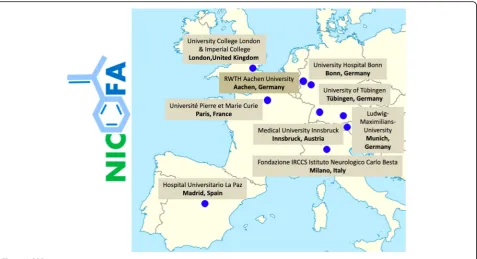
NICOFA will be performed at 10 academic hospital centres across Europe (Innsbruck, Austria; Paris, France; Milano, Italy; twice in London, United Kingdom; Madrid, Spain; Aachen, Bonn, Munich, and Tübingen in Germany), please see Fig.1. Further details of the participating study sites can be obtained at ClinicalTrials.gov NCT03761511.
Eligibility criteria
chosen based on natural history data of disease progres-sion [8,9].
Interventions
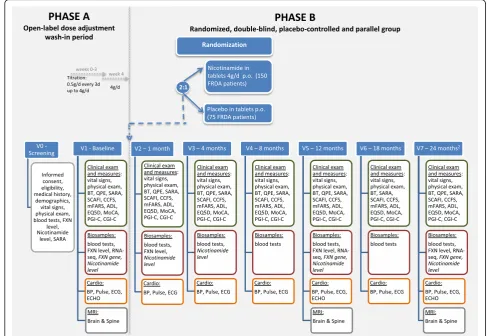
Patients will undergo a 4 week, open-label, dose-adjustment period (Phase A), see also Fig. 2. This is an open-label dose adjustment wash-in period with nico-tinamide: All patients will be slowly titrated with an i-ncrease of 0.5 g nicotinamide every 3 days up to a dose of 4 g/day. Thus, the titration period will be 3 weeks, patients should then be stable on 4 g/d or the highest tolerated dose for 1 week. Phase A is immediately
followed by a 2:1 randomization forPhase B
compromis-ing the weeks 5–104. InPhase Bthere are two arms. The
nicotinamide Group (2/3 of patients) receiving 4 g
nicotinamide (capsules) or highest tolerated dose with a minimum of 2 g/d per os once daily and the Placebo Group (1/3 of patients) receiving matching Placebo (capsules) once daily. The expected duration of patient re-cruitment into the study will be 12 months; the study will be 24 months per patient and in total 36 months including evaluation and clinical study report.
Safety assessments will consist of monitoring and recording all adverse events and serious adverse events, the regular monitoring of blood and urine values, regular measurement of vital signs and the performance of phys-ical examinations including cardiologphys-ical signs.
Patients are allowed to continue participation in natural history studies but not in other clinical trials during participation in NICOFA.
Outcomes
The primary objective of the study is to evaluate the effi-cacy of daily doses of nicotinamide in slowing disease progression as measured by changes in the SARA as compared with placebo in patients with FA. SARA is val-idated for FA and shown to be the most suitable meas-ure of disease progression in FA [8,9].
Secondary objectives are to determine the change of sec-ondary endpoints such as quality of life, functional motor and cognitive measures, clinician’s and patient’s global impression-change scales as well as the up-regulation of the frataxin protein level, safety and survival/death. Sec-ondary endpoints will include: Activity of Daily Living (ADL), part of the Friedreich ataxia rating scale (FARS), the EuroQol five dimensions questionnaire (EQ-5D); the modified Friedreich Ataxia Rating Scale (mFARS) [15], the Spinocerebellar Ataxia Functional Index (SCAFI) [16]; the Composite Cerebellar Functional Severity (CCFS), the up-regulation of frataxin protein level, the Clinician’s Global
Impression-Change Scale (CGI-C); the Patient’s Global
Impression-Change Scale (PGI-C), and safety and
survival/death. Tertiary objectives are mainly cognitive (Montreal Cognitive Assessment (MoCA)), genetics, car-diological (echocardiogram), and neuroimaging measures of the central nervous system (spinal cord and brain mag-netic resonance imaging (MRI)) [17,18].
Participant timeline
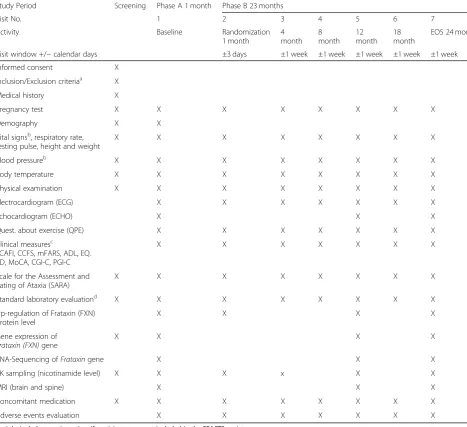
The study duration is 24 months per patient, in total 39 months including evaluation and clinical study report
(Fig. 2, Table 2). The recruitment period will last 12 months, and data cleaning, processing, analysis and reporting about 3 months.
Sample size
Within the EFACTS register [8, 9], inclusion of patients with a SARA < 28 and an age < 50 years resulted in a slope i.e. the progression in SARA score of 1.19 per year; established by fitting a linear mixed effects model to the data. To determine a 50% reduction in the progression in the treatment group by a corresponding linear mixed effects model was used to test the difference in the slopes at the (two-sided) 5% significance level with a two-year observational period and scheduled visit at baseline and month 4, 8, 12, 18 and 24, a sample size of 150 + 75 = 225 is required (90% power, 2:1 allocation ratio).
Within the range of observed SARA measurements, it has been shown, that SARA progression is mainly linear over time in a cohort that fulfills the inclusion criteria [8, 9].
Recruitment
For enrolment of the necessary total sample size of 225 patients screening of 360 patients is expected to be
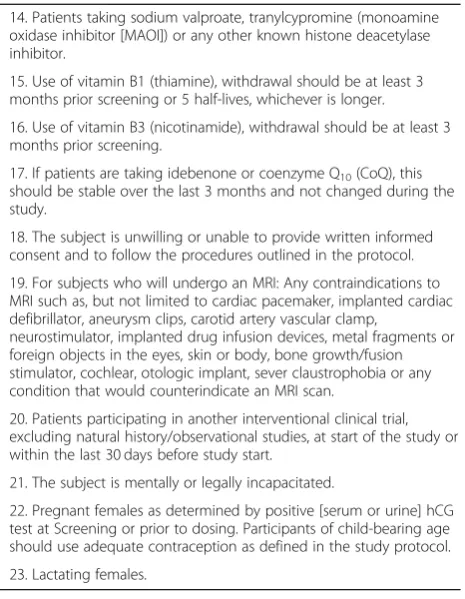
Table 1Inclusion and exclusion criteria
Inclusion Criteria
1. Patients must have a molecular genetic diagnosis of Friedreich ataxia with a GAA-repeat expansion on both alleles of the FXN gene and a SARA Score > 7 and < 28.
2. Patients must be≥18 years and < 50 old and have a weight of at least 50 kg.
3. Written informed consent prior to study participation
4. A female subject is eligible to participate if she is of: Non-childbearing potential defined as pre-menopausal females with a documented tubal ligation or hysterectomy; or postmenopausal defined as 12 months of spontaneous amenorrhea or of childbearing potential and agrees to use of highly effective birth control methods (Pearl Index < 1).
Exclusion Criteria
1. Patients with any medical condition or illness that, in the opinion of the investigator would interfere with study compliance and/or impair the patient’s ability to participate or complete the study.
2. Any uncontrolled medical or neurological/neurodegenerative condition (other than Friedreich ataxia).
3. Clinically significant psychiatric illness (e.g., uncontrolled major depression, schizophrenia, bipolar affective disorder) within 6 months prior to screening.
4. Patients with significant clinical dysphagia that will be screened with dysphagia screening questionnaire.
5. Hypersensitivity to nicotinamide.
6. Patients known to be positive for human immunodeficiency virus (HIV).
7. Patients with a significant history of substance abuse (e.g. alcohol or drug abuse) within the previous 6 months before enrolment. Substance abuse refers to the harmful or hazardous use of psychoactive substances, including alcohol and illicit drugs.
8. Patients with a history of severe allergies.
9. Indication of impaired liver function as shown by an abnormal liver function profile at Screening (e.g., repeated values of aspartate aminotransferase [AST], alanine aminotransferase [ALT] and bilirubin ≥3 × the upper limit of normal).
10. History of malignancy or carcinoma. The following exceptions may be made after discussion with the Sponsor:
•Subjects with cancers in remission more than 5 years prior to screening.
•Subjects with a history of excised or treated basal cell or squamous carcinoma.
•Subjects with prostate cancer in situ.
11. History or evidence of an autoimmune disorder considered clinically significant by the Investigator or requiring chronic use of systemic corticosteroids or other immunosuppressants.
12. History of clinically significant cardiac disease (ejection fraction < 40% [normal range 50–70%], cardiac insufficiency defined as New York Heart Association [NYHA] Class > 2; clinically significant congenital or acquired valvular disease; symptomatic coronary disease such as prior myocardial infarction or angina, B-type natriuretic peptide (BNP) level increase more than 2 x of the normal age- and gender dependent range; history of unstable arrhythmias, history of atrial fibrillation).
13. The subject received an investigational drug within 30 days prior to inclusion into this study.
Table 1Inclusion and exclusion criteria(Continued)
14. Patients taking sodium valproate, tranylcypromine (monoamine oxidase inhibitor [MAOI]) or any other known histone deacetylase inhibitor.
15. Use of vitamin B1 (thiamine), withdrawal should be at least 3 months prior screening or 5 half-lives, whichever is longer.
16. Use of vitamin B3 (nicotinamide), withdrawal should be at least 3 months prior screening.
17. If patients are taking idebenone or coenzyme Q10(CoQ), this should be stable over the last 3 months and not changed during the study.
18. The subject is unwilling or unable to provide written informed consent and to follow the procedures outlined in the protocol.
19. For subjects who will undergo an MRI: Any contraindications to MRI such as, but not limited to cardiac pacemaker, implanted cardiac defibrillator, aneurysm clips, carotid artery vascular clamp,
neurostimulator, implanted drug infusion devices, metal fragments or foreign objects in the eyes, skin or body, bone growth/fusion stimulator, cochlear, otologic implant, sever claustrophobia or any condition that would counterindicate an MRI scan.
20. Patients participating in another interventional clinical trial, excluding natural history/observational studies, at start of the study or within the last 30 days before study start.
21. The subject is mentally or legally incapacitated.
22. Pregnant females as determined by positive [serum or urine] hCG test at Screening or prior to dosing. Participants of child-bearing age should use adequate contraception as defined in the study protocol.
necessary. Patients will be recruited via EFACTS, ataxia outpatient centres and patient advocacies.
Randomization and blinding
The randomization list prepared by the Department of Medical Statistics of the RWTH Aachen University Hospital, Aachen in Germany using randomizeR is stratified by center. The best practice randomization procedure to minimize the impact of selection and time trend bias on the type one error will be selected
via a simulation study (ERDO) [19]. The packaging of
the investigational product and placebo following the randomization list will be done in Mainz, Germany, labelled with a randomisation code. This will maintain concealment and double blinded treatment allocation. After randomization neither the patients nor the in-vestigator or sponsor will be aware of the treatment allocation. Patients assigned to one of the double-blinded treatments will take nicotinamide capsules or matching placebo. The capsules will be identical in
appearance. The involved staff of the Department of Medical Statistics of the RWTH Aachen University Hospital as well as the involved staff of the phar-macy are aware of the randomized treatment alloca-tion sequence but keep the list and informaalloca-tion concealed till closure of the database. Neither the Department of Medical Statistics of the RWTH Aa-chen University Hospital nor the pharmacy are in-volved in patient recruitment.
Statistical analysis
Analyses will be performed within the Full Analysis Set (FAS), which is the set of subjects who have been ran-domized and have taken at least one dose of the trial medication. Evaluation of the primary endpoint SARA score is based on the linear mixed effect model (LMEM) with the fixed effects of treatment, treatment-by-time interaction, center, SARA baseline score and age as well as the random intercept and time. Treatment effect is descripted by 95% confidence intervals based on the
contrast of the treatment progression. Similar models will be used to test the treatment effects for the other outcomes.
Taking into account the concept paper on an adden-dum to ICH E9 statistical principles for clinical trials, we will further model estimates by an advanced sensitivity analysis, i.e. fitting a an ignorable likelihood model to the data [20]. Such model will be fitted using the method
described in Mallinckrodt [20] with the fixed effects
treatment, time and treatment by time interaction as well as the covariates baseline SARA score and the
baseline-by-visit interaction age of onset, age will be fitted to the data.
Perspective
This clinical trial NICOFA will assess the clinical efficacy of an epigenetic therapeutic intervention for FA and provide evidence of possible disease modifying effects of nicotinamide treatment in patients with FA.
Acknowledgements
We thank Charlotte von der Heyde for her support and negotiation in legal and regulatory procedures.
Table 2Visit schedule
Study Period Screening Phase A 1 month Phase B 23 months
Visit No. 1 2 3 4 5 6 7
Activity Baseline Randomization
1 month
4 month
8 month
12 month
18 month
EOS 24 month
Visit window +/−calendar days ±3 days ±1 week ±1 week ±1 week ±1 week ±1 week
Informed consent X
Inclusion/Exclusion criteriaa X
Medical history X
Pregnancy test X X X X X X X X
Demography X X
Vital signsb, respiratory rate, resting pulse, height and weight
X X X X X X X X
Blood pressureb X X X X X X X X
Body temperature X X X X X X X X
Physical examination X X X X X X X X
Electrocardiogram (ECG) X X X X X X X
Echocardiogram (ECHO) X X X
Quest. about exercise (QPE) X X X X X X X
Clinical measuresc
SCAFI, CCFS, mFARS, ADL, EQ. 5D, MoCA, CGI-C, PGI-C
X X X X X X X
Scale for the Assessment and Rating of Ataxia (SARA)
X X X X X X X X
Standard laboratory evaluationd X X X X X X X X
Up-regulation of Frataxin (FXN) protein level
X X X X
Gene expression of Frataxin (FXN)gene
X X X X
RNA-Sequencing ofFrataxingene X X X
PK sampling (nicotinamide level) X X X x X X
MRI (brain and spine) X X X
Concomitant medication X X X X X X X X
Adverse events evaluation X X X X X X X
a
might include genetic testing, if participants are not included in the EFACTS registry
b
after at least 15 min of resting
c
ADLActivity of daily living,CCFSComposite cerebellar functional severity,CGI-CClinician’s global impression-change scale,EQ. 5DEuroQol five dimensions questionnaire,INASInventory of non-ataxia signs,MoCAMontreal cognitive assessment,PGI-CPatient’s global impression-change scale,SCAFISpinocerebellar ataxia functional index,EOSEnd of Study
d
Further members of the EFACTS or NICOFA study group Austria:
Wolfgang Nachbauer, MD (Medical University Innsbruck; Site Investigator) Andreas Eigentler, MD (Medical University Innsbruck; Site Investigator) Elisabetta Indelicato, MD (Medical University Innsbruck; Site Investigator) Matthias Amprosi, MD (Medical University Innsbruck; Site Investigator) This study funded by the Austrian Science Fond (FWF grant I-3352-B28) within the E-RARE Program (ERARE16-FP-045)
France:
Perrine Charles, MD (Pitié-Salpêtrière University Hospital, Paris; Site Investigator).
Claire Ewenczyk, MD (Pitié-Salpêtrière University Hospital, Paris; Site Investigator)
Anna Heinzmann, MD, (Pitié-Salpêtrière University Hospital, Paris; Site Investigator)
Germany:
Florian Holtbernd, MD (RWTH Aachen University, Aachen; Site Investigator) Ilaria A Giordano, MD (University Hospital of Bonn, Bonn; Site Investigator) Okka Kimmich, MD (University Hospital of Bonn, Bonn; Site Investigator) Florentine Radelfahr, MD (University of Munich, Munich; Site Investigator) Claudia Stendel, MD (University of Munich, Munich; Site Investigator) Stefanie Hayer, MD PhD (University of Tübingen, Tübingen; Site Investigator) Italy:
Mario Fichera, MD (Fondazione IRCCS Istituto Neurologico Carlo Besta, Milan; Site Investigator)
Lorenzo Nanetti, MD (Fondazione IRCCS Istituto Neurologico Carlo Besta, Milan; Site Investigator)
Anna Castaldo, MSc (Fondazione IRCCS Istituto Neurologico Carlo Besta, Milan; Study Coordinator)
Spain:
Javier Arpa, MD (Hospital Universitario La Paz, Madrid; Site Investigator) Irene Sanz-Gallego, MD (Hospital Universitario La Paz, Madrid; Site Investigator)
United Kingdom:
Daphne Babalis, PhD (Imperial Clinical Trials Unit, Imperial College London, London, United Kingdom; Operations Manager)
Margarita Durkina (Imperial Clinical Trials Unit, Imperial College London, London, United Kingdom; Trial Manager)
Authors’contributions
JBS, KR, RF, PG, TK, RDH, PL, SI, MD and VL contributed to the design of the study. KR drafted this version. RDH performed the statistical analysis. All authors read, revised and approved the final manuscript.
Funding
This study is funded by the German Research Foundation (DFG SCHU 932/10–1, KL 795/4–1) within the E-RARE Program (ERARE16-FP-045) and the Efficacy and Mechanism Evaluation (EME) Program, an MRC and NIHR partnership (EME Ref 17/90/01 to RF). The research was supported by the National Institute for Health Research (NIHR) Biomedical Research Centres (BRC) based at Imperial College Healthcare NHS Trust/Imperial College London and University College London Hospitals (UCLH)/University College London (UCL). The views expressed in this publication are those of the author(s) and not necessarily those of the MRC, NIHR or the Department of Health and Social Care.
This research was embedded in the research of the IDeAl project funded from the European Union Seventh Framework Programme [FP7 2007–2013] under grant agreement No. 602552 supporting the work of RDH and GM. RDHs work is currently supported from the European Joint Programme on Rare Diseases within European Union’s Horizon 2020 research and innovation programme under grant agreement No. 825575.
Availability of data and materials
At individual level and adhering to the General Data Protection Regulation, every patient has the right to get access to their personal data. Data are available upon request.
Ethics approval and consent to participate
The study will be performed according to good clinical practice guidelines and in full conformity with the Declaration of Helsinki and the national or local laws and regulations of each participating site. The study was approved
by the appropriate institutional review boards in Germany (ethical board of the Medical Faculty, RWTH Aachen University, Germany [EK 021/18], Federal Institute for Drugs and Medical Devices [BfArM 61-3910-4042490,www. bfarm.de) and will a seek ethical and regulatory approval from all participating sites across Europe prior to study start at each site. Before enrolment, all patients will provide written informed consent. We initiated a Data Monitoring Committee (DMC) of an independent group of experts that advises NICOFA and the study investigators. The DMC will periodically review and evaluate the accumulated study data for participant safety, study conduct and progress, and, when appropriate, efficacy, and make recommendations to NICOFA concerning the continuation, modification, or termination of the trial. The study is registered (EudraCT-No.: 2017-002163-17, ClinicalTrials.gov NCT03761511). The sponsor is the RWTH Aachen University, Germany represented by the Dean of the Medical Faculty.
Consent for publication
Not applicable.
Competing interests
The authors declare that they have no competing interests.
Author details
1Department of Neurology, RWTH Aachen University, Pauwelsstraße 30, 52074 Aachen, Germany.2JARA-BRAIN Institute Molecular Neuroscience and Neuroimaging, Forschungszentrum Jülich GmbH and RWTH Aachen University, 52074 Aachen, Germany.3Department of Medical Statistics, RWTH Aachen University, Pauwelsstraße 19, Aachen, Germany.4Center for Translational & Clinical Research Aachen (CTC-A), RWTH Aachen University, Pauwelsstraße 30, Aachen, Germany.5Unit of Genetics of Neurodegenerative and Metabolic Diseases, Fondazione IRCCS Istituto Neurologico Carlo Besta, Milan, Italy.6Genetic Department, ICM (Brain and Spine Institute) Sorbonne Universités, UPMC University Paris 06 UMR S 1127, and INSERM U 1127, CNRS UMR 7225 and APHP, Pitié-Salpêtrière University Hospital, Paris, France. 7Department of Neurology, Medical University Innsbruck, Innsbruck, Austria. 8Department of Neurology, Friedrich Baur Institute, University Hospital of the Ludwig-Maximilians-Universität Munich, Munich, Germany.9German Center for Neurodegenerative Diseases (DZNE), Munich, Germany.10Munich Cluster for Systems Neurology (SyNergy), Munich, Germany.11Reference Unit of Hereditary Ataxias and Paraplegias, Department of Neurology, IdiPAZ, Hospital Universitario La Paz, Madrid, Spain.12Department of Neurodegenerative Diseases, Hertie-Institute for Clinical Brain Research, University of Tübingen, Tübingen, Germany.13German Center for Neurodegenerative Diseases (DZNE), Tübingen, Germany.14Department of Neurology, University Hospital of Bonn, Bonn, Germany.15German Center for Neurodegenerative Diseases (DZNE), Bonn, Germany.16Laboratory of Experimental Neurology, Université Libre de Bruxelles, Brussels, Belgium. 17Ethical Commission, Albert-Ludwigs-University Freiburg, Engelbergstr. 21, 79106 Freiburg, Germany.18Boston Biostatistics Research Foundation, Framingham, MA, USA.19Interuniversity Institute for Biostatistics and Statistical Bioinformatics, UHasselt and KU Leuven, Leuven, Belgium.20NIHR UCLH Clinical Research Facility-Leonard Wolfson Experimental Neurology Centre, University College London (UCL) Institute of Neurology, London, UK. 21
Department of Molecular Neuroscience, University College London (UCL) Institute of Neurology, London, UK.22Gene Control Mechanisms and Disease Group, Department of Medicine, Division of Brain Sciences and MRC London Institute for Medical Sciences, Imperial College London, Hammersmith Hospital, London, UK.
Received: 31 July 2019 Accepted: 5 August 2019
References
1. Reetz, K., et al. (2018). Nonataxia symptoms in Friedreich ataxia: Report from the registry of the European Friedreich’s Ataxia Consortium for Translational Studies (EFACTS).Neurology, 91,e917–e930.
2. Schulz, J. B., et al. (2009). Diagnosis and treatment of Friedreich ataxia: A European perspective.Nature Reviews Neurology, 5(4), 222–234.
4. Saveliev, A., et al. (2003). DNA triplet repeats mediate
heterochromatin-protein-1-sensitive variegated gene silencing.Nature, 422(6934), 909–913.
5. Chan, P. K., et al. (2013). Heterochromatinization induced by GAA-repeat hyperexpansion in Friedreich’s ataxia can be reduced upon HDAC inhibition by vitamin B3.Human Molecular Genetics, 22(13), 2662–2675.
6. Libri, V., et al. (2014). Epigenetic and neurological effects and safety of high-dose nicotinamide in patients with Friedreich’s ataxia: An exploratory, open-label, dose-escalation study.Lancet, 384(9942), 504–513.
7. Al-Mahdawi, S., et al. (2006). GAA repeat expansion mutation mouse models of Friedreich ataxia exhibit oxidative stress leading to progressive neuronal and cardiac pathology.Genomics, 88(5), 580–590.
8. Reetz, K., et al. (2015). Biological and clinical characteristics of the European Friedreich’s Ataxia Consortium for Translational Studies (EFACTS) cohort: A cross-sectional analysis of baseline data.Lancet Neurology, 14(2), 174–182.
9. Reetz, K., et al. (2016). Progression characteristics of the European Friedreich’s Ataxia Consortium for Translational Studies (EFACTS): A 2 year cohort study.Lancet Neurology, 15(13), 1346–1354.
10. Vaquero, A., et al. (2007). SIRT1 regulates the histone methyl-transferase SUV39H1 during heterochromatin formation.Nature, 450(7168), 440–444. 11. Hoane, M. R., Kaplan, S. A., & Ellis, A. L. (2006). The effects of nicotinamide on
apoptosis and blood-brain barrier breakdown following traumatic brain injury.Brain Research, 1125(1), 185–193.
12. Spector, R., & Kelley, P. (1979). Niacin and niacinamide accumulation by rabbit brain slices and choroid plexus in vitro.Journal of Neurochemistry, 33(1), 291–298.
13. Knip, M., et al. (2000). Safety of high-dose nicotinamide: A review. Diabetologia, 43(11), 1337–1345.
14. Gale, E. A., et al. (2004). European Nicotinamide Diabetes Intervention Trial (ENDIT): A randomised controlled trial of intervention before the onset of type 1 diabetes.Lancet, 363(9413), 925–931.
15. Subramony, S. H., et al. (2005). Measuring Friedreich ataxia: Interrater reliability of a neurologic rating scale.Neurology, 64(7), 1261–1262. 16. Schmitz-Hubsch, T., et al. (2008). SCA functional index: A useful
compound performance measure for spinocerebellar ataxia.Neurology, 71(7), 486–492.
17. Dogan, I., et al. (2019). Structural characteristics of the central nervous system in Friedreich ataxia: An in vivo spinal cord and brain MRI study. Journal of Neurology, Neurosurgery, and Psychiatry, 90(5), 615–617. 18. Dogan, I., et al. (2016). Cognition in Friedreich’s ataxia: A behavioral and
multimodal imaging study.Annals of Clinical Translational Neurology, 3(8), 572–587.
19. Hilgers, R. D., et al. (2017). ERDO - a framework to select an appropriate randomization procedure for clinical trials.BMC Medical Research Methodology, 17(1), 159.
20. Mallinckrodt, C. H., Clark, W. S., & David, S. R. (2001). Accounting for dropout bias using mixed-effects models.Journal of Biopharmaceutical Statistics, 11(1–2), 9–21.
Publisher’s Note