R E S E A R C H
Open Access
Analysis of biodegradation performance of
furfural and 5-hydroxymethylfurfural by
Amorphotheca resinae
ZN1
Hong Ran
1, Jian Zhang
1, Qiuqiang Gao
1, Zhanglin Lin
2and Jie Bao
1*Abstract
Background:Furfural and 5-hydroxymethylfurfural (HMF) are the degradation products of lignocellulose during pretreatment operations and significantly inhibit the consequent enzymatic hydrolysis and fermentation processes. The biodetoxification fungusAmorphotheca resinaeZN1 had demonstrated its excellent capacity on degrading lignocellulose derived inhibitors and helped the fermentation processes to achieve high yield of ethanol and biochemicals. Analysis of the biological degradation performance of furfural and HMF byA. resinaeZN1 will provide essential information for their fast and complete removal from the pretreated lignocellulose materials and facilitate the consequent ethanol fermentation.
Results:The degradation performance of furfural and HMF byA. resinaeZN1 was investigated by capturing intermediate metabolic products at various culture conditions.A. resinaeZN1 converts furfural/HMF into furfuryl/ HMF alcohols and furoic/HMF acids simultaneously at aerobic condition, and only the corresponding furfuryl/HMF alcohols are obtained at anaerobic condition. The existence of glucose accelerates the degradation rate of furfural and HMF byA. resinaeZN1 and the cell mass growth rate aerobically. Remarkably, glucose is not consumed before furfural or HMF is degraded to a low threshold concentration. The finding suggests that furfural or HMF has a substrate priority of utilization byA. resinaeZN1 than glucose. This property may help the detoxification of furfural and HMF to be operated without consuming glucose.
Conclusions:The biological degradation performance of furfural and HMF byA. resinaeZN1 was investigated experimentally. Oxygen supply is important on the complete biodegradation of furfural and HMF byA. resinaeZN1. Furfural or HMF has the priority of substrate utilization than glucose byA. resinaeZN1. This study provided
important information for detoxification enhancement and strain modification.
Keywords:Biodegradation, furfural, 5-hydroxymethylfurfural,Amorphotheca resinaeZN1, lignocellulose, pretreatment, oxygen supply, substrate priority
Background
Pretreatment is the crucial step to overcome the biorecal-citrance of lignocellulose for its hydrolysis and fermenta-tion into biofuels and biochemicals [1,2]. Currently, all the available pretreatment methods, including the classical di-lute acid, steam explosion [3], and alkali [4], as well as the new concepts using ionic liquids [5] and microwave [6], are inevitable to convert partial lignocellulose biomass into various small compounds, including furan derivatives
such as furfural and 5-hydromethylfurfural (HMF), organic acids such as acetic acid, formic acid, and levulinic acid, as well as phenolic compounds such as vanillin, syrin-galdehyde, 4-hydroxybenzaldehyde, coniferyl aldehyde, ferulic acid, and cinnamic acid [7,8]. These compounds are strong inhibitors of cellulase enzyme and fermenting strains [9,10]. Among the inhibitor compounds that were mentioned, furfural and HMF are considered as the major inhibitors because the two are high in concentration and strong in inhibition strength to ethanol fermenting strains [10,11]. Furfural or HMF attacks the cell membrane and interferes with intracellular metabolism [12]. Once it has entered cells, its hydrophobic groups combine with various * Correspondence:[email protected]
1
State Key Laboratory of Bioreactor Engineering, East China University of Science and Technology, 130 Meilong Road, Shanghai 200237, China Full list of author information is available at the end of the article
intracellular enzymes, making them lose the ability to combine with the substrate, especially glycolysis en-zymes [13,14].
Although a mild pretreatment may yield fewer inhibitor compounds, the practical industrial processes still need the intensively pretreated lignocellulose feedstock for a high bioconversion yield. The intensive pretreatment inevitably accompanies the high inhibitor-generation, thus, the complete removal of inhibitors from pretreated lignocellulose materials using physical, chemical, or bio-logical methods, ordetoxification, is an important step [15]. The common methods include water washing, over-liming, ammonia neutralization, ion exchange absorption, solvent extraction and activated charcoal treatment [16-18]. How-ever, these methods consume massive amounts of fresh water and generate a great amount of polluting waste water, along with significant loss of fine lignocellulose par-ticles and fermentative sugars [19]. In recent years, a new method, biodetoxification, was proposed using unique microorganisms to degrade the inhibitor compounds biologically [20,21]. Biodetoxification had been applied to various biorefining processes and has demonstrated its unique advantages, such as mild condition, complete removal of inhibitors, low sugar-loss, and minimum waste-water generation [20-22].
Several biodetoxification strains had been applied to degrade the lignocelluloses-derived inhibitor compounds. Zhanget al. [23] found thatClostridium acetobutylicum
ATCC 824 converts furfural/HMF to furfuryl alcohol/2,
5-bis-hydroxymethylfuran. Koopman et al. [24]
intro-duced the furfural/HMF oxidoreductase gene hmfH into
Pseudomonas putida S12 for conversion of highly con-centrated HMF (6.3 g/L) to its low inhibitory mesostate, 2, 5-furandicarboxylic acid. Liuet al. [10] studied the stress
tolerance of Saccharomyces cerevisiae ATCC 211239 and
NRRL Y-12632, as well as Pichia stipitisNRRL Y-7124 on
furfural and HMF, and the results showed thatS. cerevisiae
NRRL Y-12632 transformed furfural/HMF into furfuryl alcohol/2,5-bis-hydroxymethylfuran. Nicholset al. [25]
isolated a fungal, Coniochaeta ligniaria NRRL30616,
which could convert furfural to both furfuryl alcohol and furoic acid. Taherzadehet al. [26] studiedS. cerevisiae
CBS 8066 and discovered that it converted HMF into
C4H3O-CO-COH (COOH)-CH3, then became HMF
alcohol. Liuet al. [27] analyzed the evolutionarily
engi-neered S. cerevisiae NRRL Y-50049 strain and found
that a well-maintained redox balance is crucially im-portant for the robust tolerance of the yeast to furfural and HMF when they transformed furfural/HMF into furfuryl alcohol/HMF alcohol.
In our previous study, a kerosene fungus strain
Amorphotheca resinae ZN1 was isolated from micro-bial communities on pretreated corn stover materials.
A. resinae ZN1 was found to quickly degrade various
furan derivatives, organic acids, and phenolic compounds. Then it was practically applied to degrade the inhibitors on dilute acid-pretreated corn stover and the consequent sim-ultaneous saccharification and fermentation for production of ethanol, microbial lipid, and lactic acid, with dramatic decreases in fresh waste use, waste water generation, solids loss and energy consumption [21]. This work promoted
A. resinae from being considered a harmful strain (that grows in aviation kerosene fuel tanks and blocks pipelines) to a new field, since its discovery in the 1970s [28].
In this study, the degradation pathways of the two furan derivatives from the pretreated lignocellulose, furfural and HMF, byA. resinaeZN1, were experimentally investigated and analyzed. First, the degradation products from furfural and HMF were identified when furfural or HMF was used as the sole carbon source at different oxygen levels. Then, the effect of the presence of glucose on the degradation
and its pathways of A. resinae ZN1 were investigated.
Finally, the degradation pathways of furfural and HMF byA. resinaeZN1 were proposed based on the experimen-tal results and the similar previous pathways studies [29]. This study provided essential information for enhanced
understanding of the degradation pathway ofA. resinae
ZN1 for the future improvement of detoxification effi-ciency and metabolic modification of the strain.
Results and discussion
Degradation of furfural and HMF when furfural or HMF was the sole carbon source
The metabolic performance ofA. resinaeZN1 using furfural or HMF as the sole carbon source (without glucose addition in the culture medium) was tested under aerobic and anaer-obic conditions. Before these biodegradation experiments of furfural and HMF, the control experiments of furfural and HMF degradation in the bioreactor were carried out in the aerobic condition but in the absence of microbes (Additional file 1: Figure S1). When no microbe existed in the culture system, the aerated airflow blew approximately 50% volatile furfural out within 50 hours, but no furfuryl alcohol or furoic acid was observed (Additional file 1: Figure S1a). On the other hand, furfuryl alcohol concentra-tion remained constant within the 120-hour experimental period, and no furfural or furoic acid formation was observed (Additional file 1: Figure S1b). For HMF, both HMF and HMF alcohol remained constant in the 120-hour period, and no HMF acid formation was observed (Additional file 1: Figure S1c-d). The results indicate that the aeration did not lead to the direct oxidation of either furfural/furfuryl alcohol, or HMF/HMF alcohol into their corresponding acid forms. This is in agreement with the previous studies showing that furfural could not be oxidized by air directly at ambient temperature [30-33].
source (Additional file 1: Figure S2a). Furfuryl alcohol in-creased gradually from the very beginning and minor furoic acid was observed at the late stage of the culture. HMF was degraded in a similar way with furfural in the anaerobic con-dition, but with a faster rate (Additional file 1: Figure S2b). The HMF alcohol increased correspondingly with the decrease of HMF, but no HMF acid was observed during the HMF degradation.
Figure 1 shows the time courses of the degradation of furfural in the aerobic condition with a different air rate when furfural was used as the sole carbon source. At the aeration rate of 0.625 volume per volume per minute (vvm) in Figure 1a, the sum of furfuryl alcohol and furoic acid was approximately 7.5 mmol after 50 hours of cultivation. The data accounted for 75% of the ori-ginal furfural (10 mmol) approximately, indicating that
approximately 25% of the original furfural was lost by the aeration at 0.625 vvm. At the aeration rate of 1.25 vvm in Figure 1b, the sum of furfuryl alcohol and furoic acid was approximately 5.8 mmol after 30 hours, accounting 80% of the original furfural (7.2 mmol), thus, approximately 20% of furfural was lost. The loss of furfural in the presence of microbes was only less than half compared to the loss of furfural at the same air rate in the control experiment, perhaps due to the simultaneous removal of furfural by aeration and biodeg-radation, thus, the furfural concentration more reduced quickly than that in the control experiment. Figure 1 indi-cates that the degradation rate of furfural was improved significantly in the aerobic condition compared to that in the anaerobic condition when furfural was used as sole carbon source, even considering the aeration loss of
0.0 0.2 0.4 0.6 0.8 1.0 1.2 1.4
0 10 20 30 40 50 60 70 80 90 100 110 120
Furfural and its derivatives (g/L)
Furfural and its derivatives (g/L)
Time (hour)
(a)
FurfuralFurfuryl alcohol Furoic acid
0.0 0.2 0.4 0.6 0.8 1.0 1.2 1.4
0 10 20 30 40 50 60 70 80 90 100 110 120
Time (hour)
(b)
FurfuralFurfuryl alcohol Furoic acid
Figure 1Degradation of furfural byA. resinaeZN1 in the aerobic condition without glucose. (a)Air rate at 0.625 volume per volume per
furfural. Furfural was completely degraded after 64 hours, compared to only 35% degradation of furfural in the anaer-obic condition over the same time period. The quick formation of furfuryl alcohol and furoic acid was also observed with the decreasing furfural. Figure 1b shows the rates were similar for furfural degradation and furfuryl alcohol formation, and decreased furoic acid level at the two air input rates (0.625 vvm and 1.25 vvm). The major difference with the increased air input was the faster de-crease of furfuryl alcohol when it reached the maximum.
Figure 2 shows the time courses of HMF degradation in different aerobic conditions (0.625 vvm and 1.25 vvm) when HMF was used as the sole carbon source. The HMF decrease was approximately balanced with the increase in HMF alcohol and HMF acid in both aeration rates. This result was in agreement with the control experiment for
HMF (Additional file 1: Figure S1c-d) in which both HMF and HMF alcohol remained constant during aeration. Compared to the strictly anaerobic degradation of HMF (Additional file 1: Figure S2b, the HMF degradation at the two aeration rates (0.625 vvm and 1.25 vvm) was not sig-nificantly changed. The major observable change was the formation of HMF acid with the aerobic culture, whereas almost no HMF acid was observed in the anaerobic culture (Additional file 1: Figure S2b).
A significant increase of cell mass was observed with the aerobic culture compared to the anaerobic culture. However, the change in cell mass was not qualitatively recorded during the degradation culture, because of difficulties in sampling due to severe flocculation of the cell mycelium on the stirrer and the wall of the fermentor.
0.0 0.2 0.4 0.6 0.8 1.0 1.2 1.4
0 10 20 30 40 50 60 70 80 90 100 110 120
Time (hour)
(a)
HMFHMF alcohol HMF acid
0.0 0.2 0.4 0.6 0.8 1.0 1.2 1.4
0 10 20 30 40 50 60 70 80 90 100 110 120
Time (hour)
(b)
HMFHMF alcohol HMF acid
HMF and its derivatives (g/L)
HMF and its derivatives (g/L)
Figure 2Degradation of 5-hydroxymethylfurfural (HMF) byA. resinaeZN1 in the aerobic condition without glucose. (a)Air rate at 0.625
These results suggest that A. resinae ZN1 degrades furfural and HMF into their less toxic metabolites, furfuryl alcohol and HMF alcohol, respectively, without other carbon sources in both anaerobic and aerobic condi-tions. With the aerobic conditions, furfural and HMF were converted into the corresponding alcohols, as well as their corresponding acids. However, with the anaerobic condition, furfural and HMF were converted into alcohols only with the further conversion to the corresponding acids. In respect to the degradation rate, furfural degradation was significantly accelerated in the aer-obic condition compared to the rate with the anaeraer-obic condition. However, HMF degradation was not significantly affected by the switch of anaerobic to the aerobic culture, indicating that the HMF degradation was not sensitive to the presence of oxygen in its degradation pathways.
Degradation of furfural and HMF when glucose was present with furfural or HMF
Pretreatment is generally accompanied with the partial hydrolysis of cellulose into glucose, thus, biodetoxification is frequently operated in the presence of a certain level of glucose. Therefore, the degradation of furfural and HMF by
A. resinaeZN1 in the presence of glucose was examined. First, the furfural and HMF degradation in the presence of glucose were investigated with the strictly anaerobic condition as shown in Figure 3. The result indicates that both the degradation of furfural and HMF, as well as the formation of furfuryl alcohol or HMF alcohol was very slow compared to that without the addition of glucose (Additional file 1: Figure S2). Glucose consumption was also very slow. Only half of the initial glucose and inhibitors were degraded (furfural, Figure 3a), or less than half were degraded (HMF, Figure 3b) in the overall degrad-ation culture period of 104 hours). The results revealed that the presence of glucose inhibited, rather than pro-moted, the degradation metabolism of furfural and HMF in the anaerobic condition.
However, in the aerobic condition, the degradation of fur-fural and HMF in the presence of glucose was accelerated significantly. Figure 4 shows that furfural was completely degraded within 60 to 70 hours at the two aeration rates, and the degradation rates at 0.625 vvm (Figure 4a) and 1.25 vvm (Figure 4b) were approximately the same. Also the fur-fural decrease at 56 hours was approximately balanced with the increase of furfuryl alcohol and furoic acid, in which there was only 6% loss of furfural by aeration at 0.625 vvm (Figure 4a), and was almost completely balanced at 1.25 vvm (Figure 4b). Figure 4 indicates that furfuryl alcohol was formed with the decreasing furfural, then declined from its maximum, and the formation of furoic acid was observed.
Figure 5 shows that HMF was completely degraded within 60 hours at the two aeration rates, and similarly to furfural degradation in Figure 4, the increase of aeration
rate did not give observable effects on HMF degradation. The balance in mass with the HMF decrease was in agreement with the formation of HMF alcohol and HMF acid, and similar to furfural degradation Figure 5 indicates that HMF alcohol was produced correspond-ingly with decreasing HMF, but HMF alcohol was not reduced from the maximum, and only a small amount of HMF acid was formed.
Figures 4 and 5 reveal an interesting phenomenon where by in the aerobic condition glucose consumption was very slow at the beginning of the culture, but was suddenly accelerated when furfural or HMF was almost completely degraded (more than 90% of furfural or HMF was degraded). The finding suggests that furfural
and HMF substrates had the priority for A. resinaeZN1
utilization rather than glucose in the aerobic condition.
This important property ofA. resinaeZN1 may help the
detoxification of furfural and HMF without consuming glucose, thus, glucose could be preserved in the detoxifica-tion step and utilized in the consequent fermentadetoxifica-tion step for production of ethanol.
In the degradation experiment, the cell mass was not quantitatively measured because the hyphae and spores constantly aggregated and adhered to the wall and the stirrer of the fermentor.A. resinaeZN1 grew in the aerobic condition, but almost ceased growth in anaerobic
condi-tions. When glucose was added to the medium,A. resinae
ZN1 remained as spores with minor hyphae in the early period of culture, and then the spores turned black because of the generation of melanins, dark brown or black pig-ments located in cell walls [34,35]. Finally, a thick spore layer was absorbed onto the fermentor wall and a large amount of hyphae formed inside the culture medium.
Analysis of degradation pathways of furfural and HMF by A. resinaeZN1
Biological degradation of furfural and HMF is an interesting topic and various pathways for different microorganisms have been proposed [29,36]. In this study, the degradation pathway for furfural and HMF byA. resinaeZN1 was care-fully investigated for its importance in inhibitor removal in lignocellulose biorefinery processing. Some interesting re-sults are summarized as follows: 1)A. resinaeZN1 converts furfural into furfuryl alcohol as the first step of degradation in all the experimental conditions. Under the aerobic condi-tion (sufficient oxygen supply),A. resinaeZN1 converts fur-fural into furfuryl alcohol and furoic acid; under the strictly anaerobic condition (without oxygen supply), the con-version of furfural stops at furfuryl alcohol, furoic acid is not generated; 2) similar to furfural conversion, in all
the experimental conditionsA. resinaeZN1 converts HMF
into HMF alcohol first. In the aerobic condition,A. resinae
and almost no HMF acid is generated without glucose; under anaerobic condition, similar to furfural degradation, the conversion of HMF stops at the HMF alcohol; and 3)
A. resinaeZN1 has obvious priority over glucose for the utilization of furfural and HMF. When furfural or HMF is maintained at high levels, glucose is almost un-utilizedby
A. resinaeZN1. The quick uptake of glucose byA. resinae
ZN1 occurs only when furfural or HMF is reduced to a low-threshold concentration (lower than 0.2 g/L).
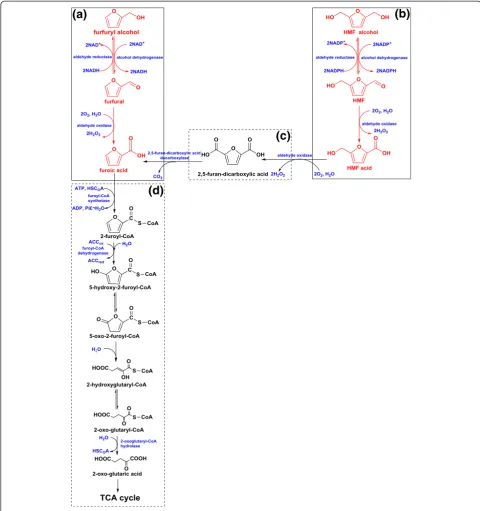
Based on the above experimental results forA. resinae
ZN1 and the previous pathway studies of Cupriavidus
basilensisHMF14 by Koopmanet al. [29], the degradation
pathway ofA. resinaeZN1 for furfural and HMF could be
proposed as shown in Figure 6.
The proposed pathway is as follows: 1) Furfural or HMF is converted to the corresponding furfuryl alcohol or HMF alcohol, as the first step by alcohol dehydrogenase or aldehyde reductase, instead of the conversion to furoic acid or HMF acid directly (boxes A and B in Figure 6). The reason is that forboth furfural and HMF, furoic acid and HMF acid has the stronger toxicity to microbes than furfuryl alcohol and HMF alcohol [7], thus the first step of
conversion releases A. resinae ZN1 from the most toxic
inhibitor of furfural or HMF, to the relatively weaker in-hibitors of furfuryl alcohol or HMF alcohol. Also, the ex-istence of furfural (HMF) is more sensitive to the activity of aldehyde oxidase than to alcohol dehydrogenase, thus, the conversion to furfuryl (HMF) alcohol is preferred
0 2 4 6 8 10 12 14 16 18 20
0.0 0.2 0.4 0.6 0.8 1.0 1.2 1.4
0 10 20 30 40 50 60 70 80 90 100 110 120
Glucose (
g
/L)
Furfural and its derivatives (g/L)
Time (hour)
(a)
FurfuralFurfuryl alcohol Furoic acid Glucose
0 2 4 6 8 10 12 14 16 18 20
0.0 0.2 0.4 0.6 0.8 1.0 1.2 1.4
0 10 20 30 40 50 60 70 80 90 100 110 120
Glucose (
g
/L)
HMF and its derivatives (g/L)
Time (hour)
(b)
HMFHMF alcohol HMF acid Glucose
Figure 3Degradation of furfural and 5-hydroxymethylfurfural (HMF) byA. resinaeZN1 in anaerobic conditions with glucose. (a)furfural;
to furoic (HMF) acid [37]; 2) under the aerobic condi-tion, furfuryl alcohol is oxidized to furfural again by alcohol dehydrogenase or aldehyde reductase, and then to furoic acid, consequently by aldehyde oxidase in the presence of oxygen (boxes A and B in Figure 6). In the two consequent conversion steps, furfural or HMF is maintained at a very low level so that it does not affect the microbial growth and metabolism; 3) under anaer-obic conditions, the degradation pathway of furfural or HMF stops at the step of furfuryl alcohol or HMF alcohol and the conversion into the corresponding acids does not occur. The presence of oxygen is the prerequisite condition for the degradation of furfuryl alcohol or HMF alcohol to the corresponding acids. The oxygen-independent aldehyde oxidase may be missing or inactive for the conversion from
furfural (HMF) to furoic (HMF) acid in the anaerobic
condition; 4) based on analysis of C. basilensisHMF14
by Koopmanet al., it is estimated that HMF acid is oxidized to 2,5-furan-dicarboxylic acid by aldehyde oxidase, then to furoic acid by 2,5-furan-dicarboxylic acid decarboxylase [29] as shown (Figure 6, box c). By these two step conver-sions, the HMF degradation pathway (Figure 6, box b) joins the furfural degradation pathway (Figure 6, box a) at the final step of furoic acid formation. Then furoic acid is con-verted to 2-oxo-glutaric acid through six steps, then joins the tricarboxylic acid (TCA) cycle to complete the degrad-ation as shown (Figure 6, box D) [29]; 5) the reason for prior utilization of furfural and HMF compared to glucose might come from the inhibition of furfural and HMF to the central carbon metabolism. Unless furfural or HMF is
0 2 4 6 8 10 12 14 16 18 20
0.0 0.2 0.4 0.6 0.8 1.0 1.2 1.4
0 10 20 30 40 50 60 70 80 90 100 110 120
Glucose(
g
/L)
Time (hour)
(a)
FurfuralFurfuryl alcohol Furoic acid Glucose
0 5 10 15 20 25 30
0.0 0.2 0.4 0.6 0.8 1.0 1.2 1.4
0 10 20 30 40 50 60 70 80 90 100 110 120
Glucose (g/L)
Time (hour)
(b)
FurfuralFurfuryl alcohol Furoic acid Glucose
Furfural and its derivatives (g/L)
Furfural and its derivatives (g/L)
Figure 4Degradation of furfural byA. resinaeZN1 in aerobic conditions with glucose. (a)Air rate at 0.625 volume per volume per minute
reduced to a low-threshold concentration, glycolysis or the TCA cycle will not be initiated for glucose utilization and cell growth. This property helps the biological de-toxification process to reserve the glucose sugar for the final fermentation of target products such as ethanol, instead of the consumption on degradation of inhibitor
compounds; 6) degradation of furfural and HMF byA.
resinaeZN1 may have a strong cofactor preference in its metabolic pathways [38,39]. The reduction of HMF is coupled with the oxidation of nicotinamide adenine dinucleotide phosphate (NADPH) [40], whereas NADPH is mainly produced by pentose phosphate pathway and its concentration level is highly associated with glucose [41,27]. Perhaps there is a similar mechanism; the existence
of HMF inA. resinaeZN1 enhances the expression of the
related genes, such asZWF1,GND1, andGND2in
glu-cose metabolism of yeast, and then the concentration of NADPH is elevated, thus, the degradation of HMF is increased [27]. On the other hand, the degradation of furfural is coupled with the oxidation of the reduced form of nicotinamide-adenine dinucleotid (NADH) [42], and the NADH level is highly associated with respiration (sufficient oxygen supply), with or without the presence of glucose.This explains why the presence of glucose affects the degradation rate of HMF significantly, but is less sensi-tive to furfural degradation.
Conclusion
The degradation performance of furfural and HMF by the biodetoxification fungusA. resinae ZN1 was investigated
0 2 4 6 8 10 12 14 16 18 20
0.0 0.2 0.4 0.6 0.8 1.0 1.2 1.4
0 10 20 30 40 50 60 70 80 90 100 110 120
Glucose (
g
/L)
HM
F and
its deriv
a
tiv
es
(g/L)
Time (hour)
(a)
HMFHMF alcohol HMF acid Glucose
0 5 10 15 20 25 30
0.0 0.2 0.4 0.6 0.8 1.0 1.2 1.4 1.6 1.8
0 10 20 30 40 50 60 70 80 90 100 110 120
Glucose (
g
/L)
Time (hour)
(b)
HMFHMF alcohol HMF acid Glucose
HMF and its derivatives (g/L)
Figure 5Degradation of 5-hydroxymethylfurfural (HMF) byA. resinaeZN1 in aerobic conditions with glucose. (a)Air rate at 0.625
and analyzed experimentally. Oxygen supply and glucose limitation were found to play crucial roles in the biodeg-radation of furfural and HMF. Under aerobic conditions, furfural and HMF were converted into the corresponding alcohols and acids at first, then further degraded. Under
the anaerobic condition, furfural and HMF were converted into alcohols only without the further conversion to the corresponding acids. The threshold for the presence of glucose provides a possibility for retaining glucose for the subsequent fermentation steps for production of ethanol
(a)
(b)
(c)
(d)
Figure 6The degradation pathway for furfural and 5-hydroxymethylfurfural (HMF) byA. resinaeZN1.Solid boxes(a and b), the
metabolic pathway were speculated on from experimental phenomena (a, furfural;b, HMF). Dotted boxes(c and d), blue (enzymes), green
(substrates), and red (compounds) were speculated on based on the existing literature and chemical reactions. NADH, nicotinamide adenine
dinucleotide; NADPH, nicotinamide adenine dinucleotide phosphate; NADP+, oxidized form of dicotinamide adenine dinucleotide phosphate;
or other fermentation products. The results provide im-portant information for process intensification of inhibitor removal from the pretreated materials and strain modifi-cations for enhancing the capacity for degradation.
Methods
Strain and medium
A. resinae ZN1 was isolated in our previous work [21] and stored in the China General Microbiological Culture Collection Center (CGMCC), Beijing, China with the
regis-tration number CGMCC 7452.A. resinaeZN1 was stored
and transferred on a potato dextrose agar medium (PDA) slant. The PDA medium was prepared by boiling 200 g of peeled and sliced potatoes in 1 L dH2O for 30 minutes
before being filtered. We added 20 g glucose and 20 g agar to the filtrate and sterilized this at 121°C for 20 minutes, then stored it at 4°C.
The culture media ofA. resinaeZN1 included: 1) carbon source medium: KH2PO42 g/L, (NH4)2SO41 g/L, MgSO4
7H2O 1 g/L, CaCl2 0.5 g/L, yeast extract 1 g/L, glucose
20 g/L and 2) inorganic salt medium: KH2PO42 g/L, (NH4) 2SO41 g/L, MgSO47H2O 1 g/L, CaCl20.5 g/L.
Inhibitor degradation cultures
A. resinae ZN1 seeds were cultivated in Erlenmeyer flasks and the subsequent bioconversion experiments were per-formed in a 3-L fermentor (Baoxing Biotech Co., Shanghai,
China). Spores ofA. resinae ZN1 were washed from two
PDA slants to prepare 20 ml of spore suspension, then were inoculated into 200 ml of seed medium into a 500-ml flask at a 10% (v/v) inoculation ratio. The culture was incubated for two days at 28°C when glucose was used as the carbon source, or four days when furfural or HMF was used as the carbon source. The cell mycelium was harvested and washed by 250 ml sterile deionized water twice to remove the remaining glucose, then suspended in 200 ml of inorganic salt medium as the seed culture.
The experiments of furfural and HMF degradation were carried out in the same 3-L fermentor containing 1 L of fermentation medium or inorganic salt medium with 1.0 g/L of furfural or HMF. The fermentation was inoculated by the seed culture at 20% (v/v) and cul-tured at 28°C and 100 rpm for approximately one week until the furfural or HMF added was almost completely degraded. The dissolved oxygen was maintained at a constant concentration by regulating the amount of air entering through an air sparger. The anaerobic culture was maintained by sparging nitrogen for 30 minutes after inoculation. The required pH value was main-tained by the addition of 2 M HCl or 2 M NaOH. 1 ml of the biotransformation mixtures were centrifuged (15,800 × g, 6 minutes) to remove the cell mycelia, and were then stored at 4°C until use.
Analytical methods
Furan and its derivatives, 2-furaldehyde (furfural), furfuryl alcohol, 2-furoic acid (furoic acid), 5-hydroxymethylfurfural (HMF), 5-hydroxymethylfurfuryl alcohol (HMF alcohol), and 5-hydroxymethylfuroic acid (HMF acid) were analyzed using reverse-phase HPLC (LC-20AT, Japan), equipped with a YMC-Pack ODS-A column (YMC, Tokyo, Japan) and an SPD-20A UV detector (Shimadzu, Kyoto, Japan). Furfural, furfuryl alcohol, and furoic acid were analyzed using 50% acetonitrile solution as the mobile phase at 1.0 ml/minute at the column temperature of 35°C and the detection wavelength of 220 nm. HMF, HMF alcohol, and HMF acid were analyzed using the following gradi-ent: the initial flow phase was composed by pure water (pump A) and acetonitrile (pump B) at a ratio of 95% to 5%; first, acetonitrile was increased from 5% to 100% over 0 to 15 minutes; then, acetonitrile was decreased from 100% to 5% over 15 to 20 minutes; finally, acetonitrile was used at 5% over 20 to 30 minutes. The flow rate was 0.6 ml/minute, the column temperature was 35°C, and the detector wavelength was 230 nm [29,43].
Glucose was analyzed using HPLC (LC-20 AD, refractive index detector RID-10A, Shimadzu, Kyoto, Japan) with a Bio-rad Aminex HPX-87H column at the temperature of 65°C. The mobile phase was 5 mM H2SO4at the rate of
0.6 ml/minute. All samples were centrifuged at 15,800 × g for 6 minutes, and then filtered through a 0.22-μm filter before analysis.
Additional file
Additional file 1:Control and anaerobic degradation experiments of furfural and 5-hydroxymethylfurfural (HMF). Figure S1.Control experiments on furfural and HMF degradation under absence of microbes. Conditions: inorganic salt medium, air rate 0.625 volume per
volume per minute (vvm), 28°C, pH 5.5, 100 rpm.Figure S2.Degradation
of furfural and HMF byA. resinaeZN1 at anaerobic condition without
glucose.(a)Furfural;(b)HMF. Conditions: inoculum ratio 20% (v/v), 28°C,
pH 5.5, 100 rpm.
Abbreviations
A. resinaeZN1:Amorphotheca resinaeZN1; CGMCC: China General Microbiological Culture Collection Center; HMF: 5-hydroxymethylfurfural; HMF alcohol: 5-hydroxymethylfurfuryl alcohol; HMF acid: 5-hydroxymethylfuroic acid; HPLC: high performance liquid chromatography; NADPH: nicotinamide
adenine dinucleotide phosphate; NADP+: Oxidized form of dicotinamide
adenine dinucleotide phosphate; NADH: reduced form of nicotinamide-adenine dinucleotide; PDA: potato dextrose agar; TCA: tricarboxylic acid cycle; Vvm: volume per volume per minute.
Competing interests
The authors declare that they have no competing interests.
Authors’contributions
JB and HR designed the experiment; HR conducted the degradation
experiment; JZ developed theA. resinaeZN1 strain culture procedure; QQG
Acknowledgements
This research was supported by the National Basic Research Program of China (2013CB733902/2011CB707406), the Natural Science Foundation of China (21306048/31300070), the National High-Tech Program of China (2012AA022301/2014AA021901), and the Fundamental Research Funds for the Central Universities of China (WF1214025/1314036).
Author details
1State Key Laboratory of Bioreactor Engineering, East China University of Science and Technology, 130 Meilong Road, Shanghai 200237, China. 2Department of Chemical Engineering, Tsinghua University, Beijing 100084, China.
Received: 31 October 2013 Accepted: 7 March 2014 Published: 5 April 2014
References
1. Palmqvist E, Hagerdal BH:Fermentation of lignocellulosic hydrolysates. II:
inhibitors and mechanisms of inhibition.Bioresour Technol2000,74:25–33.
2. Himmel ME, Ding SY, Johnson DK, Adney WS, Nimlos MR, Brady JW, Foust
TD:Biomass recalcitrance: engineering plants and enzymes for biofuels production.Science2007,315:804–807.
3. Mosier N, Wyman C, Dale B, Elander R, Lee YY, Holtzapple M, Ladisch M:
Features of promising technologies for pretreatment of lignocellulosic biomass.Bioresour Technol2005,96:673–686.
4. McIntosh S, Vancov T:Enhanced enzyme saccharification ofSorghum
bicolorstraw using dilute alkali pretreatment.Bioresour Technol2010,
101:6718–6727.
5. Dadi AP, Varanasi S, Schall CA:Enhancement of cellulose saccharification
kinetics using an ionic liquid pretreatment step.Biotechnol Bioeng2006,
95:904–910.
6. Ma H, Liu WW, Chen X, Wu YJ, Yu ZL:Enhanced enzymatic saccharification of
rice straw by microwave pretreatment.Bioresour Technol2009,100:1279–1284.
7. Klinke HB, Thomsen AB, Ahring BK:Inhibition of ethanol-producing yeast
and bacteria by degradation products produced during pre-treatment of biomass.Appl Microbiol Biot2004,66:10–26.
8. Garrote G, Cruz JM, Moure A, Dominguez H, Parajo JC:Antioxidant activity
of by products from the hydrolytic processing of selected lignocellulosic materials.Trends Food Sci Tech2004,15:191–200.
9. Parawira W, Tekere M:Biotechnological strategies to overcome inhibitors
in lignocellulose hydrolysates for ethanol production: review.Crit Rev Biotechnol2011,31:20–31.
10. Liu ZL, Slininger PJ, Dien BS, Berhow MA, Kurtzman CP, Gorsich SW:
Adaptive response of yeasts to furfural and 5-hydroxymethylfurfural and new chemical evidence for HMF conversion to 2,5-bis-hydroxymethylfuran. J Ind Microbiol Biotechnol2004,31:345–352.
11. Gorsich SW, Dien BS, Nichols NN, Slininger PJ, Liu ZL, Skory CD:Tolerance
to furfural-induced stress is associated with pentose phosphate pathway genesZWF1,GND1,RPE1, andTKL1inSaccharomyces cerevisiae. Appl Microbiol Biothnol2006,71:339–349.
12. Quemeneur M, Hamelin J, Barakat A, Steyer JP, Carrere H, Trably E:Inhibition
of fermentative hydrogen production by lignocellulose-derived compounds in mixed cultures.Int J Hydrogen Energ2012,37:3150–3159.
13. Mills TY, Sandoval NR, Gill RT:Cellulosic hydrolysate toxicity and tolerance
mechanisms inEscherichia coli.Biotechnol Biofuels2009,2:26.
14. Hristozova T, Angelov A, Tzvetkova B, Paskaleva D, Gotcheva V, Gargova S,
Pavlova K:Effect of furfural on carbon metabolism key enzymes of
lactose-assimilating yeasts.Enzyme Microbe Technol2006,39:1108–1112.
15. Solange Ines M, Ines Conceicao R:Alternatives for detoxification of
diluted-acid lignocellulosic hydrolyzates for use in fermentative processes: a review.Bioresour Technol2004,93:1–10.
16. Cantarella M, Cantarella L, Gallifuoco A, Spera A, Alfani F:Comparison of
different detoxification methods for steam-exploded poplar wood as a substrate for the bioproduction of ethanol in SHF and SSF.
Process Biochem2004,39:1533–1542.
17. Nilvebrant NO, Reimann A, Larsson S, Jonsson LJ:Detoxification of
lignocellulose hydrolysates with ion-exchange resins.Appl Biochem Biotech2001,91–93:35–49.
18. Gong CS, Chen CS, Chen LF:Pretreatment of sugar cane bagasse
hemicellulose hydrolysate for ethanol production by yeast.Appl Biochem Biotechnol1993,39:83–88.
19. Dong HW, Bao J:Metabolism: Biofuel via biodetoxification.Nat Chem Biol
2010,6:316–318.
20. Huang X, Wang YM, Liu W, Bao J:Biological removal of inhibitors leads to
the improved lipid production in the lipid fermentation of corn stover hydrolysate byTrichosporon cutaneum.Bioresour Technol2011,102:9705–9709.
21. Zhang J, Zhu ZN, Wang XF, Wang N, Wang W, Bao J:Biodetoxification of
toxins generated from lignocellulose pretreatment using a newly isolated fungus, Amorphotheca resinae ZN1, and the consequent ethanol fermentation.Biotechnol Biofuels2010,3:1–15.
22. Liu W, Wang YM, Yu ZC, Bao J:Simultaneous saccharification and
microbial lipid fermentation of corn stover by oleaginous yeast
Trichosporon cutaneum.Bioresour Technol2012,118:13–18.
23. Zhang Y, Han B, Ezeji TC:Biotransformation of furfural and 5-hydroxymethyl
furfural (HMF) byClostridium acetobutylicumATCC 824 during butanol fermentation.New Biotechnol2012,29:345–351.
24. Koopman F, Wierckx N, Winde JHD, Ruijssenaars HJ:Efficient whole-cell
biotransformation of 5-(hydroxymethyl) furfural into FDCA, 2,5-furandicarboxylic acid.Bioresourc Technol2010,101:6291–6296.
25. Nichols NN, Sharma LN, Mowery RA, Chambliss CK, Walsum GPVW, Dien BS,
Iten LB:Fungal metabolism of fermentation inhibitors present in corn
stover dilute acid hydrolysate.Enzyme Microb Tech2008,42:624–630.
26. Taherzadeh MJ, Gustafsson L, Liden CN:Physiological effects of
5-hydroxymethylfurfural onSaccharomyces cerevisiae.Appl Microbiol Biotechnol2000,53:701–708.
27. Liu ZL, Ma MG, Song MZ:Evolutionarily engineered ethanologenic yeast
detoxifies lignocellulosic biomass conversion inhibitors by reprogrammed pathways.Mol Genet Genomics2009,282:233–244.
28. Sheridan JE, Tan YL, Nelson J:Studies on the‘kerosene fungus’Cladosporium
resinae(Lindau) de Vries - Part III. Morphology, taxonomy and physiology. Tuatara1972,13:130–165.
29. Koopman F, Wierckx N, de Winde JH, Ruijssenaars HJ:Identification and
characterization of the furfural and 5-(hydroxymethyl) furfural degradation pathways ofCupriavidus basilensisHMF14.PNAS2010,107:4919–4924.
30. Chamoulaud G, Floner D, Moinet C, Lamy C, Belgsir EM:Biomass
conversion II: simultaneous electrosyntheses of furoic acid and furfuryl alcohol on modified graphite felt electrodes.Electrochim Acta2001,
46:2757–2760.
31. Kijenski J, Winiarek P, Paryjczak T, Lewicki A, Mikołajska A:Platinum
deposited on monolayer supports in selective hydrogenation of furfural to furfuryl alcohol.Appl Catal A Gen2002,233:171–182.
32. Taarning E, Nielsen IS, Egeblad K, Madsen R, Christensen CH:Chemicals
from renewables: aerobic oxidation of furfural and
hydroxymethylfurfural over gold catalysts.ChemSusChem2008,1:75–78.
33. Verdeguer P, Merat N, Rigal L, Gaset A:Optimization of experimental
conditions for the catalytic oxidation of furfural to furoic acid.J Chem Tech Biotechnol1994,61:97–102.
34. Butler MJ, Gardiner RB, Day AW:Degradation of melanin or inhibition of
its synthesis: are these a significant approach as a biological control of phytopathogenic fungi?Biol Control2005,32:326–336.
35. Fogarty RV, Tobin JM:Fungal melanins and their interactiom with metals.
Enzyme Microbe Technol1996,19:311–317.
36. Liu ZL:Genomic adaptation of ethanologenic yeast to biomass
conversion inhibitors.Appl Microbiol Biotechnol2006,73:27–36.
37. Modig T, Lide G, Taherzadeh MJ:Inhibition effects of furfural on alcohol
dehydrogenase, aldehyde dehydrogenase and pyruvate dehydrogenase. Biochem J2002,363:769–776.
38. Nilsson A, Gorwa-Grauslund MF, Hahn-Hagerdal B, Liden G:Cofactor
dependence in furan reduction bySaccharomyces cerevisiaein fermentation of acid-hydrolyzed lignocellulose.Appl Environ Microbiol
2005,71:7866–7871.
39. Almeida JRM, Modig T, Petersson A, Hahn-Hagerdal B, Liden G, Gorwa-Grauslund
MF:Increased tolerance and conversion of inhibitors in lignocellulosic hydrolysates bySaccharomyces cerevisiae.J Chem Technol Biotechnol
2007,82:340–349.
40. Wahlbom CF, Hagerdal BH:Furfural, 5-Hydroxymethyl Furfural and Acetoin
Act as External Electron Acceptors During Anaerobic Fermentation of Xylose in RecombinantSaccharomyces cerevisiae.Biotechnol Bioeng2002,
78:172–178.
41. Siso MIG, Picas MAF, Cerdan ME:Reoxidation of the NADPH produced by
42. Liu ZL, Moon J, Andersh BJ, Slininger PJ, Weber S:Multiple gene-mediated NAD (P) H-dependent aldehyde reduction is a mechanism ofin situdetoxification of furfural and 5-hydroxymethylfurfural by
Saccharomyces cerevisiae.Appl Microbiol Biotechnol2008,81:743–753.
43. Wierckx N, Koopman F, Bandounas L, Winde JH, Ruijssenaars HJ:Isolation
and characterization of Cupriavidusbasilensis HMF14 for biological removal of inhibitors from lignocellulosic hydrolysate.Microb Biotechnol
2010,3:336–343.
doi:10.1186/1754-6834-7-51
Cite this article as:Ranet al.:Analysis of biodegradation performance of furfural and 5-hydroxymethylfurfural byAmorphotheca resinae
ZN1.Biotechnology for Biofuels20147:51.
Submit your next manuscript to BioMed Central and take full advantage of:
• Convenient online submission
• Thorough peer review
• No space constraints or color figure charges
• Immediate publication on acceptance
• Inclusion in PubMed, CAS, Scopus and Google Scholar
• Research which is freely available for redistribution