R E S E A R C H
Open Access
Efficient yeast cell-surface display of exo- and
endo-cellulase using the
SED1
anchoring region
and its original promoter
Kentaro Inokuma
1, Tomohisa Hasunuma
2and Akihiko Kondo
1,3,4*Abstract
Background:The recombinant yeast strains displaying the heterologous cellulolytic enzymes on the cell surface using the glycosylphosphatidylinositol (GPI) anchoring system are considered promising biocatalysts for direct conversion of lignocellulosic materials to ethanol. However, the cellulolytic activities of the conventional cellulase-displaying yeast strains are insufficient for the hydrolysis of cellulose. In this study, we constructed novel gene cassettes for the efficient cellulose utilization by cellulase-displaying yeast strains.
Results:The novel gene cassettes for the cell-surface display ofAspergillus aculeatusβ-glucosidase (BGL1) and Trichoderma reeseiiendoglucanase II (EGII) were constructed using the promoter and the GPI anchoring region derived fromSaccharomyces cerevisiae SED1. The gene cassettes were integrated into theS. cerevisiaegenome, then theβ-glucosidase activity of these recombinant strains was evaluated. We revealed that simultaneous utilization of theSED1promoter and Sed1 anchoring domain in a gene cassette enabled highly-efficient enzyme integration into the cell wall. Theβ-glucosidase activity of recombinant yeast cells transduced with the novel gene cassette was 8.4-fold higher than that of a conventional strain. The novel EGII-displaying strain also achieved 106-fold higher hydrolysis activity against the water-insoluble cellulose than a conventional strain. Furthermore, direct ethanol production from hydrothermally processed rice straw was improved by the display ofT. reeseiiEGII using the novel gene cassette.
Conclusions:We have developed novel gene cassettes for the efficient cell-surface display of exo- and endo-type cellulolytic enzymes. The results suggest that this gene cassette has the wide applicability for cell-surface display and that cellulase-displaying yeasts have significant potential for cost-effective bioethanol production from lignocellulosic biomass.
Keywords:Saccharomyces cerevisiae, Cell-surface display,β-glucosidase, Endoglucanase, Bioethanol production, Lignocellulosic biomass
Background
The search for practical petroleum substitutes from renew-able resources has become a global priority as atmospheric carbon dioxide levels continue to rise. Lignocellulosic mate-rials such as sugar cane bagasse, corn stover, rice straw, grasses, wood chips and other agricultural waste contain large amounts of polysaccharides such as cellulose and
hemicellulose. These polysaccharides are one of the most abundant renewable resources in nature, and are attracting much attention as feedstocks for second-generation bioethanol production [1]. However, due to the recalci-trance of lignocellulosic materials, the pre-treatment requir-ing a large amount of energy and the large quantities of multiple enzymes are necessary for the complete hydrolysis of these polysaccharides to fermentable sugars [2-5]. The cost of the bioconversion of these materials to ethanol is much higher than that of conventional sugar sources such as corn starch and cane juice [1]. In particular, the cost of the enzymes is one of the biggest obstacles for commer-cially viable production of bioethanol from lignocellulosic * Correspondence:[email protected]
1Department of Chemical Science and Engineering, Graduate School of
Engineering, Kobe University, 1-1 Rokkodai, Nada, Kobe 657-8501, Japan
3Biomass Engineering Program, RIKEN, 1-7-22 Suehiro-cho, Tsurumi-ku,
Yokohama, Kanagawa 230-0045, Japan
Full list of author information is available at the end of the article
materials. Therefore, consolidated bioprocessing (CBP), which combines enzyme production, saccharification of polysaccharides, and fermentation into a single process, has a great potential for the cost-effective production of ethanol from lignocellulosic materials [6-8]. To date, however, no natural microorganisms with the capability for efficient enzyme production, lignocellulose saccharification, and ethanol production have been identified.
Cellulose, a polymer of β-(1 to 4) linked glucose resi-dues, is the major component of lignocellulosic materials (40 to 60% by total dry weight) [9]. Saccharomyces cerevisiae (S. cerevisiae) is the most commonly used microorganism for industrial ethanol production. Com-pared to bacteria, it has more rapid sugar consumption, provides a higher ethanol yield from glucose, and has higher resistance to ethanol and other compounds present in lignocellulosic hydrolysates [10,11]. However, nativeS. cerevisiaeis not a candidate microorganism for the CBP of cellulose because it lacks the enzymes re-quired for the hydrolyzation of cellulose into glucose. To address this problem, the heterologous expression and secretion of cellulolytic enzymes, including endogluca-nase (EG), cellobiohydrolase (CBH) and β-glucosidase (BGL) from yeasts and other microorganisms, have been pursued over the last two decades [12]. On the other hand, efficient whole-cell biocatalysts for simultaneous saccharification and fermentation have also been con-structed by displaying cellulolytic enzymes on the cell surface using the glycosylphosphatidylinositol (GPI) an-choring system [13-18]. The cell-surface engineering sys-tem has several industrial advantages over the enzyme secretion system. In this system, yeast is transformed by introducing fusion genes coding cellulolytic enzymes and the anchoring domain of GPI protein. The fused proteins self-immobilize into the yeast cell wall, so the activities of the enzymes are retained as long as the yeast continue to grow [19]. As the separation of the biocatalyst from the products is easy, reutilization of the yeast cells also enables re-use of the active enzymes displayed on the cell surface, without the need for the cells to repro-duce. This approach would reduce the cost of yeast
propagation as well as the cost of enzyme addition [20]. Furthermore, Matanoet al. [21] recently reported a cell-surface display system that alleviated the adsorp-tion of free cellulases onto the crystalline cellulose and im-proved the hydrolysis of cellulose and ethanol production.
In previous studies, the C-terminal domain of α-agglu-tinin (Sag1), which is a GPI protein in S. cerevisiae, has been mainly used as an anchoring domain in fusion proteins. The genes encoding these fusion proteins have been expressed by constitutive promoters such asTDH3
andPGK1promoters. However, the cellulolytic activities on the cell surface provided using conventional gene cassettes are insufficient for the efficient CBP of cellulose. There is therefore, urgent need for improvements in yeast cell-surface display cassettes.
In this study, we constructed the novel gene cassettes for the cell-surface display of cellulolytic enzymes that incorporated the promoter and the GPI anchoring re-gion derived from S. cerevisiae SED1, which encodes a major stress-induced structural GPI protein [22]. The gene cassettes for the cell-surface display of Aspergillus aculeatus β-glucosidase (BGL1) were integrated into the
HIS3locus of theS. cerevisiaegenome, then the BGL ac-tivity of these recombinant strains was evaluated. The results demonstrated that the simultaneous utilization of the SED1 promoter and the anchoring region signifi-cantly improved BGL activity on the cell surface. In addition, we also constructed a recombinant yeast strain displaying theTrichoderma reeseiiendoglucanase II (EGII) using this novel gene cassette. Hydrolysis activity against the water-insoluble cellulose of this strain also increased significantly. Furthermore, the ethanol productivity from hydrothermally processed rice straw was clearly improved by using this EGII-displaying strain.
Results
Construction of yeast strains
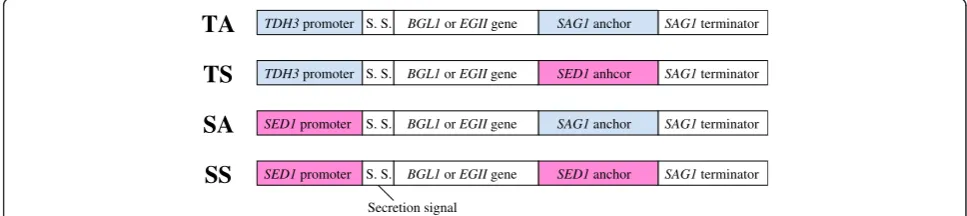
A haploid yeast strain,S. cerevisiae BY4741 was used as the host strain in this study. Figure 1 shows the four types of gene cassettes constructed for cell-surface display of cellulolytic enzymes in this study. The TA
TDH3 promoter S. S. BGL1 or EGII gene SAG1 anchor SAG1 terminator
TA
SED1 promoter S. S. BGL1 or EGII gene SAG1 anchor SAG1 terminator
SA
S. S. BGL1 or EGII gene SED1 anhcor SAG1 terminator TDH3 promoter
TS
S. S. BGL1 or EGII gene SED1 anchor SAG1 terminator SED1 promoter
SS
Secretion signal
cassette is a conventional cassette containing theS. cere-visiae TDH3 promoter and the 3′-half of S. cerevisiae SAG1 as a GPI anchoring region. The novel gene cassettes are hereinafter referred to as TS (TDH3 pro-moter and S. cerevisiae SED1 anchoring region), SA (SED1 promoter and SAG1 anchoring region), and SS cassettes (SED1 promoter and SED1anchoring region). All cassettes have the secretion signal sequence of the
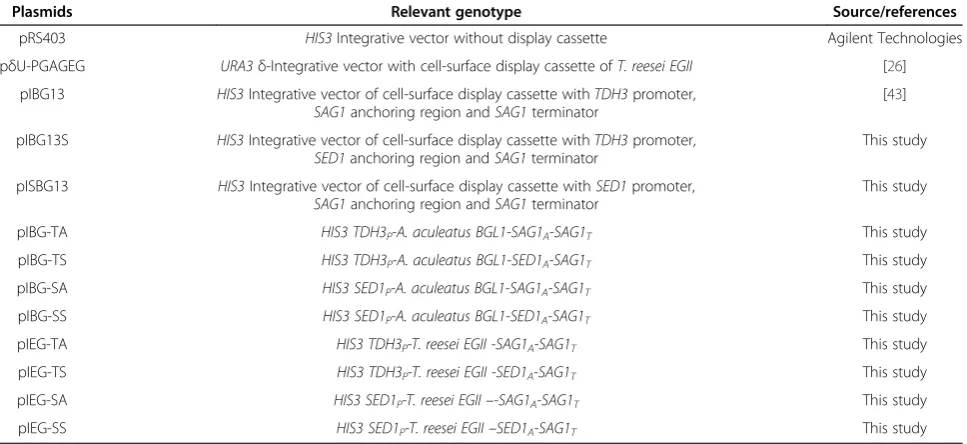
Rhizopus oryzae glucoamylase gene and SAG1 termin-ator. The plasmids with these cassettes (Table 1) were integrated into theHIS3locus of the chromosomal DNA by homologous recombination. The constructed strains listed in Table 2 were used for the experiments described below.
Transcriptional levels ofBGL1and BGL activities of recombinant yeast strains
β-glucosidase (BGL) cleaves cello-oligosaccharides from the non-reducing end to give glucose in the last step of enzymatic cellulose degradation. This enzyme is required for the complete hydrolysis of cellulose. Recombinant strains harboring gene cassettes for cell-surface display ofA. aculeatusBGL1 (BY-BG-TA, TS, SA and SS strains in Table 2) were cultivated aerobically for 96 h. The culture broth was sampled every 24 h, and the transcrip-tional level of BGL1 and BGL activity in the cell was investigated as described in Methods. Throughout the cultivation period, the transcriptional levels of BGL1
controlled by the SED1 promoter (BY-BG-SA and SS) were far higher than that of the TDH3 promoter
(BY-BG-TA and TS) (Figure 2A). Whereas BGL1
expression controlled by the TDH3 promoter gradually
increased during 72 h of cultivation, the expression under the control of theSED1promoter rose dramatic-ally and rapidly during the first 48 h of cultivation.
BGL activity of BY-BG-TA (28 ± 3 U/g dry cells at 48 h) was slightly improved by the replacement of the GPI anchoring domain by the Sed1 protein (BY-BG-TS, 32 ± 6 U/g dry cell at 48 h). Promoter replacement by the
SED1 promoter resulted in significantly improved BGL activity (BY-BG-SA). BGL activity of BY-SBGA reached 99 ± 10 U/g dry cells after 48 h cultivation (Figure 2B). Furthermore, simultaneous utilization of the SED1 pro-moter and Sed1 anchoring domain (BY-BG-SS) achieved more than double the BGL activity of BY-BG-SA (235 ± 28 U/g dry cells at 48 h) to approximately 8.4-fold higher than that of the conventional strain, BY-BG-TA. These results suggested a synergetic effect of the SED1
promoter and Sed1 anchoring domain for the cell-surface display of enzymes. In all strains investigated, most of the BGL activity was immobilized on the yeast cell surface and only a small amount of activity was detected in the culture supernatants throughout the cultivation (Figure 2C). No significant difference was ob-served in the cell growth of the various strains (data not shown).
Kinetic parameters of BGL displayed on the cell surface To characterize the BGL activities of BY-BG-SA and SS, their kinetic parameters were determined. For the determination of the Km and Vmax, BGL activity was
measured between 0.02 and 0.5 mMp-nitrophenyl-β -D-glucopyranoside (pNPG) (Figure 3). Kinetic parameters were calculated by weighted non-linear least-squares
Table 1 Characteristics of the integrative plasmids used in this study
Plasmids Relevant genotype Source/references
pRS403 HIS3Integrative vector without display cassette Agilent Technologies
pδU-PGAGEG URA3δ-Integrative vector with cell-surface display cassette ofT. reesei EGII [26]
pIBG13 HIS3Integrative vector of cell-surface display cassette withTDH3promoter,
SAG1anchoring region andSAG1terminator
[43]
pIBG13S HIS3Integrative vector of cell-surface display cassette withTDH3promoter,
SED1anchoring region andSAG1terminator
This study
pISBG13 HIS3Integrative vector of cell-surface display cassette withSED1promoter,
SAG1anchoring region andSAG1terminator
This study
pIBG-TA HIS3 TDH3P-A. aculeatus BGL1-SAG1A-SAG1T This study
pIBG-TS HIS3 TDH3P-A. aculeatus BGL1-SED1A-SAG1T This study
pIBG-SA HIS3 SED1P-A. aculeatus BGL1-SAG1A-SAG1T This study
pIBG-SS HIS3 SED1P-A. aculeatus BGL1-SED1A-SAG1T This study
pIEG-TA HIS3 TDH3P-T. reesei EGII -SAG1A-SAG1T This study
pIEG-TS HIS3 TDH3P-T. reesei EGII -SED1A-SAG1T This study
pIEG-SA HIS3 SED1P-T. reesei EGII–-SAG1A-SAG1T This study
pIEG-SS HIS3 SED1P-T. reesei EGII–SED1A-SAG1T This study
analysis of the raw data to fit to the Michaelis-Menten function [23]. TheVmaxvalues of BGL activity forpNPG
cleavage in BY-BG-SA and SS strains were 148 and 326 U/g dry cells, respectively (Figure 3). In contrast, no sig-nificant difference was observed in theKmvalue of these strains (0.181 and 0.198 mM, respectively). Generally in enzyme kinetics, such a change in kinetic parameters is due to changes in the amount of active enzyme per unit of protein weight. As the measurement unit of BGL activity is defined as per unit cell-weight (U/g dry cells) in this study, these results suggest that the amount of active enzyme per unit cell-weight differs substantially between BY-BG-SA and SS, and it accounts for the dif-ference in BGL activity.
Cell-surface display ofT. reeseiiEGII
Multiple enzymes, including endo-type cellulases, are necessary for the hydrolysis of cellulose [5]. EG, which cleaves glycosidic linkages randomly along cellulose chains, is also one of the enzymes required for the complete hydrolysis of cellulose, as is BGL. To test the applicability of the SED1 promoter and the anchoring region for cell-surface display of an endo-type cellulase,
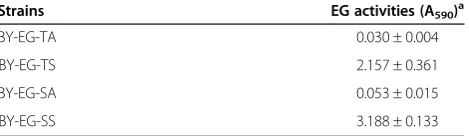
T. reeseiEGII-displaying yeast strains BY-EG-TA, TS, SA and SS were constructed (Table 2). These strains were cultured under aerobic conditions at 30°C for 48 h, then the enzyme activity of the cells against water-insoluble substrates was evaluated using azurine cross-linked hydroxyethylcellulose (AZCL-HE-Cellulose). The results are shown in Table 3. TheSED1promoter had a positive effect on the hydrolysis of AZCL-HE-Cellulose, as it had for the BGL activity (Figure 2B). The AZCL-HE-Cellulose hydrolysis activity of BY-EG-TA was signifi-cantly improved by using the Sed1 anchoring domain (BY-EG-TS), although there was only a small increase in BGL activity between BY-BG-TA and TS (Figure 2B). The hydrolysis activity of BY-EG-TS was 72-fold higher than that of the conventional strain BY-EG-TA. Furthermore,
BY-EG-SS showed 106-fold higher activity against AZCL-HE-Cellulose than BY-EG-TA. Although a measurement of AZCL-HE-Cellulose hydrolysis activity does not provide absolute values of EG activity [24], these results indicated that the gene cassettes carrying the Sed1 anchoring domain Table 2 Characteristics of the yeast strains used in
this study
Strains Relevant genotype Source
BY4741 MATa his3Δ1 leu2Δ0 met15Δ0 ura3Δ0 Life Technologies
BY-403 BY4741/pRS403 This study
BY-BG-TA BY4741/pIBG-TA This study
BY-BG-TS BY4741/pIBG-TS This study
BY-BG-SA BY4741/pIBG-SA This study
BY-BG-SS BY4741/pIBG-SS This study
BY-EG-TA BY4741/pIEG-TA This study
BY-EG-TS BY4741/pIEG-TS This study
BY-EG-SA BY4741/pIEG-SA This study
BY-EG-SS BY4741/pIEG-SS This study
0 10 20 30 40
0 24 48 72 96
Relative
BGL1
level (fold)
Cultivation time (h)
BY-BG-TA BY-BG-TS BY-BG-SA BY-BG-SS
0 50 100 150 200 250 300
0 24 48 72 96
BGL activity (U/g dry cell)
Cultivation time (h)
BY-BG-TA BY-BG-TS BY-BG-SA BY-BG-SS
0 50 100
0 24 48 72 96
Immobilizing ratio of BGL
activity (%)
Cultivation time (h)
BY-BG-TA BY-BG-TS BY-BG-SA BY-BG-SS
A
B
C
are more favorable for the cell-surface display of endo-type cellulases than those with the Sag1 anchoring domain.
Direct ethanol production from hydrothermally processed rice straw
In order to evaluate the effects of the cell-surface display of EGII on the hydrolysis of lignocellulosic biomass, direct ethanol production from hydrothermally proc-essed rice straw was performed using the cells of EGII-displaying strains BY-EG-TA and SS. One filter paper unit (FPU)/g-biomass of commercial cellulase cocktail (Cellic CTec2) was added to the fermentation mixture to supply other cellulolytic enzymes. Fermentation using the BY-403 strain, which was transformed with an empty vector (pRS403), was also carried out as a control. As shown in Figure 4, no significant difference was ob-served in ethanol productivity from the pretreated rice straw between BY-EG-TA and the control strain (11.1 ± 0.6 and 11.1 ± 0.9 g/L of ethanol after 96 h, respectively). On the other hand, the ethanol productivity of this fermentation was clearly improved by using BY-EG-SS strain (13.6 ± 0.5 g/L of ethanol after 96 h).
Discussion
In this study, we developed novel gene cassettes for the efficient cell-surface display of cellulolytic enzymes using the S. cerevisiae SED1 promoter and anchoring region (Figure 1). BGL-displaying strains using the novel gene cassettes (BY-BG-TS, SA and SS) achieved higher BGL activity on the cell surface than a conventional strain (BY-BG-TA) harboring a cassette carrying the TDH3
promoter and the SAG1 anchoring region (Figure 2B). The BY-BG-SS strain, which had a gene cassette with the S. cerevisiae SED1 promoter and its anchoring region (SS cassette), achieved the highest BGL activity (Figure 2B). Comparison of GPI anchoring domains for effective cell-surface display using the inducible GAL7
promoter has been reported [25]. However, there have been no reports on the effect of the combinations of a promoter and an anchoring domain for enzyme cell-surface display. To our knowledge, this is the first report on the synergetic effect of a GPI anchoring domain and its original promoter for the cell-surface display.
Previously, the activity of heterologous enzymes dis-played on a yeast cell surface was improved by increas-ing the copy number of the gene cassettes, for example by using the multi-copy genome integration method (δ-integration) [26]. However, the enzyme activity of recombinant strains constructed by the δ-integration method is relatively unstable, due to the random genome integration of gene cassettes. Yamada et al. [26] con-structed a recombinant S. cerevisiae strain, MT8-1/
δBEC, byδ-integration. MT8-1/δBEC had six copies of a gene cassette for BGL display using thePGK1promoter and the Sag1 anchoring domain. MT8-1/δBEC achieved a BGL activity of 15 U/g wet cells, which is comparable to approximately 100 U/g dry cells after 72 h cultivation. On the other hand, the BGL activity of BY-BG-SS reached 235 ± 28 U/g dry cells after only 48 h cultivation, even 0
50 100 150 200 250 300 350
0 0.1 0.2 0.3 0.4 0.5 0.6
BGL
activity
(U/g
dry
cell)
pNPG (mM)
Vmax
Km
BY-BG-SS
BY-BG-SA
Figure 3Kinetic parameters of theβ-glucosidase (BGL)-displaying strains.After 48 h cultivation, BGL activity of BY-BG-SA and SS cells was measured between 0.02 and 0.5 mMp-nitrophenyl-β-D-glucopyranoside (pNPG) at pH 5.0 and 30°C.KmandVmaxvalues were calculated by
weighted non-linear least-squares analysis of the raw data [23]. SA,SED1
promoter andSAG1anchoring region; SS,SED1promoter andSED1
anchoring region.
Table 3 AZCL-HE-Cellulose hydrolysis activity of EGII-displaying yeast strains
Strains EG activities (A590)
a
BY-EG-TA 0.030 ± 0.004
BY-EG-TS 2.157 ± 0.361
BY-EG-SA 0.053 ± 0.015
BY-EG-SS 3.188 ± 0.133
a
Enzyme activity was evaluated based on the absorbance at wavelength of 590 nm in a 1 cm optical path length cuvette (A590) of the blue dye released
into the supernatant after incubation for 4 h at 38°C. The averages for three independent experiments are shown with their standard deviations.
0 5 10 15
0 24 48 72 96
Ethanol (g/L)
Time (h)
BY-403 (Control) BY-EG-TA BY-EG-SS
though it carried only a single gene cassette for BGL dis-play. Although these strains cannot be compared directly, because MT8-1 and BY4741 strains have different genetic backgrounds, this novel gene cassette will thus allow the more stable construction of a heterologous enzyme-displaying yeast strain with high activity. The BGL activity of BY-BG-SS (235 ± 28 U/g dry cells after 48 h) is close to the specific activity of purified A. aculeatus BGL1 (280.7 U/g protein) at pH 5.0 and 30°C [27]. TheKmvalue of the BGL on the BY-BG-SS strain for pNPG (0.198 mM) is lower than that of purifiedA. aculeatus BGL1 (0.23 mM) [27]. Furthermore, SS cassettes also have a significant effect on the cell-surface display of T. reeseii EGII, which is an endo-type cellulolytic enzyme. Hydrolysis activity of BY-EG-SS against the water-insoluble substrate, AZCL-HE-Cellulose, was 106-fold higher than that of the conventional strain, BY-EG-TA (Table 3). These results suggest that re-combinant yeast cells displaying cellulolytic enzymes using SS cassettes are highly promising biocatalysts for efficient ethanol production from cellulosic materials.
It has been reported that the SED1 expression level increases during the stationary phase [22]. As shown in Figure 2A, the expression level of the BGL1 controlled bySED1promoter rose dramatically and rapidly after 48 h cultivation. The BGL1 activity of BY-BG-SA and SS was 3.5- and 7.4-fold higher than that of BY-BG-TA and TS after 48 h, respectively (Figure 2B). The high expres-sion level of BGL1 controlled by the SED1 promoter is likely one of the causes for the high BGL activity of the BY-BG-SA and SS strains. On the other hand, it was previously reported that the mRNA level ofSED1varies periodically during the cell cycle and that the peak of
SED1expression is M phase, whereas no apparent peak was observed in TDH3 expression during the cell cycle [28]. In the cell cycle ofS. cerevisiae, the synthesis of the new cell wall is activated in the M phase. The expression of many genes involved in the synthesis of cell-wall components and their delivery also increases in this phase [28], suggesting that the M phase is the most suitable for efficient cell wall integration of GPI proteins. Although further investigation using other constitutive promoters such as PGK1 promoter is needed, the cell cycle-regulated expression controlled by the SED1 pro-moter might be also one of the causes of high BGL activity of the BY-BG-SA and SS strains (Figure 2B).
The result shown in Figure 3 suggests that the amount of BGL1 immobilized in the cell wall varies depending on the C-terminal anchoring domain, and accounts for the difference in BGL activity between the BY-BG-SA and SS strains. It has been estimated that S. cerevisiae
cell contains the 60 GPI proteins, and most of them can be integrated into the cell wall by a covalent attachment to the β-(1 to 6) glucan chains in the glucan layer [29]. In recombinant yeasts, heterologous GPI-anchoring
fusion proteins must compete with the native GPI pro-teins for the limited protein incorporation capacity of the glucan layer [25]. Therefore, it is possible that the integration efficiency of GPI-anchoring enzymes strongly affects the population and activity of the enzymes in the cell wall [25]. It was recently reported that different GPI proteins exhibit different transportation and integration efficiencies into the cell wall [30-34]. Analysis of a large panel of biochemically verified GPI proteins suggested that specific residues in the upstream region of the
ω-site, which is the cleavage/attachment site of the C-terminal GPI-anchoring signal recognized by a GPI transamidase, seem to favor cell wall localization [32-34]. Hamadaet al. [33] reported that the amino acid sequence in the upstream region of ω-site differed sub-stantially between Sed1 and Sag1, and that reporter pro-tein fused with the Sed1 anchoring domain had higher cell-wall integration efficiency than protein fused with the Sag1 anchoring domain. The results shown in Figures 2 and 3 are in good agreement with these reports.
Another possible cause for the high BGL activity of the BY-BG-SS strain is the specific synergy of theSED1
good option for constructing gene cassettes providing efficient cell-surface display.
The cell wall of yeast is made of a thick microfibrillar array of β-(1 to 3) glucan and β-(1 to 6) glucan chains [37]. It is possible that a part of GPI anchoring enzymes expose their catalytic domain to external surface of the cell wall while the remainder is completely embedded in the glucan layer [25]. Small substrates such as cellobiose are accessible to all integrated enzymes because these substrates penetrate the cell wall. In contrast, large sub-strates such as cellulose can only access enzymes ex-posed on the external surface. Therefore, the hydrolysis of highly polymerized substrates by enzymes integrated into the yeast cell wall is more difficult than hydrolysis of small substrates [25,38]. In this study, we constructed severalT. reeseiiEGII-displaying strains (BY-EG-TA, TS, SA and SS) and evaluated the enzyme activity of these cells using AZCL-HE-Cellulose as the water-insoluble substrate. Whereas BY-EG-TA and SA had very little activity against AZCL-HE-Cellulose, BY-EG-TS and SS showed significant activity (Table 3). This result suggests that the Sed1 anchoring domain provides significant ad-vantages over the Sag1 anchoring domain not only in the efficiency of cell wall integration, but also in localiz-ing the enzyme at the external surface of the cell wall. We constructed the novel gene cassette for EGII display with theS. cerevisiae CWP2promoter and its anchoring region (Additional file 1). The EG-displaying strain harboring this cassette (BY-EG-CC) was constructed and the hydrolysis activity against AZCL-HE-Cellulose was evaluated. The hydrolysis activity of BY-EG-CC (A590=
0.021 ± 0.001) was lower than BY-EG-TA (0.030 ± 0.004), even though BGL-displaying strain using the CC cassette (BY-BG-CC) achieved high BGL activity (Additional file 2). This result also suggests that the an-choring domain has significant effect on the localization of enzymes in the cell wall. On the other hand, the pos-sibility of the effect of the steric hindrance by different anchoring domains fused with EGII cannot be excluded. Although the full length of Sed1 was used as the Sed1 anchoring domain in this study, it has been reported that C-terminal-229 amino acids of Sed1 can be used as an anchoring domain [25]. It cannot be denied that the extra N-terminal sequence of Sed1 could function as a linker, causing the positive effect of the substrate accessi-bility of EGII. Investigation of the surface accessiaccessi-bility of the displayed enzymes by other experiments such as immunofluorescence labeling [39] would be necessary for more understanding about the localization of Sed1 in the cell wall.
SED1 is a major stress-induced gene in S. cerevisiae,
and the expression level increases during stressful industrial fermentation such as sake brewing [22,40]. Hasunuma and Kondo [1] suggested that the environment
of an economically feasible CBP using cellulase-displaying yeast strains must also be stressful (highly concentrated yeast cells, high osmotic pressure, high temperature, low nutrition capacity and fluctuating processes). Therefore, the stress-induced property of theSED1gene should be favor-able for the cell-surface display of cellulolytic enzymes in CBP. On the other hand, the transcriptional levels ofBGL1
controlled by the SED1 promoter decreased dramatically after 48 h cultivation (Figure 2A). This result suggested that any factors other than stress regulate the expression of
SED1 promoter. Identification of the regulatory factors in the expression of SED1 promoter would be necessary for further enhancement of the cellulolytic activities on the cell surface provided using the SS cassette.
In the direct ethanol production from hydrothermally processed rice straw, the BY-EG-SS strain enhanced the saccharification and fermentation of the pretreated rice straw in the presence of a commercial cellulase cocktail (Figure 4). EGII was displayed in the cell surface of the BY-EG-SS strain and successfully compensated for cellulolytic activity of the commercial enzymes under stressful conditions. As stated in the Background Section, the cost of commercial enzymes is one of the biggest obstacles to cost-effective bioethanol production from lignocellulosic materials. The result shown in Figure 4 indicates that cellulase-displaying yeast strains using the SS cassette have significant potential for redu-cing the cost of commercial enzymes and for the cost-effective CBP of lignocellulosic biomass.
It has been reported that the synergetic effects of EG, CBH and BGL are necessary for the effective hydrolyza-tion of cellulose using cell-surface-displaying yeasts, and that optimization of the ratios of the activities of these enzymes is also important for the hydrolyzation effi-ciency [26,41,42]. The BY-EG-SS strain clearly improved the ethanol productivity from pretreated rice straw, but this strain expressed only EGII (Figure 4). The cellulo-lytic activity of this strain could increase with the additional display of other enzymes in the future. In addition, we revealed that the combination of the pro-moter and anchoring domains in the gene cassette has significant effects on the efficiency of enzyme display. If the activity of various enzymes on the cell surface can be controlled artificially by the combinations of their promoters and anchoring domains, we will be able to construct the recombinant yeast strains optimized for the CBP of lignocellulosic materials.
Conclusions
the enzyme integrated into the cell wall. Simultaneous utilization of the SED1 promoter and Sed1 anchoring domain in a gene cassette enabled highly efficient en-zyme integration into the cell wall. The BGL-displaying yeast strain carrying this cassette achieved high BGL activity within a relatively short cultivation time. Fur-thermore, this novel display cassette is also suitable for the hydrolyzation of insoluble substrates including ligno-cellulosic biomass. Ethanol productivity from hydro-thermally processed rice straw was clearly improved by using the novel gene cassettes for EGII display. If cell-surface cellulolytic enzyme activities can be con-trolled and optimized artificially by the combinations of the promoter and anchoring domain, then cellulase-displaying yeasts will be an attractive option for cost-effective CBP of lignocellulosic materials.
Methods Strains and media
The host for recombinant DNA manipulation was the
Escherichia coli (E. coli) strain NovaBlue (Novagen, Madison, WI, USA).E. colitransformants were grown in Luria-Bertani medium (10 g/L of tryptone, 5 g/L of yeast extract and 5 g/L of sodium chloride) supplemented with 100 μg/ml of ampicillin at 37°C. The genetic properties of all yeast strains used in this study are summarized in Table 2. Cell-surface display cassettes of cellulase were expressed in the haploid yeast strain
S. cerevisiae BY4741 (LifeTechnologies, Carlsbad, CA, USA). The yeast transformants were screened and pre-cultured in synthetic dextrose (SD) medium (6.7 g/L of yeast nitrogen base without amino acids (Difco Laboratories, Detroit, MI, USA) and 20 g/L of glucose) supplemented with appropriate amino acids and nucleic acids in a shaker incubator (180 rpm) at 30°C, and then aerobically cultured in yeast extract peptone dextrose (YPD) medium (10 g/L of yeast extract, 20 g/L of Bacto-peptone (Difco Laboratories) and 20 g/L of glucose) in a shaker incubator (150 rpm) at 30°C. Yeast cells were harvested by centrifugation at 1,000 × g for 5 minutes, then washed twice with distilled water followed by cen-trifugation at 1,000 × g for 5 minutes. Wet cell-weight of the washed yeast cells was determined by weighing the cell pellet. The estimated dry cell-weight for all strains was approximately 0.15-fold the wet cell-weight. The cell pellets were used for the enzyme assays and quantifica-tion of transcripquantifica-tional level as described below.
Plasmid construction and yeast transformation
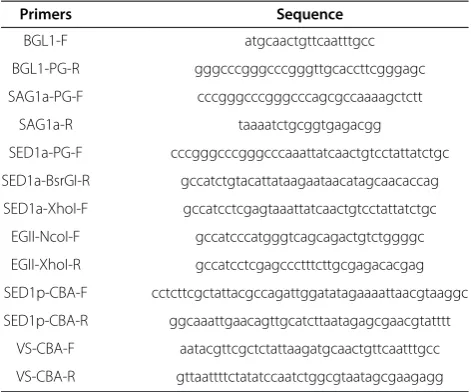
The plasmids and primers used in this study are summa-rized in Tables 1 and 4, respectively. The 3′ half of
SAG1 cording region (963 bp) and the full length of
SED1 cording region except for the start codon (1,014 bp) were used as SAG1 and SED1 anchoring regions,
respectively. The integrative plasmids for cell-surface display with TDH3 promoter were constructed as fol-lows: the DNA fragment encoding A. aculeatus BGL1 was amplified from plasmid pIBG13 [43] by PCR using the BGL1-F and BGL1-PG-R primers. Similarly, the DNA fragments encoding the anchoring domains of S. cerevisiae Sag1 and Sed1 were amplified from S. cerevi-siae BY4741 [44] genomic DNA by PCR using the SAG1a-PG-F and SAG1a-R primers and SED1a-PG-F and SED1a-BsrGI-R primers, respectively. These anchor fragments were connected to the 3′-terminus of the
BGL1 fragment by the fusion PCR method [45] using the BGL1-F and SAG1a-R primers and BGL1-F and SED1a-BsrGI-R primers, respectively. These fragments encoding BGL1-Sag1 and BGL1-Sed1 were digested with
NcoI and BsrGI, and then subcloned into the NcoI and
BsrGI sites of pIBG13. The resulting plasmids were named pIBG-TA and pIBG-TS, respectively. The XhoI -BsrGI DNA fragment encoding the Sed1 anchoring domain was amplified from S. cerevisiae BY4741 gen-omic DNA by PCR using the XhoI-F and SED1a-BsrGI-R primers. This fragment was subcloned into the
XhoI and BsrGI sites of pIBG13. The resulting plasmid was named pIBG13S. The NcoI-XhoI DNA fragment encodingT. reeseiiEGII was amplified from pδU-PGAGEG [26] by PCR using the EGII-NcoI-F and EGII-XhoI-R primers. This fragment was subcloned into the NcoI and
XhoI sites of pIBG13 and pIBG13S. The resulting plasmids were named pIEG-TA and pIEG-TS, respectively.
The integrative plasmids with theSED1promoter were constructed as follows: The DNA fragment encoding the
SED1 promoter region was amplified from S. cerevisiae
BY4741 genomic DNA by PCR using the SED1p-CBA-F and SED1p-CBA-R primers. Likewise, the vector frag-ment was amplified from pIBG13 by PCR using the VS-Table 4 PCR primers used in this study
Primers Sequence
BGL1-F atgcaactgttcaatttgcc
BGL1-PG-R gggcccgggcccgggttgcaccttcgggagc
SAG1a-PG-F cccgggcccgggcccagcgccaaaagctctt
SAG1a-R taaaatctgcggtgagacgg
SED1a-PG-F cccgggcccgggcccaaattatcaactgtcctattatctgc
SED1a-BsrGI-R gccatctgtacattataagaataacatagcaacaccag
SED1a-XhoI-F gccatcctcgagtaaattatcaactgtcctattatctgc
EGII-NcoI-F gccatcccatgggtcagcagactgtctggggc
EGII-XhoI-R gccatcctcgagccctttcttgcgagacacgag
SED1p-CBA-F cctcttcgctattacgccagattggatatagaaaattaacgtaaggc
SED1p-CBA-R ggcaaattgaacagttgcatcttaatagagcgaacgtatttt
VS-CBA-F aatacgttcgctctattaagatgcaactgttcaatttgcc
CBA-F and VS-CBA-R primers. These fragments were connected using the isothermal assembly method [46]. The resulting plasmid was named pISBG13. The NcoI -BsrGI DNA fragments encoding BGL1-Sag1, BGL1-Sed1, EGII-Sag1 and EGII-Sed1 were obtained from plasmids pIBG-TA, pIBG-TS, pIEG-TA and pIEG-TS, respectively. Then, these fragments were subcloned into the NcoI and
BsrGI site of pISBG13. The resulting plasmids were named pIBG-SA, pIBG-SS, pIEG-SA and pIEG-SS, respectively.
Each plasmid was digested withNdeI within the HIS3
gene. The linearized plasmids were then transformed into S. cerevisiae BY4741 using the lithium acetate method [47], and integrated into the HIS3 locus of the chromosomal DNA by homologous recombination, respectively.
Enzyme assays
Enzyme activities of the yeast cells were evaluated as de-scribed below. BGL activity was assayed with pNPG as the substrate. Washed yeast cells were resuspended in water (1 g wet cells/L): 100 μL of the suspended cell or culture supernatant was added to 400 μL of 2 mM
pNPG solution dissolved in 50 mM sodium citrate buf-fer, pH 5.0. After incubation for 10 minutes in a shaker incubator (500 rpm) at 30°C, 500 μL of 3.0 M sodium carbonate solution was added to terminate the reaction, and the p-nitrophenol liberated was determined based on the absorbance at 400 nm. For these conditions, the molar extinction coefficient of 18,720 M-1cm-1was used to calculate the concentration of p-nitrophenol in the assay mixture. One unit of enzyme activity was defined as the amount of enzymes required to liberate 1μmol of
p-nitrophenol per minute.
EG activity was assayed with AZCL-HE-Cellulose, which is a purified insoluble polysaccharide as the sub-strate. The substrate is supplied commercially in a tablet form as Cellazyme C tablets (Megazyme, Bray, Ireland). Washed yeast cells were resuspended in water (50 g wet cells/L), then 500μL of the cell suspension was added to 2 mL of assay solution containing a Cellazyme C tablet and 50 mM sodium citrate buffer, pH 5.0. After incuba-tion for 4 h at 38°C, endo-β-1,4-glucanase activity was evaluated based on the absorbance at 590 nm of the blue dye released into the supernatant.
Quantification of the transcriptional level of theBGL1 gene by real-time PCR
The transcriptional level was quantified by real-time quantitative-PCR as described previously [48]. The PCR primers BGL 761F and BGL 858R [26] were used for quantification of transcriptional level of BGL1. ACT1
was used as the internal standard.
Direct ethanol production from hydrothermally processed rice straw
Hydrothermally processed rice straw purchased from Mitsubishi Heavy Industries, Ltd. (Tokyo, Japan) was used as a cellulosic material. Ethanol fermentation of the cellulosic material was performed in a 50 mL polypro-pylene tube (Corning Inc., Corning, NY, USA) and a heat block (Thermo Block Rotator SN-06BN; Nissin, Tokyo, Japan) as described previously [49]. S. cerevisiae
strains used for fermentation were grown under aerobic conditions at 30°C for 48 h in 500 mL YPD medium. The yeast cells were collected by centrifugation at 1000 × g for 10 minutes at 20°C, then washed twice with distilled water. The cells were then resuspended in 10 mL yeast extract peptone (YP) medium (10 g/L of yeast extract and 20 g/L of Bacto-peptone) containing 50 mM sodium citrate buffer (pH 5.0), 100 g/L of cellulosic material and 1 FPU/g-biomass of commercial cellulase (Cellic CTec2; Novozymes Inc., Bagsvaerd, Denmark) at an initial cell con-centration of 100 g wet cells/L. Fermentation was initiated by the addition of yeast cells into the tube followed by axial rotation at 35 rpm at 38°C. The ethanol concentration in the fermentation medium was determined by HPLC (Shimadzu, Kyoto, Japan), as described previously [50].
Additional files
Additional file 1: Figure S1.Construction of novel gene cassettes with theS. cerevisiae CWP2promoter and/or its anchoring region. The novel gene cassettes with theS. cerevisiae CWP2promoter and/or its anchoring region were constructed based on the SS cassette for the yeast cell-surface display ofβ-glucosidase (BGL1). All cassettes have the secretion signal sequence of theR. oryzaeglucoamylase gene andSAG1terminator. Additional file 2: Figure S2.Time course ofβ-glucosidase (BGL) activities of BGL-displaying strains (BY-BG-SC, CS and CC). Recombinant strains harboring gene cassettes shown in Additional file 1: Figure S1 were cultured under aerobic conditions at 30°C for 96 h. The culture broth was sampled every 24 h, and BGL activity in the cell was investigated as described in the Methods. Error bars indicate the standard deviations of three independent experiments.
Abbreviations
AZCL-HE-Cellulose:azurine cross-linked hydroxyethylcellulose; BGL:β -glucosidase; bp: base pairs; CBH: cellobiohydrolase; CBP: consolidated bioprocessing; EG: endoglucanase; ER: endoplasmic reticulum; FPU: filter paper unit; GPI: glycosylphosphatidylinositol;pNPG:p-nitrophenyl-β -D-glucopyranoside; SA:SED1promoter andSAG1anchoring region; SS:SED1
promoter andSED1anchoring region; TA:TDH3promoter andSAG1
anchoring region; TS:TDH3promoter andSED1anchoring region..
Competing interests
The authors declare that they have no competing interests.
Authors’contributions
KI designed and performed the experiments, and wrote the manuscript. TH helped to draft the manuscript. TH and AK supervised the research. All authors read and approved the final manuscript.
Acknowledgements
Industrial Technology Development Organization (NEDO) under the sponsorship of the Ministry of Economy, Japan.
Author details
1Department of Chemical Science and Engineering, Graduate School of
Engineering, Kobe University, 1-1 Rokkodai, Nada, Kobe 657-8501, Japan.
2Organization of Advanced Science and Technology, Kobe University, 1-1
Rokkodai, Nada, Kobe 657-8501, Japan.3Biomass Engineering Program, RIKEN, 1-7-22 Suehiro-cho, Tsurumi-ku, Yokohama, Kanagawa 230-0045, Japan.4Department of Food Bioscience and Technology, College of Life Sciences and Biotechnology, Korea University, Seoul 136-713, Republic of Korea.
Received: 23 August 2013 Accepted: 24 December 2013 Published: 14 January 2014
References
1. Hasunuma T, Kondo A:Development of yeast cell factories for consolidated bioprocessing of lignocellulose to bioethanol through cell surface engineering.Biotechnol Adv2012,30:1207–1218.
2. Alvira P, Tomás-Pejó E, Ballesteros M, Negro MJ:Pretreatment technologies for an efficient bioethanol production process based on enzymatic hydrolysis: a review.Bioresour Technol2010,101:4851–4861. 3. da Costa Sousa L, Chundawat SP, Balan V, Dale BE:‘Cradle-to-grave’
assessment of existing lignocellulose pretreatment technologies.
Curr Opin Biotechnol2009,20:339–347.
4. Hendriks AT, Zeeman G:Pretreatments to enhance the digestibility of lignocellulosic biomass.Bioresour Technol2009,100:10–18.
5. Percival Zhang YH, Himmel ME, Mielenz JR:Outlook for cellulase improvement: screening and selection strategies.Biotechnol Adv2006, 24:452–481.
6. Xu Q, Singh A, Himmel ME:Perspectives and new directions for the production of bioethanol using consolidated bioprocessing of lignocellulose.Curr Opin Biotechnol2009,20:364–371.
7. Lynd LR, van Zyl WH, McBride JE, Laser M:Consolidated bioprocessing of cellulosic biomass: an update.Curr Opin Biotechnol2005,16:577–583. 8. Cardona CA, Sánchez OJ:Fuel ethanol production: process design trends
and integration opportunities.Bioresour Technol2007,98:2415–2457. 9. Pandey A:Handbook of plant-based biofuels.Boca Raton: CRC Press; 2009. 10. Olsson L, Hähnhagerdal B:Fermentative Performance of Bacteria and
Yeasts in Lignocellulose Hydrolysates.Process Biochem1993,28:249–257. 11. Lau MW, Gunawan C, Balan V, Dale BE:Comparing the fermentation
performance ofEscherichia coliKO11,Saccharomyces cerevisiae424A (LNH-ST) andZymomonas mobilisAX101 for cellulosic ethanol production.Biotechnol Biofuels2010,3:11.
12. van Zyl WH, Lynd LR, den Haan R, McBride JE:Consolidated bioprocessing for bioethanol production usingSaccharomyces cerevisiae.Biofuels2007, 108:205–235.
13. Fujita Y, Ito J, Ueda M, Fukuda H, Kondo A:Synergistic saccharification, and direct fermentation to ethanol, of amorphous cellulose by use of an engineered yeast strain codisplaying three types of cellulolytic enzyme.
Appl Environ Microbiol2004,70:1207–1212.
14. Fujita Y, Takahashi S, Ueda M, Tanaka A, Okada H, Morikawa Y, Kawaguchi T, Arai M, Fukuda H, Kondo A:Direct and efficient production of ethanol from cellulosic material with a yeast strain displaying cellulolytic enzymes.Appl Environ Microbiol2002,68:5136–5141.
15. Kondo A, Ueda M:Yeast cell-surface display–applications of molecular display.Appl Microbiol Biotechnol2004,64:28–40.
16. Kotaka A, Bando H, Kaya M, Kato-Murai M, Kuroda K, Sahara H, Hata Y, Kondo A, Ueda M:Direct ethanol production from barleyβ-glucan by sake yeast displayingAspergillus oryzaeβ-glucosidase and endoglucanase.
J Biosci Bioeng2008,105:622–627.
17. Yamada R, Taniguchi N, Tanaka T, Ogino C, Fukuda H, Kondo A:Direct ethanol production from cellulosic materials using a diploid strain of Saccharomyces cerevisiaewith optimized cellulase expression.Biotechnol Biofuels2011,4:8.
18. Yanase S, Yamada R, Kaneko S, Noda H, Hasunuma T, Tanaka T, Ogino C, Fukuda H, Kondo A:Ethanol production from cellulosic materials using cellulase-expressing yeast.Biotechnol J2010,5:449–455.
19. Ueda M, Tanaka A:Cell surface engineering of yeast: construction of arming yeast with biocatalyst.J Biosci Bioeng2000,90:125–136.
20. Kondo A, Shigechi H, Abe M, Uyama K, Matsumoto T, Takahashi S, Ueda M, Tanaka A, Kishimoto M, Fukuda H:High-level ethanol production from starch by a flocculentSaccharomyces cerevisiaestrain displaying cell-surface glucoamylase.Appl Microbiol Biotechnol2002,58:291–296. 21. Matano Y, Hasunuma T, Kondo A:Simultaneous improvement of
saccharification and ethanol production from crystalline cellulose by alleviation of irreversible adsorption of cellulase with a cell surface-engineered yeast strain.Appl Microbiol Biotechnol2013,97:2231–2237. 22. Shimoi H, Kitagaki H, Ohmori H, Iimura Y, Ito K:Sed1p is a major cell wall
protein ofSaccharomyces cerevisiaein the stationary phase and is involved in lytic enzyme resistance.J Bacteriol1998,180:3381–3387. 23. Jones ME:Analysis of algebraic weighted least-squares estimators for
enzyme parameters.Biochem J1992,288(Pt 2):533–538. 24. Ten LN, Im WT, Kim MK, Kang MS, Lee ST:Development of a plate
technique for screening of polysaccharide-degrading microorganisms by using a mixture of insoluble chromogenic substrates.J Microbiol Methods
2004,56:375–382.
25. van der Vaart JM, te Biesebeke R, Chapman JW, Toschka HY, Klis FM, Verrips CT:Comparison of cell wall proteins ofSaccharomyces cerevisiaeas anchors for cell surface expression of heterologous proteins.Appl Environ Microbiol1997,63:615–620.
26. Yamada R, Taniguchi N, Tanaka T, Ogino C, Fukuda H, Kondo A:Cocktailδ -integration: a novel method to construct cellulolytic enzyme expression ratio-optimized yeast strains.Microb Cell Fact2010,9:32.
27. Decker CH, Visser J, Schreier P:β-glucosidases from five blackAspergillus species: study of their physico-chemical and biocatalytic properties.J Agric Food Chem2000,48:4929–4936.
28. Spellman PT, Sherlock G, Zhang MQ, Iyer VR, Anders K, Eisen MB, Brown PO, Botstein D, Futcher B:Comprehensive identification of cell cycle-regulated genes of the yeastSaccharomyces cerevisiaeby microarray hybridization.Mol Biol Cell1998,9:3273–3297.
29. Pittet M, Conzelmann A:Biosynthesis and function of GPI proteins in the yeastSaccharomyces cerevisiae.Biochim Biophys Acta2007,1771:405–420. 30. Caro LH, Tettelin H, Vossen JH, Ram AF, van den Ende H, Klis FM:In silicio
identification of glycosyl-phosphatidylinositol-anchored plasma-membrane and cell wall proteins ofSaccharomyces cerevisiae.Yeast1997, 13:1477–1489.
31. Vossen JH, Müller WH, Lipke PN, Klis FM:Restrictive
glycosylphosphatidylinositol anchor synthesis in cwh6/gpi3 yeast cells causes aberrant biogenesis of cell wall proteins.J Bacteriol1997, 179:2202–2209.
32. Hamada K, Fukuchi S, Arisawa M, Baba M, Kitada K:Screening for glycosylphosphatidylinositol (GPI)-dependent cell wall proteins in Saccharomyces cerevisiae.Mol Gen Genet1998,258:53–59. 33. Hamada K, Terashima H, Arisawa M, Yabuki N, Kitada K:Amino acid
residues in theω-minus region participate in cellular localization of yeast glycosylphosphatidylinositol-attached proteins.J Bacteriol1999, 181:3886–3889.
34. Frieman MB, Cormack BP:Theω-site sequence of
glycosylphosphatidylinositol-anchored proteins inSaccharomyces cerevisiaecan determine distribution between the membrane and the cell wall.Mol Microbiol2003,50:883–896.
35. van der Vaart JM, Caro LH, Chapman JW, Klis FM, Verrips CT:Identification of three mannoproteins in the cell wall ofSaccharomyces cerevisiae.
J Bacteriol1995,177:3104–3110.
36. Doering TL, Schekman R:GPI anchor attachment is required for Gas1p transport from the endoplasmic reticulum in COP II vesicles.EMBO J
1996,15:182–191.
37. Dupres V, Dufrêne YF, Heinisch JJ:Measuring cell wall thickness in living yeast cells using single molecular rulers.ACS Nano2010,4:5498–5504. 38. Schreuder MP, Mooren AT, Toschka HY, Verrips CT, Klis FM:Immobilizing
proteins on the surface of yeast cells.Trends Biotechnol1996,14:115–120. 39. Shimojyo R, Furukawa H, Fukuda H, Kondo A:Preparation of yeast strains
displaying IgG binding domain ZZ and enhanced green fluorescent protein for novel antigen detection systems.J Biosci Bioeng2003, 96:493–495.
40. Wu H, Zheng X, Araki Y, Sahara H, Takagi H, Shimoi H:Global gene expression analysis of yeast cells during sake brewing.Appl Environ Microbiol2006,72:7353–7358.
42. Stricker AR, Mach RL, de Graaff LH:Regulation of transcription of cellulases- and hemicellulases-encoding genes inAspergillus nigerand Hypocrea jecorina(Trichoderma reesei).Appl Microbiol Biotechnol2008, 78:211–220.
43. Katahira S, Mizuike A, Fukuda H, Kondo A:Ethanol fermentation from lignocellulosic hydrolysate by a recombinant xylose- and
cellooligosaccharide-assimilating yeast strain.Appl Microbiol Biotechnol
2006,72:1136–1143.
44. Brachmann CB, Davies A, Cost GJ, Caputo E, Li J, Hieter P, Boeke JD: Designer deletion strains derived fromSaccharomyces cerevisiaeS288C: a useful set of strains and plasmids for PCR-mediated gene disruption and other applications.Yeast1998,14:115–132.
45. Cha-aim K, Fukunaga T, Hoshida H, Akada R:Reliable fusion PCR mediated by GC-rich overlap sequences.Gene2009,434:43–49.
46. Gibson DG, Young L, Chuang RY, Venter JC, Hutchison CA 3rd, Smith HO: Enzymatic assembly of DNA molecules up to several hundred kilobases.
Nat Methods2009,6:343–345.
47. Chen DC, Yang BC, Kuo TT:One-step transformation of yeast in stationary phase.Curr Genet1992,21:83–84.
48. Ismail KS, Sakamoto T, Hatanaka H, Hasunuma T, Kondo A:Gene expression cross-profiling in genetically modified industrialSaccharomyces cerevisiae strains during high-temperature ethanol production from xylose.
J Biotechnol2013,163:50–60.
49. Matano Y, Hasunuma T, Kondo A:Display of cellulases on the cell surface ofSaccharomyces cerevisiaefor high yield ethanol production from high-solid lignocellulosic biomass.Bioresour Technol2012,108:128–133. 50. Hasunuma T, Sung K, Sanda T, Yoshimura K, Matsuda F, Kondo A:Efficient
fermentation of xylose to ethanol at high formic acid concentrations by metabolically engineeredSaccharomyces cerevisiae.Appl Microbiol Biotechnol2011,90:997–1004.
doi:10.1186/1754-6834-7-8
Cite this article as:Inokumaet al.:Efficient yeast cell-surface display of exo- and endo-cellulase using theSED1anchoring region and its original promoter.Biotechnology for Biofuels20147:8.
Submit your next manuscript to BioMed Central and take full advantage of:
• Convenient online submission
• Thorough peer review
• No space constraints or color figure charges
• Immediate publication on acceptance
• Inclusion in PubMed, CAS, Scopus and Google Scholar
• Research which is freely available for redistribution