The use of biological control agents as an alternative to fungicides is increasing rapidly in the present day agriculture due to the deleterious effects of chemical pesticides. Among these the bacterial antagonists have the twin advantage of faster multiplication and higher rhizosphere competence hence, P. fluorescens have been
successfully used for biological control of several plant pathogens (Ramamoorthy et al., 2002) and biological control using PGPR strains especially from the genus Pseudomonas is an effective substitute for chemical pesticides to suppress plant diseases (Compant et al., 2005). P. fluorescens encompasses a group of common,
9
Evaluation of different Substrates for
Mass Multiplication of Pseudomonas fluorescens
in two Incubation Temperature
Prashant Kumar Dewangan
*, Niranjan Khare, Bhumika koma,
Sanghmitra Baghel and H.K. Singh
Department of Plant Pathology, College of Agriculture, IGKV, Raipur-492006 Chhattisgarh, INDIA. *Corresponding author: [email protected]
Paper No. 233 Received: May 20, 2014 Accepted: August 2, 2014 Published: September 5, 2014
Abstract
The present investigation was carried out to different organic substrate for develop simple, cheap and effective method to suitable mass
multiplication of biocontrol agent Pseudomonas fluorescens. Different organic substrates were treated by sterilizated method such as hot water, steam and chemical treatment at two incubation temperature separately. 200 g of each substrate was filled in polythene bag and 48 h KMB slant culture of P. fluorescens cell suspension of concentration of 108 cfu/ml was pipetted into the each bag. The observations were
recorded on 7th, 14th, 21st, 28th, and 35 th DAI. One gram of substrate from each bag was used for assessment of difference in growth of
P. fluorescens and data regarding number of colony forming units (cfu) of bioagent per gram of each substrate. After 35 DAI, found that significantly higher population in FYM followed by vermi compost and gram straw at both temperature (20-25°C) and (35-40°C) irrespective of three sterilization methods taken in the study and also observed that overall growth of isolate of P. fluorescens was maximum in steam
followed by hot water and least in chemical method of sterilization. As far as method of sterilization was concerned, the trend was similar as in cooler and room temperature. In all, cooler temperature (20-25°C) supported the mass multiplication over the room temperature (35-40°C).
Highlights
• Evaluate organic substrate for suitable mass multiplication of P. fluorescens which was sterilizated by different treatment in
two incubation temperature after 35 th DAI showed maximum growth in FYM which was treated by steam at both incubation
temperature.
Keywords: P. fluorescens, substrate-carriers, sterilization, incubation, biocontrol, in vitro.
Microbiology
Gram negative, rod shaped, non pathogenic saprophytes that colonize soil, water and plant surface environments. Since they are well adapted in soil, P. fluorescens strains are being investigated extensively for use in biocontrol of pathogens in agriculture (Ganeshan and Kumar, 2006). It is known to enhance plant growth promotion and yield and reduce severity of many diseases (Hoffland et al., 1996; Wei et al., 1996). The cell suspensions of P. fluorescens should be immobilized in certain carriers and should be prepared as formulations for easy application, storage, commercialization and field use. The potential P. fluorescens are formulated using different organic and inorganic carriers either through solid or liquid fermentation technologies. Straw consists mainly of polymers such as cellulose, hemicellulose, and lignin, requiring the activity of specific hydrolytic enzymes for their degradation (Lynch, 1979) and has a particularly high carbon to- nitrogen ratio, between 60 and 100 (Fog, 1988). Hence, amendment of the soil with these plant residues may have the potential of altering growth conditions for the inoculated bacteria and consequently their physiological responses.
In this context, this study was undertaken to evaluate different organic substrates for mass multiplication of the potential biocontrol agent P. fluorescens and also carried out to develop simple, cheap and effective method for mass production of P. fluorescens for field application to plant disease control.
Materials and Methods
Evaluation of organic substrates for quick mass multiplication of P. fluorescens
The main purpose to carry out this study was to provide cheaper and easily available substrate for mass multiplication of P. fluorescens viz., different types of straw-wheat straw, paddy straw, soybean straw, gram straw, rice bran, vermi compost, poultry manure, FYM, cotton cake and mustard cake were evaluated.
Different sterilization methods for the organic substrates
All the substrates were sterilized by different methods to avoid the contamination and obtained good growth of
Sterilization by hot water treatment
All the substrates were finely chopped and soaked in 100°C boiled water for 8 hrs for sterilization. Then water was completely drained out. Rice bran, vermi compost, FYM, poultry manure, cotton cake and mustard cake were moistened with water and 200 g of each substrate was filled in polythene bag (12 x 8 cm2) and the 48 h
KMB slant culture of P. fluorescens cell suspension of concentration of 108 cfu/ml was pipetted into the each
bag thoroughly mixed with the help of sterilized spoon and plugged by using cotton and nylon strings. Four replications for each treatment were maintained. These bags were incubated at room temperature (35 to 40± 1°C) and cooler temperature (20 to 25± 1°C).
Observations on the number of colony farming units (CFU) per gram were recorded at 7th, 14 th, 21st, 28 th
and 35 days after inoculation by serial dilution agar plate technique. Population dynamics was examined by mixing 1 g of formulations aseptically with 10 ml sterile distilled water for 20 min in a rotary shaker. Serial dilutions were prepared and 0.1 ml aliquot from 10-5 to 10-8 dilutions
were spread on KMB plates (Chakravarty et al., 2011). After incubating the plates at 28 ± 1°C for 48 h, the cfu/g formulations were counted out of Pseudomonas fluorescens on different substrates by using following formula (Aneja, 2003):
No. of colonies No. of P.fluorescens/g (avg. of 3 replicates) of the sample = Amount plated ×
dilution factor
Sterilization by steam treatment
All the substrates were finely chopped and soaked in water for 8 hrs then water was completely drained out. Rice bran, vermi compost, FYM, poultry manure, cotton cake and mustard cake were moistened with water and 200 g of each substrate was filled in polythene bag (12 x 8 cm2) and sterilized in autoclave or pressure cooker.
After sterilization, polythene bag were cooled and the 48 h KMB slant culture of P. fluorescens cell suspension of concentration of 108 cfu/ml was pipetted into the each
replications for each treatment were maintained, these bags were incubated at room temperature (35 to 40± 1°C) and cooler temperature (20 to 25± 1°C). Observations on the number of colony farming units (CFU) per gram were recorded at 7th, 14 th, 21st, 28 th and 35 days after
inoculation by dilution plate technique. Population dynamics was examined by mixing 1 g of formulations aseptically with 10 ml sterile distilled water for 20 min in a rotary shaker. Serial dilutions were prepared and 0.1 ml aliquot from 10-5 to 10-8 dilutions were spread on KMB
plates (Chakravarty et al., 2011). After incubating the plates at 28 ± 1°C for 48 h, the cfu/g formulations were counted out of Pseudomonas fluorescens on different substrates by using the formula as described earlier.
Sterilization by chemical treatment
All the substrates were finely chopped and soaked in water containing Formaldehyde (1.35 ml) + Bavistin (0.07g) lt -1 for 12 hrs for sterilization then water was
completely drained out. Rice bran, vermi compost, FYM, poultry manure, cotton cake and mustard cake were moistened with water contains Formaldehyde (1.35 ml lt-1) + Bavistin (0.07 g lt -1). Each substrate of 200 g
was filled in polythene bag (12 x 8 cm2) and the 48 h
KMB slant culture of P. fluorescens cell suspension of concentration of 108 cfu/ml was pipetted into the each
bag thoroughly mixed with the help of sterilized spoon
and plugged by using cotton and nylon strings. Four replications for each treatment were maintained. These bags were incubated at room temperature (35 to 40± 1°C) and cooler temperature (20 to 25± 1°C).
Observations on the number of colony forming units (CFU) per gram were recorded at 7th, 14 th, 21st, 28 th
and 35 day after inoculation by dilution plate technique. Population dynamics was examined by mixing 1 g of formulations aseptically with 10 ml sterile distilled water for 20 min in a rotary shaker. Serial dilutions were prepared and 0.1 ml aliquot from 10-5 to 10-8 dilutions
were spread on KMB plates (Chakravarty et al., 2011). After incubating the plates at 28 ± 1°C for 48 h, the cfu/g formulations were counted out of Pseudomonas fluorescens on different substrates by using the formula as described earlier.
Results and Discussion
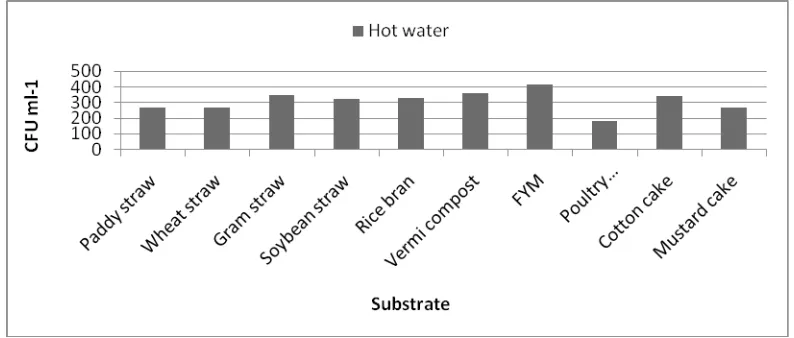
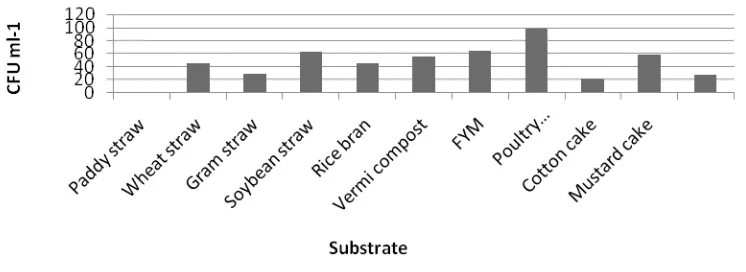
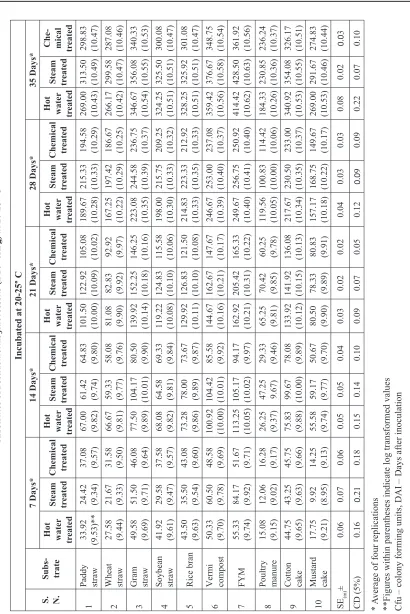
The present investigation was carried out to screen different organic substrate suitable for mass multiplication and sterilizated by hot water, steam and chemical treatment. These were incubated at two incubation temperatures. One gram of substrate from each bag was used for assessment of difference in growth of Pseudomonas fluorescens. The observations were recorded on 7, 14, 21, 28, and 35DAI and data regarding number of colony forming units (cfu) of bioagent per gram of each substrate are presented in Table 1 and 2 and graph 1-6.
Fig. 2. Effect of heat steam sterilization method on mass multiplication of Pseudomonas fluorecsens (x 108 cfu/g) in different substrates at 20-25° C
Fig. 3. Effect of chemical sterilization method on mass multiplication of Pseudomonas fluorecsens (x 108 cfu/g) in different substrates at 20-25° C
Fig. 5. Effect of heat steam sterilization method on mass multiplication of Pseudomonas fluorecsens (x 108 cfu/g) in different substrates at 35-40°C
Fig. 6. Effect of chemical sterilization method on mass multiplication of Pseudomonas fluorecsens (x 108 cfu/g) in different substrates at 35-40° C
At cooler temperature (20-25°C)
Ten substrates were evaluated for three sterilization methods at cooler temperature (20-25°C) at different incubation period (7 to 35 days) for their effect on mass multiplication of local isolate of Pseudomonas fluorescens.
It is evident from the data presented in Table 1 that P. fluorescens multiplied best in substrate farm yard manure which was closely followed by vermi compost and gram
Table 1. Effects of sterilization methods and differ
ent incubation period on mass multiplication in differ
ent
substrates of
Pseudomonas fluorecsens
(x 10
8 cfu/g) at 20-25 °C
Incubated at 20-25
°
C
S. N. Subs- trate 7 Days* 14 Days* 21 Days* 28 Days* 35 Days*
Hot water treated Steam treated Chemical treated Hot water treated
Steam treated Chemical treated Hot water treated
Steam treated Chemical treated Hot water treated
Steam treated Chemical treated Hot water treated
Steam treated Che- mical treated
1
Paddy straw 33.92 (9.53)** 24.42 (9.34) 37.08 (9.57) 67.00 (9.82) 61.42 (9.74) 64.83 (9.80) 101.50 (10.00) 122.92 (10.09) 105.08 (10.02) 189.67 (10.28) 215.33 (10.33) 194.58 (10.29) 269.00 (10.43) 313.50 (10.49) 298.83 (10.47)
2
Wheat straw 27.58 (9.44) 21.67 (9.33) 31.58 (9.50) 66.67 (9.81) 59.33 (9.77) 58.08 (9.76) 81.08 (9.90) 82.83 (9.92) 92.92 (9.97) 167.25 (10.22) 197.42 (10.29) 186.67 (10.25) 266.17 (10.42) 299.58 (10.47) 287.08 (10.46)
3
Gram straw 49.58 (9.69) 51.50 (9.71) 46.08 (9.64) 77.50 (9.89) 104.17 (10.01) 80.50 (9.90) 139.92 (10.14) 152.25 (10.18) 146.25 (10.16) 223.08 (10.35) 244.58 (10.39) 236.75 (10.37) 346.67 (10.54) 356.08 (10.55) 340.33 (10.53)
4
Soybean straw 41.92 (9.61) 29.58 (9.47) 37.58 (9.57) 68.08 (9.82) 64.58 (9.81) 69.33 (9.84) 119.22 (10.08) 124.83 (10.10) 115.58 (10.06) 198.00 (10.30) 215.75 (10.33) 209.25 (10.32) 324.25 (10.51) 325.50 (10.51) 300.08 (10.47)
5
Rice bran
43.50 (9.63) 35.50 (9.54) 43.08 (9.60) 73.28 (9.86) 78.00 (9.89) 73.67 (9.87) 129.92 (10.11) 126.83 (10.10) 121.50 (10.08) 214.83 (10.33) 223.33 (10.35) 212.92 (10.33) 328.25 (10.51) 325.92 (10.51) 301.08 (10.47)
6
Vermi compost 50.33 (9.70) 60.50 (9.78) 48.58 (9.69) 100.92 (10.00) 104.42 (10.01) 85.58 (9.92) 144.67 (10.16) 162.67 (10.21) 147.67 (10.17) 246.67 (10.39) 253.00 (10.40) 237.08 (10.37) 359.42 (10.56) 376.67 (10.58) 348.75 (10.54)
7
FYM
55.33 (9.74) 84.17 (9.92) 51.67 (9.71) 113.25 (10.05) 105.17 (10.02) 94.17 (9.97) 162.92 (10.21) 205.42 (10.31) 165.33 (10.22) 249.67 (10.40) 256.75 (10.41) 250.92 (10.40) 414.42 (10.62) 428.50 (10.63) 361.92 (10.56)
8
Poultry manure 15.08 (9.15) 12.06 (9.02) 16.28 (9.17) 26.25 (9.37) 47.25 9.67) 29.33 (9.46) 65.25 (9.81) 70.42 (9.85) 60.25 (9.78) 119.56 (10.05) 100.83 (10.00) 114.42 (10.06) 184.33 (10.26) 230.85 (10.36) 236.24 (10.37)
9
Cotton cake 44.75 (9.65) 43.25 (9.63) 45.75 (9.66) 75.83 (9.88) 99.67 (10.00) 78.08 (9.89) 133.92 (10.12) 141.92 (10.15) 136.08 (10.13) 217.67 (10.34) 230.50 (10.35) 233.00 (10.37) 340.92 (10.53) 354.08 (10.55) 326.17 (10.51)
10
Mustard cake 17.75 (9.21) 9.92 (8.95) 14.25 (9.13) 55.58 (9.74) 59.17 (9.77) 50.67 (9.70) 80.50 (9.90) 78.33 (9.89) 80.83 (9.91) 157.17 (10.18) 168.75 (10.22) 149.67 (10.17) 269.00 (10.53) 291.67 (10.46) 274.83 (10.44)
SE(m) ± 0.06 0.07 0.06 0.05 0.05 0.04 0.03 0.02 0.02 0.04 0.03 0.03 0.08 0.02 0.0 3 CD (5%) 0.16 0. 21 0.18 0.15 0.14 0.10 0.09 0.07 0.05 0.12 0.0 9 0.09 0.22 0.07 0.10 *
Table 2. Effects of sterilization methods and differ
ent incubation period on mass multiplication in differ
ent substrates of
Pseudomonas fluorecsens
(x
10
8 cfu/g) at 35-40°C
Incubated at 35-40
° C S. N. Sub- strate 7 Days* 14 Days* 21 Days* 28 Days* 35 Days*
Hot water treated Steam treated Chemical treated Hot water treated
Steam treated Chemical treated Hot water treated
Steam treated Chemical treated Hot water treated
Steam treated Chemical treated Hot water treated
Steam treated Chemical treated
1
Paddy straw 39.42 (9.60)** 44.67 (9.65) 36.83 (9.54) 59.58 (9.77) 66.58 (9.82) 64.58 (9.80) 103.25 (10.01)
11
1.83
(10.05)
104.17 (10.02) 64.33 (9.81) 57.50 (9.76) 59.50 (9.77) 44.83 (9.65) 43.83 (9.64) 44.34 (9.64)
2
Wheat straw 34.42 (9.53) 43.50 (9.64) 35.92 (9.55) 57.83 (9.76) 58.50 (9.76) 63.58 (9.80) 96.50 (9.97) 107.83 (10.03) 88.67 (9.93) 48.75 (9.68) 56.17 (9.75) 54.50 (9.73) 28.83 (9.46) 32.92 (9.51) 31.17 (9.49)
3
Gram straw 44.50 (9.64) 53.42 (9.73) 45.08 (9.65) 72.08 (9.86) 79.50 (9.90) 71.25 (9.85)
11
1.25
(10.04)
144.08 (10.15) 117.33 (10.07) 159.50 (10.20) 156.08 (10.19) 143.92 (10.16) 63.58 (9.80) 69.42 (9.84) 61.83 (9.79)
4
Soybean straw 42.17 (9.62) 48.17 (9.68) 38.75 (9.59) 65.83 (9.81) 70.14 (9.85) 64.43 (9.81) 103.08 (10.01) 114.17 (10.06) 110.83 (10.04) 69.92 (9.84) 79.58 (9.89) 64.58 (9.80) 45.83 (9.66) 50.75 (9.70) 49.50 (9.69)
5
Rice bran 43.75 (9.64) 48.67 (9.68) 41.58 (9.61) 67.42 (9.83) 70.58 (9.85) 69.67 (9.84) 106.50 (10.00) 114.92 (10.06) 113.83 (10.05) 76.75 (9.88) 94.42 (9.97) 93.25 (9.97) 55.33 (9.74) 53.50 (9.73) 52.42 (9.72)
6
Vermi compost 51.42 (9.71) 57.17 (9.75) 49.75 (9.69) 75.50 (9.88) 85.08 (9.93) 77.92 (9.89) 112.58 (10.05) 215.33 (10.33) 119.42 (10.08) 177.83 (10.25) 188.83 (10.27) 177.08 (10.24) 63.92 (9.80) 72.92 (9.86) 66.75 (9.82)
7
FYM
51.92 (9.71) 61.67 (9.79) 52.17 (9.72) 80.17 (9.90) 106.67 (10.03) 79.50 (9.90) 112.83 (10.05) 228.50 (10.35) 123.25 (10.09) 180.25 (10.25) 239.59 (10.38) 180.25 (10.25) 98.00 (9.99) 100.67 (10.00) 86.84 (9.93)
8
Poultry manure 18.09 (9.23) 34.92 (9.53) 15.58 (9.15) 56.33 (9.75) 56.92 (9.75) 49.42 (9.69) 84.00 (9.92) 82.25 (9.90) 71.00 (9.84) 43.58 (9.63) 44.50 (9.65) 42.42 (9.63) 21.67 (9.33) 21.75 (9.33) 19.50 (9.29)
9
Cotton cake 43.83 (9.64) 49.42 (9.69) 44.33 (9.64) 68.25 (9.83) 71.75 (9.85) 69.83 (9.84) 107.17 (10.03) 116.00 (10.06) 116.33 (10.06) 118.08 (10.07) 133.42 (10.12) 109.00 (10.04) 58.83 (9.77) 56.50 (9.75) 56.83 (9.75)
10
Mustard cake 29.25 (9.47) 35.42 (9.55) 27.75 (9.43) 57.33 (9.76) 57.33 (9.76) 54.33 (9.73) 96.25 (9.98) 107.75 (10.03) 85.67 (9.93) 48.25 (9.68) 49.08 (9.69) 44.00 (9.64) 27.25 (9.43) 27.75 (9.44) 27.17 (9.43)
SE(m) ± 0.04 0.03 0. 06 0.03 0.02 0.03 0.04 0.03 0.04 0.03 0.03 0.03 0.03 0.03 0.04 CD (5%) 0.1 1 0.10 0.16 0. 08 0.07 0.08 0.12 0.08 0.1 1 0.08 0.07 0.08 0.08 0.10 0.10 *
The trend was similar for P. fluorescens population when substrates sterilized with steam and chemicals from 7 to 35 DAI. Among these top three substrates, farm yard manure, vermi compost and gram straw was significantly superior over other substrate at 7 and 14 DAI. FYM was significantly superior over other substrate at 21 DAI; non significant difference among top three substrates at 28 DAI and 35 DAI when steam was used for sterilization. Significant higher population of P. fluorescens was observed in farm yard manure, vermi compost and gram straw at 7, 14 DAI. FYM was at par with vermi compost but significantly higher to gram straw at 21 DAI when chemicals were used for sterilization. Whereas non significant differences were observed among all these top three substrate at 28 and 35 DAI.
After 35 DAI, it was observed that overall growth of local isolate of P. fluorescens was maximum in steam followed by hot water and least in chemical method of sterilization.
At room temperature (35-40°C)
Three methods of sterilization and ten substrates were evaluated for their effect on mass multiplication of local isolate of P. fluorescens at room temperature (35- 40°C) at 7, 14, 21, 28 and 35 DAI.
The data presented in table 2 revealed that farm yard manure was found best followed by vermi compost and gram straw for mass multiplication of P. fluorescens at 7 DAI, when sterilized by hot water. This trend was continued at 14, 21, 28 and 35 DAI. At 7, 14, 21 and 28 DAI, non significant difference was observed among these three substrates. At 35 DAI, significantly higher population in FYM was recorded than that of in vermi compost and gram straw.
Steam was used for sterilization of substrates and it is clear from the presented in table 2 that farm yard manure was found best among the substrates tested followed by vermi compost and gram straw at 7 DAI. Similar trend
was recorded at 14, 21, 28 and 32 DAI. No significant difference was observed among the top three substrates at 7 DAI. At 14, 28 and 35 DAI, significantly higher population in FYM was recorded than that of in vermi compost and gram straw. Whereas FYM was at par with vermi compost and significantly superior over gram straw at 21 DAI. FYM was found best among the substrates tested followed by vermi compost and gram straw at 7 DAI when chemicals were used for sterilization. The trend was continued at 14, 21, 28 and 35 DAI. Top three substrates were non significant among themselves at 7, 14, and 21 DAI. At 35 DAI, significantly higher population in FYM was recorded than that in vermi compost and gram straw. Whereas FYM was at par with vermi compost and significantly superior over gram straw at 28 DAI.
The population dynamics of P. fluorescens at 35- 40°C showed that there was slow and progressive decline on 28 and 35 DAI in all sterilization methods.
As far as method of sterilization was concerned, the trend was similar as in cooler temperature. In all, cooler temperature (20-25°C) supported the mass multiplication over the room temperature (35-40°C).
Several workers reported various substrates suitable for mass multiplication of P. fluorescens. Bora and Deka
(2007) found vermicompost; Jayaraj et al., (2007) found poultry manure and FYM; Ambardar and Sood (2010) reported FYM + sand and Chakravarty and Kalita (2011) recorded vermicompost and FYM as host substrates for P. fluorescens multiplication. Almost similar results were also obtained in present study agreeing with the findings of earlier workers. On the contrary, Niranjana et al., (2009) reported rice bran was host substrate but in the present findings, rice bran substrate was not reported the growth of P. fluorescens on compared to others.
Conclusion
Hence, it is concluded that out of ten substrates tested for suitability to mass multiplication of local isolate of Pseudomonas fluorescens and it was found that FYM supported maximum growth followed by vermi compost and gram straw at cooler temperature (20-25°C) irrespective of three sterilization methods taken in the study. After 35 DAI, it was observed that overall growth of isolate of P. fluorescens was maximum in steam followed by hot water and least in chemical method of sterilization. The trends for substrate and method optimization were similar at room temperature (35-40°C). Therefore In all, cooler temperature (20-25°C) supported the more mass multiplication over the room temperature (35-40°C).
Plate 4. Observed plates of different substrate (a) Paddy straw, (b) Wheat straw, (c) Gram straw, (d) Soybean straw,
(e) Rice bran, (f) Vermi compost, (g) FYM, (h) Poultry manure, (i) Cotton cake, (j) Mustard cake.
Acknowledgements
This study was supported by Department of Plant Pathology, College of Agriculture (IGKV), Raipur, Chhattisgarh. We are grateful to Dr. N. Khare, Principal Scientist, Dr. A. S. Kotasthane Professor & Head, Dr. C.P. Khare, Principal Scientist, Department of Plant Pathology, College of Agriculture, Raipur, for being suggested the research in initial state that has been enough to initiate me into various techniques involved in this work.
References
Ambardar, V.K. and Sood, A.K. 2010. Suitability of Different Growth Substrate for Mass Multiplication of Bacterial
Antagonists. Indian Phytopathology 63(4):380-383.
Aneja, K.R. 2003. Experiments in microbiology, plant pathology tissue culture and mushroom cultivation. p. 111-234. 4th ed. New Age International (P) Ltd., Publishers, New Delhi.
Bora, L.C. and Deka, S.N. 2007. Wilt disease suppression and
yield enhancement in tomato (Lycopersicon esculentum)
by application of Pseudomonas fluorescens based
biopesticide (Biofor-Pf) in Assam. Indian Journal of
Agricultural Science77(8): 490-494.
Chakravarty, G. and Kalita, M.C. 2011. Comparative evaluation of organic formulations of Pseudomonas fluorescens based biopesticides and their application in the management of
bacterial wilt of brinjal (Solanum melongena L.). African
Journal of Biotechnology10(37): 7174-7182.
Compant, S., Reiter, B., Sessitsch, A., Nowak, J., Clément, C. and Barka, E. A. 2005. Endophytic colonization of Vitis vinifera L. by plant growth-promoting bacterium
Burkholderia sp. strain PsJN; Applied Environmental
Microbiology 71 : 1685–1693.
Fog, K. 1988. The effect of added nitrogen on the rate of
decomposition of organic matter. Biological Review 63:
433–462.
Ganeshan, G. and Kumar, M.A. 2006. Pseudomonas fluorescens,
a potential bacterial antagonist to control plant diseases. Journal of Plant Interactions1(3): 123-134.
Hoffland, E., Halilinen, J. and Van Pelt, J.A. 1996. Comparison
of systemic resistance induced by avirulent and non
pathogenic Pseudomonas sp. Phytopathology 86:
757-762.
Jayaraj, J. Parthasarathi, T. and Radhakrishnan, N.V. 2007. Characterization of a Pseudomonas fluorescens strain from tomato rhizosphere and its use for integrated
management of tomato damping-off. BioControl 52 (5):
683-702.
Lynch, J. M. 1979. Straw residues as substrates for growth and product formation by soil micro-organisms, In E. Grossbard (ed.), Straw decay and its effect on disposal and utilization. John Wiley & Sons, Chichester, England. p. 47–56.
Niranjana, S.R. Lalitha, S. and Hariprasad, P. 2009. Mass
Multiplication and Formulations of Biocontrol Agents for Use against Fusarium Wilt of Pigeonpea through Seed
Treatment. International Journal of Pest Management
55 (4): 317-324
Ramamoorthy, V., Raguchander, T. and Samiyappan, R. 2002. Enhancing resistance of tomato and hot pepper
to pythium diseases by seed treatment with fluorescent
Pseudomonads. European Journal of Plant Pathology
108: 429-441.
Wei, G., Kloepper, J.W. and Tuzun, S. 1996. Induced systemic resistance to cucumber diseases and increased plant growth by plant growth pranoting rhizobacteria under