This is an open access journal, and articles are distributed under the terms of the Creative Commons Attribution-Non Commercial-ShareAlike 4.0 License, which allows others to remix, tweak, and build upon the work non-commercially, as long as appropriate credit is given and the new creations are licensed under the identical terms.
© 2019 Journal of Advanced Pharmacy Education & Research | Published by SPER Publication 85
Intra versus extra-thoracic oscillations in chronic obstructive
Pulmonary disease (A randomized clinical trial)
Alaa M. Mohamed
1*, Nagwa M. Badr
2, Aisha A. Hagag
3, Yasser M. Mohamed
41 Assistant lecturer at the Department of physical therapy for Cardiovascular / Respiratory Disorder and Geriatrics, Faculty of Physical Therapy, Cairo University, Nasr City,
Cairo, (11765)2 .Professor at the Department of physical therapy for Cardiovascular / Respiratory Disorder and Geriatrics, Faculty of Physical Therapy, Cairo University,
Egypt3 .Assistant Professor at the Department of physical therapy for Cardiovascular / Respiratory Disorder and Geriatrics, Faculty of Physical Therapy, Cairo University,
Egypt4.Professor at Department of chest diseases, Faculty of Medicine, Ain Shams University, Egypt.
Correspondence:
Alaa M. Mohamed. Assistant lecturer at the Department of physical therapy for Cardiovascular / Respiratory Disorder and Geriatrics, Faculty of Physical
Therapy, Cairo University, Nasr City, Cairo, (11765). Email: alaamotasem @ rocketmail.com.
ABSTRACT
Objective: This study was conducted to compare the efficacy of intra versus extra-thoracic oscillations in chronic obstructive pulmonary disease (COPD) patients. Subjects and methods: Sixty male patients with COPD with an age range between 50-60 years were randomly divided into two groups, equal in number. Patients in Group (A) were treated by Oscillatory Positive Expiratory Pressure Quake device and patients in Group (B) were treated by High-frequency chest wall oscillation (HFCWO) vest. The treatment protocol was 30-45 minutes 4 sessions/week for 6 weeks for both groups in addition to COPD medications. All patients were evaluated before and after treatment by spirometry and impulse oscillometry. Results: Pre and Post-study comparison demonstrated that there was a significant improvement in the spirometric indices (FEV1, FVC, FEV1/FVC, and FEF25%-75%) and impulse oscillometry parameters (R5, X5) in both groups. A statistically significant difference was also found between the Quake device and vest HFCWO in most of the measured post-treatment parameters in favor of Quake device. Conclusion: Both intra (Quake) and extra (vest HFCWO) thoracic oscillations have high effectiveness in the treatment of COPD patients by improving the impulse oscillometry parameters and ventilatory function with better results in favor of intrathoracic oscillations (Quake device).
Keywords: Chronic obstructive pulmonary disease, High-frequency chest wall oscillation vest, Oscillatory PEP, Quake device
Introduction
Chronic obstructive pulmonary disease (COPD) is a prevalent community problem characterized by chronic mucus hyper-secretion and impaired mucociliary clearance. This is an important disease because both exaggerated sputum production and chronic cough are associated with hospitalization, exacerbation, accelerated pulmonary function decline, and increased mortality [1].
There is a considerable unfulfilled demand to maintain and facilitate airway function in the patients, especially in the post-exacerbation period when airways are most compromised. The goals in treating airway mucus hypersecretion are to increase elimination and mobilization of excess secretions, facilitate gas exchange, prevent recurring infection, improve pulmonary mechanics, and reduce patient symptoms. Pharmacologic and non-pharmacologic interventions are often used concurrently to address these goals [2].
The physiotherapy of the chest is usually administered to help the airway clearance in people with excessive secretions. An oscillating device generates extra- or intra-thoracic oscillation external to the chest wall or orally. It internally generates a controlled oscillating positive pressure by making a variable resistance in the airways to mobilize mucus. The forces outside the respiratory system including high-frequency chest wall oscillation, generate extra-thoracic oscillations [3].
One of the extra-thoracic oscillatory devices is the high-frequency chest compression systems, such as the vestairway
Access this article online
Website: www.japer.in E-ISSN: 2249-3379
How to cite this article: Alaa M. Mohamed, Nagwa M. Badr, Aisha A. Hagag, Yasser M. Mohamed. Intra versus extra-thoracic oscillations in chronic obstructive Pulmonary disease (A randomized clinical trial). J Adv Pharm Edu Res, 2019;9(3):85-90.
clearance system. The vest system has been acknowledged as an approved alternative to chest physical therapy, consistent with good medical practice and case management. Although few studies about the vest system and treatment adherence have been completed, clinicians anticipate high rates of compliance because the simplicity of the method obviates many traditional treatment disincentives [4].
From the most recent devices that deliver intra-thoracic oscillations, the Quake is an innovative and unique device that provides mucus clearance therapy in a portable, easy-to-use, and handheld device and also it combines high-frequency oscillations with Positive Expiratory Pressure (PEP) therapy. This combination allows for expansion of both lungs, which is achieved by the patient exhaling through a fixed orifice flow resistor, creating a positive expiratory pressure, and airway clearance by vibrating the small and large airways, dislodging and thinning secretions, and facilitating the clearanceofmucus [5].
Regarding these two different techniques, we did a controlled randomized study aimed to compare their effectiveness in the treatment of COPD patients.
Materials and Methods
This interventional study was conducted on 60 male patients with stable COPD in the period from November 2017 to December 2018. They were recruited from Ain shams University hospital outpatient clinic. The investigation was approved by the research ethics committee, Faculty of physical therapy, Cairo University (No:P.T.REC/012/001741). The investigators obtained informed written consent from all the patients before their enrollment into the study after they were informed about the aim of the study as well as the importance of the study procedures as a whole.
Inclusion criteria were as follows:
BMIless than 29, presence of chronic bronchitis, airway obstruction on spirometry (GOLD stage 3-4), and age ranged 50-60 years. All patients were treated by their prescribed pharmacological therapy.
Exclusion criteria were as follows:
acuteexacerbation of COPD, history of osteoporosis,
gastroesophageal reflux disease, hiatus hernia, congestive cardiac failure, or acute cardiac disease in last 6 weeks, any significant musculoskeletal disorders, presence of active hemoptysis, and presence of malignant disease.
Treatment protocols
Patients were divided into 2 groups, randomly.
Group (A): Quake device (fig.1)
The patients with a mouthpiece, which was firmly sealed to the lips and they were advised to deeply exhale and inhale. In Quake breathing, patients were asked to take a deep breath and hold it for 3-5 seconds. While the handle was rotated at a comfortable and steady rate of 0.5 to 1 rotation/s. This allows the vibrations to be controlled because it depends on a hand-turned crank, like a fishing reel. The handle rotating decreases the pulsatile expiratory pressure but rapidly provides fast oscillations and
thus, they were asked not to rotate the handle quickly but rotate at 30-60 RPM. It was recommended that the procedure be repeated 6 times. This constituted one set and 10 such sets were given interspersed with a rest period for 10 min. Later, they were advised to exhale forcefully to aid airway clearance [5].
Figure 1:The quake device [6].
Group (B): HFCWO vest
The patients were prepared in a comfortable and relaxed position either lying down or sitting upright and then connected to the inflatable circumferential vest, which was applied to the chest wall. The air pulse generator of the vest was set at low frequency and pressure and then increased to the recommended amounts according to the patient’s tolerance during the “tuning
procedure”, (frequency = 13–15 Hz) and the pressure was set to
achieve a tight but comfortable snug fit. Each patient received pressure and frequency for 30 min gradually increased to 45 min, 4 sessions/week for 6 weeks. During the therapy, the patients were evaluated for the function of breathing, pulse, any change in the respiratory pattern, and skin color. After the end of each session, the patients were advised to cough and take a deep breath to clear the loosened secretions [7].
Figure 2:The vest system, model 104 (Hill.Rom).
Measurements and outcomes
At enrollment, the patients’ anthropometric and physiological characteristics were recorded. The following evaluations were conducted before and after the treatment protocol for all participants.
The following indices were recorded using Mini flow meter: FVC, FEV1, FEV1/FVC, and FEF 25%-75%. By using the best out of 3 technically satisfactory trials the spirometric indices were calculated according to ATS/ER [8].
Impulse oscillometry
The IOS was measured by using Master lab-IOS unit (Masterscreen IOS 2001, version 4.5, Erich Jaeger GmbH, Germany) in accordance with the principles of the European Respiratory Society (ERS) Task Force recommendations. The actual respiratory resistance (R5) and reactance (X5) values were recorded [9].
Statistical analysis
▪ SPSS software version 20.0 (SPSS Inc., Chicago, Illinois, USA) was used to analyze the recorded data. Quantitative data were expressed as mean± standard error. The analysis was done within the group by comparing pre and post values using the paired t-test. Independent-samples t-test of significance was used when comparing the means of both groups. Pearson's correlation coefficient (r) test was also used to assess the degree of association between the 2 sets of variables.
Results
Sixty male patients, divided into two equal groups were recruited from chest out clinic at Eldemerdash hospital, Ain shams University. The two groups were age-matched (p = 0.161) with no significant difference between them regarding height, weight, and BMI (P= 0.513, 0.475, and 0.523 respectively) (Table 1).
Table 1: Baseline characteristics of patients in both groups
Demographic Data Quake Group (A)
(n=30)
Vest Group (B)
(n=30) t-test p-value
Age (years)
Mean±SD 57.10 ±7.08 54.67 ±6.17 2.013 0.161
Height (cm)
Mean±SD 169.10 ±7.89 167.83 ±6.98 0.434 0.513
Weight (kg)
Mean±SD 71.13 ±12.71 73.27 ±10.10 0.518 0.475
BMI (kg/m2)
Mean±SD 24.88±2.49 25.89±2.09 0.454 0.523
Data expressed in mean±SD, P-value > 0.05 Non significant
Within-group comparisons demonstrated that the spirometric indices (FVC, FEV1, FEV1/FVC, and FEF 25%-75 %) and IOS parameters were significantly improved for both studied groups as shown in table 2.
Table 2: Spirometric indices, Impulse oscillometric parameters in both groups
Quake Group HFCWO vest Group Variables Pre Post p-value Pre Post p-value
FVC (L) 1.99±0.14 2.57±0.18 <0.001** 1.99±0.12 2.27±0.14 <0.001** FEV1 (L) 0.91±0.11 1.51±0.13 <0.001** 0.95±0.12 1.23±0.09 <0.001** FEV1/FVC 46.13±2.85 56.81±2.65 <0.001** 48.93±2.36 53.63±2.83 <0.001** FEF 25%-75 % 0.51±0.08 0.91±0.16 <0.001** 0.53±0.12 0.74±0.16 <0.001** Resistance 5 (R5) (Hz) 316.54±28.39 247.59±24.54 <0.001** 311.78±26.12 246.30±22.81 <0.001** Reactance 5 (X5) (Hz) -0.75±0.11 -0.49±0.08 <0.001** -0.62±0.12 -0.46±0.09 <0.001**
**p-value <0.001 HS, FVC: forced vital capacity, FEV1: forced expiratory volume in 1 second, FEF: forced expiratory flow
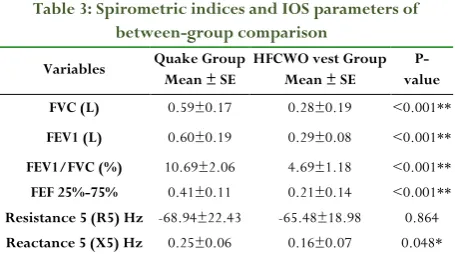
There was a statistical difference in the comparison between Quake and vest group in post-treatment results of most of the measured variables (FVC, FEV1, FEV1/FVC, FEF 25%-75%, R5, and X5) in favor of quake group (Table 3).
Table 3: Spirometric indices and IOS parameters of between-group comparison
Variables Quake Group Mean ± SE
HFCWO vest Group Mean ± SE
P- value FVC (L) 0.59±0.17 0.28±0.19 <0.001**
FEV1 (L) 0.60±0.19 0.29±0.08 <0.001**
FEV1/FVC (%) 10.69±2.06 4.69±1.18 <0.001**
FEF 25%-75% 0.41±0.11 0.21±0.14 <0.001**
Resistance 5 (R5) Hz -68.94±22.43 -65.48±18.98 0.864
Reactance 5 (X5) Hz 0.25±0.06 0.16±0.07 0.048* *p-value <0.05 S, FVC: forced vital capacity, FEV1: forced expiratory volume in 1 second, FEF: forced expiratory flow
Table 4: Correlation between an impulse Oscillometry system and FEV1, using the Pearson Correlation Coefficient
in the Quake group.
An impulse Oscillometry
system
FEV1
Pre Post Change
r p-value r p-value r p-value
Resistance 5 (Hz) -0.462 0.010* -0.412 0.024* -0.044 0.819
Reactance 5 (Hz) 0.139 0.464 0.180 0.340 0.131 0.490
r-Pearson Correlation Coefficient *p-value <0.05 S
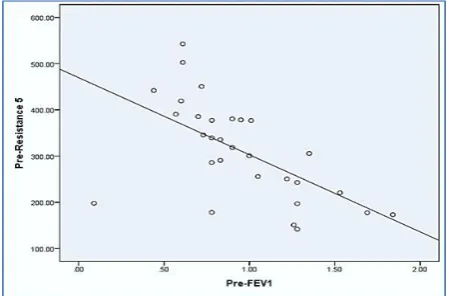
The significant and negative correlation between FEV1 with pre and post R5
Figure 3:Scatter plot between pre FEV1 and pre-resistance 5 in Quake group.
Figure 4:Scatter plot between post FEV1 and post-resistance 5
in Quake group.
Table 5: Correlation between an impulse Oscillometry system and FEV1, using the Pearson Correlation Coefficient
in Vest group.
An impulse Oscillometry
system
FEV1
Pre Post Change r p-value r p-value r p-value
Resistance 5 -0.595 <0.001** -0.171 0.365 -0.037 0.845
Reactance 5 0.342 0.046* 0.256 0.172 0.436 0.016*
r-Pearson Correlation Coefficient *p-value <0.05 S; **p-value <0.001 HS Significant negative correlation between FEV1 with pre resistance 5
A significant positive correlation between FEV1 and pre reactance 5 and change X5.
Figure 5:Scatter plot between pre FEV1 and pre-resistance 5
in Vest group.
Figure 6:Scatter plot between pre FEV1 and pre-reactance 5
in Vest group.
Figure 7:Scatter plot between change pre and post FEV1 and
change pre and post reactance 5 in Vest group.
Discussion
In this investigation, the two studied groups were age-matched with no significant difference between them regarding weight and height, indicating the appropriate selection of participants to ensure strict control of confounders that affects mucociliary clearance, as Bhowmik et al. [10] postulated that physiological
factors including age, gender, posture, weight, and height influence the mucociliary clearance.
Regarding the effect of extrathoracic oscillations (HFCWO vest), the current work demonstrated that 6 weeks of treatment via the vest caused a considerable improvement in ventilatory functions as FVC, which showed a significant increase with a change percentage of 14.1%, FEV1 showed a statistically significant increase with a change percentage of 29.5%, FEV1/FVC showed a statistically significant increase with a change percentage of 9.6% and FEF25%-75% showed a statistically significant increase with a change percentage of 39.6%.
These results come in agreement with the study done by
Nicolini et al. 2018 who found that both techniques (HFCWO and intrapulmonary percussive ventilation) performed in patients with severe COPD improved several parameters including FVC, FEV1, and FEV1/FVC in comparison to the control group [11].
minutes using HFCWO vest, which may be due to insufficient treatment duration to detect improvements [12].
In our study, the HFCWO vest showed a significant improvement in IOS parameters as resistance (R5), which was decreased by a change percentage of 21% and reactance increased (X5) by 25.8%.
The improvement in all variables may be attributed to several mechanisms caused by pressurized air pulses delivered by HFCWO vest to the external chest, which results in the loosening of transient spikes of cephalad airflow bias in the airways and moving trapped secretions during the compression phase of HFCWO. Moreover, the vest affected the physical properties of mucus due to its high-frequency oscillations, which disentangle mucus gel by reducing its cross-linkages and decreasing its viscoelasticity that eventually can enhance ciliary beating and mucociliary clearance [11].
Regarding the effect of intrathoracic oscillations, the current work showed large improvements by quake device on spirometric indices with the percentage of change in FVC, FEV1, FEV1/FVC, and FEF25%-75% equal to 29.1%, 65.9%, 23.2%, and 78.4% respectively.
This result comes in agreement with the study done by Nicolini et al. 2017 on temporary positive expiratory pressure vs. oscillatory positive expiratory pressure in severe COPD, which showed that both airway clearance devices (T-PEP and O-PEP) improved functional respiratory parameters, dyspnea, exercise capacity, and health status evaluation scores [13].
In contract, Sethi et al. 2014 did not find any changes in lung function after 26-week treatment with lung flute (O-PEP) in COPD patients, which probably was due to relatively small size sample to definitely evaluate the treatment benefit in different aspects of COPD [14].
In the current work, IOS parameters showed a statistical decrease via the O-PEP Quake device with the percentage of change in resistance (R5) by 21.8% and increase in reactance (X5) by 34.7%.
These results were consistent with the study done by Gastaldi et al. 2015, who showed a decrease in the respiratory resistance after one session treatment by flutter (O-PEP) in COPD patients
[15].
In contrast, the airway resistance was not changed in the study done by Veiga et al. 2008, who investigated the short-term effect of using (O-PEP) flutter in healthy subjects and patients with Pulmonary Disease, Chronic Obstructive (COPD), asthma, and bronchiectasis. The device was used for a period of 5 to 10 minutes and resistance was analyzed before and immediately after using the device [16].
In the present study, the improvement in all measured variables is probably because of the fact that the Quake device, belonging to the family of oscillating positive expiratory pressure devices, provides strong vibratory pulses during both exhalation and inhalation unlike traditional OPEP devices and causes vigorous percussive pulses that not only helps in reducing viscosity of mucus but also maximizes airflow and protects dynamic air collapse; thus it can be helpful for people with severe COPD [5].
In this study, comparison of the same variables’ analyses between the HFCWO vest group and the Quake group showed a significant improvement in Quake group than the vest group that might be explained by intrathoracic oscillations generated from the Quake device, which produced unfolding of physical entanglements between the primary mucus glycoprotein network and other structural macromolecules thereby improving the mucus transport. In addition, the beneficial effect of Quake device on the airway resistance and reactance could be related to the mobilization of secretions; keeping the airways patent and preventing its collapse; and increasing airflow, eventually leading to the alveolar ventilationincrease [5].
There was a single study conducted by Farag and El-Syed 2018
on acute exacerbation of COPD, in which they compared the HFCWO vest with OPEP flutter device and found that both devices significantly improved oxygenation parameters and spirometric indices but with no statistically significant difference between them in all measured post-treatment parameters [17].
In the current study, FEV1 appears to correlate well with the outcomes of IOS (R5 & X5) in both groups which was an expected result, on the basis of results presented in several previous studies as that done by Mousa and Kamal 2018 who found statistically significant negative correlation between the spirometric indices and R5, and positive correlation between these indices and X5 [18].
This emphasizes the usage of IOS along with the spirometry not only in assessing the severity of airway obstruction but also in following up the efficacy of treatment in COPD.
Conclusion
Both intra and extra-thoracic oscillations in the form of Quake and HFCWO vest are effective in the treatment of COPD patients and should be added to medical therapy to improve ventilatory function and lung compliance.
Conflict of interest:
The authors declare noconflicts of interest.
Funding:
This investigation received no specific grant fromfunding agencies in the commercial, public, or not-for-profit sectors.
References
1. Svenningsen S, Paulin GA, Sheikh K, Guo F, Hasany A, Kirby M, Etemad Rezai R, McCormack DG, Parraga G. Oscillatory positive expiratory pressure in chronic obstructive pulmonary disease. COPD: Journal of Chronic Obstructive Pulmonary Disease. 2016 Jan 2;13(1):66-74.
3. Morrison L, Milroy S. Oscillating devices for airway clearance in people with cystic fibrosis. Cochrane Database of Systematic Reviews. 2017(5).
4. Chakravorty I, Chahal K, Austin G. A pilot study of the impact of high-frequency chest wall oscillation in chronic obstructive pulmonary disease patients with mucus hypersecretion. International journal of chronic obstructive pulmonary disease. 2011;6:693–699. 5. Vyas A, Alaparthi GK, Krishnan S, Acharya V.
Comparison of Quake and RC-Cornet for Airway Clearance in Bronchiectasis: A Randomized Crossover Trial. International Journal of Health Sciences and Research. 2012;2(6):20-7.
6. Volsko TA Airway clearance. Equipment for respiratory care 2014: 515-526
7. Mejia-Downs A. Airway clearance techniques.
Cardiovascular and Pulmonary Physical Therapy-E-Book: Evidence to Practice. 2014 Mar 12:309-334
8. Miller MR, Crapo R, Hankinson J, Brusasco V, Burgos F, Casaburi R, Coates A, Enright P, van der Grinten CM, Gustafsson P, Jensen R. General considerations for lung function testing. European Respiratory Journal. 2005 Jul 1;26(1):153-61.
9. Oostveen E, MacLeod D, Lorino H, Farre R, Hantos Z, Desager K, Marchal F. The forced oscillation technique in clinical practice: methodology, recommendations, and future developments. European respiratory journal. 2003 Dec 1;22(6):1026-41.
10. Bhowmik A, Chahal K, Austin G, Chakravorty I. Improving mucociliary clearance in chronic obstructive pulmonary disease. Respiratory medicine. 2009 Apr 1;103(4):496-502.
11. Nicolini A, Grecchi B, Ferrari-Bravo M, Barlascini C. safety and effectiveness of the high-frequency chest wall oscillation vs intrapulmonary percussive ventilation in patients with severe COPD. International journal of
chronic obstructive pulmonary disease. 2018;13:617-625.
12. Mahajan AK, Diette GB, Hatipoğlu U, Bilderback A, Ridge A, Harris VW, Dalapathi V, Badlani S, Lewis S, Charbeneau JT, Naureckas ET. High frequency chest wall oscillation for asthma and chronic obstructive pulmonary disease exacerbations: a randomized sham-controlled clinical trial. Respiratory research. 2011 Dec;12(1):120. 13. Nicolini A, Mascardi V, Grecchi B, Ferrari‐Bravo M,
Banfi P, Barlascini C. Comparison of effectiveness of temporary positive expiratory pressure versus oscillatory positive expiratory pressure in severe COPD patients. The clinical respiratory journal. 2018 Mar;12(3):1274-82.
14. Sethi S, Yin J, Anderson PK. Lung flute improves symptoms and health status in COPD with chronic bronchitis: A 26 week randomized controlled trial. Clinical and translational medicine. 2014 Dec;3(1):29. 15. Gastaldi AC, Paredi P, Talwar A, Meah S, Barnes PJ,
Usmani OS. Oscillating positive expiratory pressure on respiratory resistance in chronic obstructive pulmonary disease with a small amount of secretion: a randomized clinical trial. Medicine. 2015 Oct;94(42).
16. Veiga J, Miranda IA, Dames KK, Jansen JM, Melo PL. Respiratory mechanics effects of Flutter VRP1 in healthy subjects and COPD, asthma and bronchiectasis patients. Pulmão RJ. 2008;17:18-21.
17. Farag TS, Mariam ES. Utility of vest high frequency chest wall oscillation device versus flutter device in acute exacerbation of chronic obstructive pulmonary disease. Int J Res Med Sci. 2017;6(1):1-9.
![Figure 1: The quake device [6].](https://thumb-us.123doks.com/thumbv2/123dok_us/8763091.1753035/2.595.320.545.523.675/figure-the-quake-device.webp)