© 2015 Gugulothu Sailaja and Bollikolla Hari Babu. This is an open access article distributed under the terms of the Creative Commons Attribution License -NonCommercial-ShareAlikeUnported License (http://creativecommons.org/licenses/by-nc-sa/3.0/).
Journal of Applied Pharmaceutical Science Vol. 5 (12), pp. 061-066, December, 2015 Available online at http://www.japsonline.com
DOI: 10.7324/JAPS.2015.501210 ISSN 2231-3354
A Validated High Performance Liquid Chromatography Method for
the Simultaneous Analysis of Guaifenesin, Ambroxol and Loratidine
in Bulk and Liquid Dosage form
Gugulothu Sailaja
1, Bollikolla Hari Babu
2*1
Department of Chemistry, Singareni Collieries Women’s Degree College, Kothagudem, Khammam, Andhra Pradesh, India.
2
Department of Chemistry, Acharya Nagarjuna University, Guntur, Andhra Pradesh, India.
ARTICLE INFO
ABSTRACT
Article history:
Received on: 15/09/2015 Revised on: 20/10/2015 Accepted on: 01/11/2015 Available online: 27/12/2015
A simple and sensitive HPLC method for simultaneous quantification of guaifenesin, ambroxol and loratidine in bulk and liquid dosage form was developed and fully validated. The separation and quantification was performed using a Kromasil C8 (250 × 4.6 mm, particles 5 μm) HPLC column. Isocratic elution mode with a flow rate of 1.2 mL/min was used, and the injection volume was 10 µL. The detector was set to a wavelength of 290 nm and the column oven was maintained at 30 °C. Orthophosphoric acid (0.1%) and acetonitrile in the ratio of 60:40 v/v
was used as the mobile phase. Guaifenesin, ambroxol and loratidine were eluted with retention time of3.045 min, 5.489 min and 13.981 min, respectively. The method was validated in accordance with ICH guidelines and the results of all the validation parameters were found to be within the acceptable limits. The calibration plots were linear over the concentration ranges from 50-150 µg/mL, 30-90 µg/mL and 5-15 µg/mL for guaifenesin, ambroxol and loratidine, respectively. Developed method was successfully applied for the quantification of the above three drugs in liquid dosage form. The excipient did not interfere with drug peaks.
Key words:
Guaifenesin, Ambroxol, Loratidine, HPLC, Syrup, Simultaneous analysis
INTRODUCTION
Guaifenesin
(Dicpinigaitis
and
Gayle,
2003;
Dicpinigaitis
et al.,
2009; Storms and Farrar, 2009), glyceryl
ether of guaiacol, is an expectorant used to lessen chest
congestion caused by the common cold, infections, or allergies.
Guaifenesin clears chest congestion by loosening and reducing
the viscosity of phlegm, increasing the volume of phlegm and
making coughs more productive. Chemically Guaifenesin is
known as 3-(2-Methoxyphenoxy)-1,2-propanediol. Analytical
methods for the determination of guaifenesin, either alone or in
combination with other drugs, include spectrophotometry
(Bhattacharyya
et al.,
2013; Harika
et al.,
2012), gas
chromatography (Sharaf and Stiff, 2004; Harsono
et al.,
2005),
HPLC (Aluri and Stavchansky, 1993; Amer
et al.,
2008; Galli
and Barbas, 2004; Stavchansky,
et al.,
1995; Shervington, 1997;
* Corresponding Author
Bollikolla Hari Babu, Department of Chemistry, Acharya Nagarjuna University, Guntur, Andhra Pradesh, India.
Vasudevan
et al.,
2000; Wilson
et al.,
1993; Wilcox and Stewart,
2000), capillary electrophoresis-mass spectrometry (Tanaka
et al.,
1998), X-ray diffraction (Grygar
et al.,
2008), voltammetry
(Tapsoba
et al.,
2005). Ambroxol hydrochloride (Beeh
et al.,
2008;
Chenot
et al.,
2014; Gupta, 2010), chemically known as
trans-4-((2-amino-3,
5-dibromobenzyl)
amino)-cyclohexanol
hydrochloride, is a potent mucolytic and mucokinetic, capable of
inducing bronchial secretion. Ambroxol is used in the treatment of
a variety of respiratory disorders including chronic bronchitis. It is
also used in the treatment of cough. Literature survey revealed that
several methods that have been reported for the estimation of
ambroxol hydrochloride either alone or in combination
with other drugs by using colorimetry (Levent and Şentürk, 2010;
Pai
et al.,
2006), atomic absorption spectrometry (Levent and
Şentürk, 2010), spectrophotometry (Gunawan and Ratna, 2008;
Nagras
et al.,
2012; Ponnilavasaran
et al.,
2012), conductometric
titration (Ashour and Khateeb, 2013), high performance thin layer
chromatography (Agrawal
et al.,
2010; Jain, 2010; Mehta
et al.,
2013; Sharma and Shah, 2010) and high performance liquid
Gopalakrishnan
et al.,
2012; Kumar
et al.,
2012; Moses
et al.,
2013; Patel
et al.,
2011; Raja
et al.,
2012; Venkateshwari
et al.,
2012). Loratadine (Day
et al.,
1998; Llupià
et al.,
2003; Prenner
et al.,
2009), chemically known as ethyl
4-(8-chloro-5,6-dihydro-11H-benzo(5,6)cyclohepta(1,2-b)pyridin-11-ylidene)-1- piperidine
carboxylate, is a second-generation piperidine histamine
H1-receptor antagonist with anti-allergic properties. It is used in the
treatment of allergic rhinitis, urticaria and reduce the symptoms of
hay fever for the short term. The review of the literature has
revealed that several methods have been reported for the
quantification of loratadine alone or in combination with other
drugs. These methods included spectrophotometry (Bushra, 2013;
Mabrouk
et al.,
2003; Radhakrishna
et al.,
2003; Singhvi and
Bhatia, 2006), high performance liquid chromatography (Bushra,
2013; El-Sherbiny
et al.
, 2007; Gajjela
et al.,
2011; Mabrouk
et
al.,
2003; Lu
et al.,
2010; Radhakrishna
et al.,
2003; Singhvi and
Bhatia, 2006), voltammetry (Norouzi and Ganjali, 2008) and high
performance liquid chromatography with mass spectrometry
detection (Patel
et al.,
2010; Salem
et al.,
2004; Vlase
et al.,
2007). The chemical structures of guaifenesin, ambroxol and
loratidine are shown in Fig. 1.
C
Fig. 1: Chemical structure of A) Guaifenesin B) Ambroxol C) Loratidine.
The combination of guaifenesin, ambroxol and loratidine
is used to treat cough, cold, allergy and other related conditions.
The combination of these three drugs is not official in any
pharmacopeias. As per the thorough literature review only one
spectrophotometry (Patel and Chaudhri, 2013) and two HPLC
(Sameena
et al.,
2014; Vani
et al.,
2014) methods are reported for
the simultaneous estimation of guaifenesin, ambroxol and
loratidine in bulk and liquid dosage form. The reported methods
suffers from one or more drawbacks like use of triple solvent
system
as
mobile
phase,
less
precise,
less
accurate,
preparation of buffer, greater tailing factor (>1.25), less resolution
factor and less sensitive. Hence, the present investigation is aimed
to develop and validate a simple, sensitive and accurate HPLC
method for the simultaneous quantification of guaifenesin,
ambroxol and loratidine in bulk and in its liquid dosage form.
MATERIALS AND METHODS
Apparatus
The
Waters
HPLC
system,
consisted
of
a
binary HPLC pump model 2695, photodiode-array (PDA) detector
model 2998 and a vacuum degasser, all controlled by a Waters
Empower2 software was used in the present investigation.
Chromatographic conditions
Kromasil C8 (250 × 4.6 mm; 5 µm particle size)
analytical column was used for separation and analysis of
guaifenesin, ambroxol and loratidine. The column temperature was
maintained at 30 ± 1
oC. Mobile phase consisted of 0.1%
orthophosphoric acid and acetonitrile in the ratio of (60:40
v/v
,
respectively). The separation was done under isocratic elution with
flow rate maintained at 1.2 mL/min. The injection volume was 10
μL. The guaifenesin, ambroxol and loratidine were analyzed using
a PDA detector set at 290 nm.
Standard solutions
Reference standard of guaifenesin, ambroxol and
loratidine were obtained from Lara Drugs Private Limited,
Telangana. A combined standard stock solution of accurately
weighted guaifenesin (50 mg), ambroxol (30 mg) and loratidine (5
mg) was prepared in 100 mL volumetric flask and dissolved in
mobile phase. 5 mL aliquot of guaifenesin, ambroxol and
loratidine stock solution were added to a 25 mL volumetric flask,
and diluted in mobile phase, yielding a final concentration of 100,
60 and 10 µg/mL, respectively.
Sample solution
Commercial
syrup
(Lorfast
AM
Syrup,
Cadila
Pharmaceuticals Ltd., Ahmadabad: labeled to contain
50 mg
guaifenesin, 30 mg ambroxol and 5 mg loratidine per 5 mL of
syrup) was purchased from local pharmacy store. The syrup was
shaken thoroughly to make homogenous mixture. A volume of the
syrup equivalent to 50 mg guaifenesin, 30 mg ambroxol and 5 mg
loratidine was transferred accurately into a 100 mL volumetric
flask containing 30 mL of mobile phase. The contents of the flask
was shaken for about 10 min and diluted to volume with the
mobile phase. The solution was then filtered through a 0.45 µm
millipore filter. The above solution was appropriately diluted with
the mobile phase to get a final concentration of 100, 60 and 10
µg/mL of guaifenesin, ambroxol and loratidine, respectively.
RESULTS AND DISCUSSION
Method development
loratidine. For optimization of the chromatographic conditions and
to obtain symmetrical peaks with better resolution and with
acceptable system suitability results, various chromatographic
conditions such as composition of mobile phase, flow rate and two
different analytical columns were applied to guaifenesin, ambroxol
and loratidine combination. Among the tested analytical columns
[ACE C8 (150 mm x 4.6mm, 5 μm particle size) and Kromasil C8
(250 × 4.6 mm; 5 µm particle size)] during preliminary
investigations, Kromasil C8 (250 × 4.6 mm; 5 µm particle size)
was the most appropriate column for simultaneous analysis of
guaifenesin, ambroxol and loratidine. In the preliminary trials
different compositions of mobile phases consisting of 0.1 M
dipotassium
hydrogen
phosphate/acetonitrile
and
0.1%
orthophosphoric acid/acetonitrile, different ratios and different
flow rates of these solutions were employed to achieve the best
system suitability results. Finally, the mobile phase composition of
0.1% orthophosphoric acid: acetonitrile in the ratio of 60:40
v/v
with a flow rate of 1.2 mL/min was shown to have good resolution
with minimal tailing factor in acceptable range. The column
temperature of 30
oC and detector wavelength set at 290 nm was
chosen
as
suitable
condition.
Under
the
mentioned
chromatographic conditions highly symmetrical and sharp peaks
of guaifenesin, ambroxol and loratidine were obtained at retention
times of 3.045 min, 5.489 min and 13.981 min, respectively (Fig.
2).
Fig. 2: Chromatogram of guaifenesin, ambroxol and loratidine combination standard solution under optimized chromatographic condition.
Method validation
The developed method was validated for system
suitability, linearity, sensitivity, precision, accuracy and robustness
following the ICH guidelines (International Conference on
Harmonization, 2005).
System suitability
Earlier to each analysis, the chromatographic system
must satisfy suitability test requirements. System suitability test
was performed from five replicate injections of a standard solution
containing 100, 60 and 10 µg/mL of guaifenesin, ambroxol and
loratidine, respectively. All peaks were well resolved. The
precision of injections for all peaks were acceptable. The percent
relative standard deviations of the peaks area responses were
measured. The USP tailing factor, USP resolution and USP plate
count were also calculated. The results of system suitability in
association with the required limits are presented in Table 1.
The developed method met requirements within the accepted
limits.
Table 1: System suitability.
Parameters
Results
R
e
c
o
m
m
e
n
d
e
d
li
m
its
Guaifenesin Ambroxol Loratidine
Retention time 3.045 5.489 13.981 -
Peak area 360940 (%RSD – 0.8)
1363778 (%RSD – 0.4)
710371 (%RSD – 0.3)
RSD ≤1
USP resolution 25.03 10.38 18.30 > 1.5 USP plate count 5517 5236 8467 > 2000
USP tailing factor 1.22 1.06 1.10 ≤ 2
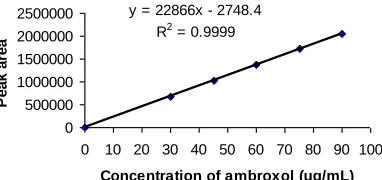
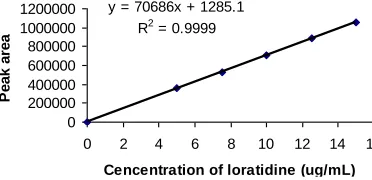
Linearity
The linearity test was performed using five different
amounts of guaifenesin, ambroxol and loratidine in the range
50-150 µg/mL, 30-90 µg/mL and 5-15 µg/mL, respectively. Solutions
corresponding to each concentration level were injected in
duplicate and linear regression analysis of the guaifenesin,
ambroxol and loratidine peak area
vs
guaifenesin, ambroxol and
loratidine concentration were calculated. The results are
summarized in Fig. 3, 4 & 5. The results show a good correlation
between the peak area of drugs and their concentrations with
R
2value > 0.9998.
Fig. 3: Linearity and regression equation of guaifenesin.
Fig. 4: Linearity regression equation of ambroxol. y = 3609.7x + 1078.1
R2 = 0.9999
0 100000 200000 300000 400000 500000 600000
0 25 50 75 100 125 150 175
Concentration of guaifenesin (ug/mL)
P
e
a
k
a
re
a
y = 22866x - 2748.4
R2 = 0.9999
0 500000 1000000 1500000 2000000 2500000
0 10 20 30 40 50 60 70 80 90 100
Concentration of ambroxol (ug/mL)
P
e
a
k
a
re
Fig. 5: Linearity regression equation of loratidine.
Sensitivity
The sensitivity of the developed method was assessed by
determining Limit of quantification (LOQ) and detection (LOD).
The LOQ and LOD were predicted by the following formulae
(a)
LOQ = 10 σ / S
(b)
LOD = 3.3 σ / S
Where σ = standard deviation of response; S = slope of the
calibration curve.
The
LOD was found to be 0.754 μg/mL, 0.231 μg/mL
and 0.145 μg/mL, whereas LOQ was found to be 2.513 μg/mL,
0.769 μg/mL and 0.483 μg/mL for guaifenesin, ambroxol and
loratidine, respectively. The results reveal satisfactory sensitivity
of the developed method.
Precision
The precision of the developed method was demonstrated
by intra-day variation studies. For this purpose, six repeated
injections of standard solutions (guaifenesin-100 μg/mL;
ambroxol-60 μg/mL; loratidine-10 μg/mL) were made. The
response of guaifenesin, ambroxol, loratidine and their percentage
relative standard deviation (%RSD) were calculated. From the
results, the developed method was considered to be precise
(Table 2).
Table 2: Results of precision of the method.
Guaifenesin Ambroxol Loratidine
Peak area %RSD Peak area %RSD Peak area %RSD
364354
0.29
1369971
0.41
712382
0.16
363644 1377191 714875
361943 1359782 711901
362672 1371184 713348
363559 1368971 713069
361704 1367314 711824
Accuracy
The accuracy of the method was determined via recovery
experiments. The accuracy of the proposed method was
demonstrated by preparing samples spiked with 50%, 100%, and
150% of the test concentration of guaifenesin, ambroxol and
loratidine. Each concentration level was analyzed thrice.
Mean percent recovery and percent RSD were calculated
for each concentration. Recovery of individual components was
well within the acceptable limit (Table 3). From the data
obtained, added recoveries of drugs were found to be accurate.
Table 3: Results of accuracy of the method.
Accuracy level
μg/mL added
Peak area μg/mL
found
% Recovery
% Mean Guaifenesin
50%
50.00 181685 50.03 100
100 50.00 180916 49.82 100
50.00 181188 49.90 100
100%
100.00 363957 100.23 100
100 100.00 361611 99.58 100
100.00 364536 100.39 100
150%
150.00 543535 149.69 100
100 150.00 545074 150.11 100
150.00 544511 149.95 100
Ambroxol
50%
30.00 683406 29.92 100
100 30.00 682872 29.89 100
30.00 682683 29.88 100
100%
60.00 1373533 60.13 100
100 60.00 1369581 59.95 100
60.00 1358886 59.49 99
150%
90.00 2057259 90.06 100
100 90.00 2047357 89.62 100
90.000 2061957 90.26 100
Loratidine
50%
5.00 354211 4.98 100
100
5.00 356071 5.00 100
5.00 355322 4.99 100
100%
10.00 714041 10.03 100
100 10.00 712498 10.01 100
10.00 713146 10.02 100
150%
15.00 1072341 15.07 100
100 15.00 1068522 15.01 100
15.00 1067093 14.99 100
Robustness
Robustness of the method was determined by making
slight changes in the chromatographic conditions. In all the
deliberate varied chromatographic conditions, the parameters like
tailing factor, peak area and theoretical plates were not much
affected, which shows that the method is robust. The results are
shown in Table 4.
Table 4: Results of robustness. Sample.
No Parameter
Retention time
Peak area
USP plate count
USP Tailing Guaifenesin
1 Temp-1 3.263 385392 6262 1.23
2 Temp-2 2.564 283126 5611 1.21
3 Flow-1 3.213 381517 6547 1.25
4 Flow-2 2.555 290572 5489 1.22
Ambroxol
1 Temp-1 5.975 1489174 5725 1.07
2 Temp-2 4.698 1099458 4734 1.05
3 Flow-1 5.939 1473039 5665 1.08
4 Flow-2 4.703 1112064 4818 1.04
Loratidine
1 Temp-1 15.205 786656 8873 1.08
2 Temp-2 11.955 567326 8074 1.07
3 Flow-1 15.167 766862 9136 1.11
4 Flow-2 11.951 580928 7842 1.08
CONCLUSION
The optimal chromatographic conditions for separation
and simultaneous quantification of guaifenesin, ambroxol and
loratidine were achieved on an Kromasil C8 (250 × 4.6 mm; 5 µm
y = 70686x + 1285.1 R2 = 0.9999
0 200000 400000 600000 800000 1000000 1200000
0 2 4 6 8 10 12 14 16
Cencentration of loratidine (ug/mL)
P
e
a
k
a
re
particle size) analytical column with a isocratic elution at a flow
rate of 1.2 mL/min, using 0.1% orthophosphoric acid:acetonitrile
(60:40
v/v
) as mobile phase and detection set to a wavelength of
290 nm. The method was simple and does not require preparation
of buffer. The proposed method has the advantages of being
sensitive, high resolution factor and less tailing factor than the
reported HPLC methods (Sameena
et al.,
2014; Vani
et al.,
2014).
All measured parameters of the validation reveal the suitability of
developed HPLC method for the simultaneous analysis of
guaifenesin, ambroxol and loratidine in bulk and liquid
pharmaceutical preparation.
ACKNOWLEDGEMENT
I am thankful to department of chemistry of Singareni
Collieries Women Degree College, Kakatiya University,
Hyderabad, for providing instruments and analytical support.
REFERENCES
Agrawal OD, Shirkhedkar AA, Surana AJ. Simultaneous determination of levofloxacin hemihydrate and ambroxol hydrochloride in tablets by thin-layer chromatography combined with densitometry. J Anal Chem, 2010; 65: 418-422.
Aluri JB, Stavchansky S. Determination of guaifenesin in human plasma by liquid chromatography in the presence of pseudoephedrine. J Pharm Biomed Anal, 1993; 11: 803-808.
Amer SM, Abbas SS, Shehata MA, Ali NM. Simultaneous determination of phenylephrine hydrochloride, guaifenesin, and chlorpheniramine maleate in cough syrup by gradient liquid chromatography. J AOAC Int, 2008; 91: 276–284.
Arora P, Arora V, Jain S. Simultaneous estimation of cetirizine dihydrochloride and ambroxol hydrochloride in pharmaceutical formulation by a novel HPLC method. Int J Pharma Sci Res, 2012; 2: 3149–3151.
Ashour S, Khateeb M. Conductometric titration method for determination of Alfuzosin hydrochloride and fexofenadine hydrochloride using tetraphenylborate. Can Chem Trans, 2013; 1: 292-304.
Beeh KM, Beier J, Esperester A, Paul LD. Anti-inflammatory properties of ambroxol. Eur J Med Res, 2008; 13: 557-562.
Bhattacharyya SP, Kyal C, Choudhury P, Dhakal B, Ghosh SK. Estimation and validation of stability indicating UV spectrophotometric method for the determination of guaifenesin in presence of its degradant products. Int J Pharma Pharma Sci, 2013; 5 (Suppl 1): 262-268.
Buchupalli P, Medidi S. RP-HPLC method for the simultaneous estimation of ambroxol hydrochloride and fexofenadine hydrochloride in bulk and in a tablet mixture. J App Pharm Sci, 2015; 5: 74-80.
Bushra BQ, Spectrophotometric and FIA Methods for determination of loratadine in pharmaceutical formulations based on charge transfer reaction. Int J Res Pharma Biomed Sci, 2013; 4: 279-285.
Chenot JF, Weber P, Friede T. Efficacy of Ambroxol lozenges for pharyngitis: a meta-analysis. BMC Fam Pract, 2014; 15: 45-49.
Day JH, Briscoe M, Widlitz MD. Cetirizine, loratadine, or placebo in subjects with seasonal allergic rhinitis: effects after controlled ragweed pollen challenge in an environmental exposure unit. J Allergy Clin Immunol, 1998; 101: 638-645.
Dicpinigaitis PV, Gayle YE. Effect of guaifenesin on cough reflex sensitivity. Chest, 2003; 124: 2178-2181.
Dicpinigaitis PV, Gayle YE, Solomon G, Gilbert RD. Inhibition of cough-reflex sensitivity by benzonatate and guaifenesin in acute viral cough. Respir Med, 2009; 103: 902-906.
El-Sherbiny DT, El-Enany N, Belal FF, Hansen SH. Simultaneous determination of loratadine and desloratadine in
pharmaceutical preparations using liquid chromatography with a microemulsion as eluent. J Pharm Biomed Anal, 2007; 43: 1236-1242.
Galli V, Barbas C. High-performance liquid chromatographic analysis of dextromethorphan, guaifenesin and benzoate in a cough syrup for stability testing. J Chromatogr A, 2004; 1048: 207–211.
Gajjela R, Yalavarthi RK, Krishnamurthy V, Mulukutla VS, Khagga M. A new validated liquid chromatographic method for the determination of loratadine and its impurities. Sci Pharm, 2011; 79: 277– 291.
Gopalakrishnan S, Chitra TA, Aruna A, Chenthilnathan A. Development of RP-HPLC method for the simultaneous estimation of ambroxol hydrochloride, cetirizine hydrochloride and antimicrobial preservatives in combined dosage form. Der Pharma Chemica, 2012; 4: 1003–1015.
Grygar T, Frýbort O, Bezdička P, Pekárek T. Quantitative analysis of antipyretics and analgesics in solid dosage forms by powder X-ray diffraction. Chem Analityczna, 2008; 53: 187–200.
Gupta PR. Ambroxol - Resurgence of an old molecule as an anti-inflammatory agent in chronic obstructive airway diseases. Lung India, 2010; 27: 46–48.
Gunawan I, Ratna H. Quantitative determination of ambroxol hydrochloride in syrups by RP-HPLC and UV spectroscopy. Drug Dev Ind Pharm, 2008; 20: 1639-1647.
Harika S, Rani AP, Mubarak, Sekaran CB. Spectrophotometric quantification of guaifenesin in tablet dosage form using potassium permanganate. Current Res Bio Pharm Sci, 2012; 1: 11-14.
Harsono T, Yuwono M, Indrayanto G. Simultaneous determination of some active ingredients in cough and cold preparations by gas chromatography, and method validation. J AOAC Int, 2005; 88: 1093–1098.
International Conference on Harmonization, ICH Guidelines, Validation of Analytical Procedures Technical Requirements for Registration of Pharmaceuticals for Human Use: Text and Methodology Q 2 (R1), International Conference on Harmonization, Geneva, Switzerland, November 2005.
Jain, PS. Stability-indicating HPTLC determination of ambroxol hydrochloride in bulk drug and pharmaceutical dosage form. J Chromatogr Sci, 2010; 48: 45-48.
Kumar TP, Haque MA, Kumar KP, Nivedita G, Diwan VP. Simultaneous determination of cetirizine hydrochloride and ambroxol hydrochloride in combined dosage form by using RP-HPLC method. Am J PharmTech Res, 2012; 2: 716–723.
Levent A, Şentürk Z. Colorimetric and atomic absorption spectrometric determination of mucolytic drug Ambroxol through ion -pair formation with iron and thiocyanate. Comb Chem High T Scr, 2010; 13: 675-682.
Llupià J, Gras J, Llenas J. Comparative antiallergic effects of second-generation H1-antihistamines ebastine, cetirizine and loratadine in preclinical models. Arzneimittelforschung, 2003; 53: 93-97.
Lu J, Wei YC, Markovich RJ, Rustum AM. Development and validation of a novel stability-indicating reversed-phase high-performance liquid chromatography method for assay of loratadine and determination of its related compounds. J AOAC Int, 2010; 93: 891–903.
Mabrouk MM, El-Fatatry HM, Hammad S, Wahbi AAM. Simultaneous determination of loratadine and pseudoephedrine sulfate in pharmaceutical formulation by RP-LC and derivative spectrophotometry. J Pharm Biomed Anal, 2003; 33: 597-604.
Mehta FA, Patelia EM, Bhoya PN. Simultaneous estimation of ambroxol hydrochloride and doxofylline in pharmaceutical formulation by HPTLC desitometric method. J Chromat Separation Techniq, 2013; 4: 168-171.
Moses PF, Singh P, Raja A, Banji D. Analytical method development and validation for simultaneous estimation of ambroxol and desloratadine in its pharmaceutical dosage form by RP-HPLC. World J Pharma Pharmaceut Sci, 2013; 2: 6246-6262.
Norouzi P, Ganjali MR. A new method for the determination of loratadine at an Aumicroelectrode in flowing systems with the use of fast continuous cyclic voltammetry. J Anal Chem, 2008; 63: 566-573.
Pai PNS, Lalitha N, Balakrishna B, Rao GK. Determination of ambroxol hydrochloride using dithiocarbamic acid colorimetric method. Indian J Pharm Sci, 2006; 68: 501-502.
Patel BN, Sharma N, Sanyal M, Shrivastav PS. LC-MS-ESI for the determination of loratadine and descarboethoxyloratadine in human plasma. J Chromatogr Sci, 2010; 48: 35-44.
Patel BA, Patel SG, Patel DP, Patel BH, Patel MM. Stability indicating HPTLC method development and validation for estimation of ambroxol hydrochloride and cetirizine dihydrochloride in combine tablet dosage form. Int Res J Pharma, 2011; 2: 95–99.
Patel PV, Chaudhri BG. Spectrophotometric method for simultaneous estimation of ambroxol hydrochoride, guaifenesin and loratadine in combined syrup formulation , Inventi Rapid - Pharm Analysis & Quality Assurance, 2013; Inventi:ppaqa/708/13.
Ponnilavasaran I, Narendra CS, Asha P. Simultaneous estimation of ambroxol hydrochloride and loratadine in tablet dosage form by using UV spectrophotometric method. Int J Pharma and Bio Sci, 2011; 2: 338-344.
Prenner B, Anolik R, Danzig M, Yao R. Efficacy and safety of fixed-dose loratadine/montelukast in seasonal allergic rhinitis: effects on nasal congestion. Allergy Asthma Proc, 2009; 30: 263-269.
Radhakrishna T, Narasaraju A, Ramakrishna M, Satyanarayana A. Simultaneous determination of montelukast and loratadine by HPLC and derivative spectrophotometric methods. J Pharm Biomed Anal, 2003; 31: 359-368.
Raja MG, Geetha G, Sankaranarayanan A, Raju KMG, Kumar PS. Simultaneous and stability indicating method for determination of cetrizine hydrochloride and ambroxol hydrochloride in syrup. Int J Pharma Sci Res, 2012; 3: 2658–2663.
Salem II, Idrees J, Al Tamimi JI. Determination of loratadine in human plasma by liquid chromatography electrospray ionization ion -trap tandem mass spectrometry. J Pharm Biomed Anal, 2004; 34: 141-151.
Sameena M, Syed AAB, Asiya F. Stability indicating method development & validation for simultaneous estimation of loratadine, ambroxol hydrochloride and guaiphenesin in bulk drug and liquid dosage form using RP-HPLC method. Int J Pharm Tech, 2014; 6: 6536-6551.
Sharaf MH, Stiff DD. Determination of guaifenesin in human serum by capillary gas chromatography and electron capture detection. J Pharm Biomed Anal, 2004; 35: 801-806.
Sharma EA, Shah NJ. Development and validation of high performance thin layer chromatography method for simultaneous estimation of ambroxol hydrochloride and desloratadine hydrochloride in their combined tablet dosage form. Int. Res. J. 2010; 3: 305-308.
Shervington LA. A quantitative simultaneous high performance liquid chromatographic determination of pseudoephedrine HCl, guaifenesin and dextromethorphan HBr. Anal Lett, 1997; 30: 927–944.
Singhvi I, Bhatia N. Spectrophotometric and HPLC methods for simultaneous estimation of pseudoephedrine hydrochloride and loratadine from tablets. Indian J Pharma Sci, 2006; 68: 72-75.
Stavchansky S, Demirbas S, Reyderman L, Chai CK. Simultaneous determination of dextrorphan and guaifenesin in human plasma by liquid chromatography with fluorescence detection. J Pharma Biomed Anal, 1995; 13: 919–925.
Storms W, Farrar JR. Guaifenesin in rhinitis. Curr Allergy Asthma Rep, 2009; 9: 101-106.
Tanaka Y, Kishimoto Y, Otsuka K, Terabe S. Strategy for selecting separation solutions in capillary electrophoresis-mass spectrometry. J Chromatogr A, 1998; 817: 49–57.
Tapsoba I, Belgaied JE, Boujlel K. Voltammetric assay of guaifenesin in pharmaceutical formulation. J Pharma Biomed Anal, 2005; 38: 162–165.
Vani R, Kumar BV, Mohan GK. Analytical method development and validation for the determination of loratadine, ambroxol hydrochloride and guaiphenesin using reverse phase HPLC method in bulk and liquid dosage form. J Global Trends Pharma Sci, 2014; 5: 2248-2252.
Vasudevan M, Ravisankar S, George M, Ravi J. Simultaneous estimation of terbutaline, bromhexine and guaiphenesin in soft gelatin capsules by HPLC method. Indian Drugs, 2000; 37: 489-492.
Venkateshwari P, Kumar GVS, Puranik SB. Development of stability indicating RP-HPLC method for simultaneous estimation of ambroxol hydrochloride and levocetirizine dihydrochloride. Int J Adv Pharma Anal, 2012; 2: 34-40.
Vlase L, Imre S, Muntean D, Leucuta SE. Determination of loratadine and its active metabolite in human plasma by high -performance liquid chromatography with mass spectrometry detection. J Pharm Biomed Anal, 2007; 44: 652-657.
Wilcox ML, Stewart JT. HPLC determination of guaifenesin with selected medications on underivatized silica with an aqueous-organic mobile phase. J Pharma Biomed Anal, 2000; 23: 909–916.
Wilson TD, Jump WG, Neumann WC, Martin TS. Validation of improved methods for high-performance liquid chromatographic determination of phenylpropanolamine, dextromethorphan, guaifenesin and sodium benzoate in a cough-cold formulation. J Chromatogr, 1993; 641: 241–248.
How to cite this article: