ISSN: 1821-1291, URL: http://www.bmathaa.org Volume 2 Issue 4(2010), Pages 146-151.
CONCERNING SOME SIXTH-ORDER ITERATIVE METHODS FOR FINDING THE SIMPLE ROOTS OF NONLINEAR
EQUATIONS
(DEDICATED IN OCCASION OF THE 70-YEARS OF PROFESSOR HARI M. SRIVASTAVA)
F. SOLEYMANI
Abstract. This study deals with simple roots of nonlinear equations. A mis-take in Kim’s paper, [Y. Kim, New sixth-order improvements of the Jarratt method, Kyungpook Math. J., 50(2010), 7-14] is noticed and solved. Next, a novel algorithm of local order six in which we have three evaluations of the function and one evaluation of the first derivative per iteration is presented, i.e., a new iterative method for finding the simple zeros of𝑓(𝑥) = 0 that has less computational burden in contrast with Kim’s family in viewpoint of the number of derivative evaluations per cycle. As things develop, three illustrative examples are given to put on show the effectiveness of the novel technique.
1. Background
Let us consider the nonlinear scalar equation 𝑓(𝑥) = 0, which has a simple zero (i.e. root) on the open interval 𝐷 be sufficiently smooth. Then a sequence of iterations by choosing an appropriate guess in this neighborhood is called to converge to the simple root𝛼, when after some iterations, it gets closer and closer to the root. Technically speaking, when the sequence{𝑥𝑛}∞
𝑛=0 for a positive𝜆and 𝑝satisfies in the following relation
lim 𝑛→∞
∣𝑥𝑛+1−𝛼∣ ∣𝑥𝑛−𝛼∣𝑝
=𝜆, (1.1)
then the iterative method which produces this sequence, is of local order of con-vergence 𝑝. For instance, the Newton’s method (NM) converges to the simple zeros locally quadratically [5]. By the beginning of the new century, the endeavor for increasing up the order of convergence and efficiency index (𝑝1/𝑛whereas 𝑛is whole function and derivative evaluations per iteration for an iterative method) has emerged; see e.g. [6, 7] due to vast applications of numerical root solvers in
1991Mathematics Subject Classification. 41A25, 65H05.
Key words and phrases. Jarratt method, fourth-order, sixth-order, efficiency index, error equa-tion, asymptotic error constant.
c
⃝2010 Universiteti i Prishtin¨es, Prishtin¨e, Kosov¨e. Submitted August 27, 2010. Published November 26, 2010.
applied sciences and other fields of study. The simplest root-finding algorithm is the bisection method. It works when 𝑓 is a continuous function and it requires previous knowledge of two initial guesses, 𝑎 and 𝑏, such that 𝑓(𝑎) and 𝑓(𝑏) have opposite signs. Although it is reliable, it converges slowly, gaining one bit of ac-curacy with each iteration. Newton’s method assumes the function 𝑓 to have a continuous derivative. Newton’s method may not converge if started too far away from a zero. However, when it does converge, it is faster than the bisection method, and is usually quadratic. Newton’s scheme is also significant because it readily gen-eralizes to higher-dimensional problems. Newton-like methods with higher order of convergence are the Householder’s methods. The first one after Newton’s method is Halley’s technique with cubic order of convergence. Replacing the derivative in Newton’s method with a finite difference, we get the secant method. This method does not require the computation (nor the existence) of a derivative, but the price is slower convergence (the order is approximately 1.6). A generalization of the secant method in higher dimensions is Broyden’s method [5]. The false position method, also called the regula falsi method, is like the secant scheme. However, instead of retaining the last two points, it makes sure to keep one point on either side of the root. The false position method is faster than the bisection method and more robust than the secant method, but requires the two starting points to bracket the root.
The fourth-order Jarratt method [1] which consists of one evaluation of the func-tion and two evaluafunc-tions of the first derivative is given by (JM)
{
𝑦𝑛=𝑥𝑛−23 𝑓(𝑥𝑛)
𝑓′(𝑥 𝑛),
𝑥𝑛+1=𝑥𝑛− 3𝑓
′(𝑦
𝑛)+𝑓′(𝑥𝑛)
6𝑓′(𝑦
𝑛)−2𝑓′(𝑥𝑛)
𝑓(𝑥𝑛)
𝑓′(𝑥 𝑛).
(1.2)
Motivated by this method some other iterative methods with higher orders of convergence have been presented to the world of numerical analysis up to now. Ren et al. [4] mentioned a sixth-order convergent family including three steps, four evaluations per iteration (two function and two first derivative evaluations) and two parameters (RWB)
⎧
⎨
⎩
𝑦𝑛=𝑥𝑛−23 𝑓(𝑥𝑛)
𝑓′(𝑥 𝑛),
𝑧𝑛 =𝑥𝑛− 3𝑓
′(𝑦
𝑛)+𝑓′(𝑥𝑛)
6𝑓′(𝑦
𝑛)−2𝑓′(𝑥𝑛)
𝑓(𝑥𝑛)
𝑓′(𝑥 𝑛),
𝑥𝑛+1=𝑧𝑛− (2𝑎−𝑏)𝑓
′(𝑥
𝑛)+𝑏𝑓′(𝑦𝑛)+𝑐𝑓(𝑥𝑛)
(−𝑎−𝑏)𝑓′(𝑥
𝑛)+(3𝑎+𝑏)𝑓′(𝑦𝑛)+𝑐𝑓(𝑥𝑛)
𝑓(𝑧𝑛)
𝑓′(𝑥 𝑛),
(1.3)
wherein𝑎, 𝑏, 𝑐∈ℝand𝑎∕= 0.
In 2010, Kim in [2] proposed a new sixth-order family as follows (KM)
⎧
⎨
⎩
𝑦𝑛=𝑥𝑛−2 3
𝑓(𝑥𝑛)
𝑓′(𝑥 𝑛),
𝑧𝑛=𝑥𝑛− 3𝑓′(𝑦𝑛)+𝑓′(𝑥𝑛)
6𝑓′(𝑦
𝑛)−2𝑓′(𝑥𝑛)
𝑓(𝑥𝑛)
𝑓′(𝑥 𝑛),
𝑥𝑛+1=𝑧𝑛− (𝛼+𝛽)(𝑧𝑛
−𝑥𝑛)2𝑓′(𝑥𝑛)+((𝛼+𝛽)(𝑧𝑛−𝑥𝑛)−𝛽(𝑦𝑛−𝑥𝑛))[𝑓(𝑥𝑛)−𝑓(𝑧𝑛)]
𝛼(𝑧𝑛−𝑥𝑛)2𝑓′(𝑥𝑛)+𝛽(𝑧𝑛−𝑥𝑛)2𝑓′(𝑦𝑛)+((𝛼+𝛽)(𝑧𝑛−𝑥𝑛)−𝛽(𝑦𝑛−𝑥𝑛))[𝑓(𝑥𝑛)−𝑓(𝑧𝑛)]
𝑓(𝑧𝑛)
𝑓′(𝑥𝑛),
(1.4)
wherein𝛼,𝛽 are two free-parameter inℝ.
2. Main Outcomes
In [2], it has been claimed that the method (1.4) has two function evaluations and three first derivative evaluations per iteration. That is in other words, it has five evaluations per iteration.
Correction 1. As we can see from the iterative scheme (1.4), it has two func-tion evaluafunc-tions, i.e., 𝑓(𝑥𝑛), 𝑓(𝑧𝑛) and two derivative evaluations, i.e., 𝑓′(𝑥𝑛), 𝑓′(𝑦𝑛). Thus, it includes four evaluations per iteration, not five evaluations and consequently its efficiency index is 1.565, not 1.431, as it has been claimed in [2].
Remark 1. In real-world circumstances or when the functions are complicated, evaluations of more derivatives of the function in new points are not a rational or practical work. Occasionally in such situations, we have to even approximate the derivatives in the new points and therefore the applications of some iterative algo-rithms like (1.3) and (1.4) are restricted.
Motivated by (1.4) and Remark 1, in this research we assume that the value of the function in the second step of the Jarratt method is available, that is𝑓(𝑦𝑛). Af-terwards we estimate𝑓′(𝑦
𝑛) by𝑓(𝑥𝑛),𝑓(𝑦𝑛) and𝑓′(𝑥𝑛). Thus, we consider the non-linear fraction𝑤1(𝑡) =𝑎1+𝑎2(𝑡−𝑥)
1+𝑎3(𝑡−𝑥). This approximation function must meet the real
function𝑓(𝑥) in the points𝑥𝑛,𝑦𝑛. Thus we have𝑤1(𝑥𝑛) =𝑓(𝑥𝑛),𝑤′1(𝑥𝑛) =𝑓′(𝑥𝑛) and𝑤1(𝑦𝑛) =𝑓(𝑦𝑛). Note that𝑤1′(𝑡) is of the following form
𝑤′1(𝑡) = 𝑎2(1 +𝑎3(𝑡−𝑥))−(𝑎1+𝑎2(𝑡−𝑥))𝑎3 (1 +𝑎3(𝑡−𝑥))2
. (2.1)
Hence, we obtain a system of three linear equations with three unknowns as follows
⎧
⎨
⎩
𝑎1=𝑓(𝑥𝑛),
(𝑦𝑛−𝑥𝑛)𝑎2−𝑓(𝑦𝑛)(𝑦𝑛−𝑥𝑛)𝑎3=𝑓(𝑦𝑛)−𝑓(𝑥𝑛), 𝑎2−𝑓(𝑥𝑛)𝑎3=𝑓′(𝑥𝑛).
(2.2)
The unknown parameters are obtained by solving the system (2.2) in the follow-ing form𝑎1=𝑓(𝑥𝑛), 𝑎2=−(𝑓′(𝑥𝑛)𝑓(𝑦𝑛))/(𝑓(𝑥𝑛)−𝑓(𝑦𝑛)) + (𝑓(𝑥𝑛)/(𝑥𝑛−𝑦𝑛)) and 𝑎3 = (𝑓′(𝑥𝑛)/(−𝑓(𝑥𝑛) +𝑓(𝑦𝑛))) + (1/(𝑥𝑛−𝑦𝑛)). Now we consider the following three-step iterative method (a novel variant of Jarratt method) as follows
⎧
⎨
⎩
𝑦𝑛=𝑥𝑛−23 𝑓(𝑥𝑛)
𝑓′(𝑥 𝑛),
𝑧𝑛=𝑥𝑛−
3𝑤′1(𝑦𝑛)+𝑓′(𝑥𝑛)
6𝑤′
1(𝑦𝑛)−2𝑓′(𝑥𝑛)
𝑓(𝑥𝑛)
𝑓′(𝑥 𝑛),
𝑥𝑛+1=𝑧𝑛−𝑓𝑓′((𝑧𝑧𝑛) 𝑛).
(2.3)
where𝑤′
1(𝑦𝑛) is obtained by (2.1).
At this time, we construct our novel sixth-order method by providing an effec-tive estimation of 𝑓′(𝑧𝑛). To achieve our goal, we use another nonlinear fraction
of the form 𝑤2(𝑡) =
𝑏1+𝑏2(𝑡−𝑥)+𝑏3(𝑡−𝑥)2
1+𝑏4(𝑡−𝑥) . Note that the same approach was taken
scheme of order six ⎧ ⎨ ⎩
𝑦𝑛 =𝑥𝑛−23 𝑓(𝑥𝑛)
𝑓′(𝑥 𝑛),
𝑧𝑛=𝑥𝑛−
3𝑤′1(𝑦𝑛)+𝑓′(𝑥𝑛)
6𝑤′
1(𝑦𝑛)−2𝑓′(𝑥𝑛)
𝑓(𝑥𝑛)
𝑓′(𝑥 𝑛),
𝑥𝑛+1=𝑧𝑛− 𝑏2−𝑏1𝑏4 +𝑏3 (𝑧𝑛𝑓−(𝑥𝑛𝑧𝑛))(2+𝑏4 (𝑧𝑛−𝑥𝑛)) (1+𝑏4 (𝑧𝑛−𝑥𝑛))2
. (2.4) whereas ⎧ ⎨ ⎩
𝑏1=𝑓(𝑥𝑛),
𝑏3= 𝑓′(𝑥𝑛)𝑓[𝑦𝑛,𝑧𝑛]−𝑓[𝑥𝑛,𝑦𝑛]𝑓[𝑥𝑛,𝑧𝑛]
𝑥𝑓[𝑦𝑛,𝑧𝑛]+𝑦𝑛𝑓(𝑧𝑛) −𝑧𝑛𝑓(𝑦𝑛) 𝑦𝑛−𝑧𝑛 −𝑓(𝑥𝑛)
,
𝑏4= 𝑏3
𝑓[𝑥𝑛,𝑦𝑛]+
𝑓′(𝑥𝑛)−𝑓[𝑥𝑛,𝑦𝑛]
(𝑦𝑛−𝑥𝑛)𝑓[𝑥𝑛,𝑦𝑛],
𝑏2=𝑓′(𝑥𝑛) +𝑏4𝑏1.
(2.5)
Theorem 1. Let the one variable function 𝑓 :𝐷⊆ℝ→ℝ has a simple zero and is sufficiently smooth in this neighborhood, then the iterative method (2.4) by con-sidering the relations (2.1) and (2.5), is a sixth-order method and consists of three evaluations of the function and one evaluation of the first derivative per iteration. We name it PM.
Proof. Using the Taylor series and symbolic computation in the programming package Mathematica, we can determine the asymptotic error constant of the three-step method (2.4). We also mention that 𝑐𝑘 =𝑓𝑘(𝛼)/(𝑘!𝑓
′
(𝛼)), 𝑘 ≥2 and
𝑒𝑛=𝑥𝑛−𝛼. Therefore
𝑓(𝑥𝑛) =𝑓′(𝛼)[𝑒𝑛+𝑐2𝑒2𝑛+𝑐3𝑒 3 𝑛+𝑐4𝑒
4 𝑛+𝑂(𝑒
5
𝑛)], (2.6)
furthermore, we obtain
𝑓′(𝑥𝑛) =𝑓′(𝛼)[1 + 2𝑐2𝑒𝑛+ 3𝑐3𝑒2𝑛+ 4𝑐4𝑒 3 𝑛+𝑂(𝑒
4
𝑛)]. (2.7)
Dividing (2.6) by (2.7) gives us
𝑓(𝑥𝑛) 𝑓′(𝑥
𝑛)
=𝑒𝑛−𝑐2𝑒2𝑛+ 2(𝑐 2
2−𝑐3)𝑒3𝑛+ (7𝑐2𝑐3−4𝑐32−3𝑐4)𝑒4𝑛+𝑂(𝑒 5
𝑛), (2.8)
now we have
𝑥𝑛− 2 3 𝑓(𝑥𝑛) 𝑓′(𝑥 𝑛) =𝛼+𝑒𝑛 3 +
2𝑐2𝑒2𝑛
3 −
4 3(𝑐
2 2−𝑐3)𝑒
3 𝑛+
2 3(4𝑐
3
2−7𝑐2𝑐3+ 3𝑐4)𝑒 4 𝑛
−4 3(4𝑐
4 2−10𝑐
2 2𝑐3+ 3𝑐
2
3+ 5𝑐2𝑐4−2𝑐5)𝑒 5 𝑛+𝑂(𝑒
6
𝑛). (2.9)
We expand𝑤1′(𝑦𝑛) about the simple root and consequently, we attain
𝑤′1(𝑦𝑛) =𝑓′(𝛼)[1 + 2𝑐2
3 𝑒𝑛+ 1 9(16𝑐
2 2−𝑐3)𝑒
2 𝑛−
4 27(30𝑐
3
2−47𝑐2𝑐3+ 7𝑐4)𝑒 3 𝑛+𝑂(𝑒
4 𝑛)]. (2.10) Thus, we attain
3𝑤′
1(𝑦𝑛) +𝑓′(𝑥𝑛) 6𝑤′1(𝑦𝑛)−2𝑓′(𝑥𝑛)
= 1+𝑐2𝑒𝑛+ 1 3(−4𝑐
2
2+7𝑐3)𝑒2𝑛+ 2 9(3𝑐
3
2−16𝑐2𝑐3+17𝑐4)𝑒𝑛3+𝑂(𝑒4𝑛). (2.11) At this time, it is only necessary to find the Taylor expansion of the second step of our novel method
𝑥𝑛−
3𝑤′1(𝑦𝑛) +𝑓′(𝑥𝑛) 6𝑤′
1(𝑦𝑛)−2𝑓′(𝑥𝑛) 𝑓(𝑥𝑛) 𝑓′(𝑥
𝑛)
=𝛼+1 3(𝑐
2
2−𝑐3)𝑒3𝑛+ 1
9(8𝑐2𝑐3−7𝑐4)𝑒
4 𝑛+𝑂(𝑒
5
Using (2.12) leads us to
𝑓(𝑧𝑛) =𝑓′(𝛼)[ 1 3(𝑐
2
2−𝑐3)𝑒3𝑛+ 1
9(8𝑐2𝑐3−7𝑐4)𝑒
4 𝑛+𝑂(𝑒
5
𝑛)]. (2.13)
By taking into consideration (2.13), we have the following error equation for𝑤′2(𝑧𝑛)
𝑤′2(𝑧𝑛) =𝑓′(𝛼)[1 + 2𝑐4
2−𝑐22𝑐3−𝑐23+𝑐2𝑐4
3𝑐2
𝑒3𝑛
+64𝑐
4
2𝑐3+ 28𝑐33−32𝑐32𝑐4−56𝑐2𝑐3𝑐4+ 3𝑐22(−8𝑐23+ 9𝑐5)
36𝑐2 2
𝑒4𝑛+𝑂(𝑒5𝑛)]. (2.14)
Finally, using (2.14) and the last step of (2.4), we obtain
𝑒𝑛+1=
(𝑐6
2−2𝑐42𝑐3+𝑐33+𝑐22𝑐4−𝑐2𝑐3𝑐4)
9𝑐2 𝑒
6 𝑛+𝑂(𝑒
7
𝑛). (2.15)
This shows that (2.4) is of order six with four evaluations per iteration.
3. Computational Aspects
In this Section we apply the proposed method (PM) for finding the simple zero of the following test functions: 𝑓1(𝑥) = 𝑒−𝑥+ cos(𝑥), while its root is 𝛼=
1.746139530408810 and 𝑥0 = 0.8 is the guess, 𝑓2(𝑥) = √𝑥2+ 2𝑥+ 5−2 sin(𝑥)− 𝑥2+ 3, 𝛼 = 2.331967653883964, 𝑥0 = 2.33 and also 𝑓3(𝑥) = 𝑥4+ sin(𝜋/(𝑥2))−
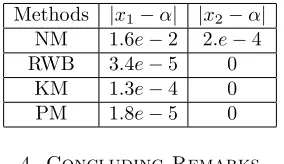
5, 𝛼= 1.414213562373095, 𝑥0= 1.3. The results of comparisons are summarized in Tables 1, 2 and 3. We accept an approximate solution rather than the exact root, depending on the precision (𝜀) of the computer where 𝜀= 10−15. The numerical
results presented in Tables 1-3 show that the presented iterative method in this contribution has equal or better performance as compared with the other iterative schemes of the same order. All computations were done using Mathematica 7.
Table 1. Results of different methods after some iterates for𝑓1
Methods ∣𝑥1−𝛼∣ ∣𝑥2−𝛼∣ NM 3.6𝑒−2 2.1𝑒−4
RWB 1.2𝑒−4 0
KM 7.7𝑒−5 0
PM 6.9𝑒−4 0
All numerical results are in accordance with the theory of convergence analysis developed in Section 2. From the Tables 1-3, we see that the novel constructed technique in this paper is natural and efficient. In fact, Numerical experiments show that the new method is effective and comparable to well-known methods.
Table 2. Results of different methods after some iterates for𝑓2 Methods ∣𝑥1−𝛼∣ ∣𝑥2−𝛼∣
As far as the numerical results are considered, for all cases, the method (2.4), requires the less Total Number of Derivative Evaluations (TNDE) than the other ro-bust methods to obtain the root with a fixed stopping criterion. This means that the new scheme can compete with the existing methods in literature.
Table 3. Results of different methods after some iterates for𝑓3 Methods ∣𝑥1−𝛼∣ ∣𝑥2−𝛼∣
NM 1.6𝑒−2 2.𝑒−4
RWB 3.4𝑒−5 0
KM 1.3𝑒−4 0
PM 1.8𝑒−5 0
4. Concluding Remarks
In numerical analysis many methods produce sequences of real numbers, for example the iterative schemes for solving𝑓(𝑥) = 0. Sometimes, the convergence of these sequences is slow and their utility in solving practical problems, quite limited. Convergence acceleration methods try to transform a slowly converging sequence into a fast convergent one. Accordingly in this work, a new method has developed. The proposed method is a three-step sixth-order iterative scheme that consists of three evaluations of the function and one evaluation of the first derivative. Therefore the method’s efficiency index is 1.565. In view of real applicable situations, our method is much better, because it has less computational burden and effort in finding more derivatives of the function unlike the methods (1.3) and (1.4).
Acknowledgement
Special thanks go to the unknown referee for many valuable comments which have substantially improved the quality of this paper.
References
[1] P. Jarratt,Some fourth-order multipoint iterative method for solving equations,Math. Com-put.,20(1966), 434-437.
[2] Y. Kim, New sixth-order improvements of the Jarratt method, Kyungpook Math. J.,
50(2010), 7-14.
[3] L.D. Petkovic, M.S. Petkovic, J. Dzunic,A class of three-point root-solvers of optimal order of convergence,Appl. Math. Comput.,216(2010), 671-676.
[4] H. Ren, Q. Wu, W. Bi,New variants of Jarratts method with sixth-order convergence,Numer. Algor., 52(2009), 585-603.
[5] T. Sauer, Numerical Analysis, Pearson, Boston, (2006).
[6] F. Soleymani, M. Sharifi, A simple but efficient multiple zero-finder for solving nonlinear equations,Far East J. Math. Sci., (FJMS)42(2010), 153-160.
[7] F. Soleymani,A note on a family of zero-finder fourth-order methods for nonlinear equations,
J. Math. Res.,2(2010), 43-46.
F. Soleymani