Genetic Algorithm Optimization for Thermal
Generating Unit Scheduling and Economic Dispatch
Evaluation
Prof. Vikrant Sharma
Associate Professor Department of EEE CT Group of InstitutionsJalandhar, India
Navpreet Singh Tung
Assistant Professor Department of EEE CT Group of InstitutionsJalandhar, India
Amitesh Prakash
Research Scholars Department of EEE CT Group of InstitutionsJalandhar, India
Ankit Raj
Research Scholars Department of EEE CT Group of InstitutionsJalandhar, India
Abstract – This paper presents an evolutionary programming based genetic algorithm approach for the solution of multi-constrained complex unit commitment and economic dispatch problem in electrical power system. A unit commitment in power system is used for deciding and planning for optimium generation of power from generating unit according to load demand at particular hour. Genetic algorithm is an evolutionary algorithm which works on the principle of natural selection like "survival of fittest". In the case study, 5 power generating units system for 12 hour period of cycle is considered. The objective is to minimize the total operating cost subjected to system constraints, and generate a solutions for economically use of power generating unit.
Keywords – Economic Dispatch (ED), Genetic Algorithm (GA), Load Demand (LD), Power Generation (PG), Unit Commitment (UC).
Nomenclature
N Number of units PD Power Demand PGmax Maximum limit of Unit PGmin Minimum Limit of Unit IC Incremental Cost PG Power Generation SC Start up Cost OC Operating CostC Total Cost
I. L
ITERATURE BACKGROUNDA. Genetic based Hybrid Algorithms
Christober C. et al[5] coined an algorithm based on genetic algorithm to minimize the total operating cost.It uses standard reproduction, cross over and mutation operators for the optimization. Ganguly D. et al[9] proposed a new genetic approach based on parallel system to handle impossible solution in an organized fashion for thermal unit commitment. Jenkins L.[13] implemented four hybrid algorithms based on simulated annealing, local search, tabu search, dynamic programming and genetic algorithms and compared the cost with earlier literature .Liao G.C. and Tsao T.P.[18] introduced hybrid algorithm based on fuzzy logic, tabu search and genetic algorithm to solve short term unit commitment results in reduction in computation time. Liao G.C. and Tsao T.P.[19] implemented an algorithm based on genetic algorithm and Meta Heuristic method for unit commitment problem. It
includes genetic algorithm, fuzzy logic and simulated annealing to determine shutdown and startup schedule. Maojun L. and Tiaosheng T.[20] proposed a modified genetic algorithm with three genetic operators called Gene Complementary Genetic Algorithm. Senjyu T. et al[32] implemented an algorithm based on genetic algorithm for large scale unit commitment with the consideration of new genetic operator and unit integration technique. Senjyu T. et al [33] presented a genetic algorithm based on unit. Characteristics classification. Numerical results for system of up to 100 units are compared to previously reported results.
B. Particle Swarm Optimization based Hybrid
Algorithms
Pappala V.S. and Erlich I. [24] proposed a new approach based on adaptive particle swarm optimization. It results in reduction in no. of decision variables. Saber A.Y. et al[29] introduced algorithm based on fuzzy adaptive particle swar optimization approach. It tracks continuously changing solutions. Sadati N. et al[30] proposed a technique based on particle swarm fusion with simulated annealing for unit commitment optimization. It performs two functions unit schedule and economic dispatch. Sriyanyong P. and Song Y.H.[35] proposed a hybrid algorithm based on Particle Swarm Optimization and Lagrange and performed on various 4 and 10 unit systems. Wang B. et al[37] implemented algorithm for rescheduling of units in fuzzy logic. They proposed a heuristic algorithm called local convergence averse binary particle swarm optimization to solve the unit commitment problem.
C. Neural Network based Hybrid Algorithms
Christober C. et al[6] proposed a neural network based tabusearch for unit commitment optimization which is more efficient than conventional tabu search. Im T.S. and Ongsakul W.[12] implemented an Ant colony search algorithm based on new co-operative agent approach for economic dispatch and unit commitment. Liang R.H. and Kang F.C.[17] proposed an extended mean field annealing neural network approach to solve short term unit commitment problem which is tested on Taiwan power system.
D. Lagrange and Dynamic Programming based
Hybrid Algorithms
Copyright © 2013 IJECCE, All right reserved considerin gramp rate constraint. Momoh J.A. and Zhang
Y.[21] proposed a unit commitment method based on adaptive dynamic programming algorithm. Norhamim et al[23] presented a approach for cost minimization based on unit commitment and economic dispatch in large scale power system and comparison has been done with lagrange algorithm. Park J.D. et al[25] proposed an algorithm based on the effect of economic dispatch and consideration of ramp constraints. It reduces the generation level of less efficient units by commiting additional units or by economic dispatch.Rampriya B. et al[28] proposed a method in deregulated power system based on lagrangian firefly algorithm for profit based unit commitment. Dynamic programming is used for optimium
search. Wang M. et al[38] proposed a technique
considering various constraints for the optimization of unit commitment. It uses the combination of dynamic programming with economic dispatch and comparison with lagrange algorithm has been done. Zheng H. and Gou B.[40] designed new algorithm based on ON-OFF unit schedule by using lagrange algorithm which is superior than dynamic programming.
E.
Simulated Ann
ealing based Hybrid Algorithm
Christober C. et al[7] presented approach based on evolutionary programming simulated annealing method considering cooling and banking constraints for cost minimization. Simopoulos D.N et al[34] implemented an enhanced simulated annealing algorithm for unit commitment problem combined with dynamic economic dispatch.F. Other Algorithms
Amudha A. et al[1] solved unit commitment problem using worst fit algorithm considering the effect of reserve on profit basis.Catalao J.S. et al[3] proposed a profit based unit commitment with constraints of emission limitation. A trade trade off has been done between profit and emission in order to assist decision makers. Chang G.W. et al[4] proposed a mixed integer linear programming method for unit commitment optimization.This approach is suitable for both traditional and deregulated environment. Fei L. and Jinghua L.[8] designed algorithm based on local search which combines interior search method for large power system. Gonzalez J.G and Barquin J.[10] proposed an algorithm for self unit commitment for day ahead market based on simple bids . Iguchi M. and Yamashiro S.[11] implemented an efficient scheduling method for hydro-thermal units considering the account of transmission network. It consists of different stages and constraints are relaxed at every stage and transmission losses are calculated at every stage. Im T.S and Ongsakul W.[12] implemented an Ant colony search algorithm based on new co-operative agent approach for economic dispatch and unit commitment. Kuan E. et al[15] implemented an algorithm for unit commitment optimization considering the complete network modeling and bender method is employed to decompose the problem into integer and continous variables. Larsen T.J. et al[16] developed a model based on sequential time step. It decomposes the problem at every time step and is solved by free marked model. Park J.D. et al[26] did the
stochastic analysis based on uneven load demand on hour basis with the consideration of hit rate of units. Raglend I.J. et al [27] proposed an algorithm including operational, power flow and environmental constraints to plan secure and economic generation schedule. Navpreet et al[42-46] discussed and evaluated different techniques in unit commitment and economic dispatch in power system planning.
II. P
ROBLEM FORMULATIONA. Fuel Cost Model
C(PGi)=Σ(ai*PGi²+ bi*PGi+ci)Rs where i=1…..N
B. Constraints
ΣPGi,max≥PD PGi,min≤PGi,≤PGi,maxwhere i=1,2……N
C. Assumptions
Total losses are neglected . Load cycle of 12 hour is taken.
Some constraints are considered and others are relaxed.
III. G
ENETICA
LGORITHMThe idea of evolutionary computing was introduced in 1960 by I. Rechenberg in his work Evolutionary strategies. Genetic algorithms are computerized search and optimization algorithms based on mechanics of natural genetics and natural selection. The important imposed operators of Genetic algorithm
are-A. Coding of solution
Genetic algorithms require design space to be translated into genetic search space. So, genetic algorithms work with a code of variables. The avail of working with a code of variable space is that coding discreteness the search space even through the function may be continuous. The solution in the unit commitment problem is represented by a binary matrix (U) of dimension H X N. The proposed method for coding is a mixer of binary and decimal numbers, an H-bit string is needed to describe the operation schedule of single unit .in such string a '1' at certain location indicates that the unit is ON and 0 represent unit is OFF. In this paper, we have taken 5 generating units and 12 hours scheduling period[20].
B. Objective function
As we are generating always feasible solutions in the proposed Genetic algorithm, the fitness function is taken as the reciprocal of the total production cost. Linear scaling is used in our algorithm, which requires linear relationship between the original fitness function and the scaled on[32].
C. Population
D. Selection
Selection is a method that randomly chooses chromosome out of the population according to their evaluation function. The higher the fitness function, the better individual will be selected. The selection pressure is defined as the degree to which the better individuals are favoured. The higher the selection pressured the more the better individuals are favoured. The convergence rate of GA is determined by the magnitude of the selection pressure, with higher Selection pressure resulting in higher convergence exchange of characters between two strings is performed. The crossover technique is include, the select two mating parents, select a crossover point and swap the chromosome between two strings.Crossover has many types as single point, two point and multipoint its depends on the number of cut I n bit string[5].
E. Mutation
Mutation operation is performed by randomly selecting chromosome with a pre-specified probability. The selected chromosome is decoded to its binary digit 0 or1. Then the unit number and time period are randomly selected and the rule of mutation is applied to reverse the status of units keeping the feasibility of the constraints[9].
IV. T
ESTR
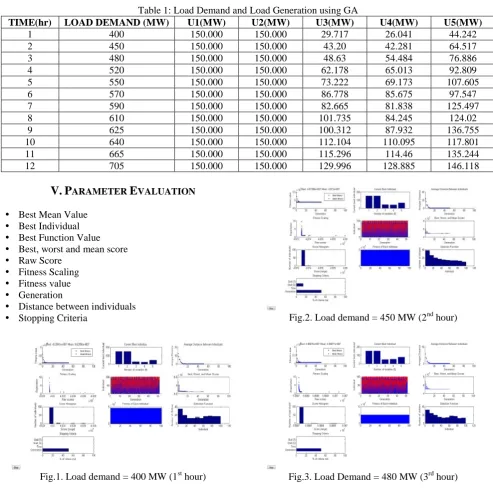
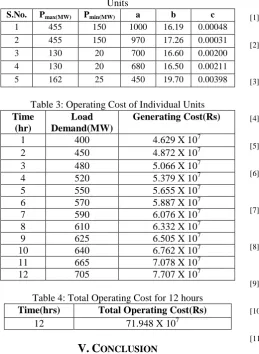
ESULTSIn the case study, we use 5 units system data. Table 1 shows load at different hours & the load sharing, Table 2 shows 5 generators data & their cost coefficients, Table 3 shows operating cost of individual units whereas Table4 shows overall generating cost.
Table 1: Load Demand and Load Generation using GA
TIME(hr) LOAD DEMAND (MW) U1(MW) U2(MW) U3(MW) U4(MW) U5(MW)
1 400 150.000 150.000 29.717 26.041 44.242
2 450 150.000 150.000 43.20 42.281 64.517
3 480 150.000 150.000 48.63 54.484 76.886
4 520 150.000 150.000 62.178 65.013 92.809
5 550 150.000 150.000 73.222 69.173 107.605
6 570 150.000 150.000 86.778 85.675 97.547
7 590 150.000 150.000 82.665 81.838 125.497
8 610 150.000 150.000 101.735 84.245 124.02
9 625 150.000 150.000 100.312 87.932 136.755
10 640 150.000 150.000 112.104 110.095 117.801
11 665 150.000 150.000 115.296 114.46 135.244
12 705 150.000 150.000 129.996 128.885 146.118
V. P
ARAMETERE
VALUATION Best Mean Value Best Individual Best Function Value Best, worst and mean score Raw Score
Fitness Scaling Fitness value Generation
Distance between individuals Stopping Criteria
Fig.1. Load demand = 400 MW (1sthour)
Fig.2. Load demand = 450 MW (2ndhour)
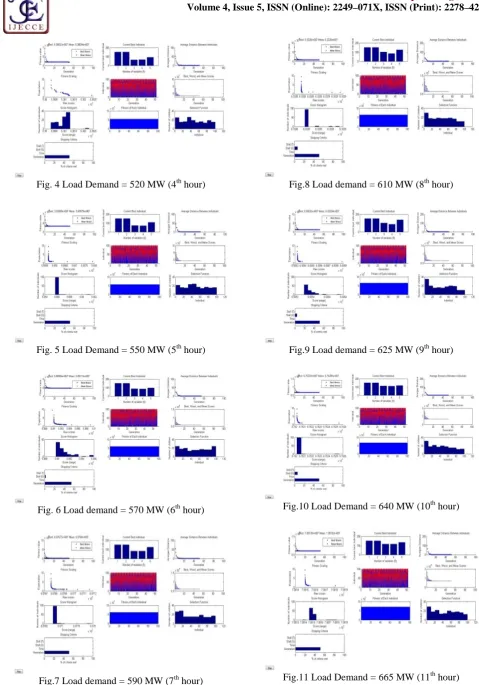
Copyright © 2013 IJECCE, All right reserved Fig. 4 Load Demand = 520 MW (4thhour)
Fig. 5 Load Demand = 550 MW (5thhour)
Fig. 6 Load demand = 570 MW (6thhour)
Fig.7 Load demand = 590 MW (7thhour)
Fig.8 Load demand = 610 MW (8thhour)
Fig.9 Load demand = 625 MW (9thhour)
Fig.10 Load Demand = 640 MW (10thhour)
Fig.12 Load Demand = 705 MW (12thhour) Table 2: Cost coefficient and Power Capacity of the 5
Units
S.No. Pmax(MW) Pmin(MW) a b c
1 455 150 1000 16.19 0.00048
2 455 150 970 17.26 0.00031
3 130 20 700 16.60 0.00200
4 130 20 680 16.50 0.00211
5 162 25 450 19.70 0.00398
Table 3: Operating Cost of Individual Units Time
(hr)
Load Demand(MW)
Generating Cost(Rs)
1 400 4.629 X 10⁷
2 450 4.872 X 10⁷
3 480 5.066 X 10⁷
4 520 5.379 X 10⁷
5 550 5.655 X 10⁷
6 570 5.887 X 10⁷
7 590 6.076 X 10⁷
8 610 6.332 X 10⁷
9 625 6.505 X 10⁷
10 640 6.762 X 10⁷
11 665 7.078 X 10⁷
12 705 7.707 X 10⁷
Table 4: Total Operating Cost for 12 hours
Time(hrs) Total Operating Cost(Rs)
12 71.948 X 10⁷
V. C
ONCLUSIONIn this paper, we have successfully implemented and formulated genetic algorithm to solve the unit commitment problem in an effective manner and simultaneously find the generating cost for different load during 12 hours. An effective robust solution for unit commitment problem is necessary for overall optimization as UC problem is complex where ambiguity exists due to a number of constraints and such problem can be addressed easily by using genetic algorithm. As the size of units increased and complicated constraints are imposed, it is difficult to address the problem using conventional methods. Genetic Algorithm is used to solve this problem as outcomes are based on ‘survival of the fittest’ and hencewe get the best result. This is easy to understand and it can be applied to
‘n’ number of units simultaneously just by making little changes in the problem equation.
F
UTURES
COPEOther soft computing algorithms can be developed and tested for unit commitment optimization on the current system with the incorporation of more constraints to minimize fitness function in this system. Proposed algorithm can be extended to many more units subjected to more number of constraints as per the requirement of the utility.
R
EFERENCES[1] Amudha, A.,Christopher, C. and Rajan, A., “Effect o reserve in
profit based Unit Commitment using Worst Fit algorithm” Proceedings of IEEE, pp 1-7, 2011.
[2] Bavafa, M.,Monsef, H. and Navidi, N., “A new hybrid approach
for UnitCommitment using Lagrangian Relaxation combined with Evolutionary and Quadratic Programming”Proceedings of IEEE, pp 1-6, 2009.
[3] Catalao, J.S,Mariano, S.S,Mendes, V.F.,Ferreira, L.M., “Profit -BasedUnit Commitment with emission limitations: A Multi-objectiveapproach,”Proceedings of Power-Tech , pp 1417-1422,
2007.
[4] Chang , G.W. ,Tsai, Y.D. ,Lai, C.Y. and Chung, J.S., “A
practical mixed integer Linear Programming based approach for
Unit Commitment,”Proceedings of IEEE, pp 1-5, 2002.
[5] Christober, C.,Rajan, A.,Mohan, M.R. and Manivannan, K.,
“Improved Genetic Algorithm Solution to Unit Commitment Problem”Proceedings of IEEE, pp 255-260, 2002.
[6] Christober, C.,Rajan, A.,Mohan, M.R. and Manivannan, K.
“Neuralbased Tabu Search Method for solving Unit Commitment Problem”Power system Management and Control,
pp 180-185, April
[7] Christober, C. and Rajan, A.,“An Evolutionary Programming based Simulated Annealing method for Unit Commitment problem with Cooling - Banking constraints” Proceedings of IEEE INDICON, pp 435-440, December 2004.
[8] Fei, L. and Jinghua, L., “A solution to the Unit Commitment
problem based on Local Search method” International Conference on Energy and Environment Technology, pp 51-56,
2009.
[9] Ganguly, D., Sarkar, V. and Pal, J., “Anew Genetic approach for solving the Unit Commitment problem” Proceedings of POWERCON, Singapore, pp 542-547, November 2004.
[10] Gonzalez, J.G. and Barquin, J., “Self-Unit Commitment of thermal units in a competitive electricity market”Proceedings of IEEE, pp 2278-2283, 2000
[11] Iguchi, M. and Yamashiro, S.,“An efficient scheduling method for weekly Hydro-Thermal Unit Commitment”Proceedings of IEEE TENCON, pp 1772-1777, 2002.
[12] Im, T.S. and Ongsakul, W.,“Ant Colony search algorithm for
Unit Commitment”Proceedings of ICIT–Marivor, Slovenia, pp
72-77, 2003.
[13] Jenkins, L., “Hybrid algorithms for Power system Unit Commitment”Proceedings of IEEE, pp 678-681, 2007.
[14] Klir, G.J. and Boyuan, F., “Fuzzy Sets and Fuzzy Logic” Prentice
Hall of India Private Limited, New Delhi , 2000.
[15] Kuan, E. ,Ano, O. and Vargas, A., “Unit Commitment
Optimization considering the complete network modeling” Proceedings of IEEE Porto Power Tech Conference, pp 1-5,
September 2001.
[16] Larsen, T.J., Wangensteen, I. and Gjengedal, T. ,“Sequential timestep Unit Commitment,” Proceedings of IEEE, pp
1524-1529, 2001
[17] Liang, R.H. and Kang, F.C., “Thermal generating unit
Copyright © 2013 IJECCE, All right reserved
[18] Liao, G.C. and Tsao, T.P., “The Use of Genetic Algorithm/Fuzzy
system and Tabu search for short-term Unit Commitment” Proceedings of IEEE, pp 2302-2307, 2002
[19] Liao, G.C. and Tsao,T.P., “A novel GA-based and meta-heuristics method for Short-Term Unit Commitment problem” Proceedings of IEEE, pp 1-6, 2004.
[20] Maojun, L. and Tiaosheng, T., “A Gene Complementary Genetic
Algorithm for Unit Commitment”Proceedings of IEEE, pp
648-651, 2001.
[21] Momoh, J.A. and and Zhang, Y., “Unit Commitment Using Adaptive Dynamic Programming”Proceedings of ISAP, pp
523-526, 2005.
[22] Nagrath, I.J. and Kothari, D.P., “Modern Power System Analysis,” 3rd ed., TMH Publications New Delhi, 2009.
[23] Norhamim, Ahmed, M.M. and Hassan, I. , “Costs optimization
for Unit Commitment and Economic Load Dispatch in large scale Power Systems” Power and Energy Conference, Kuala Lumpur, Malaysia, pp 190-194, 2004.
[24] Pappala, V.S. and Erlich, I., “A new approach for solving the Unit Commitment problem by Adaptive Particle Swarm Optimization”Proceedings of IEEE, pp 1-6, 2008.
[25] Park, J.D., Kook, H.J,Moon, Y.H. ,Shin, C.J., “Unit
Commitment algorithm considering the effects of Economic
Dispatch,” Proceedings of IEEE,pp 1028-1033, 2000.
[26] Park, J.D., Moon, Y.H. and Kook, H.J., “Stochastic analysis of
the uncertain hourly Load Demand applying to Unit Commitment problem” Proceedings of IEEE, pp 2266-2271,
2000.
[27] Raglend, I.J and Padhy, N.P., “Solutions to Practical Unit Commitment Problems with Operational, Power Flow and Environmental Constraints”Proceedings of IEEE, pp 1-8, 2006. [28] Rampriya, B.,Mahadevan, K. and Kannan, S., “Unit
Commitment in Deregulated Power System using Lagrangian firefly algorithm”Proceedings of ICCCCT, pp 389-393, 2010.
[29] Saber, A.Y., Senjyu, T.,Urasaki, M and Funabashi , T., “Unit
Commitment computation - A novel Fuzzy Adaptive Particle Swarm Optimization approach”Proceedings of PSCE, pp
1820-1828, 2006.
[30] Sadati, N.,Hajian,M. and Zamani, M., “Unit Commitment using
Particle Swarm-Based-Simulated Annealing Optimization approach”Proceedings of SIS, pp 1-6, 2007.
[31] Seifi, H. and Sepasian, M.S. ,“Electrical Power System Planning, Issues Algorithms and Solutions,” Springer, 2011. [32] Senjyu, T.,Yamashiro, and H.,Shimabukoro, K. “A fast solution
technique for large scale Unit Commitment problem using Genetic algorithm”Proceedings of IEEE, pp 1611-1616, 2002.
[33] Senjyu, T., Yamashiro, H.,Uezato, K. and Funabahi, T., “A Unit
Commitment problem by using Genetic Algorithm based on Unit characteristic classification” Proceedings of IEEE, pp 59-63,
2002.
[34] Simopoulos, D.N. , Kavatza, S.D. and Vournas, C.D,“Unit
Commitment by an enhanced Simulated Annealing algorithm” Proceedings of PSCE, pp 193-201, 2006.
[35] Sriyanyong, P. and Song, Y.H., “Unit Commitment Using
Particle Swarm Optimization Combined with Lagrange
Relaxation,” Proceedings of IEEE, pp 1-8, 2005.
[36] Valsan, S.P and Swarup, P.S., “Hopfield Neural Network
approach to the solution of Economic Dispatch and Unit Commitment”Proceedings of ICISIP, pp 311-316, 2004.
[37] Wang, B., Li, Y. and Watada, J. ,“Re-Scheduling the Unit Commitment Problem in Fuzzy Environment” IEEE International Conference on Fuzzy Systems ., pp 1090-1095,
June 2011.
[38] Wang, M. , Zhang, B. , Dang, Y., “A novel Unit Commitment
method considering various operation constraints”Proceedings of IEEE, pp 1778-1783, 2000.
[39] Wood, A.J and Wollenberg, B.F., “Power generation, operation and control” 2nd ed.,John Wiley, New York, 1996.
[40] Zheng, H. and Gou, B., “A New Algorithm for Unit
Commitment Based on On/Off Decision Criterion”Proceedings of IEEE, pp 206-210, 2005.
[41] Zhu, J. “Optimization of Power System Operation” IEEE Press
on Power Engineering, Wiley, 2009.
[42] Navpreet Singh Tung et al “Unit Commitment Dynamics-An
Introduction”, International Journal of Computer Science &
Information Technology Research Excellence , Vol. 2, Issue 1,
pp 70-74,Jan - Feb 2012.
[43] Navpreet Singh Tung et al”Unit Commitment in Power
System-A Review” International Journal of Electrical and Power Engineering, Vo.6, Issue.1,pp: 51-57,2012.
[44] Navpreet Singh Tung et al “ Start up Cost constraint Optimization using Lagrangian Algorithm for Unit Schedule in Electrical Power System” International Journal of Enhanced Research in Science, Technology and Engineering(IJERSTE)
Vol. 1,Issue 2, pp 1-5,Nov-2012.
[45] Navpreet Singh Tung et al“Economic Dispatch Forecasting in Power System Planning” Proceedings of IEEE and IETE sponsored International Conference on Advance Computing and Communication Technologies (ICACCT-2012),Nov-3,2012.
[46] T.Navpreet et al,”Programming model forOptimal Load Sharing of Generating Units based on Lagrangian multiplier Linear Programming Algorithm”,ISTE and PEDA sponsored proceedings of International Conference on Power Electronics and Energy Systems (PEES-2012) , pp-74-77,Oct,2012 .
[47] Navpreet Singh Tung et al,” Fuzzy Logic Controller Modelling
for Economic Dispatch and Unit Commitment in Electrical
Power System”International Journal of Emerging Research in Management and Technology,Vol.2,Issue 10,pp 34-40,Oct-2013.
A
UTHOR’
SP
ROFILEProf. Vikrant Sharma
is an Associate Professor in CT Group of Institutions, Jalandhar, India. His area of interest involves Optical Communication System, Analog and Digital Communication and Microwave Engineering. He authored and co-authored many research papers in leading international journals and conferences. He involves in teaching and research experience for more than a decade. He is pursuing PHD from PTU.
Navpreet Singh Tung
is an Assistant Professor, Department of Electrical and Electronics Engg., CT Group of Institutions, Jalandhar, India. His area of interest involves Power System Optimization, Power System Planning, Unit Commitment and application of artificial intelligence and MATLAB in Power System. He authored and co-authored many research papers in leading international conferences and journals.
Amitesh Prakash
is a senior undergraduate research scholar in Department of Electrical and Electronics Engineering, CT Institute of Technology Jalandhar. His area of interest involves Power System, Matlab Programming, PLC and Automation & Unit Commitment.