25
Available online at www.ijiere.com
International Journal of Innovative and Emerging
Research in Engineering
e-ISSN: 2394 - 3343 p-ISSN: 2394 - 5494
A Case Study of Circulated Cloud Intrusion Detection Model
Dr.I.Lakshmi
1, G.D. DhanaLakshmi
21Assistant Professor, Stella Maris College, Chennai, Tamil Nadu, India 2Assistant Professor, Stella Maris College, Chennai, Tamil Nadu, India
Abstract
Interruption prospects in cloud worldview are numerous and with high picks up, may it be a terrible client or a contender of cloud customer. Conveyed model makes it helpless and inclined to complex circulated interruption assaults like Distributed Denial of Service (DDOS) and Cross Site Scripting (XSS). Standing up to new usage circumstances, conventional IDSs are not appropriate for cloud environment. To handle expansive scale system access activity and regulatory control of information and application in cloud, another multi-strung circulated cloud IDS model has been proposed. Our proposed cloud IDS handles vast stream of information bundles, investigate them and produce reports productively. Straightforward reports are in a split second send for data of cloud client and master guidance for cloud administration supplier's system mis-setups through an outsider IDS checking and consultative administration.
Keywords: NIDS, HIDS, DOS, DDOS, Cloud IDS
1.Introduction
26 handle such a huge information stream. Most known IDSs are single strung and because of rich dataset stream, there is a need of multi-strung IDS in Cloud figuring environment. In a conventional system, IDS screens, recognizes and caution the authoritative client for system activity by sending IDS on key system stifle focuses on client site. Be that as it may, in Cloud system IDS must be set at Cloud server site and completely directed and oversaw by the administration supplier. In this situation, if an assailant figures out how to enter and harm or take client's information, the cloud client won't be advised specifically. The interruption information would just be conveyed through the administration supplier and client needs to depend on him. The cloud administration supplier may not prefer to educate the client about the misfortune and can conceal the data for the purpose of his picture and notoriety. In such a case, an impartial outsider checking administration can guarantee satisfactory observing and alarming for cloud client. In this paper, we have proposed a proficient multi-strung cloud IDS, managed and observed by an outsider ID checking administration, who can give ready reports to cloud client and master guidance for cloud administration supplier. With a specific end goal to determine the issues which customary IDSs can't resolve, a productive and solid circulated Cloud IDS model is proposed. The remaining some portion of the paper is sorted out as takes after. The segment II examines the security concerns and issues in the territory of Cloud registering. Segment III manages the related work in the field of cloud IDS. In area IV, we did investigation of customary and cloud IDS. In the following segment, the proposed model is depicted to indicate how particular components of the disseminated Cloud IDS can build the productivity of the framework and using so as to diminish the system load multi-strung methodology. In addition, straightforwardness of data can be accomplished through an outsider IDS checking administration. Points of interest of proposed model are talked about in segment VI. We have tried our methodology and measured the productivity of proposed model in area VII. At last, we give conclusion and future work in segments VIII and IX, individually.
2. Security Issues in Cloud Computing
Distributed computing has risen as a promising IT administrations provisioning worldview, however its security issues are approaching its across the board selection [6]. Security dangers can be arranged as take after:
2.1. System and host construct assaults with respect to remote Server Host and system interruption assaults on remote hypervisors are a noteworthy security worry, as cloud merchants use virtual machine innovation. DOS and DDOS assaults are propelled to refuse assistance accessibility to end clients.
2.2. Cloud security reviewing Cloud inspecting is a troublesome undertaking to check consistence of all the security approaches by the seller. Cloud administration supplier has the control of delicate client information and procedures, so a mechanized or outsider evaluating instrument for information honesty check and criminological examination is required. Protection of information from outsider examiner is another worry of cloud security.
2.3. Sub-contracting cloud administrations Cloud client makes an agreement or understanding for administration provisioning with the cloud administration supplier. Subcontracting of cloud administrations by cloud administration supplier to another administration supplier postures security issues like non-denial or not owing the obligation, if something turns out badly with valuable information and utilization of cloud client.
2.4. Non-accessibility of cloud administrations Non-accessibility of administrations because of Cloud blackouts can bring about fiscal misfortune to cloud client association. A purposeful and far reaching Service Level Agreement (SLA) must be composed among client and supplier covering all the significant lawful and administration provisioning issues and subtle elements.
2.5. Absence of information interoperability measures It results into cloud client information lock-in state. On the off chance that a cloud client needs to move to other administration supplier because of specific reasons it would not have the capacity to do as such, as cloud client's information and application may not be perfect with other seller's information stockpiling configuration or stage. Security and secrecy of information would be in the hands of cloud administration supplier and cloud client would be subject to a solitary administration supplier.
2.6. Cloud information privacy issue Confidentiality of information over cloud is one of the glaring security concerns. Encryption of information should be possible with the customary strategies. On the other hand, encoded information can be secured from a malignant client however the protection of information even from the overseer of information at administration supplier's end couldn't be covered up. Looking and indexing on encoded information remains a state of worry all things considered. Aforementioned cloud security issues are a couple and dynamicity of cloud structural engineering are confronting new difficulties with quick usage of new administration worldview.
3. Related Works
27 capacity holds conduct based (correlation of late client activities to common conduct) and information based (known trails of past assaults) databases. The inspected information is sent to IDS administration center, which breaks down the information and caution to be an interruption. The creators have tried their IDS model with the help of reenactment and discovered its execution palatable for ongoing usage in a cloud situation. Despite the fact that they have not examined the security strategies consistence check for cloud administration supplier and their reporting techniques to cloud clients.
3.2. Interruption recognition in the cloud Intrusion discovery framework assumes a vital part in the security and determination of dynamic guard framework against gatecrasher antagonistic assaults for any business and IT association. IDS execution in distributed computing requires a proficient, versatile and virtualization based methodology. In distributed computing, client information and application is facilitated on cloud administration supplier's remote servers and cloud client has a constrained control over its information and assets. In such case, the organization of IDS in cloud turns into the obligation of cloud supplier. In spite of the fact that the head of cloud IDS ought to be the client and not the supplier of cloud administrations. In this paper [1], Roschke and Cheng et al. have proposed a joining answer for focal IDS administration that can consolidate and incorporate different famous IDS sensors yield gives an account of a solitary interface. The interruption identification message trade group (IDMEF) standard has been utilized for correspondence between diverse IDS sensors. The creators have recommended the organization of IDS sensors on partitioned cloud layers like application layer, framework layer and stage layer. Cautions created are sent to „Event Gatherer‟ program. Occasion gatherer gets and change over ready messages in IDMEF standard and stores in occasion information base archive with the help of Sender, Receiver and Handler modules. The examination part investigates complex assaults and displays it to client through IDS administration framework. The creators have proposed a compelling cloud IDS administration structural engineering, which could be observed and regulated by the cloud client. They have given a focal IDS administration framework in view of diverse sensors utilizing IDMEF standard for correspondence and checked by cloud client.
3.3. Incorporating a system IDS into an open source distributed computing environment Security worries in distributed computing are the fundamental obstacles in cloud selection. To preclude use from securing administrations facilitated by a cloud administration supplier, dissent of administration (DOS) or appropriated refusal of administration (DDOS) assaults is utilized by the guilty party. Conventional IDSs need an extraordinary thought for a dynamic and complex cloud environment. System based IDSs are more proper for cloud framework because of the upside of observing the host virtual machine base without being traded off. Though in HIDS if host is traded off the interruption recognition framework checking would be killed and could endanger the security of entire framework. Claudio et al. have proposed [8] to emplace a NIDS on virtual switch of the physical machine facilitating virtual machines of customers utilizing open source „Eucalyptus‟ distributed computing system. The Eucalyptus based cloud IDS would have the capacity to watch all in-bound and out-bound movement from the section purpose of activity. The proposed thought depends on establishment of IDS on each physical machine facilitating other customer virtual machines rather to send IDS on a solitary point. The recommended arrangement could turned out to be successful and proficient regarding burden sharing of huge volume of information, no parcel misfortune and low computational utilization. The creators have approved their thought through test and found that IDS facilitated at a solitary point expends more CPU burden than IDS put at different physical machines and devouring nearby assets. Likewise on the off chance that if single IDS is traded off by the guilty party, it would not influence the working of different IDSs despite everything they be working leg
4. Conventional IDS versus Cloud IDS
4.1. Conventional HIDS and NIDS Weaknesses Traditional IDSs are not suitable for a dynamic and conveyed cloud environment. System based IDSs (NIDS) have the impediment that they couldn't recognize encoded information movement. Additionally host based IDSs (HIDS) are not appropriate to locate the disguised assault records.
4.2. NIDS and HIDS assault resistance NIDS gives better perception and more resistibility against culpable assaults, however does not have the information about host framework. Then again, HIDS gives security against the host framework yet couldn't recognize and oppose assaults on different has or organize and are defenceless against avoidance assaults.
4.3. Multi-strung IDS for cloud Most known IDSs are single strung though because of monster measure of activity and information stream there is a need of multi-strung IDS in Cloud figuring environment.
4.4. Incorporated IDS answer for cloud The disseminated way of Cloud framework and its administration situated worldview it is profoundly defenceless against diverse system and host security assaults. A solitary IDS principle sets/mark may not be adequate for such a different nature of noxious assaults. Along these lines, Cloud IDS requires a coordinated arrangement consolidating eminent IDS sensors to convey over a solitary stage. A coordinated IDS arrangement would cover every single referred to assault marks and also learning of new dangers.
28
Figure 1. Intruder’s Technical Knowledge Against Sophistication of Attacks and Tools [4]
5. Proposed Model
Our proposed model is a productive and compelling disseminated Cloud IDS which uses multithreading system to enhance IDS execution over the Cloud foundation. Our multithreaded IDS is a NIDS that uses sensors to sharpen and screens system movement and additionally check for noxious bundles. The framework then sends interruption alerts to an outsider observing administration, which can give moment answering to cloud client association administration framework with a counselling report for cloud administration supplier. Distributed computing gives application and capacity administrations on remote servers. The customers don't need to stress over its support and programming or equipment up-degrees. Cloud model takes a shot at the „concept of virtualization‟ of assets, where a hypervisor server in cloud server farm has various customers on one physical machine. Conveying HIDS in hypervisor or host machine would permit the executive to screen the hypervisor and virtual machines on that hypervisor. Be that as it may, with the fast stream of high volume of information as in cloud model, there would be issues of execution like over-burdening of VM facilitating IDS and dropping of information parcels. Additionally if host is bargained by a culpable assault the HIDS utilized on that host would be killed. In such a situation, a system based IDS would be more suitable for organization in cloud like base. NIDS would be set outside the VM servers on container neck of system focuses, for example, switch, switch or door for system movement observing to have a worldwide perspective of the framework. Such NIDS would in any case be confronting the issue of extensive measure of information through system access rate in cloud environment. To handle an expansive number of information bundles stream in such a situation a multi-strung IDS methodology has been proposed in this paper. The multi-strung IDS would have the capacity to process expansive measure of information and could lessen the parcel misfortune. After an effective preparing the proposed IDS would pass the checked cautions to an outsider observing administration, who might thusly straightforwardly advise the cloud client about their framework under assault. The outsider checking administration would likewise give master counsel to cloud administration supplier for misconfigurations and interruption provisos in the framework. Figure 2, demonstrates the proposed IDS model. The cloud client gets to its information on remote servers at administration supplier's site over the cloud system. Client asks for and activities are checked and logged through a multi-strung NIDS. The ready logs are promptly spoken to cloud client with a specialist guidance for cloud administration supplier.
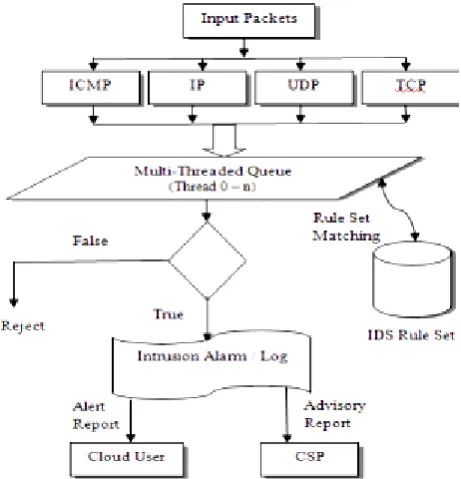
29 Our proposed multi-strung NIDS model for appropriated cloud environment depends on three modules: catch and lining module, examination/handling module and reporting module. The catch module, gets the in-bound and out-bound (ICMP, TCP, IP, UDP) information parcels. The caught information parcels are sent to the mutual line for examination. The investigation and procedure module gets information bundles from the mutual line and examine it against mark base and a pre-characterized tenet set. Every procedure in a common line can have different strings which work in a communitarian style to enhance the framework execution. The fundamental procedure will get TCP, IP, UDP and ICMP bundles and different strings would simultaneously process and match those parcels against pre-characterized set of tenets. Through an effective coordinating and investigation the awful parcels would be distinguished and cautions created. Reporting module would read the alarms from shared line and plans ready reports. The outsider observing and consultative administration having knowledge and assets would instantly produce a report for cloud client's data and sends an extensive master admonitory report for cloud administration supplier. Figure 3 portrays the stream outline of proposed multithreaded Cloud IDS.
Figure 3. Flow Chart of Multi-Threaded Cloud IDS Model
6. Focal points of Proposed Model
In correlation with the conventional IDS instrument, the proposed model has taking after focal points in cloud environment:
6.1. High volume of information in cloud environment could be taken care of by a solitary hub IDS through a multi-strung methodology.
6.2. CPU, memory utilization and in addition bundle misfortune would be decreased to enhance the general productivity of cloud IDS.
6.3. In a host based IDS (HIDS) situation, if host turns into the casualty of culpable aggressor and controlled by the interloper, HIDS on that host would be traded off. In such a case the assailant would not permit HIDS to send alarms to manager and could play devastation with the information and applications. For better deceivability and resistance, system IDS (NIDS) has been proposed for cloud framework.
6.4. Straightforwardness of IDS can't be accomplished by having complete control and organization of cloud IDS with the administration supplier. To guarantee straightforwardness of data and security of information, the cloud client must be advised of the interruptions against its virtual machine facilitating information and application. An outsider checking and counselling administration has been proposed, who has both experience and assets to watch/handle interruption information and produce reports for cloud client and in addition consultative reports for cloud administration supplier. 6.5. Being at an essential issue, proposed Cloud IDS would be able to do simultaneous preparing of information investigation, which is a proficient methodology.
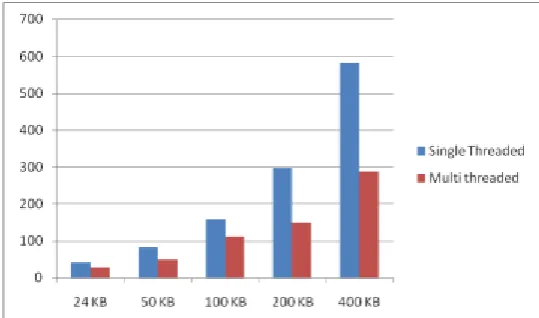
30 reason, awful parcels alongside honest to goodness information bundles were sent to the reproduced framework. Test information is appeared in Table 1. The test was directed at first in single strung mode, in which information parcels were sent to the framework numerous times and noted down the execution time (in ms). At that point test information for multi-strung method of IDS was sent for number of times and framework reaction time was noted. By monotonous testing and judgment, multi-strung methodology was discovered speedy and proficient in investigating and reporting. Amid the test stage it was watched that the examination module in multi-strung mode proficiently distinguished and disposed of terrible information parcels. The reporting module created the log reports and sent those reports to outsider checking/admonitory administration for reporting and guidance to the cloud clients and overseers, separately.
Data Size (KB) 24 50 100 200 400
Single Thread (ms) 40 82 158 296 582
Multi-Thread (ms) 28 49 112 148 286
Table 1. Input Data Size and Execution Time
The execution measure of multi-strung against single strung handling and execution time can be plainly seen by the structured presentation appeared in Figure 4. There is a sudden abatement in preparing time amid the multi-strung mode examination when contrasted with the single strung mode review. Multi-threading decreases the execution time that enhances framework execution and effectiveness through an agreeable and speedy preparing methodology.
Figure 4. Performance Measure of Single Against Multi-threaded Processing
8. Conclusion
Distributed computing has enhanced another administrations provisioning worldview with low framework support cost, adaptability for information and applications, accessibility of information administrations and pay as you go highlights. Since distributed computing is a "system of systems" over the web, along these lines shots of interruption is more with the intelligence of intruder’s assaults. Diverse IDS systems are utilized to counter vindictive assaults in conventional systems. For Cloud registering, tremendous system access rate, surrendering the control of information and applications to administration supplier and circulated assaults defencelessness, a proficient, solid and data straightforward IDS is required. In this paper, we have proposed a multi-strung cloud IDS which can be directed by an outsider observing administration for a superior streamlined proficiency and straightforwardness for the cloud client. We have executed our proposed model with the help of re-enactment and observed it to be productive and straightforward inside of a cloud framework. For disseminated nature of cloud base the capacity of conventional IDSs to handle and piece extensive malevolent assaults access from guilty party may not be adequate. Additionally the volume of information in cloud makes chairmen of IDS not able to screen each user’s activity.
9. Future Work
31
References
[1] Sebastian Roschke, Feng Cheng, Christoph Meinel,“ Intrusion Detection in the Cloud", Eighth IEEE International Conference on Dependable, Autonomic and Secure Computing, 2009.
[2] Chi-Chun Lo, Chun-Chieh Huang, Joy Ku, “A Cooperative Intrusion Detection System Framework for Cloud Computing Networks", 39th International Conference on Parallel Processing Workshops, 2010.
[3] http://en.wikipedia.org/wiki/Intrusion_detection_system.
[4] Joseph S. Sherif, Tommy G. Dearmond, “Intrusion Detection: Systems and Models”, Eleventh IEEE International Workshops on Enabling Technologies: Infrastructure for Collaborative Enterprises (WETICE‟02). [5] Andreas Haeberlen,“ An Efficient Intrusion Detection Model Based on Fast Inductive Learning”, Sixth
International Conference on Machine Learning and Cybernetics, Hong Kong, 19-22 August 2007.
[6] Richard Chow, Philippe Golle, Markus Jakobsson, “Controlling Data in the Cloud: Outsourcing Computation without Outsourcing Control”, ACM Computer and Communications Security Workshop, CCSW 09, November 13, 2009.
[7] Kleber, schulter, “Intrusion Detection for Grid and Cloud Computing”, IEEE Journal: IT Professional, 19 July 2010.
![Figure 1. Intruder’s Technical Knowledge Against Sophistication of Attacks and Tools [4]](https://thumb-us.123doks.com/thumbv2/123dok_us/8874559.1816073/4.595.218.385.574.753/figure-intruder-s-technical-knowledge-sophistication-attacks-tools.webp)