Volume 55, 2018, Pages 15–28
GCAI-2018. 4th Global Conference on Artificial Intelligence
Iterative Planning for Deterministic QDec-POMDPs
Sagi Bazinin and Guy Shani
Information and Software Systems Engineering, Ben Gurion University
Abstract
QDec-POMDPs are a qualitative alternative to stochastic Dec-POMDPs for goal-oriented plan-ning in cooperative partially observable multi-agent environments. Although QDec-POMDPs share the same worst case complexity as Dec-POMDPs, previous research has shown an ability to scale up to larger domains while producing high quality plan trees. A key difficulty in distributed execution is the need to construct a joint plan tree branching on the combinations of observations of all agents. In this work, we suggest an iterative algorithm, IMAP, that plans for one agent at a time, taking into considerations collaboration constraints about action execution of previous agents, and generating new constraints for the next agents. We explain how these constraints are generated and handled, and a backtracking mechanism for changing constraints that cannot be met. We provide experimental re-sults on multi-agent planning domains, showing our methods to scale to much larger problems with several collaborating agents and huge state spaces.
1
Introduction
In many real-world problems agents collaborate to achieve joint goals. For example, disaster response teams typically consist of multiple agents that have multiple tasks to perform, some of which require the cooperation of multiple agents. In such domains, agents typically have partial information, as they can sense their immediate surroundings only. As agents are often located in different positions and may possess different sensing abilities, their runtime information states differ. Sometimes, this can be overcome using communication, but communication infrastructure can be damaged, or communication may be costly and should be reasoned about explicitly.
In this setting it is common to plan for all agents jointly using a central engine. The resulting policy, however, is executed by the agents in a decentralized manner, and agent communication is performed only through explicit actions.
Decentralized POMDPs (Dec-POMDPs) offer a rich model for capturing such multi-agent prob-lems [1], but Dec-POMDPs solvers have difficulty to scale up beyond small toy problems. Qualitative Dec-POMDP (QDec-POMDP) were offered as an alternative model, replacing the quantitative proba-bility distributions over possible states with qualitative sets of states [6].
to scale up to larger problems. One can extract single agent local policy trees from the joint policy tree, where each local tree has an exponentially smaller branching factor. In this paper we focus on deterministic QDec-POMDPs, where one can find solutions with a finite depth.
In many problems interactions between cooperating agents are limited to a number of key points. Each agent may be able to achieve a set of tasks that require no cooperation, while assisting other agents only in several collaborative tasks. This is illustrated in the box pushing domain (Figure2), where light boxes can be pushed into place by a single agent, but a heavy box can only be pushed by two agents together.
In such cases, it may be useful to plan for each agent independently, creating a single agent plan tree, branching only on the observations of the specific agent. We suggest an iterative approach, which we call IMAP (iterative multi agent planning) where the central planning engine plans for one agent at a time. IMAP creates a local policy tree for each agent, instead of a joint policy tree for all agents.
When planning for a single agent IMAP assumes that other agents will be available to assist in required collaborations. These assumptions generate a set of conditional constraints on the behavior of other agents, that must be considered when planning for these agents. When a constraint cannot be satisfied, we backtrack to the agent that required the constraint.
In addition, agents attempt to perform tasks at the lowest cost, notifying all other agents of the cost for completing subgoals. Agents that manage to complete some tasks more cheaply, inform backward to previous agents, that replan again ignoring these tasks. Thus, our approach also contains a task allocation component that assigns tasks to agents to reduce the overall cost for completing all tasks.
For solving single agent problems, we compile the multi-agent QDec-POMDP into a single agent contingent planning problem. We use an off-the-shelf offline contingent planner [9] to generate a plan graph, and then extract the conditional constraints from that plan graph. Our method is sound, but incomplete, due to the greedy nature of our iterative process. Still, it scales up to very large QDec-POMDPs. We provide an empirical study, focusing on scaling up analysis, showing how our approach scales to very large domains, with multiple agents, many order of magnitudes beyond domains solvable by previous approaches.
2
Model Definition
We start with the basic definition of a flat-space QDec-POMDP, followed by a factored definition moti-vated by contingent planning model definitions [2,5].
Definition 2.1. A qualitative decentralized partially observable Markov decision process (QDec-POMDP) is a tupleQ=hI, S, b0,{Ai}, δ,{Ωi}, O, Giwhere
• Iis a finite set of agents indexed1, ..., m.
• Sis a finite set of states.
• b0⊂Sis the set of states initially possible.
• Aiis a finite set of actions available to agentiandA~ =⊗i∈IAiis the set of joint actions, where
~a=a1, ..., amdenotes a particular joint action.
• δ:S×A~ →2S is a non-deterministic Markovian transition function.δ(s, ~a)denotes the set of
possible outcome states after taking joint action~ain states.
• Ωiis a finite set of observations available to agentiand~Ω =⊗i∈IΩiis the set of joint observation,
where~o=o1, ..., omdenotes a particular joint observation.
• ω :A~×S→2Ω~ is anon-deterministicobservation function.ω(~a, s)denotes the set of possible joint observations~ogiven that joint action~awas taken and led to outcome state s. Here s ∈
• G⊂Sis a set of goal states.
We do not assume here a finite horizonT, limiting the maximal number of actions in each execution. We focus, however, on deterministic outcomes and deterministic observations. In such cases a successful solution is acyclic, and there is hence no need to bound the number of steps. Extension to domains with non-deterministic outcomes with a bounded horizon is simple, but extensions to infinite horizon and non-deterministic outcomes is beyond the scope of this paper. We assume a shared initial belief, like most Dec-POMDP models.
Definition 2.2. A factored QDec-POMDP is a tuplehI, P, ~A,Pre,Eff,Obs, b0, GiwhereIis a set of agents,Pis a set of propositions,A~is a vector of individual action sets,Preis the precondition function, andObsis an observation function.Eff is the effects function.b0is the set of initially possible states, andGis a set (conjunction) of goal propositions. The state spaceSconsists of all truth assignments to P, and each state can be viewed as a set of literals.
The precondition functionPremaps each individual actionai ∈Aito its set of preconditions, i.e.,
a set of literals that must hold whenever agentiexecutesai. Preconditions are local, i.e., defined over
airather than~a, because each agent must ensure that the relevant preconditions hold prior to executing
its part of the joint action. We extendPreto be defined over joint actions{~a=ha1, .., ami:ai ∈Ai}
(wherem=|I|):Pre(ha1, .., ami) =∪iPre(ai).
Brafman et al. [6] define an effects functionEff mapping joint actions into a set of pairs(c, e)of conditional effects, wherecis a conjunction of literals andeis a single literal, such that ifcholds before the execution of the actioneholds after its execution. Thus, effects are a function of thejoint action rather than of the local actions, as can be expected, due to possible interactions between local actions.
We slightly refine these definitions to explicitly support independent and collaborative actions. For each local actionaiof agentiwe define a set of local conditional effectseffl(ai) ={(c, e)}. In addition,
for each subset of local actions of agents, {ai1, ..., aik} of agents i1, ..., ik we define another set of
collaborative conditional effectseffc({ai1, ..., aik}) = {(c, e)}. When this set is empty, we say that
the local actions are independent, when the set is not empty, we say that the subset of local actions are collaborative. We further require that collaborative subsets will be minimal, in that for two subsets A1, A2such thatA1⊂A2,eff
c(A1)6=effc(A2). While the effects of collaborative actions are shared,
the preconditions are not. Specifically, when applying a collaborative action each agent must only ensure that its own preconditions hold.
For every joint action~aand agenti,Obs(~a, i) ={p1, . . . , pk}, wherep1, ..., pkare the propositions
whose value agentiobserves after the joint execution of~a. The observation is private, i.e., each agent may observe different aspects of the world. We assume that the observed value is correct and corresponds to the post-action variable value.
While QDec-POMDPs allow for non-deterministic action effects as well as non-deterministic ob-servations, we focus in this paper only on deterministic effects and obob-servations, and leave discussion of an extension of our methods to non-determinism to future research. Additionally, our model assumes a shared initial belief state, as most Dec-POMDP models. The challenging case where the initial belief states differs between agents is important, as it corresponds to the situation in on-line planning, but it is left for future research.
2.1
Policy Trees
We can represent the local plan of an agentiusing apolicy treeτi, which is a tree with branching factor
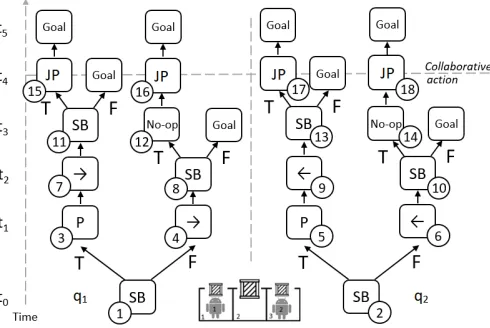
Figure 1: Illustration of Example 1 showing the box pushing domain with 2 agents and a possible set of local plan trees that produce a solution. Possible agent actions are sensing a box at the current agent location (denotedSB), moving (denoted by arrows), pushing a light box up alone (denotedP), jointly pushing a heavy box (denotedJ ointP ush), and no-op.
with the observation it obtains for future action selection. Ifτiis a policy tree for agentiandoi is a
possible observation for agenti, thenτioi denotes the subtree that corresponds to the branch labeled by
oi.
An alternative to local trees is a global joint policy tree, where nodes are labeled by joint actions and edges are labeled by joint observations. We argue that constructing global trees directly is difficult, due to the need to consider all possible observation combinations together, and suggest an iterative construction of local policy trees as a more scalable approach.
Let~τ =hτ1, τ2,· · ·, τmibe a vector of policy trees. We denote the joint action at the root of~τby~a~τ,
and for an observation vector~o=o1, . . . , om, we define~τo~=hτ1o1, . . . τmomi. When executing a policy
tree each agentimaintains its own local beliefbi — the set of possible states given the observations
thati has observed during the execution. Initially, all agents setbi = b0, but following the different
observations it is often the case thatbi 6=bj for two agentsiandj.tr(~b, ~o,~a)denotes the set of local
beliefs after executing the joint action~aand observing~ostarting from the local beliefs~b. To execute ~τwe first consider the action~a~τ in the context of the local beliefs. That is, each agentimust validate
thatbi |= pre(aτi). If for some agentj,bj 6|= pre(aτj)then the execution is not valid. Each agenti
then executesaτi, observesoi, transitioning to one of the subtreesτ 0
iofτiwith a new local beliefb0i. We
say that~τis a valid set of policy trees if every possible execution for~τstarting fromb0is valid. If the precondition of~a~τare met at the initial local beliefshb0, ..., b0i, and for every possible joint observation
~o, executing~τ~oin the new local belieftr(~b,~a~τ, ~o)is valid.
A local policy treeτiis valid if there exists a valid vector~τof local policy trees containingτi. For
example, a local policy treeτiis not valid if for somet, for two different branches ofτi of lengtht, a
collaborative action with some agentj appears in one branch but not in the other, and agentjcannot distinguish between the two branches. That is, some differentiating observations cannot be observed by j.
A set of policy trees~τ is called ajoint policyif executing the policy trees starting from the initial beliefb0 results in a valid execution. A joint policy is called a solution if for all leaves in the tree
T
Example 1. We now illustrate the factored QDec-POMDP model using a simple box pushing domain (Figure1). In this example there is a one dimensional grid of size 3, with cells marked 1-3, and two agents, starting in cells 1 and 3. In each cell there may be a box, which needs to be pushed upwards. The left and right boxes are light, and a single agent may push them alone. The middle box is heavy, and requires that the two agents push it together.
We can hence define I = {1,2} and P = {AgentAti,pos,BoxAtj,pos,Heavyj} where pos ∈
{1,2,3} is a possible position in the grid,i ∈ {1,2}is the agent index, and j ∈ {1,2,3} is a box index. In the initial state each box may or may not be in its corresponding cell —b0 =AgentAt1,1∧
AgentAt2,3∧(BoxAtj,j∨ ¬BoxAtj,j)forj= 1,2,3. There are therefore 8 possible initial states. The allowed actions for the agents are to move left and right, to push a light box up, or jointly push a heavy box up with the assistance of the other agent. There are no preconditions for moving left and right, i.e.Pre(Left) = Pre(Right) = φ. For agentito push up a light boxj, agentimust be in the same place as the box. That is,Pre(PushUpi,j) = {AgentAt0i,j¬Heavyj,BoxAtj}. For the collaborative joint push action the precondition isPre(JointPushj) ={AgentAt1,j,AgentAt2,j,Heavyj,BoxAtj}. The moving actions transition the agent from one position to the other, and are independent of the effects of other agent actions, e.g.,
Righti={(AgentAti,1,¬AgentAti,1∧AgentAti,2),(AgentAti,2,¬AgentAti,2∧AgentAti,3)}. The only joint effect is for the JointPush action —Eff(PushUp1,2, a2)wherea2is some other action,
are identical to the independent effects of actiona2,
whileEff(PushUp1,2,PushUp2,2) ={(φ,¬BoxAt2,2)}, that is, if and only if the two agents push the
heavy box jointly, it (unconditionally) gets moved out of the grid.
We define sensing actions for boxes —SenseBoxi,j, with precondition
Pre(SenseBoxi,j) =AgentAti,j, no effects, andObs(SenseBoxi,j) =BoxAtj,j. The goal is to move all boxes out of the grid, i.e.,V
j¬BoxAtj,j.
3
Iterative Construction of Policy Trees
We now describe our main contribution — a method to construct satisfying policy trees iteratively, which we call IMAP, for iterative multi agent planning. The first agent constructs an independent policy tree using only its own independent actions, and collaborative actions that it participates in, assuming that the other agents required to execute the collaborative actions will be available to assist. This single agent problem is solved by a contingent planner [9], returning a policy tree.
After the single agent policy tree is computed, the agent manipulates the tree to be a valid local policy tree in a QDec-POMDP. Then, the agent extracts constraints for other agents, encapsulating the assistance requirement of the computed policy.
We now create a new single agent problem for the next agent, containing the computed constraints. The next agent attempts to solve this constrained problem. If the agent succeeds, it again extracts con-straints and passes them on. If the single agent contingent planning problem cannot be solved, however, the agent reports the failure back, with additional information, and the first agent must replan.
The process terminates when all agents agree on a set of local policy trees that achieve the goal. Then, we run a soundness check. The following subsections describe the various parts of this algorithm. For ease of exposition, we describe our methods below assuming time, or unit costs. Our methods are directly applicable to the case of varying costs.
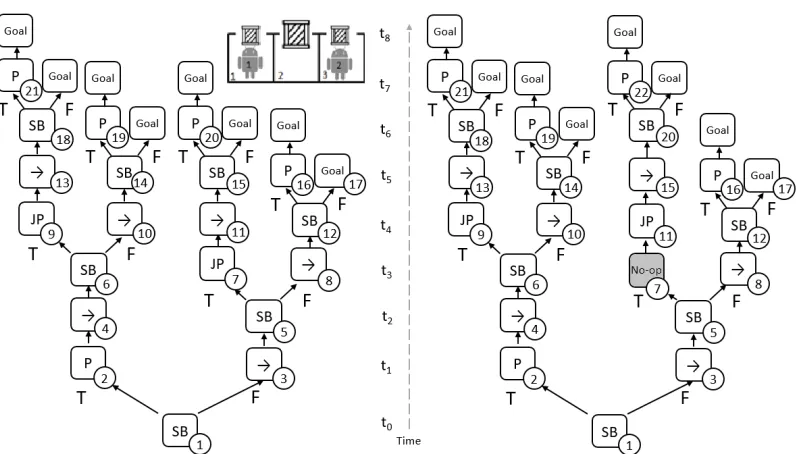
Figure 2: Policy tree (left) and an adjusted tree (right) for the compiled contingent problem of agent 1 in the simple box pushing domains. Ano-opaction (grayed) was inserted to level the JointPush action to be executed at timet4
3.1
Compilation to a Single Agent Problem
We now describe the creation of a single agent problem for the first agent1. The planning problems for the next agents will be based on this compilation, adding constraints which we later describe. Given a factored QDec-POMDPhI, P, ~A,Pre,Eff,Obs, b0, Giwe create for agentia single agent problem
hPi, A+i ,Prei,Effi,Obsi, b0, Gi. The observationsObsi, the initial beliefb0 and the set of goalsG
remain as in the multi agent problem.
A+i is the set of single agenti, containing all the independent actions inAi, as well as all
collabora-tive actions thatiparticipates in.
That is, for each minimal subset{aj1, ..., ajk}such thatEffc({aj1, ..., ajk})6=∅and there existslsuch
thatajl ∈ Ai, we add a single agent actiona{j1,...,jk}. The created action has the same preconditions
asajl — the component of agenti in the joint action. This represents an assumption of agentithat
the other agents that participate in the collaborative action will fulfill the needed precondition for the collaborative action to apply.
In addition, we identify a set Pi− of non-constant propositions that none of the independent or collaborative actions of agentican achieve, yet appear in a precondition of an actiona∈A+i or in the goalG. These are propositions which may be required for achieving the goal, yet cannot be produced by agenti. We remove all these propositions from the problem description. This represents an assumption of agentithat other agents will produce these propositions when needed.
Algorithm 1:Iterative Planning for QDEC-POMDP
1 Input: QDec-POMDPhI, P, ~A, P re, Ef f, Obs, b0, Gi
2 Ac← ∅(collaborative action constraints)
3 i←1(current agent)
4 foreach goal literalg,GT(g)← ∞
5 whilei < ndo
6 τi←solvehPi, Ai+, P rei, Ef fi, Obsi, b0, Gi
7 ifτiis validthen
8 Align and order collaborative actions inτi
9 GT
i ←goal achievement times inτi
10 if∃g∈Gs.t.GT
i(g)< GT(g)then
11 j←the earliest agent that achievedgs.t.GiT(g)< GT(g)
12 GT(g)←GTi(g)
13 Undo all constraints by agentsj..i
14 i←j
15 forCollaborative actionacinτiat timetdo
16 Add constraint onacat timettoAc
17 i←i+ 1 18 else
19 forconstraintcinAcby increasing timedo
20 τ←SolvehPi, A+i, P rei, Ef fi, Obsi, b0, ci
21 ifτis not validthen
22 cf←c
23 t←earliest time thatcfcould be achieved
24 j←the agent that introducedcf
25 notifyjthatcfcan be achieved by timet
26 Undo all constraints by agentsj..i
27 i←j
3.2
Adjustments to the Policy Tree
It may not be possible to construct a joint policy usingτ, as we must ensure that all collaborating agents execute a collaborative action together. For example, consider the single agent policy tree for agent1in Figure2. This tree is a solution for the compiled problem, assuming that agent2would assist in joint-push actions when needed. However, we can observe that in the left branch, the collaborative joint joint-push action is at timet4, while in the right branch the joint push is at timet3. To be able to assist at different times, agent2must know whether agent1is at the right or left branch.
To handle this, we force all the instances of a collaborative action to occur at the same time in all branches, by addingno-opactions (Figure2right), creating aleveledpolicy tree.
Leveling the collaborative actions may be difficult when we have multiple collaborative actions in a branch. Given two collaborative actionsa1, a2, ifa1precedesa2in all branches, then we can level the execution time as before, by first leveling the tree fora1, then leveling the tree fora2. However, when a1precedesa2in one branch, anda2precedesa1in another branch, we cannot level both together.
3.3
Extracting Constraints for Other Agents
Following the adjustments to the treeτ, resulting in treeτi for agenti, we now extract a set of
con-straints on the policy tree of other agents. We can extract two types of concon-straints — collaborative action constraints and missing preconditions constraints.
Collaborative Action Constraints
For each collaborative actionac executed at timetin policy treeτi, we add a constraint for all other
agents that participate inac to also execute the action at timet. However, even thoughac is executed
always at timet, in some branches it might be thatacis not executed at all. Consider the tree in Figure2.
In two branches the agents do not jointly push the heavy box, because it is already at the target position. Hence, the constraint to jointly push the heavy box applies only in branches where the box is not initially at its target position.
The collaborative action constraints are henceconditionalconstraints, conditioned on the value of some observed variables. The collaborative actionacmust be executed only in branches where the value
of the observed variables conforms to the conditioned values. To identify these variables we look at the set of branchesBacwhereacwas used, and the set of branchesB¬acwhereacwas not used.
We identify the set of literalsPacthat occur in all branches inBacprior to the execution ofacin that
branch, and the set of literalsP¬ac that occur in all branches inB¬ac throughout the branch execution.
Then,Pac\P¬acdefines the difference between these branches. All agents that collaborate onacmust
be able to observe the value of these propositions. Otherwise, the collaborative action cannot be soundly executed.
To employ the constraint in the single agent compiled problem, we implement time into the con-tingent problems. Although it is inconvenient to implement time into the propositional, PDDL based, description that we use, in our case we implement time only for a limited horizon, equivalent to the depthdof the already computed tree. We set the successor of timetdto bet∞, and the successor of
timet∞to be alsot∞, allowing other agents to plan beyond timedif need be. We add a time parameter
to all actions.
We now set the preconditions of all actions exceptacat timetto contain the conditioned variables
values. That is, all actions exceptac can be executed at timet only in branches that conform to the
conditioned variable values, whereacwas not executed in the original treeτi. In the example above, we
add to the precondition of all actions at timet4 the literal¬BoxAt2,2. In order to execute any action
other thanJ ointP ushU p2,2at timet4 the agent must first observe the value ofBoxAt2,2. Although
it is not always the case, in this example, the collaborative actionJ ointP ushU p2,2has a precondition BoxAt2,2, forcing the agent to observe the value ofBoxAt2,2before timet4in all branches.
3.4
Forward Progression and Backtracking
Given the constraints extracted from the adjusted policy tree for agenti, we now create a new single agent planning problem for the next agenti+1. The planning problem augments the definition in Section 3.1with the collaborative action and missing precondition constraints above. Constraints irrelevant to agenti+ 1, such as missing preconditions thati+ 1cannot achieve, or collaborative actions that do not apply toi+ 1are not added onto the single agent problem.
Agenti+ 1now runs the contingent solver over the constructed single agent planning problem. If a solution is found, then we again level the policy tree, extract additional constraints, and create a new planning problem for the next agent based on all constraints gathered thus far.
Although the original, multi-agent problem may have a solution, the single agent problem ofi+ 1
Time t1 t2 t3 t4
Agent a1 a2 a1 a2
g1=¬BoxAt1 1 - 1
-g2=¬BoxAt2 4 4 4 4
g3=¬BoxAt3 6 1 - 1
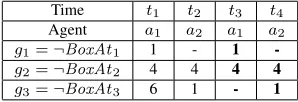
Table 1: Iterated improvements of goal completion time for the simple box-pushing problem. Agenta1 plans alone, achieving goalsg1, g2, g3att1, t4, t6, respectively, and assuming thata2will help pushing
Box2att4. Agenta2manages helping pushingBox2and achievesg3faster att1, therefore improving the overall plan and forcinga1to replan. Agenta1plans withoutg3, anda2replans ignoringg1.
positionpat timet, but agenti+ 1is unable to reachpat the appropriate time. To understand why the solver fails, we now plan again for each constraint for agenti+ 1, attempting to achieve the specified constraints by reversed order of appearance. That is, we start removing constraints that occur later in the plan, until a solution is found. This allows us to identify the first constraintcthat agenti+ 1cannot achieve at the required timetc.
We now replan for agenti+ 1given all constraints prior toc, where the goal is to achievecat any time aftertc. Ifccannot be achieved at any possible time aftertc, then we fail. Otherwise, the planner
computes a plan that achieves all constraints prior toc, and achievescat timet0at the latest.
We now identify the agentj < i+ 1that required the constraintc, which agenti+ 1cannot fulfill in the given timetc, and report back that the constraintccan be achieved only at timet0 > tc. We now
backtrack and replan for agentj, with a constraint thatccan only be achieved att0 at the earliest. All plans betweenjandi+ 1are removed. That is, ifjmanages to solve the problem, we move to agent j+ 1and continue.
3.5
Sub-Goal Assignment
While the above process can be used to solve the multi-agent problem, it may produce inefficient plans. Consider, for example, the policy tree generated in Figure2. The agent produced a solution for pushing all 3 boxes. Obviously, however, it is more efficient to leave the rightmost box at position 3 for agent2
to handle, as done in the local policy trees in Figure1. We now describe a mechanism that allows agent
1to entrust the task of pushing the rightmost box to agent2.
In addition to the constraints described in Section3.3, we extract from the policy tree of agentifor each goal literalg∈G, the minimal timetgwhengis achieved. We allow other agents to acknowledge
thatgcan be achieved by agentiat timetg, by adding a conditional effect(timetg, g)to all actions.
That is, every action executed at timetgachievesg.
An agentjmay, however, achievegat a timet0< tg. In our running example, as shown in Table1,
agent1achieves the goal¬BoxAt3at time6. Agent2can help agent1in pushing the heavy box, and then wait for time6, but a shorter plan for agent2 achieves¬BoxAt3 at time 1, and only then assist agent1with the heavy box, at which point all goals have been achieved.
When progressing forward in the agent sequence we maintain for each such goalg ∈ Gonly the earliest time of achievementtg, and add the resulting conditional effects when planning for all agents
j > i. Once we successfully finish planning for the last agent, we start again from the first agent, this time allowing agents to use all the goal achievement conditional effect. Each agent uses only goal achievement effects created by other agents, to avoid a case where agentiassigns goalg to agentj, whilejassignsgtoi, and thus no agent actually achievesg.
This process may be repeated several times, because an agent that earlier achievedgat timetg, may
Table 2: Comparing IMAP to Dec-POMDP solvers over small, 1D, box pushing problems.|Ai| = 4,
|Ωi|= 2.Wis the grid width,LandH denote the number of light and heavy boxes.E[C]is computed
given a uniform initial belief and unit costs.Pis the number of single agent planning episodes.
Domain Compilation GMAA-ICE DICEPS JESP IMAP
W L H |S| |b0| Time E[C] Time E[C] Time E[C] Time E[C] Time E[C] P
2 2 0 16 4 12.8 1.5 0.22 1.5 16.18 1.5 0.78 1.5 7.23 4.6 2
3 2 0 36 4 25.5 1.5 0.58 1.5 18.19 1.5 1.67 1.5 6.28 4.87 2
3 2 1 70 8 50.3 4.5 × × 40.88 3.85 × × 37.07 4.06 2
5 2 1 200 8 164.6 6.5 × × 83.4 4.38 × × 41.84 12.24 4
5 4 1 800 32 × × × × × × × × 123.17 14.17 4
rapidly by other agents. However, each time we start over it is because at least one goal was achieved at an earlier time than in the previous iteration. Hence, this process must terminate eventually, and we repeat this goal allocation replanning process until we converge.
3.6
Ensuring Soundness
There can be several reasons why the above procedure may not produce a sound, executable, plan. For example, it may be that one agent consumes a precondition that another agent relies on. One can simulate the joint policy for every possible initial state, effectively traversing the implicit joint policy tree, but this process is exponential.
We take instead an approximate approach. Each agent collects from all other agents the effects of their actions at each time step. Then, the agent checks whether the preconditions of its local policy tree are not invalidated by the actions of other agents.
Our soundness test is approximate because when an agent produces an effect pin two different branches, at different time stepst, t0, wheret < t0, we assume thatpis achieved at timetin all branches. Thus, our soundness test is stronger than needed, and it may be that a valid solution would be discarded, but not vice versa.
4
Experimental Results
We now provide experimental results focusing on scalability to larger QDec-POMDP problems. We ex-periment with two domains — a variant of the well-known box pushing problem [14], and an adaptation of the rovers domain [17]. All transitions and observations in both domains are deterministic. We use CPOR [10] as the underlying planner, and Metric-FF as the classical planner of CPOR. The experiments were run on a Windows 10 64-bit machine,i5,2.2GHzCPU, and 8GB RAM. IMAP is implemented in C#, while Dec-POMDP solvers were run on an Ubuntu virtual box on the same machine1.
4.1
Domains
In the box pushing domain a set of boxes are spread in a grid, and the agents must push each box to a designated location at the edge of the grid (the end of the column it appears in). Each box may be either in a pre-specified location, or at its goal location to begin with. The agent must be in the same location as the box in order to observe where it is. Agents may move in the 4 primary directions, and can push
1The implementation of IMAP can be found athttps://github.com/Sharpen6/IMAP, and the benchmark domains
boxes in these 4 primary directions, if they occupy the same location as the box. Some boxes are heavy and must be pushed by two agents jointly. There are 9 actions, and 2 possible observations.
We also experiment with an adaptation of the multi-agent rovers domain, where multiple rovers must collect together measurements of soil, and rock. The agents navigate a map of waypoints, and successful measurements can only be taken at some waypoints, unknown initially to the agents. When an agent is at a waypoint it can attempt a measurement, which may be successful or not based on whether the waypoint is appropriate for that measurement. Images of rocks, and samples of soils can be collected by a single rover, while rock samples require two rovers working jointly. After collecting the measurements, the rovers must broadcast them back to the ground station.
4.2
Comparison to Dec-POMDP Solvers
We begin with comparing IMAP to exact (GMAA-ICE [16]) and approximate (JESP [11], DICEPS [12]) Dec-POMDP solvers on small box pushing domains. While IMAP finds satisfying plans, without any optimality criterion, the Dec-POMDP solvers optimize for minimizing expected cost for achieving the goal, denotedE[C]. All solvers were executed on various horizons until convergence, and we report the result over the horizon with bestE[C](computed assuming a uniform initial belief and unit costs). In all domains we used a 1D grid, and hence only 4 actions per agent (observe-box, push, move-right, move-left). We also compare to the compilation-based approach [6]. All solvers managed to solve only very small problems, with a short horizon.
We acknowledge that this comparison is not entirely fair, because Dec-POMDP solvers try to opti-mize solution quality, whereas we only seek a satisfying solution. Thus, Dec-POMDP solvers may need to explore many more branches of the search graph, at a much greater computational cost. Furthermore, many Dec-POMDP solvers are naturally anytime, and can possibly produce a good policy even when stopped before termination. It may well be that solvers may reach a satisfying policy, which is the goal in a QDec-POMDP, well before they terminate their execution.
4.3
IMAP on Larger Problems
Table3shows results over large domains. We experimented with varying grid sizes, number of agents, and different compositions of light and heavy boxes . We report runtime (T, secs.), the expected cost under a uniform distribution (E[C]), and the plan makespan (M, maximal time to completion), as a measure of plan quality, and the total number of single agent planning episodes (P). The difficulties in this domain are mainly due to the number of collaborations, and the alternative goal assignments.
In the Rovers domain, the problem difficulty is defined, as before, by the number of agents and the size (number of waypoints), but also by the uncertainty — the number of potential waypoints where a measurement can be taken. While the number of states is smaller, the number of actions, and the initial belief uncertainty, are larger in this domain compared to the box pushing problems. The difficulty mostly stems from the size of the initial belief, requiring more complex single agent plan trees.
Table 3: IMAP on large domains.Cis the number of required collaborations,Timeis the runtime (secs),
Mis the final makespan,E[C]is the expected cost under a uniform distribution, andPlanningis the number of agent planning episodes.
|S| |I| |Ai| |Ω| |b0| C Time M E[C] Planning
Box pushing
196 2 8 2 4 1 13.2 16 8 5
400 2 8 2 4 1 30 18 10.2 3
25000 5 8 3 8 1 56.2 13 6.82 12
1000 3 8 3 8 1 59 12 6.68 11
4000 3 8 5 32 2 247.1 19 11.6 9
Rovers
308 2 15 2 4 1 13.1 18 7.81 2
462 2 16 3 8 1 14.4 16 8.7 2
300 2 16 7 128 1 33.7 35 19.3 2
20250 3 15 5 32 1 37.1 12 5.5 3
1500 3 15 7 128 1 156.3 26 11.2 6
600 2 16 9 512 1 205.01 39 17.6 4
Table 4: IMAP execution example. P denotes the planning episode, BT denotes the reason for back-tracking (F - constraint failure, I - goal improvement).
P 1 2 3 4 5 6 6 7 8 9 10 11 12
Agent 1 2 1 2 1 2 3 1 2 3 1 2 3
box0 4 × 4 4 4 4 × 7 7 7 7 7 7
box1 14 14 14 5 5 5 5 5 17 4 4 4 4
BT F I F I
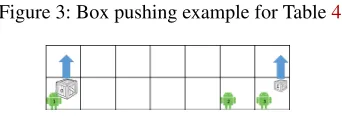
Figure3shows an example a box pushing domain with 3 agents and 2 boxes, box0which is heavy, and box1which is light. Table4shows the execution of IMAP on this domain. Agent 1 wants to push box0with agent 2 at time 4, and then push box1at time 14. Agent 2 reports that it can only push box0at time 7. Agent 1 now selects agent 3 for collaboration. Agent 2, relieved of pushing box0can push box1 at time 5. Agent 1 confirms this plan improvement. When reaching agent 3 it reports that it can help with box0only at time 8. Agent 1 replans, and chooses collaboration with agent 2, who cannot push box1at time 5. Agent 3 now reports that it can push box1at time 4. All agents confirm the new plan.
5
Discussion and Related Work
Our approach is well rooted in the multi-agent literature. Iterating over the agents, focusing on one agent at a time is used for reducing the complexity of considering a joint policy. For example, JESP [11] modifies the policy of one agent, while keeping the policies of all other agents fixed. The exponential complexity of considering all possible joint observations is not reduced, though, making scaling up difficult, as can be seen in our experiments as well.
Figure 3: Box pushing example for Table4
As such, the main contribution in this paper is in an efficient adaptation of these well known ideas into the new QDec-POMDP framework, scaling well beyond the ability of current exact and approximate Dec-POMDP solvers.
6
Conclusion
We presented IMAP — an iterative algorithm for multi-agent planning for QDec-POMDPs, which iter-atively plans for a single agent. IMAP assumes that other agents will be available to help the agent with collaborative actions, and produces constraints to the other agents for the required collaborations. Later agents that cannot meet these constraints results in backtracking. IMAP also allows for later agents to improve the previous plans, by taking responsibility for some tasks, causing again backtracking.
We experiment with two types of domains, the well-known box pushing domains and a new Dec-POMDP domain adapted from the multi-agent planning community. On both domains, we have shown a scaling up ability well beyond the limitation of current Dec-POMDP planners.
In the future, we will experiment with more domains, focusing on other types of collaborations. E.g., we would explore cases where each agent completes a part of a task, but there are no collaborative actions. We will also explore cases where agents execute actions that interfere with other agents, such as actions that consume a precondition required by another agent. We believe that simple extensions of our approach will be able to handle such cases.
An important extension of our algorithm is for non-deterministic actions, incurring loops. Our con-straints must be significantly modified to cope with loops.
Acknowledgements
This work was partially supported by the CBG Cyber Security Center at Ben Gurion University of the Negev, and by ISF grant 933/11.
References
[1] Daniel S. Bernstein, Robert Givan, Neil Immerman, and Shlomo Zilberstein. The complexity of decentralized control of Markov decision processes.Mathematics of Operations Research, 27:819–840, 2002.
[2] Blai Bonet and Hector Geffner. Belief tracking for planning with sensing: Width, complexity and approxima-tions.J. Artif. Intell. Res., 50:923–970, 2014.
[3] Daniel Borrajo. Multi-agent planning by plan reuse. InProceedings of the 2013 international conference on Autonomous agents and multi-agent systems, pages 1141–1142. International Foundation for Autonomous Agents and Multiagent Systems, 2013.
[4] Ronen I Brafman and Carmel Domshlak. From one to many: Planning for loosely coupled multi-agent sys-tems. InICAPS, pages 28–35, 2008.
[6] Ronen I. Brafman, Guy Shani, and Shlomo Zilberstein. Qualitative planning under partial observability in multi-agent domains. InProceedings of the Twenty-Seventh AAAI Conference on Artificial Intelligence, July 14-18, 2013, Bellevue, Washington, USA., 2013.
[7] Archie C Chapman, Alex Rogers, Nicholas R Jennings, and David S Leslie. A unifying framework for iterative approximate best-response algorithms for distributed constraint optimization problems1. The Knowledge Engineering Review, 26(4):411–444, 2011.
[8] Nick R Jennings. Commitments and conventions: The foundation of coordination in multi-agent systems.The knowledge engineering review, 8(3):223–250, 1993.
[9] Radimir Komarnitsky and Guy Shani. Computing contingent plans using online replanning. InProceedings of the Thirtieth AAAI Conference on Artificial Intelligence, February 12-17, 2016, Phoenix, Arizona, USA., pages 3159–3165, 2016.
[10] Radimir Komarnitsky and Guy Shani. Computing contingent plans using online replanning. InAAAI, pages 3159–3165, 2016.
[11] Ranjit Nair, Milind Tambe, Makoto Yokoo, David Pynadath, and Stacy Marsella. Taming decentralized pomdps: Towards efficient policy computation for multiagent settings. InIJCAI, volume 3, pages 705–711, 2003.
[12] Frans A Oliehoek, Julian FP Kooij, and Nikos Vlassis. The cross-entropy method for policy search in decen-tralized pomdps.Informatica, 32(4), 2008.
[13] Frans Adriaan Oliehoek, Stefan J Witwicki, and Leslie Pack Kaelbling. Influence-based abstraction for mul-tiagent systems. InAAAI, 2012.
[14] Sven Seuken and Shlomo Zilberstein. Improved memory-bounded dynamic programming for decentralized POMDPs. InProceedings of the Twenty-Third Conference on Uncertainty in Artificial Intelligence, pages 344–351, Vancouver, British Columbia, 2007.
[15] Matthijs TJ Spaan and Francisco S Melo. Interaction-driven markov games for decentralized multiagent plan-ning under uncertainty. InProceedings of the 7th international joint conference on Autonomous agents and multiagent systems-Volume 1, pages 525–532. International Foundation for Autonomous Agents and Multia-gent Systems, 2008.
[16] Matthijs TJ Spaan, Frans A Oliehoek, and Christopher Amato. Scaling up optimal heuristic search in dec-pomdps via incremental expansion. InIJCAI Proceedings-International Joint Conference on Artificial Intel-ligence, volume 22, page 2027, 2011.
[17] Michal Stolba, Anton´ın Komenda, and Daniel L. Kovacs. Competition of distributed and multiagent planners (codmap). InProceedings of the Thirtieth AAAI Conference on Artificial Intelligence, February 12-17, 2016, Phoenix, Arizona, USA., pages 4343–4345, 2016.

![Table 3: IMAP on large domains. C is the number of required collaborations, Time is the runtime (secs),M is the final makespan, E[C] is the expected cost under a uniform distribution, and Planning is thenumber of agent planning episodes.](https://thumb-us.123doks.com/thumbv2/123dok_us/8880916.1819720/12.612.180.434.159.281/collaborations-makespan-expected-distribution-planning-thenumber-planning-episodes.webp)