23 |
P a g e
Asian Journal of Pharmaceutical Science & Technology
e-ISSN: 2248 – 9185
www.ajpst.com
Print ISSN: 2248 – 9177
ANALYTICAL METHOD DEVELOPMENT AND VALIDATION FOR
SIMULTANEOUS ESTIMATION OF CEPHALEXIN AND
BROMHEXINE HCL IN PURE AND PHARMACEUTICAL DOSAGE
FORM BY RP- HPLC
A.Sanjeevarani
*1, T.Rajesh
1, G.Vijaya Kumar
1, M.A.Haneef
21KGR Institute of technology and management, Sy. No. 419, Rampally, Keesara, Secunderabad, Telangana 501301, India. 2Research Scholar, Sri Satya Sai University of Technology and Medical Sciences, Sehore. M.P. 466001, India.
ABSTRACT
A rapid and precise reverse phase high performance liquid chromatographic method has been developed for the validated of Cephalexin and Bromhexine, in its pure form as well as in tablet dosage form. Chromatography was carried out on a Hypersil C18 (4.6 x 150mm, 5µm) column using a mixture of Acetonitrile: TEA Buffer pH 4.2 (75:25) as the mobile phase at a flow rate of 1.0ml/min, the detection was carried out at 259 nm. The retention time of the Cephalexin and Bromhexine was 2.344, 3.282 ±0.02min respectively. The method produces linear responses in the concentration range of 100-500mg/ml of Cephalexin and 0.4-2mg/ml of Bromhexine. The method precision for the determination of assay was below 2.0%RSD. The method is useful in the quality control of bulk and pharmaceutical formulations.
Key words: Cephalexin, Bromhexine, RP-HPLC, validation.
INTRODUCTION
Bromhexine is an expectorant/mucolytic agent. Chemically it is 2, 4-dibromo-6-{[cyclohexyl(methyl) amino] methyl} aniline. The chemical formula is C14H20Br2N2. The molecular weight is 376.13g/mol. Bromhexine is an oral mucolytic agent with a low level of associated toxicity. Bromhexine acts on the mucus at the formative stages in the glands, within the mucus-secreting cells. Bromhexine disrupts the structure of acid mucopolysachharide fibres in mucoid sputum and produces less viscous mucus, which is easier to expectorate [1, 2].
Cephalexin is an antibiotic useful for the treatment of a number of bacterial infections. Chemically, it is (6R, 7R)-7- [(2R)-2-amino-2-phenylacetamido]-3-methyl-8-oxo-5-thia-1-azabicyclo [4.2.0] oct-2-ene-2-carboxylic acid. The chemical formula and molecular weight is C16H17N3O4S and 347.389g/mol. Cephalexin, like the penicillins, is a beta-lactam antibiotic. By binding to specific penicillin-binding proteins (PBPs) located inside the bacterial cell wall, it inhibits the third and last stage of bacterial cell wall synthesis. Cell lysis is then mediated by bacterial cell wall autolytic enzymes such as autolysins; it is possible that cephalexin interferes with an autolysin inhibitor [3]. Different analytical methods have been reported in the
literature for the assay of Bromhexine and Cephalexin in pharmaceuticals and include spectrophotometry and HPLC [4-10]. The present study was to establish a simple, sensitive and low cost RP-HPLC method for simultaneous estimation of Bromhexine and Cephalexin in bulk as well as in other dosage forms. The developed method was validated as per ICH guidelines [11, 12]Fig 2.
MATERIALS AND METHODS Reagents
Bromhexine and Cephalexin were kindly supplied by Sura Pharma Lab Hyderabad. Acetonitrile, water (HPLC grade, Merck) and all the other reagents of AR grade were purchased from M R Enterprisers. A tablet BROCIF (Zephyr Medicare Pvt Ltd) containing 4mg of Bromhexine and 250mg of Cephalexin were used.
Instrumentation
The LC system consisted of a Waters model 2695, PDA detector 2998 with 20 μL sample loop. The output signals were monitored and integrated using Empower 2 software.
24 |
P a g e
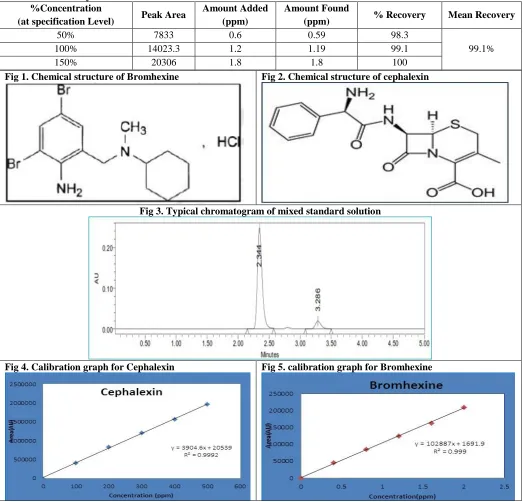
Chromatographic conditionsThe elution was isocratic and the mobile phase consisted of a mixture of buffer (Accurately weighed 1.42gm of Sodium dihyrogen Ortho phosphate in a 1000ml of Volumetric flask add about 900ml of milli-Q water added and degas to sonicate and finally make up the volume with water then pH adjusted to 5.0 with dil. Orthophosphoric acid solution) and acetonitrile (45:55 v/v). The mobile phase was filtered through a 0.45-μm (HVLP, Germany) membrane filter prior to use. A ODS C18 (100mm x 4.6 mm, 5m) was used for determination. The flow rate was 1.0 ml/min and the column was operated at ambient temperature (~30oC). The volume of sample injected was 10 μL. Prior to injection of the solutions, column was equilibrated for at least 30min with mobile phase flowing through the system. The UV detector was set at wavelength of 254nm. A typical RP-HPLC chromatogram of Bromhexine and Cephalexin is shown in Figure- 3.
Diluent: Methanol
Optimized Chromatogram (Sample)
Mobile phase : Acetonitrile: TEA Buffer pH 4.2 (75:25) Column : Hypersil C18 (4.6×150mm, 5.0 µm)
Flow rate : 1 ml/min Wavelength : 259 nm Column temp : 40ºC Injection Volume: 10 µl Run time : 5 minutes
SPECIFICITY
METHOD VALIDATION
The developed method was validated as per ICH guidelines for its accuracy, linearity, precision, specificity, robustness, ruggedness, limit of detection and limit of quantification by using the following procedures. The parameters are validated as shown in table-9.
System suitability
System suitability and chromatographic parameters were validated such as asymmetry factor, tailing factor and number of theoretical plates were calculated
Linearity
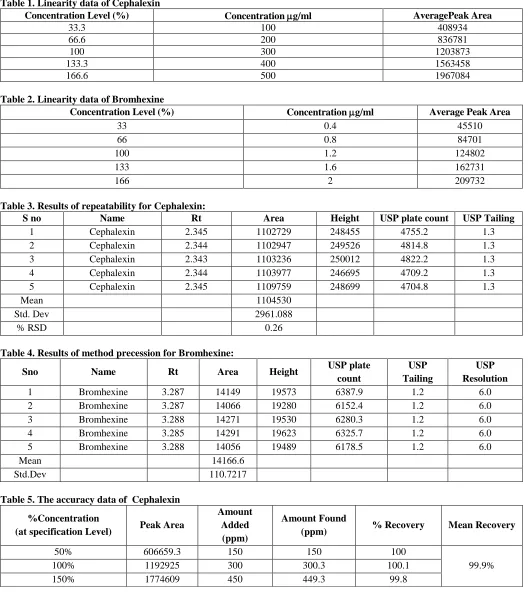
Linearity of this method was evaluated by linear regression analysis and calculated by least square method and studied by preparing standard solutions of Bromhexine and Cephalexin at different concentration levels. Absorbance of resulting solutions was measured and the calibration curve was plotted between absorbance vs concentration of the drug (Figure: 2 & 3). The response was found to be linear in the range 100-500μg/ml & 0.4 - 2.0 μg/ml for Bromhexine and Cephalexin. The data was given in table-1.
Precision
A) Method Repeatability
Six sample solutions of the same concentration (100% i.e., 4μg/ml of Bromhexine and 250μg/ml of Cephalexin) were prepared and injected into the HPLC system as per test procedure. The results were given in table-3& 4.
Accuracy
Accuracy was performed in triplicate for various concentrations of Bromhexine and Cephalexin equivalent to 50%, 100% and 150% of the standard amount was spiked to 100% sample solution and they were injected into the HPLC system per the test procedure. The average % recovery was calculated. The data was given in table-5 & 6.
Limit of detection and Limit of Quantification
LOD and LOQ were calculated from the average slope and standard deviation from the calibration curve as per ICH guidelines. The LOD and LOQ of Bromhexine were found to be 0.055μg/ml and 0.167μg/ml respectively. The LOD and LOQ of Cephalexin were found to be 4.370μg/ml and 13.242μg/ml respectively.
Robustness
Robustness was done by small deliberate changes in the chromatographic conditions and retention time of Bromhexine and Cephalexin were noted. The factors selected were change in flow rate and variation in the mobile phase composition. The results remained unaffected by small variations in these parameters as shown in table-6 and 7.
Ruggedness
Ruggedness of the method was checked by using different days and with different instruments. Six sample solutions of the same concentration (100% i.e., 4μg/ml of Bromhexine and 250μg/ml of Cephalexin) were prepared and injected into the HPLC system as per test procedure. The relative standard deviation of the results obtained from different days and with different instruments were found to be <2.0%. The results were given in table-7 and 8.
Assay
25 |
P a g e
Table 1. Linearity data of CephalexinConcentration Level (%) Concentration g/ml AveragePeak Area
33.3 100 408934
66.6 200 836781
100 300 1203873
133.3 400 1563458
166.6 500 1967084
Table 2. Linearity data of Bromhexine
Concentration Level (%) Concentration g/ml Average Peak Area
33 0.4 45510
66 0.8 84701
100 1.2 124802
133 1.6 162731
166 2 209732
Table 3. Results of repeatability for Cephalexin:
S no Name Rt Area Height USP plate count USP Tailing
1 Cephalexin 2.345 1102729 248455 4755.2 1.3
2 Cephalexin 2.344 1102947 249526 4814.8 1.3
3 Cephalexin 2.343 1103236 250012 4822.2 1.3
4 Cephalexin 2.344 1103977 246695 4709.2 1.3
5 Cephalexin 2.345 1109759 248699 4704.8 1.3
Mean 1104530
Std. Dev 2961.088
% RSD 0.26
Table 4. Results of method precession for Bromhexine:
Sno Name Rt Area Height USP plate
count
USP Tailing
USP Resolution
1 Bromhexine 3.287 14149 19573 6387.9 1.2 6.0
2 Bromhexine 3.287 14066 19280 6152.4 1.2 6.0
3 Bromhexine 3.288 14271 19530 6280.3 1.2 6.0
4 Bromhexine 3.285 14291 19623 6325.7 1.2 6.0
5 Bromhexine 3.288 14056 19489 6178.5 1.2 6.0
Mean 14166.6
Std.Dev 110.7217
Table 5. The accuracy data of Cephalexin
%Concentration
(at specification Level) Peak Area
Amount Added
(ppm)
Amount Found
(ppm) % Recovery Mean Recovery
50% 606659.3 150 150 100
99.9%
100% 1192925 300 300.3 100.1
150% 1774609 450 449.3 99.8
26 |
P a g e
Table 6.The accuracy data of Bromhexine%Concentration
(at specification Level) Peak Area
Amount Added (ppm)
Amount Found
(ppm) % Recovery Mean Recovery
50% 7833 0.6 0.59 98.3
99.1%
100% 14023.3 1.2 1.19 99.1
150% 20306 1.8 1.8 100
Fig 1. Chemical structure of Bromhexine Fig 2. Chemical structure of cephalexin
Fig 3. Typical chromatogram of mixed standard solution
Fig 4. Calibration graph for Cephalexin Fig 5. calibration graph for Bromhexine
SUMMARY AND CONCLUSION
The analytical method was developed by studying different parameters. First of all, maximum absorbance was found to be at 259 nm and the peak purity was excellent. Injection volume was selected to be 10µl which gave a good peak area. The column used for study was Hypersil C18 because it was giving good peak. Ambient temperature was found to be suitable for the nature of drug solution. The flow rate was fixed at 1.0ml/min because of good peak area and satisfactory retention time. Mobile phase is
27 |
P a g e
Cephalexin. The analytical passed both robustness and ruggedness tests. On both cases, relative standard deviation was well satisfactory.
CONCLUSION
In the present investigation, a simple, sensitive, precise and accurate RP-HPLC method was developed for the quantitative estimation of Cephalexin and Bromhexine in bulk drug and pharmaceutical dosage forms. This method was simple, since diluted samples are directly used without any preliminary chemical derivatisation or purification steps. Cephalexin and Bromhexine was freely soluble in ethanol, methanol and sparingly soluble in water. Acetonitrile: TEA Buffer pH 4.2 (75:25) was chosen as the mobile phase. The solvent system used in this method was economical. The
%RSD values were within 2 and the method was found to be precise. The results expressed in Tables for RP-HPLC method was promising. The RP-HPLC method is more sensitive, accurate and precise compared to the Spectrophotometric methods.
This method can be used for the routine determination of Cephalexin and Bromhexine in bulk drug and in Pharmaceutical dosage forms.
ACKNOWLEDGEMENTS
The authors are very thankful to KGR Management and Institute, Kesara, Secunderabad for providing all facilities to complete the work and Sura Pharma Lab Hyderabad for providing the Bromhexine and Cephalexin as gift sample.
REFERENCES
1. Kealey and Haines PJ. Analytical Chemistry, 1stedition, Bios Publisher, 2002, 1-7.
2. Braith WA and Smith FJ. Chromatographic Methods, 5thedition, Kluwer Academic Publisher, 1996, 1-2. 3. Andrea W and Phyllisr B. HPLC Principle and Practice, 1st edition, Academic press, 1997, 24-37.
4. Kazakevich Y and Rosario L. HPLC for Pharm. stedition, Wiley Interscience A JohnWiley & Sons, Inc., Publication, 2007, 15-23.
5. http://en.wikipedia.org/wiki/Chromatography.
6. Meyer VR. Practical High-Performance Liquid Chromatography, 4th Ed. England, John Wiley & Sons Ltd, 2004, 7-8.
7. Sahajwalla CG. A new drug development, Marcel Dekker Inc., New York, 2004, 421–426. 8. http://amitpatel745.topcities.com/index_files/study/column care.pdf