VOLUME 40, ARTICLE 15, PAGES 395
,
416
PUBLISHED 22 FEBRUARY 2019
https://www.demographic-research.org/Volumes/Vol40/15/ DOI: 10.4054/DemRes.2019.40.15
Research Article
Lung cancer mortality in historical context:
How stable are spatial patterns of smoking over
time?
Krzysztof Czaderny
© 2019 Krzysztof Czaderny.
This open-access work is published under the terms of the Creative Commons Attribution 3.0 Germany (CC BY 3.0 DE), which permits use, reproduction, and distribution in any medium, provided the original author(s) and source are given credit.
1 Introduction 396
2 Material and methods 397
3 Results 400
3.1 Spatial patterns of smoking and age-adjusted lung cancer mortality 400 3.2 Determinants of spatial clustering of age-adjusted lung cancer
mortality
406
4 Discussion 407
5 Conclusions 411
6 Acknowledgments 412
Lung cancer mortality in historical context:
How stable are spatial patterns of smoking over time?
Krzysztof Czaderny1
Abstract
BACKGROUND
The lands of the Recovered Territories were acquired by Poland in 1945 and populated by almost 5 million Polish settlers mostly from central provinces in the country and from ex-Polish territories in the east. Transgenerational persistence of informal institutions provides a context for the study.
OBJECTIVE
Persistence of the spatial variation of age-adjusted lung cancer mortality and their causes were evaluated. The high smoking prevalence in the Recovered Territories was hypothesised to be related to the age of the local communities and persistence of informal institutions.
METHODS
A spatial scan statistic was used to detect clusters of elevated lung cancer mortality. A two stages least squares regression model with heteroscedasticity and autocorrelation consistent standard errors was fitted to identify determinants of a spatial clustering of lung cancer mortality.
RESULTS
A strong west-to-east trend of lung cancer mortality is consistent with spatial patterns of tobacco use in interwar, post-war, and current Poland. Age-adjusted lung cancer mortality was contrastingly high in 1980–1984 in Masuria, West Pomerania, and Silesia. Tobacco prevalence and unbalanced dietary patterns were found to be associated with a spatial clustering of lung cancer mortality in the country.
CONCLUSIONS
agriculture in the Recovered Territories. The identified spatial pattern is consistent with elevated frequency of other socially condemned behaviours in the Recovered Territories, including crime, nonmarital births, and divorce.
CONTRIBUTION
Phantom borders reflecting different historical legacies can structure health-related behaviours. Spatial distribution of lung cancer mortality is persistent over time, particularly in women.
1. Introduction
In 2014, 23,200 new deaths due to lung cancer were registered in Poland, which is nearly twice as many as in 1980. The purpose of this paper is to illustrate and better understand spatial distribution of mortality due to lung cancer, which is the leading cancer cause of death in Poland and a cancer with the strongest spatial autocorrelation of mortality in the country. Determinants of spatial variation in lung cancer mortality and its historical context are examined as well.
Previous studies have documented the persistence of informal institutions, such as cultural traits and preference parameters, transmitted from generation to generation (Bisin and Verdier 2000). They were referred to as “rootedness” by Jasiewicz (2009). In this article, spatial patterns in smoking and lung cancer mortality are discussed and compared between regions defined by history. Poland regained their national independence in 1918 after 123 years of partition by Prussia, Russia, and Austria. Only in 1945 Poland acquired territories which for centuries had been under German domination and were called in the post-war Poland the Recovered Territories or now more frequently the Western Territories, which is more ideologically neutral. Since the 18th century, Pomerania and Silesia have spent most of their time within the sphere of German culture.
conservatism–liberalism cleavage between the central parts of the country and the Recovered Territories (Zarycki 2002; Bartkowski 2003; Jasiewicz 2009; Jańczak 2015). In some European studies, smoking prevalence was found to be higher among migrants (Nierkens, de Vries, and Stronks 2006; Kabir et al. 2008; Urban et al. 2015). However, most of the studies included external migrants from countries of high smoking prevalence. An inverse relationship was seen in the United States: smoking prevalence in the migrant population was found to be lower than both the country of origin and the US levels (Bosdriesz et al. 2013). Westphal (2016) finds the association between smoking and internal migration in Germany inconclusive; nonetheless, the results show that female smokers were less likely to migrate than women who did not smoke. The probability value for the same relationship in male population was near the significance threshold.
In this article, it is discussed whether smoking tends to be more frequent in newly formed communities. Spatial patterns of age-adjusted lung cancer mortality and smoking prevalence in Poland are examined in a historical context. Persistence of spatial clusters of lung cancer mortality between 1980–1984 and 2010–2014 is discussed. Factors associated with spatial variation in lung cancer mortality in 2010– 2014 are investigated. Lung cancer mortality patterns are discussed in parallel with spatial variation in smoking, since in populations with prolonged cigarette use, 90% of lung cancer cases are attributable to cigarette smoking (IARC 2004).
2. Material and methods
= ( )( ) ( ) ( )( ) ( ) ( ( )( )> ( )( )), (1)
where indicates a selected elliptic scanning window, ( ) and ( ) are the observed and the expected numbers of deaths within the window, and is the indicator function. Secondary clusters have a significantly large likelihood ratio (here = 0.001) but less than the primary one. Both primary and secondary clusters are not allowed to overlap. The rank of the likelihood ratio among all randomisation tests determines theP-value.
In the second part of the analysis, factors associated with spatial variation in lung cancer mortality are analysed based on consumption data collected in a countrywide survey in 2001–2007 (Target Group Index). A semirandom sampling approach was employed for the sample selection: quota-sampling with age, gender, and place of residence quota controls. A total number of 251,700 participants of the survey (122,600 men and 129,100 women), who were 15–75 years old, constituted a sample of the population of the entire Poland (divided into 380 counties). A mixed-mode design was used, where respondents were approached by paper-based personal interviewing, computer-assisted personal interviewing, and computer-assisted web interviewing. A different group of individuals was sampled each month. Consumption behaviour during the previous three months was reported by individuals.
Several forms of the tobacco smoking variable, which is crucial in the current study, were constructed and tested, including intensity of smoking (heavy, medium, and light smoking and nonsmoking) and smoking status (daily smoking versus nonsmoking). The food records from this survey were also used to calculate monthly intakes of protein, carbohydrates, and sucrose based on Poland’s food composition tables (Kunachowicz et al. 2012). Based on information criteria, the latter (binary) form of the covariate was chosen. In addition to survey data, information on emission of particulate matter into the atmosphere per sq. km (2001–2007) and socioeconomic controls such as number of health outpatient departments per 10,000 population (2001– 2007), average gross wages and salaries (2002–2007), and the rate of unemployment registered at labour offices (2004–2007) was derived from the local data bank of the Poland’s Central Statistical Office. All data was aggregated to produce county (LAU 1) estimates.
Highly spatially autocorrelated data of lung cancer mortality in Poland (demonstrated by global Moran’s index = 0.543 in the male population and = 0.657 in the female population) violates the independence assumption required for most statistical tests and regression techniques. To deal with the spatial autocorrelation in the data, the spatial regression model was estimated. The spatial lag model takes into account the spatial dependence of the explained variable (Anselin 1988):
where is a vector of dependent variable (here: age-adjusted lung cancer mortality rate), is the autoregressive parameter determining the importance of spatial lag, is a spatial weights matrix, is an observation matrix, is a parameter vector related to , and is a stochastic error term vector. Matrix = 1 ∗, ∗, ∗, of the
epidemiological model discussed in the next section includes variables of ∗, , the proportion of daily smokers; ∗, , the average monthly fish consumption per capita; and
∗, , the average monthly sucrose intake per capita.
Spatial units differ in important characteristics, including population size, which for Polish counties varies from 1,754,000 in the city of Warsaw to 20,000 in Sejny County. Heteroscedasticity was confirmed with the Breusch–Pagan test ( < 0.001). This problem was solved by using a spatial version of the nonparametric heteroscedasticity-autocorrelation consistent (HAC) estimator (Kelejian and Prucha 2007). The error vector in this estimation is assumed to be generated by the following process:
= , (3)
where is a vector of innovations and is a nonsingular and nonstochastic matrix, which is not assumed to be known and is not parametrised. A spatial HAC estimator assumes that each observation is a realisation of a random stationary process (Conley 1999). This nonparametric estimator is robust against heteroscedasticity and spatial autocorrelation. Since the HAC estimator has been rarely used so far, estimates for a classical spatial lag model fitted using maximum likelihood are reported for reference in Table 1.
3. Results
3.1 Spatial patterns of smoking and age-adjusted lung cancer mortality
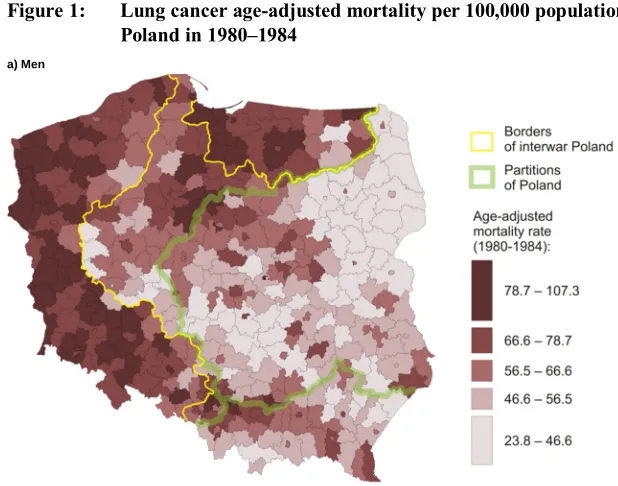
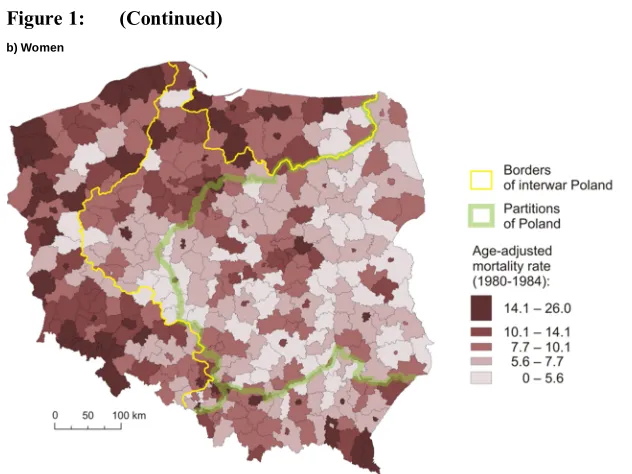
A west-to-east pattern of lung cancer mortality in 1980–1984 was similar in men and women (Figure 1). In 1980–1984, age-adjusted lung cancer mortality was higher in urban than rural areas in both genders. In 2010–2014, the gender gap in age-adjusted lung cancer mortality was low in urban areas, which is particularly noticeable in city-counties, being the largest urban centres in their respective regions. In 2010–2014, age-adjusted lung cancer mortality in men was lower in urban areas and in women it was higher in urban areas than in rural ones.
Figure 1: Lung cancer age-adjusted mortality per 100,000 population in Poland in 1980–1984
Figure 1: (Continued)
b) Women
Source: Own elaboration based on National Cancer Registry data.
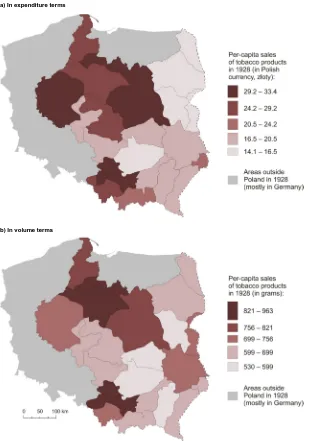
Figure 2: Sales of tobacco products in selling areas in 1928 (interwar Poland)
a) In expenditure terms
b) In volume terms
Age-adjusted lung cancer mortality in 1980–1984 was much higher in the Recovered Territories. In 1980–1984, Pomerania, Lubusz Land, and Silesia were homogenous spatial areas of elevated age-adjusted lung cancer mortality in men, according to Kulldorff’s spatial scan test. The same pattern could be observed in per-capita sales of tobacco products in post-war Poland (Figure 3). In 1958 in the Recovered Territories, only in Opole Province were per-capita sales of tobacco products somewhat below the country’s average. Tobacco consumption was also high in city-voivodeships (cities granted voivodeship status), particularly in Wrocław, the largest city of the Recovered Territories.
Figure 3: Sales of tobacco products by province in 1958 (post-war Poland)
Source: Own elaboration based on registry data of tobacco trade and manufacturing structures (Didkowska, Wojciechowska, and Zatoński 1996).
them are situated in northern Poland. The large difference between primary and secondary clusters is reflected in the likelihood ratio values, i.e., the corresponding value of the likelihood ratio for secondary clusters does not exceed ∗= 40. Lung
cancer mortality clusters for men and women are placed close together, which means that spatial distribution of risk factors is similar for both genders.
Figure 4: Lung cancer age-adjusted mortality per 100,000 population in Poland in 2010–2014 and clusters identified by Kulldorff’s scan statistic
a) Men
b) Women
Despite their heterogeneity, clusters of elevated lung cancer mortality were situated similarly in the 1980–1984 and 2010–2014 periods. This applies particularly to the female population. In 2010–2014, female lung cancer mortality was still much lower in eastern Poland. Similarly to the male population, the primary cluster of female mortality due to lung cancer in 2010–2014 was detected in central-northern Poland ( = 158.1, = 0.001). Six secondary clusters of female mortality of lung cancer were identified, most of them centred in western Poland. One of the secondary clusters stands out from others. The value of the likelihood ratio is particularly high for the Warsaw cluster of female mortality ( = 125.6, = 0.001). The probability value of = 0.001 for detected spatial clusters means that the observed rank of from the computation is 1 in 1,000 Monte Carlo simulations.
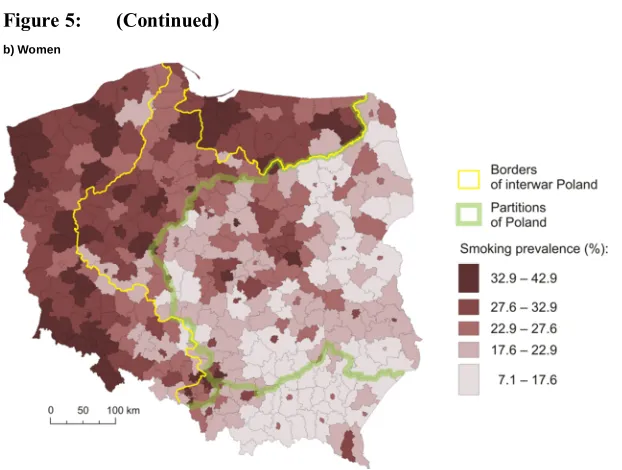
Figure 5: Tobacco smoking prevalence in the Polish population aged 15–75 in 2001–2007
Figure 5: (Continued)
b) Women
Source: Own elaboration based on questionnaire study of 251,700 participants.
3.2 Determinants of spatial clustering of age-adjusted lung cancer mortality
is, among others, related to high labour market imbalances in rural areas of northern Poland where state farms previously dominated.
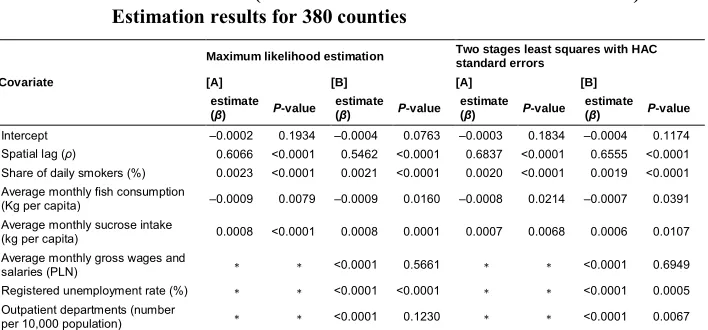
Table 1: Spatial lag model of age-adjusted lung cancer mortality in 2010– 2014: [A] an epidemiological model and [B] an epidemiological– economic model (with the inclusion of socioeconomic controls). Estimation results for 380 counties
Covariate
Maximum likelihood estimation Two stages least squares with HAC standard errors
[A] [B] [A] [B]
estimate (β) P-value
estimate (β) P-value
estimate (β) P-value
estimate (β) P-value
Intercept –0.0002 0.1934 –0.0004 0.0763 –0.0003 0.1834 –0.0004 0.1174
Spatial lag (ρ) 0.6066 <0.0001 0.5462 <0.0001 0.6837 <0.0001 0.6555 <0.0001 Share of daily smokers (%) 0.0023 <0.0001 0.0021 <0.0001 0.0020 <0.0001 0.0019 <0.0001 Average monthly fish consumption
(Kg per capita) –0.0009 0.0079 –0.0009 0.0160 –0.0008 0.0214 –0.0007 0.0391
Average monthly sucrose intake
(kg per capita) 0.0008 <0.0001 0.0008 0.0001 0.0007 0.0068 0.0006 0.0107
Average monthly gross wages and
salaries (PLN) ∗ ∗ <0.0001 0.5661 ∗ ∗ <0.0001 0.6949
Registered unemployment rate (%) ∗ ∗ <0.0001 <0.0001 ∗ ∗ <0.0001 0.0005 Outpatient departments (number
per 10,000 population) ∗ ∗ <0.0001 0.1230 ∗ ∗ <0.0001 0.0067
Source: Own elaboration.
4. Discussion
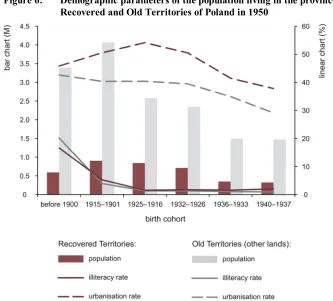
Figure 6: Demographic parameters of the population living in the provinces of Recovered and Old Territories of Poland in 1950
Source: Own elaboration based on the 1950 National Census of Poland.
Low school attainment is a well-known risk factor for smoking and this was also the case in pre-war Poland, according to school survey data (Jaxa-Bykowski 1918). According to the national censuses of 1950 and 1960, there were no major differences in the educational structure of the population of the Recovered Territories and the rest of the country (Figure 6). In 1960, the proportion of the population aged 7 and older with primary and incomplete primary education in the Recovered Territories was 27% and 48%, respectively, compared to 24% and 50% in the rest of the country.
came from rural areas and 16% from cities with under 100,000 inhabitant population. According to the 1950 census, 38% of the population of the Recovered Territories lived off agriculture, while 50% did in the rest of the country. In the post-war period, high urbanisation and availability of employment outside agriculture were two of the reasons for a high smoking prevalence in the Recovered Territories.
A two-wave survey study by Miklaszewski (1912, 1914) investigated that a smoking prevalence was slightly higher among the lower-class urban population than the upper-class population. However, low tobacco use in the former Russian territory of interwar Poland, depicted in Figure 2, was being explained mainly by low economic development, including high employment in agriculture and high ruralisation (Dzierżyński 1930). In some rural areas and small towns in central Poland, tobacco smoking was prohibited due to fire hazards (Grabowski 1886). This is in line with the results of the first large-sample survey on smoking habits and attitudes in post-war Poland (Staszewski and Wiśniewski 1960), which was carried out in Upper Silesia on a nonprobabilistic sample of 2,725 patients. The study confirmed that regardless of gender, smoking prevalence in post-war Poland was higher in individuals employed outside agriculture and those living in urban areas.
Further hypotheses about spatial discontinuities in age-adjusted lung cancer mortality in 1980–1984 can be made. Migration patterns have created considerable differences in the age structure (Figure 6). One proposes two hypotheses which are not mutually exclusive: a possible self-selection of settlers and the protective effects of family ties or expectations. Mahabee-Gittens et al. (2012) found protective effects of family bonding against smoking among all racial and ethnic groups in the United States. The protective effects of family ties and expectations were observed also against substance and alcohol use (Gil, Wagner, and Vega 2000). The effect of age of communities could be further enhanced in the Recovered Territories by a high smoking prevalence in the former German citizens who were allowed to stay in the Recovered Territories after WWII.
In pre-war Poland, smoking tobacco, especially among youth, was considered socially and religiously undesirable (Grabowski 1886; Kuznowicz 1921; Jasiński 1929). Differences in socially condemned or nonconservative behaviours between the Recovered and Old Territories are not limited to smoking habits. In 1960, the share of nonmarital births in the provinces of the Recovered Territories was higher by 113% compared to the rest of the country (7.0% versus 3.3%).2 The difference is only partly influenced by a higher urbanisation rate in the Recovered Territories. In 1960, the share
of nonmarital births in the urban population was 77% higher in the provinces of the Recovered Territories compared to the rest of the country (7.2% versus 4.1%). Kozak and Marczewski (1986) discussed the problem of elevated criminality in the Recovered Territories. In 1960, the crime rate was 30% higher in the provinces of the Recovered Territories than in the rest of the country (202.8 versus 156.1 per 10,000 population aged 16–59). According to the 1960 census, the refined divorce rate was 39% higher in the provinces of the Recovered Territories compared to the rest of the country (14.4 versus 10.4 divorces per 10,000 married population). The above-mentioned percentages become larger by over one-fifth if Opole and Gdańsk Provinces were excluded from the comparison due to a relatively high share of the native population.
Previously, the strong persistence of a conservatism–liberalism cleavage between the central parts of Poland and the Recovered Territories was shown in the example of political preferences (Zarycki 2002; Bartkowski 2003; Jasiewicz 2009; Jańczak 2015). It was hypothesised that ideological or identity factors may be related to the age of local communities. The old communities in central and eastern Poland would be well integrated and more conservative while the young communities in the Recovered Territories would be less integrated and their attachment to the traditional values would be weaker. Previously, in the structural equation approach, social conservatism was found to be correlated with lower levels of cigarette use (Castro, Stein, and Bentler 2009). Rejection of conventional values and acceptance of deviance was shown to contribute to smoking in high school seniors (Waldron and Lye 1990).
In the current study, the geographical patterns of age-adjusted lung cancer mortality and smoking prevalence were found to be more stable over time in women than in men. The spatial diffusion of smoking prevalence in men in the recent decades and high spatial persistence of smoking behaviours in women can be hypothesised to be related to differences in perceived acceptability of male and female smoking. Female smoking has been more repressed by social norms than male smoking (Grabowski 1886; Grech and Zawada 2005) and therefore spatial diffusion of smoking behaviours in women might be less likely.
Few studies have been published on smoking prevalence in the Polish migrant populations. According to the 2016 census, the Polish minority constitutes approximately 3% of Ireland’s population. Previously, smoking prevalence in Ireland residents of Polish origin was found to be higher than in the Irish counterparts (Kabir et al. 2008) and in the overall Polish population. Smoking rates and the levels of consumption of cigarettes are particularly high in the Polish migrants who have lived in Ireland for more than two years (Kabir et al. 2008).
prevalence in men are largely spatially similar over the regions. It may be concluded that in the recent decades significant spatial diffusion of tobacco use in Polish men could be observed. However, the primary cluster of lung cancer mortality in men (and women) in 2010–2014 includes areas of high smoking prevalence in interwar Poland, i.e., central-northern Poland. A current strong west-to-east trend of lung cancer mortality is hypothesised to be related to the age of the local communities and persistence of informal institutions.
As regards to the regression part of the analysis, in the 1940s, smoking tobacco was found to be an explanation for the rise of lung cancer mortality (Müller 1940; Schairer and Schöniger 1944). However, the effect of smoking on lung disease was hypothesised by then and also in Poland (Grabowski 1886; Kuznowicz 1921; Jasiński 1929). In this paper, the results of the modelling demonstrate a possible protective role of fish consumption in lung cancer, which is consistent with previous estimates (Song et al. 2014). The same refers to the variable of sucrose intake, which is associated with an increased risk of lung cancer. High sucrose intake was found to be a risk factor in lung carcinogenesis (De Stefani et al. 1998). Sucrose was found to be responsible for facilitating lung metastasis (Jiang et al. 2016).
Some limitations of the performed ecological regression should be noted. Analysed data on consumption is not available for the period prior to the 2000s. The data is retrospective and self-reported. Answers to multiple choice questions on consumption are less precise than reporting binary smoking status. No registry data on tobacco use in the country is available for the market economy period, which was the case for tobacco sales in interwar and post-war Poland.
5. Conclusions
men and women. The identification of high-risk areas of lung cancer mortality was followed by examining the underlying causal mechanisms using a spatial regression model. This study reveals that daily smoking and unbalanced dietary patterns explain most of the total variance of the spatial distribution of lung cancer mortality.
6. Acknowledgments
References
Anselin, L. (1988). Spatial econometrics: Methods and models. Boston: Kluwer Academic Publishers.doi:10.1007/978-94-015-7799-1.
Bański, J. (2016).Atlas obszarów wiejskich w Polsce [Atlas of rural areas in Poland]. Warsaw: Polish Academy of Sciences.
Bartkowski, J. (2003).Tradycja i polityka [Tradition and politics]. Warsaw: Żak. Bisin, A. and Verdier, T. (2000). Beyond the melting pot: Cultural transmission,
marriage, and the evolution of ethnic and religious traits.Quarterly Journal of Economics 115(3): 955–988.doi:10.1162/003355300554953.
Bosdriesz, J.R., Lichthart, N., Witvliet, M.I., Busschers, W.B., Stronks, K., and Kunst, A.E. (2013). Smoking prevalence among migrants in the US compared to the US-born and the population in countries of origin. PLOS ONE 8(3): e58654.
doi:10.1371/journal.pone.0058654.
Castro, F.G., Stein, J.A., and Bentler, P.M. (2009). Ethnic pride, traditional family values, and acculturation in early cigarette and alcohol use among Latino adolescents.The Journal of Primary Prevention 30(3–4): 265–292.doi:10.1007/ s10935-009-0174-z.
Conley, T.G. (1999). GMM estimation with cross sectional dependence. Journal of Econometrics 92(1): 1–45.doi:10.1016/S0304-4076(98)00084-0.
De Stefani, E., Deneo-Pellegrini, H., Mendilaharsu, M., Ronco, A., and Carzoglio, J.C. (1998). Dietary sugar and lung cancer: A case-control study in Uruguay.
Nutrition and Cancer 31(2): 132–137.doi:10.1080/01635589809514692. Didkowska, J., Wojciechowska, U., and Zatoński, W. (1996). Spożycie tytoniu w
Polsce w latach 1923–1995 [Tobacco consumption in Poland in 1923–1995]. In: Zatoński, W. and Przewoźniak, K. (eds.). Palenie tytoniu w Polsce: Postawy, następstwa zdrowotne i profilaktyka [Tobacco smoking in Poland: Attitudes, health consequences and prevention]. Warsaw: Maria Skłodowska Curie Institute – Oncology Centre: 114–126.
Dzierżyński, J. (1930). Spożycie tytoniu w Polsce [Tobacco consumption in Poland]. Warsaw: Polish Tobacco Monopoly.
Gil, A.G., Wagner, E.F., and Vega, W.A. (2000). Acculturation, familism and alcohol use among Latino adolescent males: Longitudinal relations. Journal of Community Psychology 28(4): 443–458. doi:10.1002/1520-6629(200007)28:4< 443::AID-JCOP6>3.0.CO;2-A.
Grabowski, H. (1886). Słowa prawdy o papierosianej modzie i o pijaństwie [Home truths on cigarette trends and drunkenness]. Warsaw: Czerwiński.
Grech, M. and Zawada, M. (2005). Stereotypizacja językowa i kulturowa płci: Wyniki badań empirycznych [Linguistic and cultural stereotyping of gender: Empirical research results].2K – Kultura i komunikacja 5/6(1/2): 98–109.
IARC (2004). Tobacco smoke and involuntary smoking. Lyon: IARC Working Group on the Evaluation of Carcinogenic Risk to Humans (IARC Monographs on the Evaluation of Carcinogenic Risks to Humans 83).
Jańczak, J. (2015). Phantom borders and electoral behaviour in Poland: Historical legacies, political culture and their influence on contemporary politics. Erdkunde
69(2): 125–137.doi:10.3112/erdkunde.2015.02.03.
Jasiewicz, K. (2009). The past is never dead: Identity, class, and voting behaviour in contemporary Poland. East European Politics and Societies 23(4): 491–508.
doi:10.1177/0888325409342114.
Jasiński, I. (1929). Nie palmy tytoniu! [Do not smoke!]. Warsaw: Congregation of Loreto.
Jaxa-Bykowski, L. (1918). Gmina szkolna im: Jędrzeja Śniadeckiego w Gimnazyum VIII. we Lwowie [Jędrzej Śniadecki school community of the Gymnasium no. 8 in Lviv]. Lviv: Society of High School Teachers.
Jiang, Y., Pan, Y., Rhea, P.R., Tan, L., Gagea, M., Cohen, L., Fischer, S.M., and Yang, P. (2016). A sucrose-enriched diet promotes tumorigenesis in mammary gland in part through the 12-lipoxygenase pathway. Cancer Research 76(1): 24–29.
doi:10.1158/0008-5472.CAN-14-3432.
Kabir, Z., Clarke, V., Keogan, S., Currie, L.M., Zatoński, W., and Clancy, L. (2008). Smoking characteristics of Polish immigrants in Dublin.BMC Public Health 8: 428.doi:10.1186/1471-2458-8-428.
Kelejian, H.H. and Prucha, I.R. (2007). HAC estimation in a spatial framework.
Kozak, M. and Marczewski, M. (1986). O związkach między rozwojem społecznym a nasileniem przestępczości [On the relationship between human development and crime].Problemy Kryminologiczne Wielkopolski 5(1): 279–288.
Kulldorff, M. and Nagarwalla, N. (1995). Spatial disease clusters: Detection and inference.Statistics in Medicine 14(8): 799–810.doi:10.1002/sim.4780140809. Kunachowicz, H., Nadolna, I., Iwanow, K., and Przygoda, B. (2012). Wartość
odżywcza wybranych produktów spożywczych i typowych potraw [The nutritional value of selected food products and typical dishes]. Warsaw: Wydawnictwo Lekarskie PZWL.
Kuznowicz, T.J. (1921).Palenie tytoniu a młodzież [Tobacco smoking and the youth]. Cracow: League Against Tobacco.
Mahabee-Gittens, E.M., Xiao, Y., Gordon, J.S., and Khoury, J.C. (2012). The role of family influences on adolescent smoking in different racial/ethnic groups.
Nicotine and Tobacco Research 14(3): 264–273.doi:10.1093/ntr/ntr192.
Miklaszewski, W. (1912).Rozwój cielesny proletarjatu Warszawy w świetle pomiarów antropologicznych [Body development of the Warsaw proletariat in the light of anthropometric measurements]. Warsaw: Gebethner i Wolff.
Miklaszewski, W. (1914). Rozwój cielesny klas uprzywilejowanych w Królestwie Polskim w świetle pomiarów antropometrycznych [Body development of the upper class in the Kingdom of Poland in the light of anthropometric measurements]. Warsaw: Gebethner i Wolff.
Müller, F.H. (1940). Tabakmißbrauch und Lungencarcinom [Tobacco abuse and carcinoma of the lungs]. Zeitschrift für Krebsforschung 49(1): 57–85.
doi:10.1007/BF01633114.
Nierkens, V., de Vries, H., and Stronks, K. (2006). Smoking in immigrants: Do socioeconomic gradients follow the pattern expected from the tobacco epidemic?
Tobacco Control 15(5): 385–391.doi:10.1136/tc.2006.014902.
Norström, M., Pfeiffer, D.U., and Jarp, J. (2000). A space-time cluster investigation of an outbreak of acute respiratory disease in Norwegian cattle herds. Preventive Veterinary Medicine 47(1–2): 107–119.doi:10.1016/S0167-5877(00)00159-8. Pötschke-Langer, M., Kahnert, S., Schaller, K., Viarisio, V., Heidt, C., Schun, S.,
Schairer, E. and Schöniger, E. (1944). Lungenkrebs und Tabakverbrauch [Lung cancer and tobacco consumption]. Zeitschrift für Krebsforschung 54(4): 261–269.
doi:10.1007/BF01628727.
Sheehan, J.T., Gershman, S.T., MacDougall, L.A., Danley, R.A., Mroszczyk, M., Sorensen, A.M., and Kulldorff, M. (2000). Geographic assessment of breast cancer screening by towns, zip codes, and census tracts. Journal of Public Health Management and Practice 6(6): 48–57. doi:10.1097/00124784-200006060-00008.
Song, J., Su, H., Wang, B.-I., Zhou, Y.-Y., and Guo, L.-L. (2014). Fish consumption and lung cancer risk: Systematic review and meta-analysis. Nutrition and Cancer 66(4): 539–549.doi:10.1080/01635581.2014.894102.
Staszewski, J. and Wiśniewski, K. (1960). Wstępne badania struktury spożycia tytoniu w Polsce [Preliminary results of a study on structure of tobacco consumption in Poland].Roczniki Nauk Rolniczych 81(4): 975–990.
State Statistics Service of Ukraine (2017).Population’s self-perceived of health status and availability of selected types of medical aid. Kyiv: State Statistics Service of Ukraine.
Turnau, I. (1960).Studia nad strukturą ludnościową polskiego Wrocławia [Studies on the population structure of the Polish Wrocław]. Poznań: Institute of Western Affairs.
Urban, M., Burghuber, O.C., Dereci, C., Aydogan, M., Selimovic, E., Catic, S., and Funk, G.C. (2015). Tobacco addiction and smoking cessation in Austrian migrants: A cross-sectional study. BMJ Open 5(6): e006510. doi:10.1136/ bmjopen-2014-006510.
Waldron, I. and Lye, D. (1990). Relationships between teenage smoking and attitudes toward women’s rights, sex roles, marriage, sex and family. Women and Health
16(3–4): 23–46.doi:10.1300/J013v16n03_03.
Westphal, C. (2016). Healthy migrants? Health selection of internal migrants in Germany. European Journal of Population 32(5): 703–730. doi:10.1007/ s10680-016-9397-x.