A SURVEY ON EFFICIENT DATA MINING METHOD
FOR FINDING COMPETITORS FROM LARGE
UNSTRUCTURED E-COMMERCE DATA
Komal Ghadage
1, Dr. Sunil Rahod
2Department of Computer Engineering
Dr. D. Y. Patil School of Engineering Lohgoan,
Savitribai Phule, Pune University
Pune, India
Abstract:In this new era any competitive business and success is depending on the
ability to make an item more attractive to the customer than the competition. A number
of the questions are coming in this task such as first question is that: A) Who are main
competitors of the given items? B) How to formulize and quantify competitiveness
between items? And C) What are different features of an item that most affect its
competitiveness? Solutions of these problems are available on many domains but limited
amount of work has been carried out for this problems. Here, we are presenting formal
definition of competitiveness between the two different items, which is based on the
market segments they can both cover and which are validated for qualitatively and
quantitatively. Finally from the various surveys, we find the conclusion of basic
significance of competitiveness between two items on the basis of market segments.
Keywords: Competitiveness, Qualitatively, Quantitatively and Business.
1. INTRODUCTION
The identification of competitors serves as an important fact in the various areas. In
industrial organization economics, this involves the task of defining markets, which is the
crucial for the regulatory and antitrust policy. In marketing, it supports the analysis of Journal homepage: www.mjret.in
ignore competitors at their own risk. If a company does not have an absolute monopoly
on a vital product, there are competitors offering replacement products and services. In
any business plan competitor analysis is the important requirement because (a) The
organization's competitive position in "market space" is demonstrated, (b) Partners and
readers of business plan assume it and (C) Assists you develop strategies to be
competitive. The main objectives of the competitor analysis and execution are processes
for identify the information needs and key competitor, gathering the relative information
and interpreting that information.
The management and marketing community has been focus on the empirical methods
for the analyze competitors [1]. The extensive research has been focus on the find
examples of comparative expressions: "Article A is the better than the Article B" from
different Websites or other text sources. The paradigm of competitiveness is mainly
based on the following observation: The competitiveness between the two different
factors depends on whether they compete for the attention and business of the same
customer groups (i.e the same market segments).
For example, two restaurants that are exists in the different countries are obviously not
competitive, since there is no overlap between their target groups. Consider the example
shown in Figure 1. Figure shows that the competitiveness between the three items X, Y,
and Z. Each item is mapped to the set of features that it can offer to a customer. Three
features are considered in this example: A, B and C. Although this simple example only
considers binary functions like available / unavailable. The actual formalization covers a
much wider range, including binary, categorical, and numeric functions. Users are
grouping with the preferences in terms of features. For example, customers in G2 are
only interested in features B and C. The points X and Z are not competitive because they
simply do not address the same customer groups. Y competes with both X (for groups
Fig.1 Competitiveness Paradigm
2. LITERATURE REVIEW
Here we discussed the literature review of existing techniques:
Data mining is a way of handling huge amount of information for mining competitors. In
this paper authors present an efficient method for competitiveness in the larger review
datasets. Here they describe the finding the top-k competitor’s problem [1].
In this paper [2], they describe the Bing Liu’s aspect based opinion mining technique.
This technique applied on tourism domain. Using this technique discovers consumer
preferences about the tourism products for hotels and restaurants. The result shows that
important information available on web sites about customer preferences and it is
accessed by the opinion mining approach.
In this paper [3], they propose techniques for business identify the competitors is a very
important. To signify competitor relationships, in this paper propose a method that uses
machine learning techniques and graph theoretic measures. Here they evaluate an
approach to use corporate citations in online news to create an intercompany network
In [4] this paper they propose techniques for the mining competitors automatically from
the Web. Here the CoMiner algorithm is proposed for mining all information related to
competitors, competitors’ strength and competing domains. The algorithm is used to
conduct a web scale mining in a domain independent manner.
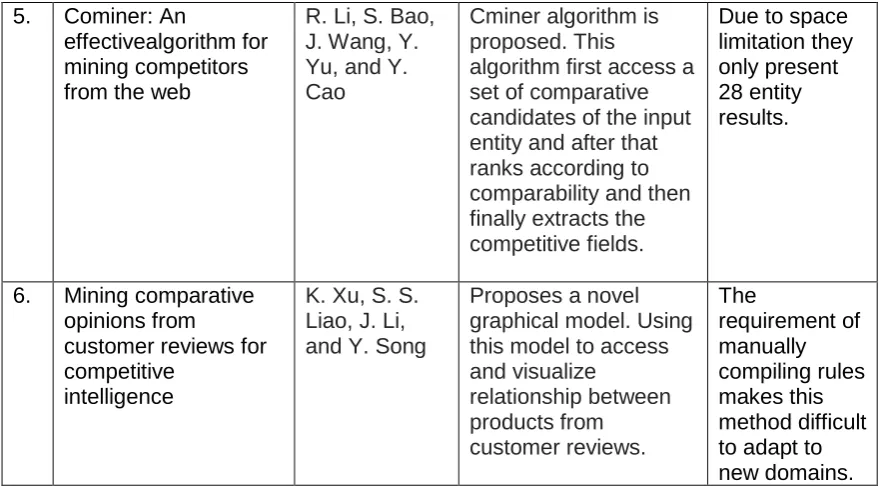
In this paper [5], they describe the techniques of mining the competitive information from
the web. In this paper a Cminer algorithm is proposed. This algorithm first access a set
of comparative candidates of the input entity and after that ranks according to
comparability and then finally extracting different competitive fields.
In this paper [6], the author proposes a novel graphical model. Using this model to
access and visualize the relationship between the customer reviews and products. The
result shows that the proposed method extracts comparative relations more accurately.
The outcome of the above study is summarized in the table below.
Sr. No
Paper Name Author Method Proposed Limitations
1. Mining Competitors from Large Unstructured Datasets George Valkanas, , and Dimitrios Gunopulos Present efficient method for competitiveness in large review datasets
Dependency on
transactional data.
2. Identifying customer preferences about tourism products using an aspect-based opinion mining approach
Marrese Taylor, and Y. Matsuo
Describes the Bing Liu’s aspect based opinion mining technique. This technique applied on tourism domain.
the algorithms were only capable of extracting 35% of the explicit aspect expressions. Less Accurate. 3. Mining competitor
relationships from online news: A network-based approach
Z. Ma, G. Pant, and O. R. L. Sheng
They propose company citations in online news for creating an
intercompany network and structural
attributes are used for infer competitor relationships between two companies.
Performance of this method is not good.
4. Competitor mining with the web
S. Bao, and Y. Cao
Focuses on problem in the mining competitors from the different websited automatically. Proposes a CoMiner algorithm.
5. Cominer: An
effectivealgorithm for mining competitors from the web
R. Li, S. Bao, J. Wang, Y. Yu, and Y. Cao
Cminer algorithm is proposed. This
algorithm first access a set of comparative candidates of the input entity and after that ranks according to comparability and then finally extracts the competitive fields.
Due to space limitation they only present 28 entity results.
6. Mining comparative opinions from
customer reviews for competitive
intelligence
K. Xu, S. S. Liao, J. Li, and Y. Song
Proposes a novel graphical model. Using this model to access and visualize relationship between products from customer reviews. The requirement of manually compiling rules makes this method difficult to adapt to new domains.
Table 1: Comparative Analysis
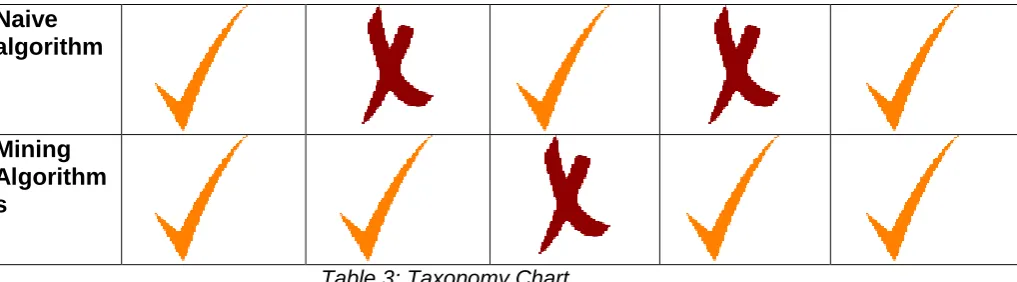
3. TAXANOMY CHART
Theme
Mining
Naive
algorithm
Mining
Algorithm
s
Table 3: Taxonomy Chart
4. DISCUSSION
Data mining is a way of handling huge amount of information for mining competitors. It
reviews information about client opinion and interest in producing the products. For
competitive products, it’s very difficult to analyze different reviews on different websites.
Competitive intelligence first classifies the potential risk and opportunities to gather
contextual information to help the manager make tactical decisions for an organization.
Data Mining is important for finding examples, assessing and disclosing learning, etc. in
different business areas. Machine learning is widely used as part of various applications.
Every business-related application uses information mining systems. For the improving
such business or to give the customer a suitable competitor, the help of web mining
systems is required. Competitive degradation is one such approach to inspecting
competitors for the preferred items.
5. CONCLUSION & FUTURE SCOPE
Research has demonstrated the strategic importance of identifying and monitoring a
firm’s competitors. This research has focuses on the mining comparatives expressions of
the items e.g. “Item A is better than the Item B” from the different websites. Such
expression indicates the competitiveness. Here we study techniques for formalization of
the competitiveness between the two items, which is depends on the marketing
segments. This technique assumes that the user requirements are uniformly distributed
within the value space of each feature. This approach is based on the assumption that
such comparative evidence can be found in abundance in the available data.
6. ACKNOWLEGEMENT
The authors would like to thank the researchers as well as publishers for making their
REFERENCES
[1] George Valkanas, and Dimitrios Gunopulos, “Mining competitors from large unstructured datasets”, 2016.
[2] E. Marrese Taylor, and Y. Matsuo, “Identifying Customer Preferences About Tourism Products Using An Aspect-Based Opinion Mining Approach,” 2013.
[3] Z. Ma, and O. R. L. Sheng, “Mining competitor relationships from online news: A network-based approach,”
2011.
[4] S. Bao, R. Li, Y. Yu, and Y. Cao, “Competitor mining with the web,” 2008.
[5] R. Li, S. Bao, J. Wang, Y. Yu, and Y. Cao, “Cominer: An effectivealgorithm for mining competitors from the
web,” 2006.
[6] K. Xu, S. S. Liao, J. Li, and Y. Song, “Mining comparative opinions from customer reviews for competitive