Dynamic Analysis of Delaminated Composite
Plate with Finite Element Method
Dnyaneshwar Hari Chavan Dr. S. I. Kolhe
PG Student Associate Professor
Department of Mechanical Engineering Department of Mechanical Engineering J. T. Mahajan college of Engineering, Faizpur 425524,
Maharashtra, India
J. T. Mahajan college of Engineering, Faizpur 425524, Maharashtra, India
Abstract
As we all know that composite material are widely used in industries because of their incredibly lightweight, high strength-to-weight and stiffness-to-strength-to-weight ratios. The most common mode of damage in the composite structures is delamination. The specimens of Glass fiber and epoxy resin composite plates are manufactured by the hand-lay-up method with different position of delamination in composite laminated plate for 8 layers. The present study involves finite element analysis to investigate the free vibration of Glass/ Epoxy composite laminate plates with delamination in simply supported boundary conditions based on the comparison between natural frequencies of the healthy and delaminated composite laminate plates by using ANSYS 18.1. Keywords: Composite, Delamination, Dynamic Analysis, FEA (ANSYS)
_______________________________________________________________________________________________________
I. INTRODUCTION
Now days, the commonly used material in industries is composite material for their excellent mechanical properties. They are known for their incredible lightweight, stiffness to weight and strength to weight ratios. We can achieve difficult structures, complex shape or design with the help of composite material. But the common mode of damage is occurring in composite material called as delamination. Delamination is nothing but separation of two layers of composites. Delamination occur in composite plate is invisible because it occur inside of the material. Delamination also develops due to repeated cyclic stresses, manufacturing defects, low velocity impact, unlike environment condition. Due to delamination in composite plates may reduce mechanical properties such as loss in strength, toughness, stiffness, and material unbalance. Therefore detecting such type of damage the non-destructive test are used for composite and to solve such type of problem by using various approximate techniques in which finite element method can be used by using software ANSYS 18.1 for damage monitoring of laminated composite plates.
II. PROBLEM DEFINITION
Now- a -days, composite material are widely used in the industries but one of the type of damage occur in composite plate called as delamination. These plates fails during the service orthotropic-ally, sometimes cracks are observed and the structure becomes weak, also sometimes its fail due to vibrations. Detect the delamination in the composite plate in the time to take remedial action in advance and to reduce the effect of delamination
III. NEED OF COMPOSITE MATERIAL
Fig. 1: Rectangular plate with through width delamination
Length = l, Width =b, Height=h
X and Y are the axis directions in the plane of the plate and
Z is perpendicular to this plane. u ,v are the displacements in X and Y-directions and w is displacement in Z-direction
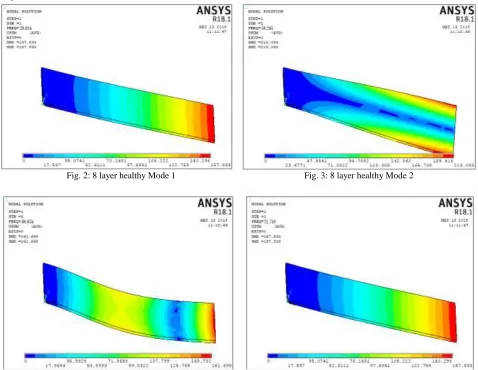
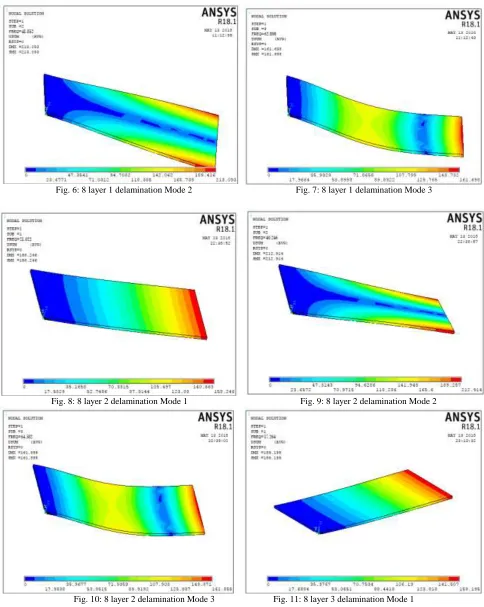
Fig. 6: 8 layer 1 delamination Mode 2 Fig. 7: 8 layer 1 delamination Mode 3
Fig. 8: 8 layer 2 delamination Mode 1 Fig. 9: 8 layer 2 delamination Mode 2
Fig. 12: 8 layer 3 delamination Mode 2 Fig. 13: 8 layer 3 delamination Mode 3
V. RESULTS
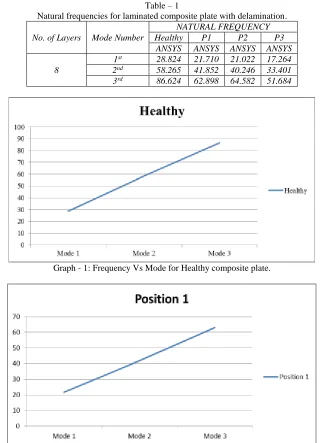
Results analysis for four layers laminated and delaminated composite plates: Table – 1
Natural frequencies for laminated composite plate with delamination.
No. of Layers Mode Number
NATURAL FREQUENCY
Healthy P1 P2 P3
ANSYS ANSYS ANSYS ANSYS
8
1st 28.824 21.710 21.022 17.264
2nd 58.265 41.852 40.246 33.401
3rd 86.624 62.898 64.582 51.684
Graph - 3: Frequency Vs Mode for delaminated composite plate with Position 2
Graph - 4: Frequency Vs Mode for delaminated composite plate with Position 3
Graph - 5: Frequency Vs Mode between healthy and delaminated plates.
VI. CONCLUSION
[1] R Sultan, S Guirguis, M Younes and E El-Soaly, “delamination identification on composite material by free vibration test”, 2012 IJMERR, ISSN 2278 – 014.
[2] Milan Zmindak, Daniel Riecky, Martin Dudinsky, “Finite element implementation of delamination in composite plates”, 2013 MEMI, ISSN 1338-6174.
[3] E. J. Barbero and J. N. Reddy, “Modeling of delamination in composite Laminates using a layer-wise plate theory” 1991 International Journal of Solid
Structures.
[4] Muhannad al-Waily, “Experimental and numerical vibration study of woven Reinforcement composite laminated plate with delamination effect”,
International journal of mechanical engineering (IJME), ISSN 2319-2240, vol. 2, issue 5, 2013, 1-18.
[5] M. R. Aagaah, M. Mahinfalah and G. N. Jazar. Linear static analysis and finite element modeling for laminated composite plates using third order shear
deformation theory. Composite Structures, 62:27--39, 2003.
[6] Y. M. Desai, G. S. Ramtekkar and A. H. Shah. Dynamic analysis of laminated composite plates using a layer-wise mixed finite element model. Composite
Structures, 59:237--249, 2003.
[7] B. N. Pandya and T. Kant. A refined higher-order generally orthotropic C0 plate bending element. Computers Structures, 28:119--133, 1988.
[8] L. Mantari, A. S. Oktem and C. G. Soares. Bending and free vibration analysis of isotropic and multilayered plates and shells by using a new accurate
higher-order shear deformation theory. Composites: Part B, 43:3348--3360, 2012.
[9] Kalita and A. Dutta. Free vibration analysis of isotropic and composite rectangular plates. International Journal of Mechanical Engineering and Research
Volume, 3(4):301--308, 2013.