1290
Irlan Fery
, AFMJ Volume 3 Issue 01 January 2018
DOI:10.18535/afmj/v3i1.10, I.F. - 4.614
© 2018, AFMJ
The Influence of Organizational Commitment to Implementation
Accounting Information Systems and its Impact against the Company's
Financial Performance (Survey on BUMN in Indonesia)
Irlan Fery
Lecturer of STIE Rahmaniyah, Jl. Merdeka No.5731 Muba- SUMSEL, Indonesia
Abstract:
The purpose of this study is to determine the effect of organizational commitment to the application of accounting information systems and their impact on corporate financial performance. The unit of analysis in this study is a state-owned enterprise in Indonesia. The results showed that organizational commitment has a significant effect on the application of management accounting system and its impact to the financial performance of the companyKeywords: Organizational Commitment, Application of Accounting Information System, Corporate Financial Performance
1. Introduction
Currently, business competition occurs globally where the company maximizes its competitiveness through continuous improvement by utilizing the use of information (Drury, 2012: 13). Judging from the intent and purpose of establishment, SOEs actually have a strategic role that is needed by the community. As agent of development (agent of development) has been progress in management of BUMN in Indonesia in recent years. According to Sofyan Djalil (2008), in the period of 2004 to 2007 there was a significant growth in sales (revenues) and assets of SOEs. In 2004 total sales (revenues) of all SOEs totaled Rp 520 trillion, then increased to Rp 654 trillion in 2005, to Rp 763 trillion in 2006, to Rp 889 in 2007. Similarly, total assets, in 2004 total assets of all SOEs totaled Rp 1,247 trillion, then increased to Rp 1,366 trillion in 2005, to Rp 1,506 in 2006, to Rp 1,719 in 2007. Furthermore, Sri Mulyani (2010) said that every year the Ministry of Finance rewards SOEs that have achievements in the preparation of financial statements, but who received the award from year to year only certain SOEs, while there are hundreds of other SOEs in Indonesia that do not improve from year to year in the process of making financial statements in accordance with applicable financial accounting standards.
The BUMN financial report also shows inaccurate and questionable figures. Based on Central Government Financial Report of 2008 which contains the financial statements of all BUMNs in Indonesia, there are 11 SOEs reporting negative equity balance. Equity represents the remaining portion of the owner of an asset claim that is technically calculated by subtracting between assets and liabilities. Theoretically equity balances are unlikely to be negatively valuable because it means that the company's capital is no longer there and technically the company must be dissolved. When viewed from the process of accounting
information systems, negative equity equity can be caused by inaccurate accounting information systems in recording financial accounting transactions. For the 2008 fiscal year as reported by the Office of the State Minister of State-Owned Enterprises, it is visible until 15 April 2009 only 95 SOEs (67.61%) have submitted the 2008 Unaudited Financial Statements, the remaining 47 SOEs (32.29%) late handed over Financial Statements of 2008 (unaudited) as governed by the Act. According to the Secretary of the Ministry of SOEs Said Didu, the delay of some SOEs said Then the Ministry of State-Owned Enterprises will give strict sanctions in the form of Key Performance Index (KPI) records for the SOE directors (Said Sidu, 2009). Furthermore Said Sidu (2009) states that, the problem of delay in the submission of BUMN financial report to the government in a timely manner in accordance with the laws and regulations caused by the lack of willingness and responsibility of BUMN management. Former Minister of State Enterprises Sugiharto (2007), also gave the spotlight on the bad financial statements of SOEs.
1291
Irlan Fery
, AFMJ Volume 3 Issue 01 January 2018
As a system composed of many components such as people, activities, data, hardware, software, and networks, accounting information systems in their applications are vulnerable to problems and failures. According to Choe (1996), the successful implementation of accounting information systems in the company is not easy to achieve and often cause problems because influenced by many factors, among others: (1) User involvement; (2) Leadership support; (3) User training and education; (4) Working group factors within the organization; and (5) Other organizational factors such as organizational size, task characteristics, and others. According to Burton, et.al. (1992), in addition to organizational factors such as task complexity, organizational size, leadership factors, etc., individual factors such as motivation, satisfaction, and usability for the user greatly determine the successful application of accounting information systems.
In theory, the application of accounting information system is influenced by individual factors and systems (hardware, software, network, procedures, tasks, etc.). Individual factors are related to human being using accounting information system which in itself contained humanity aspect which have desire, willingness, motivation, likes and dislikes, satisfied and dissatisfied, which in practice influence behavior in the use of accounting information system. According to Igrabia (1984) and Thompson et.al. (1990), that the problems that arise in the use of computer-based accounting information systems is related to economic problems, technology, system concepts, and aspects of individual behavior. From these factors problems related to aspects of individual behavior using accounting information system is a dominant problem occurs, this is because the accounting information system in practice requires accuracy, perseverance, even patience in conducting clerical process from the beginning of the transaction until the resulting report finance. Complex processes and characteristics of accounting information systems that must adhere to procedures to run accounting information systems, demanding individuals implementing accounting information systems have a strong work force in them so that they can continuously run the process of accounting information system. This powerful work force is one of them reflected in the organizational commitment of an employee to the company. According to Chen, et.al (2002), organizational commitment is an employee's psychological ties to the company that encourages the employee to work hard to achieve the company's goals. Then Gotilet and Frank (2002) explain that organizational commitment conceptually is a pattern of behavior, intensity, motivation, and attitudes that exist within a person.
The level of organizational commitment that is owned by managers and employees can drive the successful application of accounting information systems in the company, as stated by Larsen (2003), that of the many
factors affecting the successful application of accounting information system, organizational commitment is the main and very important factor, because the core of organizational commitment is the attachment and loyalty of an employee to the company that will encourage them to always work in various situations in the company. Choe (1996) also made organizational commitment a major determinant of the successful implementation of accounting information systems in addition to other factors, such as SIA's personal capabilities in engineering, user involvement, training and user education, steering committees, SIA department locations, formalization of SIA development , and organization size.
hen Sounders and Jones (1992), said that organizational commitment as an organizational factor is very important for the successful application of accounting information system in addition to other factors such as: SIA integration with corporate planning, output quality SIA, SIA operating efficiency, user attitude / management, implementers of SIA, and others. Then Lee and Kim (1992) said that organizational commitment affects the successful application of accounting information systems through the formalization of the development of accounting information systems in the company. With the formalization of the development of accounting information systems weakness in the experience and user personal learning becomes insurmountable.
The low organizational commitment of managers and company employees (including SOEs) is also a major obstacle in Indonesia. Based on a 2005 survey conducted by Hay Group (consultant based in Boston USA) on 5,080 managers and employees (including SOEs) in 31 companies in Indonesia published in Swasembada magazine II edition dated January 26, 2006, it was concluded that Indek Komitmen Karyawan Indonesia is very low and got a score of 63 and ranks 31th compared to 32 countries surveyed at the same time. The highest score of 87 was obtained by Austria, Denmark, Finland, and Mexico, then the lowest score and one level below Indonesia was obtained by Japan (Teguh Pambudi, 2006). From the Hay Group's survey on employee commitment, it is explained that the employee's commitment score and company manager in Indonesia of 63 is the overall value of the participants in the survey. However, when viewed on the index of each company in the survey there are some companies that have a high commitment index (above 80 points).
1292
Irlan Fery
, AFMJ Volume 3 Issue 01 January 2018
occurrence of transactions to the resulting financial statements, requires a financial manager has the capacity to evaluate the trouble system and then take adequate action to overcome these problems, so as not to impact on the entire accounting information system cycle. Implementation of accounting information system indirectly in allegedly affect the financial performance of the company. According Azhar (2007), the effectiveness of the application of accounting information systems in the company in addition to improve the speed and quality of information generated for decision-making, the application of accounting information systems can also improve the quality of relationships between individuals within the organization. The quality of relationships between individuals will encourage companies to become more dynamic resulting in company performance. Then Gelinas, et. al. (1993), stated that the successful implementation of accounting information system can encourage improvement in daily business operations and can improve the quality of corporate decision making, both of which are the main components to achieve the financial performance of the company.
The level of organizational commitment in addition to affect the successful application of accounting information systems in the assumption also affects the financial performance of the company. According to Chen, et.al. (2002), the core of organizational commitment is loyalty that can encourage a person to work hard to direct all his abilities to achieve company goals. According Clcq and Rius (2007), organizational commitment possessed by a person is like a great energy that encourages someone to work hard (effort) to achieve the company's success that ultimately affects the profitability of the company. Then Keller (1997), said that organizational commitment can create a goal congruence between an individual and a company, the same goal is a fundamental aspect for the achievement of non-financial performance and financial performance of the company. The financial managers' knowledge of accounting information systems theoretically also impacts the company's financial performance as submitted by Clercq and Dimov (2008), and West III and Noel (2009). Clercq and Dimov (2008) argue that the existence of internal knowledge and external knowledge within a manager in a particular field can make the organization more flexible in facing competition and have an impact on improving the company's financial performance. A financial manager who understands all the ins and outs of corporate finance, will be more creative in the various decision-making that will impact the financial performance of the company. The low financial performance of SOEs is also seen in state-owned banks which have relatively large assets. According to Paul Sutaryono (2007), based on the Financial Statements as of December 31, 2005 and 2006 the performance of state-owned banks is less competitive than foreign banks.
According to former state minister BUMN Tanri Abeng (2000), SOEs in Indonesia need to transform into a business entity that has better financial performance in the future, by doing: (1) Changing entrepreneurial behavior in self they; (2) Improving the quality of human resources; (3) Creation of a dynamic government development system; and (4) Developing a reliable accounting information system.
2. Organizational Commitment
According to Mathis and Jackson (2004), organizational commitment is the level of trust and acceptance of employees for the purpose of the organization and the desire to stay within the organization. Furthermore, Mathis and Jackson (2004) explain that the core of organizational commitment is an employee's loyalty to work: "more employers are finding that in tight labor markets, turnover of key people occurs more often when employee loyalty is low, which in turn emphasis the importance of a loyal and committed workforce ". In most employees in strict labor market conditions, the movement of an employee often occurs when an employee's loyalty is low, therefore loyalty and commitment are important aspects of the job. Meanwhile, McShane and Von Glinow (2000) revealed that organizational commitment is an emotional state of employees to identify and engage with the organization: "Gibson, et et .al (1994) in more detail says that organizational commitment deals with three attitudes: "commitment to organization to an organization involves three attitudes: (1) a sense of identification with the organization's goals; (2) a feeling of involvement in organizational duties; and (3) a feeling of loyalty for the organization ". Organizational commitment involves three attitudes, namely: (1) The existence of a person's identification of organizational goals; (2) There is involvement in organizational tasks; and (3) Loyalty to the organization.
In this study the definition of organizational commitment refers to Gibson, et.al. (1994), where organizational commitment is the attitude of identification, involvement, and loyalty of an employee to the company. The reason for the notion of organizational commitment from Gibson, et.al. (1994) because it provides a more complete and operational definition compared to that of other experts. There are two views on the dimension of organizational commitment, the first view of Mowday et.al. (1982), and the second is Meyer and Allen's view (1991). According to Mowday, et.al. (1982), the dimensions that dominate the operationalization of the concept of organizational commitment include three things as follows:
1293
Irlan Fery
, AFMJ Volume 3 Issue 01 January 2018
2. Involvement (involvement). It is the willingness of employees to provide business for the benefit of the organization.
3. Loyalty (loyality). It is a strong desire and desire of employees to always maintain the membership of the organization.
In the view of Meyer and Allen (1991), people will survive in an organization for three reasons:
1. Because they want it (affective commitment) 2. Because they need it (continuance commitment) 3. Because they feel that it should be (normative
commitment).
From the description of both models the dimensions of organizational commitment above show that there is similarity between Mowday et.al model. (1982) and the Meyer and Allen model (1991). Dimensional identification by Mowday et.al. (1982), which is defined as trust in the organization, has the same meaning with the dimensions of affective commitment which Meyer and Allen (1991) defined as the emotional relationship of employees with the company. Then dimension involvement according to Mowday et.al. (1982) interpreted as the willingness of employees to strive for the interests of the organization, has a common meaning with the continuance commitment defined Meyer and Allen (1991) as an awareness that will lose when leaving the organization. And then the dimensions of loyality according to Mowday et.al. (1982) interpreted as the desire and desire of a strong employee to always maintain membership in the organization, has a common meaning with the normative commitment that Meyer and Allen (1991) defined as a feeling of attachment of a member to continue to be in the organization.
On the other hand, the three dimensions mentioned above also show the hierarchy of each other. affective commitment is the lowest level of organizational commitment in which a new organizational commitment takes the form of awareness that exists within a person. Then continuance commitment is a higher organizational commitment of affective commitment because here organizational commitment has come into being in the form of one's involvement in organizational activities.
2.1 Application of Accounting Information System.
According to Seddon and Kiew (1994), Torkzadeh and Doll (1998), the successful implementation of accounting information system is the use of system (system use), namely the use of accounting information system to assist the completion of daily work. Then according to Etezadi and Farhoomand (1996), Kettinger and Lee (1995), Shirani et.al (1994), and Thong and Yap (1996), the successful application of accounting information system is user satisfaction, a user of the accounting information system. Meanwhile, according to Gelderman (1998), the successful application of accounting information system is the intensity
of system use (intended use) accounting information system in daily work and user satisfaction on the use of accounting information system. Then and Straub et.al. (1995) defines the successful application of accounting information systems as intention use and user satisfaction.
In this study the successful definition of application of accounting information system refers to Straub, et.al. (1995) and Gelderman (1998), where the successful application of accounting information systems is the intensity of the use (intended use) of accounting information systems in a variety of managerial and user satisfaction tasks over information generated by the accounting information system. In theory there are two comprehensive models that can be referred to the successful dimensions of the application of accounting information systems, namely: (1) Information Success Model from Delone and McLean (1992); and (2) Hierarchical Structural Model of Drury and Farhoomand (1998). In addition to these two models, Laudon and Laudon (2000) provide five dimensions to measure the successful application of accounting information systems, these dimensions are: (1) High level of system use; (2) User satisfaction with the system (user satisfaction on system); (3) The user's positive attitude (favorable attitude) to the system; (4) Achieving the objectives of the information system (achieved objectives); and (5) Financial payoff.
Information Success Model from Delone and McLean (1992), states that the success of an information system is represented by: (1) Qualitative characteristics of the information system itself (system quality); (2) Quality of output from information system (information quality); (3) Consumption of output (use); (4) User response to information system (user satisfaction); (5) Influence of information system to user habit (individual impact); and (6) influence on organizational impact (organizational impact).
The Delon and McLean model (1992) has been widely recognized in the field of information systems research as a measure of the success of information systems. McGill et al. (2003) found that information quality and system quality are significant predictors of user satisfaction, while user satisfaction is also a significant predictor of intended use and individual impact. Livari's research (2005) uses a research subject on a mandatory system, so the intended use is not an indicator of the success of the developed information system.
1294
Irlan Fery
, AFMJ Volume 3 Issue 01 January 2018
Meanwhile Outcome is divided into internal outcome (F3) and external outcome (F5). An information system Internally outcome (F3) is expected to produce accurate and complete information about a transaction, while the external information system outcome can improve corporate image and service to customers. While User requirement (F4) is focused on the involvement and participation of users of the information system. Of the three models of successful implementation dimensions of accounting information systems described above, the successful dimensions of SIA implementation can be grouped into three main aspects, namely: (1) Aspects of system quality from SIA (hardware); (2) Aspects of SIA user behavior; and (3) the impact aspect of the use of an AIS.
Of the three models of successful implementation dimensions accounting information system, user behavior aspect SIA and impact aspects of SIA use are dimensions that exists from all three models. Essex et.al. (1998), divide eight critical aspects of the success of information systems accounting are: (1) Quality of user-developed applications; (2) User self-sufficiency; (3) Organizational commitment; (4) Quality of staf; (5) Variety of services; (6) Quality of services; (7) Facilitation of EUC; dan (8) AIS role definition. Hussein et.al. (2005), divides the five aspects the determinant of the success of accounting information system, namely: (1) AIS facilities; (2) AIS competency; (3)
AIS integration; (4) User support; dan (5) AIS Structure. Dan Subherwal et.al. (2006), divide the six aspects of the success of information system that is: (1) Top management support; (2) Facilitating condition; (3) User experience; (4)
User training; (5) User attitude; dan (6) User participation. In the context of this research there are two aspects that are used as variables that measured the effect on the successful application of accounting information systems, namely organizational commitment and knowledge manager. The reason for the use of these two factors is because they refer to Igrabia (1984) and Thompson et.al. (1990), that the problems that arise in the use of computer-based accounting information systems is related to economic problems, technology, system concepts, and aspects of individual behavior. Of these factors problems related to the behavioral aspects of individuals who use the system is a dominant problem occurs.
2.2. Corporate Financial Performance
In general the meaning of the word performance (performance) is defined as a record of results or achievements that have been achieved, as described by Bernardin and Russell (1993): "performance is the record of the outcome produced on a specified time period". Performance is the outcome record generated in a period. Then Stolovitch and Keeps (1992) explained that performance is a set of results that usually refers to the achievement of the work performed. Then Gomes (2003) explains that performance is the level of achievement or
success achieved by an organization at a certain period. In this study the definition of corporate financial performance refers to Gomes (2003), where the company's financial performance is the level of achievement or financial success achieved by a company at a certain period. The level of achievement or financial success is usually associated with the level of profit earned by the company. According to Neely (1995) performance measurement is a process of quantifying the various actions undertaken. The main purpose of performance measurement is to help the company in identifying performance issues and focusing on the effectiveness and efficiency of the company (Yuksel, 2004). Therefore performance measurement can be used to assess the success of the company and also play an important role in organizational control and planning systems (Kennerley and Neely, 2003; and Chan, 2004).
According to the literature there are two ways in which performance measurement is traditional performance measurement and non-traditional performance measurement. Traditional performance measures focus on financial measures derived from financial statements, such as: Growth, profit, return on investment, economic value added, and cash flow (Chan, 2004). On this basis, the concept of non-traditional performance measurement, developed by Kaplan and Norton (1996), is known as performance measurement using the balanced scorecard approach. In a performance measurement with a balanced scorecard approach, in addition to using financial measures as well as in traditional performance measurement systems, balanced scorecard performance measurement also uses non-financial perspectives, such as: customer perspective, internal business process perspective, and learning and growth perspective.
1295
Irlan Fery
, AFMJ Volume 3 Issue 01 January 2018
of profitability from the point of view of shareholders (Wingard, 2001). While profit margin is defined how far the ability of the company in generating net income at a certain level of sales. A high profit margin indicates a company's ability to generate high profits at certain sales levels. Conversely low profit margins indicate that sales are too low for a certain level of cost, or the cost is too high for a certain level of sales. ROE and Profit Margin as well as ROA has also been widely recognized as a measure of financial performance in empirical research (Salama, 2003; and Cohen, et.al., 1997).
2.3. The Influence of Organizational Commitment To
The Implementation Of Accounting Information System
Rainer and Watson (1995) states that top management support and executive staff of SIE (organizational commitment) are key to successful development and implementation of executive information systems (EIS). Furthermore Robert T. Keller (1997), found that there is an interaction effect between job involvement (job involvement) and organizational commitment (organizational commitment) to job performance (job performance). Survey on 532 academics and technical personnel at four research and development companies in the United States. Essex, et.al. (1998) The relationship between quality of user-development, user self-sufficiency, organizational commitment, quality of staff, variety of services, quality of service, facilitation of end user computing, and IC role definition, to successful implementation of information center. Survey on 151 executives in three organizations namely manufacturing, college, and financial services in the United States. Sabherwal, et.al. (2006) Top management support (organizational commitment) and facilitating conditions affect the successful implementation of information systems. Experience, training, and user attitudes affect the successful application of information systems. Review individual and organizational factors in the successful implementation of information systems. Meta analysis of 121 research on the determinant of success of information system, published in 1980 until 2004. Michael J. Zhang (2007b) The interaction between information sharing and IS Connectivity has a positive effect on company performance. The interaction between information interpretation and IS Connectivity has an effect on company performance. The relationship between information systems and company performance. Survey on 153 senior executives of information systems in large US corporations.
2.4. Effect of Organizational Commitment, on
Implementation of Accounting Information System, to
Corporate Financial Performance (ROA)
Simultaneously.
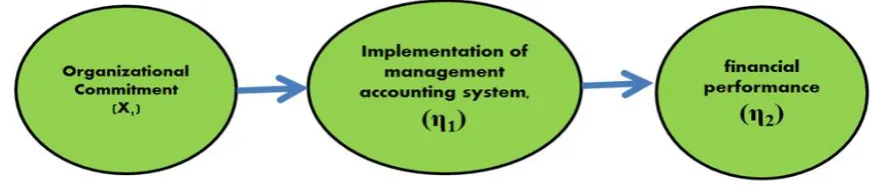
To test the influence of Organizational Commitment (X1, Application of Accounting Information System (Y), to Company Financial Performance / ROA (Z) simultaneously
performed simultaneous test with Test F. Statistical hypothesis tested is.
• Ho: PZX1 = PZX2 = PZY ≤ 0 (There is no positive and significant influence Organizational Commitment, Application of Accounting Information System to Financial Performance Company / ROA).
• H1: P ZX1 = P ZX2 = PZY> 0 (There is a positive and significant influence Organizational Commitment, Application of Accounting Information System to Corporate Financial Performance / ROA).
Determination of test result (acceptance or rejection of H0) can be done by comparing Ft with Ftable with the condition reject H0 if Fcount is greater than Ftable. The results of the test statistic to test the overall effect are:
1 21 2 2
ZYX X 2
ZYX X n k 1 R F
k 1 R
(38 3 1) 0, 508
3 (1 0, 508)
F
= 11,702From the table obtained the value of F table for degrees of freedom (df1) = number of exogenous variables = 3 and degrees of freedom (df2) = n-k-1 = 38- 3 -1 = 34 of F [0.05: 3: 34] = 2,883. The results of these calculations are presented in Table 4.16 below.
Table 1. The Influence of Organizational Commitment
(X1), Application of Information System Accounting (Y) on Corporate Financial Performance / ROA (Z)
Variable F
count F Table Information
X1, Y → Z(ROA) 11,702 2,883
Positive and Significant Influence
Source: Research Results
1296
Irlan Fery
, AFMJ Volume 3 Issue 01 January 2018
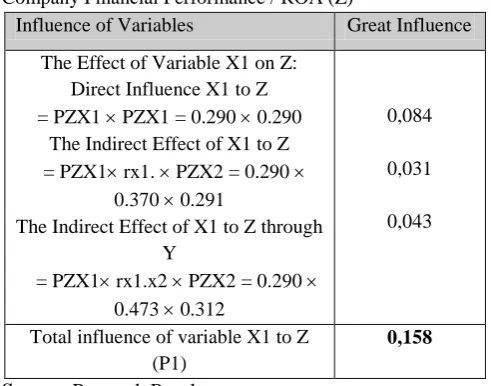
Table 2. Direct Influence of Organizational Commitment(X1), Application of Accounting Information System (Y) to Company Financial Performance / ROA (Z)
Influence of Variables Great Influence
The Effect of Variable X1 on Z: Direct Influence X1 to Z = PZX1 PZX1 = 0.290 0.290
The Indirect Effect of X1 to Z = PZX1 rx1. PZX2 = 0.290
0.370 0.291
The Indirect Effect of X1 to Z through Y
= PZX1 rx1.x2 PZX2 = 0.290 0.473 0.312
0,084
0,031
0,043
Total influence of variable X1 to Z (P1)
0,158
Source: Research Results
Table 2 shows that the magnitude of direct influence of Organizational Commitment (X1) variable to Corporate Financial Performance / ROA (Z) is 0.084 or 8.4%, while the indirect effect of Accounting Information System (Y) is 0.043 or 4.3%. Then the total influence (direct and indirect) Organizational Commitment (X1) variable to Corporate Financial Performance / ROA (Z) is equal to 0,158 or 15,8%. The big of indirect influence through Organizational Commitment (X1) is 0,031 or 3,1% , and indirect influence through the Application of Accounting Information System (Y) of 0.047 or 4.7%. Then the total influence (direct and indirect) on Corporate Financial Performance / ROA (Z) is equal to 0.163 or 16.3%.
The amount of direct influence of variable Application of Accounting Information System (Y) to Corporate Financial Performance / ROA (Z) equal to 0,097 or 9,7%, while indirect influence through Organizational Commitment (X1) equal to 0,043 or 4,3% direct and indirect) variable Application of Accounting Information System (Y) to the Company's Financial Performance / ROA (Z) is equal to 0.187 or 18.7%. Furthermore, when viewed from the total influence together variable Organizational Commitment, Application of Accounting Information System against The Company's Financial Performance / ROA shows 50.8% of the results or the value of the coefficient of determination (R2) of 0.508 or 50.8%, while the rest (100% - 50.8%) = 49.2% is influenced by factors other beyond the variables of this study.
The Effect of Organizational Commitment on Corporate Financial Performance (ROA) partially.
To see the significance of the effect of Organizational Commitment (X1) partially to the variables due to the Company's Financial Performance / ROA (Z), then the hypothesis tested partially by t test. Statistical hypothesis in the test is.
Ho: PZX1≤ 0 (There is no positive and significant influence of Organizational Commitment partially on Company Financial Performance / ROA).
H1: PZX1> 0 (There is a positive and significant influence of Organizational Commitment partially on Company Financial Performance / ROA).
The t test statistic for X1 (titung Organizational Commitment) of the calculation using the Amos software version 16 on the previous line coefficient calculation equation shows a result of 2.187. Furthermore the value is compared with the ttable value. Based on the t-student distribution table for α = 5% and degrees of freedom (38-3-1) obtained values (t0.05 / 3, 34) = 2.032. Comparison of thitung results obtained with table values is tcount larger than ttable (2.187> 2.032). The test results based on the sample data that is done declare the rejection of H0 or in other words receive H1. So it can be concluded that statistically there is a positive influence and significant Organizational Commitment to Corporate Financial Performance / ROA.
The Effect of Implementation of Accounting Information System on Corporate Financial Performance (ROA) partially.
To see the significance of the Effect of Accounting Information System Implementation (Y) in partial to the variables due to the Company's Financial Performance / ROA (Z), hypothesis testing is done partially with t test. Statistical hypothesis in the test is.
• Ho: PZY≤ 0 (There is no positive and significant influence of the Successful Application of Accounting Information System partially to Company Financial Performance / ROA).
• H1: PZY> 0 (There is a positive and significant influence of Successful Application of Accounting Information System partially to Company Financial Performance / ROA).
1297
Irlan Fery
, AFMJ Volume 3 Issue 01 January 2018
The Effect of Organizational Commitment, ManagerialKnowledge and Successful Application of Accounting Information System to Corporate Financial Performance (ROE) partially.
To determine the effect of Organizational Commitment (X1), Manager's Knowledge (X2), and Succession of Accounting Information System (Y) on Corporate Financial Performance / ROE (Z), path analysis is used, where Organizational Commitment (X1), Knowledge Manager (X2), and Successful Implementation of Accounting Information System (Y) as causal variable (exogenous
variable) while variable of Corporate Financial Performance / ROE (Z) as variable result (endogenous variable). Furthermore, to know the direct and indirect influence of Organizational Commitment, Manager Knowledge, and Successful Implementation of Accounting Information System, to the Company's Financial Performance (ROE) calculation of path coefficient using Amos version 16 program. The results of the path coefficient calculation can be expressed in the following structural equations:
Z = 0,358X1 + 0,326 X2 +0,163 Y+ 0,737
.
Figure 4. Line Chart Influence of Organizational Commitment (X1), Application of Accounting Information System (Y),
to Financial Performance Company / ROE (Z)
Based on the above structural equation, the path coefficient of Organizational Commitment to Financial Performance of the Company / ROE (PZX1) was 0.358, the path coefficient from Manager's Knowledge to Company Financial Performance / ROE (PZX2) of 0.326, and the path coefficient of Successful Implementation of Accounting Information System to Performance of Corporate Financial Performance / ROE (PZY) of 0.163. Furthermore, to test the third hypothesis (part b) is done in two stages, first performing simultaneous test to know the meaningfulness of influence together Organizational Commitment, Knowledge Manager, and Successful Application of Accounting Information System to Financial Performance Company (ROE). Both test partially to know the meaning of influence of each exogenous variable, that is influence of Organizational Commitment to Company Financial Performance (ROE), influence of Manager Knowledge to Company Financial Performance (ROE), and influence of Successful Application of Accounting Information System to Company Financial Performance (ROE ).
The Effect of Organizational Commitment on Corporate
Financial Performance (ROE) partially.
To see the significance of the influence of Organizational Commitment (X1) partially to the variable due to the Company's Financial Performance / ROE (Z), then the hypothesis tested partially by t test. Statistical hypothesis in the test is.
• Ho: PZX1≤ 0 (There is no positive and significant influence of Organizational Commitment partially to
Company's Financial Performance / ROE).
• H1: PZX1> 0 (There is a positive and significant influence of Organizational Commitment partially to Company Financial Performance / ROE).Statistik uji t untuk X1 (thitung
Organizational Commitment) of the calculation using Amos software version 16 on the equation coefficient calculation of the previous line shows the result of 2.566. Furthermore the value is compared with the ttable value. Based on the t-student distribution table for α = 5% and degrees of freedom (38-3-1) obtained values (t0.05 / 3, 34) = 2.032. Comparison of thitung results obtained with table values is tcount larger than ttable (2,566> 2.032). The test results based on the sample data that is done declare the rejection of H0 or in other words receive H1. So it can be concluded that statistically there is a positive influence and significant Organizational Commitment to Corporate Financial Performance / ROE.
Conclusion
1298
Irlan Fery
, AFMJ Volume 3 Issue 01 January 2018
System either partially. Partially, the influence of Accounting Information System implementation variable compared to Organizational Commitment variable. Organizational Commitment, Implementation of Accounting Information System simultaneously has a positive and significant impact on Company Financial Performance (ROA, ROE, and Profit Margin dimension). Because of the many factors that intermediate (intervening) between the variables of SIA Application and the variable of Corporate Financial Performance of ROE, hence directly variable of SIA Implementation does not have an effect to variable of Corporate Financial Performance (ROE).
Refferences
1. Agus Sartono. 2001. Financial Management: Theory and Applications. Fourth Edition. Yogyakarta: BPFE.
2. Ambrosini, V., & Bowman, C. 2001. Tacit Knowledge: Some Suggestions for Operationalization. Journal of Management Studies, 38 (6): 811-829.
3. Azhar Susanto. 2007. Management information system: Concepts and Development. Issue 3 Bandung: Lingga Jaya.
4. ______________. 2008. Accounting information system: Risk Control Development Structure.Initial Edition. Bandung: Lingga Jaya.
5. Barker, C., Pistrang, N., and Elliot, R. 2002. Research Methods in Clinical Psychology: An Introduction for Students and Practitioners. 2th Edition. England: John Wiley & Sons, Ltd. 6. Barker, K.J., and Cagwin, D. 2004. New Evidence
Relating TQM to Financial Performance: An Empirical Study Manufacturing Firms. Working Paper. December.
7. Bernardin, H.J., and Russel J.E. 1993. Human Resource Management. Singapore: McGraw Hill Inc.
8. Bishop, J.W., and Scott, K.D. 2000. An Examination of Organizational and Team Commitment in a Self-Directed Team Environment Journal of Applied Psychology. 85: 439-50. 9. Boland, M. 2002. Profitabilty and Risk Measure for
Investors -Owned Firms. Department of Agriculture Economics. Kansas State University. 10. Brainy Dictionary. 2004. Through
http://www.brainymedia.com [20/12/2009]. 11. Cagwin, D., and Bouwman, M.J. 2000. The
Association Between Activity Based Costing and Improvement in Financial Performance. Working paper, April 26.
12. Cerullo, M.J. 1997. Information Systems Success Factors. Journal of Systems Management. 31 (12): 10-19.
13. Chan, Y.L. 2004. Performance Measurement and Adoption of Balance Scorecard: A Survey of Municipal Governments in the USA and Canada. The International Journal of Public Sector Management. 17 (3): 204-221.
14. Chang, J.C., and King, W.R. 2005. Measuring The Performance of Information System: A Functional Scorecard. Journal of Management Information. 24 (2): 263-275. Chen, Z.X., Tsui
15. A.S., and Farh, J.L. 2002. Loyality to Supervisors vs. Organizational Commitment: Relationships to Employee performance in China. Journal of Occupational and Organizational Psychology. 75: 339–356.
16. Cho, D.Y., and Kwon, D. 2005. Self-Directing Learning Readiness as an Antecedent of Organizational Commitmen: a Korean Study.
International Journal of Training and Development. 9(2): 140-152.
17. Choe, J.M. 1996. The Relationship Among Performance of Accounting Information System, Influence Factors, and Evolution Level of Information System. Journal of Management Information System. 12(4): 215-239.
18. Clercq, D.D., and Dimov, D. 2008. Internal Knowlwdge Development and External Knowledge Access in Venture Capital Investment Performance. Journal of Management Studies. 45(3): 585-612.
19. Clercq, D.D., and Rius, I.B. 2007. Organizational Commitment in Mexican Small and Medium-Sized Firms: The Role of Work Status, Organizational Climate, and Entrepreneurial Orientation. Journal of Small Business Management. 10(2): 185-210. 20. Cohen, M.A., Scott, A.F., and Konar, S. 1997.
Envromental and Financial Performance: Are They Related?. Working Paper. Owen Graduate School of Management Vanderbilt University Nashville. 21. Delone, W.H., and McLean. 1992. Information
Systems Success: The Quest for the Dependent Variable. Information Systems Research. 3(1): 60-95.
22. Finance department of the Republic of Indonesia. 2009. Central Government Financial Statements of 2008 (Audited).
23. ____________. 2008. Central Government Financial Report of 2007 (Audited).
24. ____________. 2007. Central Government Financial Report for 2006 (Audited).Dessler, G. 2003. Human Resource Management. New Jersey: Prentice Hall, Upper Saddle River, NJ.
25. Dixon, J.R., Nanni, A.J., and Vollman, T.E. 1990.
1299
Irlan Fery
, AFMJ Volume 3 Issue 01 January 2018
Operations for World-Class Competition. Illionise: Business One Irwin. Homewood.
26. Doll, W.J. 1995. Avenues for Top Management Involvement in Successful MIS Development. MIS Quarterly. 9(1): 17-35.
27. Drury, D.H., and Farhoomand, A.F. 1998. A Hierarchical Structural Model of Information System Success. Information System Journal. 36 (1/2): 25-40.
28. Essex, P.A., Magal, S.R. and Mateller, D.E. 1998. Determinan of Information Center Success.
Journal of Management Information System. 15(2): 95-117.
29. Etezadi-Amoli, J., and Farhoomand, A.F. 1996. A structural model of end user Computing Satisfaction and User Performance. Information & Management. 30(2): 65–73
30. Etty Murwaningsari. 2008. The Role of Organizational Commitment and Procedural Justice in Moderating the Relationship Between Budgetary Participation and Managerial Performance. Gadjah Mada International Journal of Business. 10(2): 185-210.
31. Faisal Basri. 2002. Perekonomian Indonesia: Tantangan dan Harapan Bagi Kebangkitan Indonesia. Jakarta: Erlangga.
32. Fraser, L.M., and Ormiston, A. 1998.
Understanding Financial Statement. Fifth Edition. USA: Prentice Hall International inc.
33. Gelderman, M. 1998. The Relation Between User Satisfaction, Usage of Information Systems and Performance. Information & Management. 34: 11-18
34. Gelinas, J.U., Allan, O.E., and William, W.P. 1993.
Accounting Information System. Second Edition, Cincinnati, Ohio: South-Western Publishing Co. 35. Gibson, C.H. 1992. Financial Statement Analysis
Using Financial Accounting Information. Fifth Editon. USA: South-Western Publishing Campany. 36. Gibson, J.L., Invancevich, J.M., and Donnelly, J.M.
1994. Organization Behavior: Structure and Process. Seventh Edition, Boston: Homewood, Richard D. Irwin.
37. Gitman, L.J. 2003. Principles of Managerial Finance. Tenth Edition. USA: Pearson Education, Inc.
38. Gomes, F.C. 2003. Manajemen Sumber Daya Manusia. Yogyakarta: Andi Offset.
39. Haar, J.M., and Spell, C.S. 2004. Programme Knowledge and Value pf Work-Family Practices and Organizational Commitment. The International Journal of Human Resource Management. 15(6): 1040-1055.
40. Hair, F., Joseph, R.E., Anderson, Ronal, L.T., and William C.B. 2006. Multivariat Data Analysis. 9th Edition. Prentice Hall International Inc.
41. Hasan Alwi., Dendi Sugono, Adiwirmata, dan Sri Suseki. 2003. Kamus Besar Bahasa Indonesia. Jakarta: Depertemen Pendidikan Nasional dan Balai Pustaka.
42. Henni T.S. 2003. Atasan Vs. Bawahan: Komunikasi “Tidak Nyambung”. Melalui <http://www.infobanknews.com>[23/09/09]. 43. Hussein R., Selamat H., and Karim N.S. 2005. The
Impact of Technology Factors on Information System Success in the Electronic-Government Context. The Second International Conference on Innovations in Information Technology.
44. Igrabia, M., Zinatelli, N., Cragg, P., and Cavaye, A. 1997. Personal Computing Acceptance Factors in Small Firms: A Structural Equation Model. MIS Quarterly. 279-302.
45. Imam Ghozali, dan Fuad. 2005. Struktural Equation Modeling, Teori, Konsep, dan Aplikasi dengan Program Lisrel 8.54. Semarang: Penerbit Undip.
46. Kaye, G.R. 1990. Information System Successes and Failures: Research Finding from the Compunding Industry. Jurnal of Information Technology. 5: 73-83.
47. Keller, R.T. 1997. Job Involvement and Organizational Commitment as Longitudinal Predictors of Job Performance: A Study of Scientists and Engineers. Journal of Applied Psychology. 82 (4): 539-545.
48. Kettinger, W. J., and Lee, C.C. Perceived Service Quality and User Satisfaction with the Information Services Function. Decision Sciences. 25(5/6): 737-765.
49. Kreitner, Robert, and Kinichi, A. 2001.
Organizational Behavior. Fifth Edition, New York: Irwin McGraw-Hill.
50. Larsen, K.R.T. 2003. A Taxonomy of Antecedents of Information Systems Implementation: Variable Analysis Studies. Journal of Management Information Systems. 20(2): 169-246.
51. Lee, J.J., and Kim, S.H. 1992. The Relationship Between Procedural Formalization in MIS Development and MIS Success. Information and Management, 22(2): 89-111.
52. Livari, J. 2005. An Empirical Test of The Delone-McLean Model of Information System Success.
Database for Advance in Information System (DFA). ISSN: 1532-0936. Volume 36. ProQuest Company.
1300
Irlan Fery
, AFMJ Volume 3 Issue 01 January 2018
Edition. South-Western, a division of Thompson Learning, Thompson Learning is a Trademark Used Herein Under License, In Singapore.
54. Mamduh M.H., dan Abdul Halim. 2000. Analisis Laporan Keuangan. Edisi Pertama. Cetakan kedua. Yogyakarta: UPP AMP YKPN.
55. Masri Singarimbun, dan Sofian Effendi. 1995.
Metode Penelitian Survei. Edisi Ke-2. Jakarta: LP3ES.
56. Mcshane, Steven L., and Von Glinow, M.A. 2000.
Organizational Behavior. USA: McGraw-Hill Companies, Inc.
57. Mowday, R.T., Porter, L.W., and Steers, R.M. 1982. Employee-Organization Linkages. New York: Academic Press.
58. Paul Sutaryono. 2007. Bank Asing Bakal Smackdown Bank BUMN pada 2007?. Melalui <http://www.infobanknews.com>[20/06/09]. 59. Porter, L., and Lawler, E. 1968. Managerial
Attitudes and Performance. Homewood, Ill: Dorsey Press.
60. Rayner, R.K., and Watson, H.J. 1995. The Keys to Executive Information System Success. Journal of Management Information System. 12(2): 83-98. 61. Raymond L. 1990. Organizational Contex and
Information System Success: A Contingency Approach. Jurnal of Management Information System. 6(4): 5-20.
62. Romney, B.M., and Steinbart, J.P. 2009.
Accounting Information System. Eleventh Edition. USA: Pearson Prentice Hall.
63. Sabherwal, R., Jeyaraj, A., and Chowa C. 2006. Information System Success: Individual and Organizational Determinants. Management Science. 52(12): 1849-1864.
64. Said Sidu. 2009. Hard Strikes For 47 SOEs. Through <http://www.bumn.go.id> [17/06/09]. 65. Saunders, C.S., and Jones, J.W. 1992. Measuring
Performance of the Information Systems Function.
Journal of Management Information System. 8(4): 63-82.
66. Seddon, P.B., and Kiew, M.Y. 1994. A Partial Test and Development of Delone and McLean Model of IS Success. Proceding of The International Conference on Information System.
67. Sekaran, Uma. 2006. Research Method for Business: A SKil Building Appoach. Fourth Edition. New York: John Wiley & Sons Inc.
68. Shirani, et.al. 1994. A Model of User Information Satisfaction. Data Base. 25(4): 17–23.
69. Sofyan Djalil. 2008. The Role Of SOEs To Drive Real Sector In Global Crisis Situation. Through <http://www.bumn.go.id> [22/09/09].
70. Spilker, B.C. 1995. The Effects of Time Pressure and Knowledge on Key Word Selection Behavior in Tax Research. The Accounting Review. 70: 49 - 70.
71. Sri Mulyani. 2010. Menkeu Kritik Laporan Keuangan BUMN. Melalui <http://www.republika.co.id>[10/07/10].
72. Stolovitch, Harold, D., and Keeps, E.J. 1992,
Handbook of Human Performance Technology A Comprehensive Guide for Analysis and Solving Performance Problem in Organizations. San Francisco: Jersey-Bass Publisher.
73. Straub, et.al. 1995. Measuring System Usage: Implications for IS Theory Testing. Management Science, 41(8): 1328–1342.
74. Sigiharto. 2007. SOEs Fight Bad Stigma. Through <http://www.betta-online.com> [19/06/09]. Tanri Abeng. (2000). From Tanri Abeng's Table. Jakarta: Pustaka Sinar Harapan.
75. Thong, J.Y.T., and Yap, C. 1996. Information Systems Effectiveness: A User Satisfaction Approach. Information Processing & Management.
32(5): 601–610
76. Torkzadeh G., and Doll, W.J. 1998. The Test-Retest Reliability of User Involvement Instruments.
Information and Management. 26(1): 21-31. 77. Vroom, V. 1964. Work and Motivation. New York:
Jon Wiley & Sons.
78. West, G.P., and Noel, T.W. 2009. The Impact of Knowledge Resources on New Venture Performance. Journal of Small Business Management. 47(1): 1–22.
79. Yosikawa, T. 2003. The Impact of Change in Ownership and Control on Performance of the Japanese Corporation: Challenges to Agency Theory. Working Paper. Presentd at the Strategic Management Society 23th Annual Conference. Bakltimore. November.
80. Yuksel, H. 2004. An Empirical Evaluation of Problem in Performance Measurement System of Big Sized Firms in Turkey. Working paper. Second World Conference on POM and 15th Annual POM Conference. Caucun Mexico April 30-May 3. 81. ___________. 2007a. Information Systems (IS)
Connectivity as a Moderator of the Effects of IS Support for Information Interpretation on Firm Performance: An Empirical Study. International Journal of Management. 24(2): 263-275.