Vol. 14, No. 1, 2017, 1-8
ISSN: 2320 –3242 (P), 2320 –3250 (online) Published on 11 December 2017
www.researchmathsci.org
DOI: http://dx.doi.org/10.22457/ijfma.v14n1a1
1
International Journal of
Solving Critical Path Problem using Triangular
Intuitionistic Fuzzy Number
G. Sudha1, R. Sophia Porchelvi2 and K. Gnanaselvi3
1,3
Department of Mathematics, A.V.C.College (Autonomous) Mannampandal, Tamilnadu, India.
E-mail: [email protected]; [email protected]
2
Department of Mathematics, A.D.M.College for Women (Autonomous) Nagappattinam, Tamilnadu, India. E-mail: [email protected]
Received 1 November 2017; accepted 6 December 2017
Abstract. This paper presents a method for finding critical path with Intuitionistic fuzzy
project network. Triangular Intuitionistic fuzzy numbers are used to represent activity times in the project network and we propose an algorithm for finding critical path. A solution is also given to demonstrate our proposed approach.
Keywords: Network, Triangular Intuitionistic fuzzy number, Intuitionistic fuzzy critical
path analysis, Method of magnitude.
AMS Mathematics Subject Classification (2010): 52B05
1. Introduction
Critical Path Method (CPM) is one of the many network techniques which is widely used for planning, scheduling and controlling the projects. First of all it consists in the identification of the so-called critical paths, critical activities and critical events in the network , which is the project model , assuming the earliest possible completion time of the whole project .There are many literatures devoted to research about the fuzzy CPM theories and applications . Starting with the second part of the 1970s [sec (Chanas and Radosinski, 1976; Prade , 1979)] the other approach to the network project analysis, usually called the fuzzy PERT method or the fuzzy CPM ,has been developed,in which it is suggested to use fuzzy numbers (sets) to model the activity times.
G. Sudha, R. Sophia Porchelvi and K. Gnanaselvi
2
logic to assess uncertainty in critical path analysis.Chanas and Zielinski [5], assumed that the operation time of each activity can be represented as a crisp value, interval or a fuzzy number and discussed the complexity of criticality.
This paper is organized as follows. In Section 2 some elementary concepts and definitions in intuitionistic fuzzy set theory. An algorithm is presented in section 3. An illustrative example to find the critical path is explained in section 4. The last section draws some concluding remarks.
2. Preliminaries
In this section, some basic definitions used throughout the paper are presented.
2.1. Fuzzy set[12]
A fuzzy set
A
~
is defined byA~=
{
(
x,µ
A( )
x)
:x∈A,µ
A( )
x ∈[ ]
0,1}
. In the pair(x,
µ
A( )
x ) the first element x belongs to the classical set A, the second element µA(x),belongs to the interval [0, 1], called Membership function. It can also be denoted by
( )
( )
[ ]
{
/ : , 0,1}
~= ∈ ∈ x A x x x
A
µ
Aµ
A2.2. Fuzzy number
The notion of fuzzy numbers was introduced by Dubois.D and Prade.H (1980). A fuzzy
subset A of the real line R with membership function
µ
A:R→[ ]
0,1 is called a fuzzy number ifi. A is normal, i.e., there exists an element
x
0∈
A
such thatµ
A(
x
0)
=
1
ii. A is fuzzy convex,
(
)
(
1)
( )
( ) (
,)
&[ ]
0,1 .,.e
µ
λ
x1+ −λ
x2 ≥µ
x1 ∧µ
x2 ∀x1 x2 ∈R ∀λ
∈i A A A
iii.
µ
A is upper semi continuousiv. Supp A is bounded where SuppA=
{
x∈R:µ
A( )
x >0}
2.3. Triangular fuzzy number
A triangular fuzzy number
A
~
is a fuzzy number fully specified by 3-tuples
(
a
1,
a
2,
a
3)
such that a1≤ a2≤ a3 , with membership function defined as
≤ ≤ − − ≤ ≤ − − = otherwise a x ifa a a x a a x ifa a a a x x A , 0 , , )
( 2 3
2 3 3 2 1 1 2 1 ~
µ
3
Figure 1: Triangular fuzzy number
2.4. Intuitionistic fuzzy set (IFS)
Let X be the universe of discourse, then an intuitionistic fuzzy set A in X is given by
( ) ( )
{
x x x x X}
A= ,
µ
A ,γ
A / ∈ where µA (x) : X →[ 0 , 1 ] andγ
A (x) : X →[ 0 , 1 ]determine the degree of membership and non membership of the element x ∈X, respectively and for everyx∈X,0≤
µ
A( )
x +γ
A( )
x ≤1.2.5. intuitionistic fuzzy number (IFN)
LetA=
{
(
x,µ
A( ) ( )
x,γ
A x)
/x∈X}
be an IFS, then we call the pair(
µ
A( ) ( )
x,γ
A x)
an intuitionistic fuzzy number. We denote an intuitionistic fuzzy number by(
a,b,c , l,m,n)
, where a,b,c ∈F( )
I , l,m,n ∈F( )
I ,I =[ ]
0,1,0≤c+n≤1.2.6. Triangular intuitionistic fuzzy number (TIFN) and its arithmetic
A TIFN ‘A’ is given by A=
{
(
µ
A,γ
A)
/x∈R}
,whereµ
Aandγ
A are triangular fuzzy numbers withγ
A ≤µ
AC . So a triangular intuitionistic fuzzy number A is given by A =(
a,b,c , e, f,g)
with e, f,g ≤ a,b,c c i.e., either e ≥ band f ≥ cor f ≤ aand g ≤ b are membership and non-membership fuzzy numbers of A.An intuitionistic fuzzy number
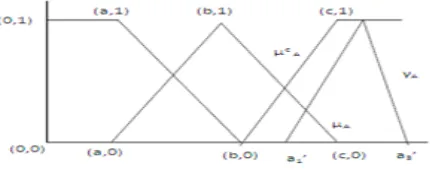
(
a,b,c , e, f,g)
with e ≥ band f≥ c is shown in the following figure:
Figure 2: Triangular Intuitionstic fuzzy number Addition
For two triangular Intuitionistic fuzzy numbers
G. Sudha, R. Sophia Porchelvi and K. Gnanaselvi
4 with
µ
A ≠µ
B andγ
A ≠γ
B, define A+B =(
)
(
)
(
a1 +a2,b1 +b2,c1+c2 :Min µA,µB , e1 +e2, f1 + f2,g1+g2 :Max γA,γB)
Subtraction
A-B =
(
)
(
)
(
a1 −a2,b1−b2,c1−c2 :Min µA,µB , e1−e2, f1− f2,g1−g2 :Max γA,γB)
where a1, a2, a3, b1, b2 and b3 are any real numbers.2.7. Forward pass calculations
Forward Pass Calculations are employed to calculate the Triangular Intuitionistic fuzzy earliest starting time TrIFESTj in the project network
{
}
ij i
i
j Max TrIFEST TrIFt
TrIFEST = ⊕ , i = number of preceding nodes. Triangular Intuitionistic Fuzzy earliest finishing time TrIFEFTj in the project
networkTrIFEFT =
TrIFEST
⊕
Fuzzy activity time2.8. Backward pass calculations
Backward Pass Calculations are employed to calculate the Triangular Intuitionistic fuzzy latest finishing time
TrIFLFT
i in the project network{
j ij}
j
i Min TrIFLFT TrIFt
TrIFLFT = Θ ~ , j = number of succeeding nodes Triangular Intuitionistic Latest starting time
TrIFLST
=TrIFLFT
Θ
Fuzzy activity time.2.9. Triangular intuitionistic fuzzy total float (TrIFTF)
TrIFTFij= TrIFLFTjΘ TrIFESTiΘ TrIFtij
2.10. Ranking function
A ranking function R : F(R)→R ,where F(R) (a set of all fuzzy numbers defined on set
of
real numbers) , maps each fuzzy number into a real of F(R) . Let
a
~
and b~ be two fuzzy numbers in F(R) , then(i)
a
~
≥Rb~
if and only if R(
a
~
) ≥ R(b~)(ii)
a
~
>Rb~
if and only if R(
a
~
) >R(b~)(iii)
a
~
=Rb~
if and only if R(
a
~
) =R(b~)2.11. Method of magnitude
Let A~ =
(
l,m,n, p,q,r)
be a TrIFN , thenMagnitude (A~) =
[
m+q +n+r] [
+ l+ p]
2 1 ) )( 12
5
3. Intuitionistic fuzzy critical path method 3.1. Notation
5
TrIFLFTj : Triangular Intuitionistic fuzzy latest finishing time of j
TrIFTFij : Triangular Intuitionistic fuzzy total fioat time of activity i -j
TrIFtij : Triangular Intuitionistic fuzzy activity time of nodes i and j
TrIECP : Triangular Intuitionistic fuzzy completion time of path
TrIFP(j) = The set of nodes connected to all predecessor activites of node j TrIFS(j) = The set of all nodes connected to all successor activites of node j.
3.2. Procedure for finding the critical path using TrIFN
Step 1: Calculate TrIFEST = Max {TrIFESTi
⊕
TrIFtij / i∈TrIFP(j), j ≠1, j ∈Nij}andTrIFEST1 = TrIFLFT1= 0
Step 2: Calculate TrIFLFTi = Min {TrIFLFTjΘ TrIFtij /j∈TrIFS(j), j ≠n, j ∈Nij}
andTrIFLFTn= TrIFESTn
Step 3: Calculate TrIFTFij =(TrIFLFTjΘTrIFESTiΘ TrIFtij ;i, j ∈Nij}
Step 4: Find all the possible paths and calculate TrIFCP in a project network
Step 5:Find the ranking value of TrIFCP(Pi) i = 1,2,3,4,5 and compute the critical
path.
4. Numerical examples
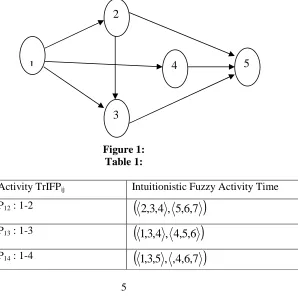
Figure 1 shows the network representation of a fuzzy project network.
Figure 1: Table 1:
Activity TrIFPij Intuitionistic Fuzzy Activity Time
P12 : 1-2
(
2,3,4, 5,6,7)
P13 : 1-3
(
1,3,4 , 4,5,6)
P14 : 1-4
(
1,3,5, ,4,6,7)
5
1
2
3
G. Sudha, R. Sophia Porchelvi and K. Gnanaselvi
6
P23 : 2-3
(
3,4,6 , 5,7,8)
P25 : 2-5
(
2,4,5, 6,7,8)
P35 : 3-5
(
3,6,8, 7,9,11)
P45 : 4-5
(
1,4,5, 5,6,7)
The computational procedures are as follows:
Step 1: To calculate the Triangular Intuitionistic Fuzzy Earliest Starting Time:
Set TrIFEST1 =
(
0,0,0 , 0,0,0)
andCalculate TrIFESTj , j = 2,3,4,5 ,by using definition (2.7)
TrIFEST2=
(
2,3,4, 5,6,7)
TrIFEST3 =
(
5,7,10 , 10,13,15)
TrIFEST4 =
(
1,3,5, 4,6,7)
and TrIFEST5 =
(
8,13,18, 17,22,26)
Step 2: To calculate the Triangular IntuitionisticFuzzy Latest Finishing Time:
Setby using definition (2.8)
TrIFLFT5 =
(
8,13,18, 17,22,26)
; TrIFLFT4 =(
7,9,13, 12,16,19)
TrIFLFT3 =
(
5,7,10, 10,13,15)
; TrIFLFT2 =(
2,3,4, 5,6,7)
TrIFLFT1 =
(
0,0,0, 0,0,0)
Step 3: To calculate the Triangular Intuitionistic Fuzzy total float:
Calculate TrIFTFij with respect to each activity by using
TrIFTFij= TrIFLFjΘ TrIFESTiΘ TrIFtij
TrIFTF12 =
(
0,0,0, 0,0,0)
;TrIFTF13 =(
4,4,6 , 6,9,9)
TrIFTF14 =
(
6,6,8, 8,10,12)
;TrIFTF23 =(
0,0,0 , 0,0,0)
TrIFTF25 =
(
4,6,9 , 6,9,11)
;TrIFTF35 =(
0,0,0, 0,0,0)
TrIFTF45 =
(
6,6,8, 8,10,12)
Step 4 :Find all the possible and calculate TrIFCP is a project network.
Pi = {(1,2,5),(1,2,3,5),(1,3,5),(1,4,5)}
TrIFCP(P1) = TrIFTF12
⊕
TrIFTF25 =(
4,6,9, 6,9,11)
7
TrIFCP(P3) = TrIFTF13
⊕
TrIFTF35=(
4,4,6 , 6,9,9)
TrIFCP(P4) = TrIFTF14
⊕
TrIFTF45 =(
12,12,16, 16,20,24)
Step 5: To obtain the critical path using Ranking procedure (2.11)
R(P1) = 15.4 ; R(P2) = 0 ; R(P3) = 12.5 ;R(P5) = 32.3
Since R(P2) < R(P3) < R(P1) < R(P5)
Intuitionistic fuzzy critical path P2is 1-2-3-5 .
5. Conclusion
In this paper, a simple approach is provided to find the triangular intuitionistic fuzzy total duration times and the critical path when the activity times are triangular intuitionistic fuzzy numbers. Ranking techniques can be implemented in the above form of project for getting better approximation. Intuitionistic fuzzy models are more effective in determining the critical path in a real project network
REFERENCES
1. L.S.Chen and C.H.Cheng, Selecting IS personnel using ranking fuzzy number by metric distance method, European Journal of Operations Research, 160 (3) (2005) 803-820.
2. S.Chanas and J.Kamburowski, The use of fuzzy variables in PERT, Fuzzy Sets and
Systems, 5 (1981) 11-19.
3. T.N.Chuang and J.Y.Kung, The fuzzy shortest path length and the corresponding shortest pathin a network, Computers and Operations Research, 32(6) (2005) 1409-1428.
4. S.Chanas and E.Radosinski, A model of activity performance time in the light of fuzzy sets theory, Problemyorganizacji, 2 (1976) 68-76 (in polish)
5. S.Chanas and P.Zielinski, The computational complexity of the criticality problems in a network with interval activity times. European Journal of Operations Research, 136 (2002) 541-550.
6. P.K.De and A.Bhinchar, A Fuzzy Critical Path Analysis by Ranking Method,
Research India Publications, 7(1) (2012) 25 – 34.
7. M.J.Liberatore and J.F.Connelly, Applying fuzzy logic to critical path analysis .In Management of Energy and Technology, Portland International Conference, I (2001) 419-419.
8. D.L.Mon, C,H.Cheng and H.C.Lu, Application of fuzzy distribution on project management, Fuzzy Sets and Systems,73 (1995) 227-234.
9. A.NagoorGani and M.Mohamed Jabarulla, on searching intuitionistic fuzz shortest path in a network, Applied Mathematics Science, 69 (2010) 3447 -3454.
G. Sudha, R. Sophia Porchelvi and K. Gnanaselvi
8
11. R.Sophia Porchelvi and G.Sudha, A new approach for finding miniumum path in anetwork using triangular intuitionistic fuzzy number, International Journal of
Current Research, 6(8) (2014) 8103- 8109.