DEMOGRAPHIC RESEARCH
VOLUME 29, ARTICLE 33, PAGES 885-906
PUBLISHED 29 OCTOBER 2013
http://www.demographic-research.org/Volumes/Vol29/33/ DOI: 10.4054/DemRes.2013.29.33
Research Article
Could changes in reported sex ratios at birth
during and after China’s 1958-1961 famine
support the adaptive sex ratio adjustment
hypothesis?
Zhongwei Zhao
Yuan Zhu
Anna Reimondos
© 2013 Zhongwei Zhao, Yuan Zhu & Anna Reimondos.
This open-access work is published under the terms of the Creative Commons Attribution NonCommercial License 2.0 Germany, which permits use, reproduction & distribution in any medium for non-commercial purposes, provided the original author(s) and source are given credit.
1 Introduction 886
2 Sex ratio at birth in human populations and reported sex ratio at birth in China
887
3 Changes in reported sex ratio at birth during China’s 1958-1961 famine
889
4 Could changes in reported sex ratio at birth in the famine provide support for the adaptive sex ratio adjustment hypothesis?
892
5 Some methodological issues in analysing changes in monthly sex ratio at birth
894
6 Conclusions 901
7 Acknowledgements 902
Could changes in reported sex ratios at birth during and after
China’s 1958-1961 famine support the adaptive sex ratio adjustment
hypothesis?
Zhongwei Zhao1
Yuan Zhu2
Anna Reimondos3
Abstract
BACKGROUND
The adaptive sex ratio adjustment hypothesis suggests that when mothers are in poor conditions the sex ratio of their offspring will be biased towards females. Major famines provide opportunities for testing this hypothesis because they lead to the widespread deterioration of living conditions in the affected population.
OBJECTIVE
This study examines changes in sex ratio at birth before, during, and after China‟s 1958-1961 famine, to see whether they provide any support for the adaptive sex ratio adjustment hypothesis.
METHODS
We use descriptive statistics to analyse data collected by both China‟s 1982 and 1988 fertility sample surveys and examine changes in sex ratio at birth in recent history. In addition, we examine the effectiveness of using different methods to model changes in sex ratio at birth and compare their differences.
RESULTS
During China‟s 1958-1961 famine, reported sex ratio at birth remained notably higher than that observed in most countries in the world. The timing of the decline in sex ratio at birth did not coincide with the timing of the famine. After the famine, although living conditions were considerably improved, the sex ratio at birth was not higher but lower than that recorded during the famine.
CONCLUSION
The analysis of the data collected by the two fertility surveys has found no evidence that changes in sex ratio at birth during China‟s 1958-1961 famine and the post-famine period supported the adaptive sex ratio adjustment hypothesis.
1. Introduction
Trivers and Willard proposed a major hypothesis in the study of sex ratios in 1973. The hypothesis suggests that “because the reproductive success of male offspring tends to be more variable and resource-sensitive than that of female offspring” (Song 2012: 1), “natural selection should favour parental ability to adjust the sex ratio of offspring produced according to parental ability to invest” (Trivers and Willard 1973: 90). This kind of adjustment or control can take place both before and after the birth. Accordingly, when the maternal condition declines, mothers tend to “produce a lower ratio of males to females” (Trivers and Willard 1973: 90; also Cronk 2007). This hypothesis, also referred to as adaptive sex ratio adjustment hypothesis, has been tested by several studies of human populations in recent years, although the results have been mixed (Keller et al. 2001; Lazarus 2002; Gibson and Mace 2003; Stein et al. 2004; Cronk 2007).
In a recent paper published by Proceedings of the Royal Society B, which is entitled „Does famine influence sex ratio at birth? Evidence from the 1959–1961 Great Leap Forward Famine in China‟, Shige Song examined the impact of this famine on changes in sex ratio at birth (SRB) through analysing the data collected by China‟s 1982 National One-Per-Thousand Population Sample Survey. According to the author, “the study identified an abrupt decline in sex ratio at birth between April 1960, over a year after the Great Leap Forward Famine began, and October 1963, approximately 2 years after the famine ended, followed by a compensatory rise between October 1963 and July 1965. These findings support the adaptive sex ratio adjustment hypothesis that mothers in good condition are more likely to give birth to sons, whereas mothers in poor condition are more likely to give birth to daughters” (Song 2012: 1). Song‟s paper has been publicized widely. In commenting on Song‟s results, Nature reported in its news section that “Hungry mothers give birth to more daughters” (Corbyn 2012). LiveScience, a major science website, also reported that “Hard times mean fewer baby boys” (Pappas 2012).
China‟s 1958-1961 famine. Our study shows that during the famine China‟s reported SRB was still significantly higher than that in most countries of the world. This was attributable, at least partly, to deliberate human intervention. Evidence provided by our analysis does not support the adaptive sex ratio adjustment hypothesis.
2. Sex ratio at birth in human populations and reported sex ratio at
birth in China
While this paper focuses on changes in SRB during China‟s 1958-1961 famine, we start with a brief description of SRB in the world and in recent Chinese history, which provides useful background information and puts changes in SRB during the famine in context.
In most human populations, if there is no deliberate intervention in the process of reproduction, the SRB is around 105, or 51.2% of all births are male.4 Table 1 presents SRB and the corresponding percentage of male births in the world in 2005-2010. It shows that out of 196 countries and territories with a population of 100,000 or more, SRB in 178 of them (more than 90%) varied between 103 and 107. It was 101 or 102 in 5 countries and territories, and 108 or 109 in 8 countries and territories. In only 5 countries (2.6% of the total) SRB was higher than 110 and the percentage of male births was between 52.4% and 54.5%. When SRB was examined by major region, it varied between 104 and 107 in almost all places in the world except East Asia, where SRB was 118. This was mainly caused by the very high SRB recorded in China (United Nations 2011).
Studies have suggested that some demographic or physiological factors are related to variations in SRB, but such links are not strong in general (James 1987a, 1987b). Large changes in SRB are often caused by human intervention, for example sex-selective abortion (Clarke 2003; Siegel and Swanson 2004; Poston and Bouvier 2010; Dyson 2012). In most countries with good demographic data and no known human interference in the process of reproduction, such as most North and West European countries, recorded SRB has long been around 105. In contrast, in some countries and areas, for example, India, Mainland China, South Korea, and Taiwan, there is strong evidence suggesting that the reported high SRB is mainly a result of human intervention and under-reporting of girls (Zeng et al. 1993; Gu and Roy 1995; Park and Cho 1995; Das Gupta and Bhat 1997; Dyson 2012). It is noteworthy that such a man-made high
4 In this paper, both sex ratio at birth and percentage of male births are used. Here sex ratio at birth is
SRB has been declining in South Korea in recent years (Chung and Das Gupta 2007; Guilmoto 2009).
Table 1: Sex ratio at birth in the world, 2005-2010
Sex ratio at birth
Percentage of male births
Number of countries and territories
Percentage of countries and territories
101 50.2 1 0.5
102 50.5 4 2.0
103 50.7 38 19.4
104 51.0 14 7.1
105 51.2 72 36.7
106 51.5 43 21.9
107 51.7 11 5.6
108 51.9 7 3.6
109 52.2 1 0.5
110+ 52.4 - 54.5 5 2.6
Total 196 100.0
Data source: United Nations (2011).
Reported SRB has been higher than 105 in Mainland China for most years since the mid-twentieth century. This was also true during the famine, when the reported SRB was not lower but significantly higher than that in many countries of the world.5 China‟s reported high SRB has been attributable to two major reasons. First, the actual SRB was indeed high, which resulted largely from sex-selective abortion (Chen 2005). Second, the reported high SRB has been affected by under-enumeration of girls. These missing or un-reported girls might have been given away by their parents for adoption. They might have also been births that took place outside of the local government birth control plan, or even the victims of neglecting daughters, abandonment, or female infanticide, which have not been uncommon in Chinese history (Johansson and Nygren 1991; Zeng et al. 1993; Lee, Wang and Campbell 1994; Zhao 2006). It is true that in comparison with recent years, sex-selective abortion was less common before the 1980s, but the effect of under-reporting girls was not negligible at that time.6
5 Detailed information on SRB is difficult to find for earlier periods, but high sex ratios were also recorded
among children in some historical Chinese populations (Lee et al. 1994).
6 Because of their relatively low status in society and the family, females were often considerably
3. Changes in reported sex ratio at birth during China’s 1958-1961
famine
The famine that took place in China between 1958 and 1961 was one of the largest tragedies in recent human history. While it has often been referred to as a “three-year natural disaster”, this is somewhat misleading because evidence shows that its major cause was not „natural‟ (Chang and Wen 1998; Lin and Yang 1998; Yang and Su 1998; Kung and Lin 2003; Cao 2005; Yang 2008). The famine also lasted for more than three years in some areas. Previous analysis showed that this famine started from at least mid-1958 when mortality was already significantly higher than in 1957 in several provinces (Zhao and Reimondos 2012).7 Even at the national level, the Crude Death Rate was notably higher in 1958 in comparison with the previous year (Yao and Yin 1994). Several researchers suggested that the famine resulted in a great surge in mortality and was directly responsible for some 30 million or more excess deaths (Ashton et al. 1984; Coale 1984; Banister 1987; Jin 1993; Coale and Banister 1994; Cao 2005). Its profound demographic, economic, political, and social impact can still be felt today.
As far as the impact of the great famine and changes in SRB during this time are concerned, the following claims have been made in a recent study. First, “the timing of the decline in the proportion of male births coincides with the timing of the Great Leap Forward Famine, suggesting that women during the famine were less likely to give birth to sons” (Song 2012: 3). Second, “the proportion of male births began to show an abrupt decline from 0.521 in April 1960 to 0.510 in October 1963” (Song 2012: 5). Third, “the rapid decline in the proportion of male births ended in October 1963”, and this was followed by a sudden “compensatory rise between October 1963 and July 1965” (Song 2012: 1). In this section we present our analysis on changes in reported SRB during and after the famine, and further examine these suggestions.
To do that we have examined the data collected by China‟s 1982 National One-Per-Thousand Population Sample Survey on Fertility, which were used in the aforementioned study, and the data gathered by China‟s 1988 National Sample Survey on Fertility and Contraception. The 1982 survey employed a clustered, proportional sampling design. It surveyed more than 310,000 women who were aged between 15 and 67 in 1982 and lived in 28 provinces, autonomous regions, and metropolitan areas administered directly by the central government. The total number of children born to these female respondents was just over 830,000. The 1988 survey used a stratified, systematic, clustered, non-proportional sampling procedure. It had a larger sample size
7 In Sichuan, Gansu, and Guizhou, for example, Crude Death Rates for 1958 were already markedly higher
and was conducted in about two-per-thousand of the national population selected from all provinces in mainland China. Detailed pregnancy histories were collected from ever-married women aged 15 to 57. The total number of pregnancies recorded in the survey was 1.5 million. Because they were collected through a non-proportional sampling procedure the 1988 survey results need to be weighted when they are used to show the demographic situation in the national population, which has been taken care of in this study.
Because the 1988 survey was conducted at a later time and among women aged 15 to 57 rather than among women aged 15 to 67 as in the 1982 survey, the two surveys recorded a different number of births at different time periods. Up to 1957 the number of births recorded by the 1988 survey in each month was smaller than that enumerated by the 1982 survey. In 1958 and 1959 the number of births recorded by the two surveys were similar. From 1960, the 1988 survey enumerated progressively more births than the 1982 survey. Therefore it is expected that the 1988 survey results, in comparison with those of the 1982 survey, will tend to provide a better representation of changes in SRB in the national population for the later period.
As with any survey that collects retrospective data, birth histories recorded by the 1982 and 1988 surveys might be affected by recall errors and some children might have been missed out in the enumeration. However, such impact is likely to be small and negligible. Many studies have shown that the quality of the two fertility surveys is high (Coale 1984; Lavely 1987;Wang 2002). Further discussion about the data collected by the two surveys can also be found in Zhao and Reimondos (2012; see also Lin and Wang 1991; Song 2012).
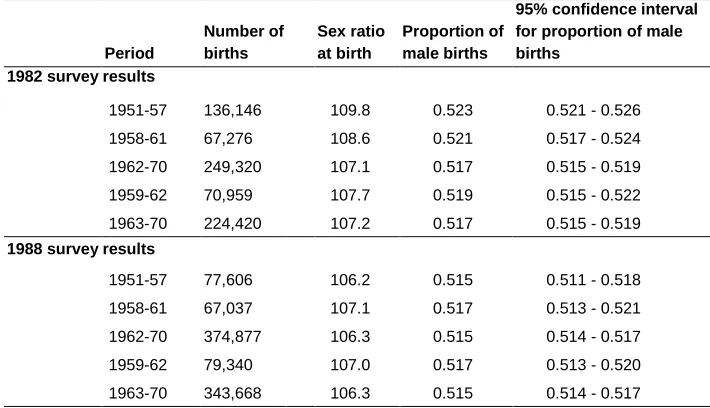
The results of the 1982 and 1988 fertility surveys showed no sign that the timing of the decline in reported SRB coincided with the timing of the famine. Table 2 presents proportions of male births for selected periods recorded by both 1982 and 1988 fertility surveys. According to the 1982 survey, the reported proportion of male births for the famine period (1958-1961) was slightly lower than that reported for the pre-famine period. However, this was caused mainly by an even higher reported SRB in the pre-famine period. During the pre-famine the reported proportion of male births was still markedly higher than that observed in populations where human interference to childbearing does not exist. In the post-famine period the reported proportion of male births did not rise but fell slightly.
the 1988 fertility survey, the reported proportion of male births increased slightly during the famine. This was followed by a decline in the post-famine period. We have also computed reported proportions of male births for 1959-1962 and 1963-1970 to take into account the fact that their mothers were subject to the influence of changing living conditions in 1958-1961 when they were pregnant (also shown in Table 2). These results are very similar to those discussed above. They do not support the claim that “women during the famine were less likely to give birth to sons” (Song 2012: 3).
Table 2: Reported sex ratio at birth and proportion of male births for selected periods
Period
Number of births
Sex ratio at birth
Proportion of male births
95% confidence interval for proportion of male births
1982 survey results
1951-57 136,146 109.8 0.523 0.521 - 0.526
1958-61 67,276 108.6 0.521 0.517 - 0.524
1962-70 249,320 107.1 0.517 0.515 - 0.519
1959-62 70,959 107.7 0.519 0.515 - 0.522
1963-70 224,420 107.2 0.517 0.515 - 0.519
1988 survey results
1951-57 77,606 106.2 0.515 0.511 - 0.518
1958-61 67,037 107.1 0.517 0.513 - 0.521
1962-70 374,877 106.3 0.515 0.514 - 0.517
1959-62 79,340 107.0 0.517 0.513 - 0.520
1963-70 343,668 106.3 0.515 0.514 - 0.517
Data sources: China’s 1982 and 1988 fertility survey data.
sample survey. The selection of the two months was also made by the method used in the study. According to the 1988 fertility sample survey, the reported percentages of male births were 52.9% and 51.0% for these two months. Their corresponding 95% confidence intervals were 50.2%-55.5% and 49.4%-52.5%, respectively. While the results of the 1988 fertility survey were fairly close to those predicted by the above study, the reported percentage of male births for April 1960 was not significantly different to that for October 1963, nor did they differ significantly to those recorded by the 1982 fertility survey.
The 1982 and 1988 surveys also showed that the recorded percentages of male births were 51.5% (95% CI: 51.2%-51.9%) and 51.8% (95% CI: 51.6%-52.2%) for the entire period from April 1960 to October 1963, respectively. These percentages are lower than that recorded by the 1982 survey for 1951-1957, but higher than that recorded by the 1988 survey for the same years. Depending on which set of survey data was used in the analysis, conclusions about whether there was a decline in reported SRB and the timing of such a decline can be different. It is also worth noting that even during the period between April 1960 and October 1963, the reported SRB was still higher than that observed in most populations in the world where SRB has not been affected by human intervention.
We have also examined the third suggestion made in the study mentioned above. According to the 1982 and 1988 fertility surveys, the reported percentages of male births were 51.4% (95% CI: 49.1%-53.7%) and 51.2% (95% CI: 49.3%-53.0%) for July 1965. Both of them were very close to those recorded in October 1963. The two surveys also recorded that percentages of male births for the period of October 1963 to July 1965 were 51.5% (95% CI: 51.0%-51.9%) and 51.6% (95% CI: 51.2%-52.0%), respectively. They were slightly lower than those observed in the famine (see Table 2). These results could not support the claim that there was a compensatory rise in the proportion of male births between October 1963 and July 1965.
4. Could changes in reported sex ratio at birth in the famine provide
support for the adaptive sex ratio adjustment hypothesis?
investigated three questions that are closely related to changes in reported SRB during the time of the famine.
We first conducted a more detailed comparison of changes in SRB during and after the famine. As noted earlier, the famine lasted from at least mid-1958 to late 1961. If the above hypothesis and claim were true, in comparison with that in post-famine years, a relatively low proportion of male births would be expected during the period approximately from 1959 to 1962 (assuming mothers were affected by the famine over 1958-1961 when they were pregnant). After the famine China‟s socio-economic conditions and people‟s health conditions improved, and this trend continued after 1962. Therefore, an increase in the proportion of male births would be expected in the period 1963-1970 if mothers in good condition were indeed more likely to give birth to sons. But this did not happen. According to 1982 and 1988 fertility surveys, the percentages of male births were 51.9% and 51.7% for 1959-1962, while they were 51.7% and 51.5% for 1963-1970, as shown in Table 2. The percentage of male births in the later period was consistently lower, not higher, than that during the famine. This comparison provides no support for the hypothesis cited above.
To further examine whether changes in reported SRB during the famine provided any support for the adaptive sex ratio adjustment hypothesis, we have also compared the proportion of reported male births between urban and rural populations. During the famine China‟s rural population was affected more severely than its urban counterpart. Mortality was much higher in rural than in urban areas. In some provinces fertility also fell to a lower level in rural than in urban areas (Zhao and Reimondos 2012). If the above hypothesis and claim were true, we would expect to see a higher SRB recorded in China‟s urban areas. We analysed 71,000 births recorded by the 1982 fertility survey and 84,000 births recorded by the 1988 fertility survey for 1959-1962. Both surveys showed that over this period the percentage of male births was 51.9% for rural areas. In urban areas male births accounted for 51.5% and 51.3% respectively according to the 1982 and 1988 surveys. These results could not support the suggestion that mothers in good condition tended to have a higher proportion of sons than those in poor condition. If anything, they have shown that in rural areas where living conditions were far worse than in urban areas, mothers tended to have a lower proportion of female births than their urban counterparts.
China‟s national population in recent years (Zeng et al. 1993; Coale and Banister 1994; Gu and Roy 1995). Although some of these results may not be seen as statistically significant evidence that allows us to accept or reject the hypothesis cited earlier, they and those reported by other studies (Zhao and Reimondos 2012) suggest that deliberate human interference has been a major factor leading to notable variations in SRB in the Chinese population.
Rather than providing support for the suggestion that mothers tend to have more sons in good conditions and more daughters when the conditions deteriorate, the above results reveal that during the great famine China‟s reported SRB was still notably higher than the level of 105 which is recorded in many countries in the world. After the famine, while living conditions were improved considerably, the reported SRB did not increase, but fell slightly in 1962-1970. The major factor affecting variations in the reported proportion of male births was not the health or living conditions of the mother but rather deliberate human intervention, including post-natal reproductive intervention and related under-enumeration. If such interference did not exist, China‟s reported SRB would most likely have been lower.
5. Some methodological issues in analysing changes in monthly sex
ratio at birth
The above analysis shows that changes in reported SRB during China‟s 1958-1961 famine provided no evidence to support the adaptive sex ratio adjustment hypothesis. This inevitably leads to the following questions. Why do our conclusions differ considerably from those drawn from the study conducted by Song (2012), which also analysed the data collected by China‟s 1982 National One-Per-Thousand Population Sample Survey on Fertility? Are these differences related to the ways in which the data have been analysed? And, if so, what are the methodological lessons that we have learned from further examining changes in SRB in recent Chinese history?
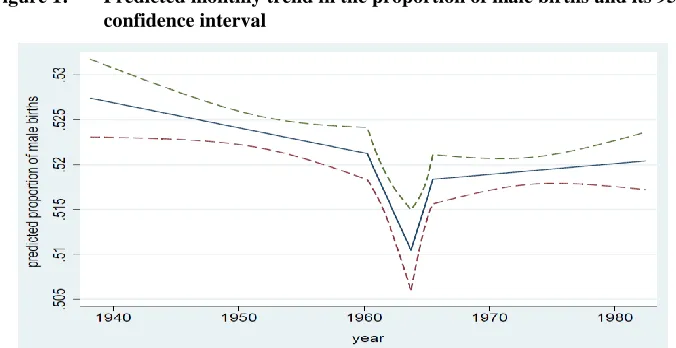
To answer these questions we start with a brief introduction to the method used in Song‟s study. In his study the author used linear spline logistic regression to identify when significant changes occurred in SRB reported for each month. The analytical procedure is provided by MVRS, a statistical package in STATA.8 To use this method Song first arbitrarily determined or made assumptions about the number of initial break points. Then the linear spline logistic regression model was used to identify the actual number of break points and their locations under each of these assumptions. Finally,
through comparing the value of Akaike Information Criterion (AIC) obtained for each of these models, Song determined the globally optimal number of final break points. The model with the lowest AIC was chosen as best representing the pattern of change in reported SRB (Song 2012). In Song‟s study the estimation was made using all births recorded from September 1929 to June 1982. According to him, the model with 89 initial break points9 yielded the best results, which identified three final break points located in April 1960, October 1963, and July 1965, as shown in Figure 1 (Song 2012).
Figure 1: Predicted monthly trend in the proportion of male births and its 95% confidence interval
Source: Song 2012.
In our study, in addition to the data analyses presented in the previous sections, we replicated the analysis conducted by Song.10 This led to the identification of some uncertainties of using this method and data collected by only the 1982 fertility survey to determine break points in changes in recorded percentage of male births in each month in China‟s national population.
9 In Song‟s article the number of breakpoints is listed as 90. This number is not the number of break points,
but the degrees of freedom, which is the number of break points plus 1. This is indicated by the fact that when the number of initial break points is assigned to 10, 20, 30 and so on, the method does not work effectively (Song 2012: 5).
10 While we feel that some methods, for example GLM with cubic splines provided by the MVRS package in
The differences between the results reported in Song‟s paper and ours, both those presented in previous sections and those to be presented below, have arisen partly from the uncertainty of using data gathered by sample surveys to model changes in SRB in the national population. When a sample was taken for each of the several hundred months of the entire study period (similar to drawing several hundred samples from a population in a given month), some of the point estimates obtained from such samples would be well beyond the 95% or even 99% confidence interval of the expected value in the population. This is responsible for some marked differences in the monthly percentage of male births recorded by the 1982 and 1988 fertility sample surveys, as shown in Figure 2. For example, the 1982 survey reported that the proportion of male births was 55.6% (95% CI: 53.5%-57.6%) for February 1969, while it was 51.4% (95% CI: 49.8%-53.0%) according to the survey conducted in 1988. Differences of this kind could easily lead to different results when the data from different surveys are used to model changes in SRB in the whole population.
Figure 2: Reported proportion of male births by month: 1951-1970
The above uncertainty can be amplified when the sample size is relatively small. Both the 1982 and 1988 fertility sample surveys were well designed and had very large samples. Their data can be used effectively in the study of many questions. However, when the data are used to determine changes in SRB by month, the number of births sampled for each month is only moderate or small. For example, in the period between September 1929 and August 1934 the number of births varied between 0 and 71 per month. For the period from September 1934 to August 1939 the number of births recorded for each month was still below 400. In comparison with those obtained from a larger sample, the percentage of male births computed from a smaller sample tends to show a greater difference from that in the whole population and to have a wider confidence interval. All else being equal, this could notably increase the difficulties and uncertainties in determining the real break points and changes in SRB in the whole population. The results presented in Song‟s paper are clearly affected by the small sample size for the early months and the great variations in reported number of births for each month over the entire study period.
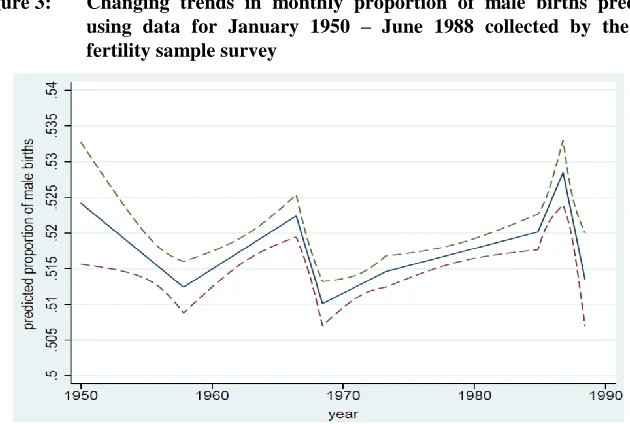
Figure 3: Changing trends in monthly proportion of male births predicted using data for January 1950 – June 1988 collected by the 1988 fertility sample survey
Data source: China’s 1988 fertility sample survey.
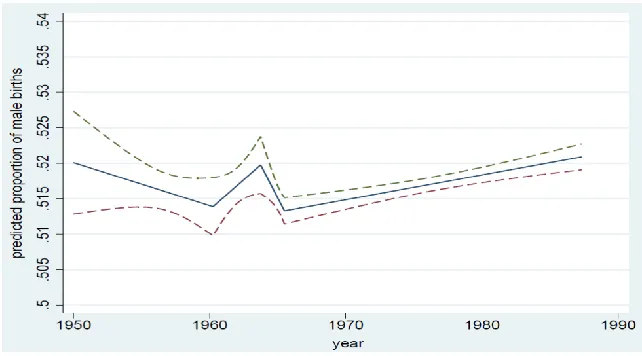
Figure 4: Changing trends in monthly proportion of male births predicted using data for January 1950 – June 1988 collected by the 1988 fertility sample survey and the three break points selected by Song using the 1982 fertility survey data
Data source: China’s 1988 fertility sample survey.
Our analysis has also found that it is difficult to use Song‟s method to exhaust all possible selections of break points. This is partly due to the fact that this method does not work effectively when the number of initial break points is assigned to 10, 20, 30, 40, etc., which was mentioned earlier. This is also indicated by Song‟s Table 1, which reported model selection information of 34 linear spline logistic regression models, including a few which could not produce the required results (Song 2012: 5).11 Furthermore, according to the information shown in Song‟s table, the best-fit model began with 90 equally spaced initial break points and its AIC was 1149308.12 The three final break points selected by this model were seen as the optimal ones. However, our analysis suggests that starting with other numbers of initial break points, the same method could produce at least a dozen linear spline logistic regression models and each of them has an AIC that is the same as or smaller than 1149308. For example, the
11 In this table, when the initial break points were assigned to 10 and 20, the model could not produce the
required results. Numbers 30 to 100 shown in the last eight rows are the degree of freedom, not the number of initial break points.
models starting with 62, 83, or 93 initial break points all have an AIC that is smaller than 1149308. The AIC for the regression model staring with 83 initial break points is only 1149304. It seems that Song has not run the linear spline logistic regression model with these initial break points.
Figure 5: Changing trends in monthly proportion of male births predicted using data for January 1945 – June 1982 collected by the 1982 fertility sample survey
Data Source: China’s 1982 fertility sample survey.
6. Conclusions
China experienced a great famine from 1958 to 1961. During this period severe food shortages occurred throughout the country. As a result living standards fell to a very low level, the health status of the population deteriorated significantly, and mortality greatly increased in many places, especially in rural areas. This catastrophic disaster resulted in a huge demographic loss. China recorded its only population decline since the mid-twentieth century.
During the famine China‟s reported SRB remained notably higher than that observed in most countries in the world. Our analysis shows that there was no evidence suggesting that the timing of the decline in SRB coincided with the timing of the famine. During the famine, while rural areas were more severely affected, SRB in the rural population was very close to or slightly higher than that in the urban population. After the famine, although living conditions improved markedly, the reported SRB was not higher but lower than that recorded during the famine. These results could not support the claim that mothers in poor condition give birth to more daughters while those in good condition produce more sons. The results presented in this paper differ notably from those reported by Song (2012). The differences between our conclusions and those drawn from Song‟s study are closely related to the methodological issues discussed in the previous section.
While our study could not provide evidence to support the adaptive sex ratio adjustment hypothesis, it and some other studies have shown that changes in SRB in China were often related to human interference in the process of reproduction. For example, our studies of demographic impacts of the famine in China‟s severely affected provinces revealed that among women already having two surviving children, those with only sons or with both sons and daughters were less likely to give birth to another child, in comparison with those who had only surviving daughters. Among children with one surviving sibling, those with an elder brother were more likely to die than those with an elder sister. Among those with two surviving siblings, children with two elder brothers were more likely to die than those with two sisters (Zhao and Reimondos 2012). During the famine, and also in recent years, SRB tended to be higher among children of higher parities than among children of lower parities (Zeng et al. 1993; Gu and Roy 1995). These patterns were closely related to the strong son preference found in the Chinese population.
among young women fell by 60% in 1960 and 1961 in comparison to that in 1957. A large proportion of young people also postponed their marriages (Zhao and Reimondos 2012). When the famine finally ended many people wanted to make up for their demographic loss. This was directly responsible for the surge in marriage and fertility observed immediately after the famine. It was in this historical context that human intervention in reproduction fell to a relatively low level.
7. Acknowledgements
References
Ashton, B., Hill, K., Piazza, A., and Zeitz, R.(1984). Famine in China, 1958–61.
Population and Development Review 10(4): 613–645. doi:10.2307/1973284.
Banister, J. (1987). China's Changing Population. Stanford: Stanford University Press. Cao, S. (2005). The deaths of China‟s population and its root cause during 1959-1961.
Chinese Journal of Population Sciences 1: 14–28.
Chang, G. and Wen, G. (1998). Food availability versus consumption efficiency: Causes of the Chinese famine. China Economic Review 9(2): 157–166.
doi:10.1016/S1043-951X(99)80012-1.
Chen, W. (2005). Induced Abortion in China: Trends, Patterns and Determinants. Beijing: Kexue Jishu Wenxian Chubanshe.
Chung, W. and Das Gupta, M. (2007). The Decline of Son Preference in South Korea: The Roles of Development and Public Policy. Population and Development Review 33(4): 757–783. doi:10.1596/1813-9450-4373.
Clarke, J.I. (2003). Sex ratio. In: Demeny, P. and McNicoll, G. (eds.). Encyclopedia of Population. New York: Macmillan Reference: 875–878.
Coale, A. (1984). Rapid Population Change in China,1952–1982. Washington D.C.: National Academy Press.
Coale, A. and Banister, J. (1994). Five Decades of Missing Females in China.
Demography 31(3): 459–479. doi:10.2307/2061752.
Corbyn, Z. (2012). Hungry mothers give birth to more daughters [electronic resource]. http://www.nature.com/news/hungry-mothers-give-birth-to-more-daughters-1.10331.
Cronk, L. (2007). Boy or girl: Gender preferences from a Darwinian point of view.
Reproductive BioMedicine Online 15(2): 23–32.
Das Gupta, M. and Bhat, P.N.M. (1997). Fertility Decline and Increased Manifestation of Sex Bias in India. Population Studies 51(3): 307–315.
doi:10.1080/0032472031000150076.
Gibson, M.A. and Mace, R. (2003). Strong mothers bear more sons in rural Ethiopia. Proceedings of the Royal Society of London Series B 270(Supplement): 108–109. doi:10.1098/rsbl.2003.0031.
Gu, B. and Roy, K. (1995). Sex ratio at birth in China, with reference to other areas in East Asia: what we know. Asia Pacific Population Journal 10(3): 17–42. Guilmoto, C.Z. (2009). The Sex Ratio Transition in Asia. Population and Development
Review 35(3): 519–549. doi:10.1111/j.1728-4457.2009.00295.x.
James, W. (1987a). The human sex ratio, Part 1: A review of literature. Human Biology
59 (5): 721–752.
James, W. (1987b). The human sex ratio, Part 2: A hypothesis and a program of research. Human Biology 59(6). 873–900.
Jin, H. (1993). A memorandum of the „three years of natural disasters‟. Society 4–5: 13–22.
Johansson, S. and Nygren, O. (1991). The missing girls of China: A new demographic account. Population and Development Review 17(1): 35–51.
doi:10.2307/1972351.
Keller, M.C., Nesse, R.M., and Hofferth, S. (2001). The Trivers–Willard hypothesis of parental investment: No effect in the contemporary United States. Evolution and Human Behavior 22: 343–360. doi:10.1016/S1090-5138(01)00075-7.
Kung, J.K. and Lin, J.Y. (2003). The causes of China‟s Great Leap Famine, 1959–1961. Economic Development and Cultural Change 52(1): 51–73.
doi:10.1086/380584.
Lavely, W.R. (1987). Chinese demographic data: A guide to major sources. The Australian Journal of Chinese Affairs 18: 167–178. doi:10.2307/2158589.
Lazarus, J. (2002). Human sex ratios: Adaptations and mechanisms, problems and prospects. In: Hardy, I.C.W. (ed.). Sex Ratios: Concepts and Research Methods. Cambridge: Cambridge University Press. doi:10.1017/CBO9780511542053.015.
Lee, J., Wang, F., and Campbell, C. (1994). Infant and Child Mortality Among the Qing Nobility: Implications for Two Types of Positive Check. Population Studies
48(3): 395–411. doi:10.1080/0032472031000147936.
Lin, F. and Wang, F. (1991). The examination of the quality of National Sample Survey on Fertility and Contraception. Population Research 1: 3–7.
Pappas, S. (2012). Hard times mean fewer baby boys, study suggests [electronic resource]. http://www.livescience.com/19311-famine-male-births-sex-ratio.html. Park, C.B. and Cho, N.H. (1995). Consequences of Son Preference in a Low-Fertility Society: Imbalance of the Sex Ratio at Birth in Korea. Population and Development Review 21(1): 59–84. doi:10.2307/2137413.
Poston, D.L. and Bouvier, L.E. (2010). Population and Society. New York: Cambridge University Press.
Royston, P. and Sauerbrei, W. (2007). Multivariable modeling with cubic regression splines: a principled approach. Stata Journal 7: 45–70.
Siegel, J.S. and Swanson, D.A. (2004). The Methods and Materials of Demography. 2nd Edition. New York: Elsevier Academic Press.
Song, S. (2009). Does Famine Have a Long-Term Effect on Cohort Mortality? Evidence from the 1959-1961 Great Leap Forward Famine in China. Journal of Biosocial Science 41(4): 469–491. doi:10.1017/S0021932009003332.
Song, S. (2010). Mortality Consequences of the 1959-1961 Great Leap Forward Famine in China: Debilitation, Selection, and Mortality Crossovers. Social Science & Medicine 71(3): 551–558.doi:10.1016/j.socscimed.2010.04.034.
Song, S. (2012). Does famine influence sex ratio at birth? Evidence from the 1959– 1961 Great Leap Forward Famine in China. Proceedings of the Royal Society Biological Sciences. doi:10.1098/rspb.2012.0320.
Stein, A.D., Zybert, P.A., and Lumey L.H. (2004). Acute undernutrition is not associated with excess of females at birth in humans: the Dutch Hunger Winter. Proceedings of the Royal Society of London Series B 271(Supplement): 138–141. doi:10.1098/rsbl.2003.0123.
Trivers, R.L. and Willard, D.E. (1973). Natural selection of parental ability to vary the sex ratio of offspring. Science 179: 90–92. doi:10.1126/science.179.4068.90.
United Nations (2011). World Population Prospects: the 2010 Revision. New York. http://esa.un.org/unpd/wpp/unpp/panel_indicators.htm.
Wang, D. (2002). Contraceptive failure in China. Contraception 66(3): 173–178.
Yang, D. and Su, F. (1998). The politics of famine and reform in rural China. China Economic Review 9(2): 141–156. doi:10.1016/S1043-951X(99)80011-X.
Yang, D. (2008). China‟s agricultural crisis and famine of 1959–1961: A survey and comparison to Soviet famines. Comparative Economic Studies 50: 1–29.
doi:10.1057/ces.2008.4.
Yao, X. and Yin, H. (1994). Basic Data of China’s Population. Beijing: China Population Publishing House.
Zeng, Y., Tu, P., Gu, B., Xu, Y., Li, B., and Li, Y. (1993). Causes and Implications of the Recent Increase in the Reported Sex Ratio at Birth in China. Population and Development Review 19(2): 283–302. doi:10.2307/2938438.
Zhao, Z. (2006). Towards a better understanding of past fertility regimes: Ideas and practice of controlling family size in Chinese history. Continuity and Change
21(1): 9–35. doi:10.1017/S0268416006005777.