A Practical Guide
to
Federal Enterprise Architecture
Chief Information Officer Council
Version 1.0
Preface
An enterprise architecture (EA) establishes the Agency-wide roadmap to achieve an Agency’s mission through optimal performance of its core business processes within an efficient information technology (IT) environment. Simply stated, enterprise architectures are “blueprints” for systematically and completely defining an organization’s current (baseline) or desired (target) environment. Enterprise architectures are essential for evolving information systems and developing new systems that optimize their mission value. This is accomplished in logical or business terms (e.g., mission, business functions, information flows, and systems environments) and technical terms (e.g., software, hardware,
communications), and includes a Sequencing Plan for transitioning from the baseline environment to the target environment.
If defined, maintained, and implemented effectively, these institutional blueprints assist in optimizing the interdependencies and interrelationships among an organization’s business operations and the underlying IT that support operations. The experience of the Office of Management and Budget (OMB) and General Accounting Office (GAO) has shown that without a complete and enforced EA, federal agencies run the risk of buying and building systems that are duplicative, incompatible, and unnecessarily costly to maintain and integrate.
For EAs to be useful and provide business value, their development, maintenance, and implementation should be managed effectively. This step-by-step process guide is intended to assist agencies in defining, maintaining, and implementing EAs by providing a disciplined and rigorous approach to EA life cycle management. It describes major EA program management areas, beginning with suggested
organizational structure and management controls, a process for development of a baseline and target architecture, and development of a sequencing plan. The guide also describes EA maintenance and implementation, as well as oversight and control. Collectively, these areas provide a recommended model for effective EA management.
Background
Reflecting the general consensus in industry that large, complex systems development and acquisition efforts should be guided by explicit EAs, Congress required Federal Agency Chief Information Officers to develop, maintain, and facilitate integrated systems architectures with the passage of the Clinger-Cohen
Act1in 1996. Additionally, OMB has issued guidance that requires agency information systems
investments to be consistent with Federal, Agency, and bureau architectures. Other OMB guidance
provides for the content of Agency enterprise architectures.2 Similarly, the Chief Information Officer
Council, the Department of the Treasury, the National Institute of Standards Technology (NIST), and GAO, have developed architecture frameworks or models that define the content of enterprise
architectures.3
1 Public Law 104-106, section 5125, 110 Stat. 684 (1996).
2 OMB Circular A-130, Management of Federal Information Resources, November 30, 2000.
3Federal Enterprise Architecture Framework,Version 1.1, Federal Chief Information Officers Council, September
A Practical Guide to Federal Enterprise Architecture Preface
This guide builds upon, complements, and is directly linked to the GAO Information Technology
Investment Management (ITIM) framework4 that was developed to provide a common structure for
discussing and assessing IT capital planning and investment control (CPIC) practices at Federal Agencies. ITIM enhances earlier Federal IT investment management guidance by extending the
Select/Control/Evaluate approach, mandated by the Clinger-Cohen Act, into a growth and maturity
framework.5 It is also directly linked to the Federal Enterprise Architecture Framework.
The Need for this Guide
While these frameworks and models provide valuable guidance on the content of enterprise architectures,
there is literally no ffeeddeerraall guidance how to successfully manage the process of creating, changing, and
using the enterprise architecture. This guidance is crucially important. Without it, it is highly unlikely that an organization can successfully produce a complete and enforceable EA for optimizing its systems’ business value and mission performance. For example, effective development of a complete EA needs a corporate commitment with senior management sponsorship. The enterprise architecture development should be managed as a formal project by an organizational entity that is held accountable for success. Since the EA facilitates change based upon the changing business environment of the organization, the architect is the organization’s primary change agent. Effective implementation requires establishment of system compliance with the architecture, as well as continuous assessment and enforcement of
compliance. Waiver of these requirements may occur only after careful, thorough, and documented analysis. Without these commitments, responsibilities, and tools, the risk is great that new systems will not meet business needs, will be incompatible, will perform poorly, and will cost more to develop, integrate, and maintain than is warranted.
Conclusion
The processes described in this guide represent fundamental principles of good EA management. Since the guide is not a one-size-fits-all proposition, Agencies or organizations should adapt its
recommendations and steps to fit their individual needs. We encourage you to consider these EA processes and best practices carefully before pursuing other approaches.
An electronic version of this guide is available at the following Internet address: http://www.cio.gov.
If you have questions or comments about this guide, please contact Rob C. Thomas II at (703) 921-6425,
by email at [email protected], or by mail at:
U.S. Customs Service 7681 Boston Boulevard Springfield, VA 22153
4Information Technology Investment Management: A Framework for Assessing and Improving Process Maturity
(GAO/AIMD-10.1.23, Exposure Draft, 2000).
5 In the Select Phase, the costs and benefits of all available projects are assessed and the optimal portfolio of projects
A Practical Guide to Federal Enterprise Architecture Preface
Credits
This document was produced by the Federal Architecture Working Group (FAWG) under the strategic direction of the Enterprise Interoperability and Emerging Information Technology Committee (EIEITC) of the Federal Chief Information Officer Council.
The following persons contributed to accomplishing this Guide.
Name Title Agency
Rob C. Thomas, II Dir., Tech. & Arch. Group, Chief Architect U.S. Customs Service Randolph C. Hite Dir., Information Technology Systems Issues General Accounting Office Ray Beamer Senior Principal Scientist The MITRE Corporation
William H. McVay Senior Policy Analyst Office of Management and Budget
Elaine Ward Principal Engineer The MITRE Corporation
Keith Rhodes Chief Technologist General Accounting Office
Mary Lou Collins Lead Engineer The MITRE Corporation
George Brundage Chief Architect U.S. Department of the Treasury Scott Bernard Management Consultant Booz-Allen & Hamilton, Inc. Lester Diamond Assistant Director General Accounting Office Michael A. Tiemann Dir., Arch. & Stnds. Div., Chief Architect U.S. Department of Energy
Thomas P. Cullen Policy Analyst U.S. Customs Service
William Lew Technical Assistant Director General Accounting Office
John Anderson Principal Engineer The MITRE Corporation
Daryl Knuth Information Architect U.S. Customs Service Barbara Scott Management Analyst U.S. Department of Education Paul J. Paradis Management Analyst U.S. Department of Energy Naba Barkakati Technical Assistant Director General Accounting Office
Kathy Sowell Lead Engineer The MITRE Corporation
Table of Contents
Prefaceiii
1. Introduction... 1
1.1. Purpose... 1
1.2. Scope... 1
1.3. Audience ... 1
1.4. Document Organization ... 2
1.5. How to Use this Guide... 3
1.6. Related Documents ... 4
2. Definitions, Drivers, and Principles ... 5
2.1. Enterprise Architecture Defined ... 5
2.2. The Uses and Benefits of Enterprise Architecture... 5
2.3. Legislation and other Guidance ... 6
2.4. Architecture Principles... 7
2.5. The Enterprise Life Cycle... 8
2.6. The Enterprise Architecture Process... 9
3. Initiate Enterprise Architecture Program... 11
3.1. Obtain Executive Buy-in and Support ... 11
3.1.1. Ensure Agency Head Buy-in and Support ... 11
3.1.2. Issue an Executive Enterprise Architecture Policy ... 11
3.1.3. Obtain Support from Senior Executives and Business Units... 12
3.2. Establish Management Structure and Control... 13
3.2.1. Establish a Technical Review Committee ... 14
3.2.2. Establish a Capital Investment Council ... 14
3.2.3. Establish an EA Executive Steering Committee... 14
3.2.4. Appoint Chief Architect... 14
3.2.5. Establish an Enterprise Architecture Program Management Office ... 15
3.3. Enterprise Architecture Program Activities and Products ... 17
3.3.1. Develop an EA Marketing Strategy and Communications Plan... 17
3.3.2. Develop an EA Program Management Plan ... 18
3.3.3. Initiate Development of the Enterprise Architecture ... 18
4. Define an Architecture Process and Approach ... 21
4.1. Define the Intended Use of the Architecture... 22
4.2. Define the Scope of the Architecture... 22
4.3. Determine the Depth of the Architecture... 22
4.4. Select Appropriate EA Products ... 23
4.4.1. Select Products that Represent the Business of the Enterprise ... 23
4.4.2. Select Products that Represent Agency Technical Assets ... 24
4.5. Evaluate and Select a Framework... 24
A Practical Guide to Federal Enterprise Architecture Contents
4.5.2. DoD C4ISR Architecture Framework... 27
4.5.3. Treasury Enterprise Architecture Framework... 28
4.6. Select an EA Toolset... 30
5. Develop the Enterprise Architecture ... 33
5.1. Collect Information... 34
5.2. Generate Products and Populate EA Repository... 35
5.2.1. Essentials in Building the Baseline Architecture... 36
5.2.2. Essentials in Building the Target Architecture ... 36
5.2.3. Review, Validate, and Refine Models ... 38
5.3. Develop the Sequencing Plan ... 38
5.3.1. Identify Gaps... 39
5.3.2. Define and Differentiate Legacy, Migration, and New Systems ... 39
5.3.3. Planning the Migration ... 40
5.4. Approve, Publish, and Disseminate the EA Products ... 41
6. Use the Enterprise Architecture... 43
6.1. Integrate the EA with CPIC and SLC Processes... 43
6.1.1. Train Personnel ... 45
6.1.2. Establish Enforcement Processes and Procedures ... 45
6.2. Execute the Integrated Process ... 47
6.2.1. Initiate New and Follow-on Projects ... 47
6.2.2. Execute the Projects... 51
6.2.3. Complete the Project... 52
6.3. Other Uses of the EA ... 54
7. Maintain the Enterprise Architecture ... 55
Maintain the Enterprise Architecture as the Enterprise Evolves ... 55
7.1.1. Reassess the Enterprise Architecture Periodically... 55
7.1.2. Manage Products to Reflect Reality... 56
7.2. Continue to Consider Proposals for EA Modifications... 57
8. Continuously Control and Oversee the Enterprise Architecture Program... 59
8.1. Ensure Necessary EA Program Management Controls Are In Place and Functioning... 59
8.2. Identify Where EA Program Expectations Are Not Being Met... 59
8.3. Take Appropriate Actions to Address Deviations ... 60
8.4. Ensure Continuous Improvement... 60
9. Summary ... 63
Appendix A: EA Roles and Responsibilities... 65
Appendix B: Glossary... 67
Appendix C: Acronyms ... 71
Appendix D: Example Architecture Products... 73
A Practical Guide to Federal Enterprise Architecture Contents
D.2. Information Dictionary ... 73
D.3. Concept of Operations (CONOPS) Graphic ... 74
D.4. Activity Models and Trees... 76
D.5. Business Use Case Model... 78
D.6. Class Model ... 81
D.7. State Model ... 82
D.8. Node Connectivity Diagrams... 83
D.9. Information Exchange Matrix... 86
D.10. Organization Chart... 87
D.11. Systems Interface Description and Connectivity Diagram ... 88
D.12. Standards Profile... 89
D.13. Technical Reference Model ... 90
Appendix E: Sample Architectural Principles ... 93
Appendix F: Bibliography... 97
List of Figures
Figure 1. Role of Architecture Principles ... 7
Figure 2. The Enterprise Life Cycle... 8
Figure 3. The Enterprise Architecture Process ... 9
Figure 4. Notional EA Organization... 13
Figure 5. Depth and Detail of the Architecture... 21
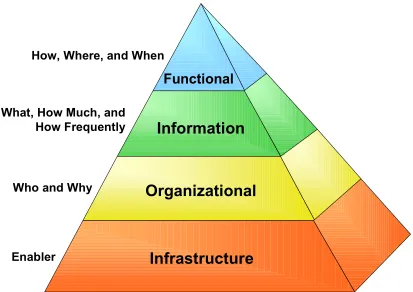
Figure 6. Structure of the FEAF Components ... 26
Figure 7. FEAF Architecture Matrix... 26
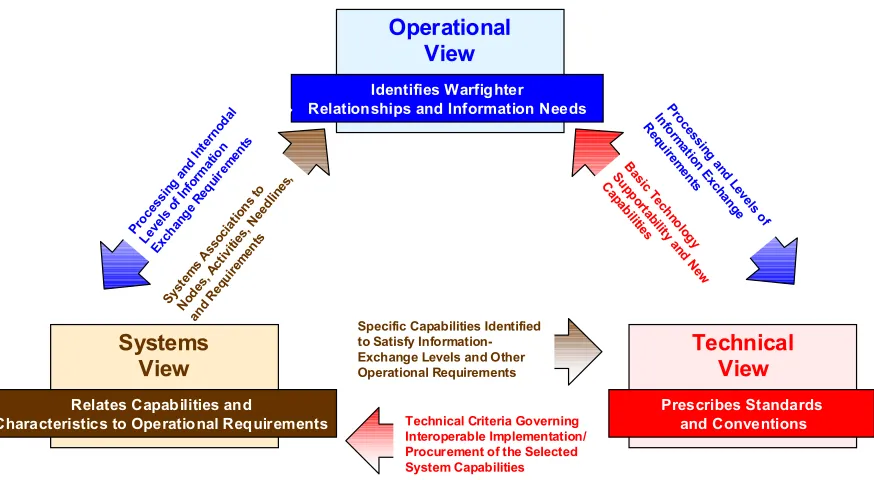
Figure 8. DoD C4ISR Framework ... 27
Figure 9. DoD C4ISR Products ... 28
Figure 10. The Treasury Enterprise Architecture Framework ... 29
Figure 11. TEAF Products ... 30
Figure 12. Example Approach for EA Development... 33
Figure 13. Systems Migration Chart ... 40
Figure 14. IMP/Architecture Project Assessment Framework ... 44
Figure 15. Architecture Management ... 45
Figure 16. Define New and Follow-on Programs/Projects ... 48
Figure 17. Execute Programs/Projects ... 51
Figure 18. Evaluate Programs/Projects... 53
Figure 19. Enterprise Architecture Transition ... 56
Figure 20. Key Success Factors ... 61
Figure 21. DoD Battlespace Concept of Operations Graphic ... 74
Figure 22. U.S. Customs Service Trade Compliance Concept of Operations Graphic... 75
Figure 23. Generic IDEF Activity Model ... 77
Figure 24. U.S. Customs, ACS, Activity Tree... 77
Figure 25. U.S. Customs, Trade Compliance, UML Activity Model ... 78
Figure 26. U.S. Customs, Trade Compliance—External, UML Use Case Diagram ... 79
Figure 27. U.S. Customs, Trade Compliance—Internal, UML Use Case Diagram ... 79
Figure 28. U.S. Customs, Trade Compliance, Declare Goods, UML Use Case Specification... 80
Figure 29. U.S. Customs, Trade Compliance, Commercial View, UML Class Diagram... 81
Figure 30. U.S. Customs, Trade Compliance, Carrier, UML State Diagram ... 82
Figure 31. U.S. Customs, ACS, Customs Systems, Node Connectivity Diagram... 84
Figure 32. U.S. Customs, ACS, N2 Chart... 85
Figure 33. U.S. Air Force Node Connectivity Diagram ... 86
Figure 34. Generic Organization Chart... 88
Figure 35. Generic System Interface Description Connectivity Diagram ... 89
Figure 36. Standards Profile Table ... 90
Figure 37. U.S. Customs Technical Reference Model... 90
Figure 38. Generic TRM Domain and Sub-domain Definitions and Components... 91
List of Tables
Table 1. EAPMO Roles and Responsibilities ... 17
Table 2. Framework Selection Criteria... 25
Table 3. Tool Selection Criteria... 31
Table 4. Baseline and Target Architecture Differentiators ... 35
Table 5. EA Review Goals... 50
1.
Introduction
1.1.
Purpose
The purpose of this document is to provide guidance to Federal Agencies in initiating,
developing, using, and maintaining an enterprise architecture (EA). This guide offers an end-to-end process to initiate, implement, and sustain an EA program, and describes the necessary roles and associated responsibilities for a successful EA program.
An EA establishes the Agency-wide roadmap to achieve an Agency’s mission through optimal performance of its core business processes within an efficient information technology (IT) environment. Simply stated, enterprise architectures are “blueprints” for systematically and completely defining an organization’s current (baseline) or desired (target) environment.
Enterprise architectures are essential for evolving information systems, developing new systems, and inserting emerging technologies that optimize their mission value. While some agencies have enterprise architectures in place, others do not. For agencies that already have an EA in place, this guide should be tailored to fit these Agencies’ needs. For smaller agencies, a streamlined version of the guide should be created to support the needs of the Agency.
1.2.
Scope
This guide focuses on EA processes, products, and roles and responsibilities. While this guide addresses the enterprise life cycle, it describes in detail how the EA processes relate to enterprise engineering, program management, and capital planning and investment control (CPIC)
processes.
The breadth and depth of information presented here should be tailored to your organization. Some examples are presented in the appendices, and references to supplementary material are included in the text or bibliography. Feel free to individualize these examples as needed.
1.3.
Audience
This guide is intended primarily for Federal Agency architects tasked with the generation and institutionalization of EAs. This document provides guidance to Agencies that currently do not have EAs and those that can benefit from improvements in their EA methods for development and maintenance. For Agencies without an EA, this document provides useful guidance to the Agency Head and the Chief Information Officer (CIO) for educating and obtaining key stakeholder commitment in establishing an effective EA.
This guide is also aimed at CPIC process participants [e.g., investment review boards, and the Office of Management and Budget (OMB)], as well as enterprise engineering and program management process participants (e.g., program/project managers, systems engineers, application architects, systems developers, configuration managers, risk managers, and security engineers).
Although the guide specifically addresses the roles and responsibilities of major players in the architecture development process, it is also a handbook for anyone who needs to know more about the EA process. Regardless of your role or responsibility—whether you have sole
A Practical Guide to Federal Enterprise Architecture Introduction
1.4.
Document Organization
The document is organized as follows:
Section 1: Introduction Defines the purpose, scope, audience, and organization of the document.
Section 2: Definitions, Drivers, and Principles
Presents the context for the EA process, i.e., principles and legislative drivers, and defines the architecture development, implementation, and maintenance process.
Section 3: Initiate Enterprise Architecture Program
Defines EA program procedural steps to initiate the program, typical EA organization, and products of the EA.
Section 4: Define an
Architecture Process and Approach
Defines a process for building an enterprise architecture and describes federally developed frameworks.
Section 5: Develop the Enterprise Architecture
Provides the procedural steps for developing baseline and target architectures and a sequencing plan.
Section 6: Use the Enterprise Architecture
Demonstrates how the EA process interacts with capital planning and investment control and with the Systems Life Cycle.
Section 7: Maintain the Enterprise Architecture
Discusses processes and procedures to maintain EA products throughout the life-cycle process.
Section 8: Continuously
Control and Oversee the EA Program
Section 9: Summary
Provides guidelines to ensure EA processes and practices are being followed and remedies and corrective actions applied when warranted.
Presents highlights of the EA guide and provides final recommendations for the initiation and implementation of a successful EA program.
Appendix A: EA Roles and Responsibilities
Provides a concise description of key personnel roles and responsibilities for EA development,
implementation, and maintenance.
Appendix B: Glossary Provides a definition of terms used within this document.
Appendix C: Acronyms Provides a list of all acronyms used within this document.
Appendix D: Example Architecture Products
A Practical Guide to Federal Enterprise Architecture Introduction
Appendix E: Sample Architectural Principles
Describes samples of the essential architectural principles that are a starting point in the architecture process.
Appendix F: Bibliography Provides a list of key documents used during the development of this guide and other informative source documentation.
Appendix G: The Zachman Framework
Presents a brief background and description of the Zachman Framework and its application to enterprise architecture.
1.5.
How to Use this Guide
This guide is a “how-to” manual for Federal Agency architects and stakeholders in the initiation, development, use, and maintenance of EAs. To find an answer to your specific need or question, please consult the following table for frequently asked questions. These and many other
questions are answered throughout the guide.
Question Section
1. Why develop an EA? 2.0
2. What are the primary benefits of using an EA? 2.0
3. What are the legislative drivers and mandates for using an
EA?
2.0
4. What is the Enterprise Life Cycle? 2.0
5. What is a baseline architecture? 2.0
6. What is a target architecture? 2.0
7. What is a sequencing plan? 2.0
8. How does the EA process relate to the CPIC process? 3.0
9. Who is responsible for architecture policies? 3.0
10. Who is responsible for the EA? 3.0
11. How does one market the selected approach to senior
executives?
3.0
12. What are frameworks and how do I select one? 4.0
13. How do I create a baseline or target architecture? 5.0
14. How do I transition from the baseline to the target? 5.0
15. How is the EA used within the CPIC process to justify
information technology investments?
6.0
16. How do architecture processes relate to other enterprise
engineering activities?
6.0
17. How does a project manager or application architect ensure
alignment to the EA when proposing a new project?
6.0
18. How do I maintain the EA in the midst of evolving systems
and new business requirements?
7.0
A Practical Guide to Federal Enterprise Architecture Introduction
Question Section
developing and maintaining an EA?
20. What do architectural products look like? Appendix D
21. What are EA architectural principles? 2.0 and Appendix E
22. Where can I find more EA information? Appendix F and G
1.6.
Related Documents
• Federal Enterprise Architecture Framework (FEAF), issued by the Federal CIO Council,
dated September 1999.
The FEAF provides guidance for developing, maintaining, and facilitating enterprise architectures in the Federal government.
• Architecture Alignment and Assessment Guide, produced for the Federal CIO Council by the Federal Architecture Working Group (FAWG), dated October 2000.
• Smart Practices in CapitalPlanning, produced by the FAWG and the Capital Planning and
IT Management Committee, dated October 2000.
Together with GAO and OMB guidance, these documents provide guidance on the interaction and integration of the CPIC and EA processes. Collectively, these documents describe the CPIC and EA processes working as a governance mechanism to ensure successful organizational change and information technology (IT) investments to support that change.
2.
Definitions, Drivers, and Principles
2.1.
Enterprise Architecture Defined
EA terminology carries many variations within each organization and in the vast array of literature. Therefore, the authors have settled on one consistent set of definitions for key terms used within this guide. The definition for
Enterprise Architecture is the endorsed definition from the Federal CIO Council and appears in the September 1999 version of the
FEAF. Although the term enterprise is defined
in terms of an organization, it must be understood that in many cases, the enterprise may transcend established organizational boundaries (e.g., trade, grant management, financial management, logistics).
Appendix B contains a listing of additional terms, their definitions, and the source authority.
2.2.
The Uses and Benefits of Enterprise
Architecture
In general, the essential reasons for developing an EA include:
• Alignment—ensuring the reality of the implemented enterprise is aligned with management’s intent
• Integration—realizing that the business rules are consistent across the
organization, that the data and its use are immutable, interfaces and
information flow are standardized, and the connectivity and interoperability are managed across the enterprise
• Change—facilitating and managing change to any aspect of the enterprise
• Time-to-market—reducing systems development, applications generation, modernization timeframes, and resource requirements
• Convergence—striving toward a standard IT product portfolio as contained in the Technical Reference Model (TRM).
Key Definitions
Architecturethe structure of components, their interrelationships, and the principles and
guidelines governing their design and evolution over time.
Enterprisean organization (or cross-organizational entity) supporting a defined business scope and mission. An enterprise includes interdependent resources (people, organizations, and technology) who must coordinate their functions and share information in support of a common mission (or set of related missions).
Baseline architecturethe set of products that portray the existing enterprise, the current business practices, and technical infrastructure. Commonly referred to as the “As-Is”
architecture.
Target architecturethe set of products that portray the future or end-state enterprise, generally captured in the organization’s strategic thinking and plans. Commonly referred to as the “To-Be” architecture.
Sequencing Plana document that defines the strategy for changing the enterprise from the current baseline to the target architecture. It schedules multiple, concurrent, interdependent activities, and incremental builds that will evolve the enterprise.
Enterprise Architecture Productsthe graphics, models, and/or narrative that depicts the enterprise environment and design.
Enterprise Architecturea strategic information asset base, which defines the
A Practical Guide to Federal Enterprise Architecture Definitions, Drivers, and Principles
An EA offers tangible benefits to the enterprise and those responsible for evolving the enterprise. The EA can:
• Capture facts about the mission, functions, and business foundation in an understandable
manner to promote better planning and decision making
• Improve communication among the business organizations and IT organizations within
the enterprise through a standardized vocabulary
• Provide architectural views that help communicate the complexity of large systems and
facilitate management of extensive, complex environments
• Focus on the strategic use of emerging technologies to better manage the enterprise’s
information and consistently insert those technologies into the enterprise
• Improve consistency, accuracy, timeliness, integrity, quality, availability, access, and
sharing of IT-managed information across the enterprise
• Support the CPIC processes by providing a tool for assessment of benefits, impacts, and
capital investment measurements and supporting analyses of alternatives, risks, and tradeoffs
• Highlight opportunities for building greater quality and flexibility into applications
without increasing cost
• Achieve economies of scale by providing mechanisms for sharing services across the
enterprise
• Expedite integration of legacy, migration, and new systems
• Ensure legal and regulatory compliance.
The primary purpose of an EA is to inform, guide, and constrain the decisions for the enterprise,
especially those related to IT investments. The true challenge of enterprise engineering is to maintain the architecture as a primary authoritative resource for enterprise IT planning. This goal is not met via enforced policy, but by the value and utility of the information provided by the EA.
2.3.
Legislation and other Guidance
Within the Federal government, numerous rules and regulations govern the development and execution of IT policy. These guidelines have been established to better manage strategic plans, enhance IT acquisition practices, justify IT expenditures, measure IT performance, report results to Congress, integrate new technologies, and manage information resources.
The Clinger-Cohen Act holds each Agency CIO responsible for developing, maintaining, and facilitating the implementation of an information technical architecture. Executive Order 13011, Federal Information Technology, established the Federal CIO Council as the principal
interagency forum for improving practices in the design, modernization, employment, sharing, and performance of Agency information resources. Sections 1 through 3 of the Federal CIO
Council’s Architecture Alignment and Assessment Guide describe IT reform and its evolution.
A Practical Guide to Federal Enterprise Architecture Definitions, Drivers, and Principles
Additional sources of mandates and drivers for EA include:
• Government Paperwork Elimination Act (GPEA)
• Freedom of Information Act (FOIA) and Amendments
• Government Performance Results Act of 1993 (GPRA)
• OMB Circulars A–130 and A–11
• GAO Guidance, Findings, and Recommendations
• Federal CIO Council documents.
2.4.
Architecture Principles
Principles establish the basis for a set of rules and behaviors for an organization. There are principles that govern the EA process and principles that govern the implementation of the architecture. Architectural principles for the EA process affect development, maintenance, and use of the EA. Architectural principles for EA implementation establish the first tenets and related decision-making guidance for designing and developing information systems.
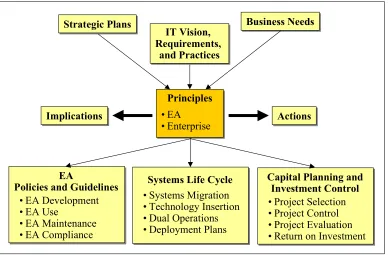
The Chief Architect, in conjunction with the CIO and select Agency business managers, defines the architectural principles that map to the organization’s IT vision and strategic plans. As shown in Figure 1, architectural principles should represent fundamental requirements and practices believed to be good for the organization. These principles should be refined to meet Agency business needs. It should be possible to map specific actions, such as EA development, systems acquisitions, and implementation, to the architectural principles. Deliberate and explicit
standards-oriented policies and guidelines for the EA development and implementation are generated in compliance with the principles. Each and every phase of the Systems Life Cycle is supported by the actions necessitated by the architecture principles. CPIC actions are governed by the implications within the principles.
Actions
Actions
Business Needs
Business Needs
Strategic Plans
Strategic Plans
Implications
Implications
EA
Policies and Guidelines • EA Development • EA Use
• EA Maintenance • EA Compliance
Principles • EA • Enterprise
IT Vision, Requirements,
and Practices
IT Vision, Requirements,
and Practices
Systems Life Cycle • Systems Migration • Technology Insertion • Dual Operations • Deployment Plans
Capital Planning and Investment Control • Project Selection • Project Control • Project Evaluation • Return on Investment
A Practical Guide to Federal Enterprise Architecture Definitions, Drivers, and Principles
Appendix E provides sample EA principles for consideration as a starting point, as well as the rationale for and the impact of implementing each principle. Each Agency should apply, add to, or modify these sample principles. Formulating these supporting statements should be an essential part of an Agency’s effort to define its principles.
2.5.
The Enterprise Life Cycle
The enterprise life cycle is the dynamic, iterative process of changing the enterprise over time by incorporating new business processes, new technology, and new capabilities, as well as
maintenance and disposition of existing elements of the enterprise.
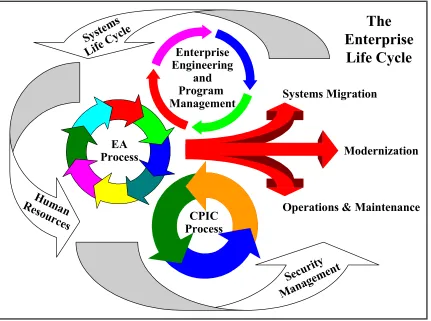
Although the EA process is the primary topic of this guide, it cannot be discussed without consideration of other closely related processes. These include the enterprise engineering and program management cycle (more commonly known as the system development/acquisition life cycle) that aids in the implementation of an EA, and the CPIC process that selects, controls, and evaluates investments. Overlying these processes are human capital management and
information security management. When these processes work together effectively, the
enterprise can effectively manage IT as a strategic resource and business process enabler. When these processes are properly synchronized, systems migrate efficiently from legacy technology environments through evolutionary and incremental developments, and the Agency is able to demonstrate its return on investment. Figure 2 illustrates the interaction of the dynamic and interactive cycles as they would occur over time.
Enterprise Engineering
and Program Management
CPIC Process
Modernization Systems Migration
Operations & Maintenance EA
Process
Securi ty
Manage ment Hu
man
Resources
The
Enterprise
Life Cycle
System
s
Life Cycle
A Practical Guide to Federal Enterprise Architecture Definitions, Drivers, and Principles
2.6.
The Enterprise Architecture Process
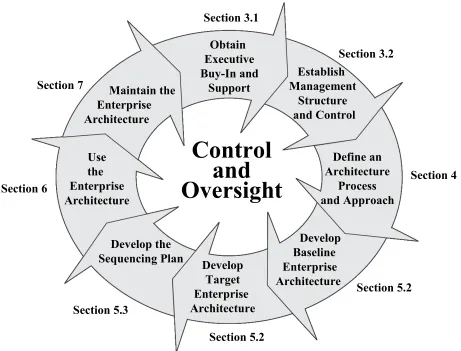
As a prerequisite to the development of every enterprise architecture, each Agency should establish the need to develop an EA and formulate a strategy that includes the definition of a vision, objectives, and principles. Figure 3 shows a representation of the EA process. Executive buy-in and support should be established and an architectural team created within the
organization. The team defines an approach and process tailored to Agency needs. The architecture team implements the process to build both the baseline and target EAs. The
architecture team also generates a sequencing plan for the transition of systems, applications, and associated business practices predicated upon a detailed gap analysis. The architecture is
employed in the CPIC and the enterprise engineering and program management processes via prioritized, incremental projects and the insertion of emerging new technologies. Lastly, the architectures are maintained through a continuous modification to reflect the Agency’s current baseline and target business practices, organizational goals, visions, technology, and
infrastructure.
Obtain
Executive
Buy-In and
Support
Establish
Management
Structure
and Control
Define an
Architecture
Process
and Approach
Develop
Baseline
Enterprise
Architecture
Develop
Target
Enterprise
Architecture
Develop the
Sequencing Plan
Use
the
Enterprise
Architecture
Maintain the
Enterprise
Architecture
Section 3.1
Section 3.2
Section 4
Section 5.2
Section 5.2
Section 5.3
Section 6
Section 7
Control
and
Oversight
Control
and
Oversight
3.
Initiate Enterprise Architecture Program
The enterprise architecture is a corporate asset that should be managed as a formal program. Successful execution of the EA process is an Agency-wide endeavor requiring management, allocation of resources, continuity, and coordination. Agency business line executives should work closely with the Agency architecture team to produce a description of the Agency’s operations, a vision of the future, and an investment and technology strategy for accomplishing defined goals.
Experience shows that obtaining the needed cooperation among Agency executives is not an easy task. Creating an EA program calls for sustained leadership and strong commitment. This degree of sponsorship and commitment needs the buy-in of the Agency Head, leadership by the CIO, and early designation of a Chief Architect.
3.1.
Obtain Executive Buy-in and Support
Gaining executive commitment to any new initiative requires the development of a strong
business case and a communications approach to effectively convey that business case. Since the concept of an EA is not intuitively understood outside the CIO organization, the CIO should create a marketing strategy to communicate the strategic and tactical value for EA development to the Agency Head, other senior Agency executives, and business units.
3.1.1.
Ensure Agency Head Buy-in and Support
Without buy-in from the Agency Head, the CIO will find it hard to maintain the necessary sponsorship desired to fund and implement improved systems and processes. The CIO takes the lead to provide understanding and gain the Agency Head’s buy-in. This can be accomplished by:
• Leveraging success stories from other Agency and private sector organizations as well as
the experience and knowledge of EA experts
• Using examples to demonstrate how an EA can provide a blueprint and roadmap for
desired changes or improvements in mission performance and accountability
• Emphasizing the legislative requirements for developing, maintaining, and implementing
an EA within the Federal sector.
Once the CIO is assured the Agency Head understands the need for an EA, it is important to secure the Agency Head’s commitment to pursue the architecture effort. The CIO accomplishes this by mobilizing the Agency Head’s appreciation into the expression of clear, Agency-wide support. This will establish a mandate to business and CIO executives to support the effort by allocating the needed time and resources. The CIO should coordinate with the Agency Head on the selection of an Agency executive to be designated as the Chief Architect. Experience demonstrates that the CIO’s authority alone is insufficient to make the endeavor a success. A clear mandate from the Agency Head is a prerequisite to success.
3.1.2.
Issue an Executive Enterprise Architecture Policy
A Practical Guide to Federal Enterprise Architecture Initiate Enterprise Architecture Program
• Description of the purpose and value of an EA
• Description of the relationship of the EA to the Agency’s strategic vision and plans
• Description of the relationship of the EA to capital planning, enterprise engineering, and
program management
• Translation of business strategies into EA goals, objectives, and strategies
• Commitment to develop, implement, and maintain an EA
• Identification of EA compliance as one criterion for new and ongoing investments
• Overview of an enforcement policy
• Security practices to include certification and accreditation
• Appointment of the Chief Architect and establishment of an EA core team
• Establishment of the EA Program Management Office (EAPMO)
• Establishment of the EA Executive Steering Committee (EAESC).
3.1.3.
Obtain Support from Senior Executives and Business Units
Commitment and participation of the Agency’s senior executive and business teams are vitally important. The CIO should initiate a marketing program to emphasize the value of the
architecture and the Agency Head’s support and commitment. The senior executive team and its organizational units are both stakeholders and users of the architecture. Therefore, the CIO invests time and effort in familiarizing the staff with what an EA is and how it can help achieve organizational goals and commitments. Even though the target audience varies among Agencies, the audience for Departments should include the Deputy and Under Secretaries and the Assistant Secretaries and their key staffs. For Agencies, the audience should include the Deputy and Assistant Administrators, Commissioners, or Bureau Chiefs.
The primary goal of educating the Department and Agency senior executives is to obtain their concurrence and commitment to having their organizations as active participants. Participation can involve the executives (or their designees) in attending planning sessions, committing resources (people and funding) for specific tasks, or becoming a champion or spokesperson for the effort. Maintaining the participation and support of key executives is crucial to sustaining a successful effort.
The Chief Architect should create a plan to obtain the support of the enterprise’s business units. It is recommended that the business units establish an "inner circle" of domain owners and subject matter experts (SMEs). This leadership group should consist of business unit managers who “own” specific lines of business. This leadership group should be able to understand and communicate enterprise goals and objectives, and to think creatively, with consideration of budgets and other constraints. This group of managers is responsible for ensuring that the business layers of the architecture are properly documented, and that the sequencing plan makes sense from the perspective of the business strategy, considering both automated and non-automated processes.
A Practical Guide to Federal Enterprise Architecture Initiate Enterprise Architecture Program
promote buy-in by program participants at middle and lower levels of the organization. After several of the first EA products are developed and analyzed, the products and analysis should be disseminated throughout the Agency and its communities of interest to demonstrate the value of these early results and achieve maximum exposure for the benefits of the EA development effort.
3.2.
Establish Management Structure and Control
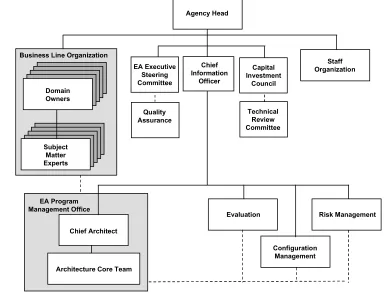
Figure 4 illustrates a notional program organization to manage, control, and monitor EA activity and progress. The organization shows the desired functional roles, interrelationships, and lines of communication. The organization structure should facilitate and advance the performance of EA roles and responsibilities. The roles of the EAESC, Technical Review Committee (TRC), and the EA Program Management Office are unique to the
introduction of the EA process. Other roles, such as Quality Assurance (QA), Configuration Management (CM), Risk Management (RM), Security, and Evaluation are customary IT support roles. These roles are expanded to explicitly include EA-related responsibilities.
EA roles should be evaluated based on the size of the organization, the complexity of the business and architecture, and other factors to effectively determine the correlation of roles assigned to personnel. In a large organization with complex business processes, an individual may be responsible for one specific role. In smaller Agencies or organizations, an individual may be assigned several roles and responsibilities.
Chief Architect
Architecture Core Team EA Program
Management Office
Technical Review Committee
Risk Management
Configuration Management Evaluation
Agency Head
Chief Information
Officer
Subject Matter Experts
Domain Owners
Business Line Organization
Staff Organization
Quality Assurance
Capital Investment
Council EA Executive
Steering Committee
Figure 4. Notional EA Organization
A Practical Guide to Federal Enterprise Architecture Initiate Enterprise Architecture Program
3.2.1.
Establish a Technical Review Committee
The CIO should charter and appoint a Technical Review Committee to manage the review of candidate projects and assess project alignment with the EA. Once the EA has been developed and approved, the TRC assesses each proposed investment for compliance with the architecture. The TRC reports their conclusions and provides recommendations to a Capital Investment Council (CIC).
In all cases, the TRC determines and documents the results and the accompanying rationale for its actions. The TRC reviews a project and assesses if:
• The project completely aligns with the EA
• The project does not align with the EA and an alternate course of action is needed
• The project does not align with the EA and a waiver is approved.
The TRC approves a waiver only if the impacts of the lack of alignment are understood and acceptable. By approving a waiver, the TRC conveys to the CIC that it does not object to the proposed project.
3.2.2.
Establish a Capital Investment Council
The Agency Head establishes a CIC to achieve informed decision making regarding costs, benefits, risks of alternative investment options and architectural alignment. The goal of the CIC is to ensure enterprise and application architecture projects are feasible from a cost-benefit standpoint. The CIC reviews proposed IT investments and makes the final investment funding decision. It accepts program and project proposals that have been assessed by the TRC and determines whether these programs/projects fit within the overall budgetary and funding goals for the enterprise. While a project may be technically aligned with the EA, the CIC may reject funding for a project because of other external constraints or budgetary reasons. CIC decisions may necessitate updates to the sequencing plan.
3.2.3.
Establish an EA Executive Steering Committee
The Agency Head establishes an EA Executive Steering Committee to direct, oversee, and approve the EA and EA program. The EAESC is responsible for approving the initial EA, approving significant changes to the EA, and approving the EA Program Plan.
The EAESC should be formally chartered, with a designated chair or co-chairs, and empowered to ensure Agency-wide strategic direction, oversight, and decision-making authority for the EA. The EAESC charter should authorize the chair or co-chairs to appoint the membership. By charter, the EAESC membership should consist of active participants that represent and include all major Agency business and technology areas. To perform effectively as a decision-making body, it is crucial that the EAESC members are senior leaders, with the authority to commit resources and make and enforce decisions within their respective organizations.
3.2.4.
Appoint Chief Architect
A Practical Guide to Federal Enterprise Architecture Initiate Enterprise Architecture Program
architectural development processes and the content of the EA products. The Chief Architect should be friend and liaison to the business line units and ensure that business unit processes are emphasized in the EA. Likewise, the Chief Architect is responsible for ensuring that the EA provides the best possible information and guidance to IT projects and stakeholders, and that systems development efforts are properly aligned with business unit requirements.
In the role of EA Program Manager, the Chief Architect has management responsibility for the EA program, with the authority, responsibility, and accountability for the overall architectural effort. The Program Manager is responsible for the planning, staffing, and ultimate success of the program, including acquisition of sustaining funding, negotiating schedules, timely and accurate delivery of the EA products, and the establishment of an appropriate support environment that ensures proper application of these assets.
The core competencies of the Chief Architect include expertise in strategic and technical planning, policy development, capital planning and investment control, change management, systems engineering and architectural design, business process reengineering, and large-scale program management. In addition, the Chief Architect becomes completely conversant with the Agency’s business and IT environments. As the primary technical leader of this effort, the Chief Architect should be a good communicator who can bridge the cultural differences that often exist between the business and systems organizations, and facilitate interaction and cooperation between these two cultures.
3.2.5.
Establish an Enterprise Architecture Program Management Office
The EA effort should be treated as a formal program with full sponsorship through the Agency's CPIC process. An EA Program Management Office should be established to manage, monitor, and control the development and maintenance of the EA. The EAPMO staff includes
experienced architects. The EAPMO identifies and performs cost analyses of alternative approaches for developing the EA, and manages in-house or outside contractor EA development work. The EAPMO is also charged with determining needed resources and securing funding and resource commitments.
A primary goal of the EAPMO and the EAESC is to ensure success of the EA program. Each phase of the program (i.e., EA development, use, and maintenance) is subject to the CIC policies and procedures for investment decisions.
3.2.5.1.
Appoint Key Personnel
The CIO should make the EA an explicit responsibility for those individuals designated as the organization’s Evaluators, Risk Manager, and Configuration Manager. The Risk Manager identifies, monitors, controls, and mitigates EA program risks in light of environmental factors (e.g., external business constraints, and technical constraints). The Configuration Manager assumes responsibility for configuration management of the EA products in the same way that configuration management is imposed on any other engineering baseline.
A Practical Guide to Federal Enterprise Architecture Initiate Enterprise Architecture Program
conduct an IV&V review or enlist the services of a non-profit entity such as a Federally Funded Research and Development Center (FFRDC).
3.2.5.2.
Establish Enterprise Architecture Core Team
At the same time the Agency Head and CIO achieve business line ownership of the effort, a core team of IT experts, business line experts, and technologists should be assigned to develop the desired process and procedures used throughout the development effort. Participants should have an understanding of the current business and technical environment and the strategic business objectives envisioned in the EA. The team includes the Chief Architect; senior business, systems, data, infrastructure and security systems architects. This team should be well grounded in the existing environment and prepared to document and develop the EA that will support evolving business needs.
The architecture core team should include IT representatives from the Agency's applications, data, and infrastructure organizations. The specific core teamwork groups should include business analysts, data analysts, systems designers, security specialists, and systems
programmers. As the program gets underway, more resources/team members are typically added to the architecture core team. The architecture core team will include program managers
proficient in managing Agency-wide programs as well as interagency initiatives.
The EA core team is responsible for all activities involving the development, implementation, maintenance, and management of the architecture. This includes:
• Developing EA processes, procedures, and standards
• Developing baseline and target architectures
• Developing and maintaining an EA repository
• Performing quality assurance, risk management, and configuration management
• Guiding systems development and acquisition efforts
• Defining EA performance measures.
A Practical Guide to Federal Enterprise Architecture Initiate Enterprise Architecture Program
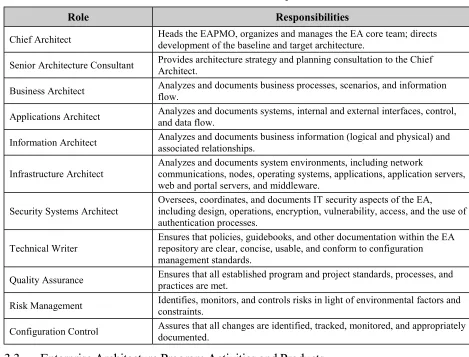
Table 1. EAPMO Roles and Responsibilities
Role Responsibilities
Chief Architect Heads the EAPMO, organizes and manages the EA core team; directsdevelopment of the baseline and target architecture.
Senior Architecture Consultant Provides architecture strategy and planning consultation to the ChiefArchitect.
Business Architect Analyzes and documents business processes, scenarios, and informationflow.
Applications Architect Analyzes and documents systems, internal and external interfaces, control,and data flow.
Information Architect Analyzes and documents business information (logical and physical) andassociated relationships.
Infrastructure Architect Analyzes and documents system environments, including networkcommunications, nodes, operating systems, applications, application servers, web and portal servers, and middleware.
Security Systems Architect Oversees, coordinates, and documents IT security aspects of the EA,including design, operations, encryption, vulnerability, access, and the use of authentication processes.
Technical Writer Ensures that policies, guidebooks, and other documentation within the EArepository are clear, concise, usable, and conform to configuration management standards.
Quality Assurance Ensures that all established program and project standards, processes, andpractices are met.
Risk Management Identifies, monitors, and controls risks in light of environmental factors andconstraints.
Configuration Control Assures that all changes are identified, tracked, monitored, and appropriatelydocumented.
3.3.
Enterprise Architecture Program Activities and Products
3.3.1.
Develop an EA Marketing Strategy and Communications Plan
The purpose of the marketing strategy and communications plan is (1) to keep senior executives and business units continually informed, and (2) to disseminate EA information to management teams. The CIO’s staff, in cooperation with the Chief Architect and support staff, defines a marketing and communications plan consisting of (a) constituencies, (b) level of detail, (c) means of communication, (d) participant feedback, (e) schedule for marketing efforts, and (f) method of evaluating progress and buy-in. It is the CIO’s role to interpret the Agency Head’s vision and to recognize innovative ideas (e.g., the creation of a digital government) that can become key drivers within the EA strategy and plan. If resources permit, the Chief Architect should use one or all of the following tools to communicate with the community of interest: seminars and forums, web pages, electronic surveys, and e-mail listservs.
A Practical Guide to Federal Enterprise Architecture Initiate Enterprise Architecture Program
The primer should describe the tenets of the EA and its many benefits as an agent of change in achieving organizational goals (e.g., integrating business services and initiatives) or as a critical resource to evaluate options for change as business and technology needs evolve. The primer should clearly describe the roles and responsibilities of the senior executives and their
organizational units in developing, implementing, and maintaining the EA. It is important that the primer include customized sections that relate directly to specific business line audiences.
The primer should demonstrate the benefits of an EA for the Agency's stakeholders. This is particularly important since many of the stakeholders may be needed to provide skilled resources, support, and time to the effort. Once completed, the primer should be widely distributed
throughout the Agency and made available on the Agency's web site. It should be briefed to all personnel impacted by the introduction of the EA. Introductory materials drawn from the primer should be incorporated into local and Agency-wide training programs.
3.3.2.
Develop an EA Program Management Plan
A formal plan is desired for sound program management. The EAPMO creates an EA program management plan (PMP) that includes a roadmap to accomplish the goals set by the EAESC and implementation plans to achieve those goals. The plan should include goals for the Chief Architect in setting Agency-wide architectural objectives. These goals should help the architecture team establish and maintain lower-level architectures that comply with the EA.
The PMP delineates plans and a set of actions to develop, use, and maintain the EA, including EA management, control, and oversight. To facilitate the tracking of cost, schedule, and performance data, oversight and control procedures should be developed, documented, and implemented within the PMP. The PMP should also include:
• Requirements for the EA Program Manager to identify all funding requirements,
spending timelines/schedules, and links to performance measures
• A Work Breakdown Structure (WBS) detailing the tasks and subtasks necessary to
acquire, develop, and maintain the architecture
• Resource estimates for funding, staffing, training, workspace requirements, and
equipment needs
• Roadmap for the initiation of project plans
• Requirements for performing quality assurance, risk management, configuration
management, and security management
• Requirements for the establishment and maintenance of an EA information repository.
3.3.3.
Initiate Development of the Enterprise Architecture
Once the EAPMO is in place and the PMP is produced, the first of the architecture projects is launched. There are several peripheral activities associated with the start of this development. The EAPMO’s initial project will:
• Institute PMP practices
• Establish EA development processes and management practices
• Train EA project participants
• Build baseline EA products
A Practical Guide to Federal Enterprise Architecture Initiate Enterprise Architecture Program
• Create the sequencing plan
• Populate the EA repository.
Goals:
• Build a baseline architecture that represents reality
• Build a target architecture that represents the business vision and IT strategies
• Develop a sequencing plan that describes an incremental strategy for transitioning the baseline to the target
• Publish an approved EA and
sequencing plan that are accessible by agency employees
Define an Architecture Process and Approach
4.
Define an Architecture Process and Approach
The next step in the EA process is establishing an EA process and approach. The EA will be used as a tool to facilitate and manage change within the Agency organization. The scope and nature of the Agency and the changes to be made will dictate the scope and nature of the architecture to be developed. While the EA is an excellent tool to manage large and complex environments, the depth and detail of the EA needs to be tailored to the individual enterprise. Figure 5 illustrates how the depth and detail in the EA varies not only with the size and complexity of the enterprise,
but also the many types of risks associated with change. Regardless, the scope of the enterprise architecture for the strategic planner and business owner views (as defined by the architecture framework selected) needs to encompass the entire enterprise. The agency will understand the relationships and dependencies among its lines-of-business and thus position itself to make informed decisions on how to approach defining EA depth and detail for these lines-of-business. The first activity in this process is to determine the intended use of the architecture. It drives the rest of the EA development process. The subsequent activities describe how to scope,
characterize, select EA products, build, and use the EA.
Before actually developing the EA, an Agency needs to evaluate and select an architectural framework as guidance. This section describes several candidate frameworks currently used within the Federal community. The selection of a framework is contingent on the purpose of the EA and the products to be developed.
Additionally, a toolset or repository for the EA
development and use should be employed. The chosen tool should be commensurate with the products to be generated.
Size
Complexity
Risk
Depth & Detail
A Practical Guide to Federal Enterprise Architecture Define an Architecture Process and Approach
4.1.
Define the Intended Use of the Architecture
Architectures should be built with a specific purpose in mind. It could be business process reengineering, systems acquisition, system-of-systems migration or integration, user training, interoperability evaluation, or any other intent. The purpose of the architecture is closely tied to the organization’s Strategic Plan(s), legislation such as GPRA and Clinger-Cohen, and support of the capital investment process. Before an architect begins to describe an architecture, the
organization determines the changes the architecture is intended to facilitate, the issue(s) the architecture is intended to explore, the questions the architecture is expected to help answer, and the interests and perspectives of the audience and users. One important practical consideration is determining the types of analyses that will be performed; i.e., knowing that the architecture may be used as input to specific models or simulations can affect what to include and how to structure the products.
The purpose of the EA may, and likely will, evolve over time to meet new requirements. The Chief Architect should ensure that any such EA evolution does, in fact, meet the newly
determined requirements. This will increase the efficiency of the architecture development and create greater balance in the resulting architecture.
4.2.
Define the Scope of the Architecture
It is critically important that EA development be approached in a top-down, incremental manner, consistent with the hierarchical architectural views that are the building blocks of proven EA frameworks, including the ones discussed later in this guide. In doing so, it is equally important that the scope of the higher level business views of the EA span the entire enterprise or agency. By developing this enterprise-wide understanding of business processes and rules, and
information needs, flows, and locations, the agency will be positioned to make good decisions about whether the enterprise, and thus the EA, can be appropriately compartmentalized. Without doing so, scoping decisions about the EA run the risk of promoting “stove-piped” operations and systems environments, and ultimately sub-optimizing enterprise performance and accountability. Other considerations relevant to defining the scope of the EA include, but are not limited to:
• Relevance of activities, functions, organizations, timeframes, etc.
• Enterprise scope (intra- and inter-Agency domains)
• Operational scenarios, situations, and geographical areas to be considered
• Projected economic benefits
• Projected business and technical risk areas
• Projected availability and capabilities of specific technologies during the target timeframe
(applies to target architecture only).
Defining the scope leads the planners to project management factors that will contribute to these determinations, including the resources available for building the architecture as well as the resources and level of expertise available for analysis and design tasks.
4.3.
Determine the Depth of the Architecture
A Practical Guide to Federal Enterprise Architecture Define an Architecture Process and Approach
included, the architecture effort may prove infeasible given the time and resources available, or the architecture may be confusing and/or cluttered with details that are superfluous. EA
characteristics are influenced by the focus: whether primarily capturing the baseline vs. the target and vice-versa. It is equally important to predict the future uses of the architecture so that, within resource limitations, the architecture can be structured to accommodate future tailoring,
extension, or reuse. The depth and detail of the EA needs to be sufficient for its purpose.
4.4.
Select Appropriate EA Products
Essential products are those required for all architectures, while supporting products may be
necessary to fulfill specific informational needs. Only those supporting products that portray the desired characteristics should be built. The required products should help formulate the selection of a framework and associated toolset.
It is essential that the Chief Architect guide the
construction of the technical content to meet the needs of the EA, especially in the desired level of detail needed in the work products. If the content is at too high a level of abstraction, it may not be sufficiently useful to guide projects and reviews. If the content is too detailed, it may be difficult to manage.
4.4.1.
Select Products that Represent the Business of the
Enterprise
As the first step in identifying and creating the business definition, the Chief Architect determines which products can be used to provide an integrated view of the Agency core business. These include functional, informational, and organizational models. Functional or process models may be represented in several forms, including:
• Use Cases
• Activity Models/Trees
• IDEF [Integrated Computer Aided Manufacturing (ICAM) Definition]
business process models
• Concept of Operations (CONOPS)
• State Models.
Information models include class models and conceptual data models. Appropriate combinations of these models should be used to represent internal and external organizational participants, activities, inputs, outputs, flow of information, sequencing, interrelationships between data, and external interfaces. The models span the enterprise and represent the enterprise at the strategic level. Additional information and examples of these models are provided in Appendix D.
The business definition should be created in the baseline and target architectures and the
sequencing plan. In the baseline architecture, it represents the current state of business operations and information exchange within and across the organization. In the sequencing plan, it
Model—representations of reality: the information, activities,
relationships, and constraints.
Essential products—the graphics, models, and/or narratives that every architecture description must include, to support the scope and characteristics of the EA.
Supporting products—the graphics, models, and/or narratives that may be needed to further elaborate on essential products or to address particular domain or scope extensions (e.g., real-time or special performance
A Practical Guide to Federal Enterprise Architecture Define an Architecture Process and Approach
represents business changes and maps to planned systems and business improvements. In the target architecture, it represents planned business operations as expressed in business strategies and visions.
4.4.2.
Select Products that Represent Agency Technical Assets
The technical content of the EA represents the technical assets of the Agency. It consists of the logical and physical designs of the baseline and target architectures. At a minimum, this content includes designs of data, applications, and infrastructure (including hardware, software, and communications). These products identify information needs, software applications/programs, middleware, and underlying physical infrastructure supporting the current environment and needed to support the Concept of Operations (CONOPS) for the enterprise in its target state.
EA products created to support business content are often extended to represent the solution space. Thus, many of the models could be reused, extended, and referenced in order to define the technical architecture. The purpose of the technical architecture is to ensure that a conforming system satisfies a specific set of business needs and requirements. It provides the technical systems implementation guidelines for creating engineering specifications and developing products.
4.5.
Evaluate and Select a Framework
As each Federal Agency embarks on this stage of the
architecture process, it must select an appropriate architectural framework. A number of well-established frameworks are successfully used throughout the Federal sector. Alternatively, an Agency may choose to develop its own framework,
although the costs, benefits, and risks of doing so should be weighed against the risks of adopting or tailoring an existing framework. While Federal Agencies vary widely in their approach to architecture development and implementation, established frameworks permit comparisons and analyses across Agencies. Therefore, it is recommended that before an Agency develops a new framework (if an Agency has a mandated framework, it must be employed), it should investigate the use of other existing Federally developed frameworks.
Three Federally sponsored (and commonly accepted) architectural frameworks are used as candidate frameworks and for descriptive purposes within this EA guide. These contain essential and supporting products, and promote development of architectures that are complete,
understandable, and integratable. The organizations that developed these frameworks continue to tailor them to ensure parallel precepts, principles, and methodologies. The frameworks are:
• Federal Enterprise Architecture Framework (FEAF)
• Department of Defense (DoD) Command, Control, Communications, Computer,
Intelligence, Surveillance and Reconnaissance (C4ISR) Architecture Framework
• Treasury Enterprise Architecture Framework (TEAF).
Other EA frameworks exist and have been used in Government programs (e.g., Department of Agriculture’s framework and the National Institute of Standards and Technology [NIST] framework). This guide does not address these other frameworks because most organizations have standardized on the FEAF, C4ISR, and TEAF for EA development. In addition to EA frameworks, many processes exist that can be used to support framework development, such as
A Practical Guide to Federal Enterprise Architecture Define an Architecture Process and Approach
the Department of Energy’s corporate systems information architecture roadmap for IT systems implementation. Since a notional process is described in this guide, other Federal Agency EA processes are not discussed.
The use of an EA framework ensures uniformity and standardization when migrating and
integrating information systems. The selected framework will depend on the intended use, scope, and characteristics of the architecture to be developed. Table 2 lists major factors to consider.