Chapter 7
Atomic Structure and Periodicity
The Nature of Light: Classification of
Electromagnetic Radiation
Characteristics of Waves,
c
=
l
n
Wavelength, l, m
distance between
identical points on
successive waves
Frequency, n
,
1/s or Hz
number of waves that
pass a point per second
Speed, c
2.9979 x 10
8m/s
Amplitude, The depth or height of a wave
Speed of light in a vacuum:
c
=
3.00
´
10
8ms
Electromagnetic Radiation
A beam of light consists of two mutually
perpendicular oscillating fields: an oscillating
electric field and an oscillating magnetic field.
The direction of propagation of the beam is also perpendicular to the electric and magnetic fields.
Light is a wave.
When light passes through two closely spaced slits, an interference pattern is produced.
The Double-Slit Experiment
Constructive interferenceis a result of adding waves that are in phase.
Destructive interference is a result of adding waves that are out of phase.
This type of interference is typical of waves and demonstrates the wave nature of light.
A laser commonly used in the treatment of vascular skin lesions has a wavelength of 532 nm. What is the frequency of this radiation?
Conversion Between Wavelength and Frequency
Strategy We must convert the wavelength to meters and solve for frequency using c = λν.
Solution λ = 532 nm×
ν =
Setup Rearranging the equation to solve for frequency gives ν = . The speed of light, c, is 3.00×10⁸ m/s.
c λ
1×10⁻⁹ m
1 nm = 5.32×10⁻⁷ m
3.00×10⁸ m/s
5.32×10⁻⁷ m = 5.64×10¹⁴ s-1
Electromagnetic Waves
For electromagnetic waves
c
=
ln
n
=
c
l
=
3.00
´
10
8m s4.4
´
10
-6m
=
6.8
´
10
13 1s=
6.8
´
10
13Hz
Determine the frequency of light with a wavelength of 4.4 mm.
Calculate Frequency From Wavelength
c =
ln
,
n
=
c
/
l
The brilliant
red
colors
seen in fireworks are due
to the emission of light
with wavelengths around
650 nm
when
strontium
salts
such as
Sr(NO
3)
2and
SrCO
3are heated.
Calculate the
frequency
of
red light
of wavelength
6.50 x 10
2nm
.
Characteristics of Waves:
Wavelength, Frequency, and Energy
Our understanding of electromagnetic radiation (EM)
played a critical role in our understanding of atomic
structure. Compare red light, blue light, and x-rays and
arrange them in order so that the longest wavelength is
first, highest frequency is second, and finally the highest
energy is at the end of the list.
1. X-ray; x-rays; x-rays
2. Red; x-rays; blue
3. Blue; x-rays; red
4. Red; x-rays; x-rays
Energy of EM Radiation
While sitting in a dentist
’
s chair you are hit with several
forms of electromagnetic radiation. The bright light is
sending energy in the visible region, the body heat of the
dentist is emanating energy in the infrared region; perhaps
a radio is playing and some energy in the radio waves
region approach your ears; and you are about to receive an
x-ray. Which arrangement places the EM waves in proper
order with respect to increasing energy per photon?
1. Visible; infrared, radio; x-rays 2. X-rays; visible; radio; infrared 3. Infrared; radio; visible; x-rays 4. Radio; infrared; visible; x-rays
Quantum Theory
Matter (particles)
Has mass
Position in space can be specified
Energy (waves)
No mass
Position in space can not be specified
1900: Matter and energy are distinctly different
Blackbody
Radiation
Light given off by a hot blackbody The amount of energy given off at a certain
temperature depends on the wavelength.
~1000K
~1500K
Classical physics failed to explain Blackbody radiation
Assumed that matter could emit or absorb any quantity of energy.
Plank’s explanation for Blackbody radiation
Matter could NOTemit or absorb any quantity of energy. Energy is only emitted or absorbed in discrete quantities, like small
packages or bundles of energy.
A quantumis the smallest quantity (bundle) of energy that can be absorbed or emitted as EM radiation.
Energy of atoms is gained or lost only in whole-number multiples of the quantity hn, i.e., energy is absorbed or released by atoms in discrete “chunks” called quantaof sizehn.
E =
h
n
h = 6.626 x 10⁻³⁴ Js (Plank’s constant)n
= frequency of the em radiationBlackbody Radiation:
Electrified Pickle Emits Yellow
Light Due to Excited Na
+
Ions
Albert Einstein used Planck’s theory to explain the photoelectric effect.
Electrons are ejected from the surface of a metal exposed to light of a certain minimum frequency, called the
threshold frequency.
The number of electrons ejected is proportional to the intensity.
Below the threshold frequency no electrons were ejected, no matter how bright (or intense) the light.
1905: Photons and the Photoelectric Effect
Einstein proposed that the beam of light is really a stream of particles.
These particles of light are now called
photons.
Each photon (of the incident light) must posses the energy given by the equation:
Photons and the Photoelectric Effect
Shining light onto a metal surface can be thought of as shooting a beam of particles – photons – at the metal atoms.
If the ν of the photons equals the energy the binds the electrons in the metal, then the light will have enough energy to knock the electrons loose.
If we use light of a higherν, then not only will the electrons be knocked loose, but they will also acquire some kinetic energy.
Photons and the Photoelectric Effect
This is summarized by the equation
KE is the kinetic energy of the ejected electron
W is the binding energy of the electron
Dual Nature of Light: Exhibits Wave
Properties AND Particulate Properties
Energy is quantized and occurs in discrete units called quanta.
Photons of Light
E
=
h
n
nl
=
c
on rearranging,n
=
c
l
on substituting,
E
=
hc
l
Energy of Photons
Red Orange Yellow Green Blue Indigo Violet
E
=
hc
l
750 nm
400 nm
l
Energy
Whose Lightsaber is More Deadly?
Mace Windu
4.47 x 10
–19J/photon
Obi-Wan Kenobi
4.18 x 10
–19J/photon
Darth Vader
3.06 x 10
–19J/photon
Yoda
3.90 x 10
–19J/photon
Calculate
the
Energy
of a Photon
Given
the
Wavelength
of EM Radiation,
E
photon=
h
n
=
hc
/
l
The
blue
color in fireworks is often achieved by
heating
copper (I) chloride (CuCl)
to about 1200
°
C.
The compound emits blue light having a
wavelength
of 450 nm
.
What is the increment of energy
(the quantum) that is emitted
at
4.50 x 10
2nm by CuCl
?
Calculate
Wavelength
of a Photon With
a
Given
Energy
,
E
=
hc
/
l
so
l
=
hc/
E
Suppose that a microwave oven uses photons with an
energy
of 1.42
10
–23joules
to provide you with a
cooked popcorn snack. You have less than two minutes
before the corn pops to determine the
wavelength
of the
microwaves.
(Note: use Planck
’
s constant as 6.626
10
–34Js.)
1. 1.40 cm
2. 2.14
10
10cm
3. 0.714 cm
Calculate
Frequency
of a Photon
Given
the
Energy
,
E
=
hn
so
n
=
E
/h
The wavelength of the laser light that allows you to listen
to your favorite tunes on a CD player lies in the red area
of the visible spectra. If one mole of the photons delivers
1.54
10
5J
, what is the frequency of this useful energy?
1. 2.59
10
–15s
–12. 3.86
10
14s
–13. 1.56
10
23s
–14. I don
’
t know (I only listen to vinyl).
Bohr’s Theory of the Hydrogen Atom
When white light is passed through a prism, a
continuous spectrum of colors results which
contains all of the wavelengths of visible light
Visible Light
Spectrum
A Continuous
Spectrum
Contains all of the
wavelengths of
visible light.
The
Hydrogen
Line
Emission
Spectrum
When a sample of hydrogen gas is excited by
electricity and passed through a prism, only a few
lines are seen, each of which corresponds to a discrete
wavelength.
Every Element Has Its Own
Unique Emission Line Spectrum
wavelength of light emitted when an electron in a
Rydberg Equation:
used to calculate the
hydrogen atom changes orbits
RH
= Rydberg constant = 1.096776 x 10
7m
-1n
1and
n
2are positive integers
n
2>
n
11
l
=
( )
R
H1
n
12-1
n
22æ
è
ç
ö
Calculate the wavelength of light emitted when
an electron in a hydrogen atom changes orbits
What is the wavelength of light emitted when an
electron falls from the
n
= 4 shell to the
n
= 2 shell?
1l
=( )
RH 1n12 -1
n22 æ è
ç ö
ø
÷=
(
1.096776´107m-1)
1 22-1 42 æ è
ç öø÷=2056455 m-1
l
= 12056455 m-1=4.86´10-7m=486 nm
Bohr Attributed the Emission of Radiation to the
Electron Dropping From a Higher Energy Orbit
to a Lower One
1.Electrons orbit the nucleus in circular orbits.
2.Only orbits of certain radii are permitted.
3.An electron in a permitted orbit has a specific energy.
4.Energy is emitted or absorbed as a photon when the electron changes its orbit.
What color of light is emitted when an excited electron in the hydrogen atom falls from:
a) n =5 to n = 2 b) n = 4 to n = 2 c)n = 3 to n = 2
What is the significance of the line spectrum of H
2?
D
E = h
n
= hc/
l
Only certain energies are possible;
that is, the electron energy levels are quantized
The Energies That an Electron in a
Hydrogen Atom Can Possess
E
nis the energy
n
is a positive integer
The energy of a free electron is arbitrarily assigned a value of zero.
Electron Energies
Calculate the energy required to remove the electron from a hydrogen atom in its ground state (i.e., calculate the ionization
energy).
n =
When n = , the electron has been removed from the atom. This is called the zero-energy
As an electron gets closer to the nucleus, n decreases.
E
n becomes larger in absolute value (but more negative) as n getssmaller.
En is most negative when n = 1.
Called the ground state, the lowest energy state of the atom
For hydrogen, this is the most stable state
The stability of the electron decreases as n increases.
For H, every energy state in which n > 1 is called an excited state.
The Energies That an Electron in a Hydrogen
Atom Can Possess
Summary: The Bohr Model Explains The Line Spectrum of HydrogenRadiant energy absorbed by the atom causes the electron to move from the ground state (n = 1) to an excited state (n > 1).
Conversely, radiant energy is emitted when the electron moves from a higher-energy state to a lower-energy excited state or the ground state.
The quantized movement of the electron from one energy state to another is analogous to a ball moving and down steps.
nf is the final state
ni is the initial state
The Transition of an Electron from a Higher to a Lower State Results in the Emission of a Photon of Energy E = hn
Suppose an electron is initially in an excited state, ni.
During emission, the electron drops to a lower energy state, nf.
The energy difference between the initial and final states is
Bohr’s Theory of the Hydrogen Atom
To calculate wavelength, substitute c/λ for ν and rearrange:
Bohr’s Theory of the Hydrogen Atom
nf is the final state
ni is the initial state
Calculate the wavelength (in nm) of the photon emitted when an electron transitions from the n = 4 state to the n = 2 state in a hydrogen atom.
Calculate the Wavelength of a Photon Emitted when an Electron Transitions from a Higher to Lower State
Solution Setup
h = 6.63×10⁻³⁴ J∙s and c = 3.00×10⁸ m/s
2.18×10⁻¹⁸ J (6.63×10⁻³⁴ J∙s )(3.00×10⁸ m/s) 1
λ = 21 2 - 41 2
= 2.055×10⁶ m-1
λ = 4.87×10⁻⁷ m 1 nm
1×10⁻⁹ m = 487 nm ×
Think About It Look again at the line spectrum of hydrogen and make sure your result matches one of them. Note that for an emission, ni, is always greater than nf, and
Wave Properties of Matter
Louis de Broglie reasoned that if light can behave like a stream of particles (photons), then electrons could exhibit wavelike properties. According to de
Broglie, electrons behave like standing waves.
Only certain wavelengths are allowed.
At a node, the amplitude of the wave is zero.
e
-Bound to the Nucleus
Similar to a Standing Wave
A string attached at both ends
vibrates to produce a musical tone.
“
Standing
”
waves because they
are stationary and maintain a
constant amplitude.
There must be a whole number of
half-wavelengths in any of the
allowed motions of a standing
wave.
The Hydrogen e
-Visualized as a
Standing Wave Around the Nucleus
Only certain circular orbits have a
circumference into which a whole number
of wavelengths of the standing electron
wave will
“
fit
”
.
Circular orbits with any other
circumference produce destructive
interference of the standing electron wave
and are not allowed.
Waves Can Behave Like Particles and Particles (Electrons) Can Behave Like Waves
De Broglie deduced that the particle and wave properties are related by the following expression:
λ is the wavelength associated with the particle
m is the mass (in kg)
u is the velocity (in m/s)
The wavelength calculated from this equation is known as the de Broglie wavelength.
Calculate the de Broglie wavelength of the “particle” in the following two cases: (a) a 25-g bullet traveling at 612 m/s and (b) an electron (m = 9.109×10⁻³¹ kg) moving at 63.0 m/s.
Calculate the de Broglie wavelength of a Particle
Solution (a)25 g ×
(b) Setup
h = 6.63×10⁻³⁴ J∙s, or 6.63×10⁻³⁴ kg∙m2/s; Remember m must be expressed in kg.
= 0.025 kg
λ = 1 kg 1000 g h mu 6.63
×10-34 kg∙m2/s (0.025 kg)(612 m/s)
= = 4.3×10⁻³⁵ m
λ = mu h 6.63×10⁻³⁴ kg∙m2/s = 1.16×10⁻⁵ m (9.109×10⁻³¹ kg)(63.0 m/s)
=
Think About It While you are new at solving these problems, always write out the units of Planck’s constant (J∙s) as kg∙m2/s. This will enable you to check your unit
cancellations and detect common errors such as expressing mass in grams rather than kilograms. Note that the calculated wavelength of a macroscopic object, even one as small as a bullet, is extremely small. An object must be at least as small as a subatomic particle in order for its wavelength to be large enough for us to observe.
Electron Diffraction Experiments Demonstrated that Electrons Exhibit the Wave Property of Interference
Experiments have shown that electrons do indeed possess wavelike properties:
X-ray diffraction pattern of
The Heisenberg uncertainty principlestates that it is impossible to know simultaneously both the momentum pand the position x of a particle with certainty.
Δx is the uncertainty in position in meters
Δp is the uncertainty in momentum
Δu is the uncertainty in velocity in m/s
m is the mass in kg
Quantum Mechanics
If the position of a particle is known more
precisely, then it’s velocity measurement
must become less precise
In the picture, weknow the exact location of the cars, but we have
no idea how fast they are moving.
If the velocity of a particle is measured more
precisely then the position must become
correspondingly less precise
In the
picture, we
know the
speed of the
cars, but we
have no idea
exactly
where they
are.
How to Use the Heisenberg Uncertainty Principle
Strategy The uncertainty in the velocity, 1 percent of 5×10⁶ m/s, is Δu. Calculate Δx and compare it with the diameter of they hydrogen atom. An electron in a hydrogen atom is known to have a velocity of 5×10⁶ m/s + 1 percent. Using the uncertainty principle, calculate the minimum uncertainty in the position of the electron and, given that the diameter of the hydrogen atom is less than 1 angstrom (Å), comment on the magnitude of this uncertainty compared to the size of the atom.
Setup The mass of an electron is 9.11×10⁻³¹ kg. Planck’s constant, h, is 6.63×10⁻³⁴ kg∙m2/s.
How to Use the Heisenberg Uncertainty Principle
Solution
Δu = 0.01 × 5×106 m/s = 5×10⁴ m/s
Δx =
Δx = h 4π ∙ mΔu
6.63×10⁻³⁴ kg∙m2/s
4π(9.11×10⁻³¹ kg)(5×10⁴ m/s) > 1×10⁻⁹ m An electron in a hydrogen atom is known to have a velocity of 5×10⁶ m/s + 1 percent. Using the uncertainty principle, calculate the minimum uncertainty in the position of the electron and, given that the diameter of the hydrogen atom is less than 1 angstrom (Å), comment on the magnitude of this uncertainty compared to the size of the atom.
The minimum uncertainty in the position x is 1×10⁻⁹ m = 10Å. The uncertainty is 10 times larger than the atom!
Think About It A common error is expressing the mass of the particle in grams instead of kilograms, but you should discover this inconsistency if you check your unit cancellation carefully. Remember that if one uncertainty is small, the other must be large. The uncertainty principle applies in a practical way only to submicroscopic particles. In the case of a macroscopic object, where the mass is much larger than that of an electron, small uncertainties, relative to the size of the object, are possible for both position and velocity.
Why are the noble gases
unreactive and the
alkali metals are very
Lithium Metal (Li) and H
2
O
Sodium Metal (Na) and H
2
O
Potassium Metal and H
2
O
Why are the noble gases unreactive
and the alkali metals are very
reactive?
Because of the different
arrangements of
electrons
in
the different elements!
The Modern Model of the Atom
The precise paths of electrons cannot be
determined accurately. Instead, the
PROBABILITY
of finding electrons
in a specific location can be
determined.
The location and energy of electrons can be
specified using three terms:
Shell (aka level)
Subshell (aka sublevel)
Orbital
An additional fourth term,
spin number
, indicates
whether the electron is spinning clockwise or
counterclockwise.
The
shell
number is indicated by
assigning a number, n.
The lowest n number is 1, the next higher number is 2, etc.
(The n numbers correlate to the rows of the periodic table, 1-7)
Higher n numbers correspond to higher energies and greater
distances from the nucleus.
Principal Quantum Number
(
n
) (aka shell):
Size and Energy
n = 1, 2, 3, 4, 5, 6, 7 (correspond to periods)
As
n
increases, the orbital becomes larger
and the electron spends more time farther from the nucleus.
An increase in
n
also means
higher energy
, because the electron is less tightly bound to the nucleus, and the energy is less negative.As
n
increases, the size of
the orbitals increases
Electrons in higher numbered shells are furtherfrom the nucleus and are higherin energy
Shells with larger numbers (n) are farther from the nucleus (larger) and can hold more electrons.
Electrons in lowernumbered shells are closerto the nucleus and are lowerin energy
The Angular Momentum Quantum Number (
l
)
(aka subshell):
Shape
l
= 0 to
n
– 1 for each value of
n
The value of l for a particular sublevel is assigned a letter.
The shell and subshell are used together to identify the subshell clearly (e.g. 2p subshell, or 3s subshell). All the electrons in the same subshell have the same energy.
The
Subshell
is indicated by assigning a letter,
l
Different values of
l correspond to different letter designations:
l
=
0,
1,
…
,
n
-
1
The subshell (broadly) indicates the shape (e.g. all s orbitals are spherical in shape)
The shell and subshell are used together to identify the subshell clearly (e.g. 2p subshell, or 3s subshell).
All the electrons in the same subshell have the same energy.
l
=
0
s subshelll
=
1
p subshelll
=
2
d subshelll
=
3
f subshellAn
orbital
is a volume of space
in which electrons are found.
s
orbitals are
spherical
and there is 1
s
-orbital for
every energy level starting with
n
= 1 (1
s
,2
s,3
s,etc)
p
orbitals are
dumbbell-shaped
and there are 3
p
-orbitals for every energy level starting with
n
= 2 (2
p
,
3
p
, 4
p
, etc)
s
orbital
p
orbitals
1s orbital
2py orbital
2pz orbital
2px orbital
d
-orbitals are shaped like clovers or double
dumbbells and there are
5 d-orbitals for every energy level starting
with
n
= 3
1s orbital
f-orbitals are shaped like flowers or triple
dumbbells and there are 7 f-orbitals for
every energy level starting with
n
= 4
1s orbital
f
orbitals
4f, 5f, etc
Magnetic Quantum Number (
m
l):
Orientation of the Orbital in Space
ml = –
l
to +l
l= 0 (s) l = 1 (p) l = 2 (d)
ml = 0 ml= -1, 0, +1 ml= -2, -1, 0, 1, 2
1 mlvalue 3 ml values 5 ml values
1 s-orbital 3 p-orbitals 5 d-orbitals
The orbital is a volume of space in the which the electrons are found.
l
= 0 (
s
)
m
l= 0
1
m
lvalue
1
s
-orbital
Spherical
l
= 1 (
p
)
m
l= -1, 0, +1
m
lvalues
3
p
-orbitals
dumbbell
l
= 2 (
d
)
m
l= -2, -1, 0, 1, 2
5
m
lvalues
5
d
-orbitals
l
= 3 (
f
)
m
l= -3, -2, -1, 0, 1, 2, 3
7
m
lvalues
7
f
-orbitals
Quantum Numbers
Quantum numbersare required to describe the distributionof electron density in an atom.
There are three quantum numbers necessary to describe an atomic orbital.
The principal quantum number (n) – designates size and energy
The angular moment quantum number (l) – describes shape
The magnetic quantum number (ml) – specifies orientation
Practice with the Allowed Values of Quantum Numbers
Strategy Recall that the possible values of ml depend on the value of l, not on the value of n.
What are the possible values for the magnetic quantum number (ml) when the principal quantum number (n) is 3 and the angular quantum number (l) is 1?
Solution The possible values of ml are -1, 0, and +1. Setup The possible values of ml are – l,…0,…+l.
Think About It Consult Table 3.2 to make sure your answer is correct. Table 3.2 confirms that it is the value of l, not the value of n, that determines the possible values of ml.
Spin Quantum Number
m
s= +1/2, -1/2:
Two Allowed Spin States for the Electron
m
s= +1/2, -1/2
The electron can spin in
one of two opposite
directions.
Pauli Exclusion Principle
In a given atom, no two electrons can have the samefour quantum numbers (n, l, ml, and ms).
n, l, ml : describe the atomic orbital
ms : describes the electron spin
Since only two values of ms are allowed, an orbital can hold only two electrons, and they must have opposite spins.
A Summary of Quantum Numbers
To summarize quantum numbers: principal (n) – size angular (l) – shape magnetic (ml) – orientation
electron spin (ms) direction of spin
Required to describe an atomic orbital
Required to describe an electron in an atomic orbital
2
p
x
principal (n = 2)
angular momentum (l = 1)
related to the magnetic quantum number (ml )
All
s orbitals
are spherical in shape but differ in size:
1s < 2s < 3s
2
s
angular momentum quantum number (l = 0)
ml= 0; only 1 orientation
All
p orbitals
are shaped like dumb-bells:
Three orientations:
l = 1 (as required for a p orbital)
ml = –1, 0, +1
Four
d orbitals
are shaped like double dumb-bells,
the fifth is a dumb-bell with a doughnut waist:
The d orbitals:Five orientations:
l= 2 (as required for a d orbital)
ml = –2, –1, 0, +1, +2
Energies of Orbitals
The energies of orbitals in the hydrogen atom depend only on the principal quantum number.
2nd shell (n = 2)
3d subshell (n = 3; l = 2)
2p subshell (n = 2; l = 1)
3rd shell (n = 3)
2s subshell (n = 2; l = 0)
3p subshell (n = 3; l = 1) 3s subshell (n = 3; l = 0)
How to Label Orbitals with Quantum Numbers
Strategy Consider the significance of the number and the letter in the 4d designation and determine the values of n and l. There are multiple values for ml, which will have to be deduced from the value of l.
List the values of n, l, and ml for each of the orbitals in a 4d subshell.
Solution 4d
Possible ml are -2, -1, 0, +1, +2.
Setup The integer at the beginning of the orbital designation is the principal quantum number (n). The letter in an orbital designation gives the value of the angular momentum quantum number (l). The magnetic quantum number (ml) can have integral values of – l,…0,…+l.
principal quantum
number, n = 4 quantum number, l = 2 angular momentum
Think About It Consult the following figure to verify your answers.
The
Electronic Configuration
shows how the
electrons are arranged in an atom’s orbitals
The ground state is the lowest energy arrangement. By following a set of rules, we can predict which orbitals are
filled and how many electrons each contains.
Rules to Determine the Ground State
Electron Configuration of an Atom
• Electrons are placed in the lowest energy
orbital beginning with the 1s orbital.
• Orbitals are then filled in order of increasing
energy.
• Within an atom, the lower the value of n,
the more stable (lower in energy) will be
the orbital (e.g. the 1s orbital is lower in
energy than the 2s, which is lower than the
3s, etc.)
There are
n
types of subshells in the
n
th energy level.
There are
n
2orbitals in the
n
th energy level.
Rule [2]
There is one
s
, three
p
, five
d
, and seven
f
orbitals.
Rule [3]
How many
subshells
are in each
shell
?
How many
orbitals
are in each
subshell
?
How many
orbitals
are in each
shell
?
Subshell Blocks of the Periodic Table
Each orbital can contain a maximum of
2 electrons, and the electrons must be
spinning in opposite directions.
Subshell
# of Orbitals
Max # of e
-s
1
2
p
3
6
d
5
10
f
7
14
Rule [5]
Order of Filling Orbitals
Electrons in an atom
fill orbitals in sublevels of the same type with one
electron each until all sublevels are half full
then pair up in the orbitals using opposite spins
Reading Electron Configuration
Directly from the Periodic Table
•
Think of each element box on the periodic table as an
electron.
•
Count and name the electrons on the table reading from
left to right.
•
Make 3 adjustments:
–For this purpose, we pretend that helium is directly next to
hydrogen, putting it in the s-sublevel, not the p-sublevel.
–Because of energy overlaps, the 1st d-sublevel is 3d not 4d.
–Because of energy overlaps, the 1st f-sublevel is 4f, not 6f.
•
To check:
Look at the last part of the electron
configuration, find this square on the periodic
table-it should be the element represented by the
electron configuration.
Reading Electron Configuration
Directly from the Periodic Table
Chlorine's Electron Configuration
•
The large numbers represent the energy level (
n
).
•
The letters represent the sublevel. (
l
=
s
and
p
)
•
The superscripts indicate the number of electrons in the
sublevel.
•
Think of each square on the periodic table as an electron.
Counting the number of squares will give you the number
of electrons in each energy level and sublevel.
To check an electron configuration: The last notation
in the electron configuration represents the location
of the element on the periodic table.
Silicon:
the 3p2in the configuration for Si indicates its location as the 2nd square in the p sublevel on the 3rd row
of the periodic table.
To check an electron configuration: The total of the
superscripts in an electron configuration equals the atomic
number of the element (the total # of electrons!).
Selenium:
The superscripts add up to the
total # of electrons in the atom.
The
last electron added
gives
the location of the element
in the periodic table.
•
Carbon-1
s
22
s
22
p
2–Carbon’s atomic # (# of electrons) is 6.
–C is the 2nd square in the p-sublevel of the 2nd energy level.
•
Aluminum- 1
s
22
s
22
p
63
s
23
p
1–Aluminum’s atomic # (# of electrons) is 13.
–Al is the 1st square in the p-sublevel of the 3rd energy level.
•
Nickel- 1
s
22
s
22
p
63
s
23
p
64
s
23
d
8–Nickel’s atomic # (# of electrons) is 28.
–Ni is the 8th square in the d-sublevel of the 3rd energy level.
Electron Configuration Practice Problems
•
Name the elements whose electron configurations
are
–
1
s
22
s
22
p
63
s
23
p
64
s
23
d
3–
1
s
22
s
22
p
63
s
23
p
64
s
23
d
104
p
65
s
24
d
9–
1
s
22
s
22
p
63
s
23
p
6•
Write electron configurations for these elements:
–
Potassium
–
Lanthanum
–
Copper
–
Bromine
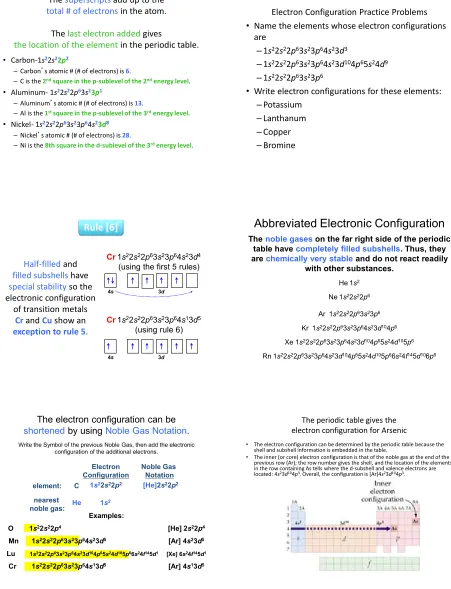
Rule [6]
Half-filled and
filled subshells have
special stability so the
electronic configuration
of transition metals
Cr
and
Cu
show an
exception to rule 5
.
3d 4s
3d 4s
Cr
1
s
22
s
22
p
63
s
23
p
64
s
23
d
4(using the first 5 rules)
Cr
1
s
22
s
22
p
63
s
23
p
64
s
13
d
5(using rule 6)
Abbreviated Electronic Configuration
He 1s2
Ne 1s22s22p6
Ar 1s22s22p63s23p6
Kr 1s22s22p63s23p64s23d104p6
Xe 1s22s22p63s23p64s23d104p65s24d105p6
Rn 1s22s22p63s23p64s23d104p65s24d105p66s24f145d106p6
The
noble gases
on the far right side of the periodic
table have
completely filled subshells
. Thus, they
are
chemically very stable
and do not react readily
with other substances.
The electron configuration can be
shortened
by using
Noble Gas Notation
.
Examples:
O 1s22s22p4 [He] 2s22p4
Mn 1s22s22p63s23p64s23d5 [Ar] 4s23d5
Lu 1s22s22p63s23p64s23d104p65s24d105p66s24f145d1 [Xe] 6s24f145d1
Write the Symbol of the previous Noble Gas, then add the electronic configuration of the additional electrons.
He 1s2
C 1s22s22p2 [He]2s22p2
element: nearest noble gas:
Noble Gas Notation Electron
Configuration
The periodic table gives the
electron configuration for Arsenic
• The electron configuration can be determined by the periodic table because the shell and subshell information is embedded in the table.
The periodic table gives the
electron configuration for Phosphorus
• The inner electron configuration is that of the noble gas at the end of
the previous row (Ne); the row number gives the shell, and the location of the elements in the row containing P tells where the
valence electrons are located: 3s23p3. Overall, the configuration is
[Ne]3s23p3.
1. Identify the element in group 18 (8A) closest to,
but not greater than, your element.
2. Put that element in brackets.
3. The
“
leftover stuff
”
always starts with an s orbital.
4. The
number before the s orbital
is the
row number
of your element
.
5. Calculate how many electrons are in your
“
leftover stuff.
”
6. Continue filling in orbitals using your guide until
your account for all the electrons in the
“
leftover
stuff.
”
Abbreviated Electronic Configuration
Half-filled and Filled Subshells
Have Special Stability:
Exceptions Include Cr and Cu
Ar
Cr: [Ar]4
s
13
d
5Cu: 4
s
13
d
10An Orbital Diagram uses a
box
to
represent
each
orbital
and
arrows
to
represent
electrons
.
•
. Boxes are labeled with the principal quantum
number, n, and the sublevel letter.
•
Two electrons must have paired spins (opposite
directions) to fit into the same orbital.
•
Possible spins are clockwise and counterclockwise,
represented by up and down arrows.
an orbital a single,
unpaired electron
an electron pair
Orbital diagram for H-atom and He-atom
The arrow represents the electron; the electron is in
the ground state because it is in the lowest-energy
shell and subshell possible.
H (Z = 1)
1 electron 1s 1s1
He (Z = 2)
2 electrons 1s 1s2
Element Notation Orbital Configuration Electron
Order of Filling Orbitals
Electrons in an atom
fill orbitals in sublevels of the same type with one electron each until all sublevels are half full then pair up in the orbitals using opposite spins
Li (Z = 3)
3 electrons 2s 1s22s1
C (Z = 6)
6 electrons 1s22s22p2 Element Notation Orbital Configuration Electron
1s
2s
1s 2p
Ne (Z = 10)
Electron configuration
,
Noble Gas
Notation
, and
Orbital Diagram
for Ca
Ca 20 electrons
1s22s22p63s23p64s2
Element Notation Orbital
Electron
Configuration Noble Gas Notation
2s
1s 2p 3s 3p 4s 4s is lower in energy;
it is filled before 3d.
[Ar]4s2
Determine the Number of Unpaired
Electrons in a Phosphorus Atom.
P: 1
s
22
s
22
p
63
s
23
p
3Determine the Number of Unpaired Electrons in a
Carbon
Atom.
Determine the Number of Unpaired Electrons in a
Silicon
Atom
(
same as Carbon because in the same group
)
What is the maximum number of electrons that
can be contained in each of the following?
a. A 2p orbital Answer: 2 Each orbital can hold 2 e– max
b. A 2p subshell Answer: 6 There are three 2p orbitals c. The second shell Answer: 8 one 2s + three 2p orbitals
2s 2p
Write an electronic configuration for each of the
following elements, using the form 1
s
22
s
22
p
6, and so
on. Indicate how many electrons are unpaired in each
case.
a. element number 37 1s22s22p63s23p64s23d104p65s1 1 unpaired e–
b. Si 1s22s22p63s23p2 2 unpaired e–
c. cobalt 1s22s22p63s23p64s23d7 3 unpaired e–
d. Ar 1s22s22p63s23p6 0 unpaired e–
Identify the outermost subshell occupied by
electrons in iron atoms.
Identify the highest energy subshell occupied
by electrons in iron atoms.
Iron
[Ar]4s
23d
6a)
The outermost subshell is the 4s subshell.
Electron Configurations
The electron configurationdescribes how the electrons are distributed in the various atomic orbitals.
In a ground state hydrogen atom, the electron is found in the 1s
orbital.
1
s
1
principal (n = 1)
angular momentum (l = 0)
number of electrons in the orbital or subshell
1s
2s 2p 2p 2p
Ene
rgy
The use of an up arrow indicates an electron with ms = + ½
Ground state electron configuration of hydrogen
Electron Configurations
If hydrogen’s electron is found in a higher energy orbital, the atom is in an excited state.
2
s
1
1s
2s 2p 2p 2p
Ene
rgy
A possible excited state electron configuration of hydrogen
Electron Configurations
The helium emission spectrum is more complex than the hydrogen spectrum.
There are more possible energy transitions in a helium atom because helium has two electrons.
Electron Configurations
In a multi-electron atoms, the energies of the atomic orbitals are split.
Splitting of energy levels refers to the splitting of a shell (n=3) into subshells of different energies (3s, 3p, 3d)
Electron Configurations
According to the Pauli exclusion principle, no two electrons in an atom can have the same four quantum numbers.
1
s
2
1s
2s
2p 2p 2p
Ene
rgy
The ground state electron configuration of helium
Quantum number
Principal (n) Angular moment (l) Magnetic (ml) Electron spin (ms)
1 0 0
+ ½ 1 0 0
‒ ½
describes the 1s orbital
describes the electrons in the 1s orbital
Electron Configurations
The Aufbau principlestates that electrons are added to the lowest energy orbitals first before moving to higher energy orbitals.
1
s
2
2
s
1
1s
2s
2p 2p 2p
Ene
rgy
The ground state electron configuration of Li
Electron Configurations
The Aufbau principlestates that electrons are added to the lowest energy orbitals first before moving to higher energy orbitals.
1s
2s
2p 2p 2p
Ene
rgy
1
s
2
2
s
2
The ground state electron configuration of Be
Be has a total of 4 electrons
Electron Configurations
The Aufbau principlestates that electrons are added to the lowest energy orbitals first before moving to higher energy orbitals.
1s
2s
2p 2p 2p
Ene
rgy
The ground state electron configuration of B
1
s
2
2
s
2
2
p
1
B has a total of 5 electrons
Electron Configurations
According to Hund’s rule, the most stable arrangement of electrons is the one in which the number of electrons with the same spin is maximized.
1
s
2
2
s
2
2
p
2
1s
2s
2p 2p 2p
Ene
rgy
The ground state electron configuration of C
The 2p orbitals are of equal energy, or degenerate.
Put 1 electron in each before pairing (Hund’s rule).
C has a total of 6 electrons
Electron Configurations
According to Hund’s rule, the most stable arrangement of electrons is the one in which the number of electrons with the same spin is maximized.
1
s
2
2
s
2
2
p
3
1s
2s
2p 2p 2p
Ene
rgy
The ground state electron configuration of N
The 2p orbitals are of equal energy, or degenerate.
Put 1 electron in each before pairing (Hund’s rule).
N has a total of 7 electrons
Electron Configurations
According to Hund’s rule, the most stable arrangement of electrons is the one in which the number of electrons with the same spin is maximized.
1
s
2
2
s
2
2
p
4
1s
2s
2p 2p 2p
Ene
rgy
The ground state electron configuration of O
O has a total of 8 electrons
Once all the 2p orbitals are singly occupied, additional electrons will have to pair with those already in the orbitals.
Electron Configurations
According to Hund’s rule, the most stable arrangement of electrons is the one in which the number of electrons with the same spin is maximized.
1
s
2
2
s
2
2
p
5
1s
2s
2p 2p 2p
Ene
rgy
The ground state electron configuration of F
F has a total of 9 electrons
Electron Configurations
According to Hund’s rule, the most stable arrangement of electrons is the one in which the number of electrons with the same spin is maximized.
1
s
2
2
s
2
2
p
6
1s
2s
2p 2p 2p
Ene
rgy
The ground state electron configuration of Ne
Ne has a total of 10 electrons
When all of the electrons in an atom are paired, as in neon, it is called diamagnetic.
Electron Configurations and the Periodic Table
The electron configurations of all elements except hydrogen and helium can be represented using a noble gas core.
The electron configuration of potassium (Z = 19) is 1s22s22p63s23p64s1.
Because 1s22s22p63s23p6 is the electron configuration of argon, we
can simplify potassium’s to [Ar]4s1.
1
s
22
s
22
p
63
s
23
p
64
s
1The ground state electron configuration of K:
[Ar]
[Ar]4
s
11
s
22
s
22
p
63
s
23
p
64
s
1Electron Configurations and the Periodic Table
There are several notable exceptions to the order of electron filling for some of the transition metals.
Chromium (Z = 24) is [Ar]4s13d5 and not [Ar]4s23d4 as
expected.
Copper (Z = 29) is [Ar]4s13d10 and not [Ar]4s23d9 as expected.
The reason for these anomalies is the slightly greater stability of d
subshells that are either half-filled (d5) or completely filled (d10).
4s 3d 3d 3d 3d 3d
[Ar]
Cr
Greater stability with half-filled 3d subshell
Electron Configurations and the Periodic Table
There are several notable exceptions to the order of electron filling for some of the transition metals.
Chromium (Z = 24) is [Ar]4s13d5 and not [Ar]4s23d4 as
expected.
Copper (Z = 29) is [Ar]4s13d10 and not [Ar]4s23d9 as expected.
The reason for these anomalies is the slightly greater stability of d
subshells that are either half-filled (d5) or completely filled (d10).
Electron Configurations and the Periodic Table
4s 3d 3d 3d 3d 3d
[Ar]
Cu
Greater stability with filled 3d
subshell
There is a distinct pattern to the
electron configurations of the elements
in a particular group
The Outermost Electrons of an Atom
are called the Valence Electrons
For Group 1A: [noble gas]ns1
valence core
For Group 2A: [noble gas]ns2
valence core
For Group 7A: [noble gas]ns2np5
valence core
The
chemical properties
of an element depend
on the number of electrons in the
valence shell
.
The
valence shell
is the outermost shell
(
highest value of n
)
Be
1
s
22
s
2Cl
1
s
22
s
22
p
63
s
23
p
5valence shell:
n
= 2
# of
valence electrons = 2
valence shell:
n
= 3
# of
valence electrons = 7
Elements in the same group have the same
number of valence electrons
Group # 1A – 8A = # valence electrons (except He = 2)Ex: All elements in Group 2A have 2 valence electrons.
Effective nuclear charge (
Z
eff)
is the actual magnitude of positive charge
that is “experienced” by an electron in the
atom
Due to
shielding
, the value of
Z
eff
increases
steadily from
left to right
because the core electrons remain the
same but
Z
increases
Z
eff
=
Z
-
S
H 1.0 Li 1.3 Na 2.2 K 2.2 Rb 2.2 Cs
Be
1.95 2.60 B 3.25 C 3.90 N 4.55 O 5.20 F 5.85 Ne
Moving left to right across period 2, the nuclear charge increases by one with
each new element, but the effective nuclear charge increases only by an
average of 0.64
The Radius of an Atom (r) is Defined as Half
the Distance Between the Nuclei in a Molecule
Consisting of Identical Atoms
228 pm
Atomic Size Increases Going Down a
Group and Decreases Across a Period
Atomic
Size
Increases
Down
a
Group
because
the Outermost Electrons in Higher Energy Levels
are Farther from the Nucleus
Simplified explanation using Bohr atom n = 1
n = 2 n = 3
n = 4
Atomic
Size
Decreases
Across
a
Period
Because the Increasing
Z
effPulls the
Valence Electrons Closer to the Nucleus
n = 1 n = 2
n = 3 n = 4
Zeff H
1.0 Li 1.3 Na 2.2 K 2.2 Rb 2.2 Cs 2.2
Be
1.95 2.60 B 3.25 C 3.90 N 4.55 O 5.20 F 5.85 Ne
Which has a larger size, C or O?
C is bigger than O.
C has 6 protons in the nucleus for a +6 charge at the
nucleus, while O has 8 protons in the nucleus, for
a +8 charge at the nucleus.
Which has a larger size, Li or K?
K is bigger than Li.
K has a valence electron in energy level 4 while Li has a valence electron in level 2. This means the K atom is larger than the Li atom because the valence electron is farther away from the
nucleus.
Which has a larger size, C or Al?
Both trends indicate that Al is larger than C. Going across the size decreases so C is smaller than Al, and
Which has a larger size, Se or I?
I is bigger than Se.
The increase in size going down a group is bigger than
the decrease in size going across a group.
Ionization Energy (IE) is the Energy Required to
Remove an Electron from an Atom
The result is an ion, a chemical species with a net charge.
Sodium has an ionization energy of 495.8 kJ/mol.
Specifically, 495.8 kJ/mol is the first ionization energy of sodium, IE1(Na), which corresponds to the removal of the most loosely held electron.
Na(g) → Na+(g) + e−
The first Ionization energy is the energy needed
to remove an electron from an atom.
Na + energy Na+ + e–
•Ionization energies decrease down a
column as the valence e− get farther away from
the positively charged nucleus.
•Ionization energies increase across a row as the number of protons in the nucleus increases.
The 1
st
ionization energy
increases
as you go
left to right across a
period
as the Z
eff
increases
.
Electrons in the filled 2
s
orbital provide some
shielding for electrons in the 2
p
orbital from the
nuclear charge.
B 1s 2s 2p
Be 1s 2s 2p
Within a given shell, electrons with a higher value of
l
are higher in energy and thus, easier to remove.
Removing a paired electron is easier
because of the repulsive forces between
two electrons in the same orbital.
N
O
1s 2s 2p
The 1
stionization energy
decreases
as you go
down a group
as the
distance between the nucleus and
valance electrons increases
.
Which has the higher ionization energy, As or Sb?
As has a higher ionization energy than Sb, according to the top-to-bottom ionization trend in the periodic table.
Which has the higher ionization energy, N or Si?
N has a higher ionization energy than Si, according to both the top-to-bottom and the left-to-right ionization trends in the
periodic table.
Which has the higher ionization energy, O or Cl?
Here we can't tell which has the higher ionization energy: Owould be higher according to the top-to-bottom trend, but Cl would be higher according to the left-to-right ionization
trend. The effects tend to cancel.
It is possible to remove additional electrons in
subsequent ionizations, giving
IE
2,
IE
3, etc.
IE1(Na) = 496 kJ/mol
IE2(Na) = 4562 kJ/mol
Na(g) → Na+(g) + e−
Na+(g) → Na2+(g) + e−
It takes much more energy to remove core
electrons than valence electrons
1s 2s
2p 3s
Mg
1
s
22
s
22
p
63
s
2738 kJ/mol 1451 kJ/mol
7733 kJ/mol Core electrons experience greater Zeff because of fewer filled shells shielding them from
the nucleus. It is harder to remove an electron from a positive ion then
Ionization Energy: X(
g
)
X
+(
g
) + e
-
The energy required to remove an electron from a
gaseous atom or ion.
Al(
g
)
Al
+(
g
) + e
-I
1
= 580 kJ/mol
[Ne]3
s
23
p
1
[Ne]3
s
2
Al
+(
g
)
Al
2+(
g
) + e
-I
2= 1815 kJ/mol
[Ne]
3
s
2
[Ne]3
s
1
Al
2+(
g
)
Al
3+(
g
) + e
-I
3
= 2740 kJ/mol
[Ne]
3
s
1
[Ne]
Al
3+(
g
)
Al
4+(
g
) + e
-I
4
= 11,600 kJ/mol
[Ne]
1
s
22
p
5Sodium and aluminum both have one unpaired electron in
their neutral ground state atoms. Why is the first ionization
energy of Na lower than Al, but the second ionization of
energy of Al lower than the second ionization energy of Na?
1. The smaller size of Al makes it difficult to ionize at first, but after losing one e–, the other atoms can expand more and make it
easier to ionize a second e–.
2. The 3s electrons of Na does a better job of shielding than the 3p electron of Al.
3. The second e– taken from Na must be taken from a new lower
level; the second e– from Al is in same level as before.
4. The first e– ionized from both is single, but the second one in
Na is paired, while the second in Al is still single
.
Electron Affinity (
EA
) is the energy
released when an atom in the gas
phase accepts an
e
–
.
Cl(g) + e−→ Cl−(g)
349.0 kJ/mol of energy is released.
A positive electron affinity indicates a
process that is energetically favorable.
Like ionization energy,
electron affinity increases from
left to right
across a period as
Z
eff increases.Easier to add an electron as the positive charge of the nucleus increases.
It is easier to add on electron to an
s
-orbital than to add one to a
p
-orbital with the
same principle quantum number.
Within a
p
-subshell, it is easier to add an electron
to an empty orbital then to add one to an orbital
While many first electronic affinities
are positive, subsequent electron
affinities are always negative.
Considerable energy is required to overcome the
repulsive forces between the electron and the
negatively charged ion.
Process Electron Affinity
O(g) + e− → O−(g)
O− (g) + e− → O2−(g)
EA1 = 141 kJ/mol
EA2 = −741 kJ/mol
Properties of Metals
Metals tend toBe shiny, lustrous, malleable (can be pounded into a sheet), and ductile (can be drawn into a wire)
Be good conductors of heat and electricity
Have low ionization energies (commonly form positive cations)
Properties of Nonmetals
Nonmetals tend toVery in color and are not shiny
Be brittle, rather than malleable
Be poor conductors of heat and electricity
Have high electron affinities (commonly form negative anions)
Metals
/ On the L
Give up one or more e
-to form a positive ion
X
X
++ e
-
low IE
Nonmetals
/ On the R
Ability to gain one or
more e
-to form an anion
when reacting with a
metal
X + e
-
X
-
large IE and the most
negative EA
Metalocity: how metallic the element is.
Trends Within the Periodic Table
Metals Metalloids Nonmetals
C
Si
Ge
Sn Pb
–
The elements get more metallic as you
go down a group.
Na Mg Al Si P S Cl Ar
The elements get less metallic as you
go left to right.
Using these generalizations, francium is the most metallic element while helium is the least metallic.